#12: Cell-cell and cell-matrix interactions
 Call Kai
 Learn
Learn Practice Test
 Spaced Repetition
 Match
Match Flashcards
 Knowt Play
1/120

There's no tags or description
Looks like no tags are added yet.
Name | Mastery | Learn | Test | Matching | Spaced | Call with Kai |
|---|
No analytics yet
Send a link to your students to track their progress
121 Terms
tissue
a group of similar cells, along w/ their extracellular matrix, that are organized together to perform a specific, specialized function
structural level of organization, operating between individual cells and complete organs
4 main types of tissues in animals
epithelial: covering
connective: supporting
muscle: movement
nervous: control
organ
a specialized structure composed of different types of tissues that work together to perform specific functions essential for survival and health of a multicellular organism
extracellular matrix
material that cells secrete around themselves
large component of connective tissue
gives supportive tissues (such as bones) their strength
cell junctions that link
the human body is composed of over ___ cells
there are more than ____ types of cells w/ ____ morphologies and functions
30 trillion
200; various
______ cells are considered the MOST abundant cell type in the human body
epithelial → estimated to make up a significant portion of the body’s cells — ~37.1% of total cell mass in skin alone!
how many unique cell types are there in the body?
142
ALL substances that ____ or _____ an organ MUST cross the epithelial tissue first
enter, leave
ex of epithelial tissue in body
epidermis
lining of intestines
lining of respiratory tract
lining of abdominal cavity
sweat glands
most of the cells in multicellular organisms are organized into cooperative assemblies called ?
tissues!
tissues are organized into ?
organs! (heart, lung, brain, kidney, etc)
what are tissues composed of?
cells — w/ their internal framework of cytoskeletal filaments
extracellular matrix (LARGE component of CT) = material that cells secrete around themselves → gives supportive tissues (such as bone) their strength

what gives supportive tissues (such as bone) their strength?
extracellular matrix!
can cells attach to one another directly?
YES — cell junctions link cells together in the flexible epithelial tissues of animals
cell junctions transmit forces either from the cytoskeleton of one cell to ____ or to _____
to the cytoskeleton of the next cell
to the extracellular (EC) matrix
how are cells in tissues held together?
cell-cell adhesions
EC matrix
both
epithelial cells
among the most abundant cells
cover skin
line organs, body cavities, and blood vessels
HIGHLY specialized histologic features are CRITICAL for their physiological functions in diff organs
fibroblasts
type of cell that contributes to the formation of CT (connective tissue)
secretes collagen and other proteins into the EC matrix

are mechanical stresses on tissues handled uniformly?
NO — handled DIFFERENTLY depending on tissue type
epithelial tissue
cells are ____ bound together into sheets
the cytoskeletons of the cells are linked from cell to cell by ?
EC matrix may be _____, and the cells are directly joined to one another and carry the mechanical load THEMSELVES
tightly
anchoring junctions
LIMITED
what attachments bond epithelial tissue to the CT beneath it
cell-matrix
basal lamina
the thin mat of EC matrix proteins (primarily laminin) that separates epithelial sheets from CT
provides area for anchorage for epithelial tissue
aka basement membrane
CT (connective tissue) ex
bone or tendon
submucosa in gut
CT is formed from ______ produced by cells that are distributed SPARSELY in the matrix
an EC matrix (primarily collagen and proteoglycan)
what bears most of the mechanical stress to which the tissue is subjected in CT?
EC MATRIX!! (rather than the cells)
are direct attachments between one cell and another in CT common?
NO — relatively rare, but cells have important attachments to the matrix through integrin receptors
in CT, cell cells have important attachments to the matrix through ?
integrin receptors
which cytoskeleton?
smallest, aka microfilaments
2 globular protein strands that are intertwined
determine the shape of the cell’s surface and are necessary for locomotion
abundant in muscle cells
resists tension (pulling forces); can stretch w/out breaking (like a rubber band)
actin filaments
which cytoskeleton?
determine the positions of membrane-enclosed organelles and direct intracellular vesicle transport
hollow structure built from 13 parallel strands
resist compression → maintains cell shape under pressure
pull apart replicated chromosomes during cell division
structural elements of flagella and cilia
microtubules → highways for vesicle transport
which cytoskeleton?
bear tension and maintain cell shape — NO role in movement
anchor nucleus and other organelles in place
diverse class w/ several types of fibrous proteins
NOT found in cytoplasm of cells w/ cell walls
intermediate filaments
side to side and end on end interactions
VERY flexible
resist pulling
actin filaments (aka microfilaments) and microtubules have faster / more polymerization growth on the plus or minus end?
PLUS end
apical
top of the cell b
basolateral
at side, near the base
basal
bottom of the cell → connected to the basal lamina
are relative positions of junctions the same in ALL epithelial cells?
YES — from apical to basal:
anchoring junctions
occluding (tight) junctions)
channel forming (gap) junctions
are epithelial cells polar or nonpolar?
polar
anchoring junctions
cell-cell adhesions at ?
cell-matrix adhesions at ?
________ stresses and are tethered to _________ inside the cell
cell-cell adhesions at adherens junctions or desmosomes (transmembrane cadherins)
cell-matrix adhesions at hemidesmosomes (transmembrane integrins)
transmit stresses and are tethered to cytoskeletal filaments inside the cell
occluding (tight) junctions
seal the gaps between cells in epithelia to make a cell sheet into an IMPERMEABLE or SELECTIVELY PERMEABLE BARRIER
involve claudin proteins
occluding (tight) junctions involve ____ proteins
transmembrane claudin and occludin — hold adjacent cells together
channel forming (gap) junctions create _________ linking the ______ of adjacent cells for passage of ________ and ______
create passageways linking the cytoplasms of adjacent cells for passage of small molecules and ions
composed of connexin or innexin proteins
channel forming (gap) junctions are composed of ___ or _____ proteins
connexin or innexin
5 types of junctions of epithelial cells (in order from apical to basal)
tight junction
adherens junction
desmosome
gap junction
hemidesmosome
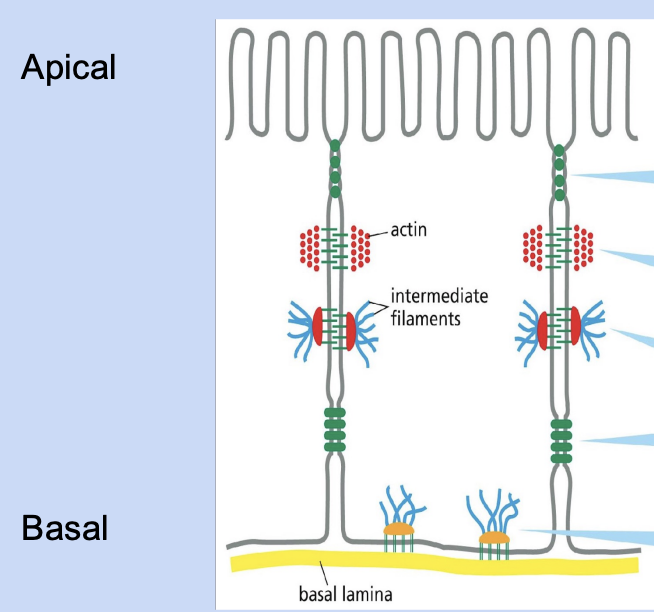
tight junction
seals neighboring cells together in an epithelial sheet to PREVENT LEAKAGE of EC molecules between them
helps polarize cells

adherens junction
thousands of ________ molecules, packed into dense, regular arrays that are linked to the _______ cytoskeleton by a complex of intracellular anchor proteins on the __________ side
joins an ACTIN bundle in one cell to a similar bundle in a neighboring cell (think adherens = actin)
thousands of transmembrane cadherin molecules, packed into dense, regular arrays that are linked to the actin cytoskeleton by a complex of intracellular anchor proteins on the cytoplasmic side
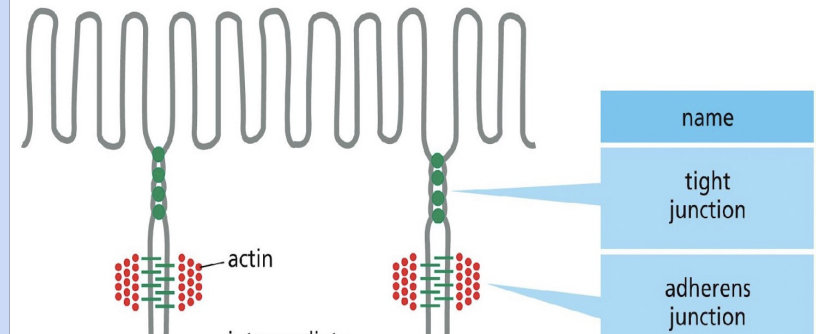
desmosome
joins the INTERMEDIATE FILAMENTS in one cell to those in a neighbor

gap junction
forms channels that allow SMALL, INTRAcellular, WATER-SOLUBLE molecules (including inorganic ions and metabolites) to pass from cell to cell
allow very rapid flow of ions
enable cells to communicate electrically and chemically → esp important in cardiac muscle cells
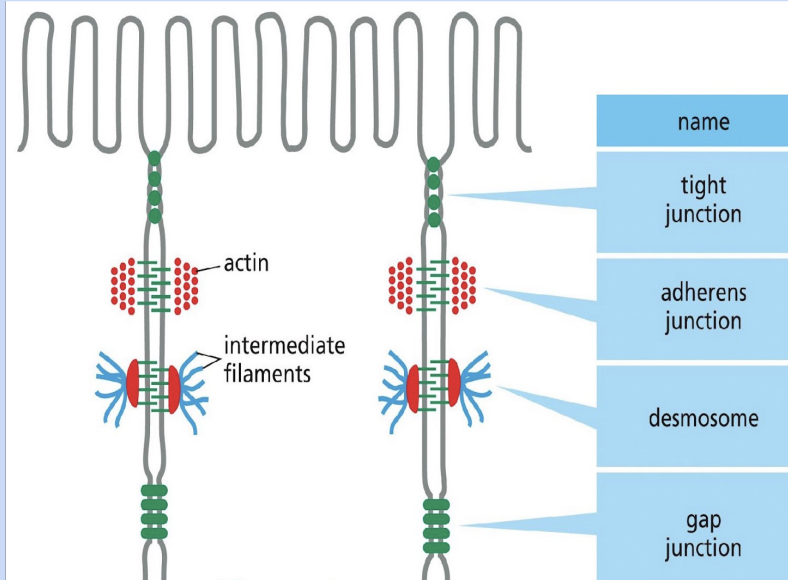
hemidesmosome
anchors INTERMEDIATE FILAMENTS in a cell TO the basal lamina
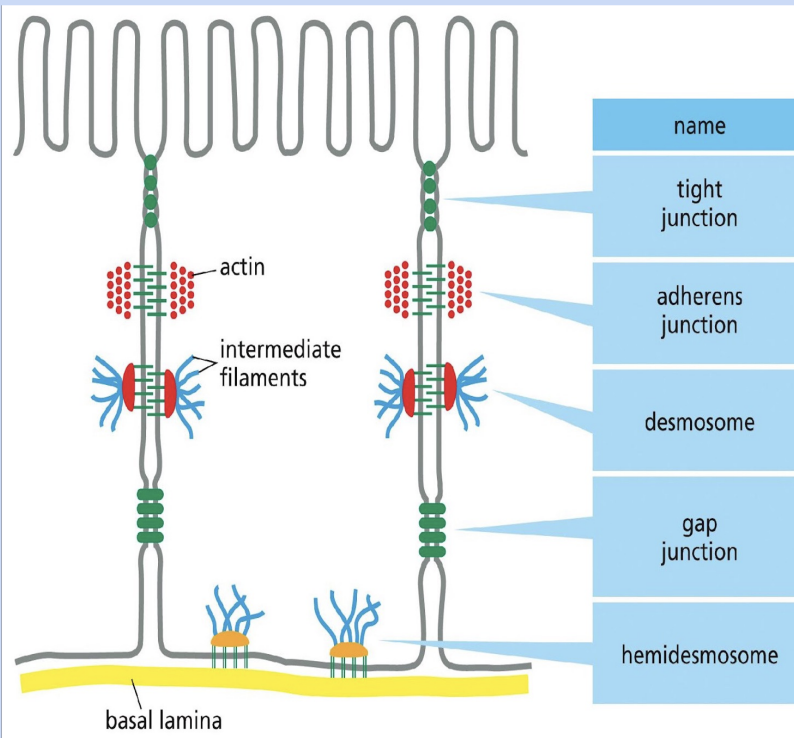
junctional complex proteins — what 3 types of epithelial cell junctions?
act as a coordinated unit to maintain tissue polarity — depend on each other for positioning
tight junction
adherens junction
desmosome
*provides STRONGEST sites of ATTACHMENT
anchoring junctions — what 3 types of epithelial cell junctions?
transmit stress, provide structure and maintain tissue integrity
adherens junction
desmosome (transmembrane cadherins)
hemidesmosome (transmembrane integrins)
*tethered to cytoskeletal filaments INSIDE the cell
what are anchoring junctions tethered to?
cytoskeletal filaments INSIDE the cell
are gap junctions used for cell adhesion?
NO — strictly for COMMUNICATION!!
______ junctions seal gaps between cells and separate apical and basolateral surfaces
tight
sealing strands in tight junctions completely encircle the ______ end of each cell
apical
epithelia are selective permeable barriers due to _____ junctions
tight → seal gaps between cells
will a low-molecular-weight tracer added to one side of an epithelium generally pass beyond the tight junction?
NO — this is very important physiologically
think about GI tract → you want epithelial cells to take up nutrients → a tightly bound epithelium is important so that nutrients don’t just float through the intracellular spaces
is there a linkage from tight junctions to cytoskeleton?
NO
consider the epithelial cells that line the lumen of the gut. why is it important for the epithelia to form a selectively permeable barrier?
allows the absorption of essential nutrients from food while simultaneously preventing harmful substances (like bacteria and large molecules) from entering the bloodstream → maintains a crucial balance between nutrient uptake and protection against pathogens and toxins w/in the digestion tract
adherens junctions link epithelial cells via _______ to form an adhesion belt
transmembrane cadherin molecules
cadherins
calcium dependent adherins
where do adherens junctions form an adhesion belt
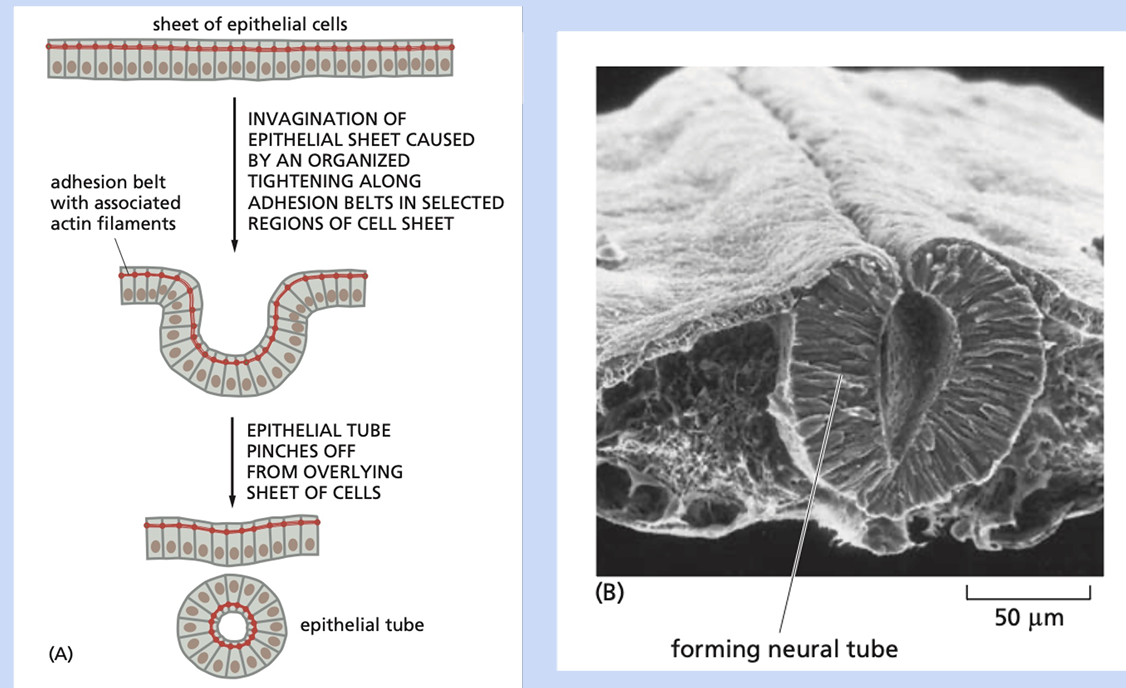
close beneath the apical face of the epithelium → encircling each of the interacting cells in the sheet

contractile bundle of actin filaments, tethered to the PM by the cadherins, can _____ w/ the help of myosin motor proteins
CONTRACT → providing the motile force for folding of epithelial cell sheets
what provides the motile force for folding of epithelial cell sheets?
contractile bundle of actin filaments (tethered to the PM by cadherins and associated intracellular anchor proteins) can contract w/ help of myosin motor proteins
contraction of epithelial sheets is important for ?
folding into tubes, vesicles, and other related structures during development
desmosomes and hemidesmosomes are connected to ________ (a type of intermediate filament)
keratin → provides tensile strength
link cells via cadherins
desmosomes
link cell to protein laminin in basal lamina through integrin receptors
hemidesmosomes
desmosomes form spots of ____cellular adhesion through what type of cadherins?
spots of INTERcellular adhesion through non-classical cadherins (desmoglein and desmocollin
desmosomes provide mechanical strength through linkage to ? and to ?
intermediate filaments (keratin filaments in epithelial cells) and similar bundles in adjacent cells
creates a framework that extends throughout the tissue for tensile strength → resists pulling / twisting forces; can withstand mechanical stress w/out breaking
desmosomes play an important role in preserving tissue ?
integrity
hemidesmosomes are epithelial cells that are anchored on their basal side to the _______, which lies at the interface w/ the underlying CT
basal lamina
________ receptors anchor the cell to the EC matrix protein laminin in the basal lamina
integrin
integrin receptors anchor the cell to the EC matrix protein ________ in the basal lamina
laminin
hemidesmosomes — intracellular attachment is to ______ → provides _____ to epithelial tissues
intermediate filaments (keratin); mechanical strength
gap junctions are built from 6 _______ transmembrane proteins that form a ______ on each cell
connexin; connexon
connexon pores align to form a ______ between 2 cells — gap junctions
channel
gap junctions consist of _______ connexon pairs in _______
many; parallel
gap junctions couple the _______ between animal cells electrically and metabolically
cytoplasm
heart muscle contraction; spread of action potentials between neurons
only molecules SMALLER THAN ______ DALTONS can pass through gap junctions
~1000
in the heart, cardiac cells are connected by ______, which allow for the rapid transmission of electrical impulses between cells, which ensures coordinated muscle contractions throughout the heart by facilitating the flow of _______ between adjacent cells
gap junctions; ions
effectively acting as a functional syncytium → CRUCIAL for proper heart rhythm and conduction of electrical signals
the cytoplasms of adjacent plant cells are connected via ?
plasmodesmata

plasmodesmata
numerous cytosolic channels that pass between adjacent plant cell walls to connect their cytoplasm, and enable transport of materials from cell to cell (and thus throughout the plant)
very similar to gap junctions
movement of ions between adjacent cells is proportional to the # of __________ that connect the cells
plasmodesmata!! (think: more openings = faster transport)
does plasmodesmata allow passage of viruses and larger molecules?
YES — including signaling molecules, RNAs, and transcription factors
cell walls are composed of EC matrix rich in _______ and _________
cellulose, polysaccharides
is there a need for anchoring junctions in plant cells? explain.
NO — cell walls of adjacent cells are FIRMLY CEMENTED to those of their neighbors → eliminates need for anchoring junctions to hold the cells in place
what is the role of the EC matrix in tissues?
network of proteins and carbs
cells interact w/ ECM through integrin receptors for migration
________ tissues consist largely of ECM (EC matrix)
connective
the ECM is made and oriented by the cells _______ it
primarily secreted by _________
WITHIN
fibroblasts — cartilage = chondroblasts; bone = osteoblasts
_______ in the ECM make, excrete, and organize components of the ECM
fibroblasts (cells)
epithelial cells are separated from the underlying tissues by the ?
basal lamina — prevents fibroblasts and CT from migrating UP
_____ is the primary organizer in the basal lamina
laminin = large, cross-shaped glycoproteins
essential for providing structural support
promoting cell adhesion
guiding cell migration and differentiation in processes like tissue development, wound repair, and the immune response
______ provides tensile strength in the ECM
collagen
true or false: ECM is dynamic and continuously remodels
TRUE!!
ECM is constructed of
proteoglycans
fibrous proteins (collagens and elastic fibers)
glycoproteins (laminin and fibronectin)
glycoprotein
a protein w/ one or more carbohydrate molecules (called oligosaccharides) covalently bonded to it
is CT uniform?
NO — NOT orderly and cells distinctly diff shapes & composition
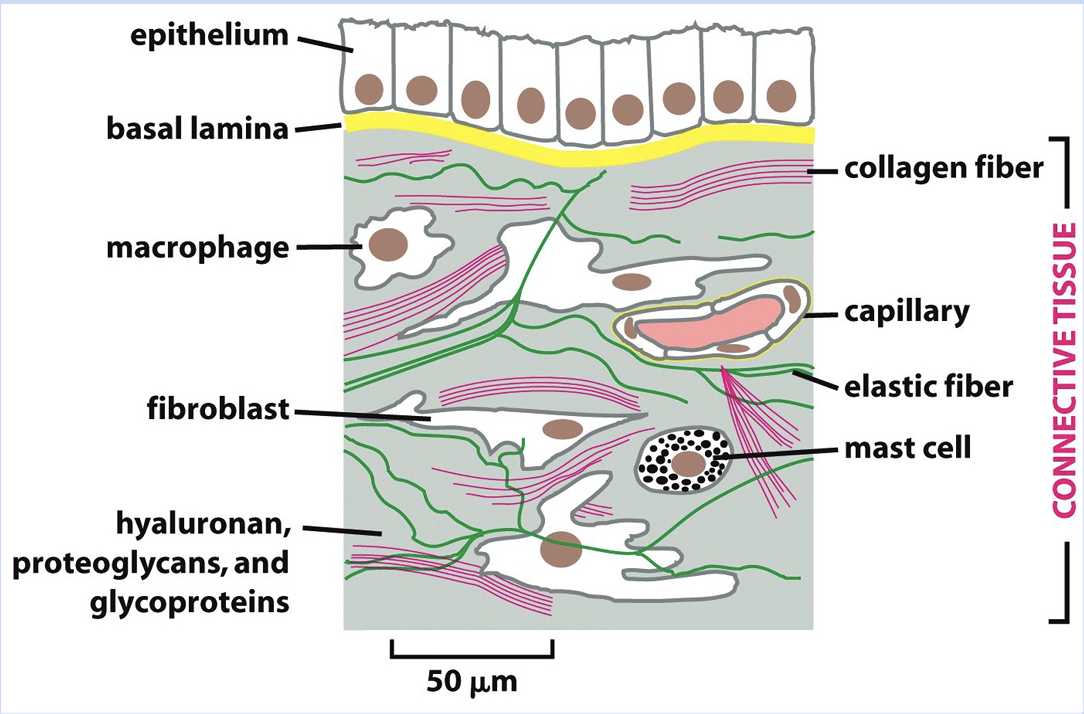
collagen chains are arranged in _______ and organized by ________
fibers; fibroblasts

the MOST abundant protein in the mammalian ECM (and in the entire human body) is
collagen — VERY LARGE
collagen structure
3 intertwined polypeptide chains → makes collagen VERY STRONG
Explore top notes

Explore top flashcards
