AMP Test 1!!!!!
 Call Kai
 Learn
Learn Practice Test
 Spaced Repetition
 Match
Match Flashcards
 Knowt Play
1/21

There's no tags or description
Looks like no tags are added yet.
Name | Mastery | Learn | Test | Matching | Spaced | Call with Kai |
|---|
No analytics yet
Send a link to your students to track their progress
22 Terms
Organic molecule
Any molecule containing CARBON. Examples include very small molecules like methane (CH4) and very large macromolecules like carbohydrates (glucose), lipids (triglycerides), nucleic acids (DNA), and proteins (the enzyme lactase)
Glucose
Glucose is a simple sugar (monosaccharide) and the primary source of energy for the body's cells, often called blood sugar.
Glucose
With the formula C6H12O6, it is a carbohydrate broken down from food or produced by the body, serving as essential fuel for brain function and muscle movement.
Atom
the smallest unit of an element that retains all of the characteristic chemical properties of that element.
Which of the following body systems is responsible for both movement and structural support?
Skeletal System
Cytology would be best defined as a study of
Cytology is best defined as the branch of biology that studies the structure, function, and pathology of cells. It involves the microscopic examination of individual cells, often to detect cancer or other diseases, and is a subspeciality of pathology focused on cellular, rather than tissue, analysis.
Oxygen's Atomic #, Symbol, Valency, and Valence Electrons are
Name-Oxygen
Atomic #-8
Symbol-O
Valency-2
Valence Electrons-6
What is a cation?
A positively charged ion, formed when an atom or molecule loses one or more electrons, resulting in more protons than electrons
Brain and spinal cord are in what cavity?
dorsal cavity
4 main elements in the human body
1. Oxygen (65%)
2. Carbon (18.5)
3. Hydrogen (9.5%)
4. Nitrogen (3.3%)
all together= roughly 96% of total body mass
integumentary system ...
is the body system that acts as a physical barrier to prevent water loss (dehydration), block the entry of pathogens (germs), and synthesizes vitamin D.
Brain and spinal cord are structures in the
central nervous system (CNS), which acts as the main processing center for the entire body. The brain is housed in the cranium (skull), while the spinal cord runs through the vertebral column.
The lungs are located in what cavity
thoracic cavity (or chest cavity)
A chemical reaction in which large molecules (polymers) are created from smaller ones (monomers) is a
dehydration synthesis (or condensation) reaction. This anabolic, energy-requiring process builds complex biological molecules like proteins, carbohydrates, and nucleic acids by removing water.
When an atom gains an electron from another atom, it becomes a
negatively charged ion, specifically called an anion
A methane molecule (CH4) has one carbon atom and four atoms of hydrogen linked by
4 equivalent nonpolar covalent bonds.
A neutral sodium (Na) atom has how many electron shells?
3 electron shells
distributed in a 2-8-1 configuration
Cell
is the smallest, independently functioning biological unit of an organism
Blood sugar levels are controlled through a ...
A negative feedback mechanism primarily managed by the pancreas, which releases the hormones insulin and glucagon. Insulin lowers high blood sugar by facilitating glucose uptake into cells, while glucagon raises low blood sugar by signaling the liver to release stored glucose.
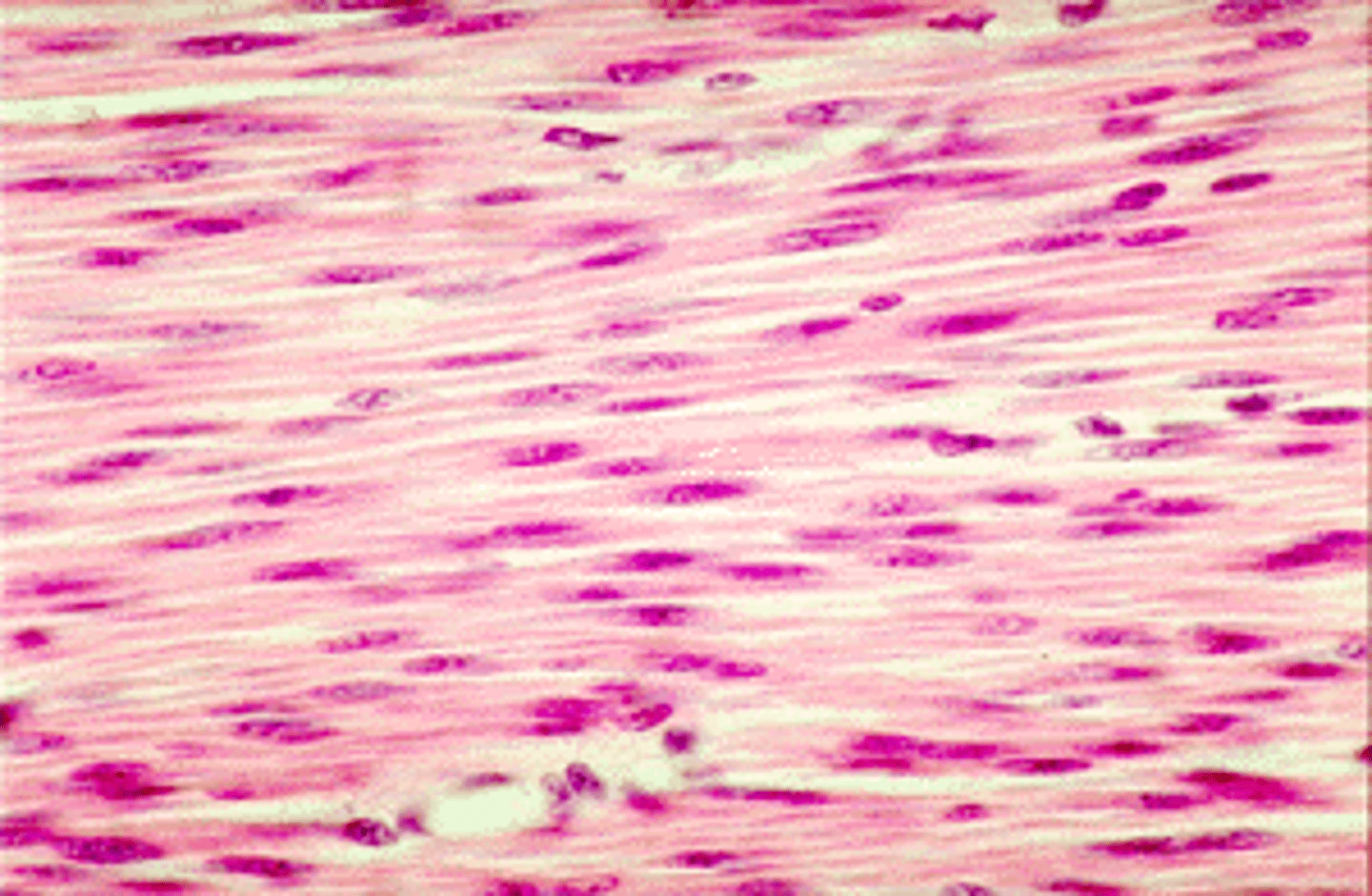
Black & white smooth muscle
Smooth muscle is a type of muscle tissue that is involuntary and non-striated, meaning it does not have the cross stripes seen in skeletal muscle. It consists of spindle-shaped cells with a single nucleus and is found in the walls of hollow organs such as the intestines, uterus, and blood vessels. Smooth muscle is controlled by the autonomic nervous system and is responsible for various functions, including regulating blood pressure, digestion, and the movement of substances through the body.
PET scan
PET highlights areas in the body where there is relatively high glucose use, which is characteristic of cancerous tissue. This PET scan shows sites of the spread of a large primary tumor to other sites.
Homeostasis
Homeostasis is maintaining relatively stable internal conditions despitethe ever-changing external environment• A dynamic state of equilibrium, always readjusting as needed• Maintained by contributions of all organ systems

