Immunology Exam 3

0.0(0)
Studied by 0 people
call kaiCall Kai
learnLearn
examPractice Test
spaced repetitionSpaced Repetition
heart puzzleMatch
flashcardsFlashcards
GameKnowt Play
Card Sorting

1/99

encourage image

There's no tags or description

Looks like no tags are added yet.

Last updated 7:44 PM on 3/24/26
Name
Mastery
Learn
Test
Matching
Spaced
Call with Kai

No analytics yet

Send a link to your students to track their progress

100 Terms

1
New cards

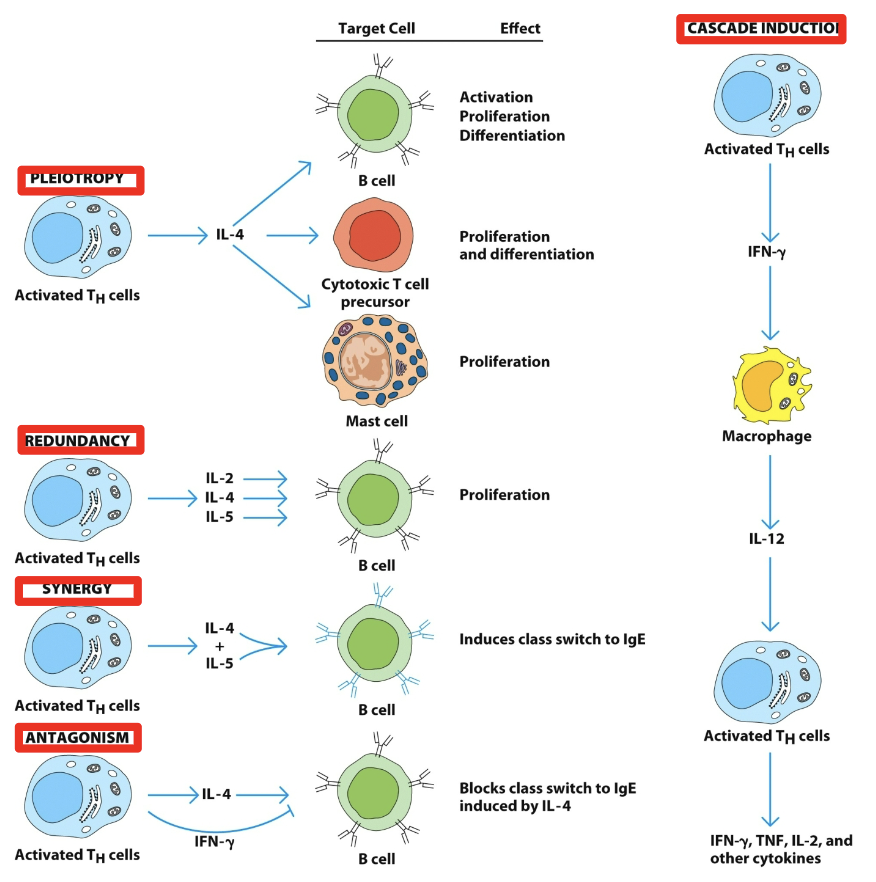
synergy

sum greater than parts

<p>sum greater than parts</p>
2
New cards

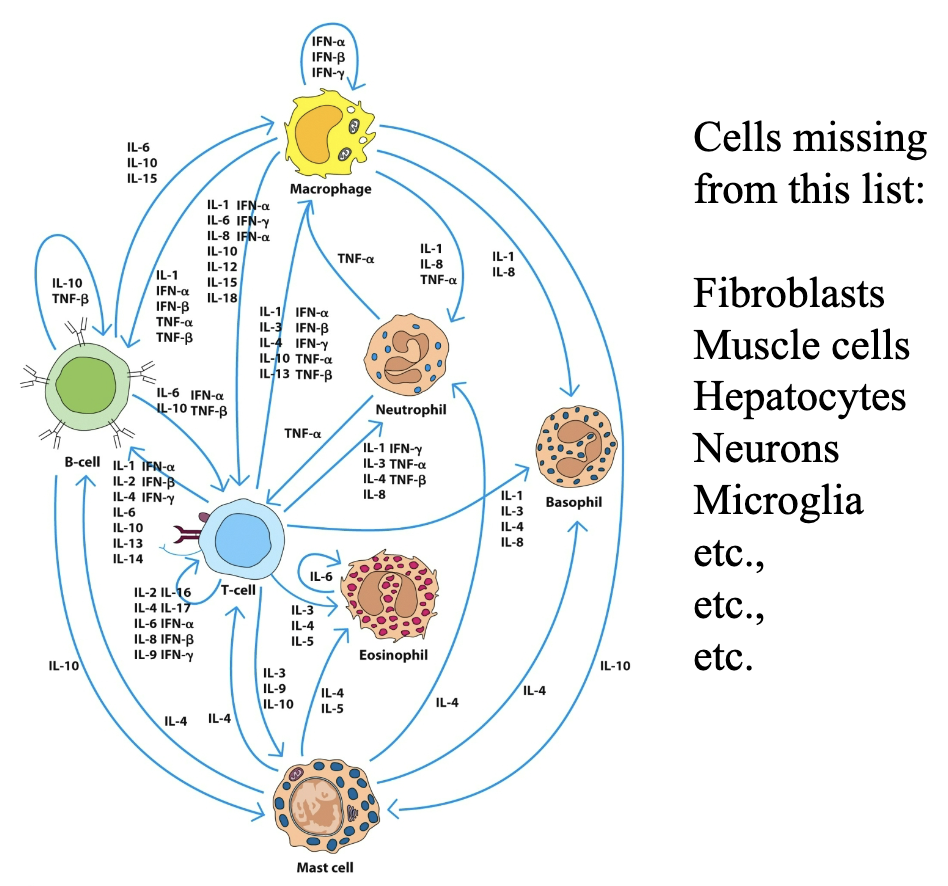
Cytokines

_:

  • Small signaling proteins secreted by immune and non-immune cells that act as essential chemical messengers to regulate inflammation, immune responses, and cell communication.

  • Major classes include interleukins (ILs), interferons (IFNs), tumor necrosis factors (TNFs), chemokines, and colony-stimulating factors (CSFs).
<p>_:</p><ul><li><p>Small signaling proteins secreted by immune and non-immune cells that act as essential chemical messengers to regulate inflammation, immune responses, and cell communication. </p></li><li><p>Major classes include interleukins (ILs), interferons (IFNs), tumor necrosis factors (TNFs), chemokines, and colony-stimulating factors (CSFs).</p></li></ul><p></p>
3
New cards

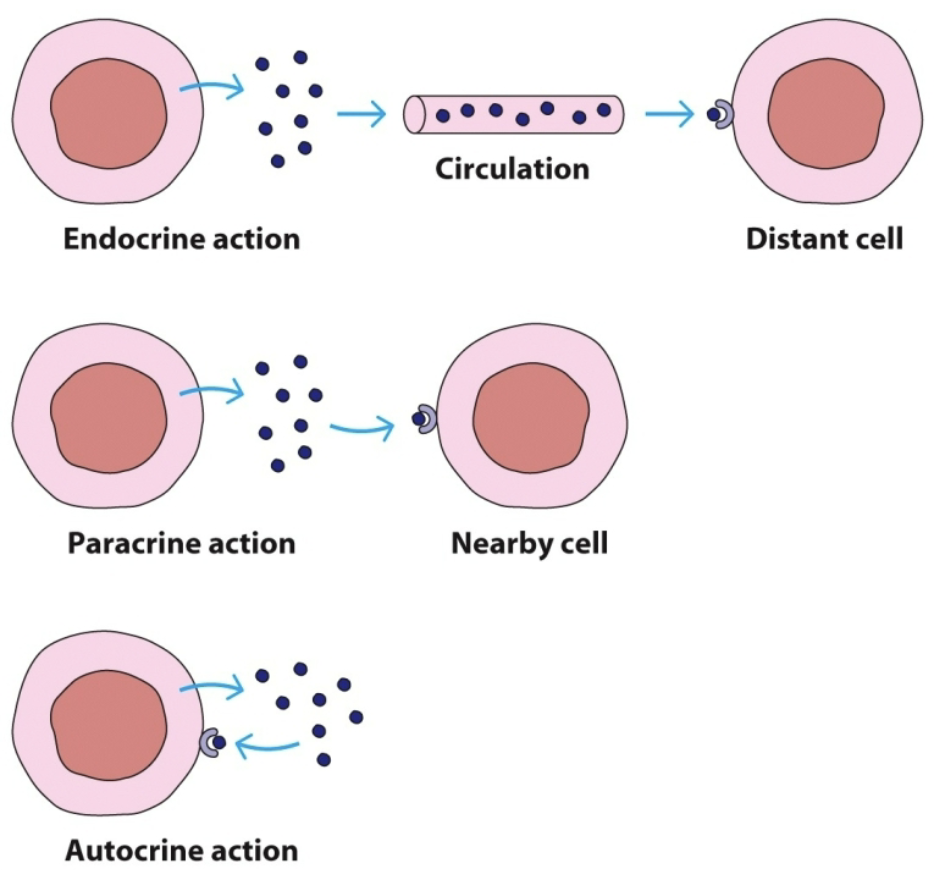
paracrine

Most cytokines act via _ action
<p>Most cytokines act via _ action</p>
4
New cards

multiple

cytokines can have _ biological affects
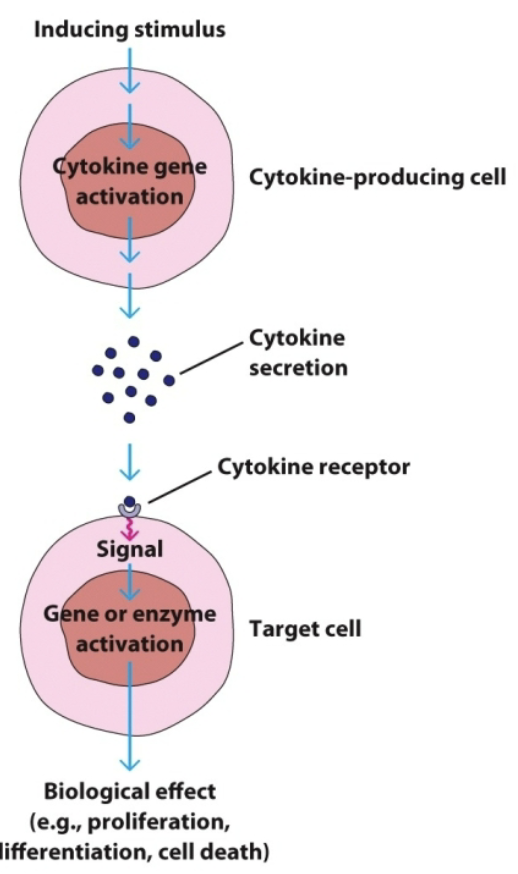
<p>cytokines can have _ biological affects</p>
5
New cards

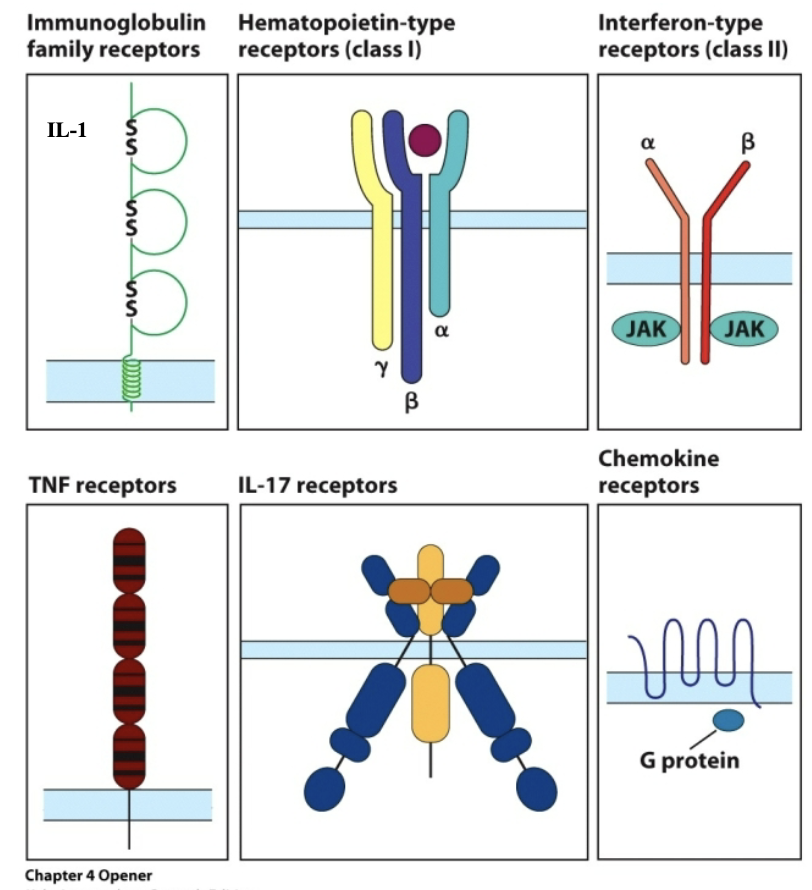
receptors

_

<p>_</p>
6
New cards
  • bottom

  • top

  • Which row is public chain?

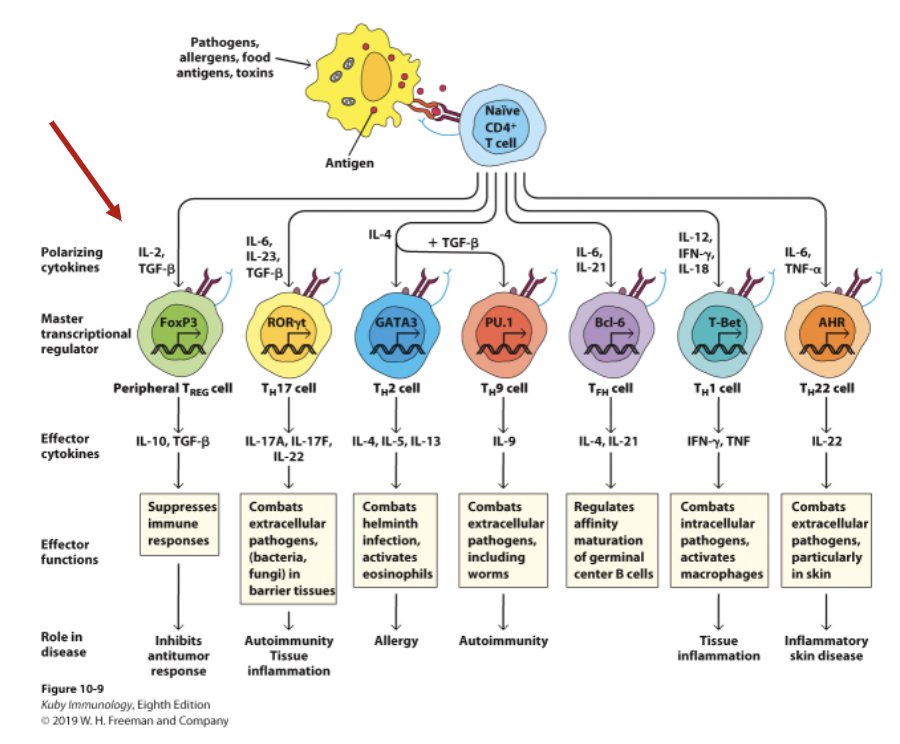
  • Which row is private chain?

<ul><li><p>Which row is public chain?</p></li><li><p>Which row is private chain?</p></li></ul><p></p>
7
New cards

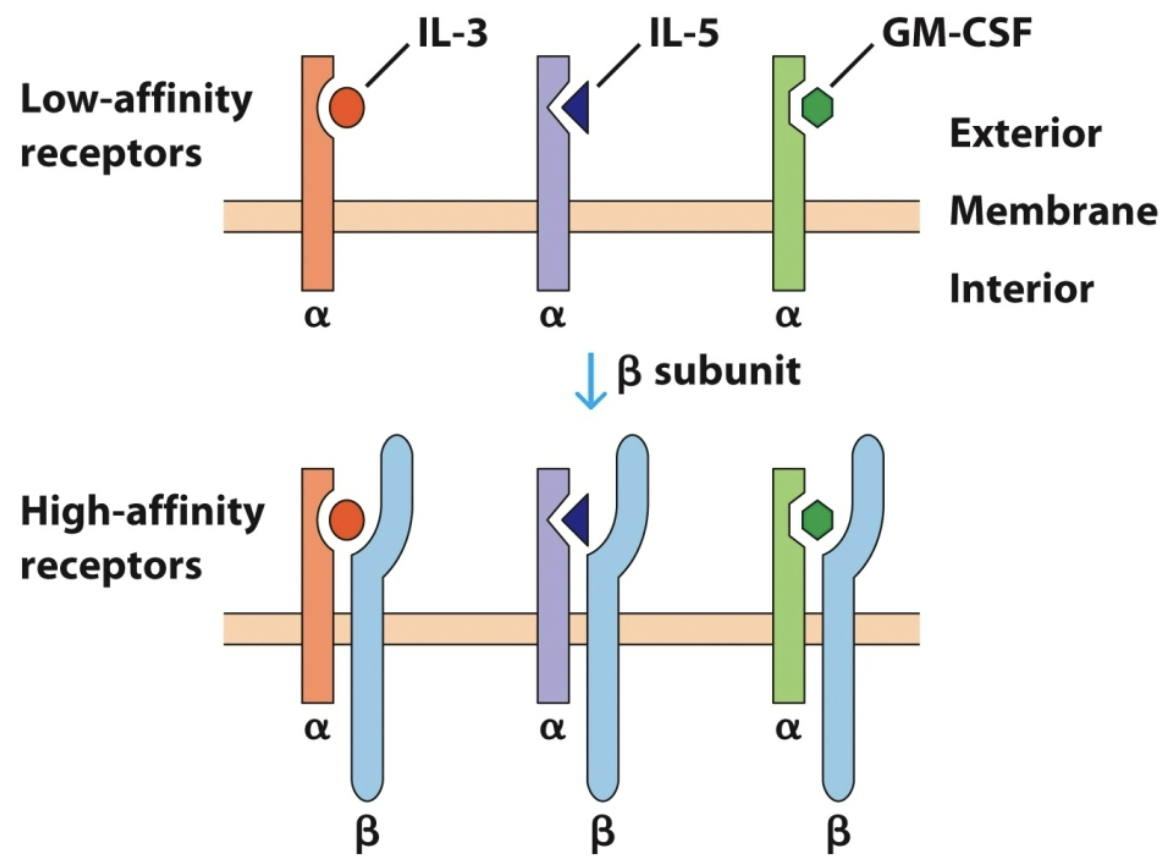
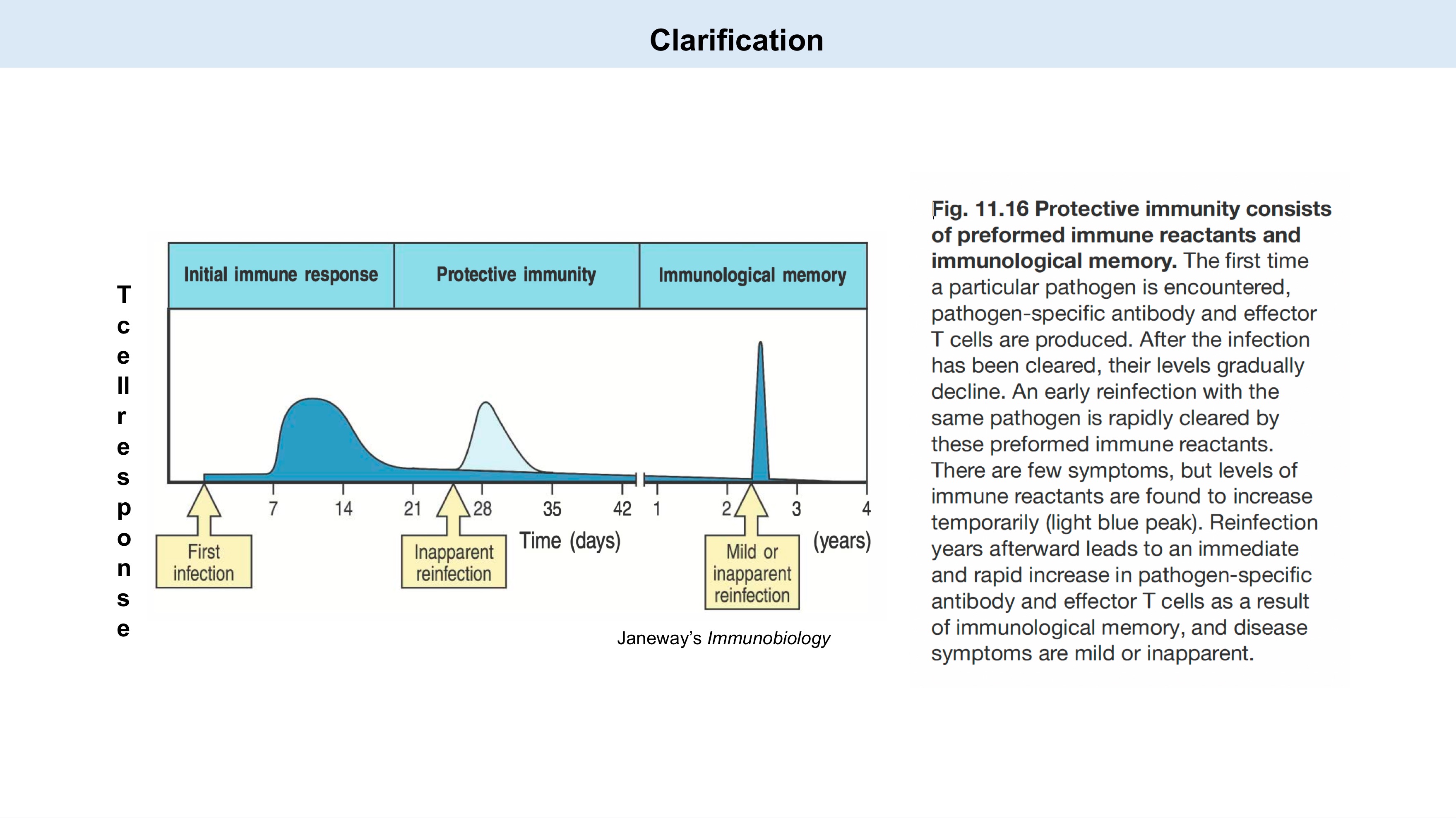
private

The receptor subunits specific for each cytokine are called _ chains because they define which specific cytokine binds, despite activating the same downstream machinery.
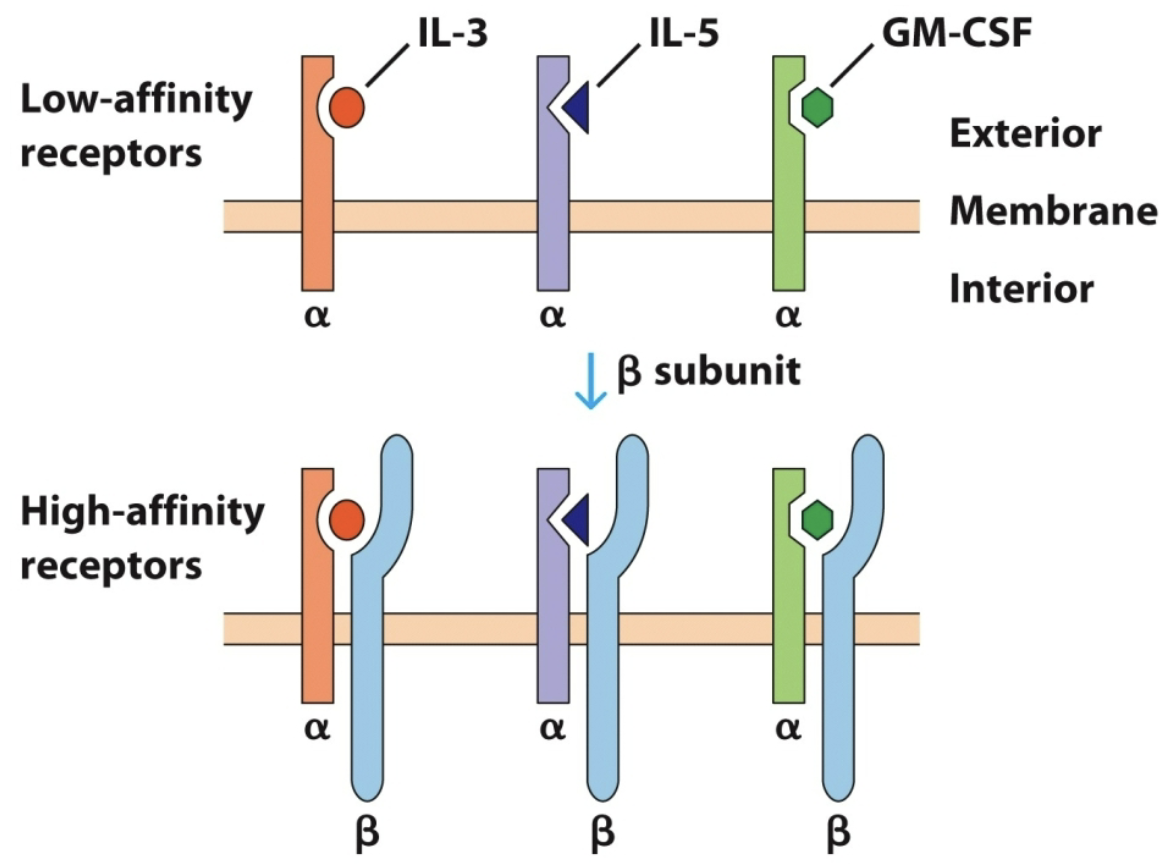
<p>The receptor subunits specific for each cytokine are called _ chains because they define which specific cytokine binds, despite activating the same downstream machinery.</p>
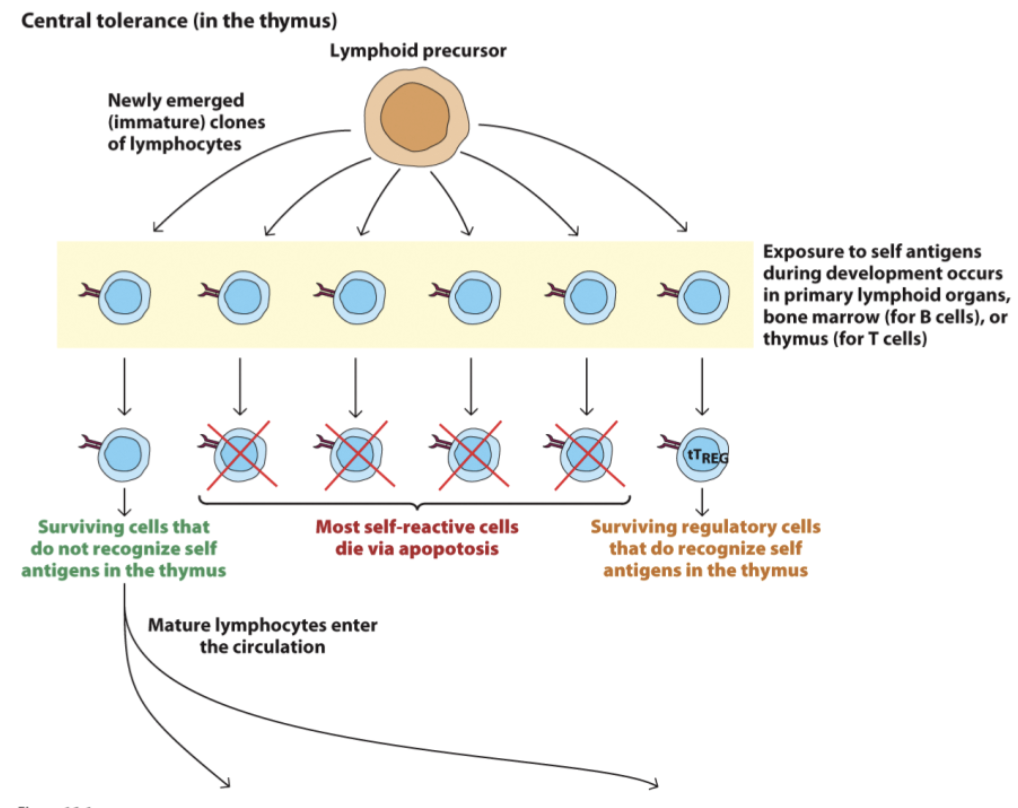
8
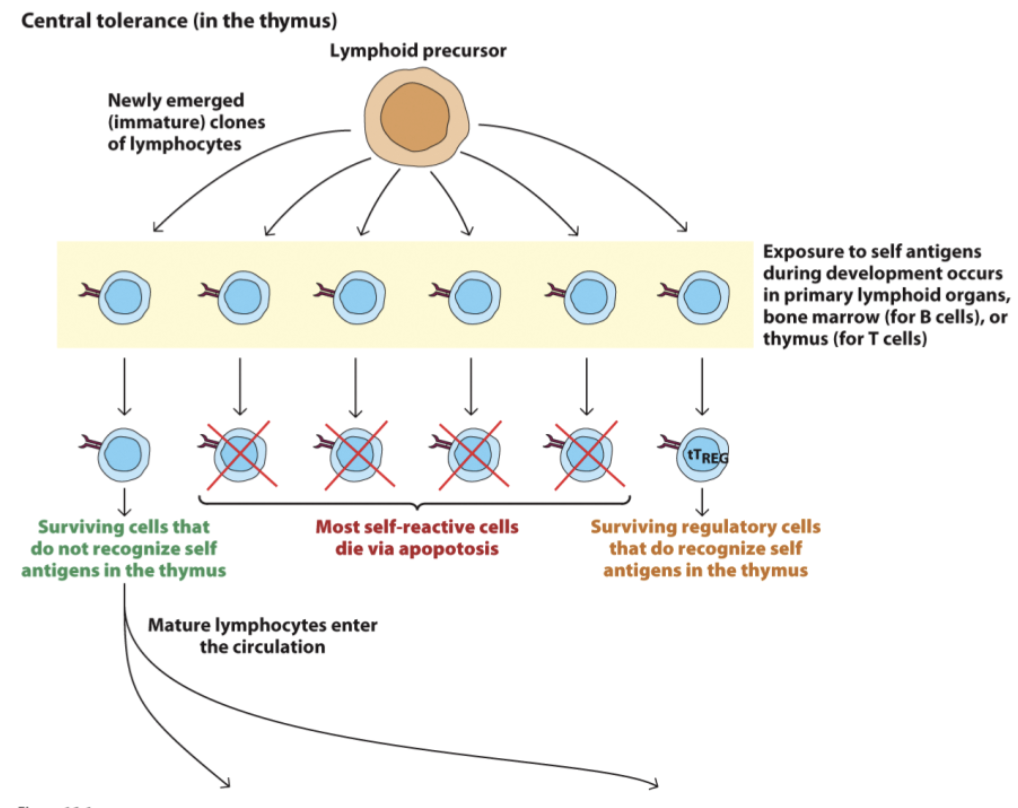
New cards

Limited public chain and lots of certain type of cytokine ligand can lead to selective representation of that receptor dimer; competitive inhibition

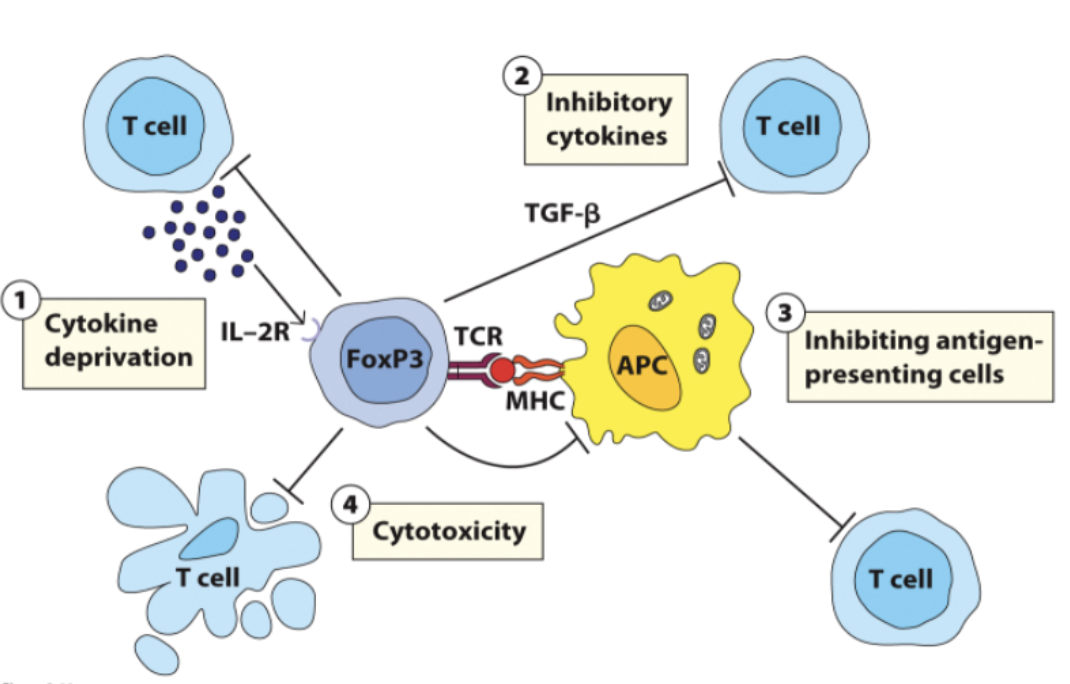
Purpose of private vs public chain?
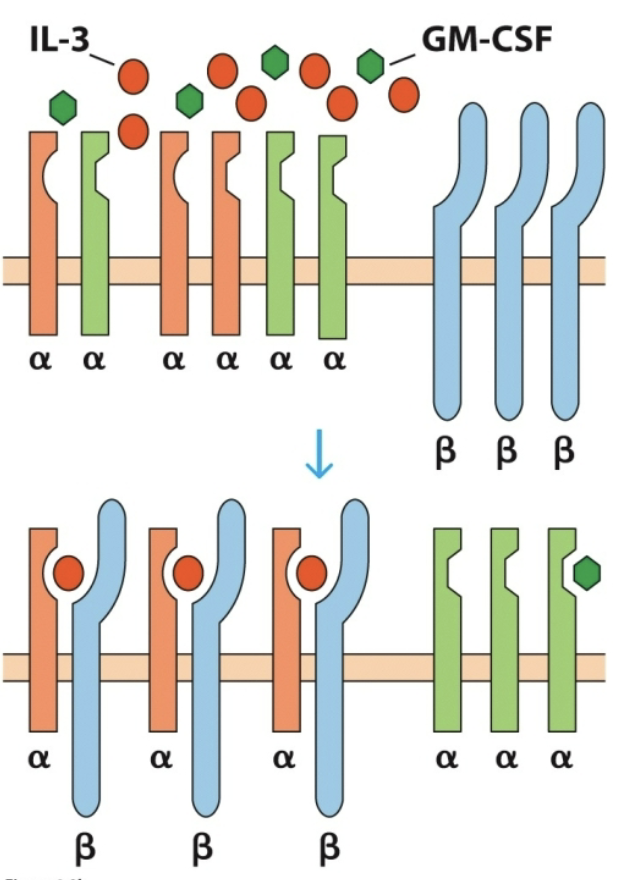
<p>Purpose of private vs public chain?</p>
9
New cards

phosphorylated tyrosines

SH2 binds to _W
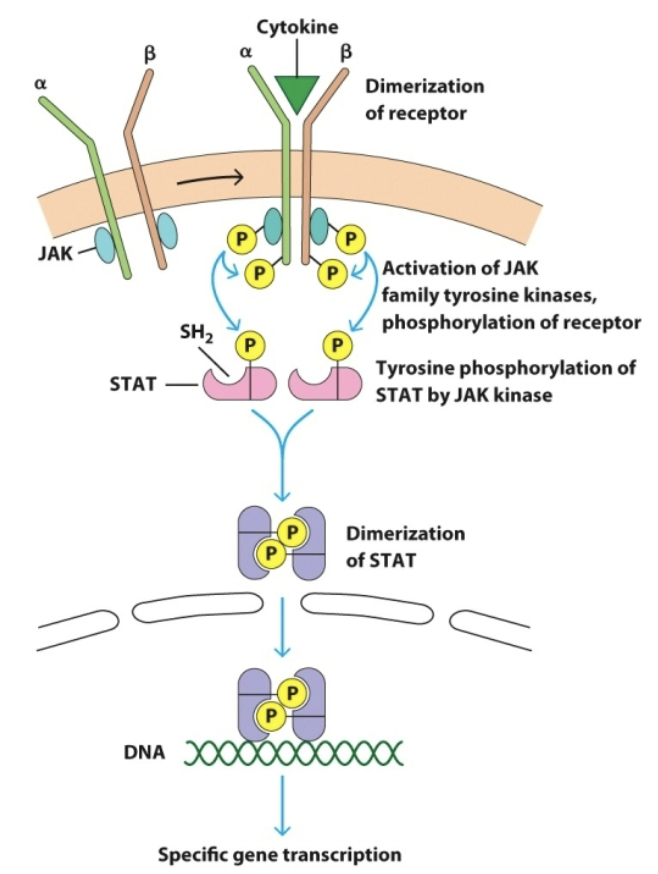
<p>SH2 binds to _W</p>
10
New cards
  1. No more binding domain

  2. Acts as a soluble inhibitor to other receptors (by binding to them)

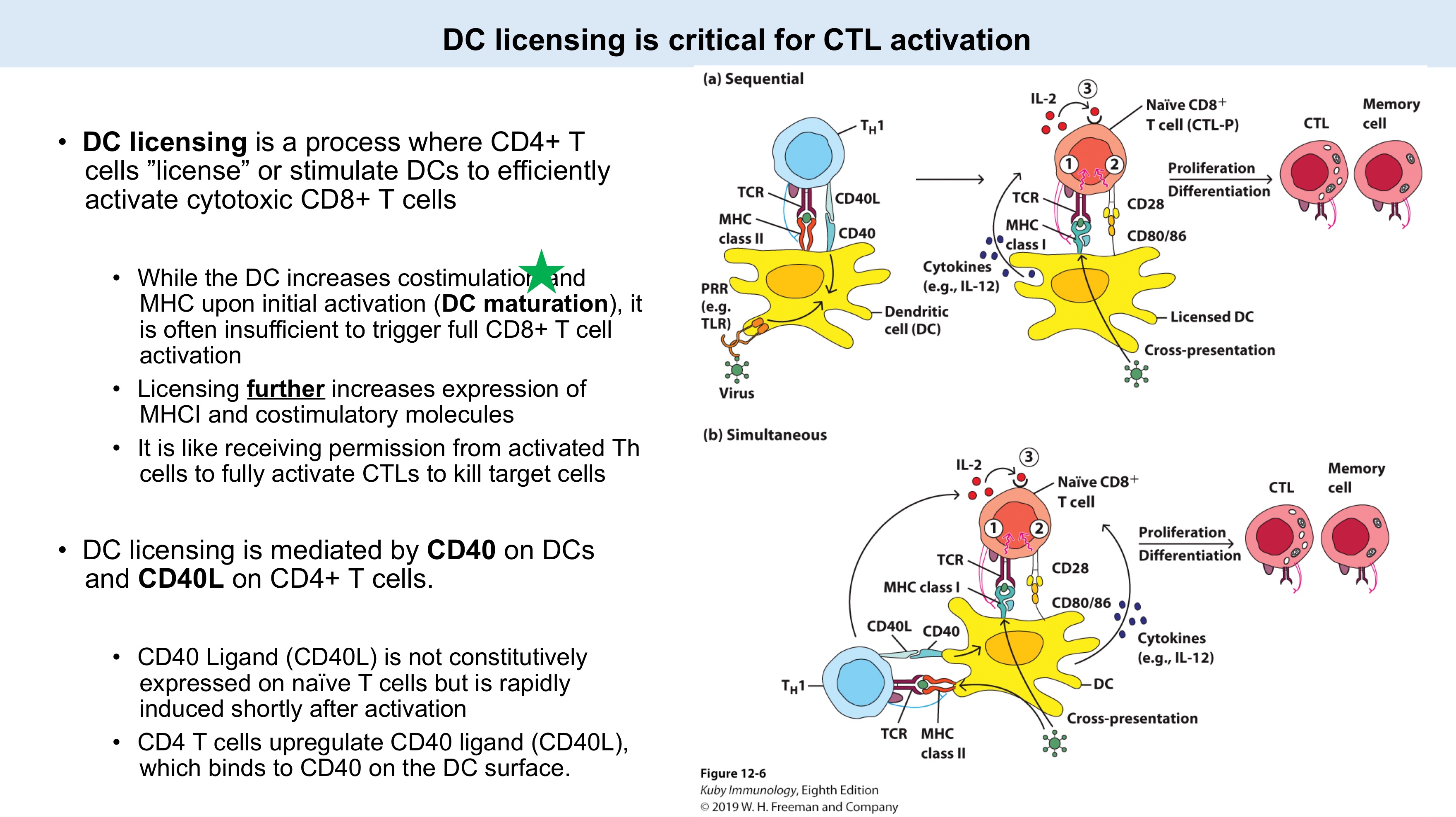
  3. Decoy receptor (ex. sIL-1RII decoy can bind IL-I but iC domain can’t signal)

Why chop off extracellular (EC) part (3 reasons)?
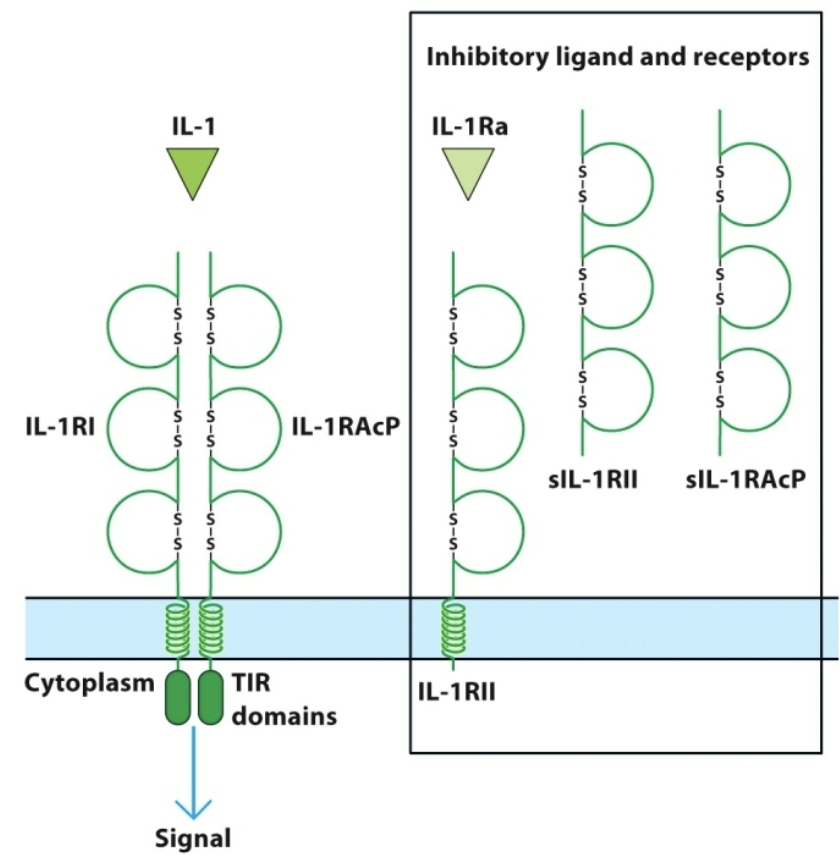
<p>Why chop off extracellular (EC) part (3 reasons)?</p>
11
New cards

neutrophils ; monocytes

Inflammation is when _ and _ migrate to sites of infection and tissue injury
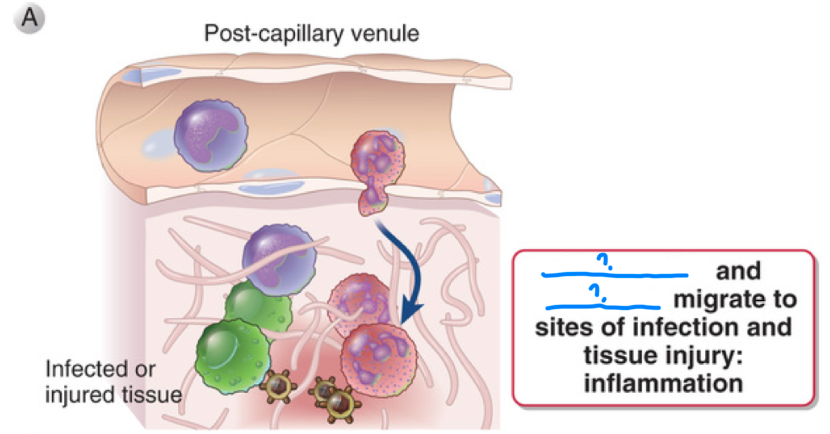
<p><strong>Inflammation</strong> is when _ and _ migrate to sites of infection and tissue injury</p>
12
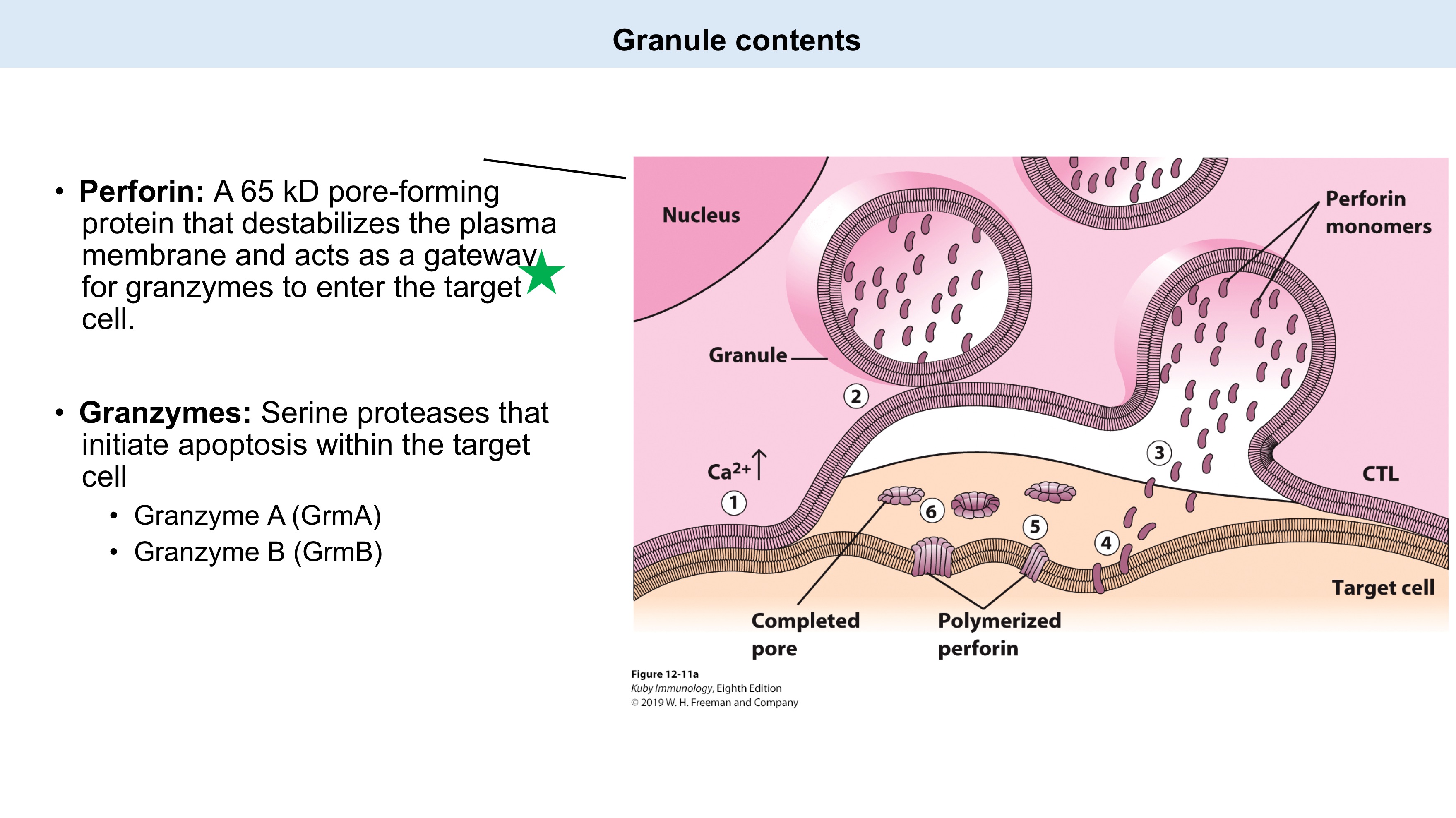
New cards

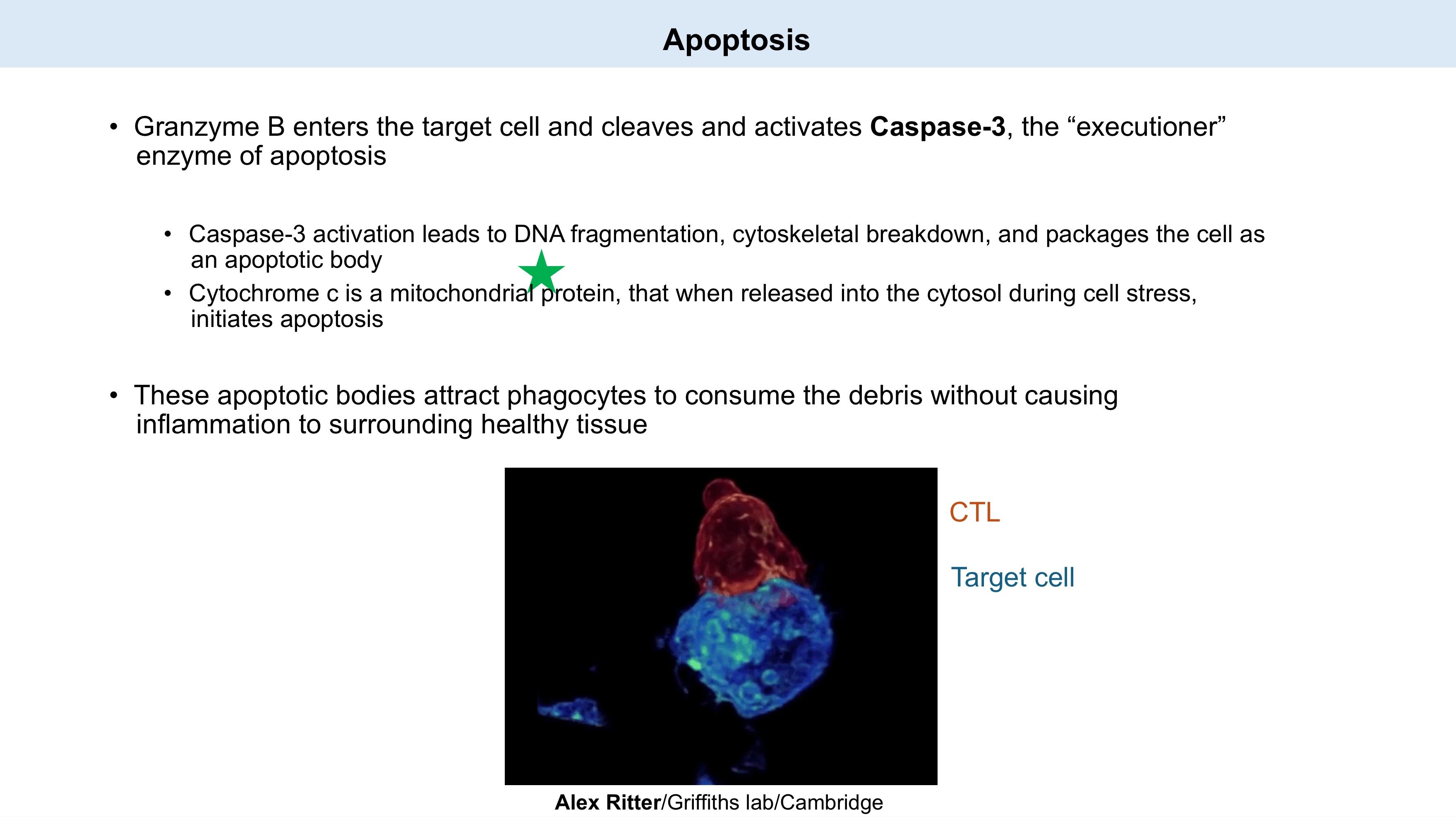
secondary lymphoid organs

Naive T and B cells migrate into ___
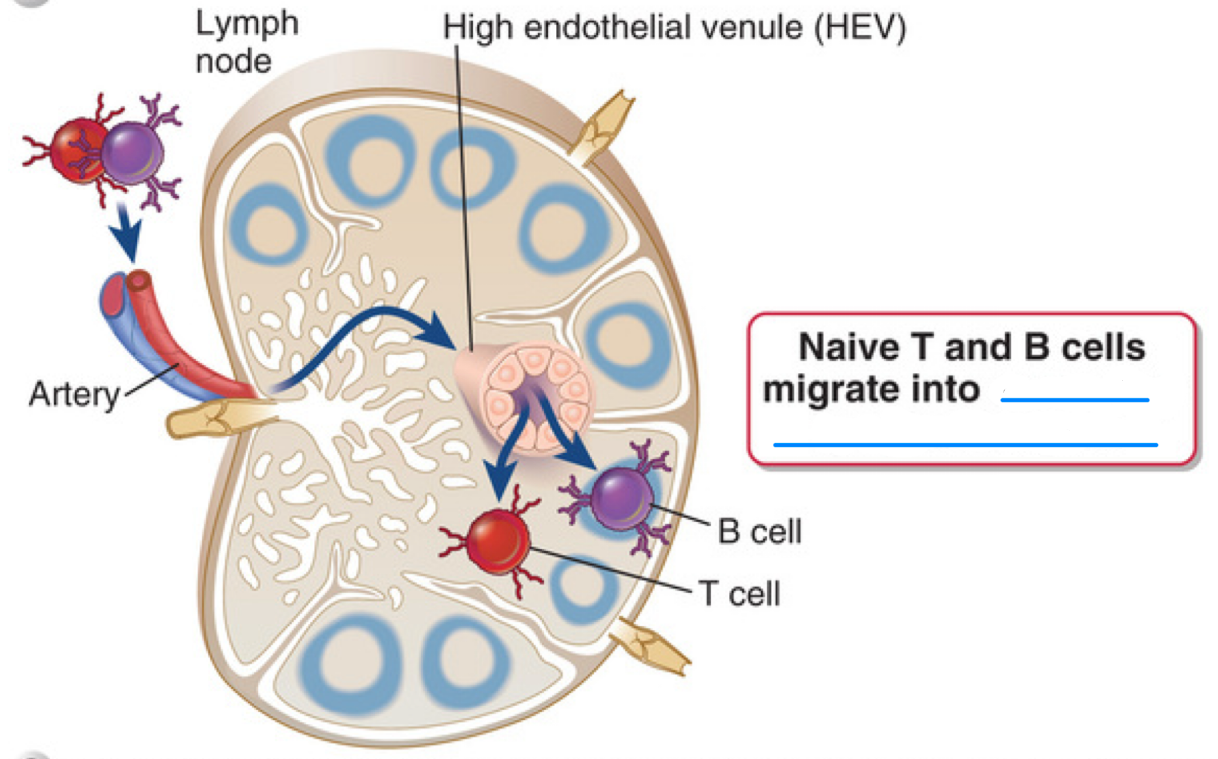
<p>Naive T and B cells migrate into ___</p>
13
New cards

Effector ; Memory T Cells

Cell-mediated immunity is when _ and _ migrate into sites of infection and tissue injury
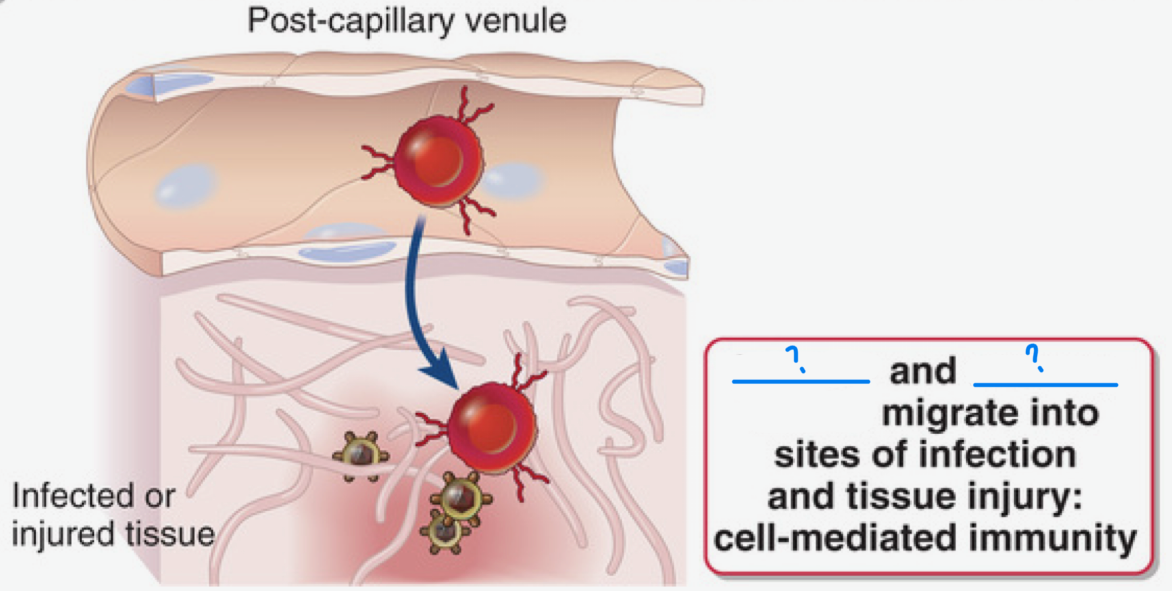
<p><strong>Cell-mediated immunity</strong> is when _ and _ migrate into sites of infection and tissue injury</p>
14
New cards
  1. Pain (dolor)

  2. Heat (calor)

  3. Redness (rubor)

  4. Swelling (tumor)

  5. Loss of function (functio laesa)

5 Hallmarks of Inflammation:

15
New cards
  • WBCs are metabolically active, releasing energy

  • Increased blood flow to the injured or infected area

Why does heat happen during inflammation?

16
New cards

Fluids leak out due to increased vascular permeability

Why does swelling happen during inflammation?

17
New cards

Increased blood flow to infection site —> blood = red

Why does redness happen during inflammation?

18
New cards
  • dead cells

  • neighboring cells

  • IL-1 alpha

Injury in big toe:

  • Who FIRST cries for help?

    • _

  • Second?

    • _

  • _ is never secreted in healthy cells; Dead cells secrete it.

19
New cards

NSAIDS

_, like ibuprofen/motrin/advil block Cox-1/2 pathways leading to inflammation
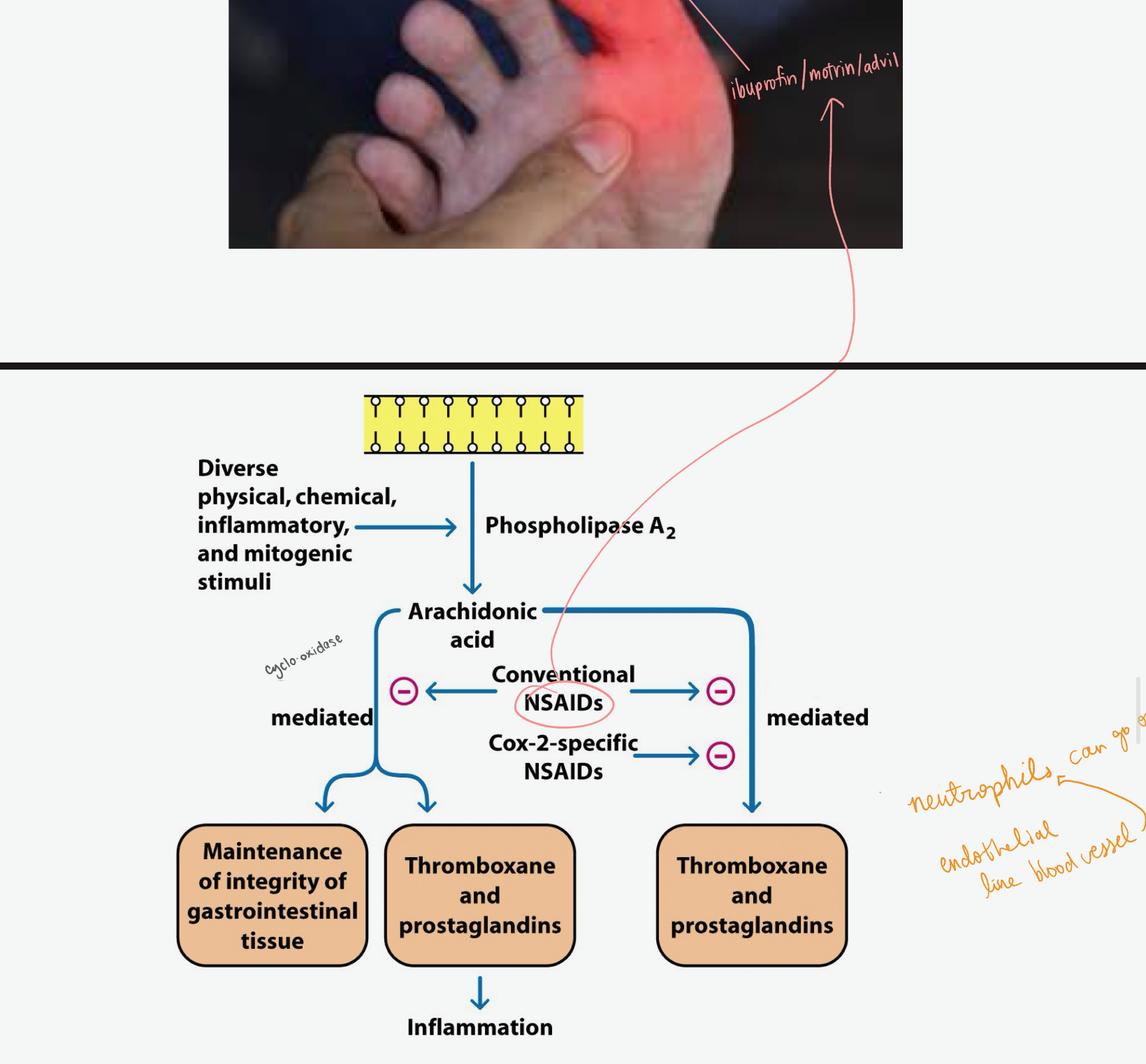
<p>_, like ibuprofen/motrin/advil block Cox-1/2 pathways leading to inflammation</p>
20
New cards

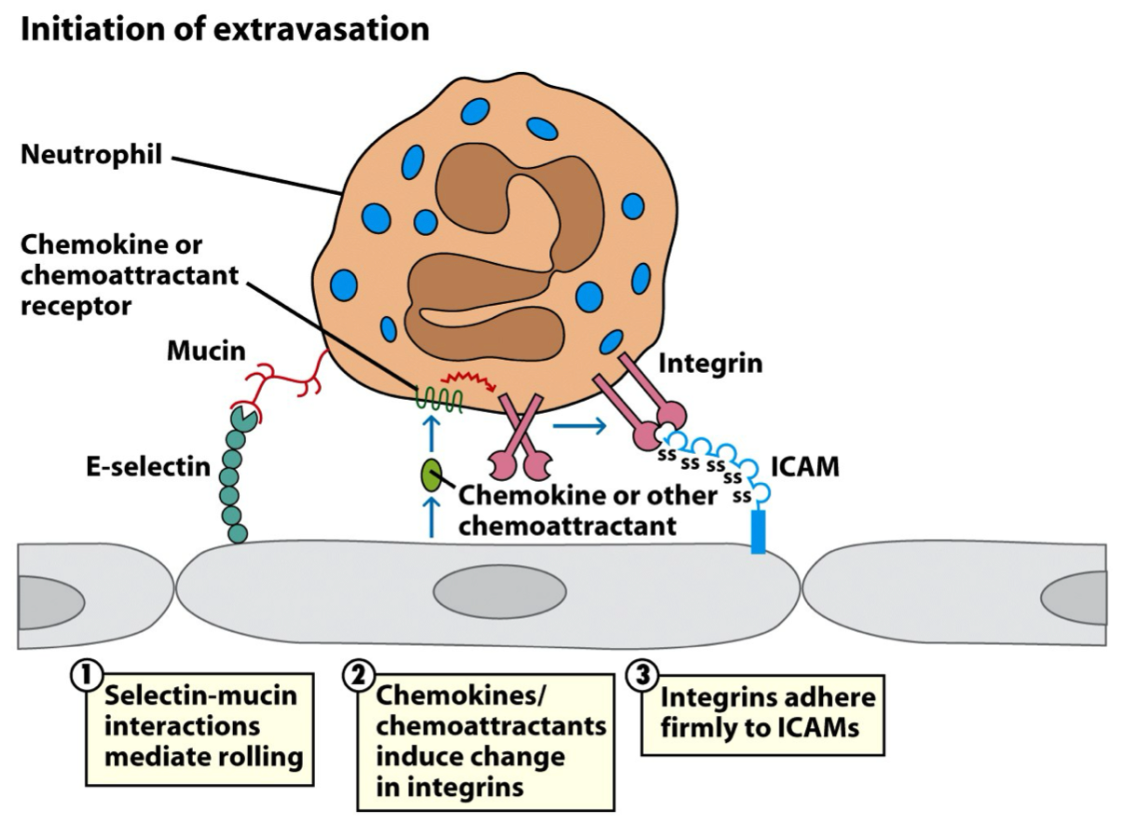
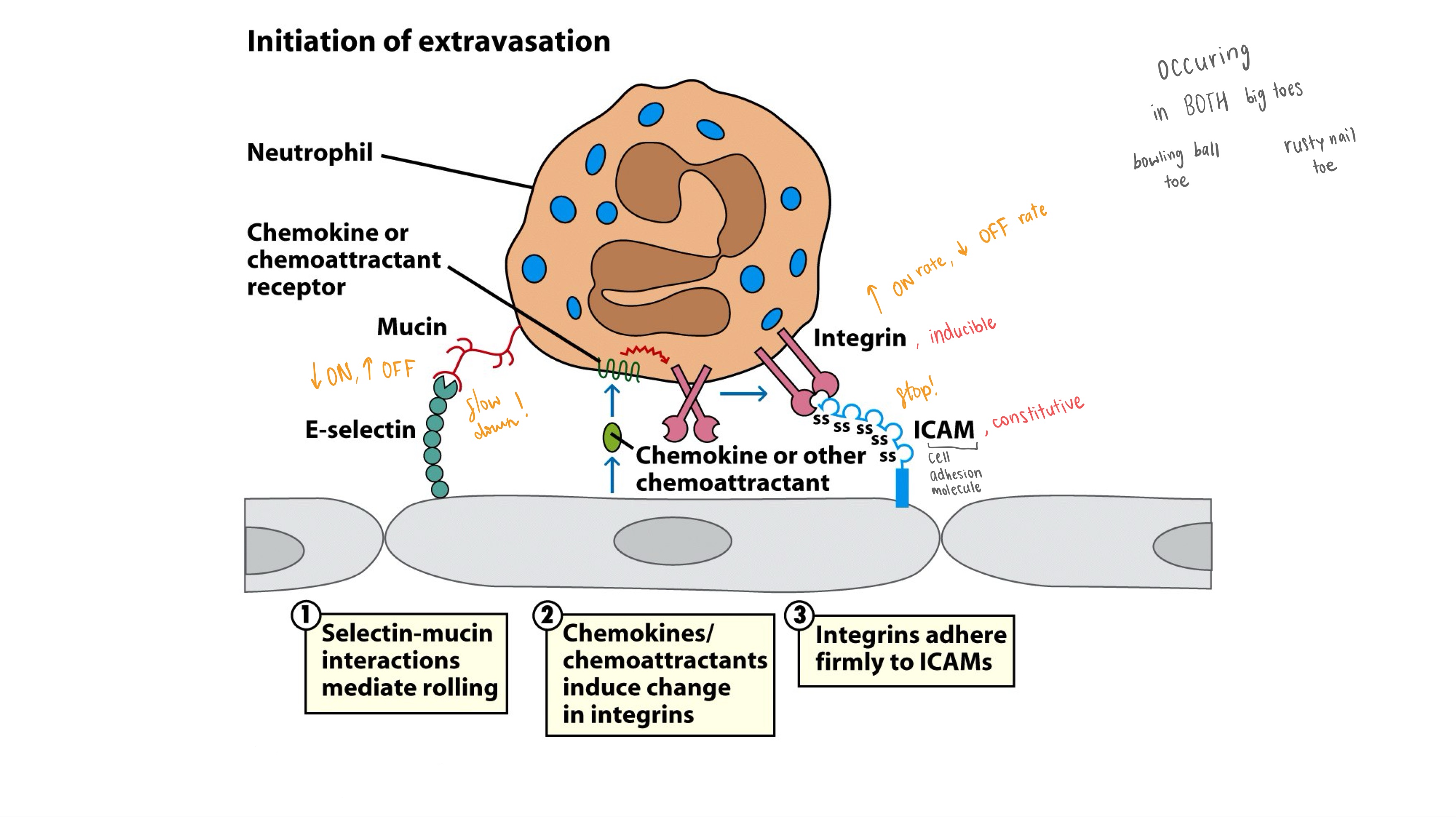
Selectin

_ are critical adhesion molecules that initiate the immune response by mediating the initial "hopping" of leukocytes along the vascular endothelium.

(image fill in blank)
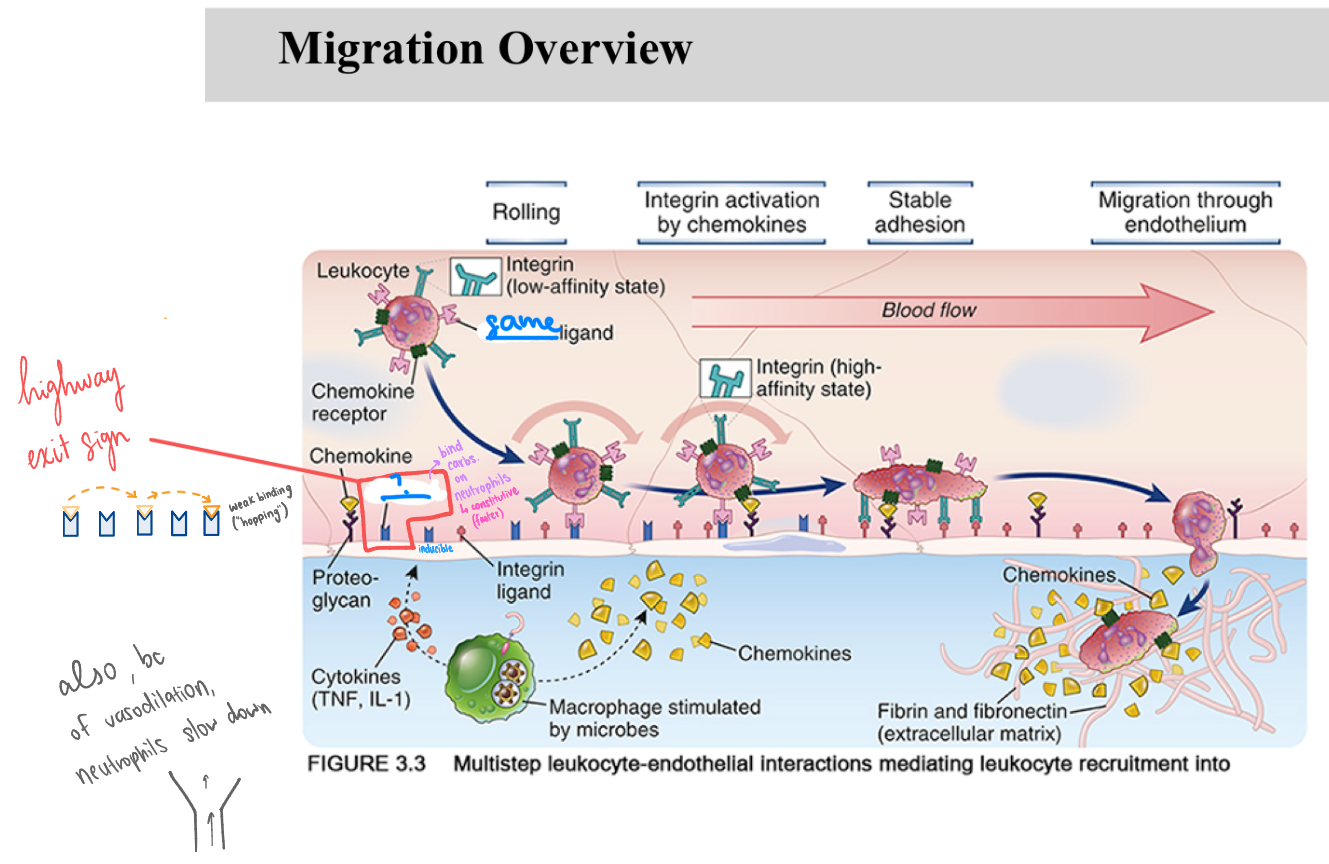
<p>_ are critical adhesion molecules that initiate the immune response by mediating the initial "hopping" of leukocytes along the vascular endothelium.</p><p>(image fill in blank)</p>
21
New cards

inducible

constitutive

Selectins are inducible on endothelial cells to prevent indiscriminate, potentially harmful neutrophil adhesion in healthy blood vessels.

Carbohydrates (selectin ligands) on neutrophils are constitutive to allow them to respond instantly to inflammatory signals.

Selectins are _

Carbs on Neutrophils are _

WHY?
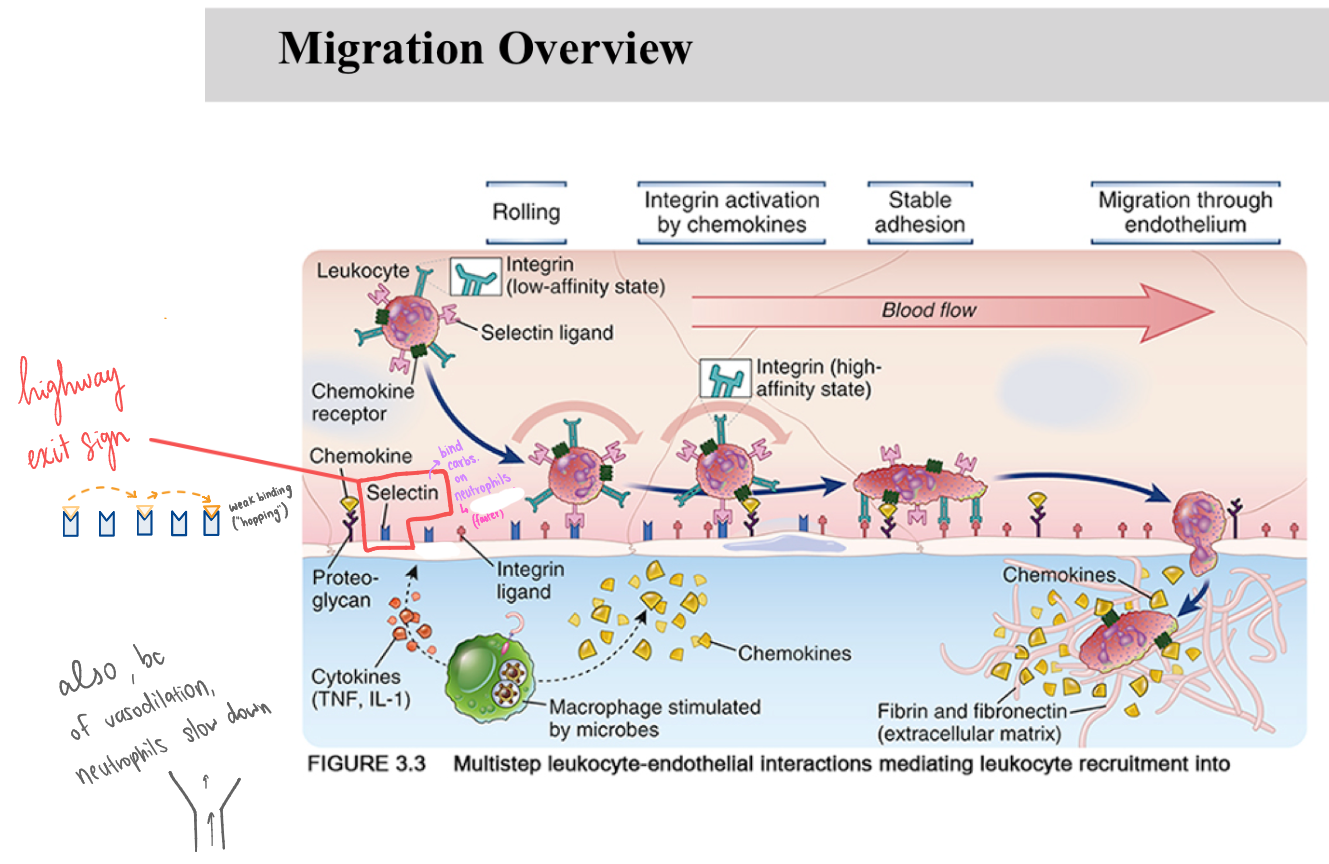
<p>Selectins are _</p><p>Carbs on Neutrophils are _</p><p>WHY?</p>
22
New cards

vasodilation

Neutrophils can slow down (for migration into the tissue) bc of selectin hopping and ALSO because of _

(image fill in blank)
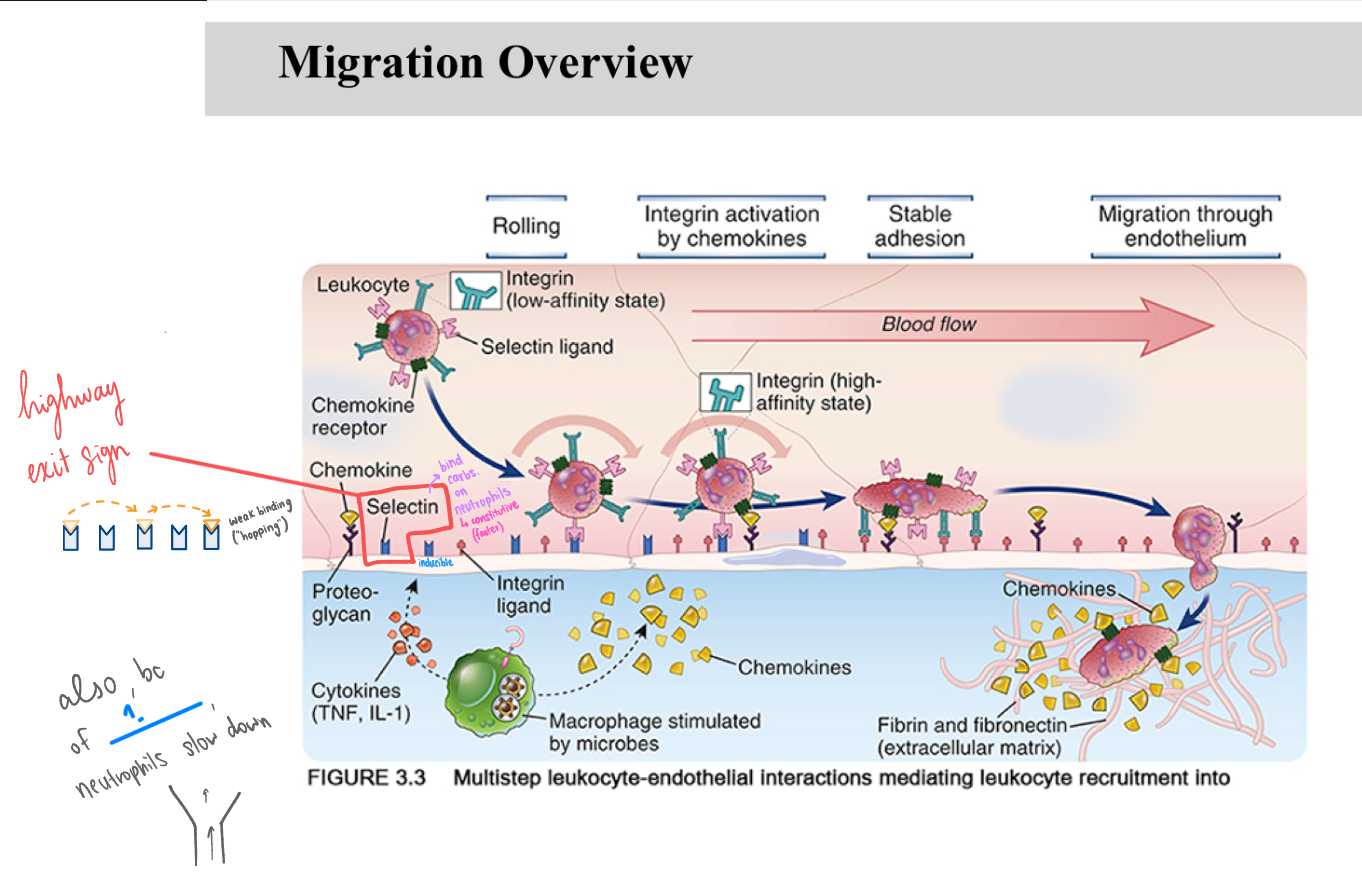
<p>Neutrophils can slow down (for migration into the tissue) bc of selectin hopping and ALSO because of _</p><p>(image fill in blank)</p>
23
New cards
<p>integrins ; ICAM</p><p>in integrins ; ICAM</p>

integrins ; ICAM

in integrins ; ICAM

After selectin binds carb on neutrophil, _ on neutrophil binds to _ on endothelial cell.

Now fill in image _’s
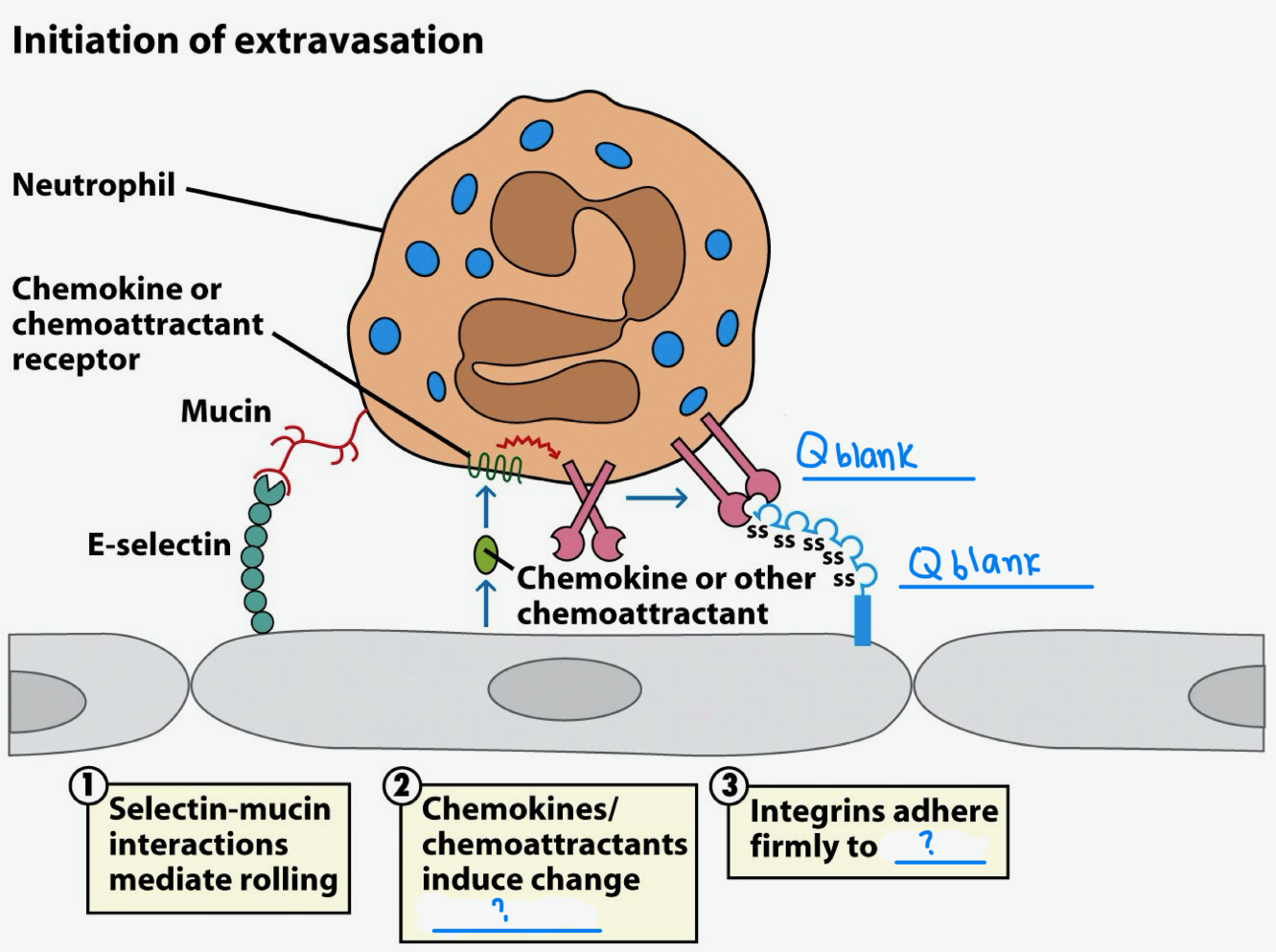
<p>After selectin binds carb on neutrophil, _ on neutrophil binds to _ on endothelial cell.</p><p>Now fill in image _’s</p>
24
New cards
  • OFF ; ON

  • ON ; OFF

  • Carb / selectin has: High _ rate; Low _ rate

  • Integrin / ICAM has: High _ rate; Low _ rate
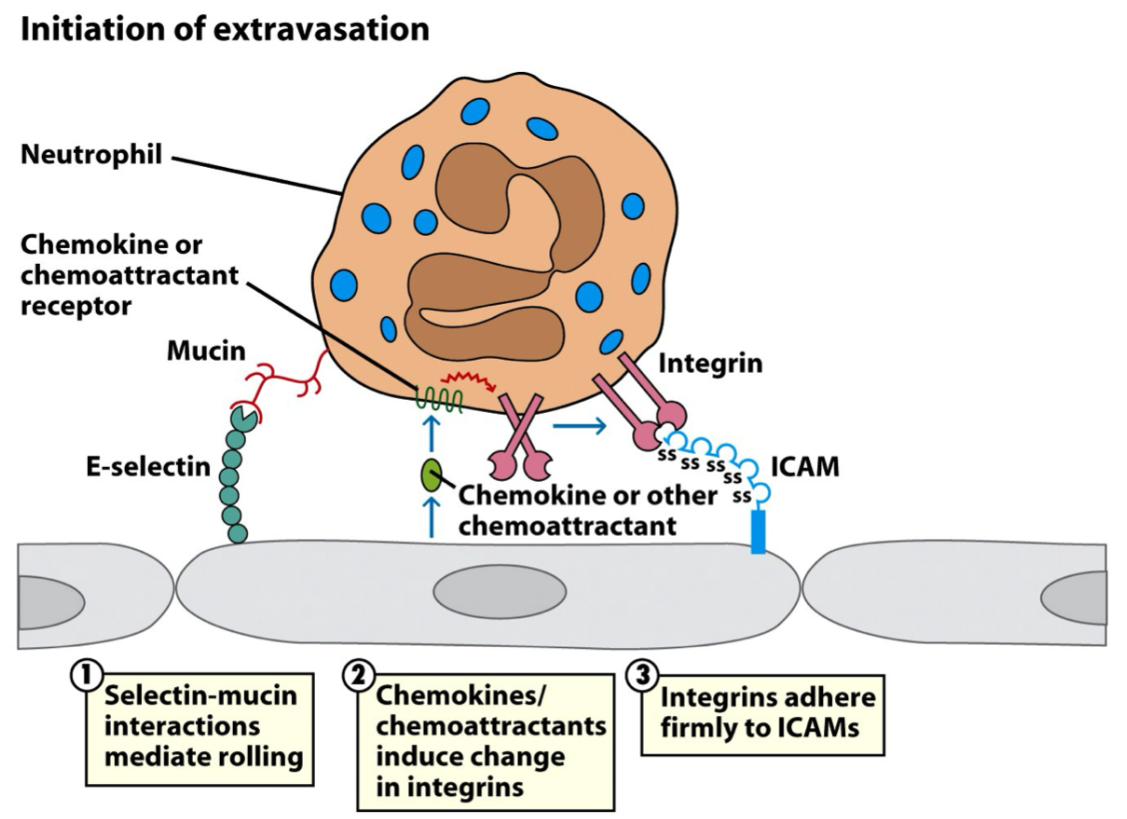
<ul><li><p><strong>Carb / selectin</strong> has: High _ rate; Low _ rate<br></p></li><li><p><strong>Integrin / ICAM</strong> has: High _ rate; Low _ rate</p></li></ul><p></p>
25
New cards
<p>inducible</p><p>constitutive</p>

inducible

constitutive

Integrin is _

ICAM is _
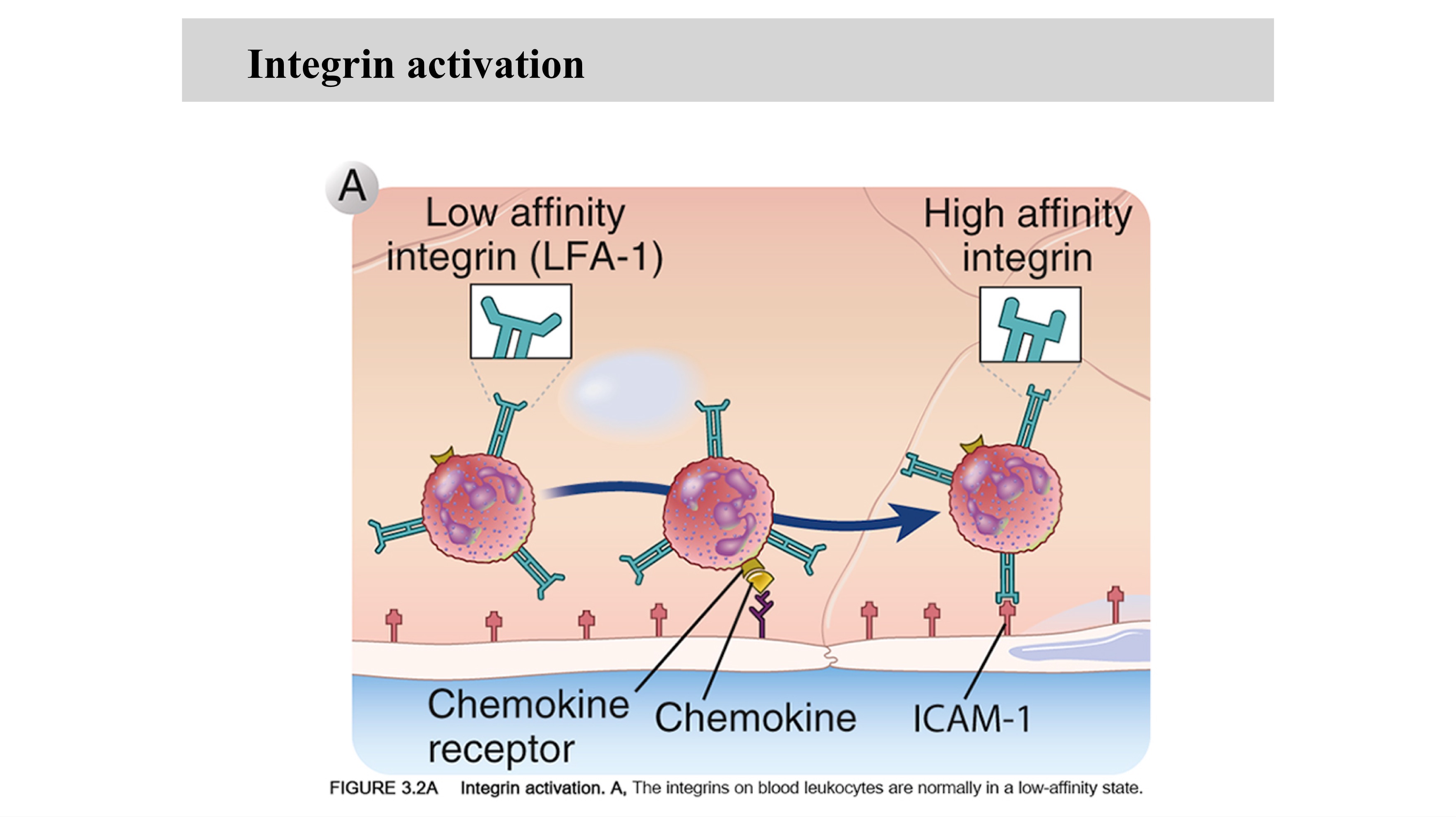
<p>Integrin is _</p><p>ICAM is _</p>
26
New cards

constitutive

In lymph nodes, everything is _
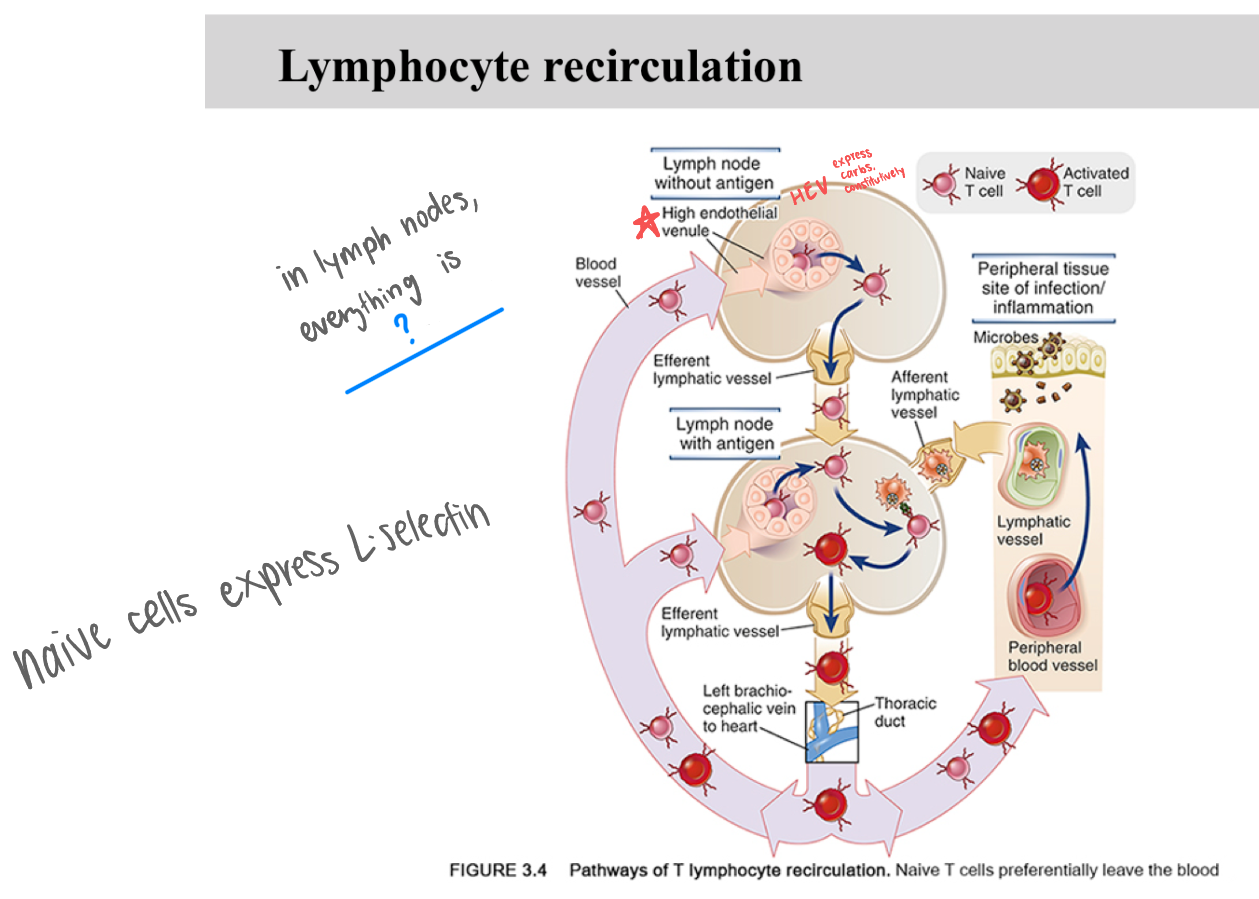
<p>In lymph nodes, everything is _</p>
27
New cards

HEV

_ are the endothelial cells in blood vessels and lymph nodes that express a carb all the time that binds L-selectin
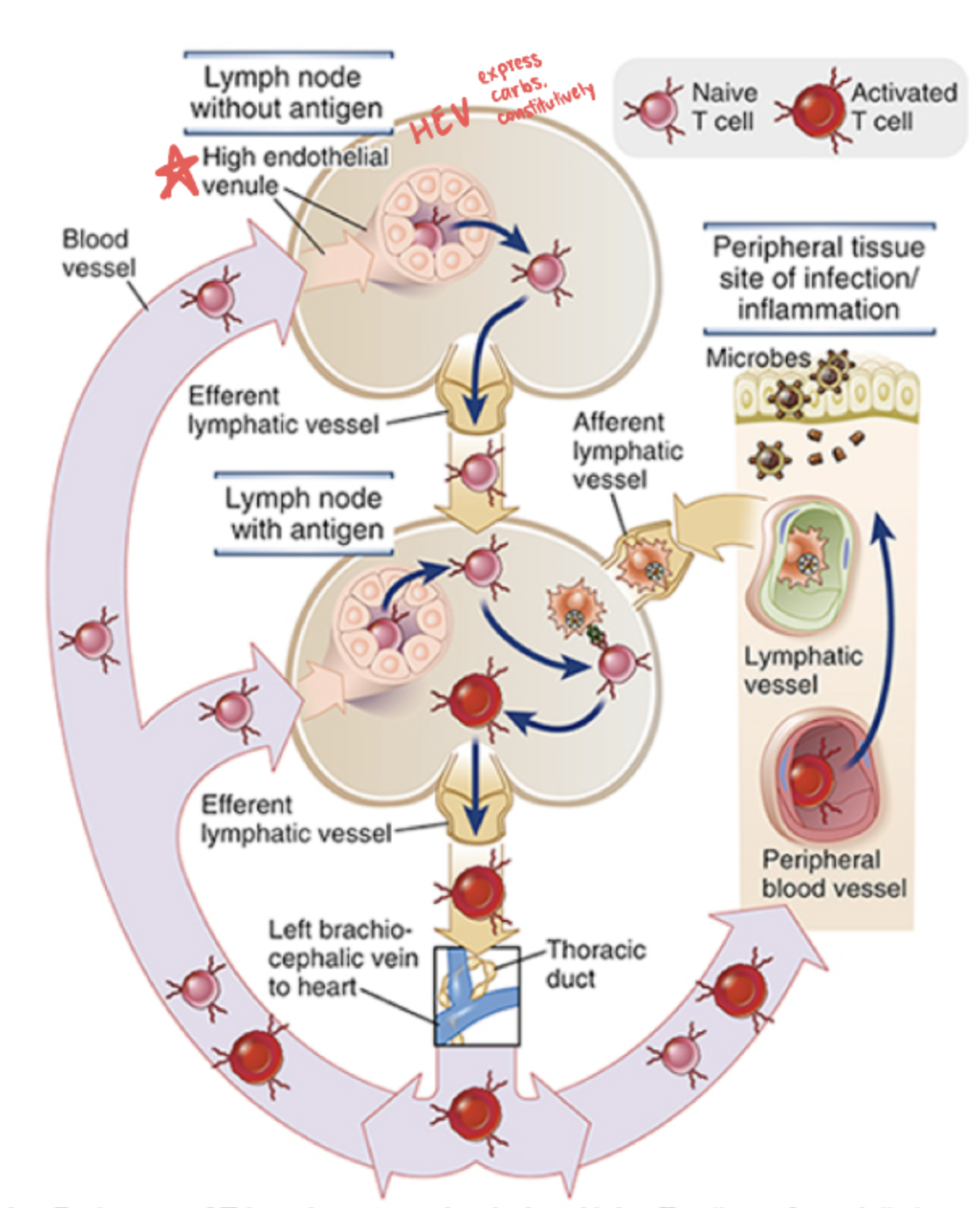
<p>_ are the endothelial cells in blood vessels and lymph nodes that express a carb all the time that binds L-selectin</p>
28
New cards
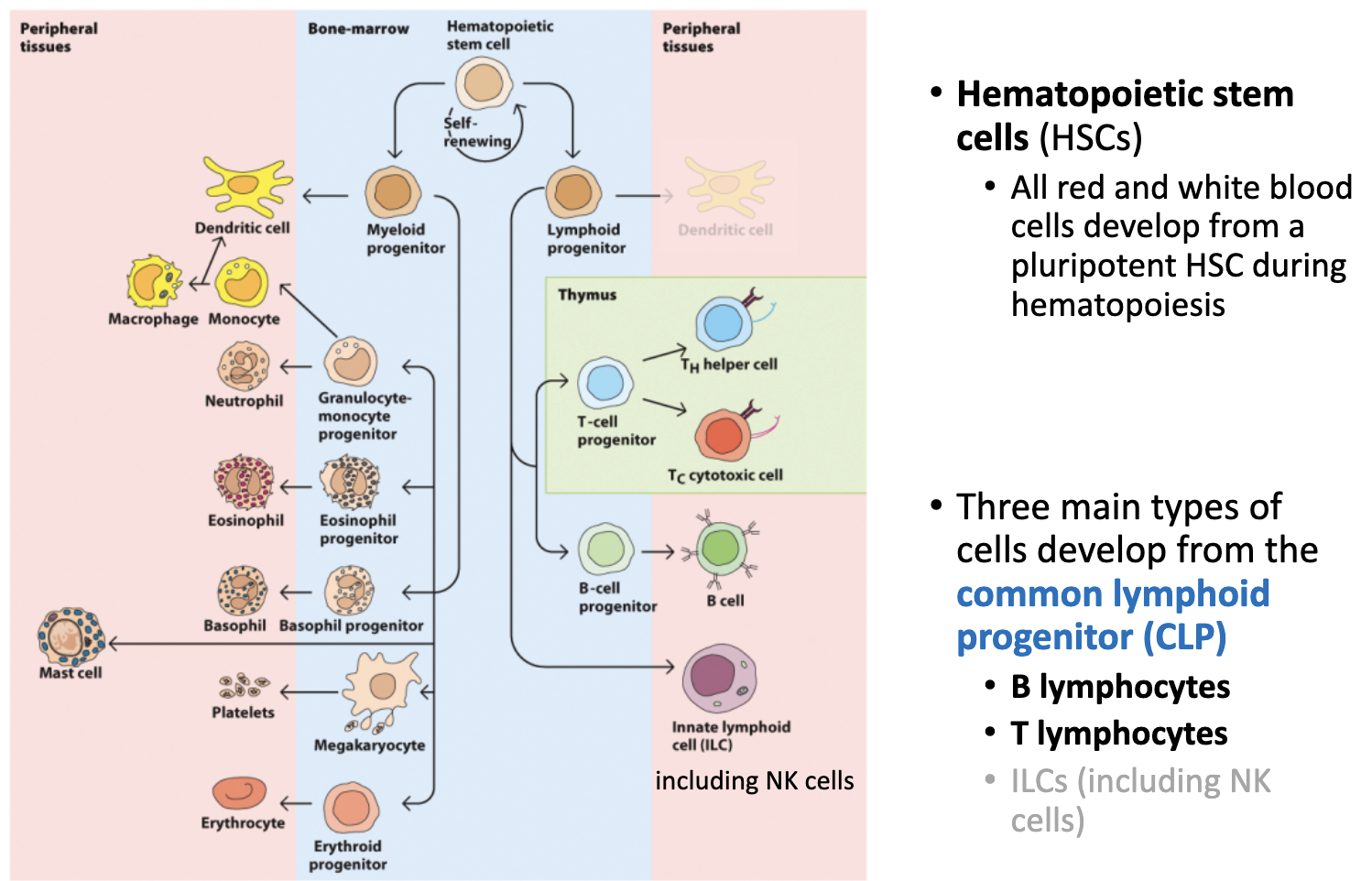
  • T cell progenitors

  • B cell progenitors

In bone marrow, lymphoid progenitors into..

  • _

  • _

<p>In bone marrow, lymphoid progenitors into..</p><ul><li><p>_</p></li><li><p>_</p></li></ul><p></p>
29
New cards
  • IgM

  • Naïve

  • self-reactive

  • LN to LN

Mature B cell in periphery

  • Expresses surface _

  • _ (no effector function)

  • Ideally, no _ cells

  • Circulate from _, “looking” for cognate antigen

30
New cards
  • HC and LC

  • Ig

What needs to happen during B cell development ….

  • Express proteins needed for gene rearrangement, B cell signaling, and B cell function.

  • Rearrange _ and _ genes

  • Test rearranged _

    • Eliminate cells with non-productive RAR

    • Tolerance – eliminate cells with Ig that recognizes self

31
New cards

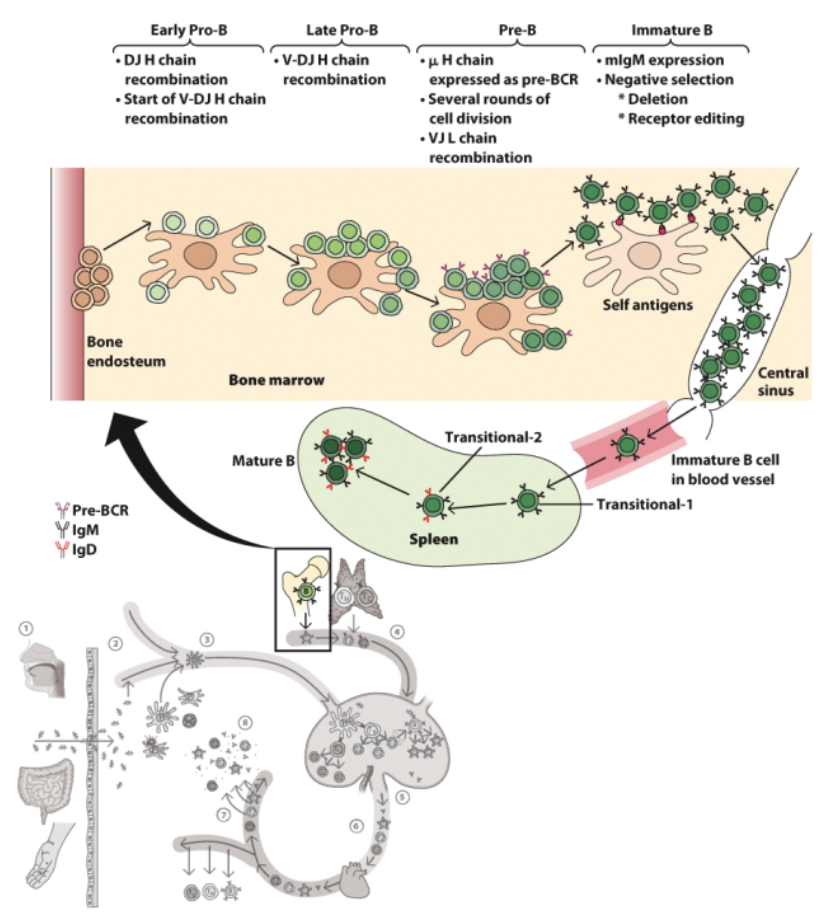
spleen

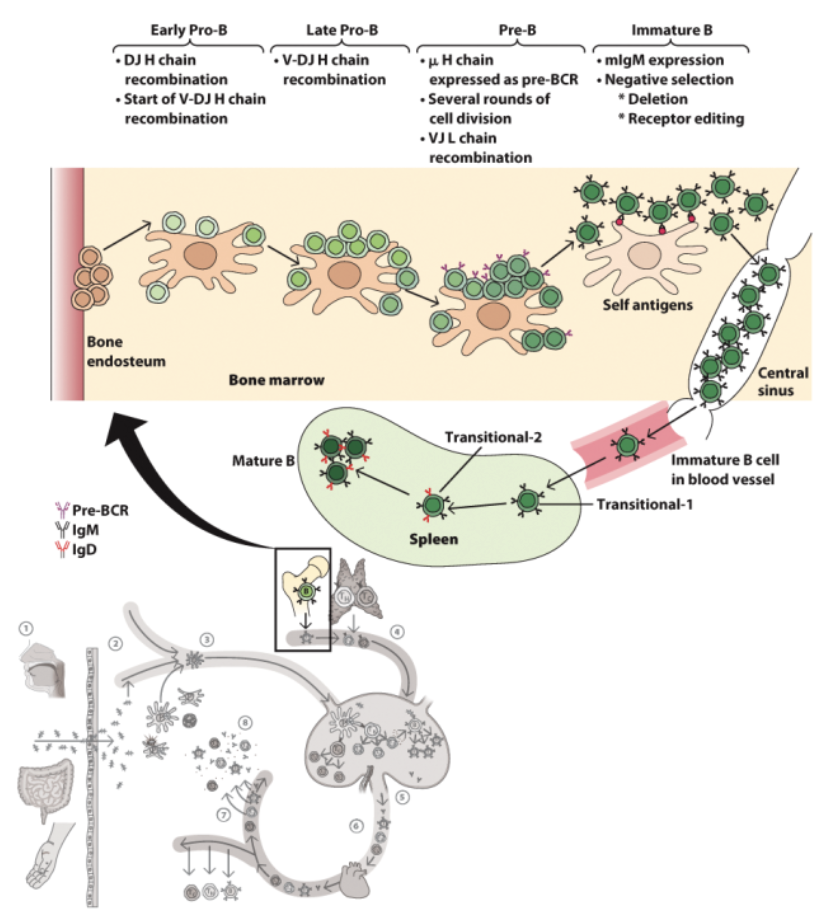
B-cell development begins in the bone marrow and is completed in the _.

  1. Commit to B cell lineage

  2. RAR (rearrangement) HC

  3. Test HC

  4. RAR LC

  5. Test HC/LC

  6. Negative selection

  7. More negative selection

<p>B-cell development begins in the bone marrow and is completed in the <span style="color: rgb(194, 152, 9);">_</span>.</p><ol><li><p>Commit to B cell lineage</p></li><li><p>RAR (rearrangement) HC</p></li><li><p>Test HC</p></li><li><p>RAR LC</p></li><li><p>Test HC/LC</p></li><li><p>Negative selection</p></li><li><p><span style="color: rgb(225, 176, 7);">More negative selection</span></p></li></ol><p></p>
32
New cards
  • Bone marrow

  • Stem cells

  • Stromal cells

B-cell development in the bone marrow

  • _ structure is dynamic & complex.

  • _ differentiate into many cell types

  • _ provide support & growth factors

    • Soluble mediators

    • Cell surface molecules

Examples for EARLY B cell development

  • SCF (stem cell factor) on stromal cells binds to c-kit on HSCs.

  • CXCL12 on stromal cells -> supports differentiation to pro-B cell stage.

  • IL-7 – growth factor for lymphoid cells -> supports differentiation to pre-B cell stage.
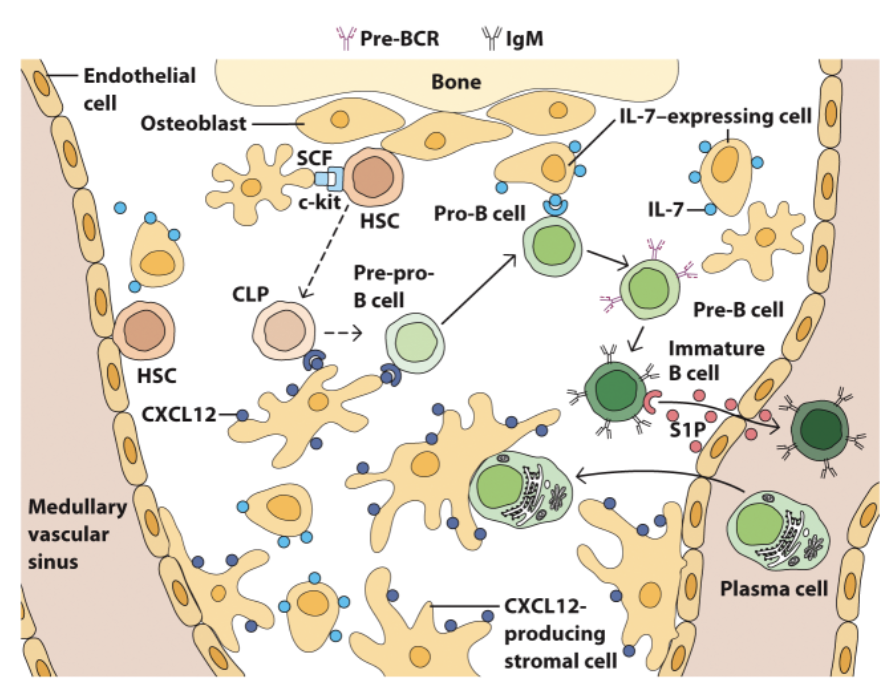
<p><strong>B-cell development in the bone marrow</strong></p><ul><li><p>_ structure is dynamic &amp; complex.</p></li><li><p>_ differentiate into many cell types</p></li><li><p>_ provide support &amp; growth factors</p><ul><li><p>Soluble mediators</p></li><li><p>Cell surface molecules</p></li></ul></li></ul><p></p><p><strong>Examples for EARLY B cell development</strong></p><ul><li><p>SCF (stem cell factor) on stromal cells binds to c-kit on HSCs.</p></li><li><p>CXCL12 on stromal cells -&gt; supports differentiation to pro-B cell stage.</p></li><li><p>IL-7 – growth factor for lymphoid cells -&gt; supports differentiation to pre-B cell stage.</p></li></ul><p></p>
33
New cards

V pre-B, Lambda 5, productively rearranged heavy chain, and signaling subunits Ig-alpha and -beta.

pre-BCR made of?
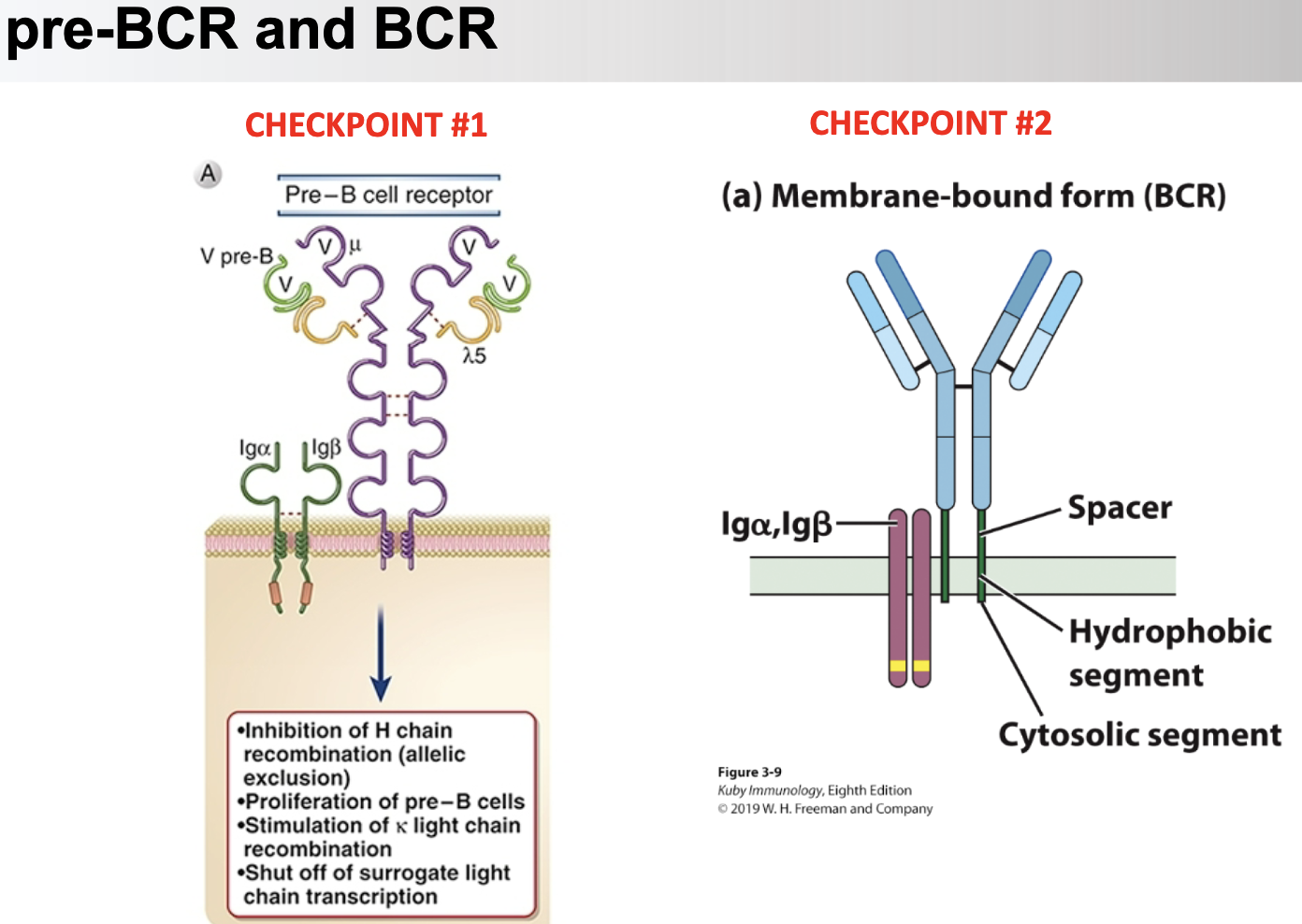
<p>pre-BCR made of?</p>
34
New cards
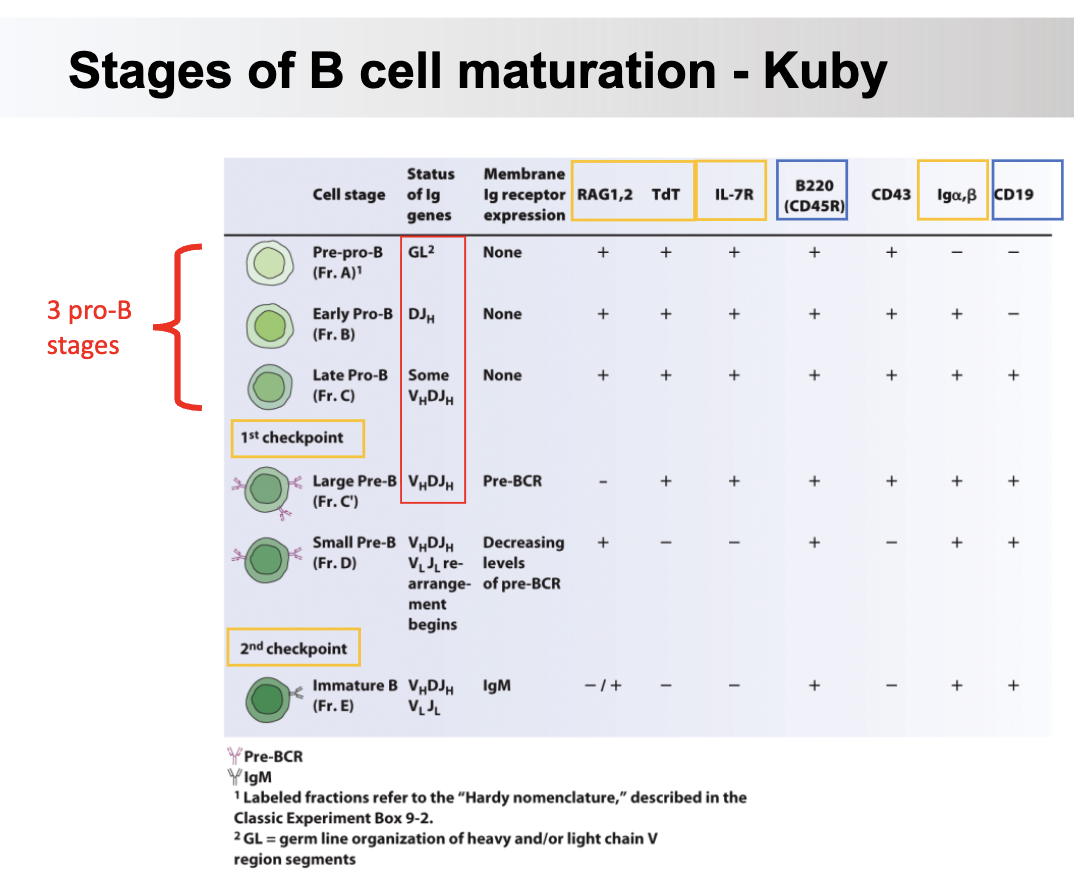
<ol><li><p>germline (big toe)</p></li><li><p>RAG1/2 ; TdT —&gt; HC RAR</p></li><li><p>Pre-BCR</p></li><li><p>2 ; <br>RAG1/2 ; TdT ; proliferation —&gt; Large pre-B</p></li><li><p>RAG1/2</p></li><li><p>VpreB and lambda5 ; BCR ; <br>IMMATURE B CELL<br>5</p></li><li><p>Blood<br>Receptor-editing<br>6 (checkpoint 2)</p></li></ol><p></p>
  1. germline (big toe)

  2. RAG1/2 ; TdT —> HC RAR

  3. Pre-BCR

  4. 2 ;
    RAG1/2 ; TdT ; proliferation —> Large pre-B

  5. RAG1/2

  6. VpreB and lambda5 ; BCR ;
    IMMATURE B CELL
    5

  7. Blood
    Receptor-editing
    6 (checkpoint 2)

STEPWISE:

PRO B

  1. CLP is genomically like _.

  2. Turn on _ and _ —> _ (D-J) (V-DJ)

  3. Turn on surrogate light chain (vpreB, lambda5, Igalpha/beta). —> _

    LARGE PRE B

  4. CHECKPOINT #1:
    If NO —> go back to step _ (try rearrangement again - if fails twice = DEATH).
    If YES —> turn OFF _ (don’t want DSB during cell replication), and undergo _ —>

    SMALL PRE B

  5. Turn ON _, express LC RNA and proteins

  6. CHECKPOINT #2:
    Turn OFF _ and _, forming —>
    If signals YES —> _
    If signals NO —> go back to step _ (if fails again = DEATH)

  7. If doesn’t bind self, exits to _.
    If binds self, undergoes _, goes back to step _.
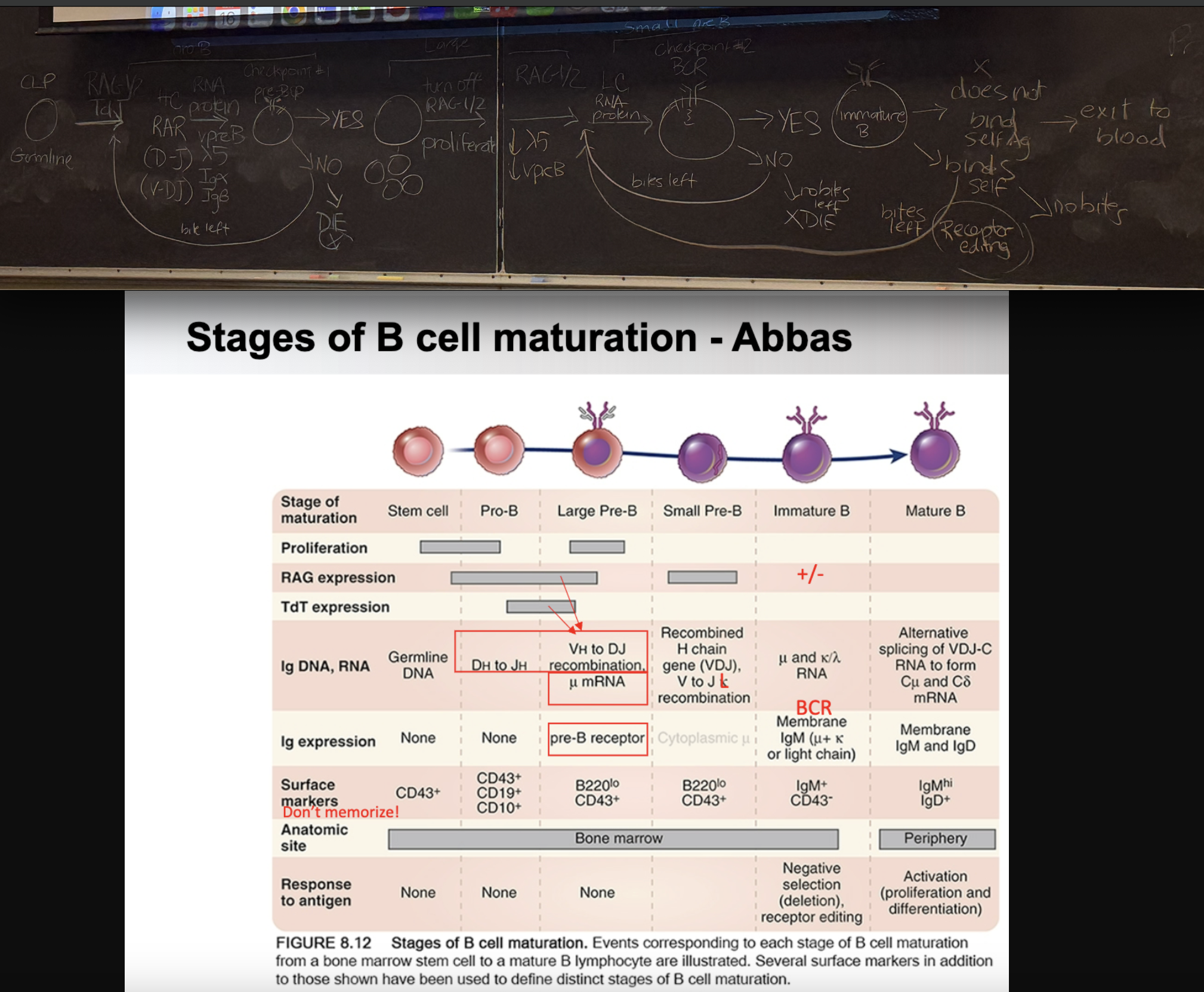
<p><strong>STEPWISE:</strong></p><p></p><p>PRO B</p><ol><li><p>CLP is genomically like _.</p></li><li><p>Turn on _ and _ —&gt; _ (D-J) (V-DJ)</p></li><li><p>Turn on surrogate light chain (vpreB, lambda5, Igalpha/beta). —&gt; _<br><br>LARGE PRE B<br></p></li><li><p><strong>CHECKPOINT #1:</strong><br>If NO —&gt; go back to step _ (try rearrangement again - if fails twice = DEATH). <br>If YES —&gt; turn OFF _ <sub>(don’t want DSB during cell replication)</sub>, and undergo _ —&gt;<br><br>SMALL PRE B<br></p></li><li><p>Turn ON _, express LC RNA and proteins<br></p></li><li><p><strong>CHECKPOINT #2:</strong><br>Turn OFF _ and _, forming —&gt;<br>If signals YES —&gt; _<br>If signals NO —&gt; go back to step _ (if fails again = DEATH)<br></p></li><li><p>If doesn’t bind self, exits to _.<br>If binds self, undergoes _, goes back to step _.</p></li></ol><p></p>
35
New cards
  • Ag

  • MHC

  • POSITIVE

B-cell development begins in the bone marrow and is completed in the periphery

Negative selection must occur, BUT ….

  • NO requirement for _ processing

  • NO need for _ restriction

  • NO _ SELECTION per se

<p>B-cell development begins in the bone marrow and is completed in the periphery</p><p>Negative selection must occur, BUT ….</p><ul><li><p>NO requirement for _ processing</p></li><li><p>NO need for _ restriction</p></li><li><p>NO _ SELECTION per se</p></li></ul><p></p>
36
New cards
  • Immature B

  • self-antigens

B cell tolerance mechanisms: starts in BM. **Many, but not all, self-reactive B cells are deleted within the bone marrow

  • _ cells are “exquisitely sensitive to tolerance induction”

  • BCR is tested against _—three possible outcomes

37
New cards
  • Surface

  • Soluble

Checking for Self Antigen in B Cell Tolerance:

BM: Check for _ Ag

Spleen: Check for _ Ag

38
New cards

Clonal deletion

Death of strongly autoreactive cells by apoptosis

39
New cards

Receptor editing

Reactivation of light-chain recombination machinery

40
New cards

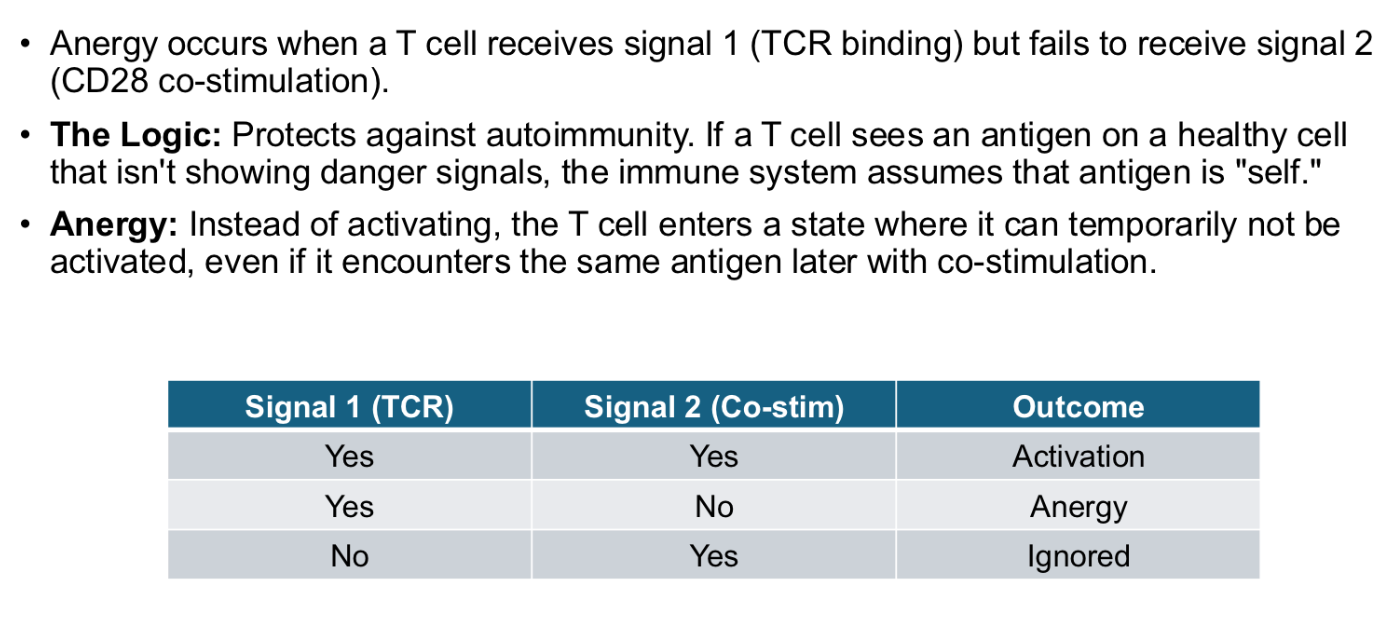
Anergy

a state of immune system unresponsiveness where lymphocytes, particularly T cells, become functionally inactive upon encountering an antigen without necessary co-stimulatory signals. (even self-antigen stimuli)
<p><span><span>a state of immune system unresponsiveness where lymphocytes, particularly T cells, become functionally inactive upon encountering an antigen without necessary co-stimulatory signals.</span></span> (even self-antigen stimuli)</p>
41
New cards

functionally immature

B cells exported from the BM are ___

42
New cards

Transitional

  • screening

T1 and T2 subsets of immune responses (these are NOT T cells!)

  • T = _

  • Differ in gene expression as they progress through the spleen for further maturation.

  • The T1 subset is still undergoing _, possessing the possibility of a negative selection event.

  • This outcome is lost as the cells transition to T2 stage

43
New cards

  • AIRE

T cells originate from the bone marrow and undergo positive and negative selection in the thymus

  • Medullary thymic epithelial cells (mTECs) produce __

  • Result are CD4+ T cells and CD8+ T cells

44
New cards

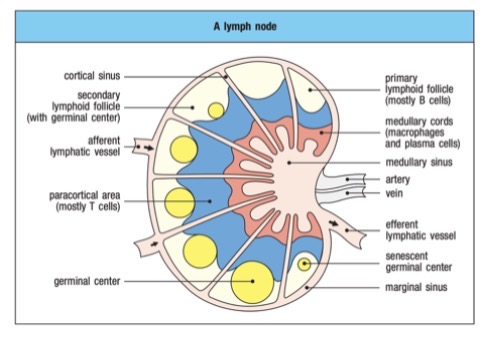
secondary lymphoid tissues

Mature T cells circulate between thenblood and lymphatic system and reside within __

• E.g. spleen and lymph nodes
<p>Mature T cells circulate between thenblood and lymphatic system and reside within __</p><p>• E.g. spleen and lymph nodes</p>
45
New cards

lymph nodes

Fill in blank

<p>Fill in blank</p>
46
New cards
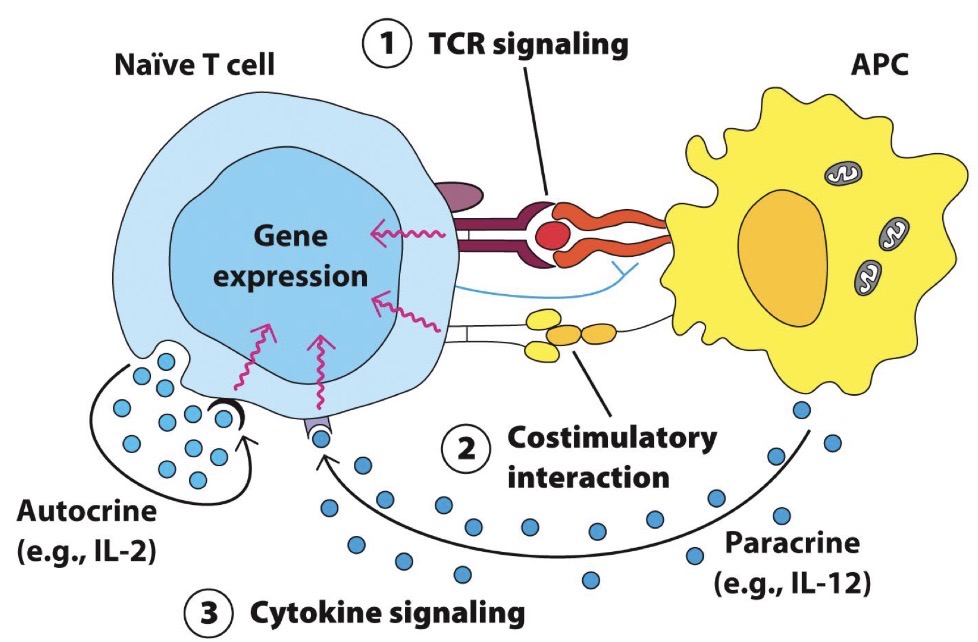
  1. TCR recognition of antigen-MHC

  2. Contact with costimulatory ligands

  3. Cytokines directing T cell differentiation into distinct effector cell types

T cell activation is mediated by three signals:
<p>T cell activation is mediated by three signals:</p><ol><li><p></p></li><li><p></p></li><li><p></p></li></ol><p></p>
47
New cards
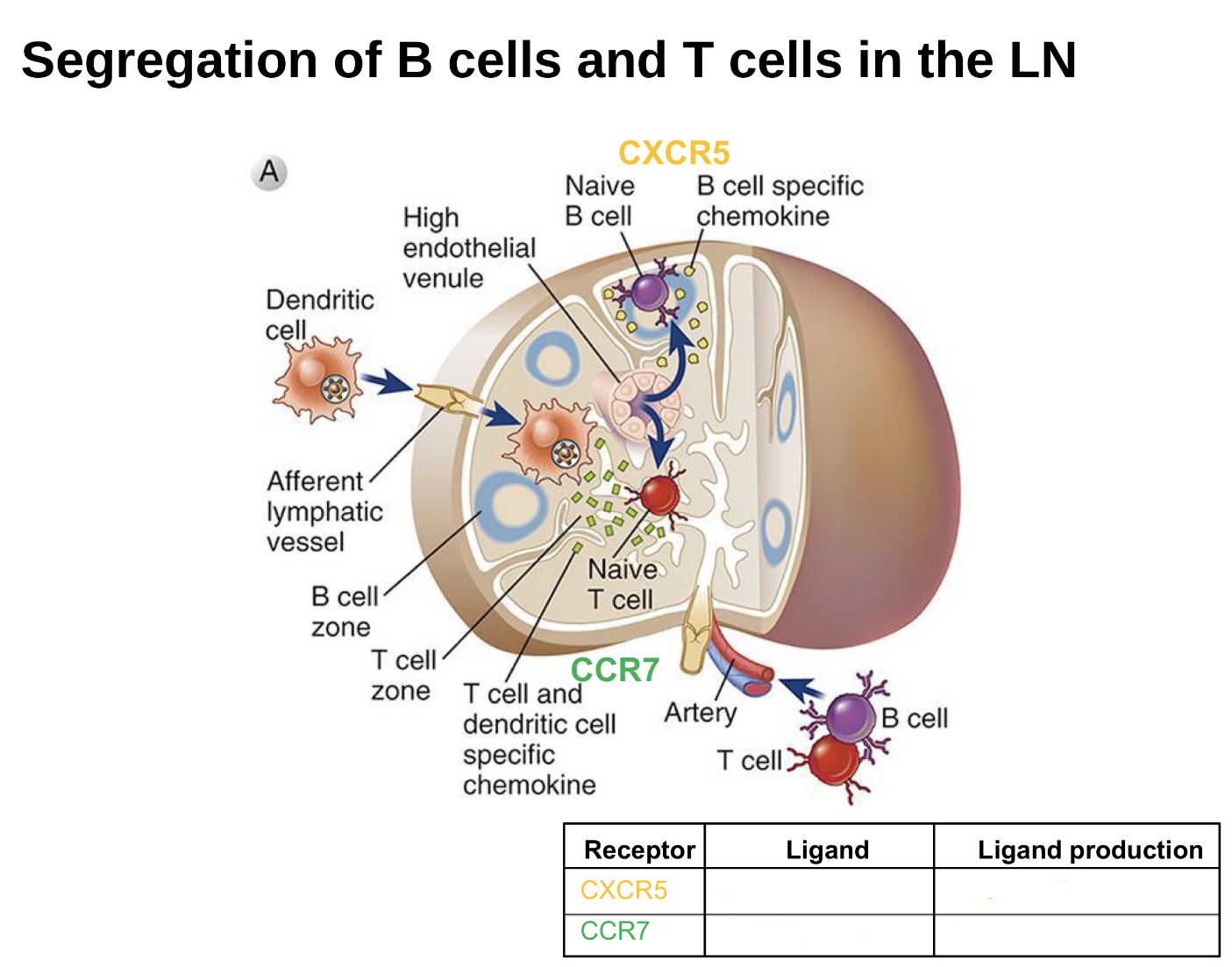
  • CXCL13 ; B-cell follicles

  • CCL19, CCL21 ; T-cell zone

Fill in table blanks
<p>Fill in table blanks</p>
48
New cards
  • innate

  • overreaction

  • danger

Why does a purified antigen not evoke immune response, only with adjuvent it does?

  • immune system doesn’t just react to “foreignness.”
    It reacts to foreignness plus danger signals.

  • Immune system (esp. DCs) needs _ immune activation signals (called PAMPs or DAMPs) to fully switch on.

  • The body constantly encounters harmless proteins (food, self proteins, environmental particles). To avoid _, the immune system is set to default tolerance unless danger is detected.

  • Adjuvant solves this problem by mimicking _.

49
New cards
  • peptide-MHC complex ; APC

  • APC ; TCR
    CD28

    ANERGIC

  • APC ; Th1, Th2, Th17

T cell activation is mediated by three signals:

  1. TCR recognition of antigen-MHC.
    TCR binds to _ on _.
    Ensures only T cells specific to particular pathogen are activated.
    CD4/CD8 coreceptors stabilize TCR-MHC interaction.

  2. Contact with costimulatory ligands.
    Interaction btwn costimulatory molecules on _ and _.
    _ on T cell binds to CD80 or CD86 on APC.
    Promotes T cell survival, prolif, and IL-2 prod.

    IF SIGNAL 1 OCCURS WITHOUT SIGNAL 2, THE T CELL BECOMES _.

  3. Cytokines directing T cell differentiation into distinct effector cell types.
    Cytokines released by _ and surrounding environment bind to TCR. Directs differentiation of T cells into specific effector subsets (ex. ___) and promotes rapid expansion.
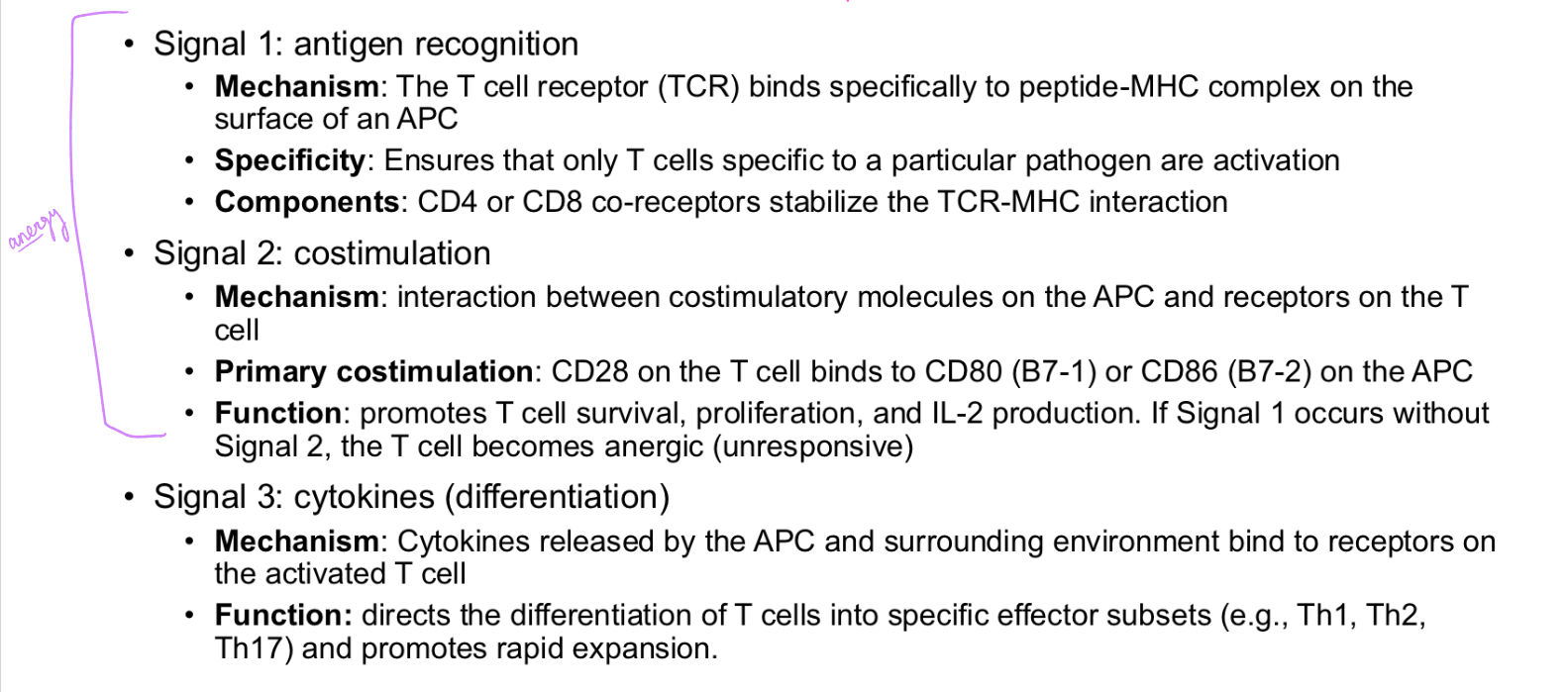
<p>T cell activation is mediated by three signals:</p><ol><li><p><strong>TCR recognition of antigen-MHC.</strong><br>TCR binds to _ on _.<br>Ensures only T cells specific to particular pathogen are activated.<br>CD4/CD8 coreceptors stabilize TCR-MHC interaction.<br></p></li><li><p><strong>Contact with costimulatory ligands.</strong><br>Interaction btwn costimulatory molecules on _ and _.<br>_ on T cell binds to CD80 or CD86 on APC.<br>Promotes T cell survival, prolif, and IL-2 prod.<br><br>IF SIGNAL 1 OCCURS WITHOUT SIGNAL 2, THE T CELL BECOMES _.<br></p></li><li><p><strong>Cytokines directing T cell differentiation into distinct effector cell types.</strong><br>Cytokines released by _ and surrounding environment bind to TCR. Directs differentiation of T cells into specific effector subsets (ex. ___) and promotes rapid expansion.</p></li></ol><p></p>
50
New cards

cSMAC (central supramolecular activating complex)

__

  • TCR/MHC-peptide and co-receptor complex.

  • Costimulatory molecules.

  • Adhesion molecules/bound ligands peripherally localize.
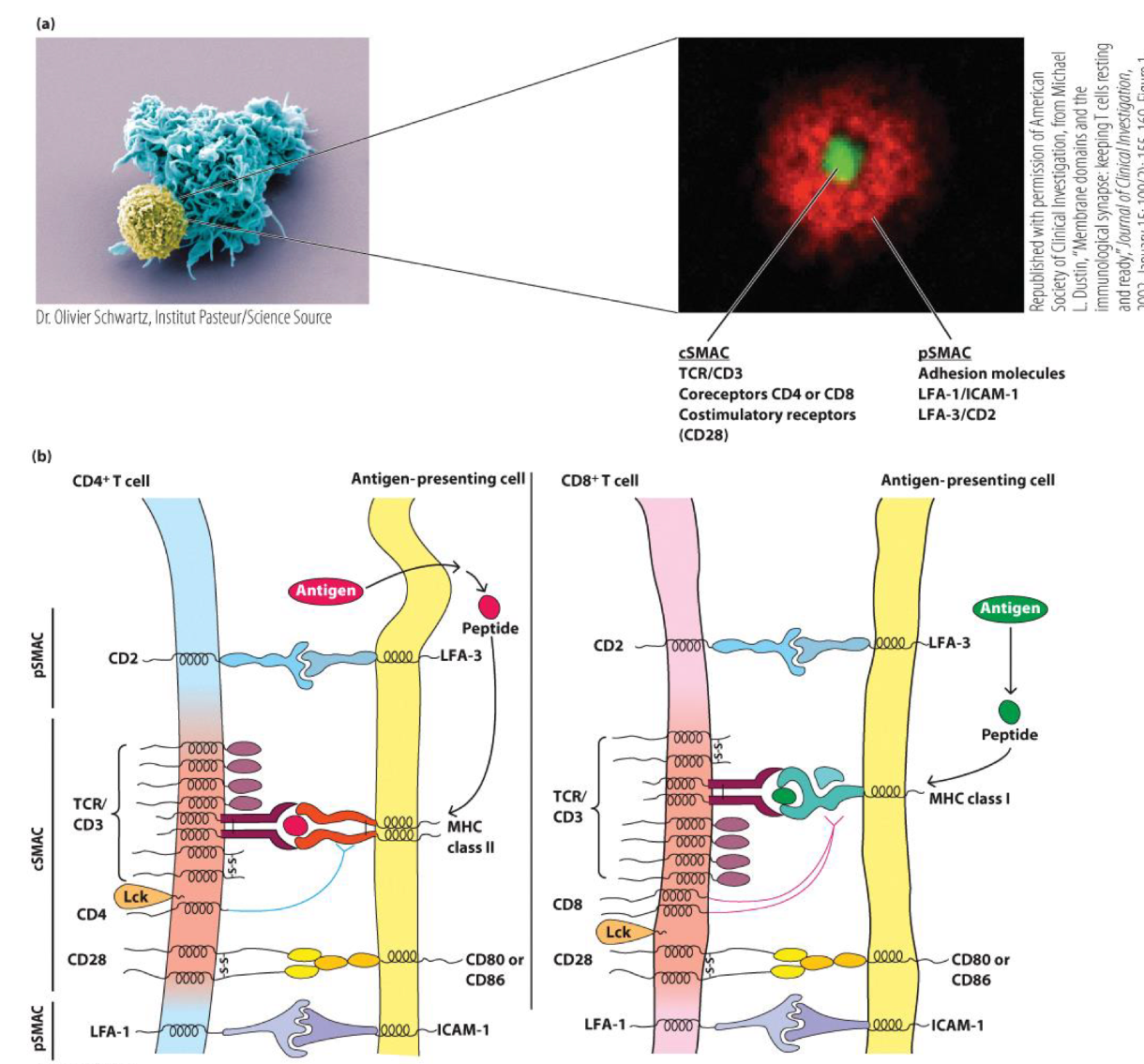
<p>__</p><ul><li><p>TCR/MHC-peptide and co-receptor complex.</p></li><li><p>Costimulatory molecules.</p></li><li><p>Adhesion molecules/bound ligands peripherally localize.</p></li></ul><p></p>
51
New cards

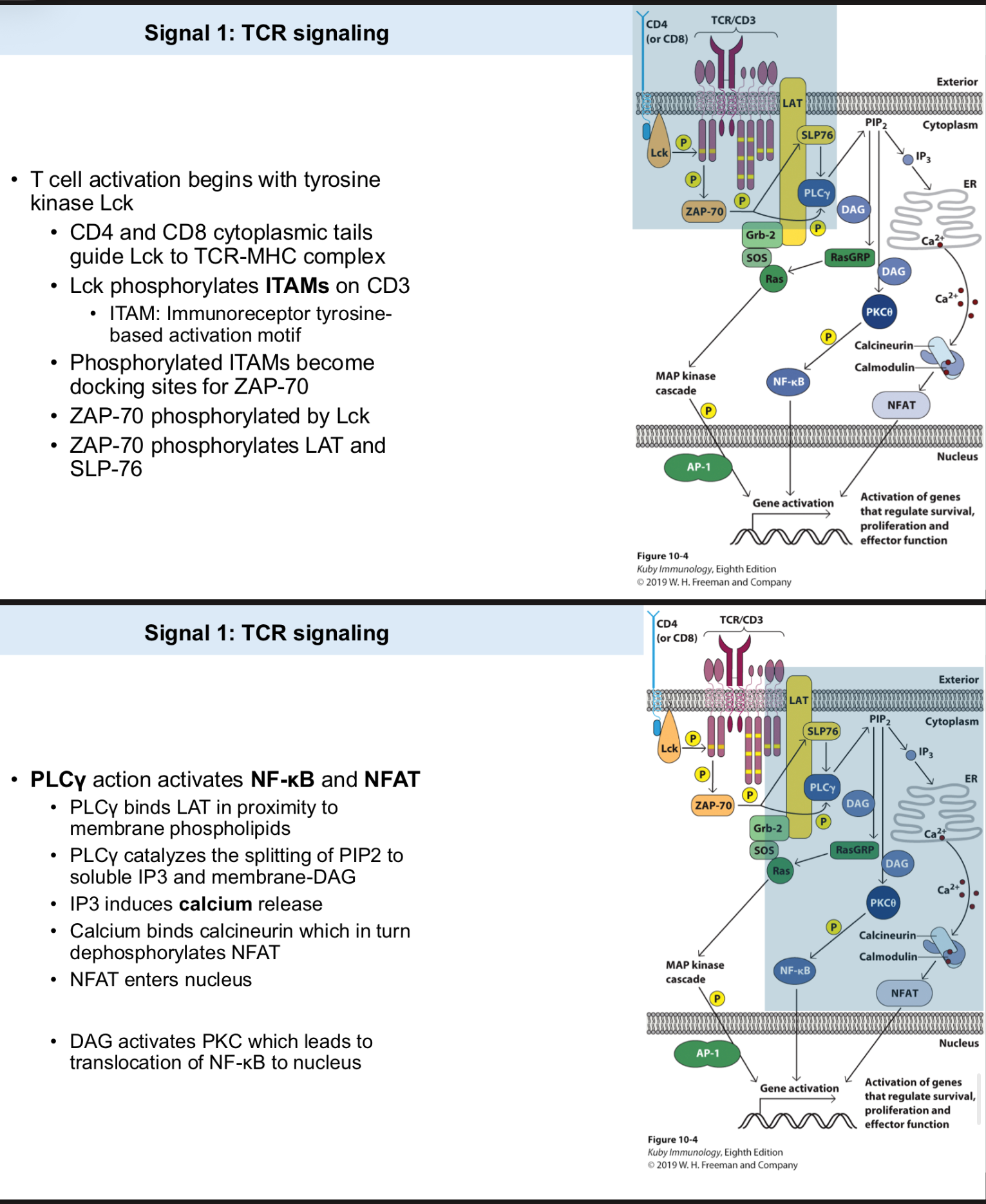
Lck

  • TCR-MHC

  • CD3

  • ZAP-70

  • LAT

  • PLCy

T cell activation begins with tyrosine kinase _

  • CD4 and CD8 cytoplasmic tails guide Lck to _ complex.

  • Lck phosphorylates ITAMs on _.

    • ITAM: Immunoreceptor tyrosine-based activation motif.

  • Phosphorylated ITAMs become docking sites for _.

  • ZAP-70 phosphorylated by Lck.

  • ZAP-70 phosphorylates _ and SLP-76.

  • _ action activates NF-kB and NFAT

    • PLCy binds LAT in proximity to membrane phospholipids.

    • PLCy catalyzes the splitting of PIP2 —> IP3 and membrane-DAG

    • IP3 —> Ca2+ release

    • Calcium binds calcineurin —> dephosphorylates NFAT

    • NFAT enters nucleus

    • DAG activates PKC —> translocation of NF-kB to nucleus

  • RAS-ERK signaling & activation of AP-1 transcription factor.

    • Ras pathway triggers MAPK activation

    • MAPK cascade phosphorylates in sequence, RAF, MEK, ERK

    • ERK activates AP-1

<p>T cell activation begins with tyrosine kinase _</p><ul><li><p>CD4 and CD8 cytoplasmic tails guide Lck to _ complex.</p></li><li><p>Lck phosphorylates ITAMs on _.</p><ul><li><p><sup>ITAM: Immunoreceptor tyrosine-based activation motif.</sup></p></li></ul></li></ul><ul><li><p>Phosphorylated ITAMs become docking sites for _.</p></li><li><p>ZAP-70 phosphorylated by Lck.</p></li><li><p>ZAP-70 phosphorylates _ and SLP-76.</p></li><li><p>_ action activates NF-kB and NFAT</p><ul><li><p><sup>PLCy binds LAT in proximity to membrane phospholipids.</sup></p></li><li><p><sup>PLCy catalyzes the splitting of PIP2 —&gt; IP3 and membrane-DAG</sup></p></li><li><p><sup>IP3 —&gt; Ca2+ release</sup></p></li><li><p><sup>Calcium binds calcineurin —&gt; dephosphorylates NFAT</sup></p></li><li><p><sup>NFAT enters nucleus</sup></p></li><li><p><sup>DAG activates PKC —&gt; translocation of NF-kB to nucleus</sup></p></li></ul></li><li><p>RAS-ERK signaling &amp; activation of AP-1 transcription factor.</p><ul><li><p><sub>Ras pathway triggers MAPK activation</sub></p></li><li><p><sub>MAPK cascade phosphorylates in sequence, RAF, MEK, ERK</sub></p></li><li><p><sub>ERK activates AP-1</sub></p></li></ul></li></ul><p></p>
52
New cards
  • IL-2 ; IL-2R

  • T cell

• TCR activation leads to transcription of the cytokine _ as well as its high affinity receptor _ (CD25).

• Autocrine and paracrine signaling.

• IL-2 signaling is necessary for _ proliferation.
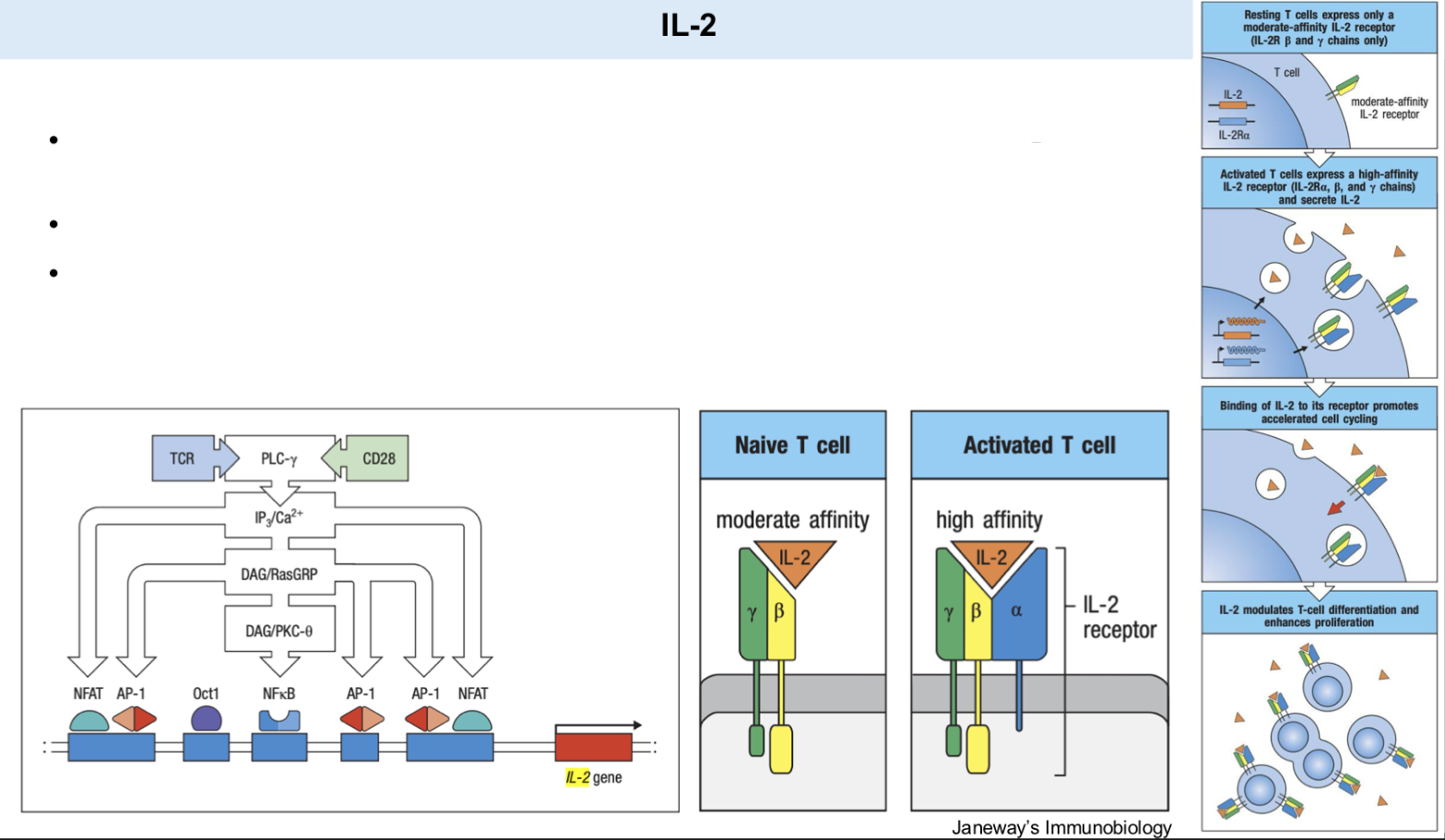
<p>• TCR activation leads to transcription of the cytokine _ as well as its high affinity receptor _ (CD25).</p><p>• Autocrine and paracrine signaling.</p><p>• IL-2 signaling is necessary for _ proliferation.</p>
53
New cards

Costimulatory

__ signals are required for T cell activation and proliferation.

  • Signal 1 gives the cell a target.
    (TCR + MHC)

  • Signal 2 gives the context that APC has detected danger.
    (CD28 on T cell + CD80/86 on APC)
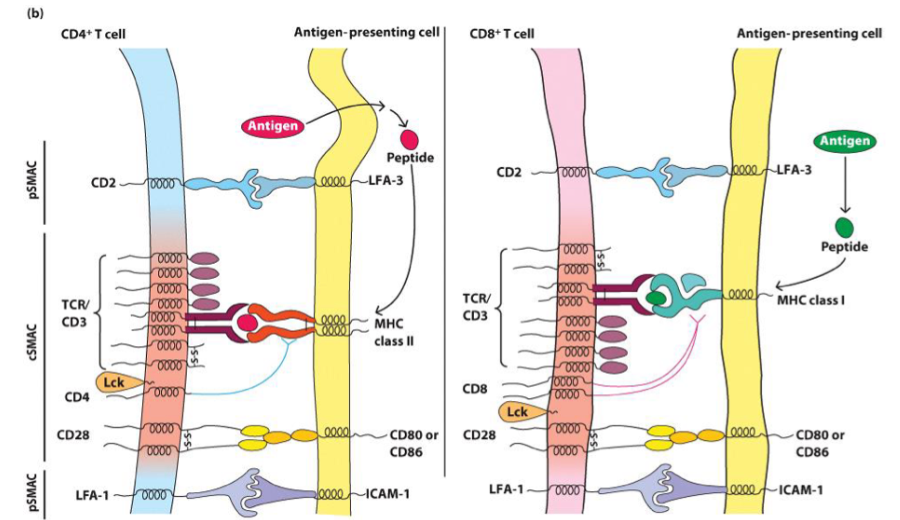
<p>__ signals are required for T cell activation and proliferation.</p><ul><li><p>Signal 1 gives the cell a target.<br><sup>(TCR + MHC)</sup><br></p></li><li><p>Signal 2 gives the context that APC has detected danger.<br><sup>(CD28 on T cell + CD80/86 on APC)</sup></p></li></ul><p></p>
54
New cards
  • CD28

  • CTLA-4, PD-1, BTLA

Costimulatory signals are required for T cell activation and proliferation.

  • Positive costim. receptors —> activation
    Example(s): _

  • Negative costim. receptors —> OFF
    Example(s):
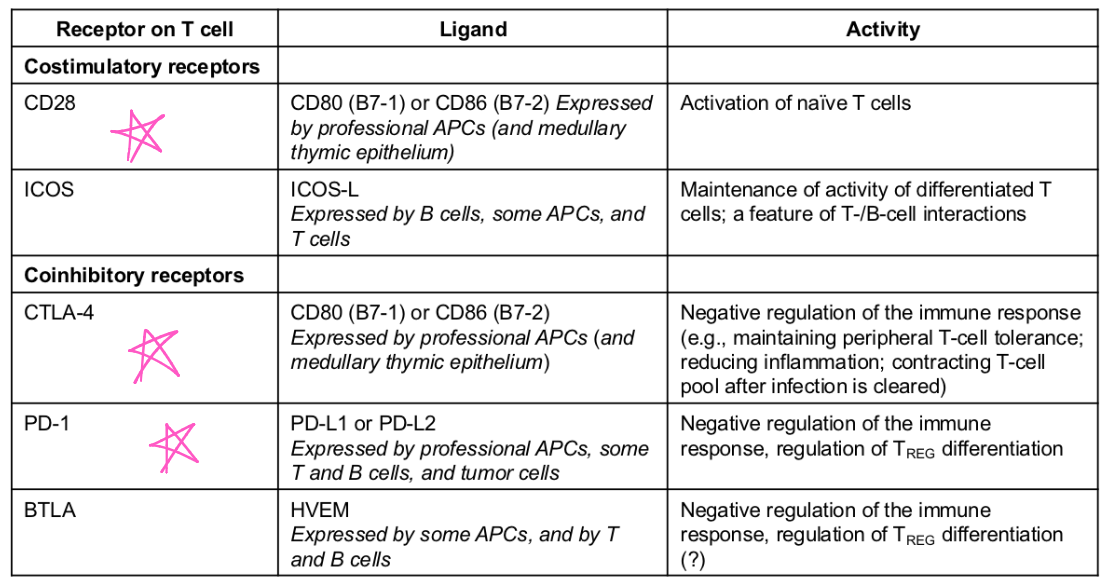
<p>Costimulatory signals are required for T cell activation and proliferation.</p><ul><li><p>Positive costim. receptors —&gt; activation<br>Example(s): _<br></p></li><li><p>Negative costim. receptors —&gt; OFF<br>Example(s): </p></li></ul><p></p>
55
New cards
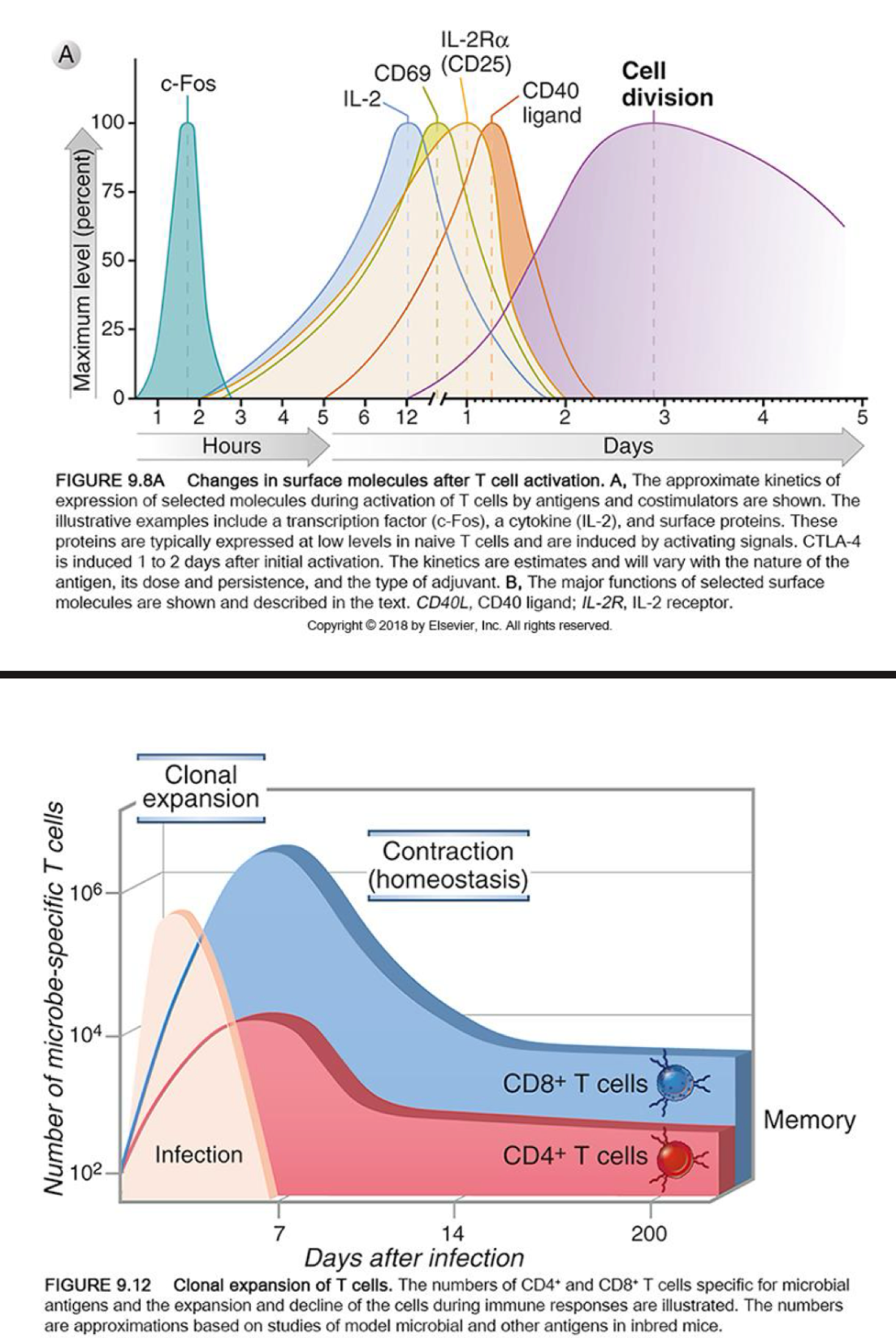
  • prosurvival

  • IL-2 and IL-2R

  • clonal cells

Clonal Expansion

  • Initial activation signals 1 and 2 induce

    • Upregulation of _ genes, e.g., Bcl-2.

  • Transcription of _ and _ genes

    • Autocrine and paracrine signaling.

    • Potent cytokine and growth factor crucial for the proliferation, survival, and differentiation of T cells

  • Outcome is activation and robust proliferation.

  • Production of memory cells and effector _.
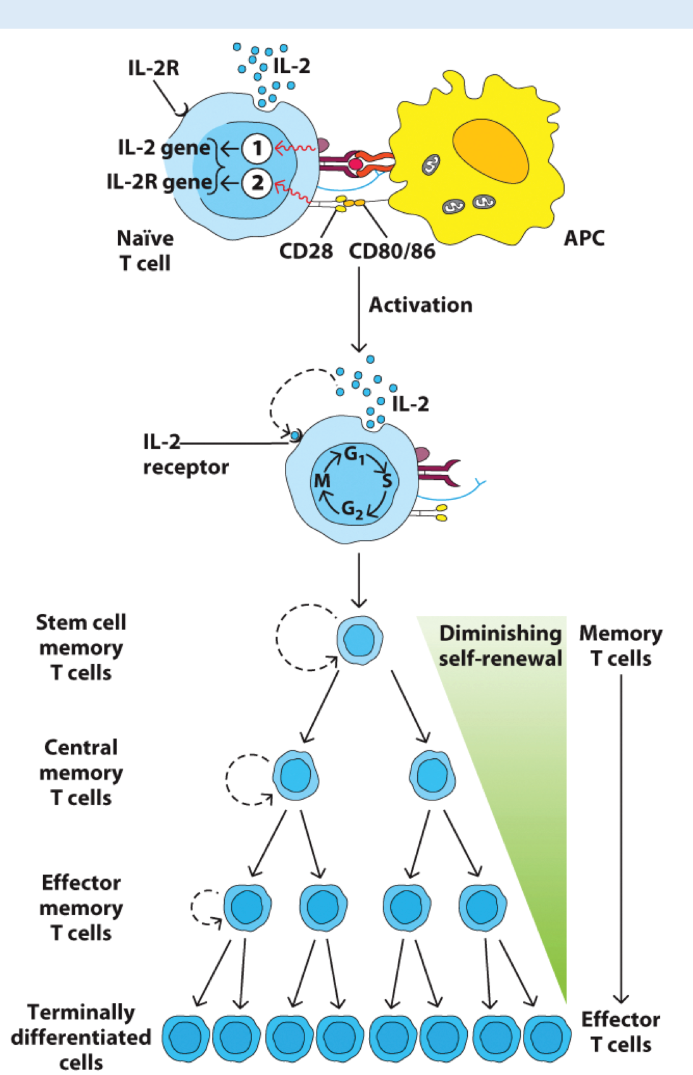
<p><strong>Clonal Expansion</strong></p><ul><li><p>Initial activation signals 1 and 2 induce</p><ul><li><p>Upregulation of _ genes, e.g., Bcl-2.</p></li></ul></li><li><p>Transcription of _ and _ genes</p><ul><li><p>Autocrine and paracrine signaling.</p></li><li><p>Potent cytokine and growth factor crucial for the proliferation, survival, and differentiation of T cells</p></li></ul></li></ul><ul><li><p>Outcome is activation and robust proliferation.</p></li><li><p>Production of memory cells and effector _.</p></li></ul><p></p>
56
New cards

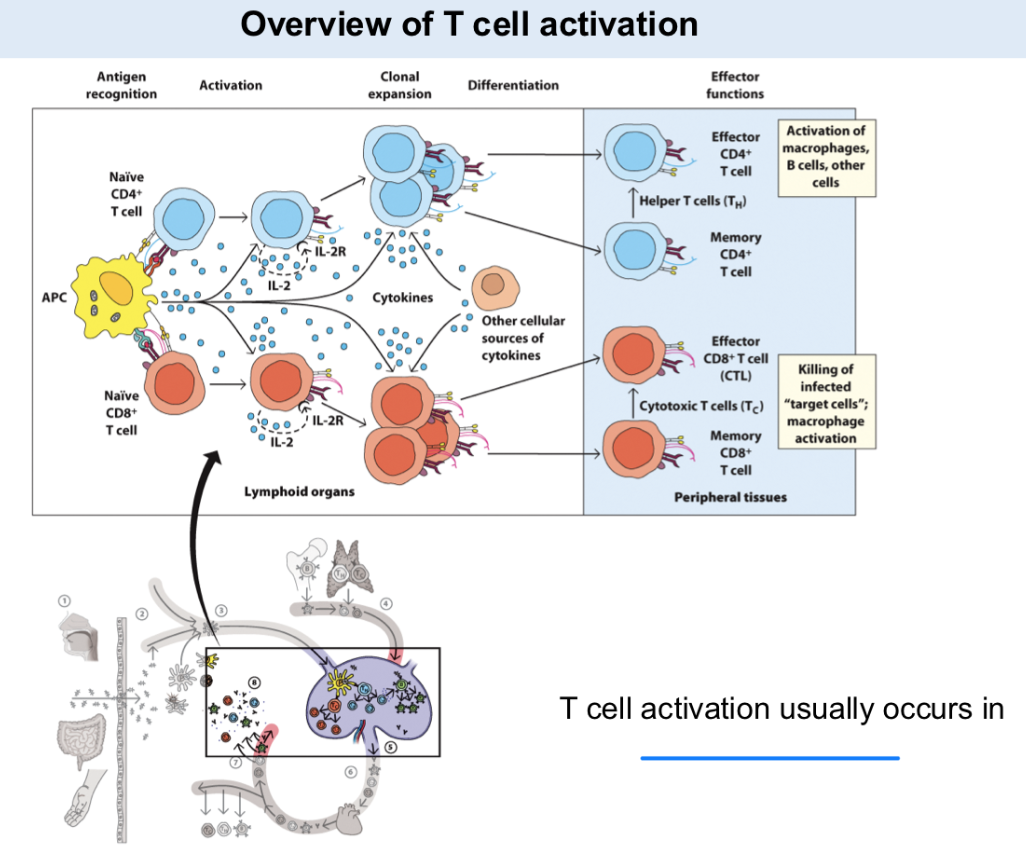
T cell

Timeframe of _ activation

<p>Timeframe of _ activation</p>
57
New cards

Superantigen

  • outside

a type of microbial protein (usually from bacteria or viruses) that causes an abnormally large and nonspecific activation of T cells, leading to an intense and potentially dangerous immune response.

  • Binds directly to MHC class II
    (_ the normal peptide-binding groove)
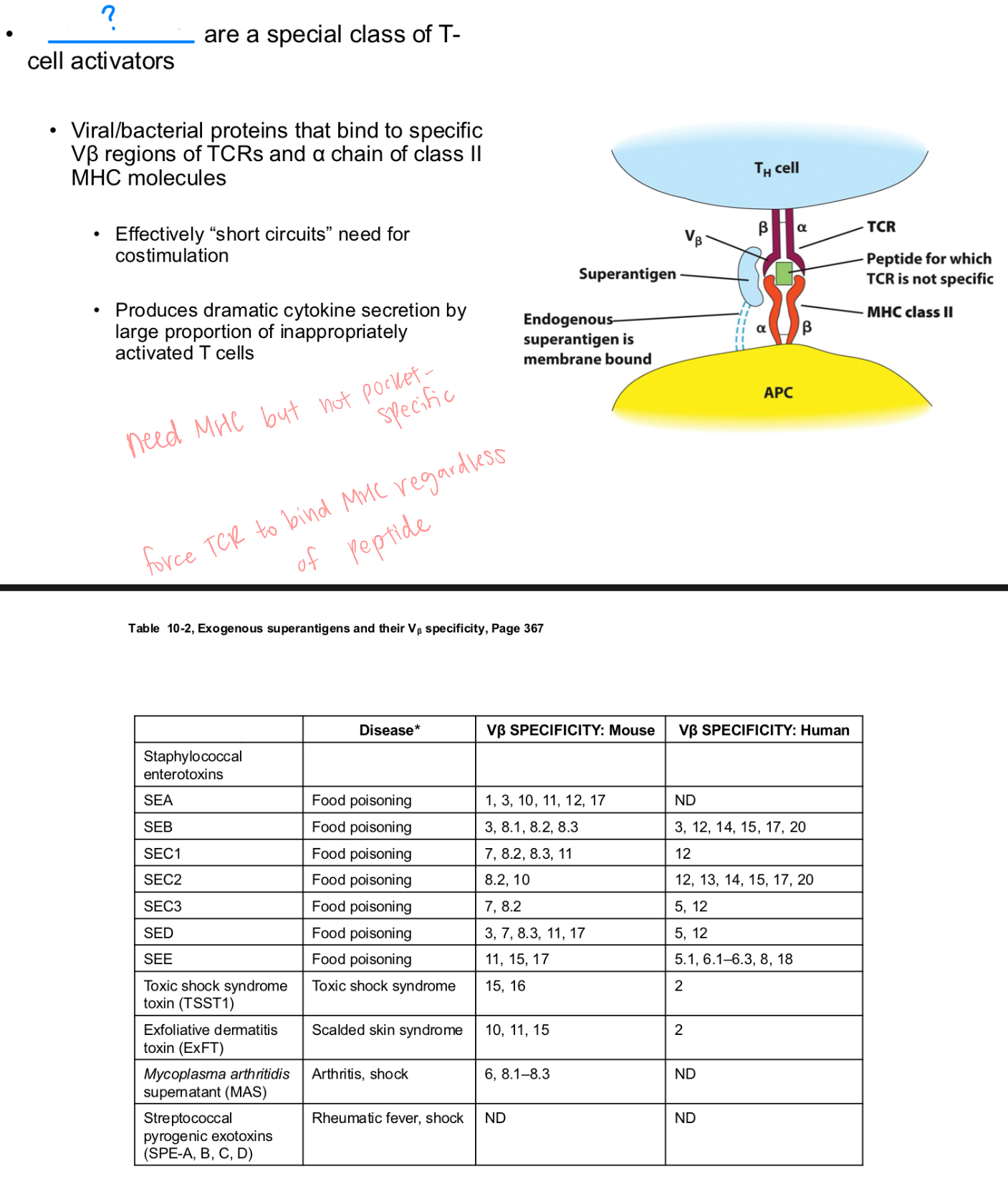
<p>a type of microbial protein (usually from bacteria or viruses) that causes an abnormally large and nonspecific activation of T cells, leading to an intense and potentially dangerous immune response.</p><ul><li><p>Binds directly to MHC class II <br>(_ the normal peptide-binding groove)</p></li></ul><p></p>
58
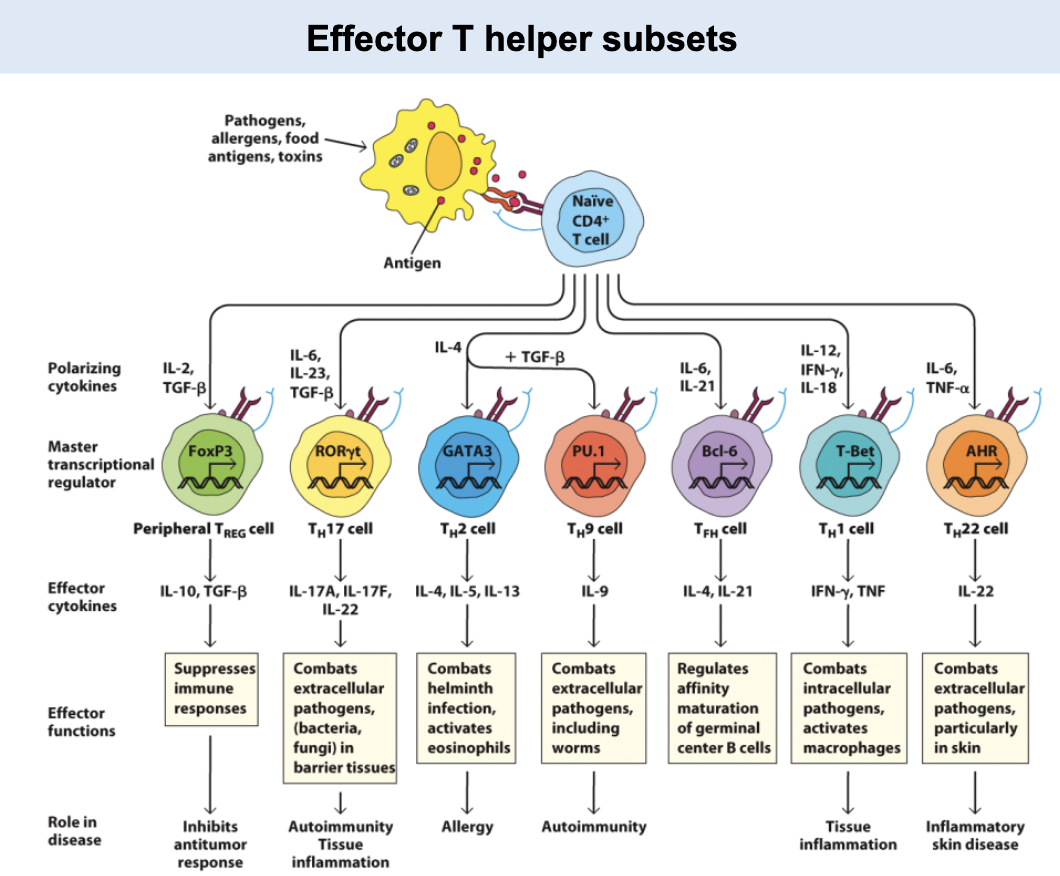
New cards
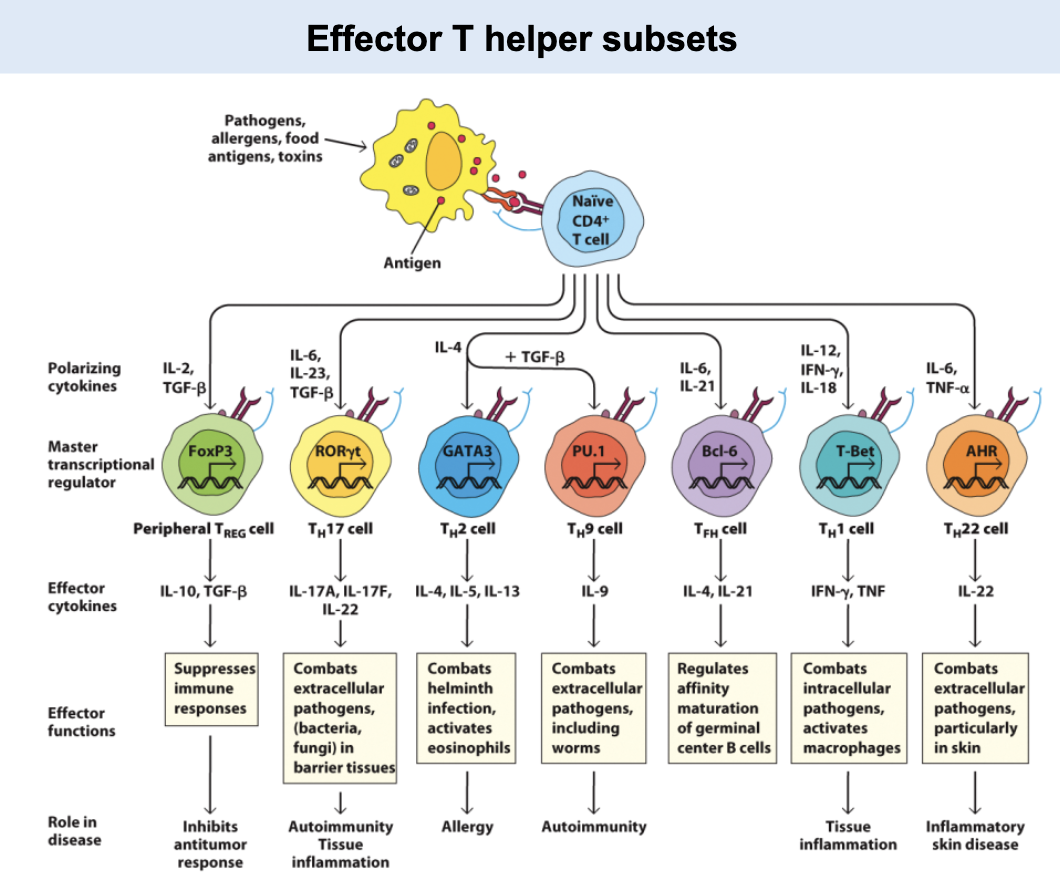
<p>Effector T helper </p>

Effector T helper

_ subsets are distinguished by these properties:

  1. Distinct polarizing cytokine set that induces expression of a master gene regulator.

  2. A signature set of effector cytokines produced by that subset.
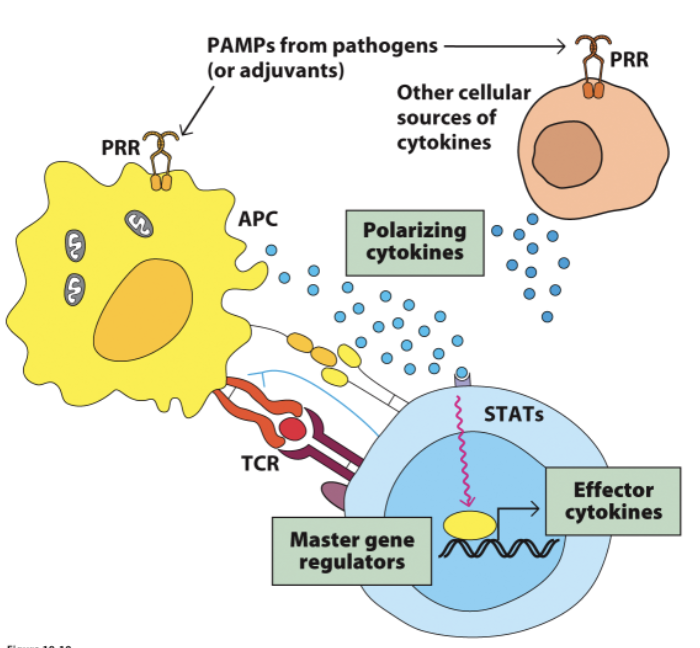
<p>_ subsets are distinguished by these properties:</p><ol><li><p>Distinct polarizing cytokine set that induces expression of a master gene regulator.</p></li><li><p>A signature set of effector cytokines produced by that subset.</p></li></ol><p></p>
59
New cards
  • TH1

  • TH2

  • TH17

  • TREGs

  • TFH

Helper T cells can be divided into at least five distinct subsets

  • _ regulate immunity to intracellular bacteria and viruses.

  • _ regulate immunity to parasites.

  • _ regulate immunity to extracellular bacteria and fungi.

  • _ are inhibitory in terminating immune responses and inhibiting autoimmunity.

  • _ regulate humoral immunity (B cells).
<p><strong>Helper T cells can be divided into at least five distinct subsets</strong></p><ul><li><p>_ regulate immunity to intracellular bacteria and viruses.</p></li><li><p>_ regulate immunity to parasites.</p></li><li><p>_ regulate immunity to extracellular bacteria and fungi.</p></li><li><p>_ are inhibitory in terminating immune responses and inhibiting autoimmunity.</p></li><li><p>_ regulate humoral immunity (B cells).</p></li></ul><p></p>
60
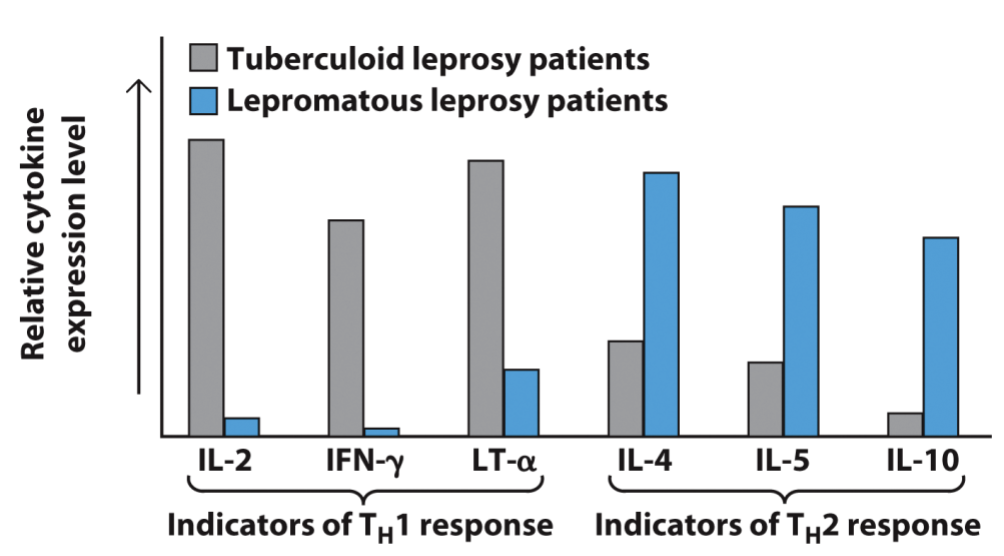
New cards

TH2

TH1 and _ response/ indicators

<p>TH1 and _ response/ indicators</p>
61
New cards
  1. antigen clearance

  2. IL-2

  3. apoptosis signaling

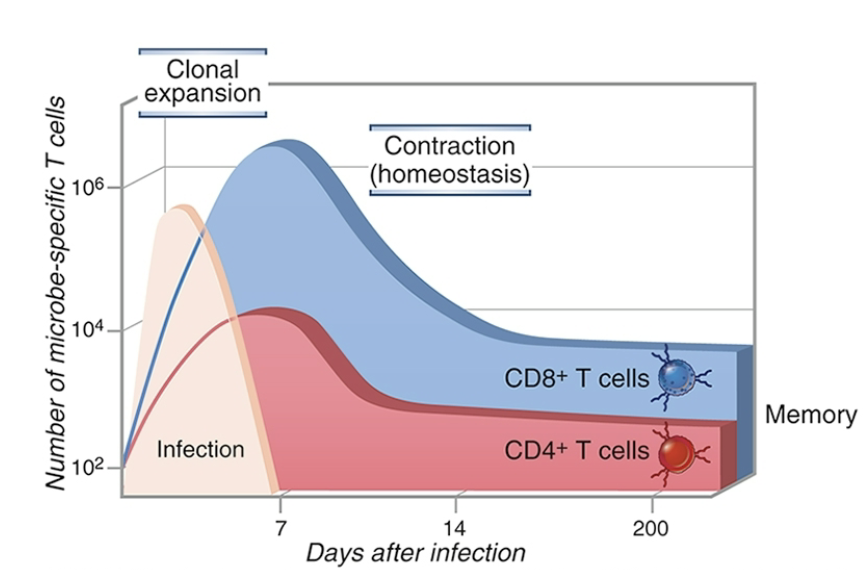
T cell contraction is the phase after an immune response where 90-95% of effector T cells die by apoptosis, leaving a

small, stable population of memory cells.

It is primarily mediated by…

  1. _ (withdrawal of stimulating signals).

  2. diminished _ availability

  3. __ __ via Bim and Fas-FasL interactions
<p>T cell contraction is the phase after an immune response where 90-95% of effector T cells die by apoptosis, leaving a</p><p>small, stable population of memory cells.</p><p>It is primarily mediated by…</p><ol><li><p>_ (withdrawal of stimulating signals).</p></li><li><p>diminished _ availability</p></li><li><p>__ __ via Bim and Fas-FasL interactions</p></li></ol><p></p>
62
New cards

Memory T cells

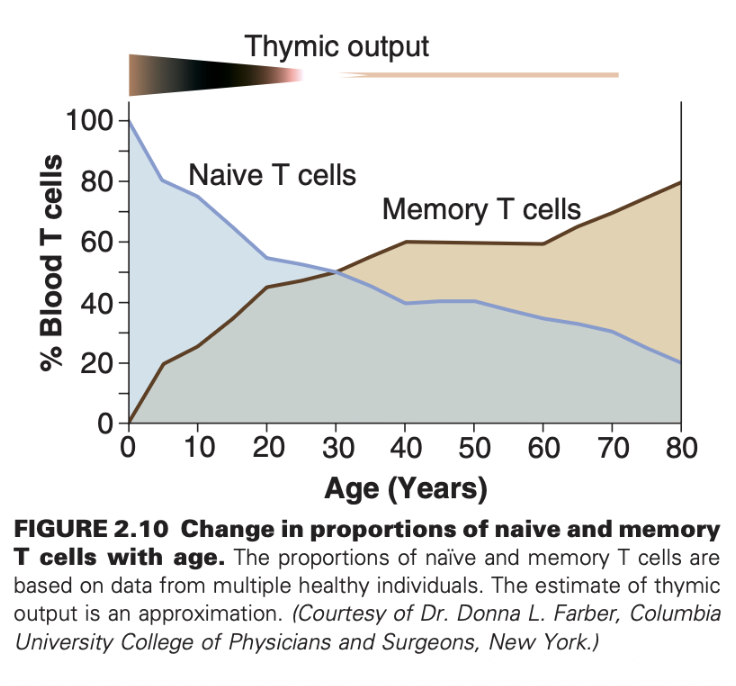
Definition: Long-lived, previously activated T cells that provide rapid, enhanced protection against pathogens from initial infection or

vaccination.

  • Persistence: They reside in lymphoid and peripheral tissues, self-renewing for life without constant antigen stimulation.

  • Rapid Response: Upon re-encountering an antigen, they quickly produce high numbers of effector cells, minimizing the immune response lag time.
<p>Definition: Long-lived, previously activated T cells that provide rapid, enhanced protection against pathogens from initial infection or</p><p>vaccination.</p><ul><li><p>Persistence: They reside in lymphoid and peripheral tissues, self-renewing for life without constant antigen stimulation.</p></li><li><p>Rapid Response: Upon re-encountering an antigen, they quickly produce high numbers of effector cells, minimizing the immune response lag time.</p></li></ul><p></p>
63
New cards
  • TEM (effector memory T cells)

  • TRM (permanent residents of previously infected tissue )

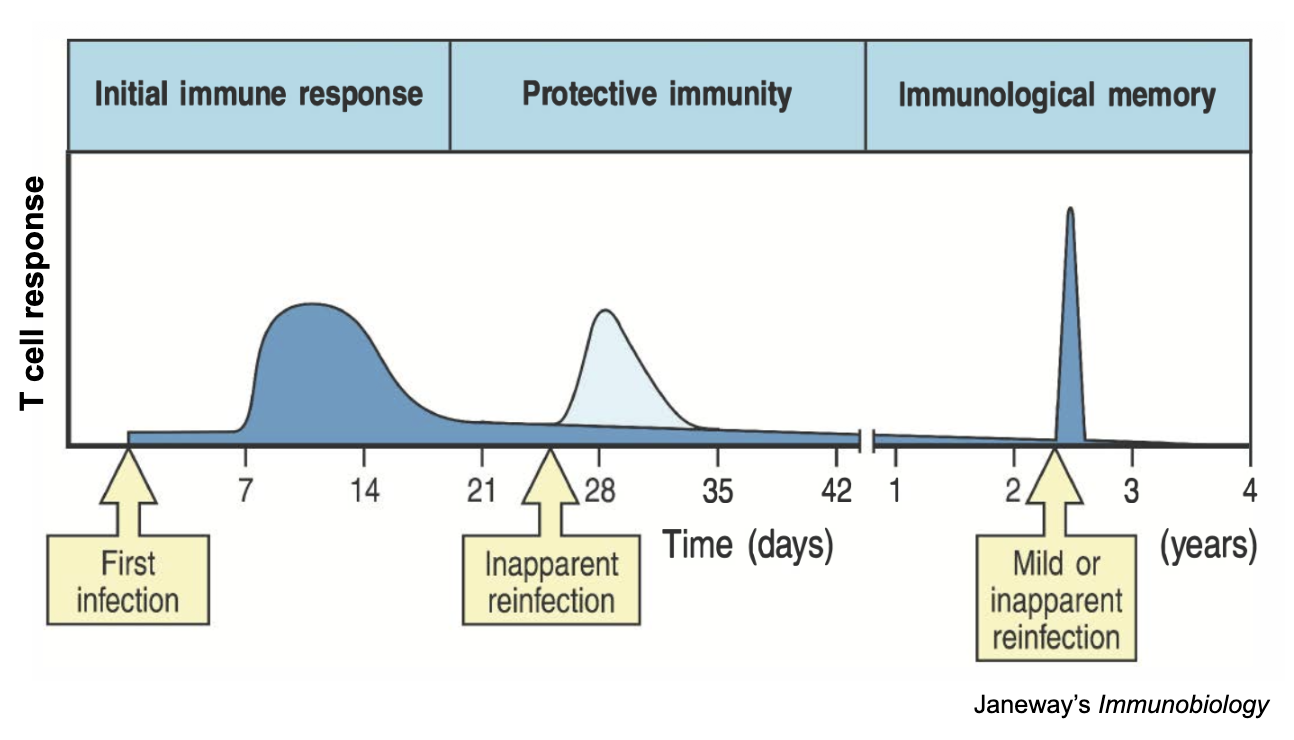
Memory T cells are distinguished by their location and commitment to effector function

  • They circulate in the blood and non-lymphoid tissues. They are ready to act immediately, providing quick protection by killing infected cells or releasing signals to help other immune cells.

  • They do not circulate. Instead, they stay behind in specific barrier tissues (like skin, lungs, or gut) where the original infection occurred, providing immediate, localized protection against reentry.
<p><strong>Memory T cells are distinguished by their location and commitment to effector function</strong></p><ul><li><p>They circulate in the blood and non-lymphoid tissues. They are ready to act immediately, providing quick protection by killing infected cells or releasing signals to help other immune cells.<br></p></li><li><p>They do not circulate. Instead, they stay behind in specific barrier tissues (like skin, lungs, or gut) where the original infection occurred, providing immediate, localized protection against reentry.</p></li></ul><p></p>
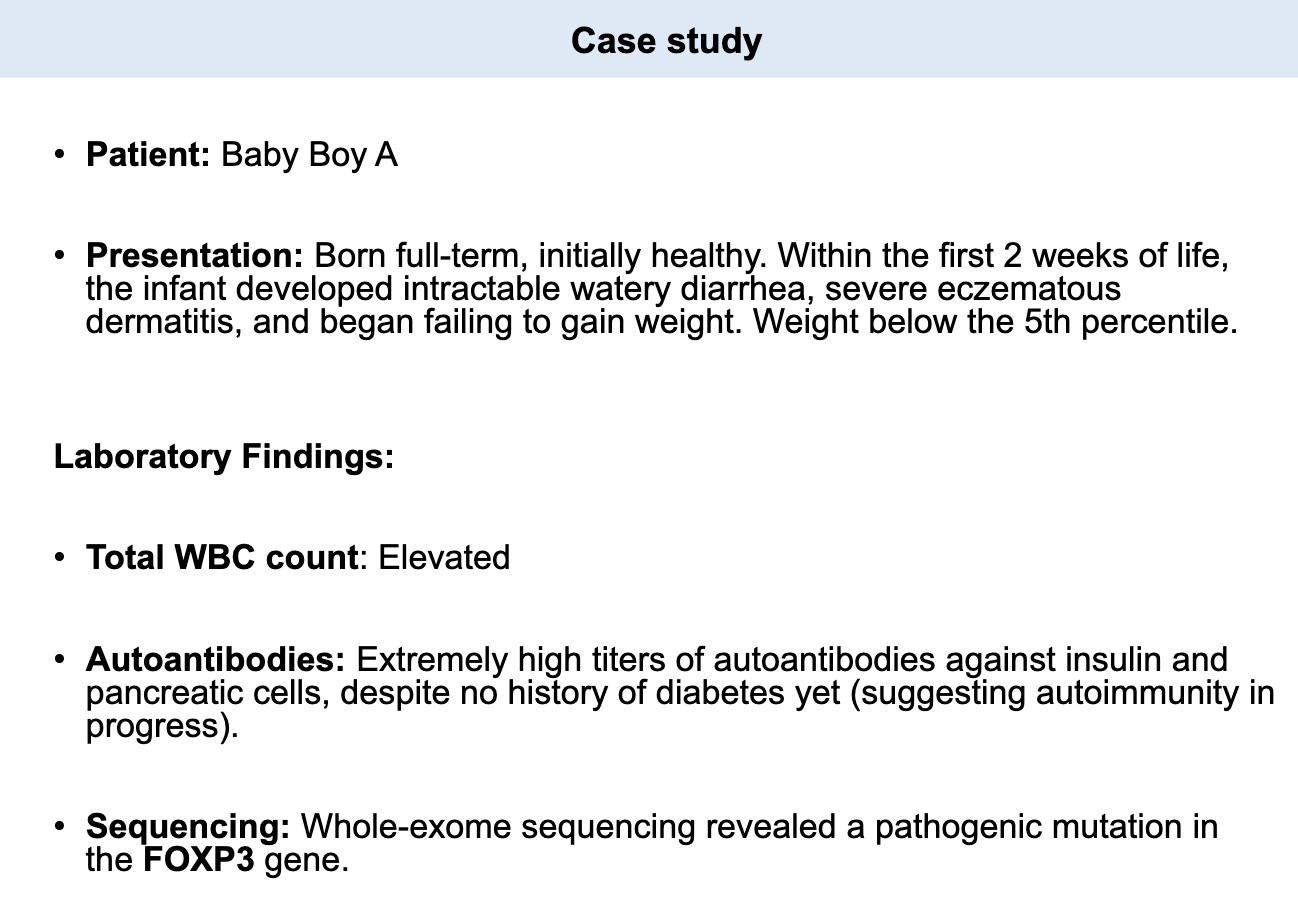
64
New cards

no reg T cells

Read case study

<p>Read case study</p>
65
New cards

Central tolerance

deletion of autoreactive T cells (lymphocytes) during maturation/before they mature
<p>deletion of autoreactive T cells (lymphocytes) during maturation/before they mature  </p>
66
New cards

Peripheral tolerance

occurs when mature lymphocytes that escaped central deletion are suppressed ; active generation of inhibitory lymphocytes
<p>occurs when mature lymphocytes that escaped central deletion are suppressed ; active generation of inhibitory lymphocytes</p>
67
New cards

Failure of tolerance

Immune system attacks healthy tissues or benign entities, resulting in disease

68
New cards

TREG

_ cells negatively regulate immune responses:

  • Belong to a subset of CD4 T cells characterized by the expression of Foxp3 transcription factor

  • Function to:

    • Deplete the local area of stimulating cytokines

    • Produce inhibiting cytokines

    • Inhibits the activity of APCs, T cells, etc
<p>_ cells negatively regulate immune responses:</p><ul><li><p>Belong to a subset of CD4 T cells characterized by the expression of Foxp3 transcription factor</p></li><li><p>Function to:</p><ul><li><p>Deplete the local area of stimulating cytokines</p></li><li><p>Produce inhibiting cytokines</p></li><li><p>Inhibits the activity of APCs, T cells, etc</p></li></ul></li></ul><p></p>
69
New cards

tTREG

Type of TREG:

  • Can be generated in the thymus (_ cells) in response to high affinity to self-peptide

  • Still engage Ag-MHC class II complexes through TCR , Downregulate responses when they do so
<p>Type of T<sub>REG<sup>:</sup></sub></p><ul><li><p>Can be generated in the thymus (_ cells) in response to high affinity to self-peptide</p></li><li><p>Still engage Ag-MHC class II complexes through TCR , Downregulate responses when they do so</p></li></ul><p></p>
70
New cards

pTREG

Type of TREG:

  • Can also be generated in the periphery following Ag induction (_ cells) in the presence of retinoic acid, TGFβ, and IL-2

  • Still engage Ag-MHC class II complexes through TCR, Downregulate responses when they do so
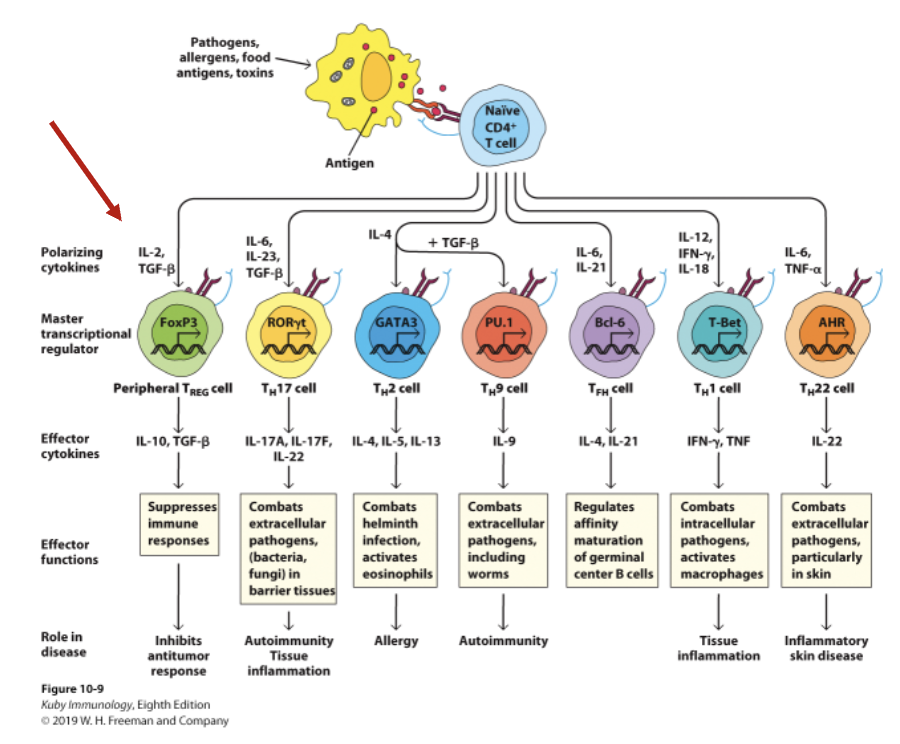
<p>Type of T<sub>REG<sup>:</sup></sub></p><ul><li><p>Can also be generated in the periphery following Ag induction (_ cells) in the presence of retinoic acid, TGFβ, and IL-2</p></li><li><p>Still engage Ag-MHC class II complexes through TCR, Downregulate responses when they do so</p></li></ul><p></p>
71
New cards
  • IL-2 receptor (CD25)

  • Tregs constitutively express the high-affinity _, allowing them to consume local IL-2 and deprive other T cells, preventing their activation

  • In comparison, other T cells inducibly express the high-affinity IL-2 receptor
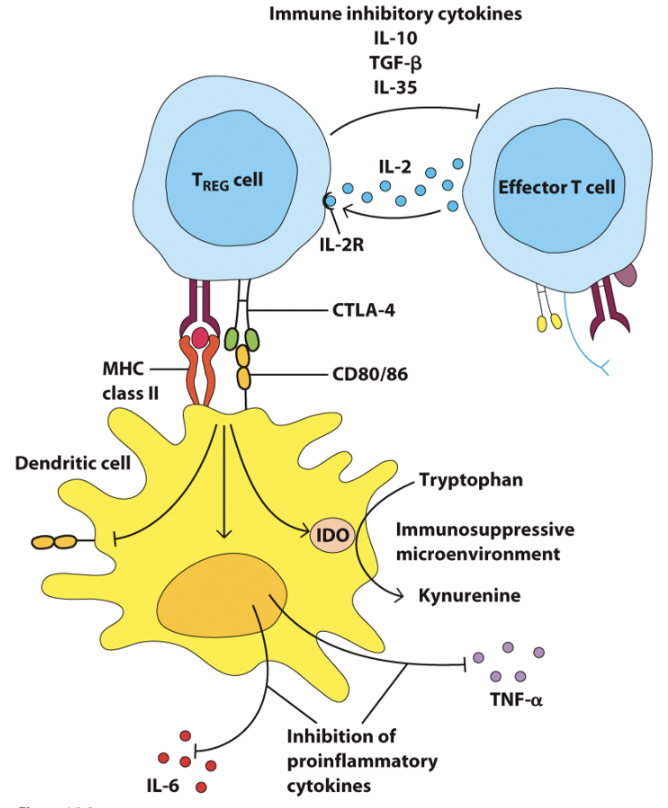
<ul><li><p>Tregs constitutively express the high-affinity _, allowing them to consume local IL-2 and deprive other T cells, preventing their activation</p></li><li><p>In comparison, other T cells inducibly express the high-affinity IL-2 receptor</p></li></ul><p></p>
72
New cards

IL-10

Tregs produce broadly inhibitory cytokines such as _

73
New cards

CTLA-4

Tregs constitutively express _, which binds to CD80/CD86 on APCs with higher affinity than CD28, effectively depriving effector T cells of necessary costimulatory signals.

  • What is the term to describe what happens to cells that receive signal 1 (TCR stim) but not co-stim?

  • This is a form of competitive inhibition

74
New cards
  • CTLA-4 ; CD80/CD86

  • PD-1

Negative receptors - help turn activation off

  • _ (CD152) competes for binding to _

    • Induced within 24 hours after activation, peaks 2–3 days post-stimulation

    • Binds to CD80 (B7-1)/CD86 (B7-2) with higher affinity than CD28 but shuts down signaling pathways (“putting the brakes on”)

  • Program death-1, CD279

    • _ binds to its ligands PD-L1/PD-L2, which inhibits T cell activation, proliferation, and dephosphorylaties TCR machinery

75
New cards

IL-10

_ is a broadly inhibitory cytokine essential for maintaining self-tolerance and immune homeostasis

  • Inhibits proinflammatory cytokine production (IL-6, IL-12) by APCs.

  • Suppresses Th1 and Th17 cell differentiation.

  • Promotes Treg differentiation.

  • What about this cytokine makes it effective across so many different cell types?

  • Link to excess inflammation: Deficiency in IL-10 can lead to spontaneous colitis and increased Th17 pathology.
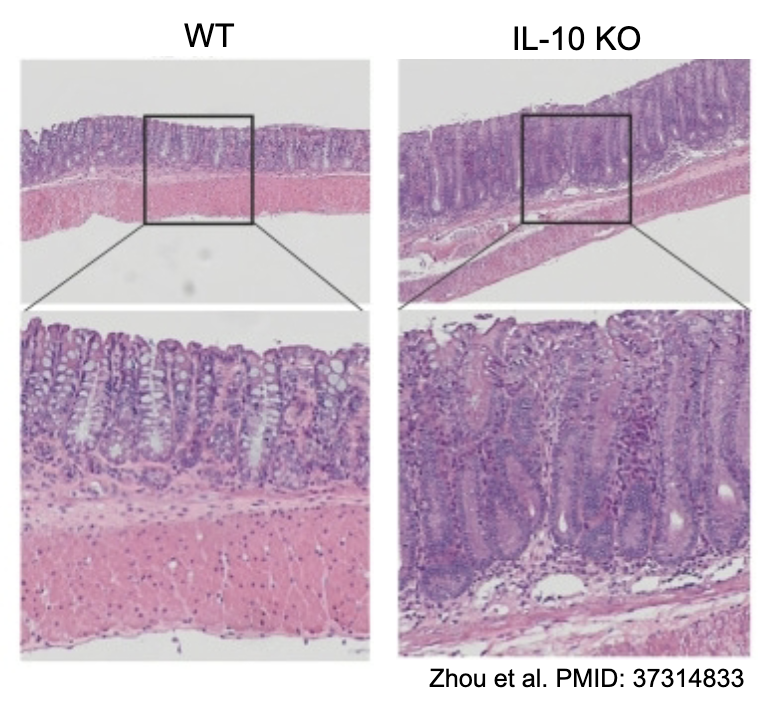
<p>_ is a broadly inhibitory cytokine essential for maintaining self-tolerance and immune homeostasis</p><ul><li><p>Inhibits proinflammatory cytokine production (IL-6, IL-12) by APCs.</p></li><li><p>Suppresses Th1 and Th17 cell differentiation.</p></li><li><p>Promotes Treg differentiation.</p></li><li><p>What about this cytokine makes it effective across so many different cell types?</p></li><li><p>Link to excess inflammation: Deficiency in IL-10 can lead to spontaneous colitis and increased Th17 pathology.</p></li></ul><p></p>
76
New cards

Tregs

Shimon Sakaguchi’s pivotal 1995 experiments discovered _ by showing that removing the thymus from 3-day-old mice caused autoimmune diseases, which could be prevented by injecting CD4+CD25+ T cells from healthy adults.

This demonstrated that _^_, maturing in the thymus, prevent self-attacking immune responses.
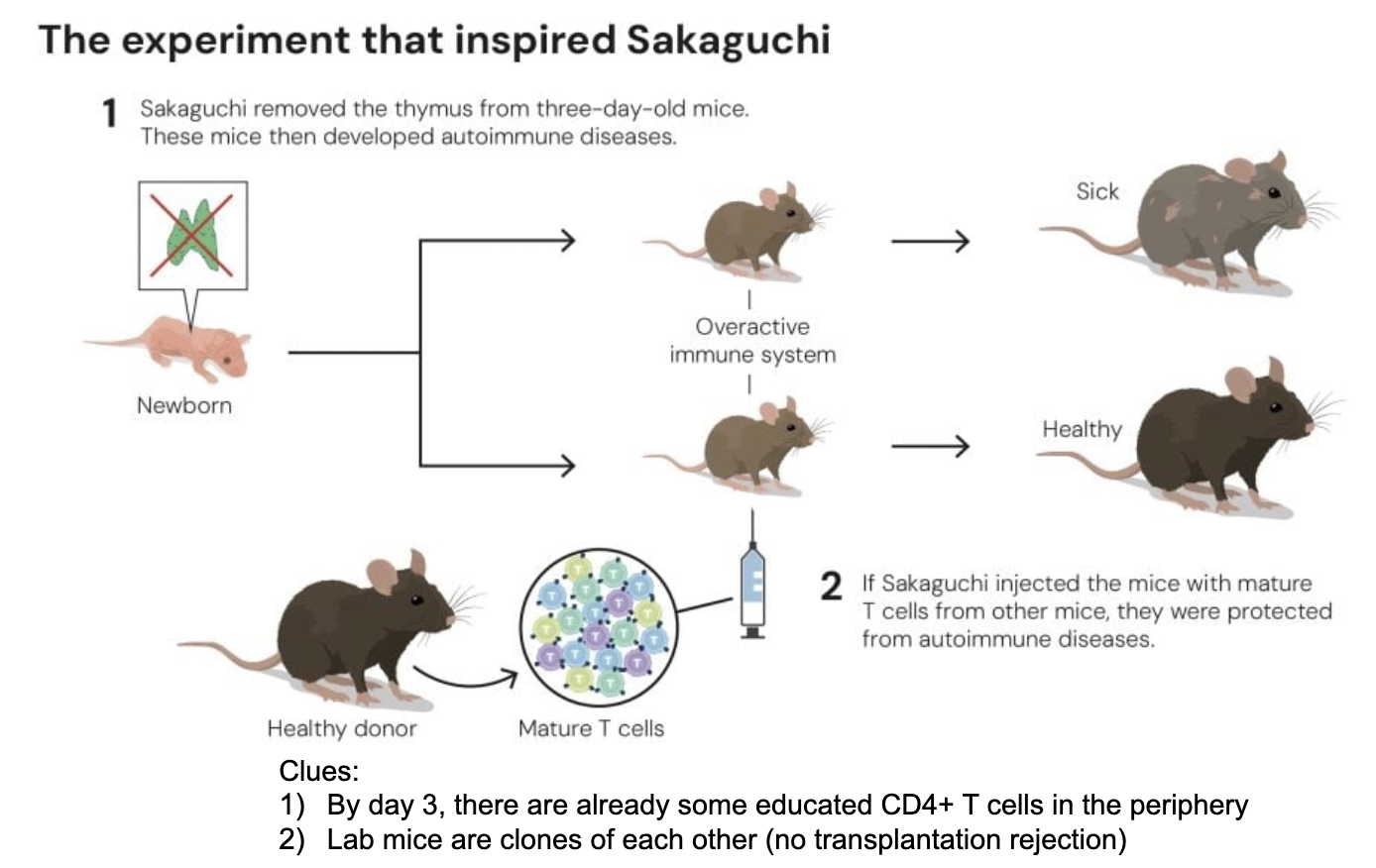
<p>Shimon Sakaguchi’s pivotal 1995 experiments discovered _ by showing that removing the thymus from 3-day-old mice caused autoimmune diseases, which could be prevented by injecting CD4+CD25+ T cells from healthy adults. </p><p>This demonstrated that _^_, maturing in the thymus, prevent self-attacking immune responses. </p>
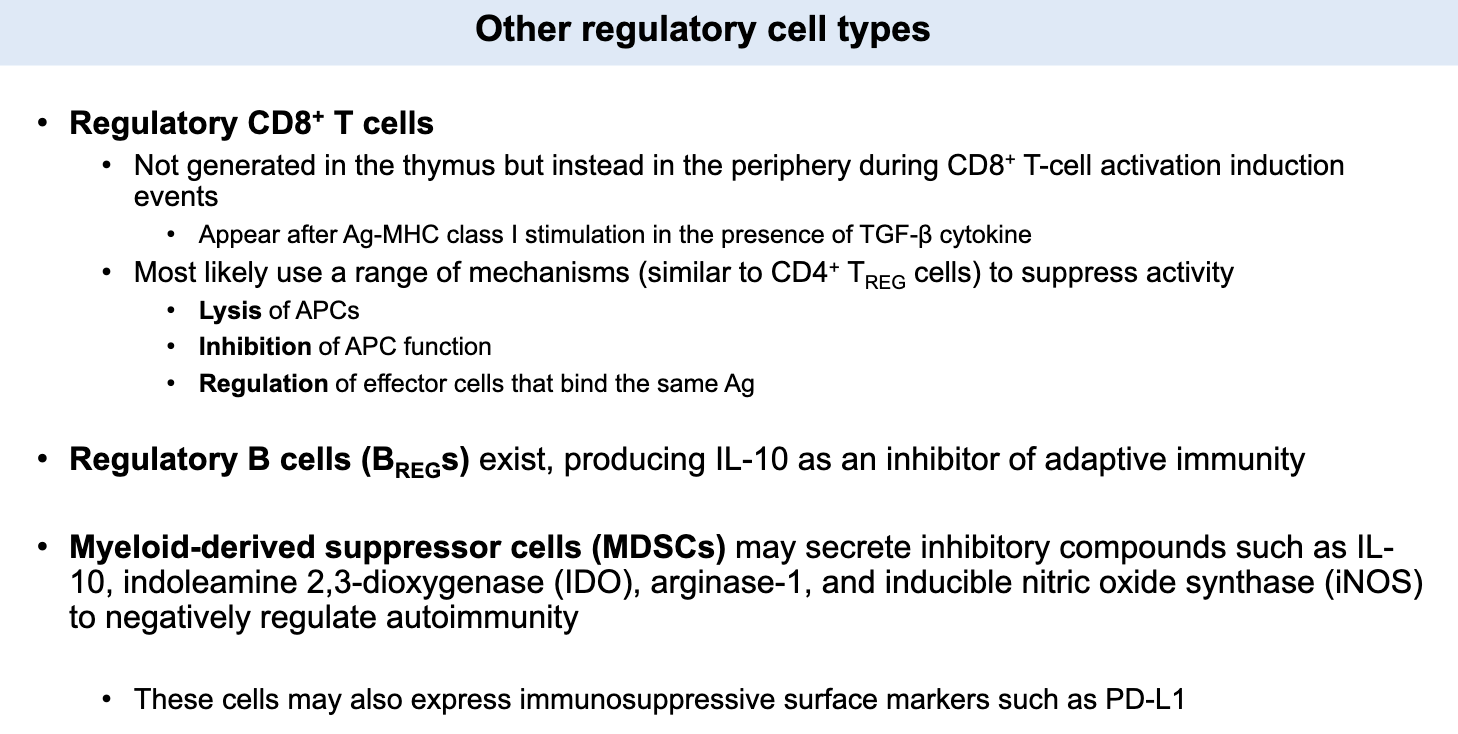
77
New cards

ok

Other regulatory types

<p>Other regulatory types</p>
78
New cards

TCR doesn't recognize entire peptide/antigen, but peptide presented by SELF MHC (not someone else's MHC)

What does this experiment show?
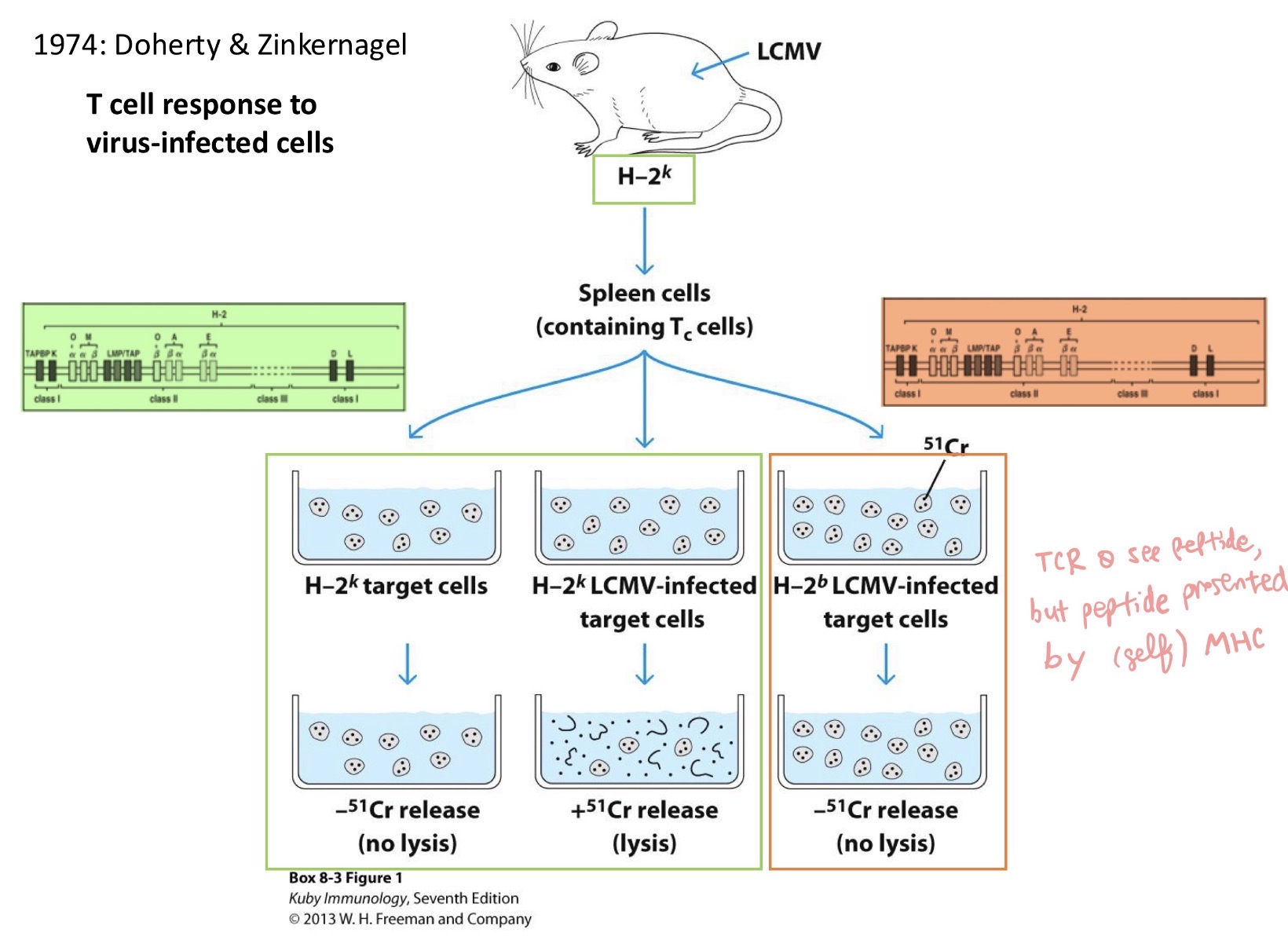
<p><span>What does this experiment show?</span></p>
79
New cards
<p>DC licensing</p><ul><li><p>DC maturation</p></li><li><p>MHCI ; costimulatory</p></li><li><p>Th</p></li></ul><p></p><ul><li><p>CD40 Ligand (CD40L)</p></li><li><p>DC</p></li></ul><p></p>

DC licensing

  • DC maturation

  • MHCI ; costimulatory

  • Th

  • CD40 Ligand (CD40L)

  • DC

__ is a process where CD4+ T cells ”license” or stimulate DCs to efficiently activate cytotoxic CD8+ T cells.

  • While the DC increases costimulation and MHC upon initial activation (__), it is often insufficient to trigger full CD8+ T cell activation.

  • Licensing further increases expression of _ and _ molecules.

  • It is like receiving permission from activated _ cells to fully activate CTLs to kill target cells.

DC licensing is mediated by CD40 on DCs and CD40L on CD4+ T cells.

  • _ is not constitutively expressed on naïve T cells but is rapidly induced shortly after activation.

  • CD4 T cells upregulate CD40 ligand (CD40L), which binds to CD40 on the _ surface.
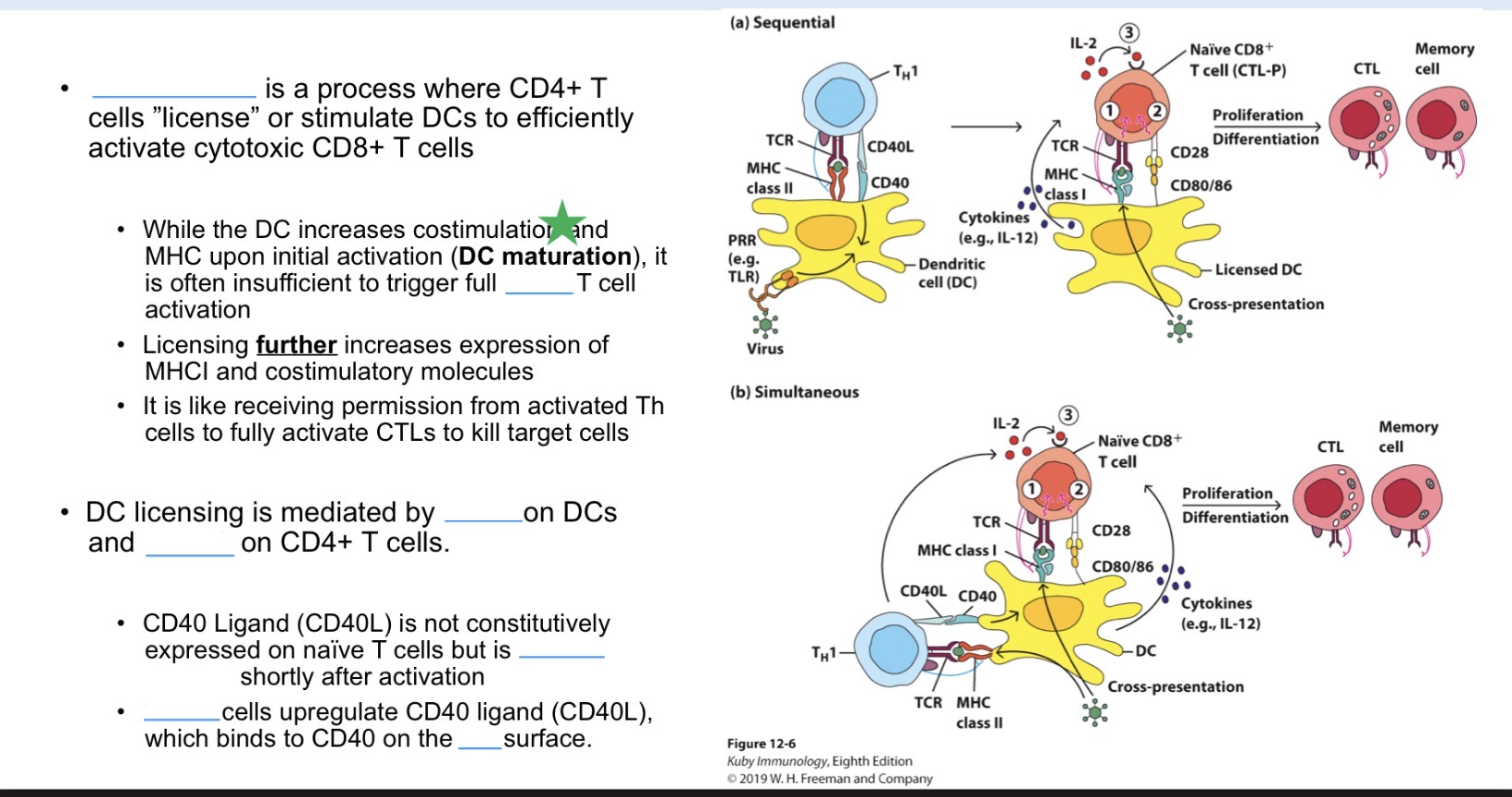
<p>__ is a process where CD4+ T cells ”license” or stimulate DCs to efficiently activate cytotoxic CD8+ T cells.</p><ul><li><p>While the DC increases costimulation and MHC upon initial activation (__), it is often insufficient to trigger full CD8+ T cell activation.</p></li><li><p>Licensing further increases expression of _ and _ molecules.</p></li><li><p>It is like receiving permission from activated _ cells to fully activate CTLs to kill target cells.</p></li></ul><p></p><p>DC licensing is mediated by CD40 on DCs and CD40L on CD4+ T cells.</p><ul><li><p>_ is not constitutively expressed on naïve T cells but is rapidly induced shortly after activation.</p></li><li><p>CD4 T cells upregulate CD40 ligand (CD40L), which binds to CD40 on the _ surface.</p></li></ul><p></p>
80
New cards

done

Explain this graph

<p>Explain this graph</p>
81
New cards
  • cell-surface

  • fluorescent

  • naïve T cells ; effector memory

  • cytokines

  • Flow cytometry allows for the identification of immune cell populations, subsets, and functions by detecting _ proteins and is used in the clinic as well as in research.

  • It uses fluidics, optics (lasers and filters), and electronics to detect _ signals on cells.

  • Can help to identify CD4+ helper T cells, CD8+ cytotoxic T cells, and Tregs as well, & can aid in distinguishing between _ (CD62L+, CD44-) and _ (CD62L-, CD44+) cells.

  • Intracellular staining allows for the detection of _ (IFNγ, TNF, IL-2) to assess T cell function rather than just presence.
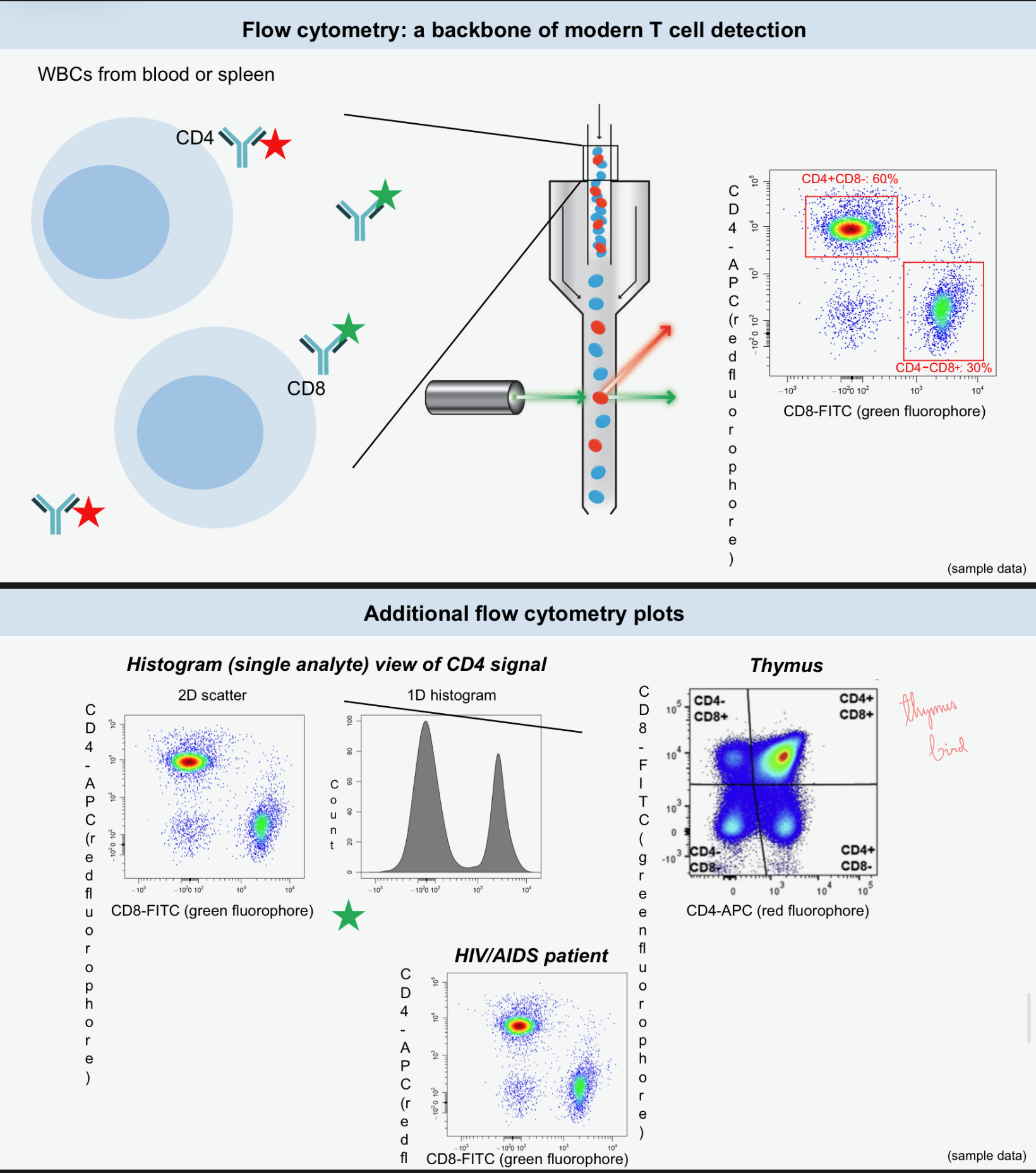
<ul><li><p>Flow cytometry allows for the identification of immune cell populations, subsets, and functions by detecting _ proteins and is used in the clinic as well as in research.<br></p></li><li><p>It uses fluidics, optics (lasers and filters), and electronics to detect _ signals on cells.<br></p></li><li><p>Can help to identify CD4<sup>+</sup> helper T cells, CD8<sup>+</sup> cytotoxic T cells, and Tregs as well, &amp; can aid in distinguishing between _ (CD62L+, CD44-) and _ (CD62L-, CD44+) cells.<br></p></li><li><p>Intracellular staining allows for the detection of _ (IFNγ, TNF, IL-2) to assess T cell function rather than just presence.</p></li></ul><p></p>
82
New cards

CD4+ T helper

_ cells coordinate the immune response

  • They recognize antigens via MHCII on specialized cells, then secrete cytokines to activate other immune cells
    (e.g. B cells, macrophages, DCs).

83
New cards

CD8+ T cytotoxic

_ cells directly destroy threats.

  • They patrol the body, recognize antigens via MHCI, and kill infected cells directly, typically through apoptosis.

84
New cards
  • all nucleated cells VS professional APCs

  • endogenous (infection, cancer) VS exogenous

  • thymus (DP —> SP, thymic selection)

  • What cells express MHCI vs MHCII?

  • What peptides (endogenous/exogenous) are presented on MHCI vs MHCII?

  • When does a CD4+ or CD8+ T cell acquire these co-receptors?

85
New cards

naïve CD8+ T cells ; lymph node

  • MHC I

  • CD28-CD80/CD86

  • IL-2

CTL Activation:

CD8+ T cell effectors are generated from _ in the _

  • Signal 1 — TCR binds peptide presented by APC on _

  • Signal 2 — Costimulatory signal transmitted by _ interaction btwn T cell and APC

  • Signal 3 — Provided by _, inducing prolif. and differentiation into CTL form

86
New cards
  • periphery

  • MHC I

  • granules (perforin/granzymes) ; apoptosis

  • Following activation, CTLs go to _ to scan cells to see if healthy or diseased.

  • Infected cells present foreign peptides on their surface using _ molecules

  • When a CTL’s TCR binds to this peptide-MHC I complex, it activates T cell to release _ that force target cell to undergo _

87
New cards
  • TCR ; tight junction ; lytic

  • Fas-FasL

Mechanisms of CTL killing:

  • Directional release of cytotoxic granule contents

    • Upon antigen recognition by the _, the CTL forms a _ with the target cell (immune synapse), which creates a secure, restricted space where _ molecules are released, protecting healthy neighboring cells.

  • Cell-contact interactions

    • _ interactions initiate cell death in target cell
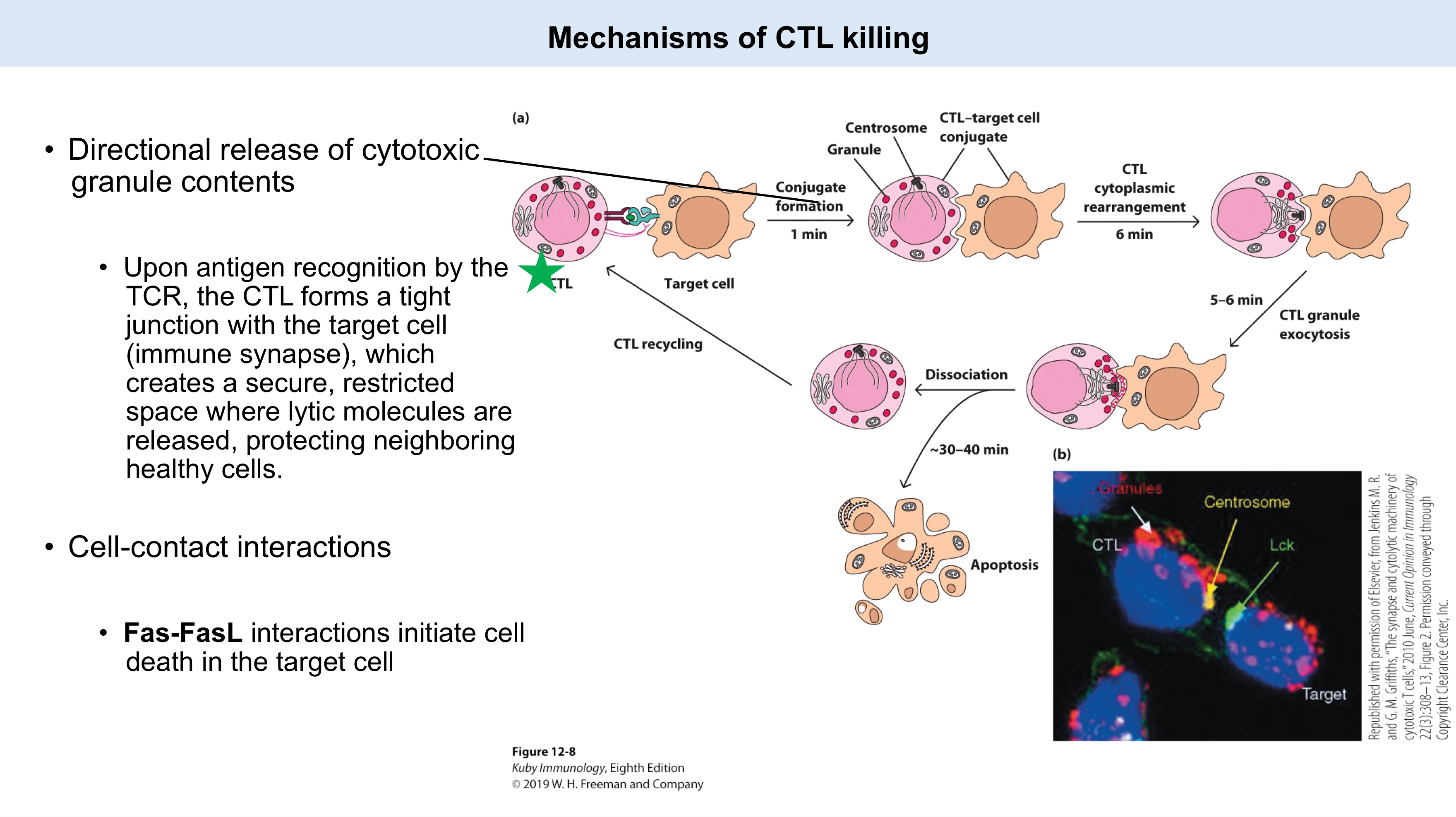
<p><strong>Mechanisms of CTL killing:</strong></p><ul><li><p><strong>Directional release of cytotoxic granule contents</strong></p><ul><li><p>Upon antigen recognition by the _, the CTL forms a _ with the target cell (immune synapse), which creates a secure, restricted space where _ molecules are released, protecting healthy neighboring cells.</p></li></ul></li><li><p><strong>Cell-contact interactions</strong></p><ul><li><p>_ interactions initiate cell death in target cell</p></li></ul></li></ul><p></p>
88
New cards
  • Perforin

  • Granzymes ; Serine

Granule contents of CTL killing

  • _: A 65 kD pore-forming protein that destabilizes the plasma membrane and acts as a gateway for granzymes to enter the target cell.

  • _: _ proteases that initiate apoptosis within the target cell

    • GrmA

    • GrmB

<p><strong>Granule contents of CTL killing</strong></p><ul><li><p>_: A 65 kD pore-forming protein that destabilizes the plasma membrane and acts as a gateway for granzymes to enter the target cell.<br></p></li><li><p>_: _ proteases that initiate apoptosis within the target cell</p><ul><li><p>GrmA</p></li><li><p>GrmB</p></li></ul></li></ul><p></p>
89
New cards
<ul><li><p>Caspase-3</p></li><li><p>DNA fragmentation ; cytoskeletal breakdown</p></li><li><p>mitochondrial</p></li><li><p>phagocytes</p></li></ul><p></p>
  • Caspase-3

  • DNA fragmentation ; cytoskeletal breakdown

  • mitochondrial

  • phagocytes

Apoptosis by GrmB:

  • Granzyme B enters the target cell and cleaves and activates _, the "executioner" enzyme of apoptosis.

  • Activation of this leads to _, _, and packages the cell as an apoptotic body.

  • Cytochrome c is a _ protein, that when released into the cytosol during cell stress, initiates apoptosis.

  • These apoptotic bodies attract _ to consume the debris without causing inflammation to the surrounding healthy tissue.
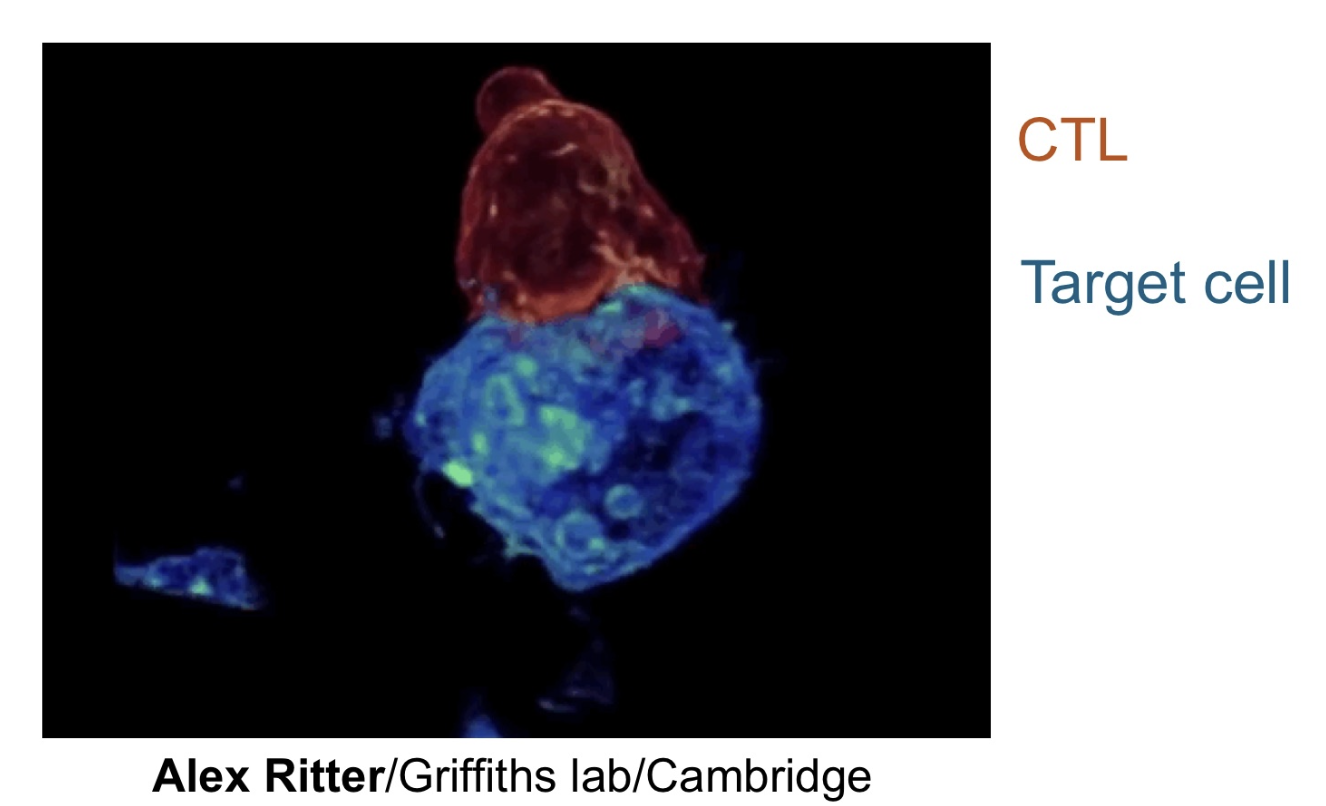
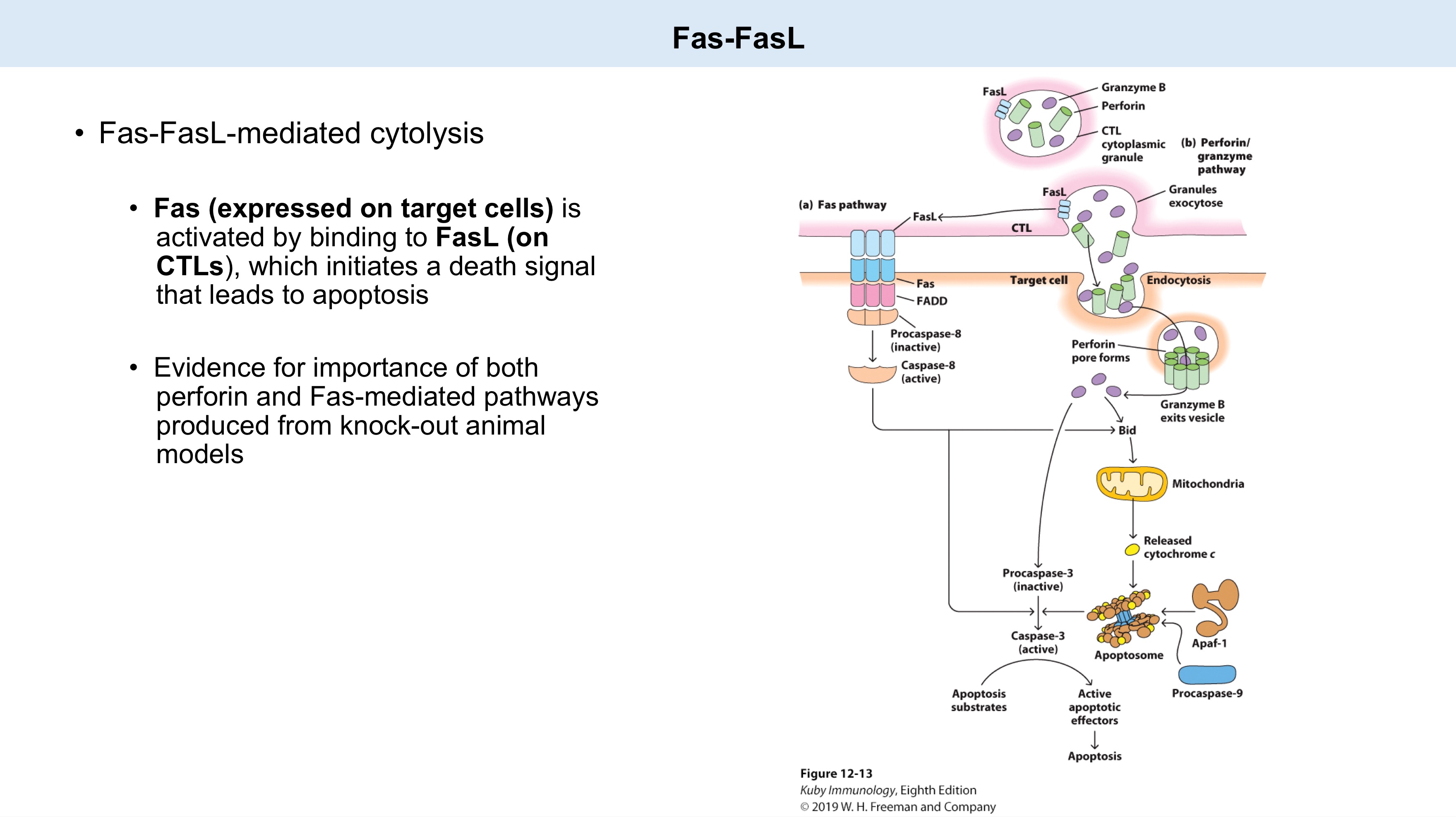
<p><strong>Apoptosis by GrmB:</strong></p><ul><li><p>Granzyme B enters the target cell and cleaves and activates _, the "executioner" enzyme of apoptosis.</p></li><li><p>Activation of this leads to _, _, and packages the cell as an apoptotic body.</p></li><li><p>Cytochrome c is a _ protein, that when released into the cytosol during cell stress, initiates apoptosis.</p></li><li><p>These apoptotic bodies attract _ to consume the debris without causing inflammation to the surrounding healthy tissue.</p></li></ul><p></p>
90
New cards
<ul><li><p>target ; CTLs</p></li><li><p>perforin</p></li></ul><p></p>
  • target ; CTLs

  • perforin

Fas-FasL-mediated cytolysis

  • Fas (expressed on _ cells) is activated by binding to FasL (on _), which initiates a death signal that leads to apoptosis.

  • Evidence for the importance of both _ and Fas-mediated pathways produced from knock-out animal models.
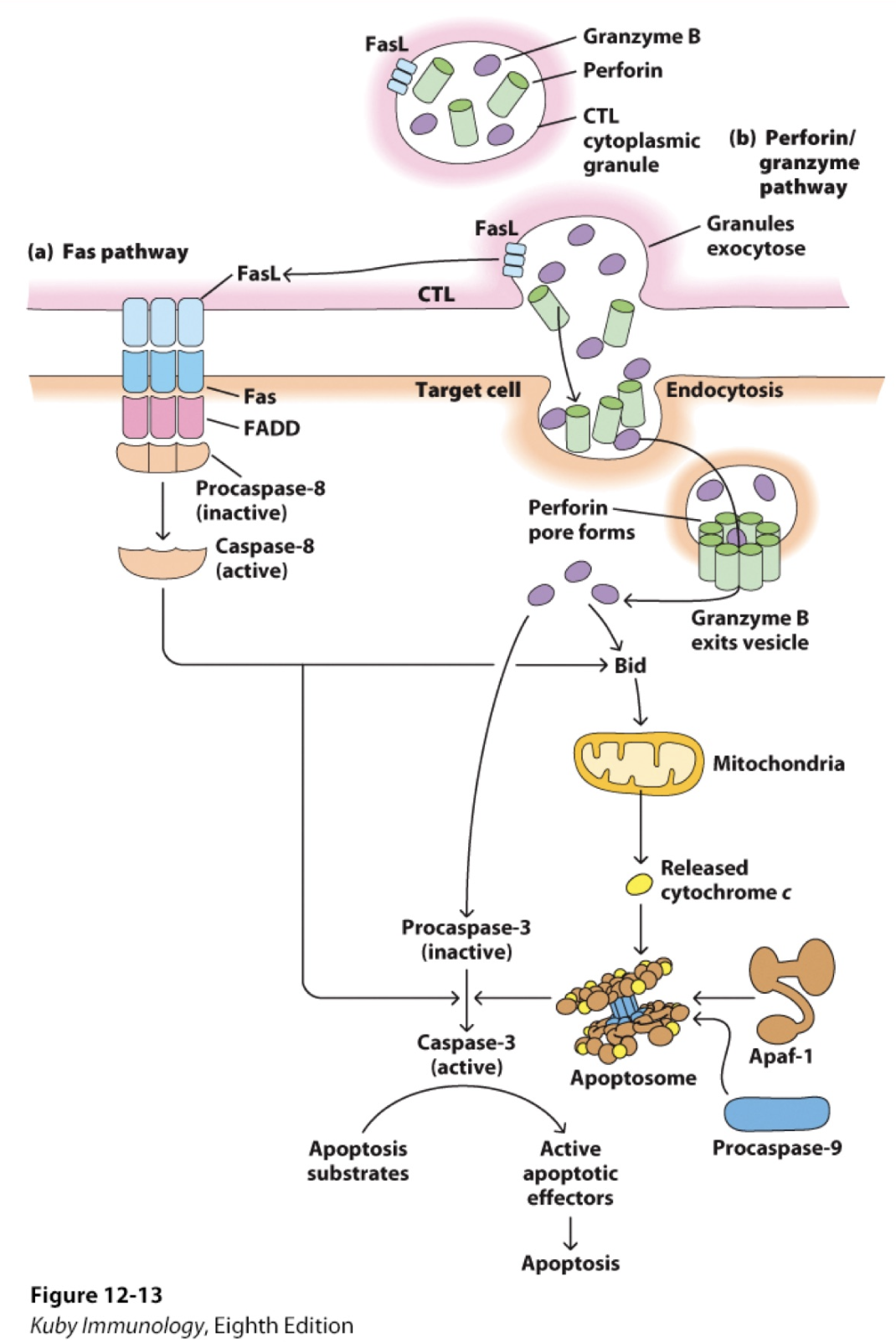
<p><strong>Fas-FasL-mediated cytolysis</strong></p><ul><li><p>Fas (expressed on _ cells) is activated by binding to FasL (on _), which initiates a death signal that leads to apoptosis.</p></li><li><p>Evidence for the importance of both _ and Fas-mediated pathways produced from knock-out animal models.</p></li></ul><p></p>
91
New cards
  • cross-presentation ; DCs ; MHC I

  • co-stimulation

Conundrum...

To become activated, a naive T cell needs to see its specific antigen presented by a professional APC (usually a DC).

If a tumor or virus does not directly infect a DC, how does a CD8+ T cell become activated to fight it?

  • Through _, where _ engulf dead/dying tumor or infected cells, process the foreign antigens, and present them on _ molecules to T cells.

  • DCs also receive necessary _, upregulating activation markers (CD80/86) to fully prime the T cells in lymph nodes.
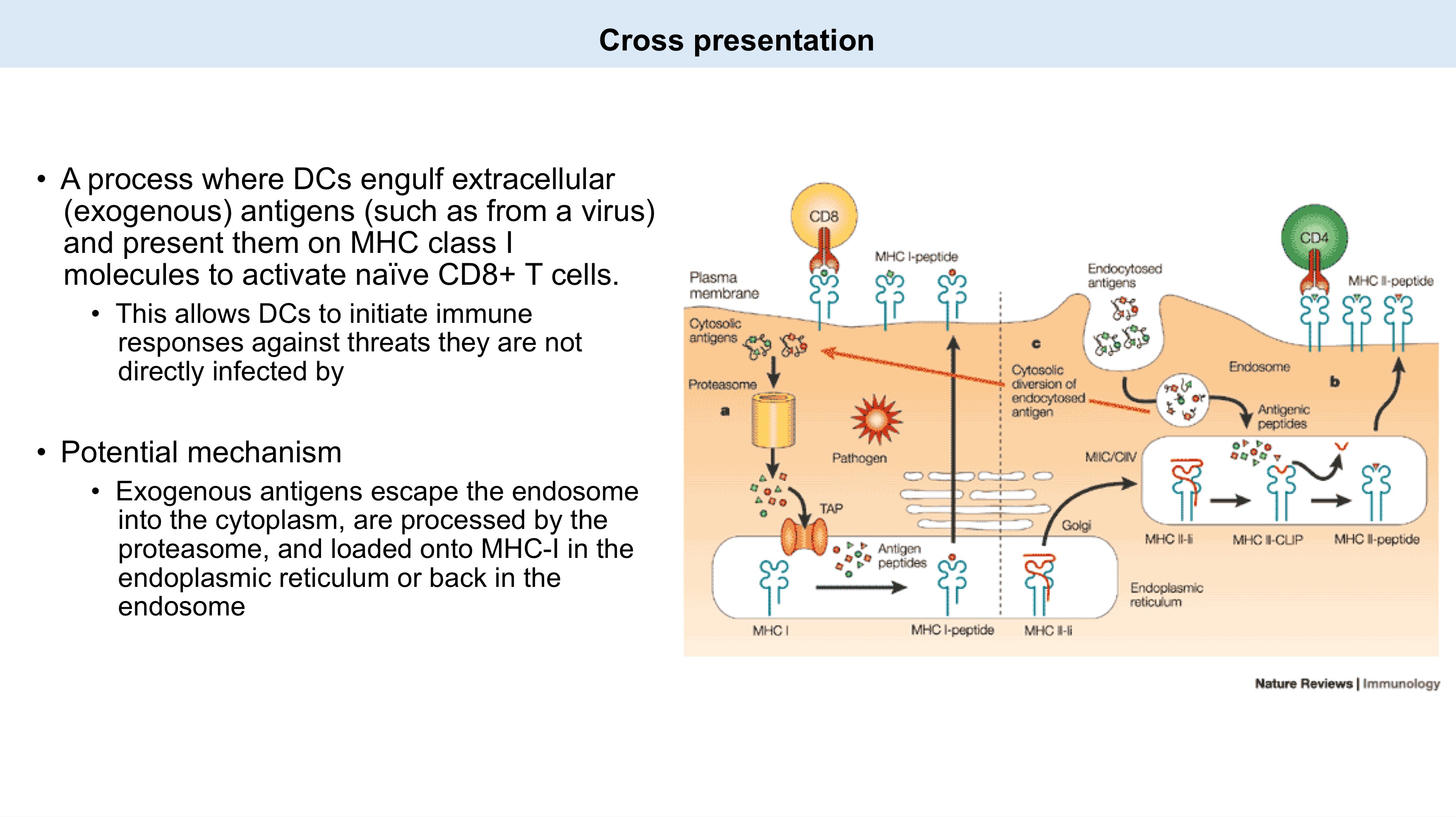
<p><strong>Conundrum...</strong></p><p>To become activated, a naive T cell needs to see its specific antigen presented by a professional APC (usually a DC).</p><p>If a tumor or virus does not directly infect a DC, how does a CD8<sup>+</sup> T cell become activated to fight it?</p><ul><li><p>Through _, where _ engulf dead/dying tumor or infected cells, process the foreign antigens, and present them on _ molecules to T cells. </p></li><li><p>DCs also receive necessary _, upregulating activation markers (CD80/86) to fully prime the T cells in lymph nodes.</p></li></ul><p></p>
92
New cards

Periphery

(Found patrolling the entire body to eliminate infected or abnormal cells, with their location shifting based on their activation state)

Where are CTLs/activated CD8+ T found?
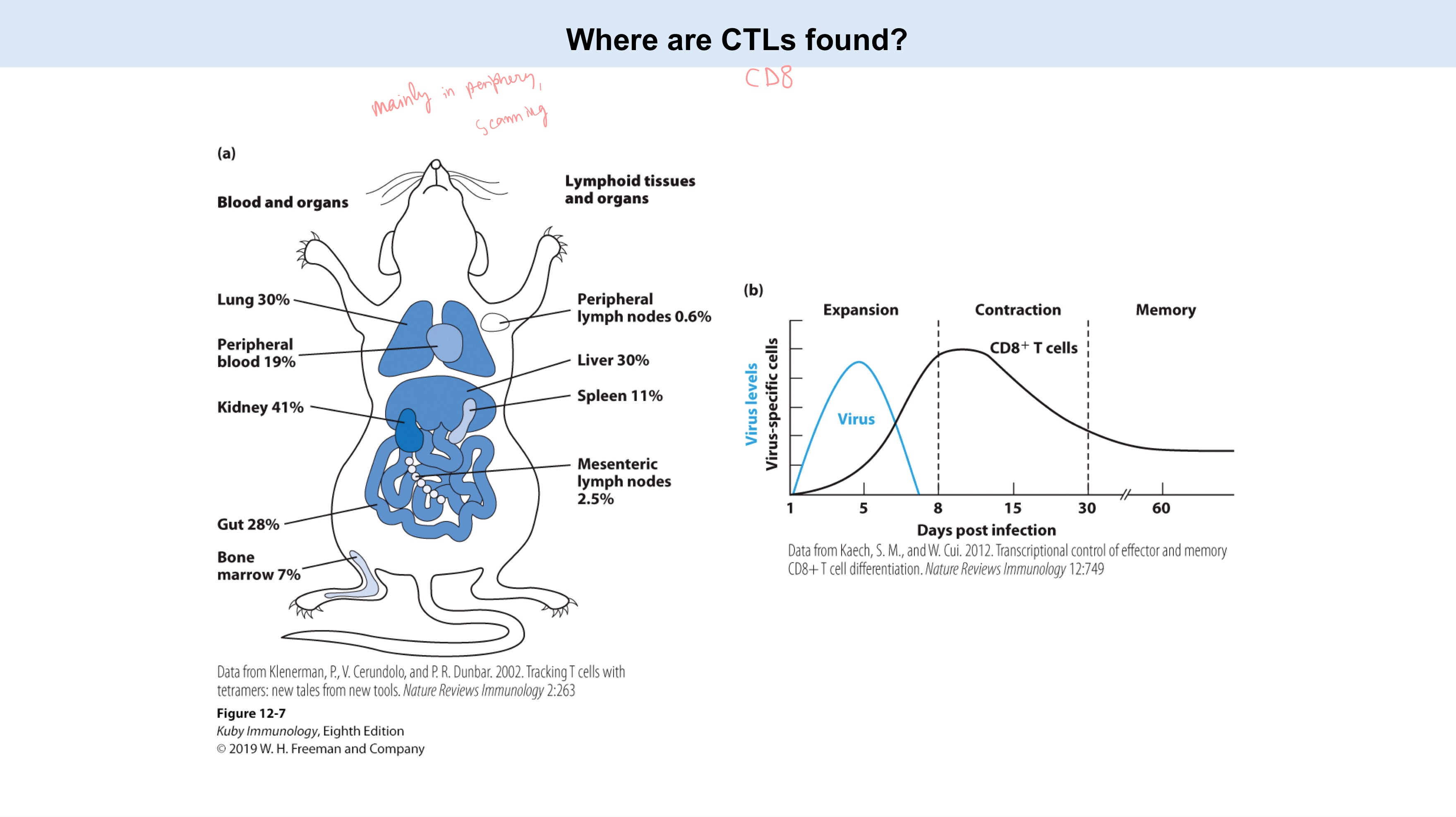
<p>Where are CTLs/activated CD8<sup>+</sup> T found?</p>
93
New cards
  • CD8+ T ; effector

  • fail to respond

    • IL-2

    • killing

    • PD-1

    • CTLA-4

CTL exhaustion:

  • A state of dysfunction in _ cells caused by chronic antigen exposure (e.g., cancer or persistent infections), characterized by the progressive loss of _ functions.

    • CTLs _ despite seeing necessary activation signals.

    • Loss of effector functions

      • Decreased _ production

      • Decreased _

    • Inhibitory receptor expression

      • _

      • _

  • Allows for viral infections and tumors to persist.

  • Reversing exhaustion is promising therapeutic potential in cancer.

    • Checkpoint immunotherapy (e.g. anti-PD-1, anti-CTLA-4)

94
New cards
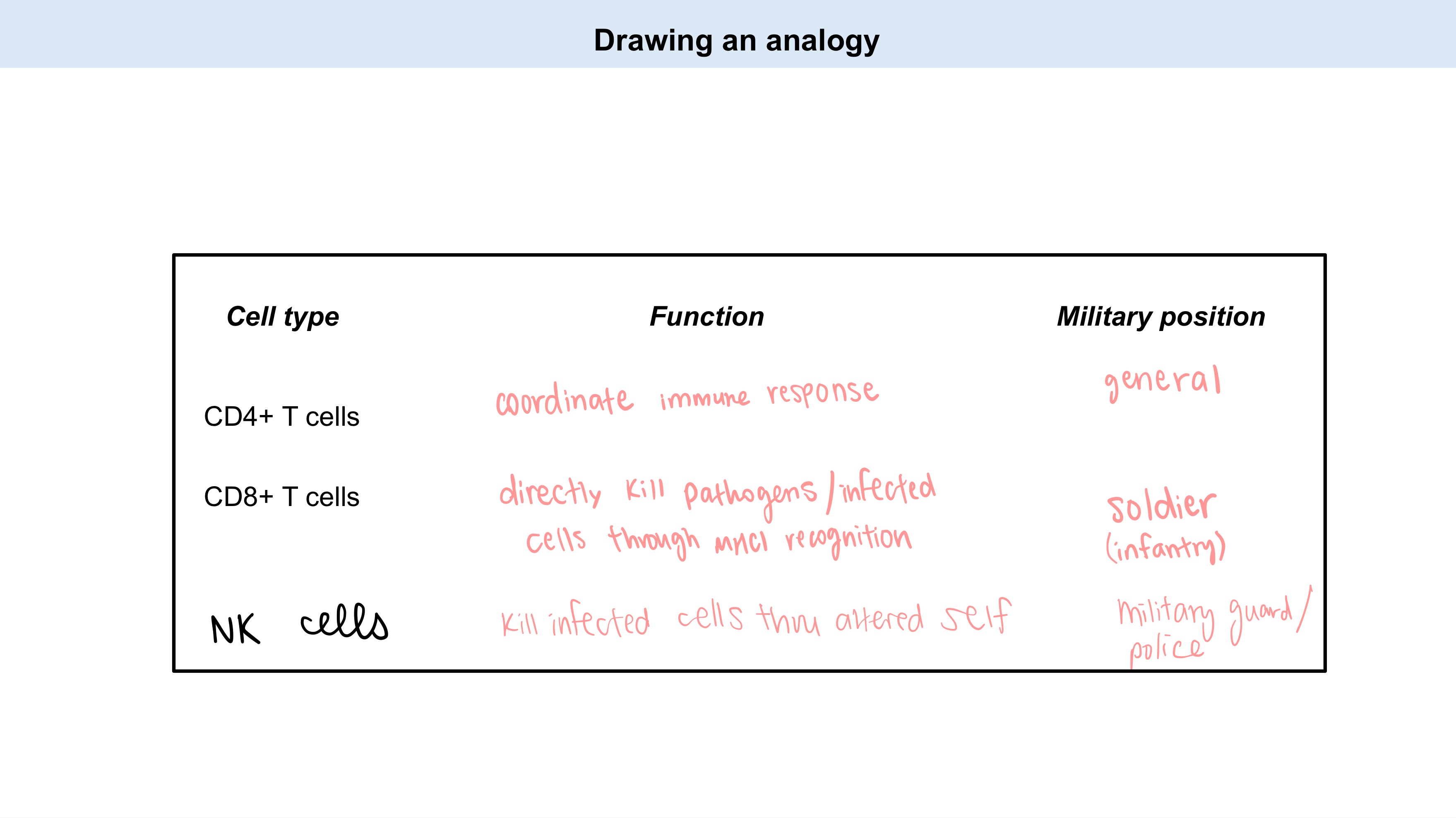
  • coordinate immune response

  • directly kill pathogens /infected cells through MHC I recognition

  • kill infected cells through altered self

Cell type

Function

Military Position

CD4+ T cells

general

CD8+ T cells

_

soldier

NK cells

_

military guard

Fill in FUNCTION!

<table style="min-width: 75px;"><colgroup><col style="min-width: 25px;"><col style="min-width: 25px;"><col style="min-width: 25px;"></colgroup><tbody><tr><td colspan="1" rowspan="1" style="overflow: hidden; padding: 2px 3px; vertical-align: bottom; font-weight: bold;"><p><strong>Cell type</strong></p></td><td colspan="1" rowspan="1" style="overflow: hidden; padding: 2px 3px; vertical-align: bottom; font-weight: bold;"><p><strong>Function</strong></p></td><td colspan="1" rowspan="1" style="border-right: 1px solid transparent; overflow: visible; padding: 2px 0px; vertical-align: bottom; font-weight: bold;"><p><strong>Military Position</strong></p></td></tr><tr><td colspan="1" rowspan="1" style="overflow: hidden; padding: 2px 3px; vertical-align: bottom;"><p>CD4+ T cells</p></td><td colspan="1" rowspan="1" style="overflow: hidden; padding: 2px 3px; vertical-align: bottom;"><p></p></td><td colspan="1" rowspan="1" style="overflow: hidden; padding: 2px 3px; vertical-align: bottom;"><p>general</p></td></tr><tr><td colspan="1" rowspan="1" style="overflow: hidden; padding: 2px 3px; vertical-align: bottom;"><p>CD8+ T cells</p></td><td colspan="1" rowspan="1" style="overflow: hidden; padding: 2px 3px; vertical-align: bottom;"><p>_</p></td><td colspan="1" rowspan="1" style="overflow: hidden; padding: 2px 3px; vertical-align: bottom;"><p>soldier</p></td></tr><tr><td colspan="1" rowspan="1" style="overflow: hidden; padding: 2px 3px; vertical-align: bottom;"><p>NK cells</p></td><td colspan="1" rowspan="1" style="overflow: hidden; padding: 2px 3px; vertical-align: bottom;"><p>_</p></td><td colspan="1" rowspan="1" style="overflow: hidden; padding: 2px 3px; vertical-align: bottom;"><p>military guard</p></td></tr></tbody></table><p></p><p>Fill in FUNCTION!</p>
95
New cards

NO!

(NK cells dom’t need MHC - can kill without)

Is downregulating MHC-I a good immune evasion strategy for pathogens?

96
New cards
  • absence of MHC class I

    • common lymphoid progenitors (CLPs)

      • TCR

      • Thymus

  • Inhibitory

  • Activating

  • earlier

  • 5-10

  • Ag

Natural killer (NK) cells

  • Natural killer cells recognize and kill infected cells and tumor cells by their _

    • NK cells are derived from _ in the bone marrow

      • Are considered lymphoid cells but NOT T cells (as they don't express _)

      • _ not required for NK development

  • Do not undergo receptor gene rearrangements

  • Defining trait is the expression of a set of activating and inhibiting NK receptors

    • These receptors are used to determine whether to kill a target or not

    • _ receptors: recognize self-MHC-I, which provides an "off' signal

    • _ receptors: recognize ligands induced by stress, infection, or DNA damage

  • NK cells proliferate _ in infection than CTLs

  • NK cells make up _% of circulating lymphocytes

    • 60-80% T cells

    • 10-20% B cells

Virus titer

  • NK cells lack specific _ receptors

  • NK cells recognize and kill pathogen-infected cells and abnormal tumor cells
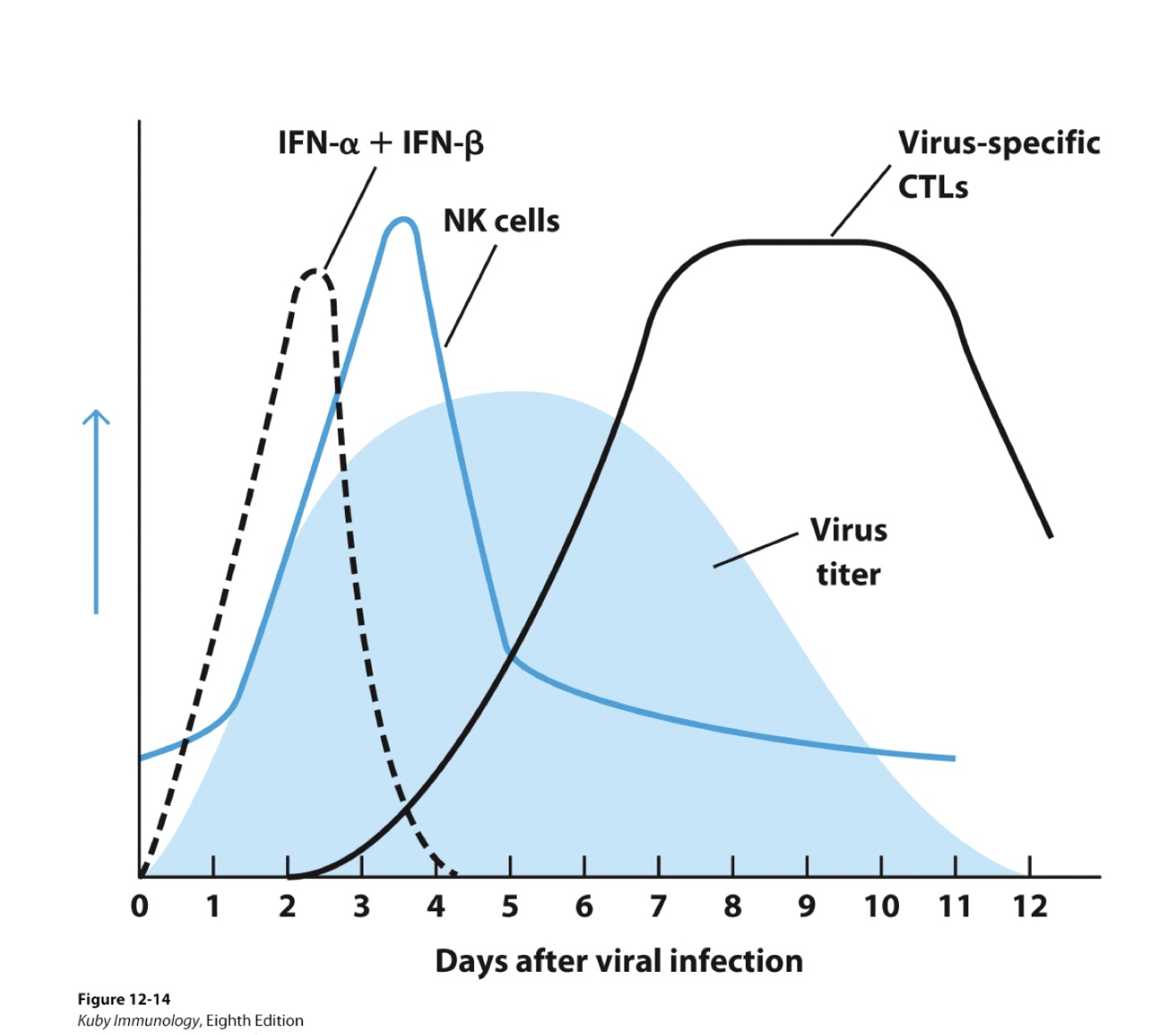
<p><strong>Natural killer (NK) cells</strong></p><ul><li><p>Natural killer cells recognize and kill infected cells and tumor cells by their _</p><ul><li><p>NK cells are derived from _ in the bone marrow</p><ul><li><p>Are considered lymphoid cells but NOT T cells (as they don't express _)</p></li><li><p>_ not required for NK development<br></p></li></ul></li></ul></li><li><p>Do not undergo receptor gene rearrangements<br></p></li><li><p>Defining trait is the expression of a set of activating and inhibiting NK receptors</p><ul><li><p>These receptors are used to determine whether to kill a target or not</p></li><li><p>_ receptors: recognize self-MHC-I, which provides an "off' signal</p></li><li><p>_ receptors: recognize ligands induced by stress, infection, or DNA damage</p></li></ul><p></p></li><li><p>NK cells proliferate _ in infection than CTLs</p></li></ul><ul><li><p>NK cells make up _% of circulating lymphocytes</p><ul><li><p>60-80% T cells</p></li><li><p>10-20% B cells</p></li></ul></li></ul><p class="p1"></p><p class="p1">Virus titer</p><ul><li><p>NK cells lack specific _ receptors</p></li><li><p>NK cells recognize and kill pathogen-infected cells and abnormal tumor cells</p></li></ul><p></p>
97
New cards
  • The missing self model

  • The "balance" test

How NK cells recognize target:

  • _

    • Normal cells present a ligand for the activating (killing) receptor on NK cells AND an MHC class I ligand for the inhibitory receptor.

    • When viruses infect cells, some may inhibit MHC class I expression to evade detection and elimination by CTLs.

    • The balance of inhibitory vs activating signals determines whether NK is activated or not.

  • _

    • NK cells display activating and inhibitory receptors that govern its function and therefore consequence of the target cell
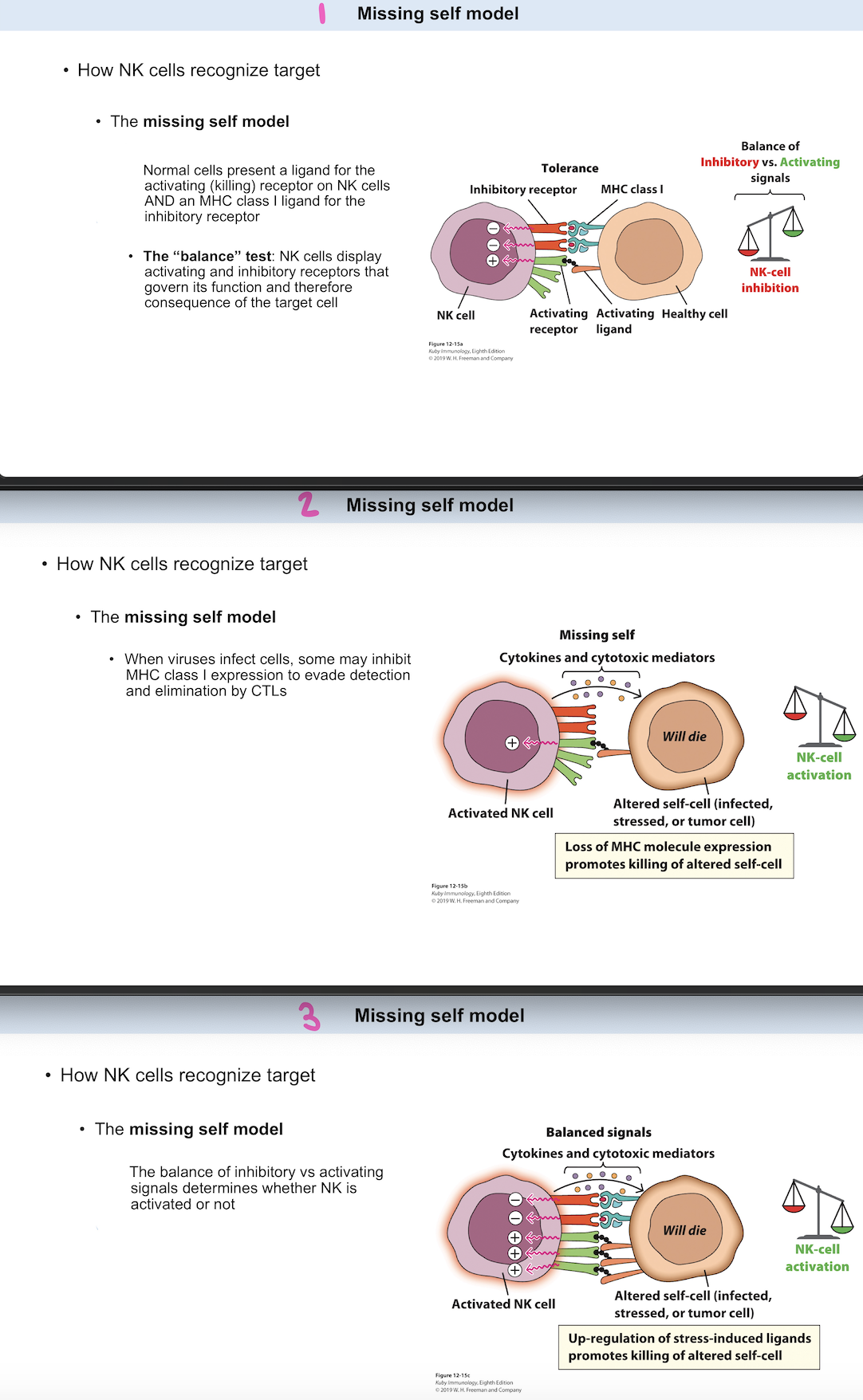
<p><strong>How NK cells recognize target:</strong></p><ul><li><p><strong>_</strong></p><ul><li><p>Normal cells present a ligand for the activating (killing) receptor on NK cells AND an MHC class I ligand for the inhibitory receptor.</p></li><li><p>When viruses infect cells, some may inhibit MHC class I expression to evade detection and elimination by CTLs.</p></li><li><p>The balance of inhibitory vs activating signals determines whether NK is activated or not.</p></li></ul></li><li><p class="p1"><strong>_</strong></p><ul><li><p class="p1">NK cells display activating and inhibitory receptors that govern its function and therefore consequence of the target cell</p></li></ul></li></ul><p></p>
98
New cards
  • bone marrow

  • functional ("licensed") ; MHC-I

  • exhibit restraint

NK cell maturation

  • NK cells education and licensing occur in the _ during maturation.

  • Immature NK cells become _ by interacting with _, allowing them to distinguish self from non-self

  • This gives the "license" only to those NK cells that can _ when encountering a healthy, normal cell.

99
New cards
  • apoptosis

    • CTLs

      • perforins/granzymes

  • memory

Cell-mediated effector responses:

  • NK cells induce _ of their targets

    • Once activating signal molecules are engaged, NK cells use mechanisms very similar to _ to induce target cell death

      • Release of _ at the junction between two cells

  • Some evidence suggests NK cells can generate a _ response

    • Altered function: Increased proliferation, greater degranulation for a duration of time
100
New cards
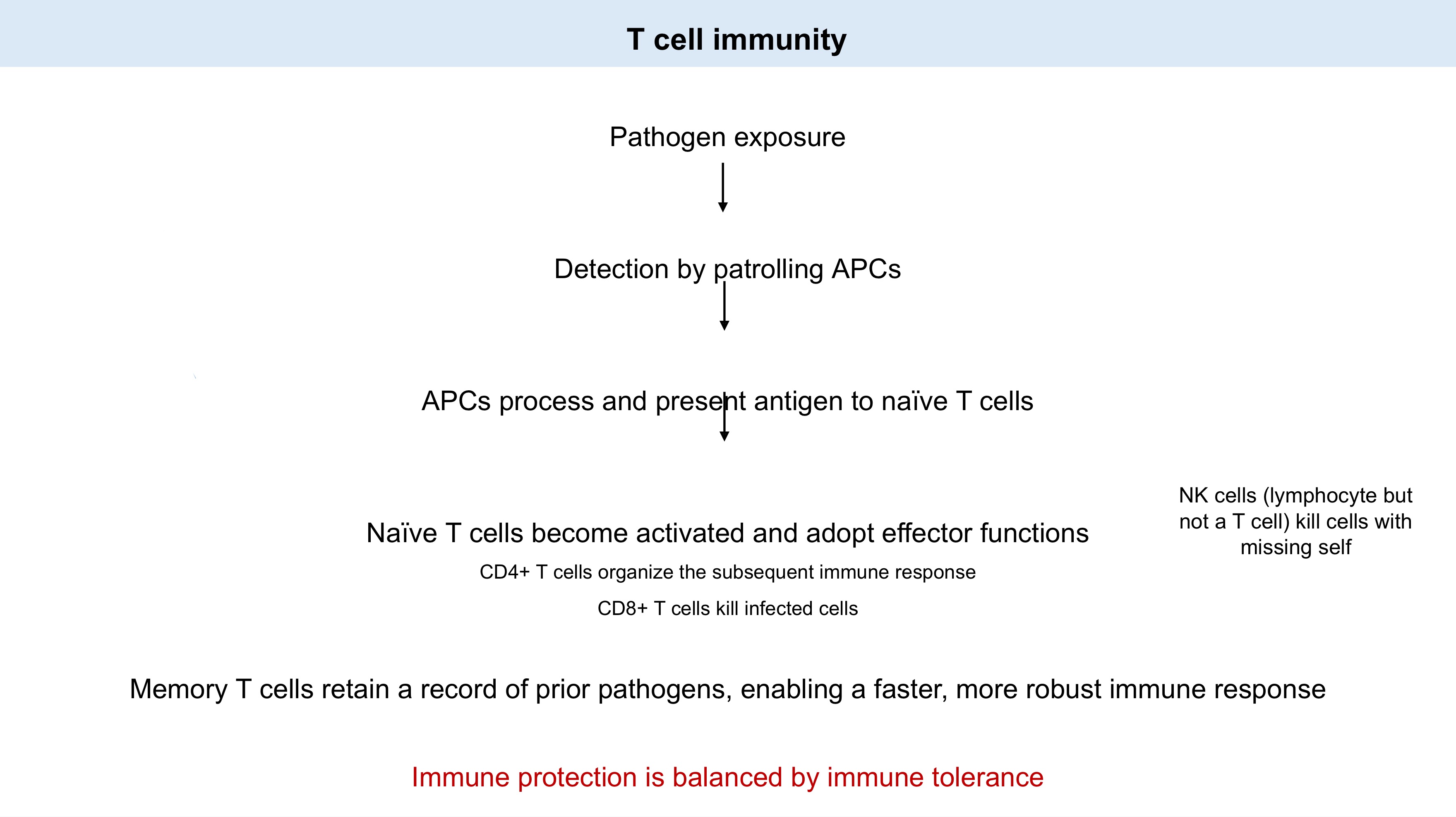
<ol><li><p>Detection by patrolling APCs</p></li><li><p class="p1">APCs process and present antigen to naïve T cells</p></li><li><p class="p1">organize</p></li><li><p class="p1">kill infected cells</p></li></ol><p></p>
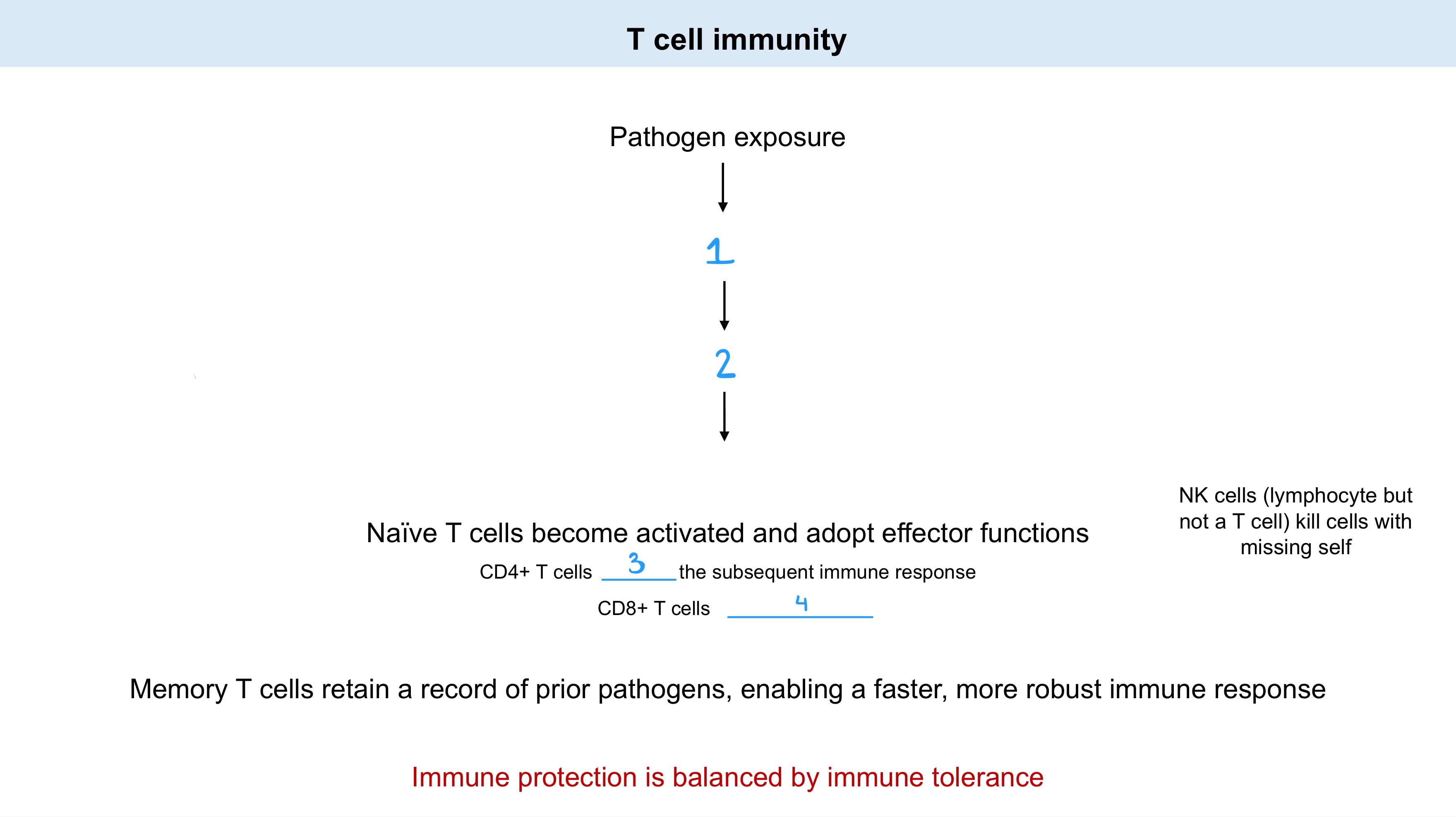
  1. Detection by patrolling APCs

  2. APCs process and present antigen to naïve T cells

  3. organize

  4. kill infected cells

Fill in blanks!

<p>Fill in blanks!</p>

Explore top notes

note
Bio Chapter 2 - The Cell
Updated 1023d ago
0.0(0)
note
Kamienie na Szaniec
Updated 761d ago
0.0(0)
note
Chapter 22: Solutions
Updated 1036d ago
0.0(0)
note
Chapter 24: Lipid Metabolism
Updated 1264d ago
0.0(0)
note
Bio Chapter 2 - The Cell
Updated 1023d ago
0.0(0)
note
Kamienie na Szaniec
Updated 761d ago
0.0(0)
note
Chapter 22: Solutions
Updated 1036d ago
0.0(0)
note
Chapter 24: Lipid Metabolism
Updated 1264d ago
0.0(0)

Explore top flashcards

flashcards
Lesson 12 vocab
48
Updated 441d ago
0.0(0)
flashcards
Kunstgeschiedenis volledig
121
Updated 80d ago
0.0(0)
flashcards
Verbs - Winter Journal
182
Updated 92d ago
0.0(0)
flashcards
Literary Terms Polagri
126
Updated 1179d ago
0.0(0)
flashcards
Lesson 12 vocab
48
Updated 441d ago
0.0(0)
flashcards
Kunstgeschiedenis volledig
121
Updated 80d ago
0.0(0)
flashcards
Verbs - Winter Journal
182
Updated 92d ago
0.0(0)
flashcards
Literary Terms Polagri
126
Updated 1179d ago
0.0(0)