Chapter 1 + Interlude D
 Studied by 14 people
 Call Kai
 Learn
Learn Practice Test
 Spaced Repetition
 Match
Match Flashcards
 Knowt Play
1/46

There's no tags or description
Looks like no tags are added yet.
Name | Mastery | Learn | Test | Matching | Spaced | Call with Kai |
|---|
No analytics yet
Send a link to your students to track their progress
47 Terms
Slow Geologic Processes
Mountain Building
Glacier formation
weathering & erosion
Fast Geologic Processes
Earthquakes
Landslides
Volcanoes
The Solar System
Sun is 99.85% of solar system mass
Eight planets
Their Satellites
Smaller Bodies
Dwarf planets
Asteroids
Comets
Meteoroids
Inner vs. Outer Planets
Inner Planets
Mercury, Venus, Earth, Mars
Smaller
Rocky
Outer Planets
Jupiter, Saturn, Uranus, Neptune
Gas giants
Larger
Galaxies
Come in different shapes and sizes
Earth is located within the Milky Way
All visible stars are within the Milky Way
The Big Bang
13.8 billion years ago, all energy and matter of the universe existed in a hot and dense state
Began a cataclysmic explosion
Everything continued to expand, cool, and evolve
First stars formed about 200 million years later, composed of hydrogen and helium
Stars have recycled and produced heavier elements over time
First galaxies formed ~12.7 Billion years ago
What is the evidence of the Big Bang?
Redshift of Galaxies
Microwave Background Radiation
Mixture of Elements
What is the electromagnetic spectrum?
Energy travels through space via electromagnetic radiation
All objects in the universe emit electromagnetic radiation
The type of radiation an object emits depends on its temperature
What is the Redshift?
The light from many galaxies is stretched slightly and appears redder than it would be otherwise
“Lower” and farther light means more red, while “higher” and closer light means more blue
Redshift shows that universe is expanding, with galaxies moving farther and farther from the universe’s starting point
Cosmic Microwave Background Radiation
Discovered in 1964 by Robert Wilson & Arno Penzias
Essentially microwave radiation that fills the universe, creating a faint glow around the universe that has been decreasing in brightness as the universe stretches
Mixture of Elements
The chemical composition of the universe is dominated by Hydrogen and Helium, produced in the Big Bang
The remaining chemicals are produced by stars and are a low percentage of the universe’s overall mass
How did the first stars come about?
As the universe cooled & expanded, atoms began to bond
Hydrogen molecules were formed
Gravity collected matter and began the process of making a star
How does Stellar Birth work?
Stars begin as nebulae, clouds of interstellar gas & dust
Usually molecular clouds, which are cold and dense enough for hydrogen atoms to bond to hydrogen molecules
The matter clumps together until its massive enough to contract, and form a star
What is Stellar Nucleosynthesis?
Formation of new elements via nuclear reactions
In the stars’ center, atoms are taken apart by atomic collisions, altering the atomic structure and releasing an enormous amount of energy (nuclear fusion)
Mostly converting Hydrogen into helium
Formed elements 1-26 (Ending at Iron)
Star size depends on the type of nucleosynthesis occurs
What are the types of Nucleosynthesis
Small Stars
Hydrogen to Helium
Medium Stars (Sun-size)
Hydrogen to Helium to Oxygen & Carbon
Massive stars (5x the Sun-size)
Hydrogen to Helium to Oxygen & Carbon to Neon, Sodium, Magnesium, Sulfur, and Silicon
What is a Supernova?
When a massive star goes supernova, it creates all natural elements heavier than iron which forms the basis for life
The elements disperse in space and then condense, becoming new stars and solarsystems
Star Burnout & Death
Eventually fusion in a star’s core runs out of fuel
Star collapses under the force of its gravity
Ultimate fate of the star depends on its mass
What is the Nebular Hypothesis?
A solar nebula began to compress and collapse, forming a rotating accretionary disc
A protosun forms at the center, where it is the hottest
The rotating disc begins to cool & condense
Material collides to form boulder-sized planetesimals
Plantesimals accrete to form protoplanets
Formation of Inner Solar System
Temperatures were very hot
Planetesimals were made of metals & rocky materials
Formed the terrestrial planets
Formation of Outer Solar System
Temperatures were cooler
Gases condensed into ice
Formed Jovian planets
What is an Asteroid & The Asteroid Belt?
An asteroid is planetesimals left over from formation of the solar system
Most orbit within the region between Mars & Jupiter
The asteroid belt
What are comets & where do they come from?
A comet is a small body that generally revolved around the sun in an elongated orbit
Is made of loose collection of rocky materials, dust, water, ice, and frozen gases
They come from the Kuiper belt (beyond Neptune) and the Oort Cloud, a spherical shell around parts of the solar system
Meteors
Light phenomenon seen when a meteoroid enters in the atmosphere
Meteoroid
Small solid particles that have orbits in the solar system (in space)
Meteorite
A meteoroid that survives travel through the atmosphere to land on earth
Thought to be representative samples of what formed the early solar system
believed to have solidified at the same time as earth (4.5 to 4.6 billion years old)
What is on the lunar surface?
Marias (Lowlands), dark areas formed from impacts and lava flows
Highlands, bright densely cratered areas making most of the Moon’s surface
What is the Giant Impact Hypothesis?
How the moon came to be:
During middle to late stages of Earth’s accretion a Mars-sized body impacted the Earth
A shower of debris from both bodies went into space
The impact sped up the earth’s rotation and tilted the earth’s plane 23 degrees
Earth reformed and the moon aggregated from the debris
The theory is supported by 4.47 billion yo moon rocks brought by apollo astronauts
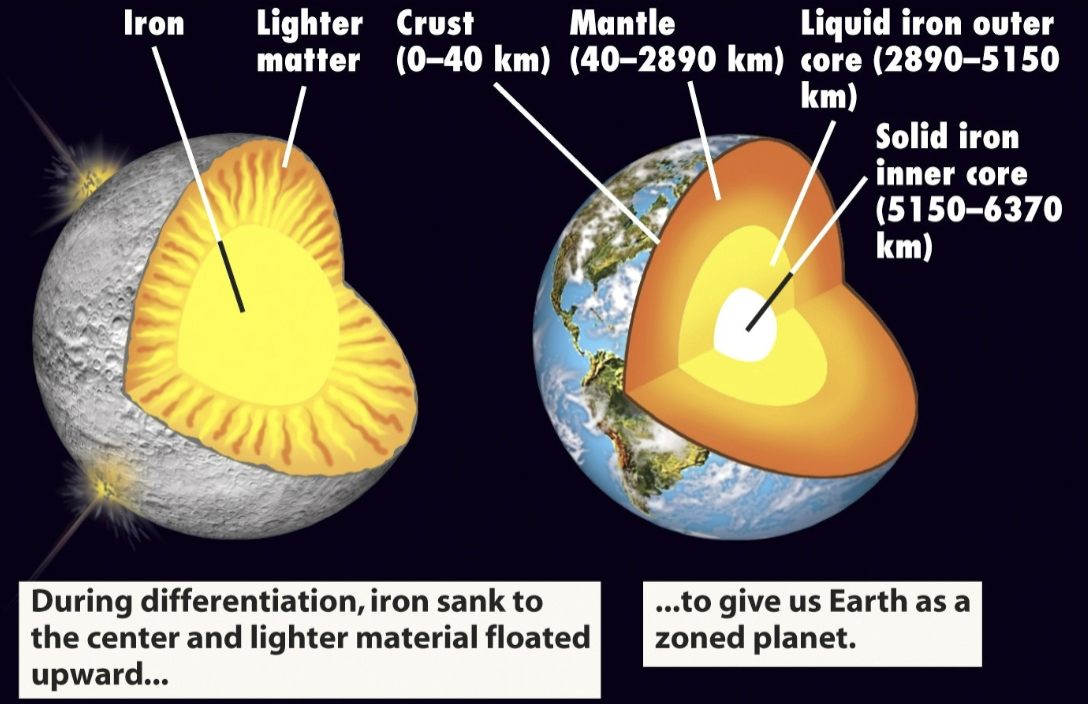
What was going on in Early Earth (Layer formation)?
Earth accreted about 4.6 BYA
As Earth cooled, layers of different elements formed
Layers were naturally sorted by density & gravity
Differentiation/density Stratification
Lower density materials form concentric circles around core
Low density gases pushed to surface to create Earth’s atmosphere (water vapor, CO2, hydrogen)
Differentiation/Density stratification flow
Lowest Density - Silicon
Aluminum
Nickel
Highest Density - Iron
Density equation
D = mass / volume
How do we know Earth’s interior has varying density?
From seismic waves, bending with increasing density through the earth
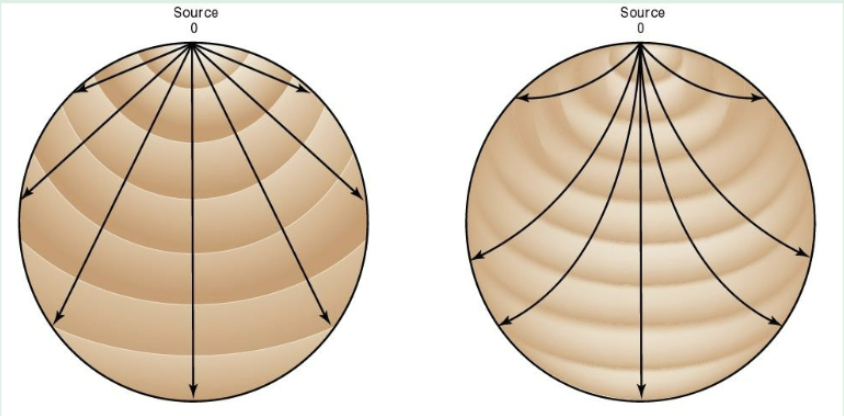
What are the types of seismic waves?
P-waves
Compressional
Fastest
S-waves
Shear
Cannot travel through liquid
How to we know the earth has a liquid outer core?
S-waves cannot travel through it
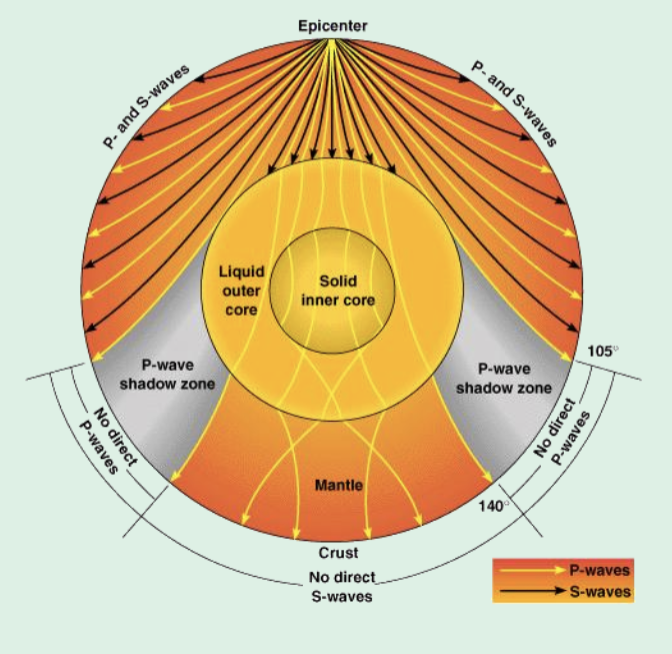
What are the two ways to characterize Earth’s layers?
Chemical and Physical States
Earth’s Internal Structure: Chemical
Crust
Mantle
Core
Crust
Avg 30km thick
Low density
Silicate rocks: granite and basalt
Two types
Continental
Oceanic
Oceanic vs Continental crust
Oceanic
Mostly basalt (fine grained igneous rock)
Darkly colored
Higher density
rich in silicon, oxygen, and magnesium
Continental
Mostly granite
Light colored
Lower density
rich in aluminum, silicon & oxygen
Mantle
30km to 2900km thick
Higher density: 4.5gm/cm3
Iron and magnesium rich silicates
Separated from crust by Moho
Core
2900km to 6371 km thick
Highest density: 13g/cm3
Mostly iron and nickel
Outer core and inner core are compositionally the same
Earth’s internal structure: Physical
Lithosphere
Asthenosphere
Mesosphere
Outer Core
Inner Core
Lithosphere
Avg 100km depth
Cool, rigid, brittle
Crust, and upper mantle
Asthenosphere
100km - 700km depth
Hot, plastic (flows), partially melted
Upper mantle
Mesosphere
700km - 2900km
More rigid because of pressure, some flow
Mid and lower mantle
Outer Core
Extremely Hot
Liquid, flows
Inner Core
Extremely hot
Rigid, no flow
What is the geothermal gradient?
The rate of change of temperature correlated with depth into the earth
Temperature and pressure increase with depth inside the earth
Earth’s internal heat come from residual heat from formation and radioactive decay
 Note
Note  Flashcards (92)