Ultimate BEHV 2700 Midterm Master Guide
 Call Kai
 Learn
Learn Practice Test
 Spaced Repetition
 Match
Match Flashcards
 Knowt Play
1/38

Earn XP
Description and Tags
These flashcards cover the key concepts and terminology related to behavioral research, focusing on principles of behavior analysis, experimental designs, and conditioning processes.
Name | Mastery | Learn | Test | Matching | Spaced | Call with Kai |
|---|
No analytics yet
Send a link to your students to track their progress
39 Terms
Empiricism
Knowledge gained through observation and experience (basis of behavior analysis).
Dependent Variable
The behavior being measured in a study.
Independent Variable
The environmental factors that are manipulated during an experiment.
Falsifiable Hypotheses
Hypotheses that can be proven wrong through experimentation.
Correlational Relationship
A relationship where two variables may change together, but one does not necessarily cause the other.
Group Design
An experimental design that involves random assignment of participants to different conditions.
Single-Subject Design
An experimental design focusing on individual participants, allowing for control comparisons within the same individual.
Comparison Design (A-B)
A simple baseline followed by treatment design, though limited by potential confounding variables.
Reversal Design (A-B-A)
An experimental design that alternates between baseline and treatment then back to baseline to prove functional relations.
Generalization
Occurs when a new stimulus similar to the original evokes the same response.
Operant Antecedent Stimuli
Environmental signals that trigger voluntary actions based on past experiences.
Continuous Reinforcement
Reinforcing every instance of a behavior, typically used in initial learning phases.
Intermittent Reinforcement
Reinforcing some responses, useful for maintaining behavior.
Phylogeny
Innate, unlearned behavior that is genetically driven.
Pavlovian Conditioning
A learning process that involves creating associations between a stimulus and a response.
Extinction (Pavlovian)
The decreased response to a conditioned stimulus after repeated presentation without the unconditioned stimulus.
Multiple Baseline
Staggers the start of treatment across different people, behaviors, or settings
Alternating Treatments
Rapidly swapping two or more conditions to see which is more effective. Used to compare interventions or test hypotheses about why behavior is occurring. (Two-lined graph)
Reversal Design (A-B-A-B)
An experimental design that alternates from baseline to treatment, then to baseline again, then back to final treatment
Three-term Contingency
Antecedent (A) → Behavior (B) → Consequence (C)
Discriminative Stimulus (SD)
An antecedent stimulus that can evoke a specific operant response because the individual has learned that when the SD is present, that response WILL be reinforced
SD Three components
It’s learned, It evokes a specific operant response, that response has to be reinforced in its presence
S-Delta (SΔ)
An antecedent stimulus that decreases a specific operant response because the individual has learned that when the SΔ is present, that response WILL NOT be reinforced.
Discriminative Stimulus for Punishment (SDp)
An antecedent stimulus that decreases a specific operant response because the individual has learned that when the SDp is present, that response will be PUNISHED.
Discrimination Training
Reinforcing a response in the presence of SD and placing it on extinction in SΔ.
Respondent Antecedent Stimuli
biological triggers that automatically elicit reflexes.
Tight Stimulus Control
Behavior only occurs in the presence of the SD and is suppressed in the SΔ, has a narrow generalization gradient
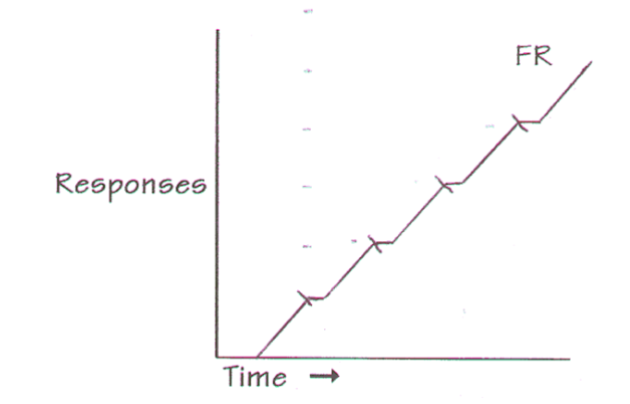
Fixed Ratio (FR)
Reinforcer is delivered after fixed number of responses. Pattern: "Break and Run" (High response rate + Post-Reinforcement Pause).
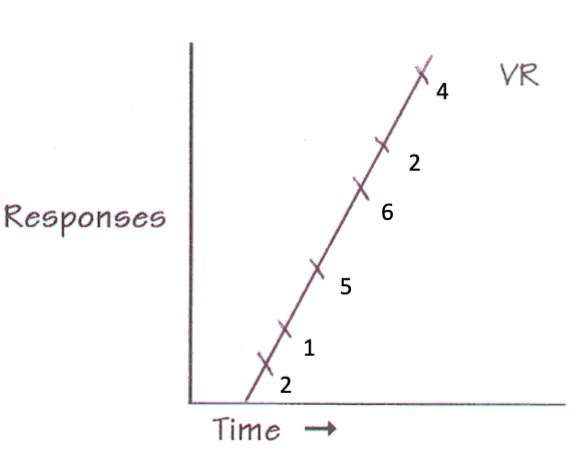
Variable Ratio (VR)
Reinforcer is delivered after variable number of responses. Pattern: Highest, steadiest rate (no pauses). Example: Slot machines. The more unpredictable the reinforcer, the more “lever” presses
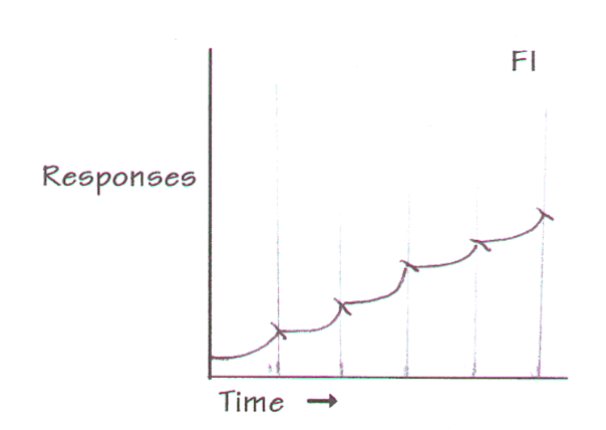
Fixed Interval (FI)
Reinforcer is delivered after the first response that occurs after a constant amount of time. Pattern: "Scallop" (Responding speeds up as the time limit nears). Organism knows the exact time the reinforcer will happen & speeds up near it
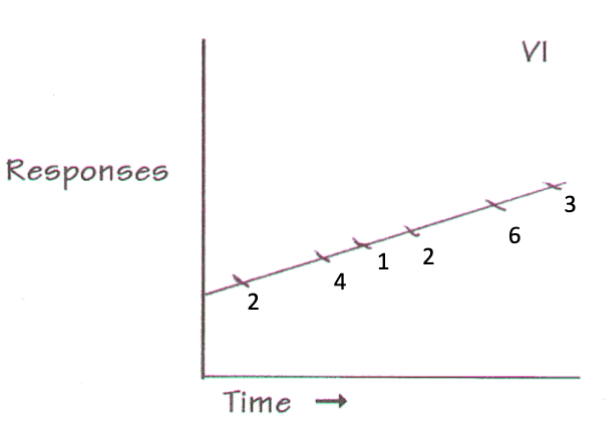
Variable Interval (VI)
Reinforcer is delivered following the first response that occurs after a variable amount of time. Pattern: Low, steady rate. No reinforcement pause, Low to moderate rate of responding
Thinning the Schedule
Gradually increasing the response requirement (e.g., going from FR1 to FR10) to make the behavior more durable.
Elicit
For reflexes and Pavlovian responses (involuntary)
Evoke
For operant behavior (voluntary)
Habituation
Response decreases after repeated exposure (getting used to a noise)
Sensitization
Response increases after exposure (getting jumpy after a scare)
Forward Conditioning
CS presented before US. Most effective arrangement
Backward Conditioning
US presented before CS.
Discrimination
Only the specific CS evokes the CR

