Lecture 1 - cells and tissue of immune system
 Call Kai
 Learn
Learn Practice Test
 Spaced Repetition
 Match
Match Flashcards
 Knowt Play
1/20

There's no tags or description
Looks like no tags are added yet.
Name | Mastery | Learn | Test | Matching | Spaced | Call with Kai |
|---|
No analytics yet
Send a link to your students to track their progress
21 Terms
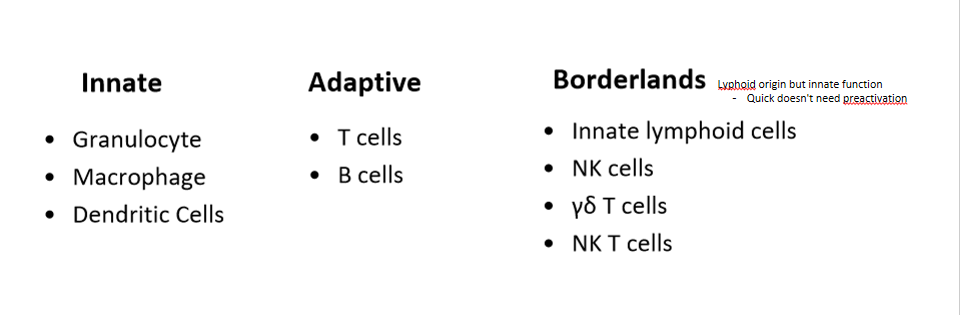
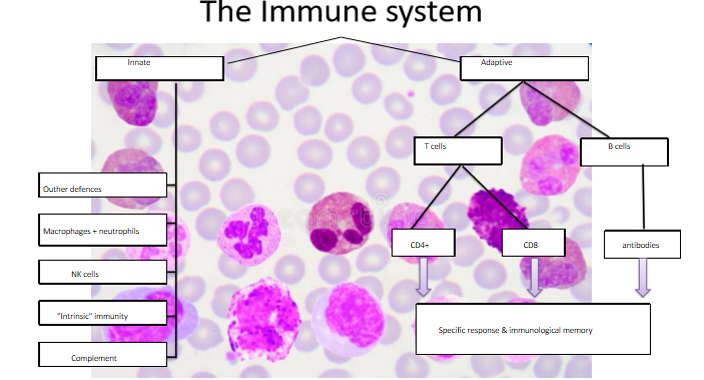
what are the branches of immune system
Innate and adaptive immune system
The 3 Rs of immunity
Recognition
Response
Regulation
What do Immune cells have that help them detect their surroundings?
Thousands of receptors, transmit signals from cell surface to nucleus
What are Cytokines
Soluble messengers that allow cells to communicate (not just for immune cells
made from activated immune cells, epithelial cells and stroma cells
What are the different types of Cytokines ?
Interleukins → communication between immune cells
Interferons → intefere viral infection
Tumour necrosis factors (TNFs)→ cause tumour necrosis
Colony stimulating factors ( CSFs) → stimulate cell growth
Chemokines → allow cell movement
What are the different ways cytokines can behave?
Pleitropy → same cytokine, differnet effect on different cells
Redundancy → different cytokine, same effect
Synergy → have amplified effect on cell
Anagonism → opposite effects
What do immune cells originate from
all orginate in bone marrow
Hematopoietic stem cells → hematopoitic porgenirator cells → Mature Hematopoietic cells
Why doesn’t immune response happen in circulation?
Immune cells must stop at their target cell in order to initiate a response, in circulation blood is constantly moving
Geography of immune cells
All originate in bone marrow, once differntiated enter circulation where can:
enter lymphoid organs through High endothelial venules, then leave to entre lymphatics (where it connects to tissue)
From blood can also enter peripheral tissue through capillaries or venous to act as first line of defence then can drain into lyphatics through lymphatic endotehlial cells
What are the different lymphoidal organs
Primary lyphoidal organs, where immune cells made/originate → bone marrow and thymus
Secondary lymphoidal organs, where immune cells have a repsonce → spleen, lymph nodes
What are the types of graulocytes
immune cells that contain granules :
Neutrophils
Eosiphils
Basophils / mast cells
Neutrophils
major circulting white blood cell
short lived
no inflammation just die
if inflammation they are recruited from blood into tissue, attach to blood vessles
good at phagocytosis, engulf things and have lots of toxic things in granules
different granules release toxic things
no damage to surroudning tissue as toxins released inside neutraphil
funny shaped nucleus
Esinophils
contain granules but with different things inside, contain arganine rich proteins
Mostly in tissue, only few cirulating
reslease highly toxic granules killing paracytes and bacteria that cannot be phagocytosed
release cytokines and prostaglandins inportant for innflamation IL-3, IL-5,IL-8
Mast cells (and basophils)
Mast cells in tissue, they degranulate (herparin , histomines), important in inflammation - they recognise something is wrong and start immune response/ inflammation , sentinal cells
Basophils in circulation
Macrophages
importnat in engulfing bacteria
very long lived
found in tissue
precursor monocyte in circulation → enter tissue become macrophage
Many made before birth e.g in feital liver Kuppfer cells
also have important role in cleaning up debri
Lymphocytes
no granules, just nucleus
make up 25% of white blood cells (leukocytes)
major cell of adaptive immune system
live very long
Various stages of differntatition and behave differently ar different stages ; resting, activates, plamsa cells (only make antibodies, type of B cell), niave (e.g. T cell never seen antigen/ exposed to antigen ), memory
3 types of Lymphocytes:
B cells
originate in bone marrow
recognises antigen diffrentatied into plasma cell and then create antibodies , becomes memory B cell
antibody- meditated immunity
T cells
develop in bone marrow then into thymus matures
cell mediated immunity
activate B cells and other cells
different types of T cells; CD4+ (HELPER T cell), CD8 (cytotoxic T cell)
Natural Killer cells (NK cells)
Important in Innate immune response
large garnular lymphocytes
kill cells that have been infected by virus NOT VIRUS ITSELF
release garnules containing perforin, granzymes to kill cells
secreate IFN-gamma
Lymph node structure
like a sac, all blood passively drains through lymph comes in through afferent end and leaves through efferent end
have T cells in paracorex and B cells in cortex in follicles within germinal center
Dendritic cells
main bridge between innate and adaptive immunity
they are an APC
come form bone marrow, enter blood and then travel to organ where they take residance in e.g. skin
once they encounter an antigen they take up antigen then change conformation/phenotype and then leaves tissue through lyphatics and then goes to lymph nodes
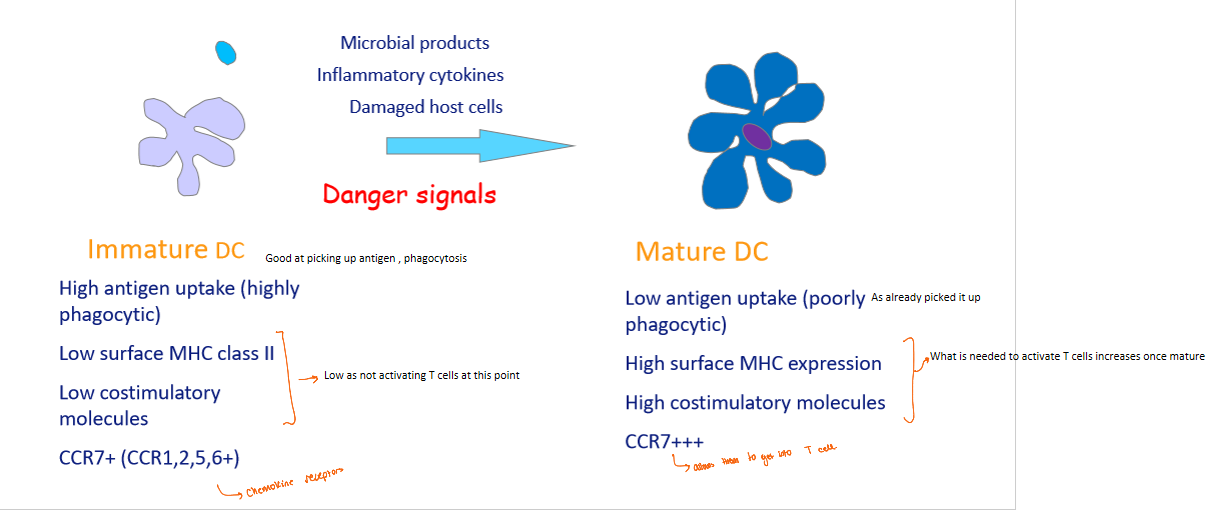
what happens when dentritic cells get into lymph nodes
In lymph nodes have niave T cells ciruclation to match with a DC
T cells enter lyphoid organ from blood through High endothelial venolue
if T cell matches with DC then become effector T cell where will then enter blood and then site of tissue infection
Cells of innate and adaptive immune system