CSD 251 FINAL
 Studied by 0 people
 Call Kai
 Learn
Learn Practice Test
 Spaced Repetition
 Match
Match Flashcards
 Knowt Play
1/75

There's no tags or description
Looks like no tags are added yet.
Name | Mastery | Learn | Test | Matching | Spaced | Call with Kai |
|---|
No analytics yet
Send a link to your students to track their progress
76 Terms
What is ontogeny
the series of steps that ultimately leads to a mature state
What is embryogenesis
the formation and development of an embryo
What happens by 5 weeks of pregnancy?
two small spots appear on either side of the embryo’s head which eventually become the inner ear
What happens by 8 weeks of pregnancy?
middle ear begins to form
What happens by 12 weeks of pregnancy?
hair cells develop
What happens by 22 weeks of pregnancy?
the fetus hears sounds from inside the mothers womb
What happens by 23 weeks of pregnancy?
the fetus can hear sounds from the outside world
What happens by 26 weeks of pregnancy?
the fetus may begin to respond to the sounds it hears
What happens by 32-35 weeks of pregnancy?
post conception, the middle ear cavity, outer ear canal, and outside part of the ear are fully formed
Deafness caused during the fetal development is called?
congenital
What does congenital mean?
present at birth
What are the two basic categories of hearing loss?
non-genetic
genetic
Ototoxicity
from mothers placenta
Anoxia
happens as baby passes through the birth canal
Diseases
from the mothers placenta or birth canal
What are teratogens?
environmental agents that cause a birth defect
What is a syndrome?
a group of symptoms which consistently appear together
How many pairs of chromosomes do humans have?
23
What are the 3 basic types of simple genetic transmission?
autosomal dominant transmission
autosomal recessive transmission
X-linked transmission
What is a neural tube and why it is important for the development of ear structures?
the fundamental embryonic structure that develops into the central nervous system, including the brain and spinal cord
It is crucial for the development of ear structures because neural crest cells, migrate to form key components of the outer, middle, and inner ear.
What does the pinna do?
collects sound and funnels it into the external auditory canal
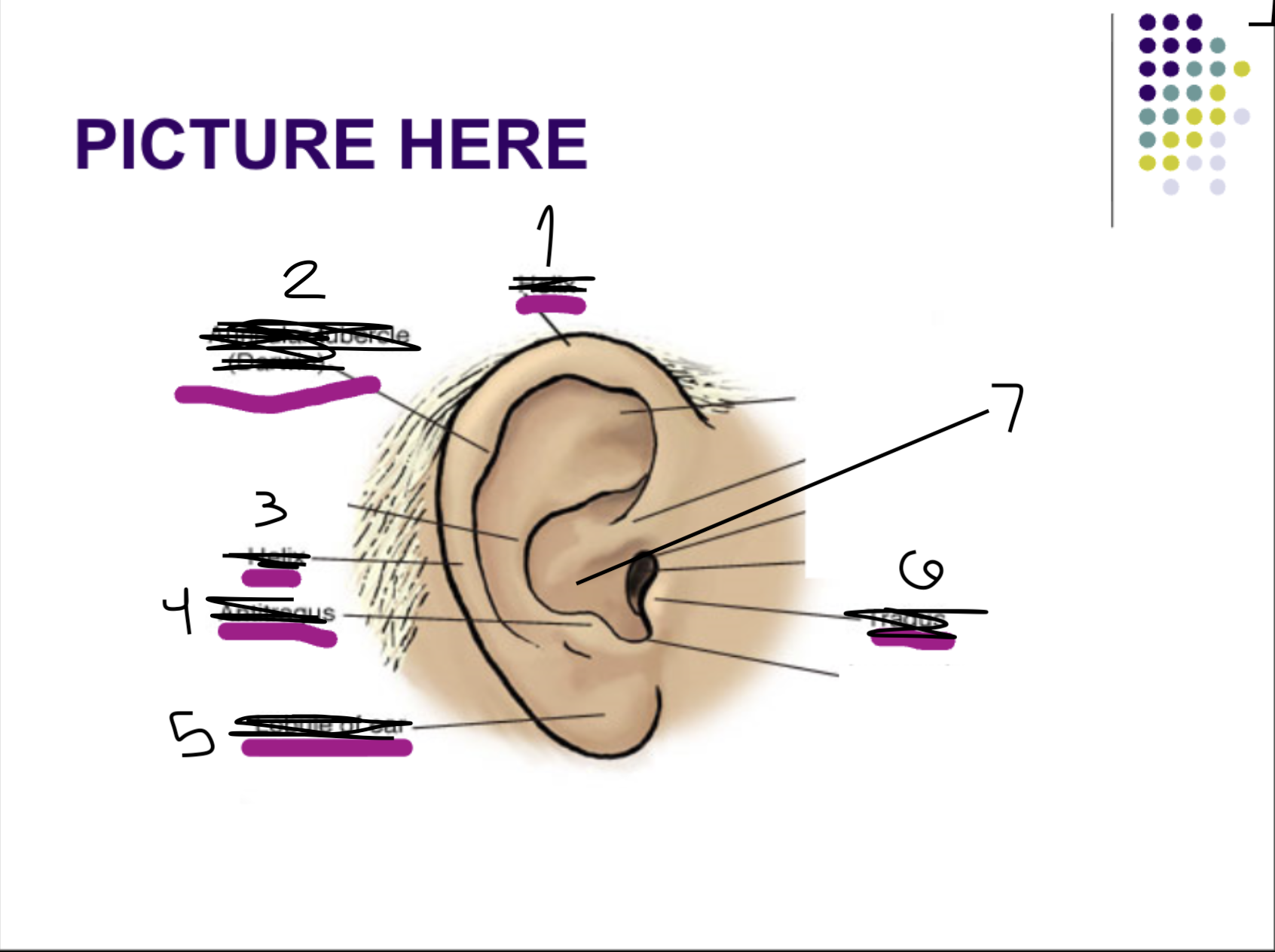
Name the numbered parts of the ear
helix
darwin’s tubercle
helix
anti-tragus
lobule of ear
tragus
concha (cymba/cavum)
The outer lateral 1/3 portion of the ear is what?
cartilaginous
The inner medial 2/3 portion of the ear is what?
bony
The outer ear protects the tympanic membrane from what?
-foreign bodies
-changes in humidity/temperature
What do the structures within the EAC do?
-ceruminous and sebaceous glands form cerumen
- hairs and cerumen protect objects from getting into the TM
What is another name for pinna?
auricle
What does the tympanic membrane do?
separates the EAC from the tympanum or middle ear cavity
What are the two types of fibers in the middle layer of the tympanic membrane?
radial
spiral
What is the pars flaccida?
the upper portion of the TM where the rings of fibers are sparse
What is the pars tensa?
the lower portion of the TM where there are more fibers and the membrane is stronger
What is the umbo?
the very middle point of maximum concavity of TM; where the point of manubrium attaches to the medial (back) of TM
What does the eustachian tube do?
opens and closes to equalize pressure between middle ear and environment
The tympanic membrane holds what ossicles?
-malleus
-incus
-stapes
What does the annular ligament do?
supports the footplate of stapes in oval window
What are the axial ligaments?
posterior ligament (incus) and anterior ligament (malleus)
What is the tensor tympani connected to?
the upper part of the manubrium of the malleus by a tendon
What is the stapedial muscle?
the smallest muscle in the body that attaches to the head of the stapes
What are the 3 methods in which sound can be transmitted through the middle ear?
through bone conduction
thru air in the middle ear cavity
across the middle ear cavity by means of the ossicular chain
What are chilblains?
inflammation of small blood vessels on the skin caused by repeated exposure to cold
How does OME develop?
by bacteria/germs/pathogens migrating up the eustachian tube, which causes swelling+ obstruction
What are the 3 main reasons young children have more OME episodes?
the muscle responsible for opening and closing the ET (tensor veli palatini) is relatively inefficient among young infants+ children
the ET is angled 10 in young children, whereas it is angled 45 in adults
the ET is very short in infants, so fluid is able to reach the ME from nasopharyngeal area fairly easily
What are the most common pathogens?
-streptococcus pneumoniae
-haemophilus influenzae
-moraxella catarrhalis
What is tympanosclerosis?
white shale-like plaques on the TM and deposits on ossicles, which result in stiffening the TM and impedes movement
What is adhesive otitis media?
a form of chronic otitis media where there is an adhesion of the middle ear structures as a result of chronic inflamation
What causes facial paralysis?
VII cn passing through a section of the middle ear- if the toxic effects of the fluid errode a section of ME, then the VII nerve can be exposed and paralysis can occur
How do you manage OME
-administration of antimicrobial agents
-antihistamines and decongestants
-surgeries
What do bone conduction hearing aids do?
vibrate the skull to activate the cochlea
What is osteosclerosis?
a disorder in which there is formation of new bone around the foot plate of stapes, resulting in progressive conductive hearing loss
What is a stapedectomy?
a tiny plastic or steel strut that completely replaces the removed stapes
What is osteogenesis imperfecta?
a genetic disorder also know as brittle bone disease, that mainly affects the development of bones
what is barotrauma?
physical damage to body tissues caused by a difference in pressure between gas space inside the body and the surrounding gas or fluid
What are the two types of hearing loss?
conductive hearing loss
sensorineural hearing loss
What is conductive hearing loss?
hearing impairment that occurs when sound waves are unable to pass through the outer and middle ear structures to reach the inner ear
What is sensorineural hearing loss?
hearing loss that occurs when the hair cells in the inner ear (cochlea) or the auditory nerve are damaged.
Disorders of the outer and middle ear cause what?
conductive hearing loss
Disorders of the cochlea cause what?
the “sensori” part of “sensorineural”
Disorders of the VIII cn cause what?
the “neural” part of “sensorineural”
What is ototoxicity?
the term used to describe hearing loss caused by chemical agents
What is vestibulotoxicity?
damage to the vestibular system, which is responsible for balance and spatial orientation
What is acquired hearing loss?
hearing loss that develops after birth
What are synergistic effects?
two or more agents that work together to cause more of a problem/loss/disorder than any one of the agents alone would cause by itself
What are ototoxins?
chemicals or agents that are toxic to the auditory system and effect hearing and/or balance
What do aminoglycosides do?
treat gram-negative aerobic bacteria
What are the “Mycin” drugs?
-streptomycin
-gentamycin
-kanamycin
-tobramycin
What do chemotherapeutic drugs do?
treat cancers/destroy cancer cells
eg: cisplatin, carboplatin
What is serial monitoring of hearing?
the practice of tracking changes in a person's hearing over time by repeatedly performing hearing tests
What are loop diuretics?
drugs that increase urine flow and cause diuresis
What is presbycusis?
a usually gradual, frequently bilateral sensorineural hearing loss related to the damage caused by the affects of aging in the inner ear
What are the symptoms of presbycusis?
other peoples voices sounding mumbled or slurred
can’t hear high pitched sounds
men’s voices are easier to hear than women’s
What does decussate mean?
to cross over
What does ipsilateral mean?
on the same side of the body
What does contralateral mean?
on opposite sides of the body
What is a noise notch?
a characteristic "dip" on an audiogram that indicates hearing loss, often caused by exposure to loud noise
What does bilateral mean?
hearing loss in both ears
Right ear advantage
The right ear’s strongest pathway decussates across to the left hemisphere of the brain, where the primary and secondary auditory cortex is. The left ear’s strongest pathway
decussates across to the right hemisphere of the brain, then the neural activity has to pass back across the corpus callosum to get to the left hemisphere to be processed as speech and language.
 Note
Note  Flashcards (87)