Forensic Psychology and Psychiatry - HOSA
 Studied by 2 people
 Call Kai
 Learn
Learn Practice Test
 Spaced Repetition
 Match
Match Flashcards
 Knowt Play
1/51

There's no tags or description
Looks like no tags are added yet.
Name | Mastery | Learn | Test | Matching | Spaced | Call with Kai |
|---|
No analytics yet
Send a link to your students to track their progress
52 Terms
Psychologist
Scientist and/or counselor who studies the human mind and behavior. Holds a PhD or PsyD degree.
Psychiatrist
A medical doctor who has specialized in the diagnosis and treatment of psychological disorders.
Counselor
An expert in the field of psychology; may obtain a license without an M.D. or a doctorate.
Forensic Psychology
Experts in human thoughts and behavior are brought in by law enforcement or the court to provide psychological assessments
Who, what, when, where, how?
Question(s) answered by physical and testimonial evidence collected by forensic investigators.
Why?
Question(s) answered by forensic psychology professionals.
Unsub
Term used to describe the individual who is thought to be guilty of a group of serial murders. (Short for unknown subject)
Malingering
Deliberate faking of a physical or psychological disorder motivated by gain.
Insanity Plea
A claim by a defendant that he or she lacks the soundness of mind required by law to accept responsibility for a criminal act.
Child Custody Evaluation
a psychologist provides an assessment to help the court in deciding who has legal and physical care and control of a minor child.
Tools of Forensic Psychology
Medical records, examinations and tests; Psychiatric tests, interrogations; Reports from police, witnesses, friends, and family; Crime scene evidence
Adversarial
opposing, antagonistic; the type of relationship between a forensic psychiatrist and the suspect of a crime
Cooperative
trusting, working together; the type of relationship between a clinical psychiatrist and their patient
Psychological Autopsy
Information is gathered from personal documents and belongings, police reports, and interviews with friends and family. This info is used to reconstruct what the person thought, felt, and did before death.
CT (computed tomography) & MRI (magnetic resonance imaging)
Provide(s) a 3-D image that can identify structural problems in the brain that might cause psychological abnormalities
EEG (electroencephalogram)
Tool that measures brain activity under various conditions; may reveal cognitive abnormalities.
Myers Briggs Test
Personality inventory tool that analyzes an individual's social, emotional, organizational, and other behavioral tendencies.
OCD (obsessive compulsive disorder)
an individual has anxiety, provoking thoughts that will not go away and or urges to perform repetitive ritualistic behaviors to prevent or produce future something
Schizophrenia
A disorder characterized by the profound disruption of basic psychological processes; a distorted perception of reality; disturbances in thought, motivation, behavior, and speech
Bipolar Disorder
A mood disorder in which a person alternates between the hopelessness and lethargy of depression and the overexcited state of mania
Dissociative Identity Disorder
Psychological disorder that occurs when a person has two or more distinct, well-developed personalities. Typically the personalities are dramatically different from each other, and there is a distinct unawareness of the other personalities. A.K.A. Multiple Personality Disorder (MPD)
Projective Testing
Group of personality assessments where a client is asked to analyze or draw an image--the client is thought to project subconscious aspects of his psyche through these tests. Used to identify abuse and psychopathology.
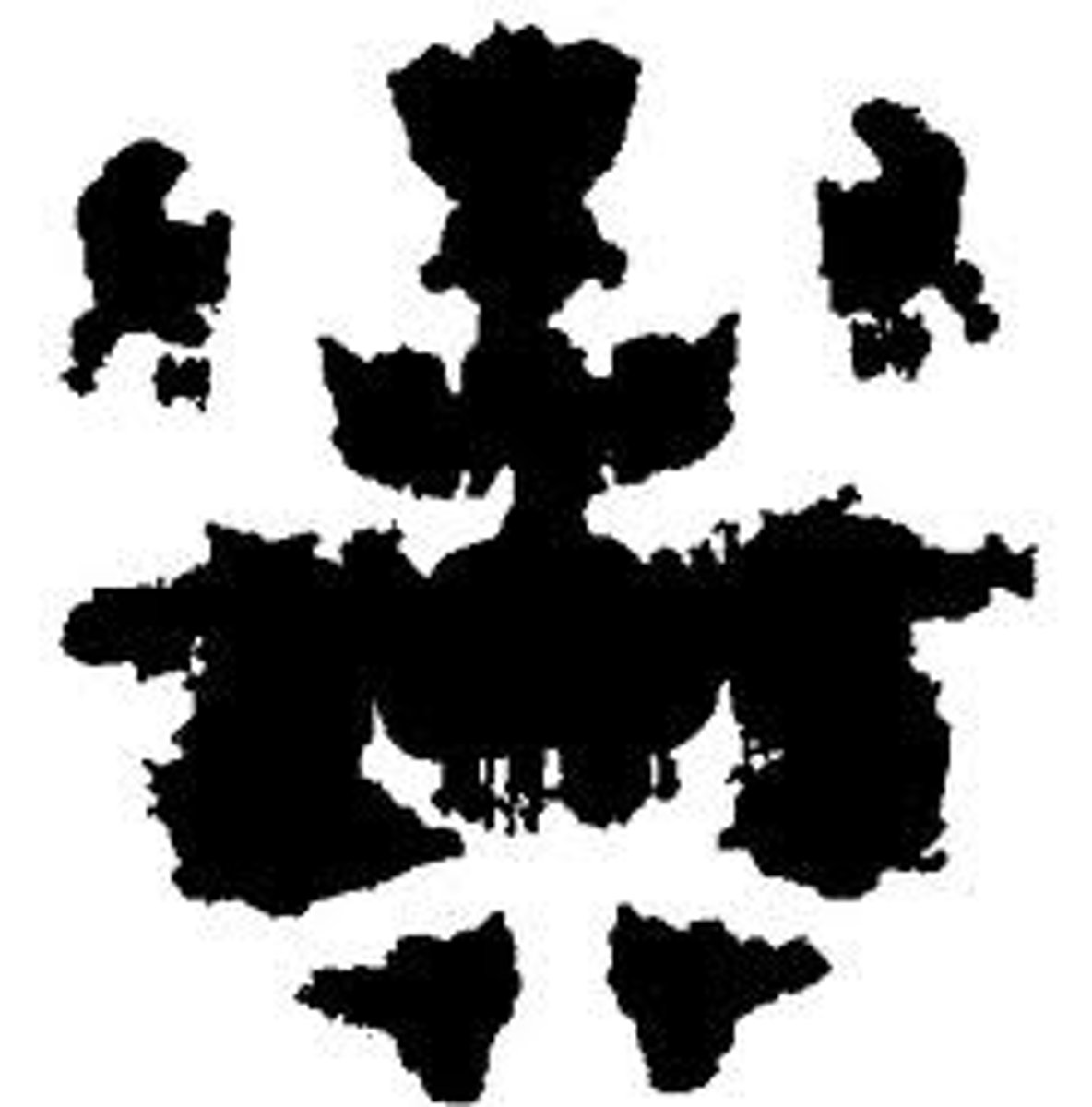
Rorshach Test
psychological assessment in which ink blots are used to examine a person's emotions and personality
Projective Drawing
A subject is asked to draw a picture, for example: draw a picture of a family doing something together. The contents of the drawing are used to analyze the subject's psychology.
Thematic Apperception Test
Subject is instructed to analyze a picture of people and make inferences about what is happening or what happened before the picture.
Signs of Lying
Micro expressions, nervousness, body language, abnormal eye contact, eye movements
Micro Expressions
when trying to hide true feelings, reflexes cause the facial muscles to show emotions for a few tenths of a second
Kenneth Bianchi
Serial rapist and murderer who famously faked multiple personality disorder in an attempt to get an insanity plea; Steve made me do it.
Aileen Wuornos
Paranoid schizophrenic prostitute turned serial killer; shot and killed at least seven of her clients in Florida.
Ted Bundy
raped and murdered over 30 women in the 1970s; bite marks were used as primary convicting evidence; law student who represented himself in court; showed typical signs of antisocial personality disorder.
Richard Ramirez
convicted for mutilation, rape, and the murders of at least 16 people in California in the 1980s; known as the "Night Stalker;"
Charles Manson
serial killer/cult leader who orchestrated the murders many people in an attempt to start a "race war"; sentenced the death penalty, but sentence was changed to life in prison after Furman v. Georgia
Amanda Knox
convicted, acquitted, convicted again, acquitted again during a four-year murder investigation in Italy
False Confessions
Especially in sensationalized cases, people often tell law enforcement that they committed crimes when they are actually innocent.
Competence
According to due process, the defendant must be able to understand the proceedings of the court system as well as the possible consequences of his actions
Insanity
legal term describing a condition where a person does not appreciate the wrongness or illegality of his actions
M'Naughten Rule
The idea that a person is considered to be insane if he suffers from any mental disorder that prevents him from understanding the nature and the consequences of his actions
Omnibus Crime Code for Insanity
people can be found not guilty by reason of insanity if they didn't appreciate the illegality of their behavior.
Diminished Capacity
temporary conditions during the commission of a crime reduced the criminal's ability to alter his actions or to distinguish between right and wrong
Spree Killer
a killer of multiple victims whose murders occur over a relatively short span of time with no cooling-off period between murders.
Serial Killer
A person who kills 3 or more persons in three or more separated events with a cooling-off period in between murders
Mass Murderer
the killing of four or more victims at a single location during one event with no cooling-off period.
Jeffrey Dahmer
lured young men into his apartment, drugged, sexually assaulted, murdered, mutilated, and ate them, storing their body parts around his house; experimented in making "sex zombies" by performing lobotomies on his victims
generalized anxiety disorder
a state of constant, uncontrolled worry that is not associated with any specific object or event
Wayne Williams
Convicted of the Atlanta child murders of 1979 to 1981; his case was a breakthrough success in the early stages of criminal profiling by the FBI
John Douglas
Considered the father of criminal profiling; former chief of the FBI's Behavioral Analysis Unit
Jason Gideon
Supervisor of the FBI's Behavioral Analysis Unit on the fictional series "Criminal Minds"
Organized Offender
A person who commits a planned crime, in a premeditated and controlled manner, leaving few to no clues. Will generally choose their victims with precise specifications.
Disorganized Offender
A person who commits a crime haphazardly as an opportunity presents itself, using weapons found at the scene and often leaving many clues.
Modus Operandi (MO)
The steps taken by a criminal that are necessary for the completion of the crime (ex: how they access the victim and what weapon they use).
Signature
Things done by a a criminal that are unnecessary for completing the crime; an added "flourish" (ex: taking something away or leaving something at the crime scene.)
Victimology
a field of study that examines how certain people become the victims of crimes, as well as how victims are affected by crimes
 Note
Note  Flashcards (25)