CLST210 - Final test
 Call Kai
 Learn
Learn Practice Test
 Spaced Repetition
 Match
Match Flashcards
 Knowt Play
1/30

There's no tags or description
Looks like no tags are added yet.
Name | Mastery | Learn | Test | Matching | Spaced | Call with Kai |
|---|
No analytics yet
Send a link to your students to track their progress
31 Terms

The Satirical Papyrus in the British Museum,
Ramesside period (ca. 1250BC-1150BCE)
Depiction of an antelope and a lion playing a board
game called senet; use of astrologoi (ankle bones) as
game pieces
- Depiction of a fox and a cat herding goats and ducks
respectively
- Depiction of a lion having sex with an unknown hoofed
animal
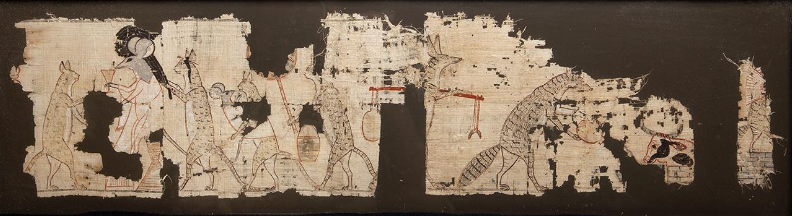
The Satirical papyrus at the Cairo Museum
Depicts a “Lady-Mouse” being waited on by cats,
including one who is braiding her hair, which is a wig
- There is another cat who is holding the baby mouse
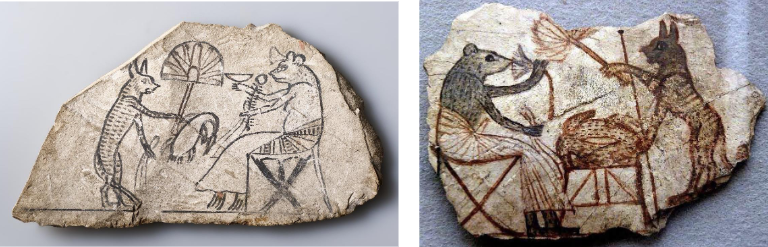
Limestone ostraka showing a Mouse-lady waited by a cat servant
Ostraka (Singular: Ostrakon) incorporate either
textual attestations or figured attestations
- There are a number which also depict animals
in human roles, specifically cats serving mice
- Limestone Ostraka Showing a
Lady-Mouse Waited on by a Cat Servant
- Fanning He
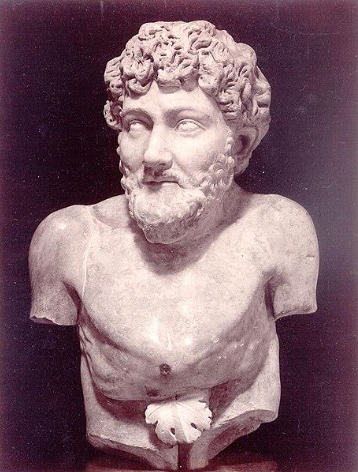
Portrait thought to represent Aesop, storyteller and author of fables. Lived between the end of the 7th c. BCE and mid 6th c. BCE.
Aesop is first mentioned in Herodotos, who places him in a time that corresponds
to the 6th c. BCE. Aesop was a storyteller and author of fables and he was a slave. He lived between the end of the 7th c. BCE and mid 6th c. BCE.
Aesop was a storyteller and fable-writer who lived between the
end of the 7th century BCE and mid-6th c. BCE
- Logopoios: fable-teller
- He was Phrygian
- He was also a slave
➔ Most biographical information about Aesop comes from the
anonymous Life of Aesop, a 1st or 2nd c. CE biography
- In this work, there is a focus on his ugly appearance and
inability to speak
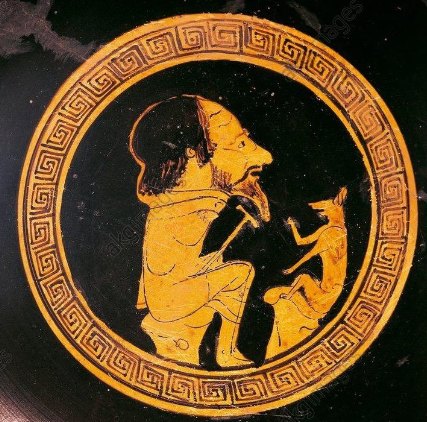
Aesop and the fox, Attic cup, 460-430 BCE
“The life of Aesop”
Great benefactor of mankind,
He was a slave of a really ugly, short, disabled dude. then Isis restored his voice and gave him excellent speech. Then the Muses gave him the power to devise stories and the ability to conceive and elaborate tales in Greek.
Aesop and the Fox, Attic Cup, 460-430 BCE
- Caricature of Aesop
- This works claims that the goddess Isis gave him the ability to speak
➔ Aesop is first mentioned in Herodotus, who places him in the 6th c. BCE
➔ Portrait Thought to Represent Aesop
- It is likely that he was disabled, as is visible in this depiction
in the way the chest is represented
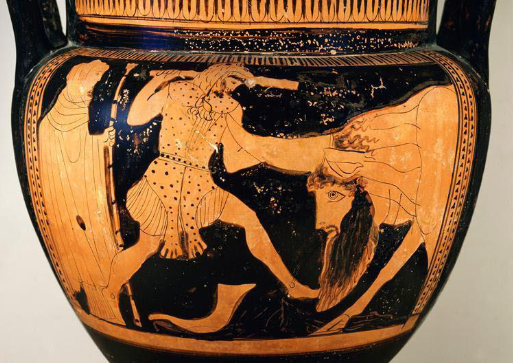
Strabo says -
Athenian red-figure vase depicting Herakles Acheloos and Deianira, ca. 450 BCE
River deity associated with the largest river in Greece
- There is a myth which is mentioned by Strabo in which Herakles
defeats Acheloos and therefore wins the hand of Deianeira
- After this, Acheloos attempts to convince her father to allow him to
win her hand instead, and presents himself to him in three forms: a
bull, serpent, and half ox/half man
Myth narrating how Herakles defeated the Acheloos
The prize of his victory was the hand of Deianeira, the daughter of Oeneus.
According to Sophocles - coming now as a bull in bodily form or Serpent coils or the trunk of man and front of ox.
Rep of Herakles fighting against Acheloos
Athenian red-figure vase depicting Herakles Acheloos and Deianira
Acheloos is pictured with water coming out of its mouth to symbolize the river
Herakles wearing lionskin with club.
Cornacopia - Herakles gets married and has children - Sign of Fertility
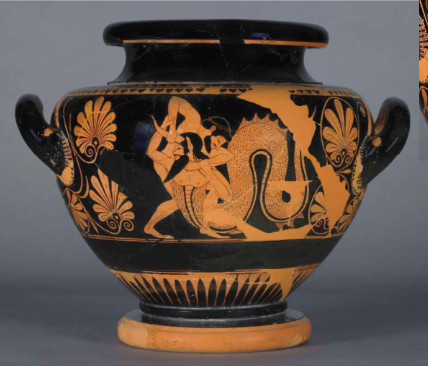
Athenian red-figure vase depicting Herakles and Acheloos, ca. 520 BCE
- Achellos - Coils of a snake
○ Herakles is fighting Acheloos - big horn coming out of his forehead
○ Athenian red-figure wave dipicting Herakles and Acheloos ca. 520 BCE
- This myth was also very popular among the Romans
They pictured Acheloos as a man - keep the horn coming out of his head
In this example, Acheloos is depicted as a snake; there is multiple
versions
- He is still depicted with a large horn coming out of his head,
identifying him, but in this case the figures are also labelled
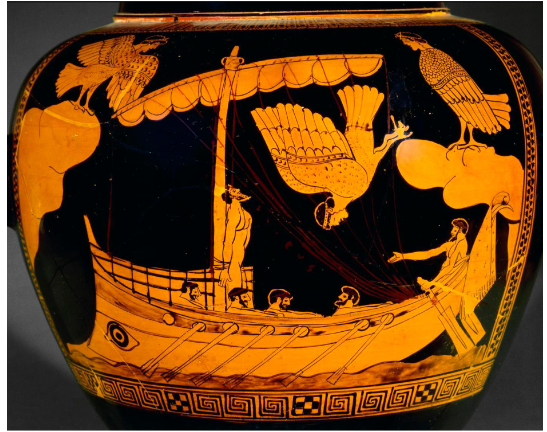
Odysseus and the Sirens on an Athenian red-figure vase, 480-470 BCE
Sirens
- The return of Odysseus to Ithaca-
- Odysseus and the Sirens on an Athenian red-figure vase.
- Songs of the Sires are sweet- Put bees wax in his ears and is companions ears - so that no one would be turned by the songs
- Sirens were so distressed that they threw themselves into the sea
- He had his companions tie him to the mass so that he could experience the songs
- Through their songs - the sailors would die- funerary meaning given to them
When the Sirens could not succeed in luring them into the
sea, they were so distraught that they dove and threw
themselves into the water
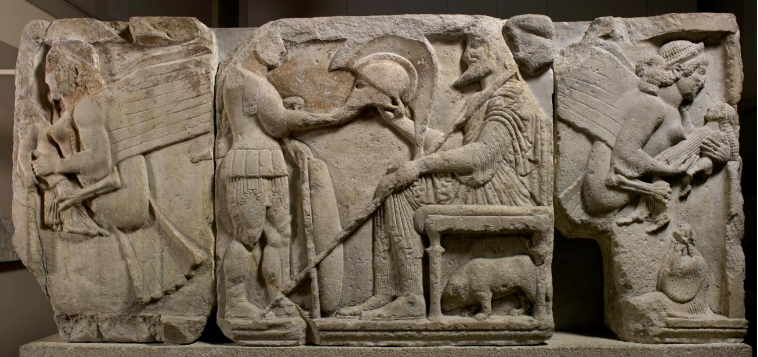
Relief from the so-called Harpy Tomb found in Xanthos Lycia, 480-470 BCE
○ Relief from the so-called Harpy Tomb found in Xanthos Lycia, 480-470 BCE
○ Sirens are represented with the bust of a women - they are transporting the body of the deceased
Sirens were also the grieving companions of Persephone
- Persephone was abducted by Hades - taken to the underworld
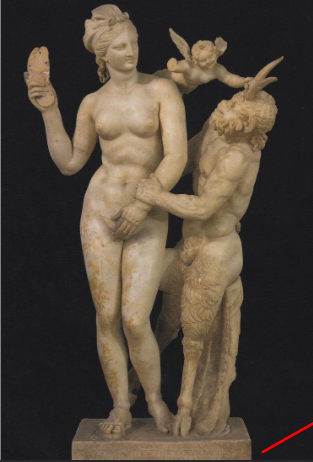
Aphrodite, Pan and Eros, from Delos, Establishment of Poseidoniasts of
Berytos, dedicated by Dionysios of Berytos to his native gods, c. 100 BCE
Pan
- Pan had horns and looks like a goat from the waist down, and with that long beard he sports he is little different from a goat
- Pan was one of the deities from the homomeric hymns - created from Homer
○ Goats feet, two horns, a lover of merry noise - Shepard god, long haired, unkempt.
- Represented sometimes as an outright goat
- Also represented as a half - Human body- goat head and feet. - with beard
Pan Aphrodite, and eros - found on delos
- Dedicated by Dionysos, son of zenon.
- Aphrodite, pan and Eros, from delos, establishment of Poseidoniasts of Berytos, dedicated by
○ Pan is studying Aphrodite closely and Eros (her son) is pushing him away.
○ Aphrodite is covering her private areas.
○ Pan is pictured with a human torso - hybrid goat/human face and goat legs/feet
○ Lagobolon - hunting tool - pictured beside pans legs
- Not really a cult for animal/human hybrids
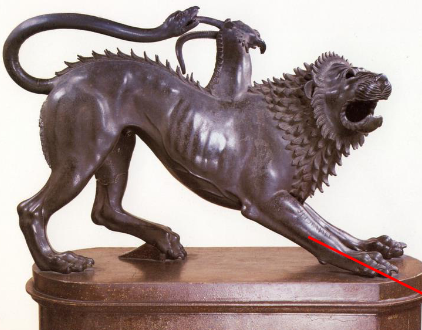
The Bronze Chimaera for Arretium (Arezzo); uncovered in 1553, late 5th c. BCE
Chimaera
The Chimaera consists of a lion with a
goat head coming out of the back, and a
snake as a tail
- There is an Etruscan inscription on front
leg, tinscvil, declaring it a votive offering
- While it was a votive offering, there is no
indication that the Chimaera was
worshipped
- Term: Teras = Monster
- In general, it seems that animal-animal
hybrids did not receive a cult, while
human-animal hybrids did
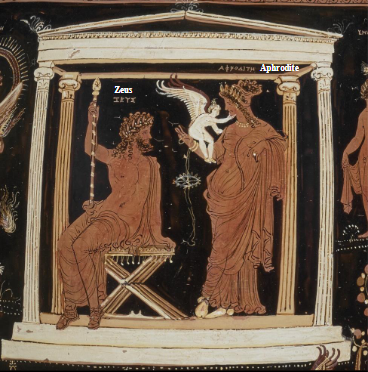
Apulian red-figure vase with the Myth of Zeus and Leda, 350-330 BCE
Bestiality and Metamorphosis
- The change can be temporaneous or permanent
○ Gods could change themselves into animals to serve a specific purpose
○ Humans could also be turned into animals for life
Myth of Leda and the Swan
- Zeus was interested in Leda, so he transforms into a swan in order
to “mate” with her
- Apulian Red-Figure Vase with the Myth of Zeus and Leda, 350-330
BCE
- Aphrodite is depicted with an iynx, helping Zeus in his desire
for Leda
- Leda is depicted kissing the beak of the swan
- One of the offspring fom this union is Helen, who was born from an
egg
- Limestone Egg with Helen Hatching Out, 5th Century BCE
○ Hellen (of troy) was the offspring of Zeus and Leda - she was born from an egg
○ Hellens father was King Tyndareus
Helen - Limestone egg with Helen hatching out, 5th c. BC
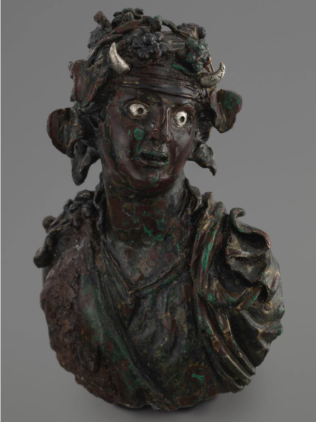
Bronze and Sliver bust in the shape of Dionysos Tauros from Alexandria Egypt, 2nd-1st cen BCE
Dionysus appears to Pentheus with bull
Metamorphosis and liminal creatures were heavily associated with
Dionysos
- This can be seen when Dionysos appears to Pentheus with bull features
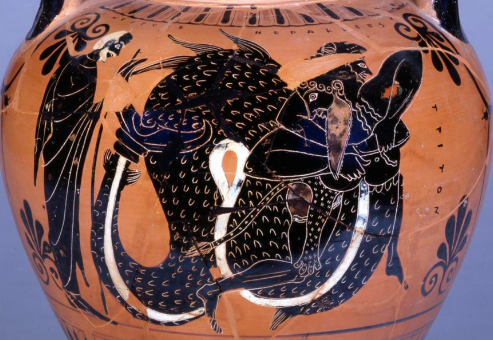
thenian black-figure amphora depicting Herakles and Triton, 510-500 BCE
Athenian Black figure Amphora
- Herakles and triton represented - fighting
- Figure that has the upper part of the body as a human and the rest looks like a snake/fish- there is also fins
- Nereus is pictured on the left- pictured as an old man
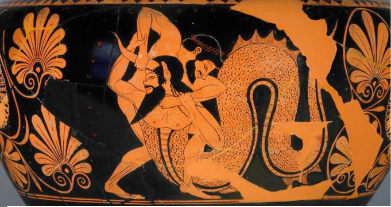
Athenian red-figure vase depicting Herakles and Acheloos, ca. 520 BCE
Acheloos
- Could also have a snake form
- Athenian red-figure vase depicting Herakles and Acheloos,
- Acheloos - pictured with a horn - because of his depiction as a bull - can be recognized by this horn in the middle of his head
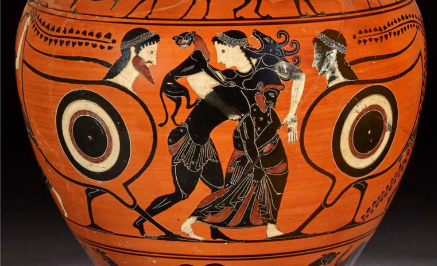
Athenian black-figure amphora with Peleus and Thetis, 520-510 BCE
Peleus is saved by Kheiron
- Peleus was accused that he was trying to make advances toward Astydamia, wife of Akastos, after she fell in love with him and he said no. Akastos made Peleus complete a challenging deed - hoping they would die in the process.
- They went hunting - Peleus fell asleep Akastos left him alone and took his sword. When Peleus woke up the centaurs surrounded him -Kheiron gave him back his sword and then he was able to protect himself.
- Peleus then married one of the Nereids. (Thetis)
- Thetis was trying to escape Peleus
- Athenian black-figure amphora with Peleus and Thetis, 520-520
○ Thetis has 2 different animals coming out of her shoulders - these are the animals she is changing into - while Peleus is trying to abduct her.
○ Sirens pictured - usually women with human head and breasts - bird body
○ Expetion of male pictured with white face(which was reserved for women in Greek art)
Nereus is the father of Thetis - the fair-tressed cuttlefish - dread goddess with voice mortal, who of all fish along knows the difference between black and white
- Cuttlefish (Sepia
- Compared to cuttlefish because they can change color - Thetis in myth changed herself to avoid Peleus - Shared changing aspect.
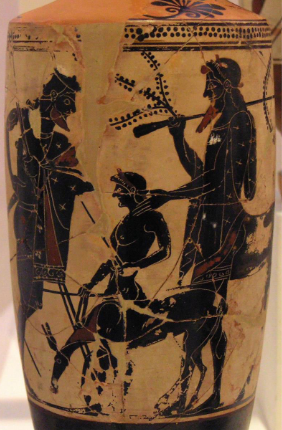
Athenian black-figure vase with Peleus entrusting Achilles to Cheiron, ca. 500 BCE
Peleus and Thetis - after married
- Produced Achillies
- Cheiron gave Peleus a spear of ash
- Posiden gave him horses, Balios and Xanthos, these were ummortal. - later given by Peleus to Achillies and taken to Troy
Chiron - teacher of Achillies
Athenian Black-Figure Amphora with Peleus and Thetis, 520-510
BCE
- Thetis is depicted with two animals coming out of her
shoulders, indicating her transformation is occurring
- The scene is set between two Sirens
- The male Siren is painted with white, which was
conventionally used to indicate that a figure was a woman
- In this case, it was probably meant to indicate a
liminal figure, who exists “in between”
- Chiron also later became Achilles’ teacher
- Athenian Black-Figure Vase with Peleus Entrusting Achilles
to Cheiron, ca. 500 BCE
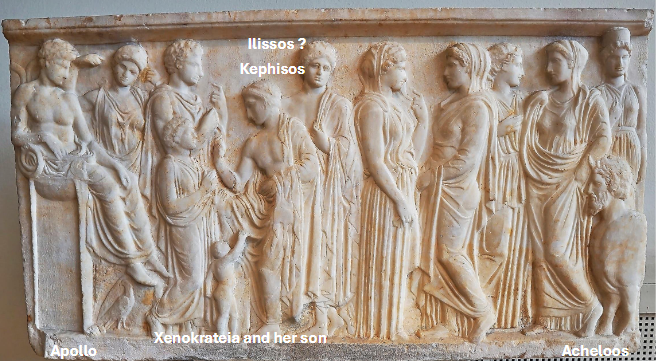
Sanctuary of the river Kephisos,
Relief of Xenokrateia with group of gods, ca. 400 BCE
Sanctuary of the River Kephisos, Relief of Xenokrateia with group of gods
- Pictured Apollo, Lissos, Kephisos, Acheloos, Xenokratia and her son
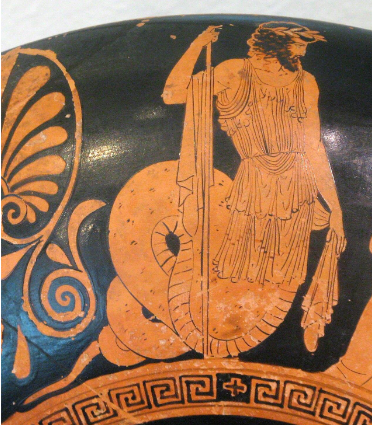
Kekrops on an Athenian red-figure cup, 440-430 BCE
Kekrops
- One of the first kings of Athens
- He has a snake body - head and torso is human
- Very import figure for Athenians - they claimed they had been there from the very beginning. - not concurred by other Greeks
- Snakes not have legs- they slide - they have contact with the survice in which they move -making evident the connection with the territory-
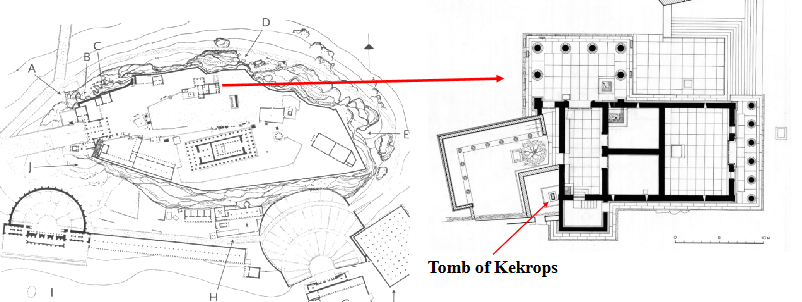
Acropolis of Athens
Erechtheion
Tomb of Kekrops
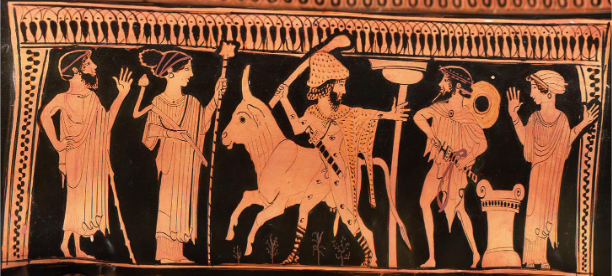
Hermes and Argos Panoptes (Hundred-eyed) on an
Athenian vase, 470-460 BCE
Oistros= Gadfly
- In greek poetic lang - was used for "sting of passion" or
- This goes back to Zeus - Zeus had a fight with Io - Hera turned Io int a Cow
- Zeus sent Hermes to defeat Argos - Fly struck the cow- which ran all the way to Egypt. - Hermes killed Argos infront of Io -
- also pictured as a bull - why?
- Also a Pompeian Frecso of IO reaching Egypt and Isis receiving him.
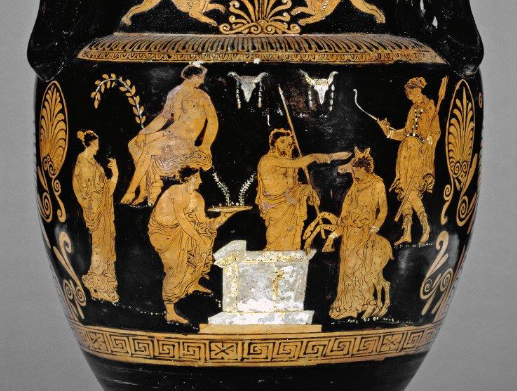
The sacrifice of Iphigeneia at Aulis, South Italian vase, c. 360 BCE
Iphigeneia at Aulis
Iphigeneia was told she was going to get married, by her father Agamemnon- then was brought to be sacrificed
- Artemis then transformed her into a deer
- Sacrifice of Iphigeneia at Aulis, south Italian vase, c.360 BCE
○ Transformation has already started
- She is then brought away by Artemis
She is already in the process of transformation, being depicted with the head and legs of a doe sticking out of her body
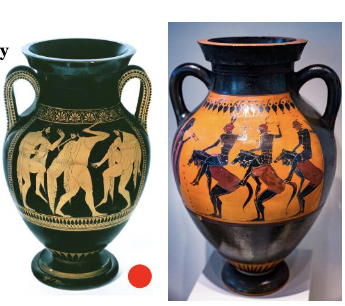
Animals in Comedy
➔ It seems that animal choruses were most popular from 510-480
BC, with a decline until 440 BCE, when there was a revival until
410 BCE
➔ Comedy = komoidia (κωμώδια): “komos-singing” -
- komos: dance at a drinking party; ritualistic procession of
revellers
- Comedy associated with Dionysos
- Athenian Red-Figure Amphora by Euthymides with
Komos Scene, ca. 510 BCE
➔ Periods of Comedy
- Old Comedy (450-380 BC) (Aristophanes)
- Middle Comedy (380-320 BC)
- New Comedy (after 320 BC)
➔ Key Dates
- 486 BC: first comedy at Dionysia
- 445 BC: First comedy at Lenaia
➔ Dithyrambs: choral song in honour of Dionysos
- Attic Vase, Chorus Performing a Dithyramb, mid-6th
century BCE
Aristophanes - Clouds
Plot: Sokates’ method of education is under attack.
Strepsiades enrolls in order to learn how to argue, but when he is too old, sends his son Pheidippides
eventually, the son is able to defend the beating of his father
Animals associated with Strepsiades identify him as a farmer; his problem derives from horses.
Socrates is associated with negative animals to debase his morals
roosters are associated with sleeplessness and aggression in a negative way.
Aristophanes - Birds
Plot: two Athenians, Peisthetairos and Euelpides, are tired of the bureaucracy of Athens, and look for king Tereus, who was turned into a Hoopoe.
they decide to found a city in the sky, eating a magic root which turns them into birds
there is a chorus of birds
Many names of birds are used as jokes and characters introduce bird-like sounds into their speech.
Aristophanes - Wasps
Plot; old man Philocleon has passion for serving on juries
his son, Bdelycleon arranges for a “court” at home.
Philocleon is heald from his passion for law-courts and becomes a drunkard
A chorus of wasp-jurors support Philocleon
Philocleon tries to escape his house in the manner of different animals
Aristophanes - Frogs
Plot- Dionysos is lamenting the low-quality of drama in Athens after the death of Euripides.
he goes to Hades, disguised as Herakles
Dionysos is persuaded by Aiskhylos to bring him back instead
there is a chorus of frogs which make croaking noises.
Pre-Socratic Contributions
Most of the work of Pre-Socratic philosophers are in a poor state of
preservation and are mostly known through secondhand sources
- Differences between animals and humans are less of a concern to
Pre-Socratic philosophers
- Common idea was that unity existed between animals and humans
- This implies that humans eating animals constitutes cannibalism
- Pythagoras and Empedocles were both in favour of vegetarianism
- Anaxagoras of Clazomenae stated the main difference between
humans and animals was that humans have hands
Sophists
Sophists were Intellectuals and teachers who frequented Athens and other Greek cities in the second half of the
5th century BCE
- They believed humans had intellectual superiority over animals, and thus could attain culture and technology
Socrates and Plato
According to Xenopohon, Socrates thought men were superior to animals
- Plato expressed ideas of metempsychosis which were sometimes contradictory
- In his Phaedo, he says that the characteristics one exhibits in life will determine which animal his soul will
transmigrate into after death
- In his Republic, he says one has the choice of what animal he will transmigrate into after death
Stoics and Epicureans
Stoics
- Animal behaviour was entirely driven by nature, and so they acted in accord with nature (kata phusin)
- Humans have reason and so can make bad choices, acting contrary to nature (para phusin)
Epicureans
- Denied rationality in non-human animals

