bio phis
 Call Kai
 Learn
Learn Practice Test
 Spaced Repetition
 Match
Match Flashcards
 Knowt Play
1/41

There's no tags or description
Looks like no tags are added yet.
Name | Mastery | Learn | Test | Matching | Spaced | Call with Kai |
|---|
No analytics yet
Send a link to your students to track their progress
42 Terms
Endocrine gland cells
secrete hormone signals into
blood
Hypothalamus
part of the brain, has neurosecretory cells that secrete releasing hormones
to signal the anterior pituitary
Anterior pituitary
endocrine gland that secretes “tropins” (tropic hormones that signal specific glands,
like the thyroid, adrenal cortex, gonads, etc)
Thyroid gland
secretes thyroxine into the blood; thyroxine hormone (T3/T4) controls metabolic rate and growth
Pancreas
a multi-part gland Bulk is gland that secretes digestive enzymes (into duct)
Small endocrine organs “islets” wthin it, also:
alpha cells secrete glucagon
beta cells secrete insulin (directly into the blood)
also produces enzymes to break down molecules through duct into small intestine
Insulin
a protein hormone secreted by the beta
cells of the pancreas. It is in a control system that
helps keep blood glucose from rising too high.
homeostasis
ability of an organism to maintain internal environment within a
certain range
Negative feedback
A change in a variable triggers a response that counteracts that change
and maintains homeostasis
Positive feedback:
a control mechanism where a change in a system triggers responses that amplify the original change, pushing the process further in the same direction.
neuro-secretory cells.
(hypothalamus) specialized neurons that produce and release hormones directly into the blood, linking the nervous system to the endocrine system.
Tropin
a hormone that stimulates another endocrine gland to release its hormones.
small intestine
site of major digestion (hydrolysis)
and site of absorption into blood via diffusion through epithelial transport cells (gut lining)
Receives secretions from pancreas and liver (fats via bile ducts)
liver
nutrients pass through epithelial cells into hepatic portal vein that in. then process through this organ
processes and redistributes nutrients through the blood into the body
stomach
site of low ph and breaks down proteins
NOT HYDROLYSIS
transport epithelial cells
line organs or cavities and move substances, like nutrients, ions, or water, across their surfaces to regulate absorption and secretion.
tight junctions
connections between epithelial cells that seal the spaces between them, preventing substances from leaking between the cells and controlling what passes through the tissue.
microvilli
tiny finger-like projections on the surface of epithelial cells that increase surface area to enhance absorption of nutrients and other substances.
Na+-Glucose co-transporter
protein in epithelial cells that moves glucose into the cell from the gut lumen by using the sodium (Na⁺) gradient, allowing glucose absorption against its concentration gradient.
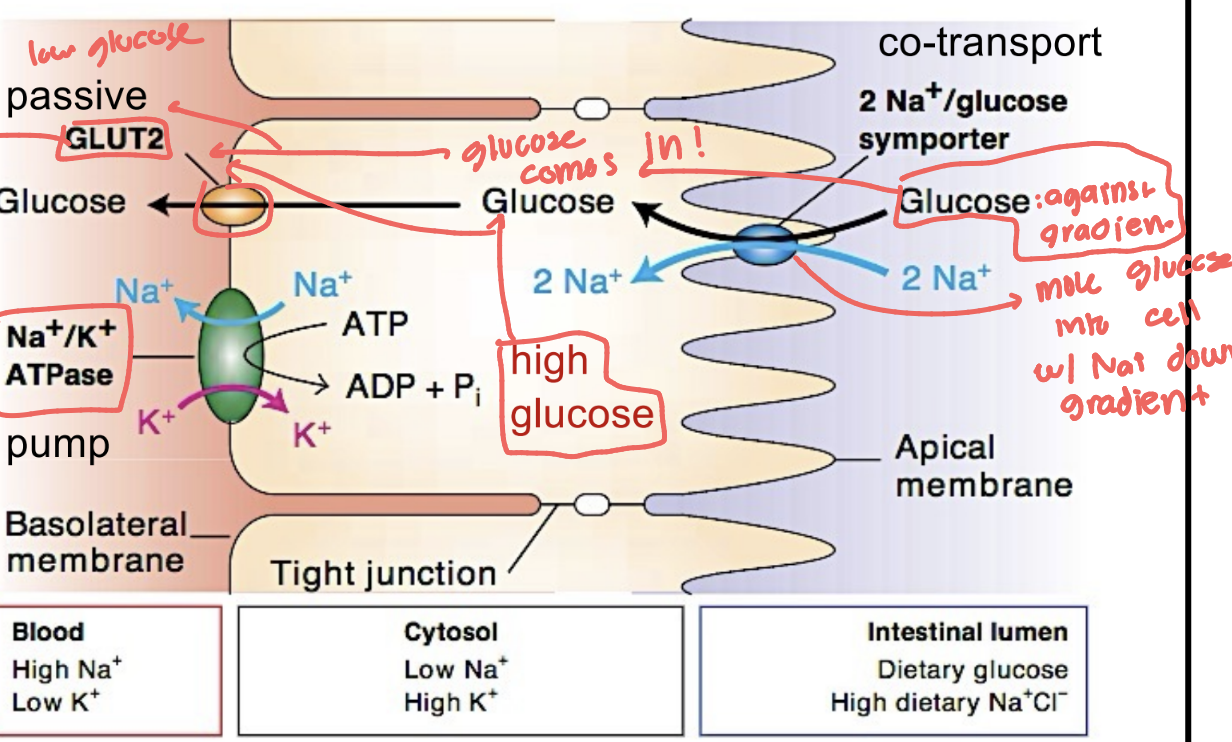
gut lumen
space in front of the epithelial cell- before they enter
osmoregulation
control of fluid solute concentration and overal gain or loss of water by epitheial tissues and blood
excretory tubule
a tube (unit of the kidney) that exchanges water and solutes in the tubule with the blood then eliminates whats left (elimination)
nitrogenous waste
(ammonia, urea, uric acid)- cell waste products (from breaking down amino acids) that are eliminated via excretory system
salt water fish
not enough H2O and too much solute —> excrete small amounts of water and alot of solute\
cells in gills pump out solute
freshwater fish
too much H20 in cells and not enough salt —> excrete lots of water and little solute
nephron
functional unit of the kidney that filters blood and forms urine.
filtration
blood into tubule
reabsorbtion
solutes and water moves from tubules into the blood via transport epithelium cells
secretion
moves solutes and water from blood back into the tubule
excretion
elimination
innate (inborn) immunity
non speicfic- defense repsonse to many types of invading substances
inflammation
body’s protective response to injury or infection, involving immune cells, blood vessels, and chemical signals to eliminate the cause and begin healing.
adaptive (acquired) immunity
involves recognition and responses to highly soecific invading substances with a specific antibody
antigen
specific invading substance
lymphocyte; (B or T)
specialized by cutting and mutating DNA to recognize and defence against one specific antigen, clones itseld and fights the antigen
B cells
lymphocytes that recognize specific antigens and produce and release antibodies through the bodily fluids
T cells
recognize infected or abnormal cells and either directly destroy them (cytotoxic T cells) or help regulate and coordinate the immune response (helper T cells)
macrophage
large immune cell that engulfs and digests pathogens, dead cells, and debris, and also helps activate other immune cells by presenting antigens
mast cell
part of the innate immunity and leases histamine and other chemicals during allergic reactions and inflammation- histome makes capilalries leaking —> water leaks —> swelling
nuetrophil
a type of white blood cell that rapidly responds to infections by engulfing and destroying bacteria and fungi, and is one of the first cells to arrive at sites of inflammation.
humoral
b cells secrete antibody to fight their antigen in body fluids
cell mediated
cytotoxic T cells that kils cells containing their antigen
cytokines
signals released by Helper T cells- proteins that coordinate and regulate inflammation, immune responses, and cell communic

