BIMM 120 (based on notes)
 Studied by 0 people
 Call Kai
 Learn
Learn Practice Test
 Spaced Repetition
 Match
Match Flashcards
 Knowt Play
1/345

There's no tags or description
Looks like no tags are added yet.
Name | Mastery | Learn | Test | Matching | Spaced | Call with Kai |
|---|
No analytics yet
Send a link to your students to track their progress
346 Terms
First Law of Biology
All of Biology must follow the laws of Chemistry and Physics
1st law of thermodynamics
energy/matter cannot be created or destroyed, only transformed
2nd law of the thermodynamics
entropy of a closed system always increases
Corollary 1 of 1st Law of Biology
Life requires the creation of order (decrease in internal entropy while increasing external entropy)
Corollary 2 of 1st Law of Biology
An organism at biochemical equilibrium is dead
2nd Law of Biology
All life is enclosed in membranes
Corollary 1 of 2nd Law of Biology
The cell is the only structure that is able to grow independently; viruses are not “living” because they are unable to grow independently
Corollary 2 of 2nd Law of Biology
All life is programmed by cellular and genetic instructions. If they are insufficient for independent growth, symbiosis will be required
3rd Law of Biology
All living organisms on Earth arose in an evolutionary process, accounting for their similarities, differences and relatedness
Evidence: the genetic code is essentially universal for all organisms on Earth
Corollary 1 of 3rd Law of Biology
All living organisms contain homologous macromolecules (DNA,RNA, and proteins) that are derived from a common ancestor
Corollary 2 of 3rd Law of Biology
Genetic code is universal
Darwin
Darwin was right about the importance of evolution
He did not account for the importance of mutation in the process of evolution
Cooperation can be just as important as competition
Partial Microbes: Nanobacteria and nanoarchaea (CPR/Asgard)
These are extremely small organisms that cannot live independently, as their small genomes lack the genes necessary for DNA replication/metabolic pathways.
They are extremely diverse and live in symbiosis with other diverse, larger organisms
Due to their small genomes, cooperation (symbiosis) must have been the driver of the development of life forms, and once independent organisms arose, competition drove evolution.
“cooperation (symbiosis) must have been the driver behind the development of life form and then once independent organisms arose, competition drove evolution.”
Metagenomics allowed for this discovery. What is metagenomics?
● Consists of DNA sampling of the environment that is amplified by PCR -> sequenced -> pieced together to reveal life forms within the environment
● Allowed for the discovery of organisms that could not be isolated in the laboratory
Timeline of Life on Earth
Bacteria
Archaea
Eukaryotes derived from Asgard archaea
The tree of life is derived from one common ancestor, as evidenced by the universal genetic codes
Lamarck
● Another person, before Darwin. Believed that organisms arose from an evolutionary process
● First theory of inheritance or acquired characteristics (soft inheritance or Lamarckism)
● Believed in a complexifying force
● Proposed the theory of Use and Disuse for phenotypic characteristics
The idea that the giraffe had to evolve to stretch its neck to reach the leaves it needs to consume
Fast forward to today -> Bioinformatics
Every detail of an organism is encoded
This information is to be deciphered and rendered
Evolution is the guide through which we can make sense of biology
Molecular phylogeny
is the most reliable guide for function, mechanisms, and phenotype, and is responsible for many of the aforementioned discoveries
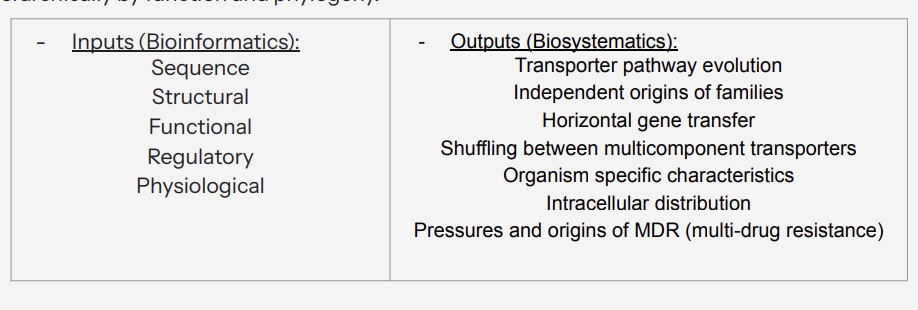
TCDB
Transport classification database, organizes and classifies transporter proteins hierarchically by function and phylogeny.
Purines vs Pyrimidines
● Purines: have 2 aromatic rings
● Pyrimidines: have 1 aromatic ring
C-G vs A-T
C and G have 3 H-bonds when binding,
whereas A:T and A:U have 2 H-bonds
Base pairs aren’t always _____
Base pairs aren’t always linear.
They can have different configurations, such as bent and non-standard pairs (mismatches)
Orientation can make C:G bonds stronger or weaker
Linear -> all 3 H bonds align -> strongest
Bent/twisted -> H bonds not perfectly aligned -> weaker
Codon positions
P2: most important, determine amino acid (AA) type
P3: Wobble position; tolerates mutations, typically without changing the amino acid
P1: Less critical, but determines how crucial P3 is for codon specificity
“P1: Less critical, but determines how crucial P3 is for codon specificity”
Example: If P1 is A or T, H bonds at P3 are less constrained
changing P3 affects binding strength
P3 really matters, and changing it will affect which amino acid you get
If P1 is C or G
H bonds at P3 are already stable
changing P3 doesn’t affect binding much and usually won’t change the amino acid
Amino Acid Rules
If P2 = T
the amino acid is hydrophobic (avoids water)
If P2 = A
the amino acid is hydrophilic (likes water)
If P2 = C or G
the amino acid is semi-polar (partly likes water)
Codon redundancy
the idea that many amino acids are encoded by more than one codon
Protects against mutations such that if one nucleotide changes (mutation occurs), it often still codes for the same amino acid
Known as a synonymous mutation. Protects from harmful changes
Initiation Codons
AUG is strongest, then GUG, then UUG/CUG -> all read as fMet during initiation
Initiation - Wobble
During initiation, wobble rules are different: instead of P3 being the wobble position, P1 will behave as the wobble position, where mutations often won’t change the amino acid
During initiation: P2 and P3 hardly change.
This stability ensures correct recognition by the ribosome
Stop Codons
UAA (ochre) is most commonly used
Weaker H bonds -> _____ for the ribosome to release the chain of amino acids
Weaker H bonds -> easier for the ribosome to release the chain of amino acids
“mRNA:tRNA binding is asymmetric”
Even though we often learn that A pairs with T (or U) and C pairs with G, the direction of the pairing actually matters
A:T is not equivalent to T:A, and C:G is not the same as G:C when one base is on mRNA and the other is on tRNA
tRNA purine:mRNA pyrimidine is ______ than tRNA pyrimidine:mRNA purine
tRNA purine:mRNA pyrimidine is stronger than tRNA pyrimidine:mRNA purine
This is because the ribosome, for reasons not yet fully known, “prefers” that the larger base (purine) be on the tRNA and the smaller base (pyrimidine) be on the mRNA
better stacking, geometry and H bonding
First Law of Biology
All living organisms obey the laws of thermodynamics
Cells are open systems. They constantly exchange matter and energy with their environment. Metabolism is the mechanism that enables this
Genetic variation and evolution allow life to persist and diversify within these physical constraints
Corollary 1: Entropy and resource use
Corollary 2: Biochemical equilibrium = death. Change must be occurring: breakdown, buildup, etc.
Second Law of Biology
All living organisms consist of membrane-encased cells
Corollary 1: The cell is the only structure that can grow and divide fully on its own
Corollary 2: All is programmed by genetic instructions and the instructions are required for sexual reproduction
Third Law of Biology
All living organisms arose in an evolutionary process
All life is related
Genetic similarities and differences are programmed
Natural selection occurs at BOTH genotypic and phenotypic levels
Corollary 1: All living organisms contain homologous macromolecules (DNA,RNA, and proteins) that are derived from a common ancestor
Corollary 2: Genetic code is universal
DNA sequencing has been a massive drive in biological discoveries
We may never know how life arose, however, life is not required for the inanimate universe to continue
Likely life came from inorganic molecules but requires a lot of research to be completely sure
Discovery of new microbial groups reshapes our understanding of the tree of life. What is the relationship between Eukaryotes and Archaea?
Evidence suggests Eukaryotes evolved from within archaea, not as a separate domain
“Eukaryotes evolved from within archaea, not as a separate domain.” What allowed for these findings?
Metagenomics allowed for these findings
Genome reconstruction was possible directly from environmental DNA
Organisms were revealed that could not be cultured in the laboratory
Classification does not rely solely on morphology anymore!
CPR (Candidate Phyla Radiation) Bacteria represents a…
CPR represents a massive monophyletic radiation of bacterial phyla (includes Patescibacteria).
Monophyletic: Descended from a common evolutionary ancestor
Most CPR bacteria are symbionts or episymbionts (symbionts that live on the surface of another microbe)
CPR (Candidate Phyla Radiation) Bacteria
Typically have: very small genomes, small cell sizes, limited metabolic pathways
CPR bacteria often lack the ability to synthesize ______
Amino acids, nucleotides, lipids
They depend on host microbes for survival
DPANN Archaea
DPANN is a radiation of archaea found mostly in extreme environments
Despite this, their genomes contain genes associated with free-living lifestyles
DPANN archaea:
Have outer membranes
Possess surface structures (exp. hami) for attachment. Like grappling hooks
Form biofilms and may grow autotrophically
DPANN vs CPR
They share some key traits with CPR bacteria:
Small genomes and cells
Limited metabolic abilities
Missing or incomplete pathways
Show evidence of gene-sharing across domains
Asgard Archaea and eukaryotic origins
Asgard archaea are closely related to eukaryotes
Their genomes encode eukaryotic signature proteins (cytoskeleton, trafficking…)
This supports the idea that:
A bacterial endosymbiont fused with an Asgard archaeal host
This event gave rise to early eukaryotic cells
Isoprenoids and the “Lipid Divide”:
● Isoprenoids are essential carbon-based metabolites in all life
● Lipid Divide: Idea that bacteria and archaea are fundamentally different because their cell membranes are built differently
Lipid Divide
Archaea membranes use isoprenoid-based lipids synthesized through the MVA (mevalonate) pathway
Bacteria typically use the MEP pathway (methylerythritol phosphate)
This paper challenges the classic “Lipid Divide” by discussing some CPR bacteria that do NOT use the MEP pathway.
Tree topology suggests this was inherited early in evolution, and not recently borrowed from other organisms, so the old distinction between bact. and arc. was oversimplified
Metabolic Handoffs
Microbial communities can function through shared metabolism
One organism’s waste becomes another’s substrate
Intermediates, byproducts, and precursors are continuously exchanged
These metabolic handoffs allow survival in nutrient-poor environments
Cooperation and Competition Paper - Saier 2025
Big Idea: Early evolution was driven not only by competition, but also by cooperation between organisms with different abilities
Cooperation
different organisms living together in a way that benefits their long-term survival.
Each partner contributes something the other lacks
This can eventually lead to permanent biological integration
Endosymbiont theory
one cell lives inside another, and over time they become a single, more complex cell.
This allows organisms to combine metabolic abilities and gain evolutionary advantages.
Classic examples:
Mitochondria ← proteobacteria
Plastids (e.g., chloroplasts) ← cyanobacteria
Nanoarchaeum equitans (key points):
Extremely small archaeon that cannot survive independently.
Lives attached to the surface of a larger archaeon (Ignicoccus).
Lacks genes for DNA synthesis, but can process and repair DNA.
Depends on its host for essential metabolic functions.
Genome is compact and efficient, not degraded → suggests ancient symbiosis, not parasitism.
Can assemble functional tRNAs from split gene halves, an ancestral trait.
Can redirect host metabolism to meet its own needs.
Provides a model for how early cooperation may have led to endosymbiosis and complex cells.
Ancient Plagues
Justinian plague and the Black Death arose most likely from commerce (exp. the Silk Road trade), which allowed for contact between different groups of people
Modern Plagues:
Arise from close contact (like wet markets in Wuhan, China) and have the ability to spread fast to various parts of the world due to factors such as air travel.
Important Preventive Health Measures
Sanitation and ventilation
Hippocrates
Helped begin this movement of separating medicine and superstition
Black Death
(caused by bubonic plague in Europe)
Caused by the bacteria Yersinia pestis that was
carried by rats, gerbils, and marmots that had infected fleas
Y. pestis caused “buboes” (red swellings that can ooze pus) (favor done by not including photo)
Death toll: 30-60%of European population within a few years!
Black Death Misinformation
At the time, people believed disease was caused by miasma, meaning foul-smelling or polluted air.
The logic was that dead bodies and sickness produced strong odors -> these smells were thought to enter the body through breathing -> believed to cause disease
The theory of miasma was actually the reason doctors at the time wore masks and filled them with spices to counteract the smell and “protect” themselves from death
Black Death Treatment
Treatment: quarantining of ships and burning down houses of those who’s died from the disease (which also killed rats)
Smallpox
Caused by the virus Variola
Edward Jenner
Edward Jenner developed the first true vaccine after observing that milkmaids infected with cowpox (which caused pustular lesions on the hands) did not develop smallpox
He inoculated a boy with cowpox material and showed that the boy was protected against smallpox.
In short, he used cowpox (a related but less virulent virus) to protect against smallpox ○
This was vaccination, not variolation
Vaccination vs Variolation
Variolation: Deliberate exposure to smallpox to induce immunity
Vaccination: Exposure to a weakened, or in this case, related and less virulent pathogen (exp. cowpox) to induce immunity; much safer.
H1N1 Flu (Great Influenza)
H: Hemagglutinin
Viral surface protein that allows influenza to bind to and enter host cells.
N: Neuraminidase
Viral surface protein that helps new virus particles exit infected cells.
H and N constantly mutate, making it difficult to create a vaccine to protect against the flu long-term, thus, we vaccinate every year
Misinformation surrounding Diseases
During the history of diseases there were many differing reasons as to why people believed that they were getting sick, whether through superstition, religion, or philosophical reasons.
When many are dying and fear is rampant, some reacted by blaming others and finding scapegoats, unfortunately
Influenza
Three kinds of RNA viruses (A, B, C)
discovered in pigs
by Richard Shope (1931)
The A strain causes the most infections out of all 3
H and N mutate, allowing for the virus to repeatedly evade the immune system
H1N1
Swine/Spanish Flu is the most prevalent currently
we have developed immunity/vaccines against it
H5N1
is the avian flu
most recent one
high fatality rate (no immunity to this one yet)
The mRNA vaccines allow for the best protection against the flu
Effects when host is infected with two different strains of flu virus
If the host is infected with two different strains of flu virus there is the
increased chance that flu is able to recombine
allowing for an increased chance of pathogenicity
1918 Influenza (Spanish Flu) (H1N1)
Spread from avian origin -> pig -> human
Major pandemic that led to many deaths and changed the course of WWI to favor the allies
(H1N1) Age differences in susceptibility
The most susceptible to the flu are usually the very young and the very old (weaker immune system).
(H1N1) Cytokine Storm
During the 1918 pandemic the age range with the most cases were 25-44
due to cytokine storm (immune system overreaction)
Note: viruses want to increase transmissibility and decrease virulence
Transmissibility vs Virulence
Transmissibility: the ability of the virus to infect hosts. Can it spread?
Virulence: the degree/severity of disease caused by a pathogen
Logic of Virus
As a virus, you do not want to kill the host that is allowing you to replicate and spread.
You want to infect as many people as you can without your host dying
With this logic, viruses often mutate to a less lethal strain.
Evolution (natural selection!) often selects for more infectious, less virulent strains
Flu Vaccine
Created by viewing the current strains that are in circulation and guessing what is going to be of prevalence later
In the US the vaccine is created by looking at the strains that are in circulation in the Southern Hemisphere and creating vaccines against those active strains
The efficacy of the flu vaccine is about ⅔ at preventing the disease as the flu can mutate quickly and heavily but it is extremely good at preventing death from the virus
Poliomyelitis
Virus that enters through the gut and
then leads to paralysis once it enters the bloodstream.
This occurs by killing motor neurons in the spinal cord, resulting in muscle atrophy
Polio created need for the “iron lung” (not the radiohead album)
a machine that mechanically stimulates breathing in patients who have lost function in their respiratory muscles
Polio Vaccines
Salk Vaccine was the first heat-killed (inactivated) viral vaccine
Virus is dead -> cannot replicate and cause disease -> induces immunity without risk of infection
Sabin Vaccine was an attenuated virus vaccine
(orally administered)
The virus was weakened, so that it would no longer cause disease. It still retains its antigens, allowing the immune system to recognize polio
Led to the eradication of polio from the U.S.
Measles
Typical rash
Unfortunately, there are increasing cases of the virus due to people not being vaccinated
The most infectious virus that we know of
Measles - Vaccine
The MMR (measles, mumps, rubella) vaccine is effective,
but mini epidemics can occur in unvaccinated populations because this virus’s R0 value is high (extremely transmissible)
(95% vaccination rates required for herd immunity)
Measles - R0 (“R naught”)
the average number of people one infected person will transmit a disease to in a fully susceptible population.
Thinking like bacteria
Do not disfigure your host too much, because then people would know you are infected, and you cannot spread the disease as much
Also can use toxins to force you to cough, which then helps with the spread
Evolution at work
Thinking like bacteria - Syphilis
It has evolved to make hosts look less sick, because if one looks like they have a severe disease people would most likely avoid them -> infection spreads less
HIV
Origin: likely jumped from humans from Africa from primates with SIV (Simian Immunodeficiency Virus)
Spreads via unprotected sexual intercourse and contact with bodily fluids, particularly blood
HIV - Vaccines
No cure or vaccine yet
but modern antiviral drugs are effective in suppressing replication
and making the disease more of a chronic condition than a lethal one
COVID-19 (SARS CoV-2)
Origin: animal virus (bats, civets) -> humans
Most likely came from bats and transferred over to the wet market animals and jumped from animals to humans (zoonotic)
China -> Europe -> U.S. - The virus mutated and spread everywhere via airplanes
COVID - protein and receptor
Spike (S) protein binding to ACE-2 receptors is required for entry into human cells
COVID - Vaccine
We’ve created vaccines against these proteins
but the mutability of the spike proteins causes different waves of the virus as the past vaccine loses its efficacy to the newly adapted virus
Vaccine Hesitancy
Caused by misinformation, lack of access, mistrust of government , mistrust of science fundamentalist religious objections, extreme conservatism, politicization, lying
Consensus: vaccinations do work in decreasing severity of illness and deaths
The Causal Relationship Between Eating Animals and Viral Epidemics
Over 75% of emerging infectious diseases are zoonotic
There are many animal pathogens that have infected humans, BUT there has not yet been a plant virus that has caused an epidemic
Our immune system learns from pathogens -> pathogens learn from us too -> this arms race happens over and over again.
Antigenic Drift
Small, gradual, continuous accumulation of point mutations in viral genes (exp., H/N in influenza) → small antigenic changes over time.
Antigenic Shift
Abrupt, major change due to mixing bird/animal and human viruses (reassortment) of genome segments,
creating a novel virus with new surface proteins, often causing pandemics
SARS (Severe Acute Respiratory Syndrome)
Many of the first patients with SARS CoV-1 in 2002 lived near produce markets where about 40% were food handlers with extensive exposure to animals
It is known that the virus jumped from horseshoe bats to other animals (pangolins/civet cats/raccoon dogs) and then humans had direct contact with those animals since they served as a significant source of nutrition for local populations
MERS (Middle-East Respiratory Syndrome)
Another virus that is part of the coronavirus family
It was again harbored by bats and humans received it through an intermediate host, most likely the camel
MERS had higher pathogenicity and progression to respiratory failure than SARS-CoV-2, leading to its lower pandemic potential.
Transmission was also limited because camels are only present in certain regions of the world
Ebolavirus
Fruit bats were the reservoir for this virus
Bats are the only flying mammals.
As flying requires a lot of energy, they do not want to expend it fighting infections, so they have ongoing tolerant relationships with viruses
makes them reservoirs for possible diseases and makes spillover into other species possible
Ebolavirus - Animal Reservoir
A population that naturally harbors a pathogen and serves as a long-term source of infection, from which the pathogen can spill over into other animals (incl. humans)
It is highly transmissible and causes fatal infections in both humans and non-human primates. It is a hemorrhagic fever virus.
Ebolavirus - Hemorrhagic Fever Virus
Illness caused by viruses like ebola virus that can damage blood vessels, leading to fever, weakness and internal or external bleeding
It is believed that human infection occurred through direct contact with an animal reservoir or the preparing of bush meat
Ebola is transmitted through bodily fluids and person-to-person contact
Marburg Virus
It is an enveloped RNA filovirus that causes hemorrhagic fever
Its reservoir is within fruit bats, just like with ebola virus
It is a fatal infectious disease that can infect both non-human primates and humans
The Marburg virus is highly mutable which can lead to the expansion of its hosts range
which most likely allowed for the shift from infecting primates to humans
HIV
Causes AIDS (Acquired Immunodeficiency Syndrome)
Enveloped RNA lentivirus
Spilled over into humans through cross-species transmission of SIV: simian immunodeficiency syndrome via other primates
It is often thought that both came from either the consumption of primate bush meats or attacks by primates that lead to blood to blood contact
Due to its retrovirus mechanism,
which is highly error-prone, it has a very fast mutation rate
Retrovirus
RNA virus that converts its RNA genome into DNA, which is then integrates into the host’s genome
Avian Influenza Virus
Disease caused by infection with avian (bird) influenza (flu) type A viruses (AIV-A)
Occurs naturally among wild aquatic birds and has the ability to infect domestic poultry as well
While they rarely infect humans, there is an AIV also known as H5N1 that has killed billions of domesticated poultry in Asia
H5N1 - How does it infect humans?
Has the ability to infect humans by mutating its surface proteins
allows for binding to human cell receptors and infecting them
This makes humans a reservoir for this virus
Due to the virus constantly mutating and increasing the number of reservoirs that it has, this increases the likelihood for major threats globally
This is also why there needs to be new vaccines every year and constant monitoring
Swine Influenza Virus (Swine Flu)
Pigs express two types of receptors:
one recognized by avian influenza viruses and
one recognized by human influenza viruses.
- This allows pigs to be co-infected by bird and human influenza strains.
During co-infection, influenza viruses can reassort (swap genome segments), generating novel and potentially more virulent strains.
Therefore, pigs are considered “mixing bowls” or intermediate hosts for influenza viruses.
H1N1 and other strains arise when birds, pigs and humans are in close proximity
 Note
Note  Flashcards (127)