Biology Placement Review
0.0(0)
 Studied by 3 people
 Call Kai
 Learn
Learn Practice Test
 Spaced Repetition
 Match
Match Flashcards
 Knowt Play
Card Sorting
1/149

Earn XP
Last updated 12:04 AM on 8/28/23
Name | Mastery | Learn | Test | Matching | Spaced | Call with Kai |
|---|
No analytics yet
Send a link to your students to track their progress
150 Terms
1
New cards
Which of the following is FALSE about scientific theories? A) They have been thoroughly tested.
B) They are developed by inductive reasoning.
C) They are used to support observations using deductive reasoning.
D) They can be either supported or modified by new observations.
E) They are firmly established and cannot be refuted.
B) They are developed by inductive reasoning.
C) They are used to support observations using deductive reasoning.
D) They can be either supported or modified by new observations.
E) They are firmly established and cannot be refuted.
E) They are firmly established and cannot be refuted.
2
New cards
Which of the following issues would be LEAST helped by application of the scientific method?
A) Developing more effective high school curricula B) Evaluating the relationship between violence in video games and criminal
behavior in teens C) Determining the most effective safety products for automobiles D) Formulating public policy on euthanasia E) Comparing the effectiveness of two potential antibiotics
A) Developing more effective high school curricula B) Evaluating the relationship between violence in video games and criminal
behavior in teens C) Determining the most effective safety products for automobiles D) Formulating public policy on euthanasia E) Comparing the effectiveness of two potential antibiotics
D) Formulating public policy on euthanasia
3
New cards
In controlled experiments: A) One variable is manipulated while others are held constant B) All variables are dependent on each other C) All variables are held constant D) All variables are independent of each other E) All critical variables are manipulated
A) One variable is manipulated while others are held constant
4
New cards
Which of the following is/are characteristics of living organisms? A) Organized structure
B) Growth and reproduction C) Maintenance of homeostasis D) A and B E) A, B and C
B) Growth and reproduction C) Maintenance of homeostasis D) A and B E) A, B and C
E) A, B and C
5
New cards
What do we call the maintenance of internal conditions of an organism within a certain boundary range?
A) Evolution B) Homeostasis C) Adaptation D) Metabolism E) Photosynthesis
A) Evolution B) Homeostasis C) Adaptation D) Metabolism E) Photosynthesis
B) Homeostasis
6
New cards
Which is the correct sequence of increasing organization? A) Molecule, cell, organelle, organ
B) Organelle, tissue, cell, organ C) Atom, molecule, tissue, cell D) Organ, organism, tissue, cell E) Cell, tissue, organ, organ system
B) Organelle, tissue, cell, organ C) Atom, molecule, tissue, cell D) Organ, organism, tissue, cell E) Cell, tissue, organ, organ system
E) Cell, tissue, organ, organ system
7
New cards
Which kingdom possesses unicellular animal-like species and unicellular plant-like species?
A) Fungi B) Animalia C) Protist D) Plant E) Bacteria
A) Fungi B) Animalia C) Protist D) Plant E) Bacteria
C) Protist
8
New cards
The Bacteria and Eukarya domains are distinguished by: A) All members of Bacteria are single-celled and all members of Eukarya
are multicellular. B) All Bacteria get nutrients via absorption and all Eukarya by
photosynthesis. C) Only Eukarya have the ability to grow and reproduce. D) In Bacteria there is an absence of membranous organelles, such as a
nucleus. E) Only Eukarya have DNA
are multicellular. B) All Bacteria get nutrients via absorption and all Eukarya by
photosynthesis. C) Only Eukarya have the ability to grow and reproduce. D) In Bacteria there is an absence of membranous organelles, such as a
nucleus. E) Only Eukarya have DNA
D) In Bacteria there is an absence of membranous organelles, such as a
nucleus.
nucleus.
9
New cards
A basic difference between a prokaryotic cell and a eukaryotic cell is that the prokaryotic cell:
A) Possesses membrane-bound organelles. B) Lacks a nucleus. C) Lacks DNA D) is considerably larger.
E) is structurally more complex.
A) Possesses membrane-bound organelles. B) Lacks a nucleus. C) Lacks DNA D) is considerably larger.
E) is structurally more complex.
B) Lacks a nucleus.
10
New cards
The atomic number of carbon is 6. Its nucleus must contain: A) 6 neutrons and 6 protons
B) 3 protons and 3 neutrons C) 6 neutrons and 0 electrons D) 6 protons and 0 electrons E) 6 protons and 6 electrons
B) 3 protons and 3 neutrons C) 6 neutrons and 0 electrons D) 6 protons and 0 electrons E) 6 protons and 6 electrons
D) 6 protons and 0 electrons
11
New cards
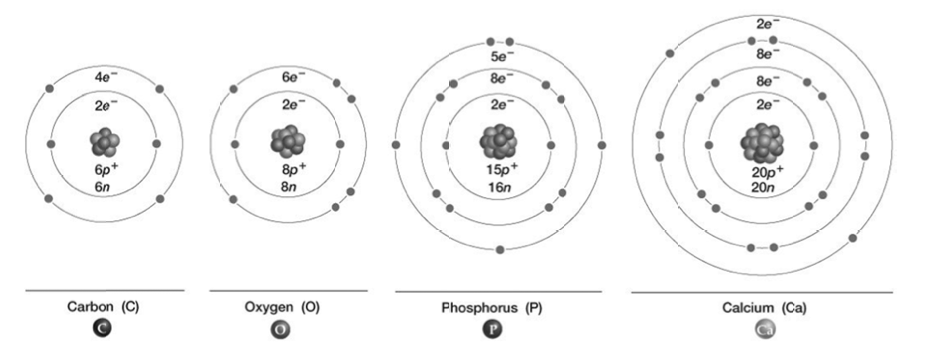
Which of these atoms would become inert if it accepted three electrons?
A) Carbon B) Hydrogen C) Phosphorus D) Calcium E) All of the above
A) Carbon B) Hydrogen C) Phosphorus D) Calcium E) All of the above
C) Phosphorus
12
New cards
A chemical compound that releases OH- into a solution is called: A) A proton B) A base C) An acid D) A hydroxide ion E) A hydrogen ion
B) A base
13
New cards
What happens when hydrochloric acid is added to water? A) The HCl molecules separate into H+ and Cl- B) The water had less free H+ C) The concentration of OH- increases D) The pH of the water increases. E) None of the above
A) The HCl molecules separate into H+ and Cl-
14
New cards
Which property of water molecules enables water to function as a moderator of temperature for living organisms?
A) High specific heat B) High heat of vaporization C) High heat of fusion D) A and B E) A, B, and C
A) High specific heat B) High heat of vaporization C) High heat of fusion D) A and B E) A, B, and C
E) A, B, and C
15
New cards
15) The formation of ions involves the: A) Gain or loss of electrons B) Gain or loss of protons C) Sharing of electrons
D) Sharing of protons E) Gain or loss of neutrons
D) Sharing of protons E) Gain or loss of neutrons
A) Gain or loss of electrons
16
New cards
16) A covalent bond is formed when: A) Two non-polar molecules associate with each other in a polar environment B) A positively charged particle is attracted to a negatively charged particle C) One atom gives up electrons to another atom D) Two atoms share electrons E) Two polar molecules are attracted to each other
D) Two atoms share electrons
17
New cards
17) What type of chemical reaction results in the breakdown of organic polymers into their respective subunits?
A) Condensation B) Hydrolysis C) Oxidation D) Ionization
E) Dehydration
A) Condensation B) Hydrolysis C) Oxidation D) Ionization
E) Dehydration
B) Hydrolysis
18
New cards
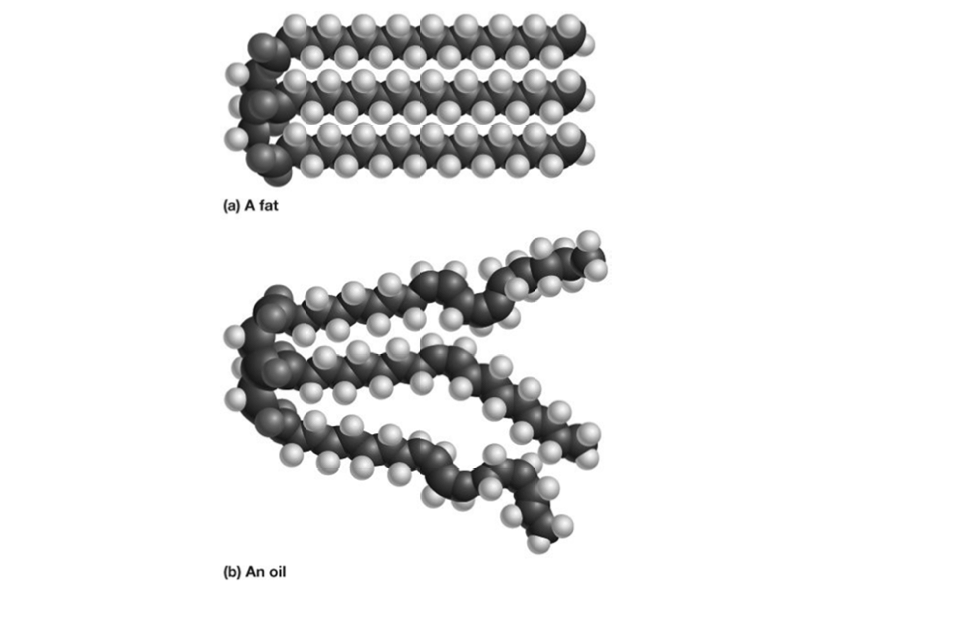
As shown in this figure, the top triglyceride (a) has \____; the bottom triglyceride has \____.
A) Double bonds and is saturated; no double bonds and is unsaturated B) No double bonds and is saturated; double bonds and is unsaturated C) No double bonds and is unsaturated; double bonds and is saturated D) Double bonds and is unsaturated; double bonds and is unsaturated E) Double bonds and is unsaturated; no double bonds and is saturated
A) Double bonds and is saturated; no double bonds and is unsaturated B) No double bonds and is saturated; double bonds and is unsaturated C) No double bonds and is unsaturated; double bonds and is saturated D) Double bonds and is unsaturated; double bonds and is unsaturated E) Double bonds and is unsaturated; no double bonds and is saturated
B) No double bonds and is saturated; double bonds and is unsaturated
19
New cards
Which of the following reactions requires the removal of water to form a covalent bond?
A) Glycogen -\> glucose subunitsB) Peptide -\> amino acids C) Cellulose -\> glucose D) Glucose and galactose -\> lactose E) Fat -\> fatty acids and glycerol
A) Glycogen -\> glucose subunitsB) Peptide -\> amino acids C) Cellulose -\> glucose D) Glucose and galactose -\> lactose E) Fat -\> fatty acids and glycerol
D) Glucose and galactose -\> lactose
20
New cards
Which of the following refers to the amino acid sequence of proteins? A) Primary B) Secondary C) Tertiary D) Quaternary E) None of the above
A) Primary
21
New cards
Which is not a feature of a prokaryotic cell? A) A plasma membrane B) A nuclear membrane C) Ribosomes D) Enzymes E) DNA
B) A nuclear membrane
22
New cards
After being formed by ribosomes on the endoplasmic reticulum, what is the next organelle to which a protein might be transported?
A) Mitochondria B) Smooth endoplasmic reticulum C) Nucleus D) Golgi apparatus E) Chloroplast
A) Mitochondria B) Smooth endoplasmic reticulum C) Nucleus D) Golgi apparatus E) Chloroplast
D) Golgi apparatus
23
New cards
Which type of cell does NOT produce cell walls? A) Animal cells B) Plant cells C) Archaea D) Bacteria E) Prokaryotic cells
A) Animal cells
24
New cards
In an experiment, you measure the concentration of a polar molecule inside and outside the cell and find that the concentration of this molecule is gradually increasing inside the cell. You also measure the concentration of ATP inside the cell and find that it is dropping. Which of the following processes are you likely to be observing?
A) Osmosis B) Facilitated diffusion C) Active Transport D) Simple diffusion E) Passive transport
A) Osmosis B) Facilitated diffusion C) Active Transport D) Simple diffusion E) Passive transport
C) Active Transport
25
New cards
The movement of water across a membrane from a solution of lower solute concentration to a solution of higher solute concentration is best described as
A) Osmosis B) Facilitated diffusion C) Active Transport D) Simple diffusion E) Endocytosis
A) Osmosis B) Facilitated diffusion C) Active Transport D) Simple diffusion E) Endocytosis
A) Osmosis
26
New cards
Mitochondria and chloroplasts share all of the following characteristics EXCEPT that they:
A) Are capable of ATP synthesis. B) Capture the energy of sunlight to meet metabolic demands. C) Possess their own DNA
D) Are surrounded by a double membrane E) Were originally independent organisms
A) Are capable of ATP synthesis. B) Capture the energy of sunlight to meet metabolic demands. C) Possess their own DNA
D) Are surrounded by a double membrane E) Were originally independent organisms
B) Capture the energy of sunlight to meet metabolic demands
27
New cards
Which of the following will be least likely to degrade a protein? A) Temperature greater than 100 degrees centigrade B) Strong acid C) Strong base
D) Water E) Poisons
D) Water E) Poisons
D) Water
28
New cards
Which of the following energy-generating processes is the only one that occurs in almost all living organisms?
A) Glycolysis B) Combustion C) Krebs Cycle D) Photosynthesis E) Chemiosmosis
A) Glycolysis B) Combustion C) Krebs Cycle D) Photosynthesis E) Chemiosmosis
A) Glycolysis
29
New cards
At the end of glycolysis, the original carbons of the glucose molecule form: A) Six molecules of carbon dioxide
B) Two molecules of NADH C) Two molecules of pyruvate D) Two molecules of citric acid E) Two molecules of fructose
B) Two molecules of NADH C) Two molecules of pyruvate D) Two molecules of citric acid E) Two molecules of fructose
C) Two molecules of pyruvate
30
New cards
The oxygen we breathe in is used in A) Glycolysis
B) Krebs cycle C) Electron Transport System D) Preparatory Step E) Fermentation
B) Krebs cycle C) Electron Transport System D) Preparatory Step E) Fermentation
C) Electron Transport System
31
New cards
If a DNA sample contains 13% adenine, what percentage of the sample contains cytosine?
A) 13% B) 0% C) 37% D) 26% E) 74%
A) 13% B) 0% C) 37% D) 26% E) 74%
C) 37%
32
New cards
For the DNA sequence G-C-C-T-A-T in one polynucleotide chain, the sequence found in the other polynucleotide chain must be:
A) C-G-G-A-T-A. B) G-C-C-A-T-A. C) C-G-G-A-U-A. D) A-T-T-C-G-C. E) G-C-C-T-A-T.
A) C-G-G-A-T-A. B) G-C-C-A-T-A. C) C-G-G-A-U-A. D) A-T-T-C-G-C. E) G-C-C-T-A-T.
A) C-G-G-A-T-A.
33
New cards
Which of the following are expected to result in genetic variation among offspring?
A) Mutations B) Crossing over C) Random assortment of parental chromosomes during meiosis D) A and B E) A, B, and C
A) Mutations B) Crossing over C) Random assortment of parental chromosomes during meiosis D) A and B E) A, B, and C
E) A, B, and C
34
New cards
For a mutation to affect the evolution of an animal species, it must occur in A) Somatic cells
B) Prokaryotic cells C) Gametes D) None of the above E) All of the above
B) Prokaryotic cells C) Gametes D) None of the above E) All of the above
C) Gametes
35
New cards
If a sperm cell has 6 chromosomes, it comes from an animal whose somatic cells have \___ chromosomes.
A) 6 B) 10 C) 12 D) 18 E) 24
A) 6 B) 10 C) 12 D) 18 E) 24
C) 12
36
New cards
The haploid number of chromosomes for humans is A) 23 B) 24 C) 26 D) 46 E) 48
A) 23
37
New cards
Which represents the correct sequence of stages in the cell cycle? A) G1, G2, S, M.
B) G1, G2, M, S. C) M, S, G1, G2. D) G1, S, G2, M. E) G1, M, G2, S.
B) G1, G2, M, S. C) M, S, G1, G2. D) G1, S, G2, M. E) G1, M, G2, S.
D) G1, S, G2, M.
38
New cards
Which of the following is TRUE regarding the genetic information in the cells of your body?
A) Different kinds of body cells contain different genetic information. B) Each type of body cell contains only the genetic information it needs to
be that type of cell. C) The genetic information in almost all of your body cells is identical. D) The genetic information in your body cells changes in a predictable
manner as you grow and develop. E) The genetic information is stored in the sequence of amino acids in proteins
A) Different kinds of body cells contain different genetic information. B) Each type of body cell contains only the genetic information it needs to
be that type of cell. C) The genetic information in almost all of your body cells is identical. D) The genetic information in your body cells changes in a predictable
manner as you grow and develop. E) The genetic information is stored in the sequence of amino acids in proteins
C) The genetic information in almost all of your body cells is identical.
39
New cards
What is the importance of crossing over in meiosis? A) It provides extra genetic material for the daughter cells B) It produces proteins necessary for cell division C) It causes the separation of homologous chromosomes D) It ensures that the daughter cells have different genetic material E) It initiates meiosis 11
D) It ensures that the daughter cells have different genetic material
40
New cards
At which stage of meiosis is each chromosome composed of a single chromatid? A) Prophase 1
B) Prophase 11 C) Metaphase 1 D) Metaphase 11 E) Anaphase 11
B) Prophase 11 C) Metaphase 1 D) Metaphase 11 E) Anaphase 11
E) Anaphase 11
41
New cards
Which of the classes of RNA molecules carries the genetic information as it is needed for the construction of a protein?
A) Ribosomal RNA B) Transfer RNA C) Messenger RNA D) Primary RNA
E) Secondary RNA
A) Ribosomal RNA B) Transfer RNA C) Messenger RNA D) Primary RNA
E) Secondary RNA
C) Messenger RNA
42
New cards
Which the following occurs in the nucleus in a eukaryotic cell? A) Transcription only
B) Assembly of amino acids into protein only C) Replication of genetic material only D) Both transcription and replication of genetic material E) Translation only
B) Assembly of amino acids into protein only C) Replication of genetic material only D) Both transcription and replication of genetic material E) Translation only
D) Both transcription and replication of genetic material
43
New cards
What are alleles?
A) Genes for different traits, such as hair color or eye color B) Alternative forms of a gene for a single trait, such as blue eyes or brown eyes C) The location of genes on the chromosome D) Recessive forms of the gene E) Dominant forms of the gene
A) Genes for different traits, such as hair color or eye color B) Alternative forms of a gene for a single trait, such as blue eyes or brown eyes C) The location of genes on the chromosome D) Recessive forms of the gene E) Dominant forms of the gene
B) Alternative forms of a gene for a single trait, such as blue eyes or brown eyes
44
New cards
An individual who is a carrier for a sex-linked trait, such as hemophilia: A) Is always male
B) Is homozygous for the condition C) Shows the dominant phenotype D) Cannot pass the gene to his or her daughters E) Is never a female
B) Is homozygous for the condition C) Shows the dominant phenotype D) Cannot pass the gene to his or her daughters E) Is never a female
C) Shows the dominant phenotype
45
New cards
An individual with a dominant phenotype is crossed with an individual with a recessive phenotype and 4 of their 9 offspring show the recessive phenotype. What is the genotype of the parent with the dominant phenotype?
A) Aa B) AA C) aa D) AAAa E) Aaaa
A) Aa B) AA C) aa D) AAAa E) Aaaa
A) Aa
46
New cards
Which of the following is NOT true according to Mendel's law of segregation? A) Each individual contains two factors for each trait B) One factor must be dominant and one must be recessive C) Factors separate from each other during the formation of gametes
D) Each gamete contains one copy of each factor E) Fertilization restores the two copies of each factor
D) Each gamete contains one copy of each factor E) Fertilization restores the two copies of each factor
B) One factor must be dominant and one must be recessive
47
New cards
Which of the following can evolve? A) Individuals
B) Populations C) Genes D) DNA E) All of the above
B) Populations C) Genes D) DNA E) All of the above
B) Populations
48
New cards
Genetic variations in natural populations develop due to: A) Random mutations of the DNA
B) Changes in the diet C) Changes in the environment D) Environmental catastrophes E) Individual activities
B) Changes in the diet C) Changes in the environment D) Environmental catastrophes E) Individual activities
A) Random mutations of the DNA
49
New cards
An antibiotic is given repeatedly to treat a recurrent ear infection. It worked initially but now is no longer effective. This likely indicates that the
Streptococcus bacterium:A) Is very sensitive to the antibiotic. B) Is being treated with an antibiotic that has experienced a manufacturing
error, making it ineffective. C) Experienced natural selection that has allowed the resistant
Streptococcus bacteria to survive and multiply. D) Are infectious only if they are sensitive to the antibiotic. E) All of the above
Streptococcus bacterium:A) Is very sensitive to the antibiotic. B) Is being treated with an antibiotic that has experienced a manufacturing
error, making it ineffective. C) Experienced natural selection that has allowed the resistant
Streptococcus bacteria to survive and multiply. D) Are infectious only if they are sensitive to the antibiotic. E) All of the above
C) Experienced natural selection that has allowed the resistant
Streptococcus bacteria to survive and multiply.
Streptococcus bacteria to survive and multiply.
50
New cards
Natural selection can act on a trait only if the trait is: A) Heritable B) Behavioral C) Favorable D) New E) Morphological
A) Heritable
51
New cards
A primary source of scientific results is \___ A) The news media
B) Anecdotes from others C) Articles in peer- reviewed journals D) The internet E) All of the above
B) Anecdotes from others C) Articles in peer- reviewed journals D) The internet E) All of the above
C) Articles in peer- reviewed journals
52
New cards
A guess in a scientific process is called __; a unifying explanation for a range of observations is termed\___?
A) Theory: Hypothesis B) Theory: Experiment C) Hypothesis: Control D) Hypothesis: Theory E) Experiment: Theory
A) Theory: Hypothesis B) Theory: Experiment C) Hypothesis: Control D) Hypothesis: Theory E) Experiment: Theory
D) Hypothesis: Theory
53
New cards
To test the effect of vitamin D on growth, two groups of rats were raised under identical conditions and fed the same diet. One of the groups received daily injections of vitamin D. The other group received injections of saline, which did not contain vitamin D. All the rats were weighed weekly for 2 months. In this experiment, the control was the:
A) Group receiving vitamin D. B) Group receiving saline. C) Average weight gain of the rats. D) 2-month period of time. E) The diet the rats ate
A) Group receiving vitamin D. B) Group receiving saline. C) Average weight gain of the rats. D) 2-month period of time. E) The diet the rats ate
B) Group receiving saline.
54
New cards
Which of the following are both universal characteristics of life? A) The ability to grow and the ability to reproduce using DNA B) The ability to reproduce using DNA and the ability to capture energy
from the sun C) The ability to move and the ability to sense the environment D) The ability to grow and the ability to think E) The ability to reproduce and the ability to sleep
from the sun C) The ability to move and the ability to sense the environment D) The ability to grow and the ability to think E) The ability to reproduce and the ability to sleep
A) The ability to grow and the ability to reproduce using DNA
55
New cards
Which of the following levels of organization is the most inclusive? A) Organism
B) Population C) Biosphere D) Community E) Ecosystem
B) Population C) Biosphere D) Community E) Ecosystem
C) Biosphere
56
New cards
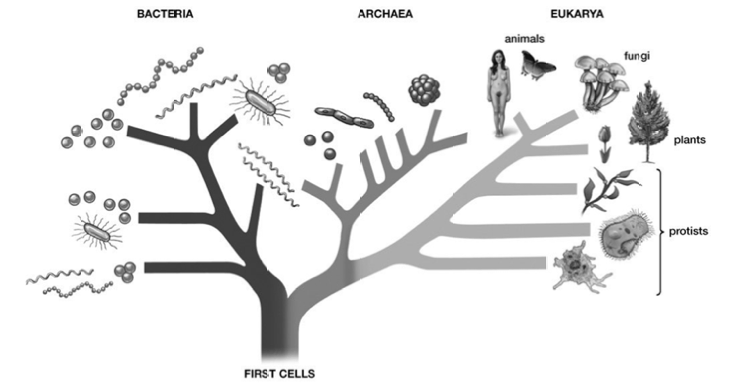
The "first cells" shown at the bottom of this illustration most likely refer to:
A) Prokaryotes. B) Animals. C) Plants. D) Fungi.
E) Protists.
A) Prokaryotes. B) Animals. C) Plants. D) Fungi.
E) Protists.
A) Prokaryotes
57
New cards
The atoms of a single element A) Have the same number of electrons
B) Can form bonds only with atoms of the same element C) Can have different numbers of electrons D) Can have different numbers of protons E) Always have an overall positive charge
B) Can form bonds only with atoms of the same element C) Can have different numbers of electrons D) Can have different numbers of protons E) Always have an overall positive charge
A) Have the same number of electrons
58
New cards
The second orbital shell of an atom can hold \___ electrons A) 2
B) 3 C) 4 D) 6 E) 8
B) 3 C) 4 D) 6 E) 8
E) 8
59
New cards
A chemical compound that releases H+ into a solution is called: A) A proton
B) A base C) an acid D) A hydroxide ion E) A hydrogen ion
B) A base C) an acid D) A hydroxide ion E) A hydrogen ion
C) an acid
60
New cards
A neutral solution has A) No H+
B) No OH- C) equal amounts of H+ and OH- D) No pH E) A pH of 0
B) No OH- C) equal amounts of H+ and OH- D) No pH E) A pH of 0
C) equal amounts of H+ and OH-
61
New cards
What determines the cohesiveness of water molecules? A) Hydrogen bonds
B) Ionic bonds C) Covalent bonds D) Hydrophobic interactions E) High heat of vaporization
B) Ionic bonds C) Covalent bonds D) Hydrophobic interactions E) High heat of vaporization
A) Hydrogen bonds
62
New cards
What bond is (are) easily disrupted in aqueous (water) solutions? A) Covalent
B) Polar covalent C) Ionic D) A and B are correct E) A, B, and C are correct
B) Polar covalent C) Ionic D) A and B are correct E) A, B, and C are correct
C) Ionic
63
New cards
Large biological molecules are synthesized by removal of A) Carbon
B) Covalent bonds C) Water D) Oxygen E) Peptides
B) Covalent bonds C) Water D) Oxygen E) Peptides
C) Water
64
New cards
Which of the following is NOT one of the four most common elements found in living organisms?
A) Hydrogen B) Carbon C) Oxygen D) Sulfur
E) Nitrogen
A) Hydrogen B) Carbon C) Oxygen D) Sulfur
E) Nitrogen
D) Sulfur
65
New cards
If a reaction results in one molecule losing an electron and a second molecule gaining that electron, the electron donor is said to be
A) Reduced B) Oxidized C) Transformed D) Activated E) Inhibited
A) Reduced B) Oxidized C) Transformed D) Activated E) Inhibited
B) Oxidized
66
New cards
A molecule of glucose has the molecular formula C6H12O6. Therefore it has \__ atoms.
A) 3. B) 12. C) 6. D) 24. E) None of the above
A) 3. B) 12. C) 6. D) 24. E) None of the above
D) 24
67
New cards
A lipid is a polymer made up of which kind of monomers? A) Glucose or modified glucose molecules B) Amino Acids C) Nucleotides
D) Alternating sugar and phosphate groups E) Fatty acids and glycerol
D) Alternating sugar and phosphate groups E) Fatty acids and glycerol
E) Fatty acids and glycerol
68
New cards
How are amino acids and proteins related? A) Proteins are made up of chains of amino acids
B) Amino acids are formed by joining together many proteins C) Proteins are a portion of an amino acid D) Proteins are chains of carbohydrates; amino acids are a type of lipid E) Amino acids are similar to fatty acids
B) Amino acids are formed by joining together many proteins C) Proteins are a portion of an amino acid D) Proteins are chains of carbohydrates; amino acids are a type of lipid E) Amino acids are similar to fatty acids
A) Proteins are made up of chains of amino acids
69
New cards
Fish sperm consists mostly of the male fish's DNA. If tested chemically, there would be relatively high amounts of
A) Nitrogenous bases, sugar and phosphate groups B) Phospholipids and steroids C) Triglycerides and ATP D) Proteins and stored fats
E) Amino acids and unsaturated fats
A) Nitrogenous bases, sugar and phosphate groups B) Phospholipids and steroids C) Triglycerides and ATP D) Proteins and stored fats
E) Amino acids and unsaturated fats
A) Nitrogenous bases, sugar and phosphate groups
70
New cards
Which of the following statements about prokaryotes is incorrect? A) Prokaryotes appeared on earth before eukaryotes B) Prokaryotes have circular pieces of DNA within their nuclei C) Prokaryotes contain cytoplasm
D) Prokaryotes contain ribosomes E) Some prokaryotes con photosynthesize
D) Prokaryotes contain ribosomes E) Some prokaryotes con photosynthesize
B) Prokaryotes have circular pieces of DNA within their nuclei
71
New cards
In plant cells, chloroplasts A) Serve the same purpose as mitochondria do in animal cells
B) Are the site of conversion of light energy into chemical energy C) Play an important role in the breakdown of plant toxins D) Generate turgor pressure E) A and B are correct
B) Are the site of conversion of light energy into chemical energy C) Play an important role in the breakdown of plant toxins D) Generate turgor pressure E) A and B are correct
B) Are the site of conversion of light energy into chemical energy
72
New cards
Cell walls A) Have many small holes B) Only occur in plant cells C) Dissolve when a plant dies D) Are made primarily from phospholipids E) All of the above
A) Have many small holes
73
New cards
The movement of molecules across a membrane from an area of higher concentration (of the molecule)to an area of lower concentration is best described as
A) Osmosis B) Passive transport C) Active transport D) Electron transport E) Receptor-mediated endocytosis
A) Osmosis B) Passive transport C) Active transport D) Electron transport E) Receptor-mediated endocytosis
B) Passive transport
74
New cards
From your knowledge of the function of lysosomes, the pH of lysosomes is likely to be
A) Always changing D) 9 B) 5 E) 12 C) Neutral
A) Always changing D) 9 B) 5 E) 12 C) Neutral
B) 5
75
New cards
In a phospholipid bilayer, the A) Phosphate groups are hydrophobic
B) Fatty acids tails are ionized C) Fatty acid tails are hydrophilic D) Proteins are located only between the two phospholipid bilayers E) Phosphate heads are oriented toward the exterior of the cell or toward the cytoplasm
B) Fatty acids tails are ionized C) Fatty acid tails are hydrophilic D) Proteins are located only between the two phospholipid bilayers E) Phosphate heads are oriented toward the exterior of the cell or toward the cytoplasm
E) Phosphate heads are oriented toward the exterior of the cell or toward the cytoplasm
76
New cards
If enzymes were used during a reaction, which of the following could be added to a system to make the reaction occur faster?
A) Water B) A decrease in temperature C) An small increase in heat energy D) End products E) All of the above
A) Water B) A decrease in temperature C) An small increase in heat energy D) End products E) All of the above
C) An small increase in heat energy
77
New cards
Which of the following does NOT describe a chemical reaction? A) The products are placed to the left of the arrow
B) The reactants are placed to the left of the arrow C) The arrow represents the direction in which the reaction proceeds D) Atoms must be balanced on both sides of the equation E) All of the above are true
B) The reactants are placed to the left of the arrow C) The arrow represents the direction in which the reaction proceeds D) Atoms must be balanced on both sides of the equation E) All of the above are true
A) The products are placed to the left of the arrow
78
New cards
Which of these processes occurs in the cytosol? A) Glycolysis
B) Electron Transport System C) Krebs Cycle D) Photosynthesis E) Chemiosmosis
B) Electron Transport System C) Krebs Cycle D) Photosynthesis E) Chemiosmosis
A) Glycolysis
79
New cards
During the Krebs cycle: A) The products of glycolysis are further broken down, generating
additional ATP and NADH molecules B) High-energy electron carriers pass their energy to molecules of sugar,
which store them as potential energy C) Cellular respiration can continue even in the absence of oxygen D) Pyruvate molecules are converted to lactate E) NADH gets oxidized to NAD+
additional ATP and NADH molecules B) High-energy electron carriers pass their energy to molecules of sugar,
which store them as potential energy C) Cellular respiration can continue even in the absence of oxygen D) Pyruvate molecules are converted to lactate E) NADH gets oxidized to NAD+
A) The products of glycolysis are further broken down, generating
additional ATP and NADH molecules
additional ATP and NADH molecules
80
New cards
The anaerobic breakdown of glucose is called A) Glycolysis
B) Electron Transport System C) Krebs Cycle D) Photosynthesis E) Fermentation
B) Electron Transport System C) Krebs Cycle D) Photosynthesis E) Fermentation
E) Fermentation
81
New cards
What is the significance of the conversion of pyruvate to lactate during fermentation?
A) Pyruvate becomes available to enter the mitochondrial matrix B) The citric acid/Krebs cycle is initiated C) NAD+ is regenerated for use in glycolysis D) ATP is produced
E) The energy in pyruvate is used up
A) Pyruvate becomes available to enter the mitochondrial matrix B) The citric acid/Krebs cycle is initiated C) NAD+ is regenerated for use in glycolysis D) ATP is produced
E) The energy in pyruvate is used up
C) NAD+ is regenerated for use in glycolysis
82
New cards
If a species contains 40% guanine in its DNA, what is the percentage of adenine that it would contain?
A) 40% B) 60% C) 100% D) 20% E) 10%
A) 40% B) 60% C) 100% D) 20% E) 10%
E) 10%
83
New cards
In an analysis of the nucleotide composition of DNA to see which bases are equivalent in amount, which of the following is true?
A) A \= C. B) A \= G and C \= T. C) A + C \= G + T. D) A + T \= C + G. E) G \= T
A) A \= C. B) A \= G and C \= T. C) A + C \= G + T. D) A + T \= C + G. E) G \= T
C) A + C \= G + T.
84
New cards
Which of the following statements about DNA replication is NOT correct? A) The DNA molecule unwinds as the hydrogen bonds are broken
B) Replication occurs as each base is paired with one exactly like it C) The process is known as semiconservative replication because one old
strand is conserved in the new molecule D) The enzyme that replicates the DNA is DNA polymerase E) The enzyme that links the Okazaki fragments together is DNA ligase
B) Replication occurs as each base is paired with one exactly like it C) The process is known as semiconservative replication because one old
strand is conserved in the new molecule D) The enzyme that replicates the DNA is DNA polymerase E) The enzyme that links the Okazaki fragments together is DNA ligase
B) Replication occurs as each base is paired with one exactly like it
85
New cards
A "mini-gene" has the base sequence TACCCGTGCACG. If the T at the beginning of the sequence is deleted, what will be the consequence?
A) All of the codons after that point will be changed B) Only the amino acid coded for in that codon will be changed. C) RNA polymerase will skip that codon, but all the others will be read
normally. D) RNA polymerase will correct the deletion, and a normal protein will be
produced. E) The first nucleotide is always replaced anyway, so there will be no
change.
A) All of the codons after that point will be changed B) Only the amino acid coded for in that codon will be changed. C) RNA polymerase will skip that codon, but all the others will be read
normally. D) RNA polymerase will correct the deletion, and a normal protein will be
produced. E) The first nucleotide is always replaced anyway, so there will be no
change.
A) All of the codons after that point will be changed
86
New cards
Which point mutation would be most likely to have a catastrophic effect? A) A base substitution
B) A base deletion near the start of the coding sequence C) The deletion of three bases near the start of the coding sequence D) A base deletion near the end of the coding sequence E) A base deletion at the very end of the coding sequence
B) A base deletion near the start of the coding sequence C) The deletion of three bases near the start of the coding sequence D) A base deletion near the end of the coding sequence E) A base deletion at the very end of the coding sequence
B) A base deletion near the start of the coding sequence
87
New cards
The cell formed through fertilization is called a/an A) Zygote B) Gamete C) Sperm cell D) Ovum E) Egg cell
A) Zygote
88
New cards
Which sequence of stages in mitosis is correct? A) Prophase, anaphase, metaphase, telophase
B) Prophase, metaphase, anaphase, telophase C) Anaphase, metaphase, telophase, prophase D) Anaphase, prophase, telophase, metaphase E) Prophase, telophase, anaphase, metaphase
B) Prophase, metaphase, anaphase, telophase C) Anaphase, metaphase, telophase, prophase D) Anaphase, prophase, telophase, metaphase E) Prophase, telophase, anaphase, metaphase
B) Prophase, metaphase, anaphase, telophase
89
New cards
Which does not occur in telophase? A) Cytokinesis is under way
B) The nuclear membrane is being reconstructed C) The centromeres split apart D) Chromosomes de-condense into chromatin E) The nucleolus reforms
B) The nuclear membrane is being reconstructed C) The centromeres split apart D) Chromosomes de-condense into chromatin E) The nucleolus reforms
C) The centromeres split apart
90
New cards
During which stage of meiosis does crossing-over occur? A) Prophase 1
B) Metaphase 1 C) Anaphase 11 D) Prophase 11 E) Metaphase 11
B) Metaphase 1 C) Anaphase 11 D) Prophase 11 E) Metaphase 11
A) Prophase 1
91
New cards
Prior to protein synthesis, the DNA A) Attracts tRNAs with appropriate amino acids
B) Must first undergo replication C) Contains anticodons that must become codons D) Serves as a template for the production of mRNA E) Attaches to ribosomes for protein synthesis
B) Must first undergo replication C) Contains anticodons that must become codons D) Serves as a template for the production of mRNA E) Attaches to ribosomes for protein synthesis
D) Serves as a template for the production of mRNA
92
New cards
Which of the classes of RNA molecules carries the amino acids that are added to the growing polypeptide chain?
A) Ribosomal RNA B) Transfer RNA C) Messenger RNA D) Primary RNA
E) Secondary RNA
A) Ribosomal RNA B) Transfer RNA C) Messenger RNA D) Primary RNA
E) Secondary RNA
B) Transfer RNA
93
New cards
The process of converting the "message" of mRNA into a sequence of amino acids is called:
A) Translation B) Transcription C) Replication D) Activation E) Duplication
A) Translation B) Transcription C) Replication D) Activation E) Duplication
A) Translation
94
New cards
Suppose one strand of a "mini-gene" has the base sequence TACCCGGATTCA. The last codon in the mRNA sequence will be:
A) UGA B) AGT C) AGU D) TCA E) ACT
A) UGA B) AGT C) AGU D) TCA E) ACT
C) AGU
95
New cards
Traits controlled by sex-linked recessive genes are expressed more often in males because:
A) Males inherit these genes from their fathers B) Males always carry two copies of these genes C) All male offspring of a female carrier get the gene D) The male has only one copy of these genes E) Males get more copies of recessive genes than females do
A) Males inherit these genes from their fathers B) Males always carry two copies of these genes C) All male offspring of a female carrier get the gene D) The male has only one copy of these genes E) Males get more copies of recessive genes than females do
D) The male has only one copy of these genes
96
New cards
A human male has \___ chromosomes with \___ sex chromosomes. A) 46, XY
B) 48, XY C) 46, XX D) 48, XX E) 48, YY
B) 48, XY C) 46, XX D) 48, XX E) 48, YY
A) 46, XY
97
New cards
Which statement is NOT true about x-linked characteristics? A) More males than females are affected
B) If a female has the characteristic, all her sons will show it C) Females can be carriers of the gene without showing it D) The characteristic often skips a generation, from a woman's father
to her son E) Males can have two copies of the allele for the trait, but females only
have one
B) If a female has the characteristic, all her sons will show it C) Females can be carriers of the gene without showing it D) The characteristic often skips a generation, from a woman's father
to her son E) Males can have two copies of the allele for the trait, but females only
have one
E) Males can have two copies of the allele for the trait, but females only
have one
have one
98
New cards
Which organism is least likely to survive to reproduce? A) A flower that produces a scent that attracts bees
B) A shrub that produces a toxin in its flower buds that repels deer C) An animal with a mutation that causes skin color to be more noticeable
D) A dark-furred rodent that comes out only at night E) a seahorse that mimics the weeds in which it lives
B) A shrub that produces a toxin in its flower buds that repels deer C) An animal with a mutation that causes skin color to be more noticeable
D) A dark-furred rodent that comes out only at night E) a seahorse that mimics the weeds in which it lives
C) An animal with a mutation that causes skin color to be more noticeable
99
New cards
Evolution: A) Occurs too slowly to be observed B) Can occur in the wild but not in the laboratory C) Is responsibility for the increased occurrence of antibiotic-resistant
bacteria D) Is unrelated to mutations in DNA E) All of the above are correct
bacteria D) Is unrelated to mutations in DNA E) All of the above are correct
C) Is responsibility for the increased occurrence of antibiotic-resistant
bacteria
bacteria
100
New cards
Which mutation provides a survival advantage? A) A flower that attracts more bees
B) A tree that grows shorter than the surrounding trees C) A horse that lacks the ability to digest either grains or grass D) A brightly colored fish that attracts predators E) A shrub that loses the ability to make seeds
B) A tree that grows shorter than the surrounding trees C) A horse that lacks the ability to digest either grains or grass D) A brightly colored fish that attracts predators E) A shrub that loses the ability to make seeds
A) A flower that attracts more bees
 Note
Note  Flashcards (99)