ANFS345 Respiratory System
 Studied by 0 people
 Call Kai
 Learn
Learn Practice Test
 Spaced Repetition
 Match
Match Flashcards
 Knowt Play
1/38

There's no tags or description
Looks like no tags are added yet.
Name | Mastery | Learn | Test | Matching | Spaced | Call with Kai |
|---|
No analytics yet
Send a link to your students to track their progress
39 Terms
what four gases are contained in atmospheric air?
nitrogen, oxygen, argon, carbon dioxide
what are the partial pressures of each of these gases dependent on?
only dependent on the gas itself
which molecules are respiratory gases or chemical forms of respiratory gases?
O2, CO2, and N2
respiratory gases move from place to place principally by
both diffusion and convective transport
the total partial pressure of any given gas
is the individual pressure exerted by the gas in a gas mixture
a scuba diver remaining at a depth of 50m for a significant amount of time needs to worry about the possible effects of which gas when he or she ascends?
nitrogen
if a water beetle has used up half of the oxygen in its air bubble, the concentration of oxygen in the bubble is __ the concentration of oxygen in the water. The partial pressure of the oxygen in the bubble is __ the partial pressure of the oxygen in water. Therefore, oxygen will move from the ___.
greater than; less than; water into the bubble
if a water beetle has been using an air bubble as a gill for 1 hr, the O2 partial pressure will be __ that of air and the N2 partial pressure will be __ that of air
less than; equal to
which morphology sets up the least efficient gas exchange?
cocurrent gas exchange
what increases in the blood during diving and why?
partial pressures of gases in the blood increases because the diver is at an elevated pressure
which direction does gas move?
from high partial pressure to low partial pressure
explain the process of a beetle respirating in water
a bubble of air will form around the beetle and oxygen will continue to diffuse into the bubble because air moves from higher concentration to lower concentration. the partial pressure is far higher in the water than the bubble, but the concentration of oxygen in the bubble is far higher in the bubble than the water. partial pressure rules, so oxygen diffuses into the bubble.
definition of lungs
invaginated into the body and contain the environmental medium
definition of external gills
evaginated from the body and project directly into the environmental medium
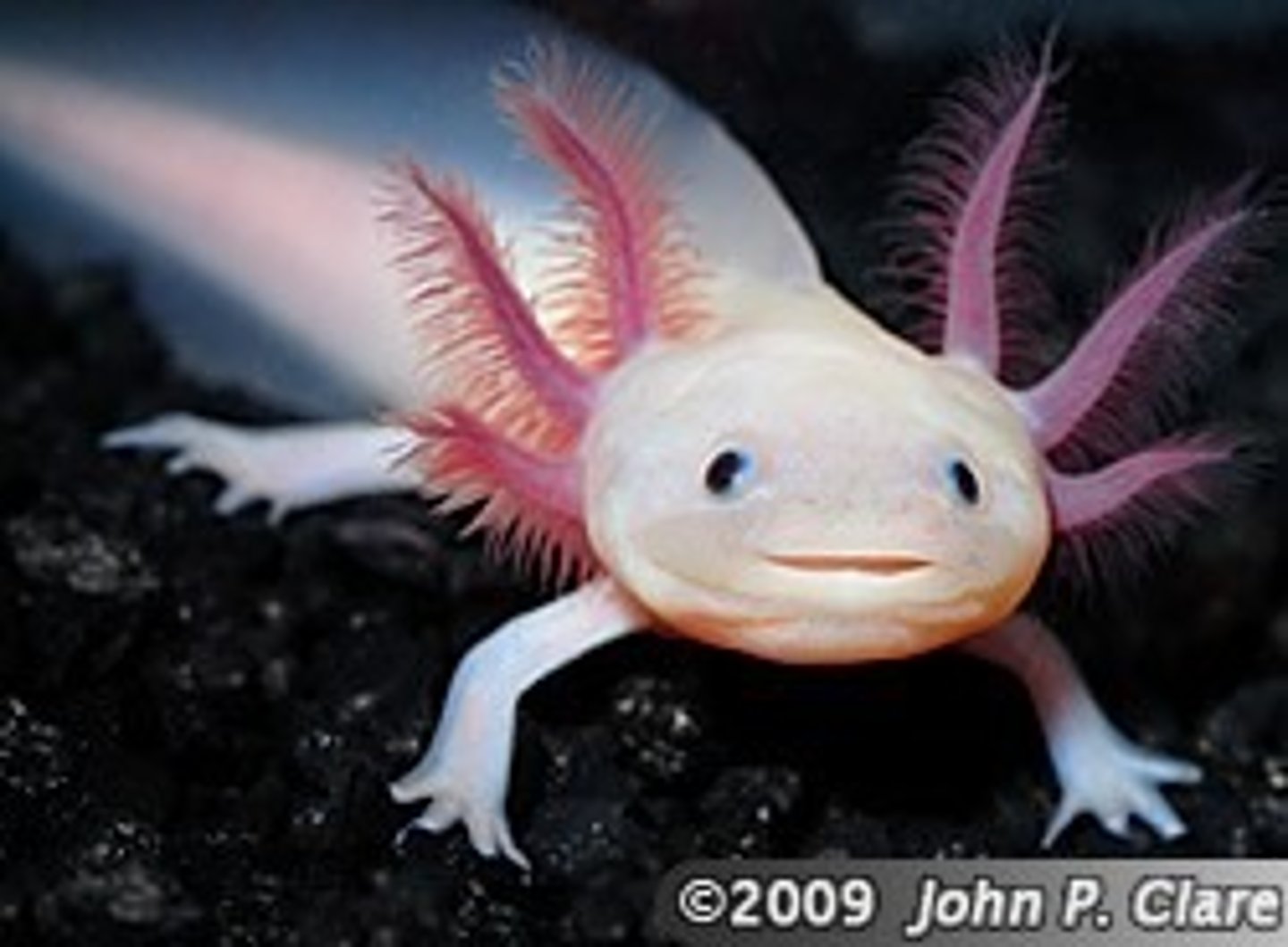
definition of internal gills
evaginated from the body and project into a superficial body cavity, through which the environmental medium is pumped
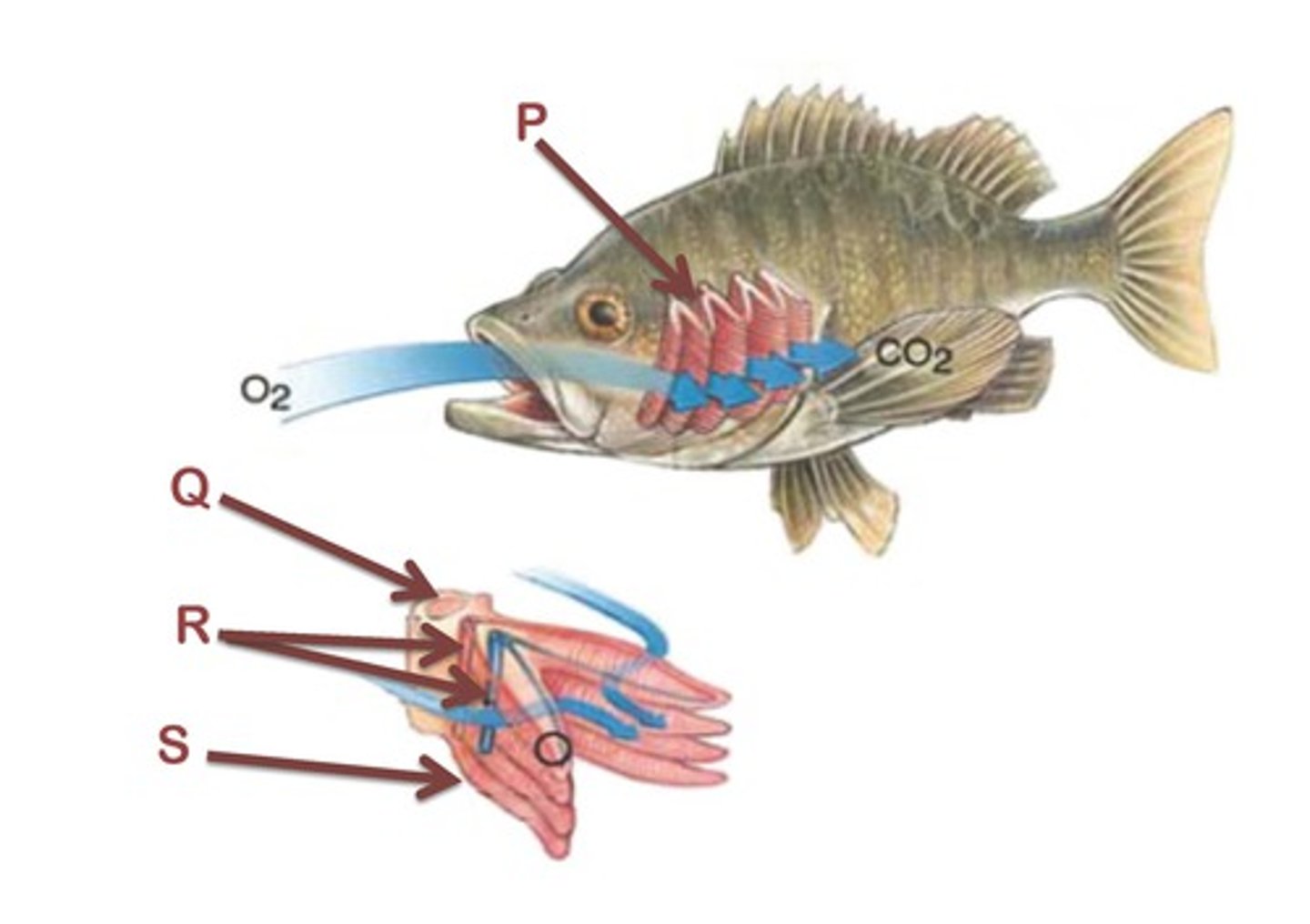
how does an increase in temperature affect the amount of gas able to dissolve?
the amount of gas able to dissolve decreases
--> bubbles form when water warms bc a rise in temp drives dissolved gases out of solution
how does an increase in salinity affect the amount of gas able to dissolve?
an increase in salinity causes a decrease in the amount of gas able to dissolve
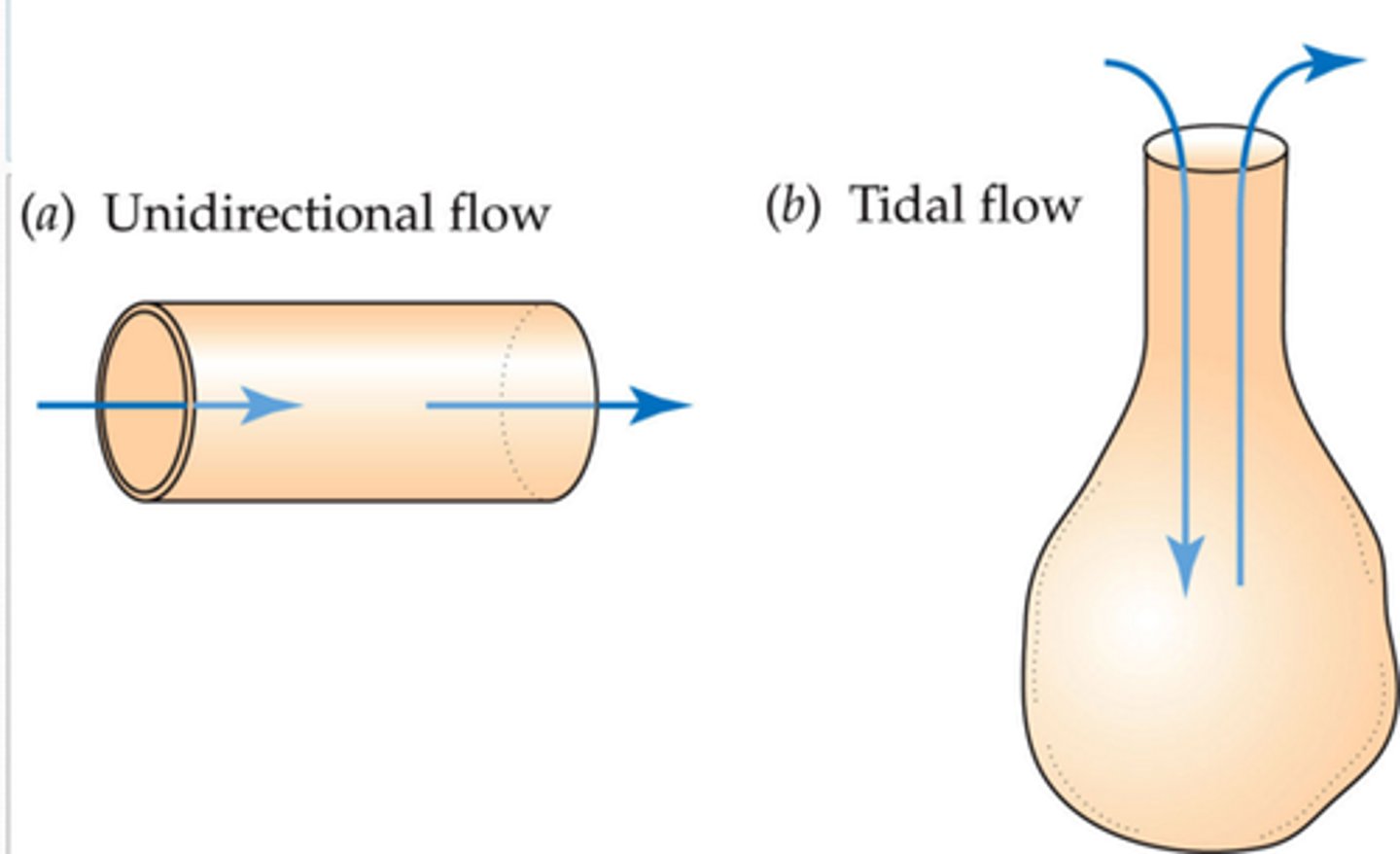
what is characteristic of unidirectional flow?
air moves in one direction through a tube
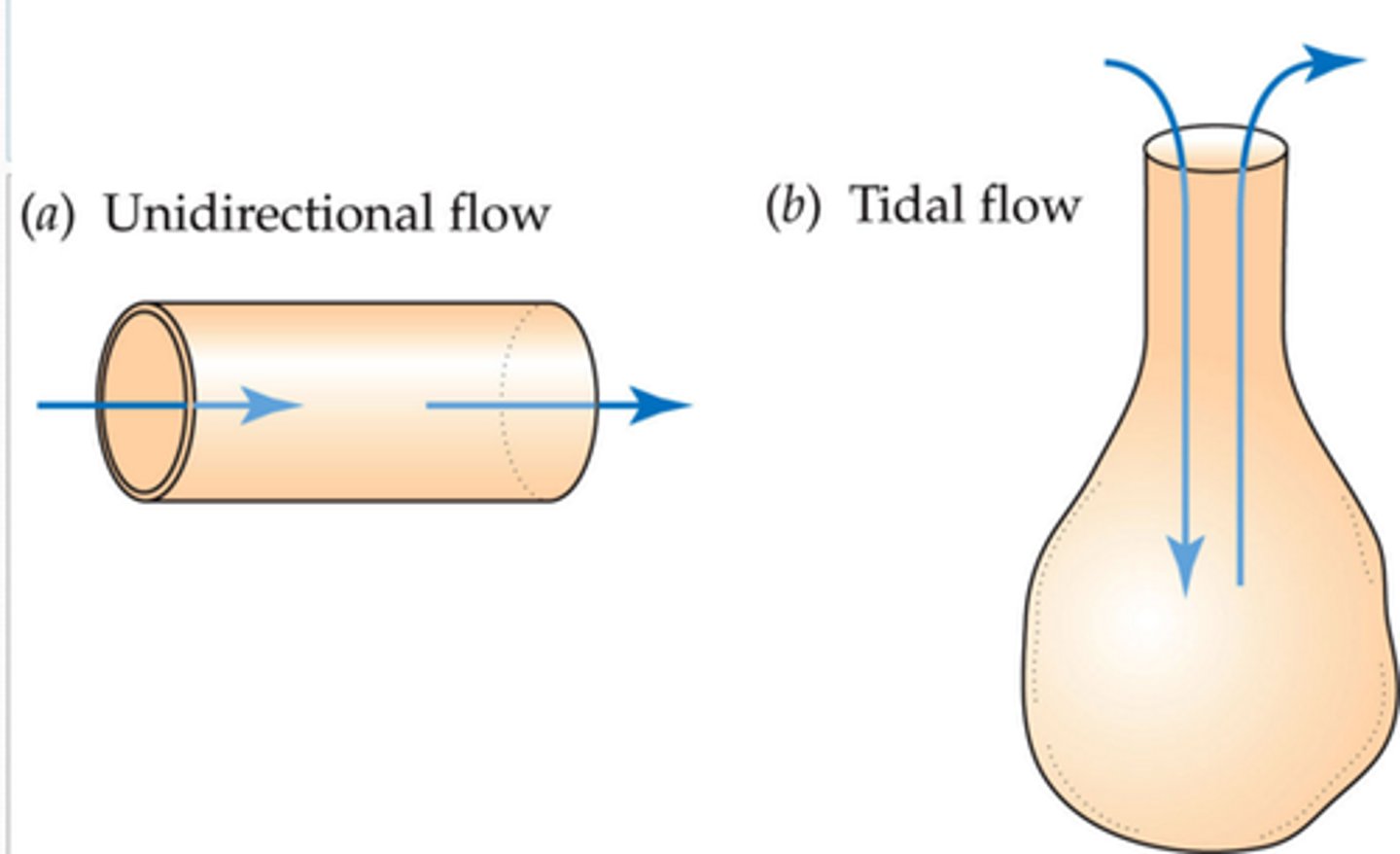
what is characteristic of tidal flow? (how our lungs work)
enter and exit through same opening
does convection transport gas over short or long distances?
long
does diffusion transport gas over short or long distances?
short
how can partial pressures in a region be the same as neighboring regions while other regions will be far different from neighboring regions?
same: gases are exchanged w/ adjacent regions by diffusion and convection, evening out the partial pressures of O2 and CO2
different: resident organisms can cause the local partial pressures of O2 and CO2 to be far different from those in neighboring regions
if there is a change in phase, what does this indicate for a gas?
diffusion
what is external respiration?
transport of O2 and CO2 to and from the gas-exchange membrane
describe the process of external respiration for gas transport between an environmental medium (air/water) into the internal body
O2 begins in the air or water through convection (ventilation) or diffusion, the O2 crosses the gas-exchange membrane through diffusion, the O2 undergoes convection (circulation) or diffusion in the body, CO2 circulates through convection (circulation) or diffusion, CO2 passes gas-exchange membrane through diffusion (sometimes active transport), and remains in environmental medium through convection (ventilation) or diffusion
what process does crossing a cell membrane indicate?
diffusion
explain the process of oxygen transport in the body
1. convection ~0.5m taken into the airway
2. diffusion ~0.0001m into blood from alveolus of lung across capillary and alveolar epithelium into pulmonary blood capillary
3. convection ~0.6m in blood from the lung moves to muscle cell
4. diffusion ~0.00002m into muscle cell from capillary
what is the order of structures that is involved in the oxygen cascade?
ambient air --> alveolar gas --> arterial blood --> average systemic capillary blood --> mitochondria
what does the oxygen cascade imply?
only the O2 partial pressure that prevails in the systemic capillaries is available to drive O2 diffusion to the mitochondria
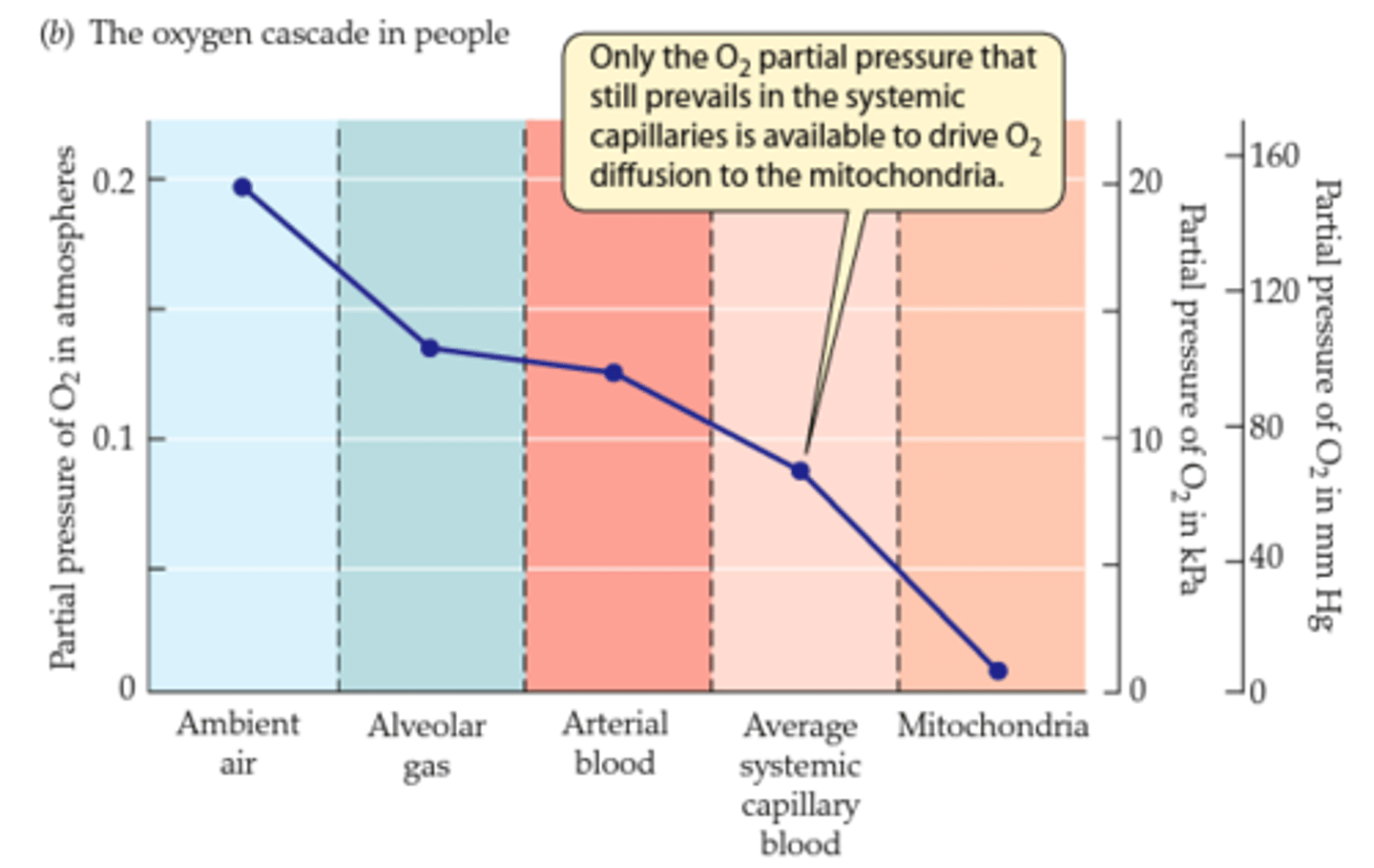
what does the greatest drop in partial pressure allow the gas to do more efficiently?
easiest to push out into next structure
what does the graph look like when our bodies are releasing CO2 rather than taking in O2?
the opposite of the O2 graph meaning the highest concentration of CO2 would begin in the mitochondria
what is the predominant gas exchange for domestic animals?
tidal gas exchange
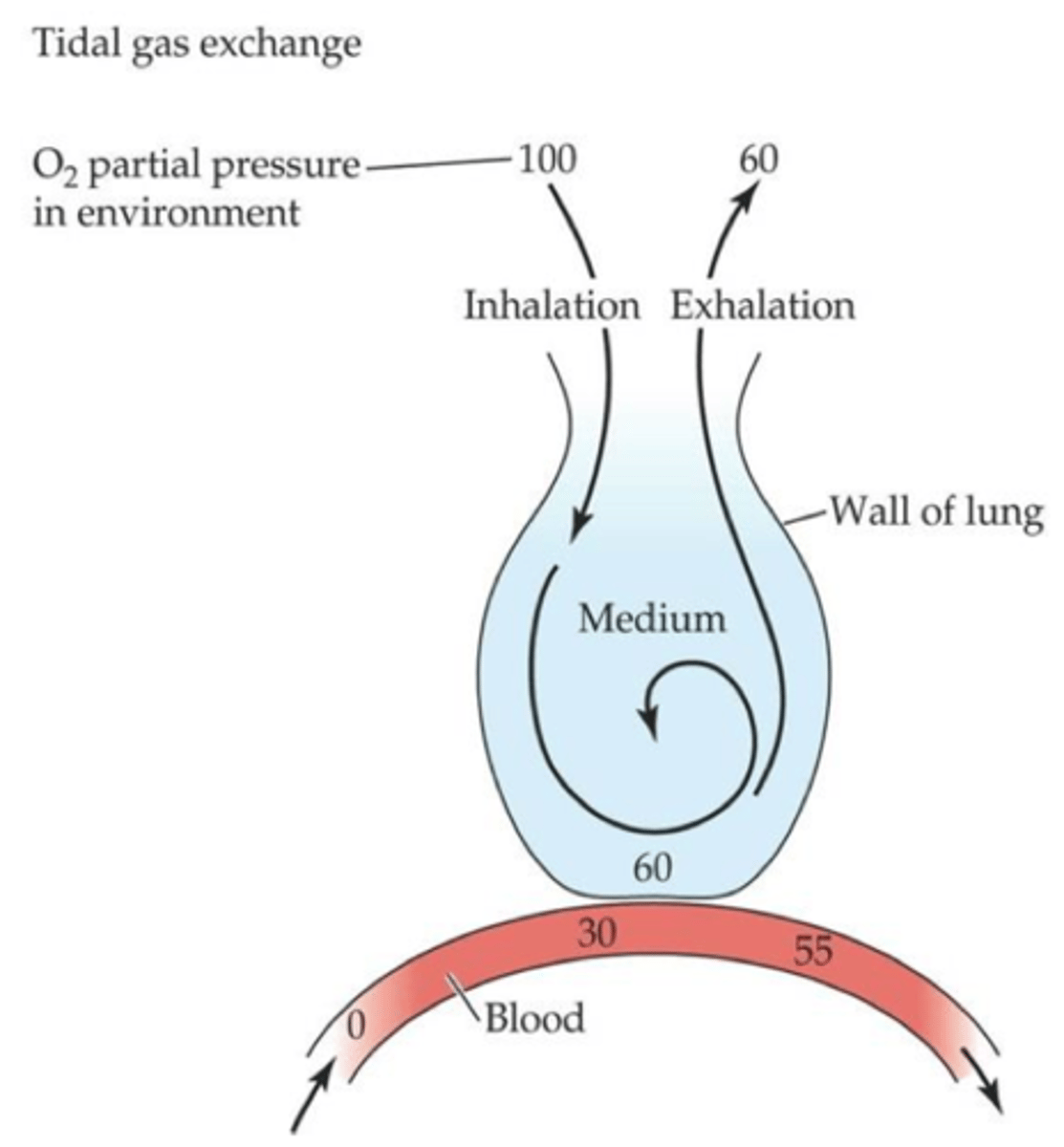
where does O2 enter the blood in the tidal gas exchange?
along the exchange surface
what is significant about the O2 partial pressure in the blood leaving the lung?
it is lower than that in the EXHALED medium
what overarching idea plays into cocurrent (concurrent) gas exchange?
equilibrium: as blood and medium flow in the same direction, they gradually approach equilibrium
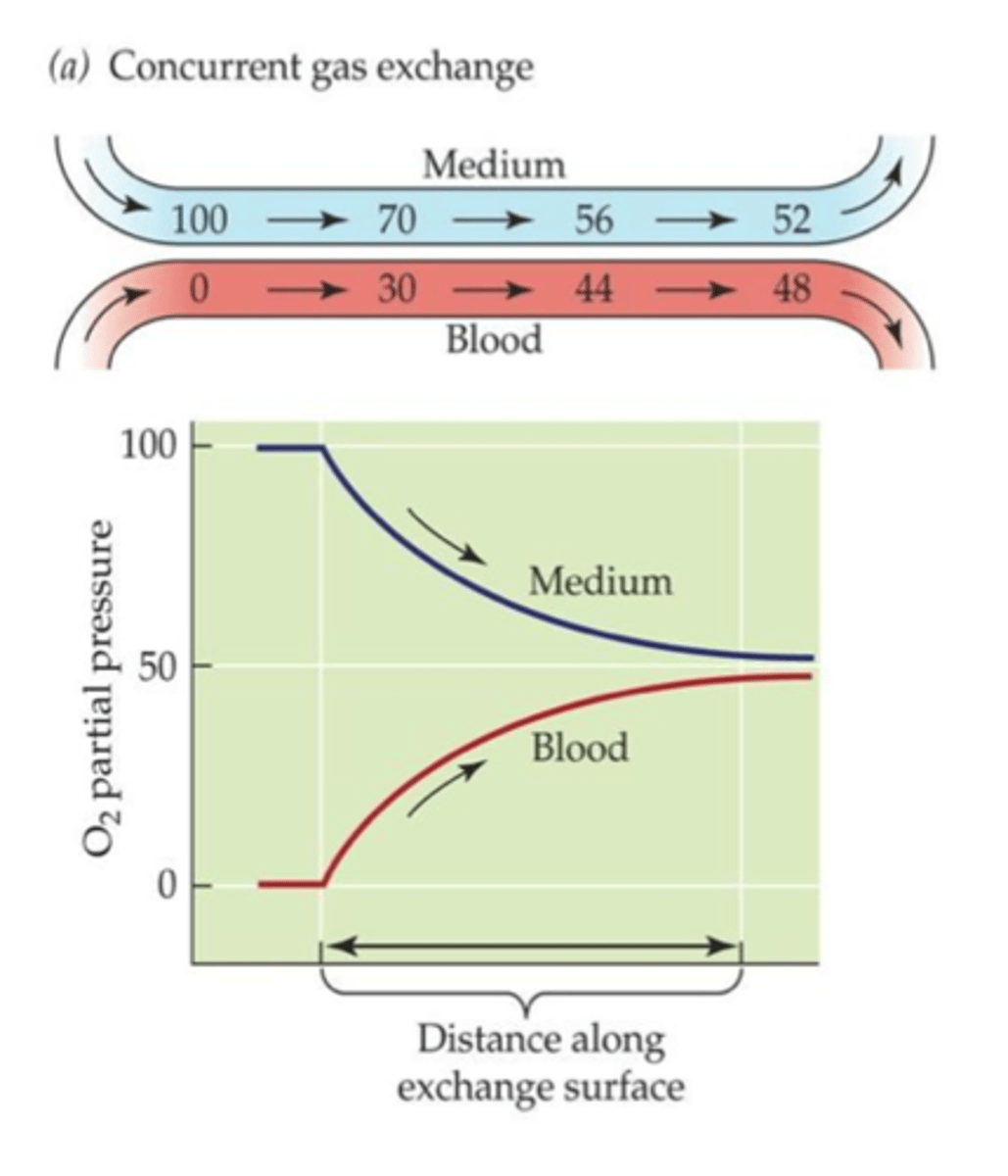
explain countercurrent gas exchange
as blood flows in the opposite direction to the medium and picks up O2, the medium that the blood encounters steadily has a higher partial pressure of O2, so the partial-pressure gradient is maintained and O2 consistently diffuses into blood
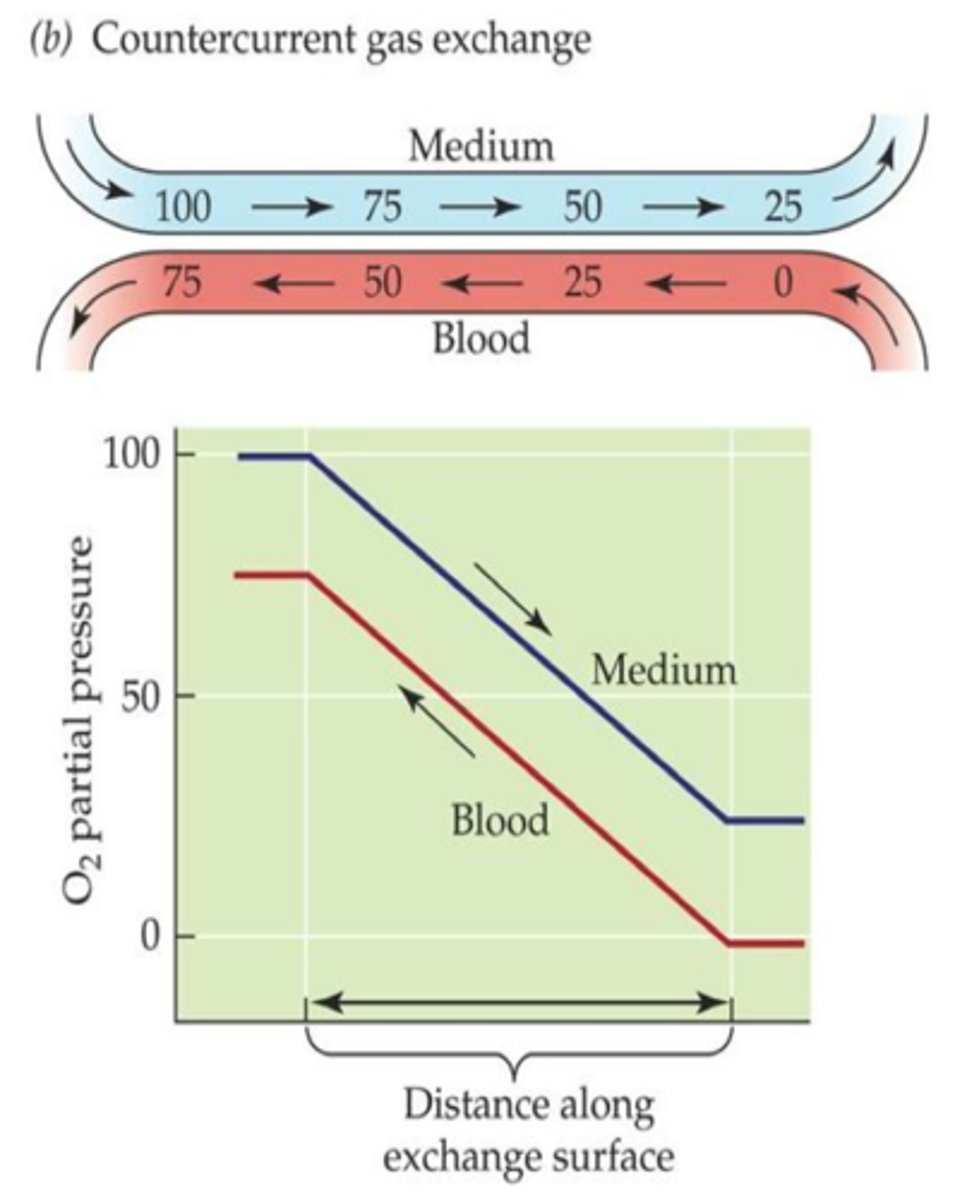
is cocurrent or countercurrent more efficient?
countercurrent
explain crosscurrent gas exchange
the blood crosses the air medium in perpendicular lines, so the first line to cross has the highest partial pressure of O2, and it will decrease each time a line of blood runs perpendicular, blood leaves at a concentration of ~65 and air at ~35
order of gas exchange efficiencies
cocurrent, tidal, cross-current, countercurrent
 Note
Note  Flashcards (23)