Chemistry Definitions
 Studied by 0 people
 Call Kai
 Learn
Learn Practice Test
 Spaced Repetition
 Match
Match Flashcards
 Knowt Play
1/143

There's no tags or description
Looks like no tags are added yet.
Name | Mastery | Learn | Test | Matching | Spaced | Call with Kai |
|---|
No analytics yet
Send a link to your students to track their progress
144 Terms
What is an element?
An element is a substance that cannot be split into simpler substances by chemical means.
What is a triad?
A triad is a group of three elements with similar chemical properties in which the relative atomic mass of the middle element is approximately equal to the average of the other two.
What are Newland's Octaves?
Newland's Octaves are arrangements of elements arranged in rows of 7 in which the first and eighth element, counting from a particular element, have similar properties.
What is Mendeleev's Periodic Law? State it.
When elements are arranged in order of increasing atomic weight, the properties of the elements recur periodically.
What is the atomic number?
The atomic number of an atom is the number of protons in the nucleus of that atom.
What is the modern Periodic Table?
The modern Periodic Table is an arrangement of elements in order of increasing atomic number.
What is the Modern Periodic Law? State it.
When elements are arranhed in order of increasing atomic number, the properties of the elements recur periodically.
What is the mass number?
The mass number of an element is the sum of the number of protons and neutrons in the nucleus of an atom of that element.
What are isotopes?
Isotopes are atoms of the same element which have different mass numbers due to the different number of neutrons in the nucleus.
What is relative atomic mass?
Relative atomic mass is the average of the mass numbers of the isotopes of the element as they occur naturally, taking their abundances into account and expressed on a scale in which the atoms of the carbon-12 isotope have a mass of exactly 12 units.
What is the principle of mass spectrometry?
The principle of mass spectrometry is that charged particles moving in a magnetic field are deflected to different extents according to their masses and are thus separated according to these masses.
What is the Aufbau Principle? State it
When building up the electron configuration of an atom in its ground state, the electrons occupy the lowest available energy levels.
What is Hund's Rule of Maximum Multiplicity? State it.
When two or more orbitals of equal energy are available, the electrons occupy them singly before filling them in pairs.
What is the Pauli Exclusion Principle? State it.
No more than two electrons may occupy an orbital and they must have opposite spin.
What is a compound?
A compound is a substance that is made up of two or more different elements combined together chemically.
What does the Octet Rule state?
When bonding occurs, atoms tend to reach an electron arrangement with eight electrons in the outermost energy level.
What is an ion?
An ion is a charged atom or group of atoms.
What is an ionic bond?
An ionic bond is the force of attraction between oppositely charged ions in a compound. They are always formed by the complete transfer of electrons from one atom to another.
What is a covalent bond?
A covalent bond is a shared pair of electeons.
What is a transition metal?
A transition metal is one that forms at least one ion with a partially filled d sublevel.
What is a molecule?
A molecule is a group of atoms jouned together. It is the smallest particle of an element or compound that can exist independently.
What is the valency of an element? Define it.
The number of atoms of hydrogen or any other monovalent element with which each atom of the element combines.
What is a sigma bond?
A sigma bond is formed by the head-on overlap of two orbitals.
What is a pi bond?
A pi bond is formed by the sideways overlap of p orbitals.
What is electronegativity?
Electronegativity is the relative attraction that an atom has for a shared pair of electrons in a covalent bond.
What is a polar covalent bond?
A polar covalent bond is a bond in which there is unequal sharing of the pair (or pairs) of electrons. This causes one end of the bond to be slightly positive and the other end to be slightly negative.
What is intramolecular bonding?
Intramolecular bonding is bonding that takes place within a molecule. E.g. covalent bonding
What are intermolecular forces?
Intermolecular forces are the forces of attraction that exist between molecules.
What are Van der Waals forces?
Van der Waals forces are weak attractive forces between molecules resulting from the formation of temporary dipoles. They are the only forces of attraction between non-polar molecules.
What are dipole-dipole forces?
Dipole-dipole forces are forces of attraction between the negative pole of one polar molecule and the positive pole of another polar molecule.
What are hydrogen bonds?
Hydrogen bonds are particular types of dipole-dipole attractions between molecules in which hydrogen atoms are bonded to nitrogen, oxygen or fluorine. The hydrogen atom carries a partial positive charge and is attracted to the electronegative atom in another molecule. Thus, the hydrogen bond acts as a bridge between two electronegative atoms in separate molecules.
State the Law of Conservation of Mass.
The total mass of the products of a chemical reaction is the same as the total mass of the reactants.
What is an energy level?
An energy level is defined as the fixed energy value that an electron in an atom may have.
What is the excited state?
The excited state of an atom is one in which the electrons occupy higher energy levels than those available in the ground state.
What is the ground state?
The ground state of an atom is one in which the electrons occupy the lowest available energy levels.
What is a sublevel?
A sublevel is a subdivision of a main energy level and consists of one or more orbitals of the same energy.
What is an orbital?
An orbital is a region in space within which there is a high probability of finding an electron.
What is Heisenberg's Uncertainty Principle? State it.
It is impossible to measure at the same time both the velocity and the position of an electron.
What are cathode rays?
Cathode rays are streams of negatively charged particles called electrons. They travel in straight lines from the cathode to the anode, are deflected by electric and magnetic fields, and have sufficient energy to move a light object such as a paddle wheel.
What is the atomic radius (covalent radius) of an atom?
The atomic radius of an atom is defined as half the distance between the nuclei of two atoms of the same element that are joined together by a single covalent bond.
What is the first ionisation energy of an atom? State it.
The minimum energy required to completely remove the most loosely bound electron from a neutral gaseous atom in its ground state.
What is the second ionisation energy? State it.
The energy required to remove an electron from an ion with one positive charge in the gaseous state.
What is one mole?
One mole of a substance is the amount of that substance that contains 6×10²³ particles of that substance.
What is the relative molecular mass?
The relative molecular mass of a compound is the average mass of one molecule of that compound compared with one twelfth of the mass of one atom of the carbon-12 isotope.
What is a gas?
A gas is a substance that has no well-defined boundaries but diffuses rapidly to fill any container in which it is placed.
What is Boyle's Law?
Boyle’s law states that, at constant temperature, the volume of a fixed mass of a gas is inversely proportional to its pressure.
What is Charles’ law?
Charles' law states that, at constant pressure, the volume of a fixed mass of gas is directly proportional to its temperature measured on the Kelvin scale.
What is Gay-Lussac's Law?
Gay-Lussac's Law of Combining Volumes states that, in a reaction between gases, the volumes of the reacting gases and the volumes of any gaseous products are in the ratio of small whole numbers provided the volumes are measured at the same temperature and pressure.
What is Avogadro's Law?
Avogadro's law states that equal volumes of gases contain equal numbers of molecules under the same conditions of temperature and pressure.
What is an ideal gas?
An ideal gas is one that perfectly obeys all the assumptions of the kinetic theory of gases under all conditions of temperature and pressure.
What is the molecular formula of a compound?
A formula which shows the number and type of each atom present in a molecule of that compound.
What is the empirical formula of a compound?
The formula showing the simplest whole number ratio of the numbers of different atoms present in the molecule.
What is radioactivity?
Radioactivity is the spontaneous breaking up of unstable nuclei with the emission of one or more types of radiation.
What is a nuclear reaction?
A process that alters the composition, structure or energy of an atomic nucleus.
What is the half-life of an element?
The half-life of an element is the time taken for half of the nuclei in any given sample to decay.
What is a radioisotope?
A radioisotope is a radioactive isotope. Isotopes are atoms of the same element which have different mass numbers due to the different number of neutrons in the nucleus.
What is radiocarbon dating?
A technique used to determine the age of an object containing carbon. It is based on the ratio of carbon-14 to carbon-12 in the object.
What is radioactive decay?
Radioactive decay is a reaction that occurs when a radioisotope naturally breaks down to emit radiation.
What is nuclear fission?
Nuclear fission is the break up of large nuclei to form two smaller nuclei with the release of large amounts of energy.
What is nuclear fusion?
Nuclear fusion is the joining together of small light nuclei to form heavier nuclei with the release of large amounts of energy.
Arrhenius - What is an acid?
An acid is a substance that dissociates in water to produce H+ ions.
Arrhenius - What is a strong acid?
A strong acid is a substance that almost completely dissociates in water to give H+ ions.
Arrhenius - What is a weak acid?
A weak acid is a substance that only slightly dissociates in watwr to give H+ ions.
Arrhenius - What is a base?
A base is a substance that dissociates in water to produce OH- ions.
Arrhenius - What is a strong base?
A strong base is a substance that almost completely dissociates in water to give OH- ions.
Arrhenius- What is a weak base?
A weak base is a substance that only slightly dissociates in water to give OH- ions.
B/L - What is an acid?
An acid is a proton donor.
B/L - What is a strong acid?
A strong acid is a good proton donor.
B/L - What is a weak acid?
A weak acid is a poor proton donor.
B/L - What is a base?
A base is a proton acceptor.
B/L - What is a strong base?
A strong base is good proton acceptor.
B/L - What is a weak base?
A weak base is a poor proton acceptor.
What is a conjugate base?
An acid changes into its conjugate base when it donates a proton.
What is a conjugate acid?
A base changes into its conjugate acid when it accepts a proton.
What is a conjugate acid-base pair?
A conjugate acid-base pair is any pair consisting of an acid and a base that differ by one proton.
What is a salt?
A salt is the substance formed when the hydrogen ion from an acid is replaced by a metal or an ammonium ion.
What is neutralisation?
Neutralisation is the reaction between an acid and a base to form a salt and water.
What is a solution?
A solution is a homogenous mixture of a solute and a solvent.
What is the concentration of a solution?
The concentration of a solution is the amount of solute that is dissolved in a given volume of solution.
What is the molarity of a solution?
The molarity of a solution is the number of moles per litre of solution.
Define a one molar solution.
One that contains one mole of the solute dissolved in one litre of solution.
What is a standard solution?
A standard solution is a solution whose concentration is accurately known.
What is a primary standard?
A primary standard is a substance that can be obtained in a stable, pure and soluble solid form so that it can be weighed out and dissolved in water to give a solution of accurately known concentration.
Define a titration.
A laboratory procedure where a measured volume of one solution is added to a known volume of another solution until the reaction is complete.
What is oxidation?
Oxidation is the loss of electrons.
Oxidation is an increase in oxidation number.
What is reduction?
Reduction is the gain of electrons.
Reduction is a decrease in oxidation number.
What is an oxidising agent?
An oxidising agent brings about oxidation in other substances.
What is a reducing agent?
A reducing agent brings about reduction in other substances.
Define an oxidation number.
The charge that an atom has or appears to have when electrons are distributed according to certain rules.
What is a reversible reaction?
A reversible reaction is one in which the products react to give back reactants.
What is chemical equilibrium?
Chemical equilibrium is a state of dynamic balance in a reversible reaction where the rate of the forward reaction is equal to the rate of the backward reaction.
What happens in a dynamic state?
In a dynamic state, the reactants are continuously forming products and the products are continuously forming reactants.
State Le Chatelier's Principle.
If a stress is applied to a system at equilibrium, the system re-adjusts to relieve the stress applied.
What is pH?
The pH of a solution is the negative logarithm to the base 10 of the hydrogen ion concentration measured in moles per litre.
What is pOH?
The pOH of a solution is the negative logarithm to the base 10 of the OH- ion concentration measured in moles per litre.
Formulas
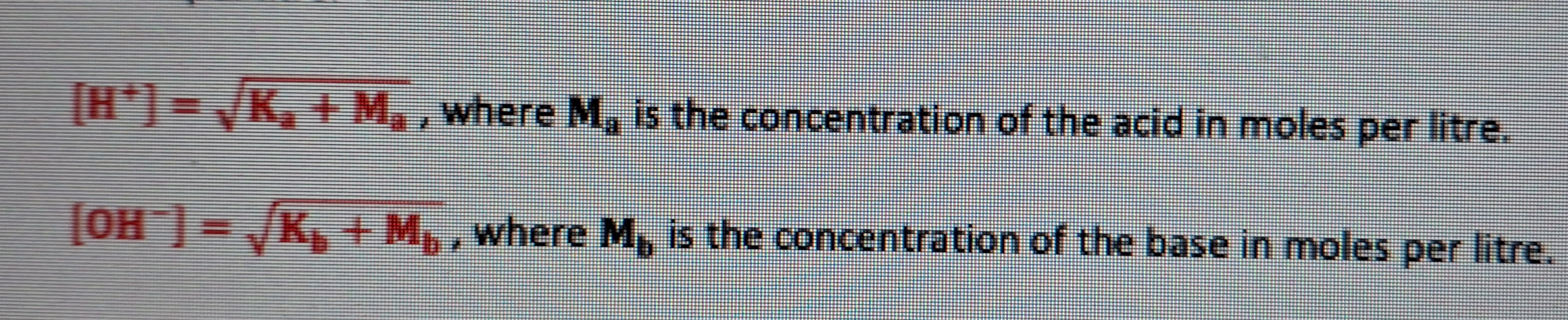
Define an acid-base indicator.
A substance that changes colour according to the pH of the solution in which it is placed.
Define the range of an indicator.
The pH interval over which there is a clear change of colour for that indicator.
What is electrolysis?
Electrolysis is the use of electricity to bring about a chemical reaction in an electrolyte.
What is a saturated compound?
A saturated compound is one in which there are only single bonds between the atoms in the molecule.
 Note
Note  Flashcards (72)