NEURO2020 WEEK 5

0.0(0)
Studied by 0 people
call kaiCall Kai
learnLearn
examPractice Test
spaced repetitionSpaced Repetition
heart puzzleMatch
flashcardsFlashcards
GameKnowt Play
Card Sorting

1/32

encourage image

There's no tags or description

Looks like no tags are added yet.

Last updated 1:27 AM on 4/6/26
Name
Mastery
Learn
Test
Matching
Spaced
Call with Kai

No analytics yet

Send a link to your students to track their progress

33 Terms

1
New cards

LIGHT

  • Electromagnetic radiation 

  • Wavelength = colour 

  • Amplitude = brightness 

  • Humans respond to approx. 400-700nm 

2
New cards

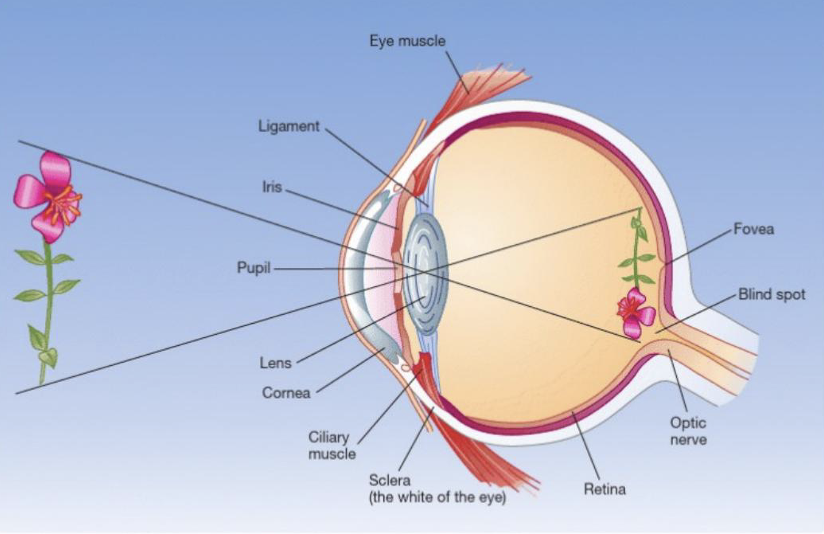
EYES

  1. Light enters through pupil 

  2. Refracted by cornea  

  3. Fine-tuned by lens  

  4. Image lands at retina 

<ol><li><p class="Paragraph SCXO125499717 BCX0" style="text-align: left;"><span style="background-color: inherit; line-height: 19.55px; color: windowtext;">Light enters through pupil</span><span style="line-height: 19.55px; color: windowtext;">&nbsp;</span></p></li><li><p class="Paragraph SCXO125499717 BCX0" style="text-align: left;"><span style="background-color: inherit; line-height: 19.55px; color: windowtext;">Refracted by cornea&nbsp;</span><span style="line-height: 19.55px; color: windowtext;">&nbsp;</span></p></li><li><p class="Paragraph SCXO125499717 BCX0" style="text-align: left;"><span style="background-color: inherit; line-height: 19.55px; color: windowtext;">Fine-tuned by lens&nbsp;</span><span style="line-height: 19.55px; color: windowtext;">&nbsp;</span></p></li><li><p class="Paragraph SCXO125499717 BCX0" style="text-align: left;"><span style="background-color: inherit; line-height: 19.55px; color: windowtext;">Image lands at retina</span><span style="line-height: 19.55px; color: windowtext;">&nbsp;</span></p></li></ol><p></p>
3
New cards

FOVEA

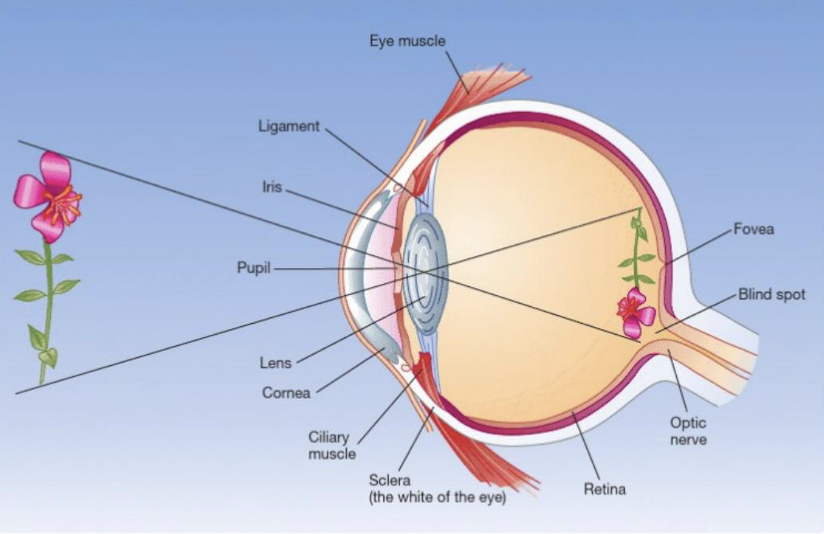
  • small central depression where fine-detail vision is sharpest 

  • Layers are cleared aside for maximum acuity 
<ul><li><p class="Paragraph SCXO60085957 BCX0" style="text-align: left;"><span style="background-color: inherit; line-height: 19.55px; color: windowtext;">small central depression where fine-detail vision is sharpest</span><span style="line-height: 19.55px; color: windowtext;">&nbsp;</span></p></li><li><p class="Paragraph SCXO60085957 BCX0" style="text-align: left;"><span style="background-color: inherit; line-height: 19.55px; color: windowtext;">Layers are cleared aside for maximum acuity</span><span style="line-height: 19.55px; color: windowtext;">&nbsp;</span></p></li></ul><p></p>
4
New cards

EYE PLACEMENT

Laterally placed eyes 

  • Usually prey  

  • Wider view  

  • Detect predator sneaking up  

Frontal face eyes 

  • Binocular disparity 

  • Can break camouflage  

  • Usually predator  

Cyclopean eye 

  • Combining both images 

5
New cards

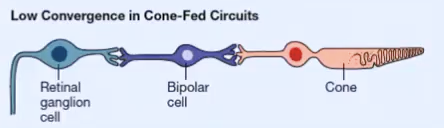
CONES

  • densely packed in the fovea 

  • Short, medium, long wavelength cones 

  • High visual acuity  

  • Not sensitive to dim lights  

  • Colour vision 

  • Low convergence  

    • One/two cones connected to the retinal ganglion cell 

    • Precise spatial information 

  • Photopic system 

    • Peak sensitivity of 550nm 

<ul><li><p class="Paragraph SCXO190912360 BCX0" style="text-align: left;"><span style="background-color: inherit; line-height: 19.55px; color: windowtext;">densely packed in the fovea</span><span style="line-height: 19.55px; color: windowtext;">&nbsp;</span></p></li><li><p class="Paragraph SCXO190912360 BCX0" style="text-align: left;"><span style="background-color: inherit; line-height: 19.55px; color: windowtext;">Short, medium, long wavelength cones</span><span style="line-height: 19.55px; color: windowtext;">&nbsp;</span></p></li><li><p class="Paragraph SCXO190912360 BCX0" style="text-align: left;"><span style="background-color: inherit; line-height: 19.55px; color: windowtext;">High visual acuity&nbsp;</span><span style="line-height: 19.55px; color: windowtext;">&nbsp;</span></p></li><li><p class="Paragraph SCXO190912360 BCX0" style="text-align: left;"><span style="background-color: inherit; line-height: 19.55px; color: windowtext;">Not sensitive to dim lights&nbsp;</span><span style="line-height: 19.55px; color: windowtext;">&nbsp;</span></p></li><li><p class="Paragraph SCXO190912360 BCX0" style="text-align: left;"><span style="background-color: inherit; line-height: 19.55px; color: windowtext;">Colour vision</span><span style="line-height: 19.55px; color: windowtext;">&nbsp;</span></p></li><li><p class="Paragraph SCXO190912360 BCX0" style="text-align: left;"><span style="background-color: inherit; line-height: 19.55px; color: windowtext;">Low convergence&nbsp;</span><span style="line-height: 19.55px; color: windowtext;">&nbsp;</span></p><ul><li><p class="Paragraph SCXO190912360 BCX0" style="text-align: left;"><span style="background-color: inherit; line-height: 19.55px; color: windowtext;">One/two cones connected to the retinal ganglion cell</span><span style="line-height: 19.55px; color: windowtext;">&nbsp;</span></p></li><li><p class="Paragraph SCXO190912360 BCX0" style="text-align: left;"><span style="background-color: inherit; line-height: 19.55px; color: windowtext;">Precise spatial information</span><span style="line-height: 19.55px; color: windowtext;">&nbsp;</span></p></li></ul></li><li><p class="Paragraph SCXO190912360 BCX0" style="text-align: left;"><span style="background-color: inherit; line-height: 19.55px; color: windowtext;">Photopic&nbsp;system</span><span style="line-height: 19.55px; color: windowtext;">&nbsp;</span></p><ul><li><p class="Paragraph SCXO190912360 BCX0" style="text-align: left;"><span style="background-color: inherit; line-height: 19.55px; color: windowtext;">Peak sensitivity of 550nm</span><span style="line-height: 19.55px; color: windowtext;">&nbsp;</span></p></li></ul></li></ul><p></p>
6
New cards

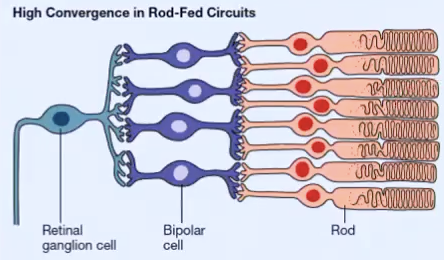
RODS

  • Non-existent in fovea 

  • Many in periphery  

  • Achromatic  

  • Very sensitive to dim lights 

  • Lower acuity 

  • High convergence  

    • Many rods connected to retinal ganglion cell 

    • Vague spatial information 

  • Scotopic system 

    • Peak sensitivity of 500nm 

<ul><li><p class="Paragraph SCXO493524 BCX0" style="text-align: left;"><span style="background-color: inherit; line-height: 19.55px; color: windowtext;">Non-existent in fovea</span><span style="line-height: 19.55px; color: windowtext;">&nbsp;</span></p></li><li><p class="Paragraph SCXO493524 BCX0" style="text-align: left;"><span style="background-color: inherit; line-height: 19.55px; color: windowtext;">Many in periphery&nbsp;</span><span style="line-height: 19.55px; color: windowtext;">&nbsp;</span></p></li><li><p class="Paragraph SCXO493524 BCX0" style="text-align: left;"><span style="background-color: inherit; line-height: 19.55px; color: windowtext;">Achromatic&nbsp;</span><span style="line-height: 19.55px; color: windowtext;">&nbsp;</span></p></li><li><p class="Paragraph SCXO493524 BCX0" style="text-align: left;"><span style="background-color: inherit; line-height: 19.55px; color: windowtext;">Very sensitive to dim lights</span><span style="line-height: 19.55px; color: windowtext;">&nbsp;</span></p></li><li><p class="Paragraph SCXO493524 BCX0" style="text-align: left;"><span style="background-color: inherit; line-height: 19.55px; color: windowtext;">Lower acuity</span><span style="line-height: 19.55px; color: windowtext;">&nbsp;</span></p></li><li><p class="Paragraph SCXO493524 BCX0" style="text-align: left;"><span style="background-color: inherit; line-height: 19.55px; color: windowtext;">High convergence&nbsp;</span><span style="line-height: 19.55px; color: windowtext;">&nbsp;</span></p><ul><li><p class="Paragraph SCXO493524 BCX0" style="text-align: left;"><span style="background-color: inherit; line-height: 19.55px; color: windowtext;">Many rods connected to retinal ganglion cell</span><span style="line-height: 19.55px; color: windowtext;">&nbsp;</span></p></li><li><p class="Paragraph SCXO493524 BCX0" style="text-align: left;"><span style="background-color: inherit; line-height: 19.55px; color: windowtext;">Vague spatial information</span><span style="line-height: 19.55px; color: windowtext;">&nbsp;</span></p></li></ul></li><li><p class="Paragraph SCXO493524 BCX0" style="text-align: left;"><span style="background-color: inherit; line-height: 19.55px; color: windowtext;">Scotopic system</span><span style="line-height: 19.55px; color: windowtext;">&nbsp;</span></p><ul><li><p class="Paragraph SCXO493524 BCX0" style="text-align: left;"><span style="background-color: inherit; line-height: 19.55px; color: windowtext;">Peak sensitivity of 500nm</span><span style="line-height: 19.55px; color: windowtext;">&nbsp;</span></p></li></ul></li></ul><p></p>
7
New cards

BLIND SPOT

  • Area with no photoreceptors  

  • Occurs where optic nerve exits the eye 

  • Brain does perceptual filling in  

8
New cards

SCOTOPIC SPECTRAL SENSITIVITY & BEHAVIOUR 

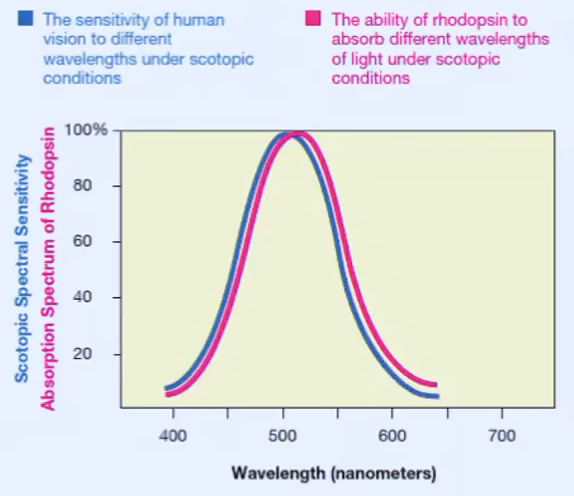
Behavioural measures of human sensitivity to different wavelengths closely matches the ability of rhodopsin (rod photoreceptor) to absorb those wavelengths of light.

Visual transduction is conversion of light energy into neural signals by the receptors.
<p><span style="background-color: inherit; line-height: 19.55px; color: windowtext;">Behavioural measures of human sensitivity to different wavelengths closely matches the ability of rhodopsin (rod photoreceptor) to absorb those wavelengths of light</span><span style="line-height: 19.55px; color: windowtext;">.</span></p><p></p><p><span style="background-color: inherit; line-height: 19.55px; color: windowtext;">Visual transduction is conversion of light energy into neural signals by the receptors</span><span style="line-height: 19.55px; color: windowtext;">.</span></p>
9
New cards

ROD LIGHT ABORPTION

In the dark: 

  1. Rhodopsin molecules are inactive  

  2. Na+ channels kept open  

  3. Na+ ions flow into the rods, partially depolarising them.  

  4. Steady flow of excitatory glutamate being emitted from rod  

In the light: 

  1. Light bleaches rhodopsin molecules 

  2. Na+ channels close 

  3. Na+ ions can’t enter rods and rods become hyperpolarised 

  4. Flow of excitatory glutamate is reduced.  


*therefore, the presence of light is signalled by a decrease in activity 
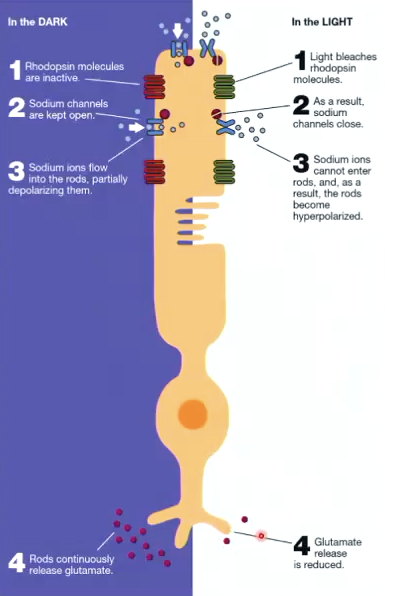
<p><span style="background-color: inherit; line-height: 19.55px; color: windowtext;"><strong>In the dark:</strong></span><span style="line-height: 19.55px; color: windowtext;">&nbsp;</span></p><ol><li><p class="Paragraph SCXO199923531 BCX0" style="text-align: left;"><span style="background-color: inherit; line-height: 19.55px; color: windowtext;">Rhodopsin molecules are inactive&nbsp;</span><span style="line-height: 19.55px; color: windowtext;">&nbsp;</span></p></li><li><p class="Paragraph SCXO199923531 BCX0" style="text-align: left;"><span style="background-color: inherit; line-height: 19.55px; color: windowtext;">Na+ channels kept open&nbsp;</span><span style="line-height: 19.55px; color: windowtext;">&nbsp;</span></p></li><li><p class="Paragraph SCXO199923531 BCX0" style="text-align: left;"><span style="background-color: inherit; line-height: 19.55px; color: windowtext;">Na+ ions flow into the rods, partially depolarising them.&nbsp;</span><span style="line-height: 19.55px; color: windowtext;">&nbsp;</span></p></li><li><p class="Paragraph SCXO199923531 BCX0" style="text-align: left;"><span style="background-color: inherit; line-height: 19.55px; color: windowtext;">Steady flow of excitatory glutamate being emitted from rod&nbsp;</span><span style="line-height: 19.55px; color: windowtext;">&nbsp;</span></p></li></ol><p class="Paragraph SCXO199923531 BCX0" style="text-align: left;"><span style="background-color: inherit; line-height: 19.55px; color: windowtext;"><strong>In the light:</strong></span><span style="line-height: 19.55px; color: windowtext;">&nbsp;</span></p><ol><li><p class="Paragraph SCXO199923531 BCX0" style="text-align: left;"><span style="background-color: inherit; line-height: 19.55px; color: windowtext;">Light bleaches rhodopsin molecules</span><span style="line-height: 19.55px; color: windowtext;">&nbsp;</span></p></li><li><p class="Paragraph SCXO199923531 BCX0" style="text-align: left;"><span style="background-color: inherit; line-height: 19.55px; color: windowtext;">Na+ channels close</span><span style="line-height: 19.55px; color: windowtext;">&nbsp;</span></p></li><li><p class="Paragraph SCXO199923531 BCX0" style="text-align: left;"><span style="background-color: inherit; line-height: 19.55px; color: windowtext;">Na+ ions can’t enter rods and rods become hyperpolarised</span><span style="line-height: 19.55px; color: windowtext;">&nbsp;</span></p></li><li><p class="Paragraph SCXO199923531 BCX0" style="text-align: left;"><span style="background-color: inherit; line-height: 19.55px; color: windowtext;">Flow of excitatory glutamate is reduced.&nbsp;</span><span style="line-height: 19.55px; color: windowtext;">&nbsp;</span></p></li></ol><p class="Paragraph SCXO199923531 BCX0" style="text-align: left;"><span style="line-height: 19.55px; color: windowtext;">&nbsp;</span></p><p class="Paragraph SCXO199923531 BCX0" style="text-align: left;"><span style="background-color: inherit; line-height: 19.55px; color: windowtext;">*therefore, the presence of light is signalled by a decrease in activity</span><span style="line-height: 19.55px; color: windowtext;">&nbsp;</span></p>
10
New cards

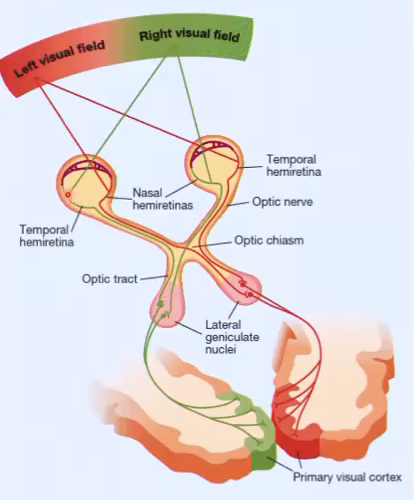
RETINA-GENICULATE-STRIATE PATHWAY: HEMI DECUSSATION

  • Anything in right visual field casts an image to the left side of the retina in the left and right eye 

  • Vice versa  

  • Information in the right visual field is transmitted to the left visual cortex 

  • Vice versa  

<ul><li><p class="Paragraph SCXO203453604 BCX0" style="text-align: left;"><span style="background-color: inherit; line-height: 19.55px; color: windowtext;">Anything in right visual field casts an image to the left side of the retina in the left and right eye</span><span style="line-height: 19.55px; color: windowtext;">&nbsp;</span></p></li><li><p class="Paragraph SCXO203453604 BCX0" style="text-align: left;"><span style="background-color: inherit; line-height: 19.55px; color: windowtext;">Vice versa&nbsp;</span><span style="line-height: 19.55px; color: windowtext;">&nbsp;</span></p></li><li><p class="Paragraph SCXO203453604 BCX0" style="text-align: left;"><span style="background-color: inherit; line-height: 19.55px; color: windowtext;">Information in the right visual field is transmitted to the left visual cortex</span><span style="line-height: 19.55px; color: windowtext;">&nbsp;</span></p></li><li><p class="Paragraph SCXO203453604 BCX0" style="text-align: left;"><span style="background-color: inherit; line-height: 19.55px; color: windowtext;">Vice versa&nbsp;</span><span style="line-height: 19.55px; color: windowtext;">&nbsp;</span></p></li></ul><p></p>
11
New cards

RETINA-GENICULATE-STRIATE PATHWAY: RETINOTOPIC MAPPING

  • Adjacent regions process features that fall on adjacent regions on the retina in the visual cortex 

  • The order of stimulation on the retina is maintained all the way through the pathway to the visual cortex 
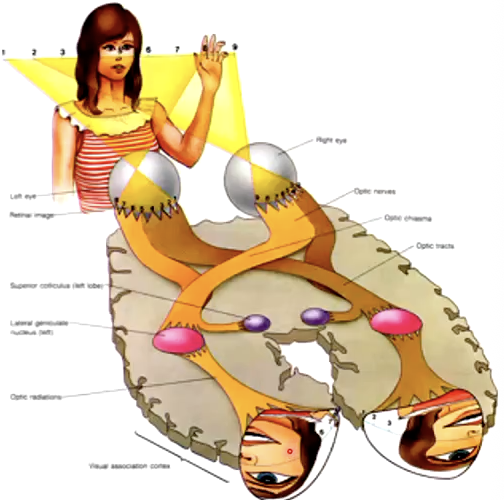
<ul><li><p class="Paragraph SCXO168500378 BCX0" style="text-align: left;"><span style="background-color: inherit; line-height: 19.55px; color: windowtext;">Adjacent regions process features that fall on adjacent regions on the retina in the visual cortex</span><span style="line-height: 19.55px; color: windowtext;">&nbsp;</span></p></li><li><p class="Paragraph SCXO168500378 BCX0" style="text-align: left;"><span style="background-color: inherit; line-height: 19.55px; color: windowtext;">The order of stimulation on the retina is maintained all the way through the pathway to the visual cortex</span><span style="line-height: 19.55px; color: windowtext;">&nbsp;</span></p></li></ul><p></p>
12
New cards

LATERAL INHIBITION

  • Mechanism by which neighbouring photoreceptors mutually suppress each other's activity 

  • Bright-side receptor sends strong inhibition to its dim neighbour 

  • Dim-side receptor can only send weak inhibition back 

13
New cards

MACH BANDS

Bright side looks brighter at border, dark side looks darker in adjacent uniform rectangles 
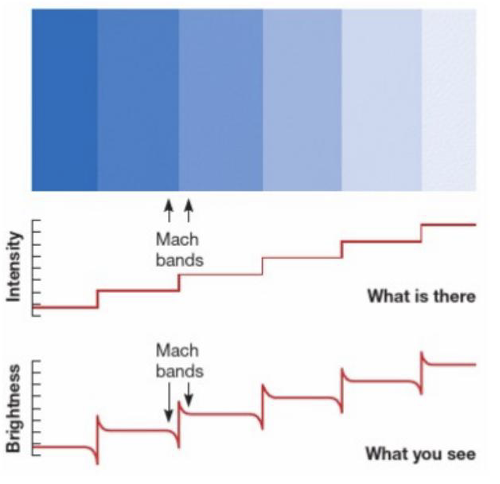
<p><span style="background-color: inherit; line-height: 19.55px; color: windowtext;">Bright side looks brighter at border, dark side looks darker in adjacent uniform rectangles</span><span style="line-height: 19.55px; color: windowtext;">&nbsp;</span></p>
14
New cards

RECEPTIVE FIELD

Region in space/on the retina, that when stimulated, affects the behaviour of a neuron that is connected to it 

15
New cards

RESPONSES OF ON-CENTRE + OFF-CENTRE CELLS

Responses of on-centre cell: 

  • There is an 'on' response when light is shone anywhere in the centre of the field  

  • There is an 'off' response when a spot of light is shone anywhere in the periphery of the field  

*off-centre process is the opposite

*if both off and on regions were illuminated together, there was little reaction  

16
New cards

SIMPLE CELLS

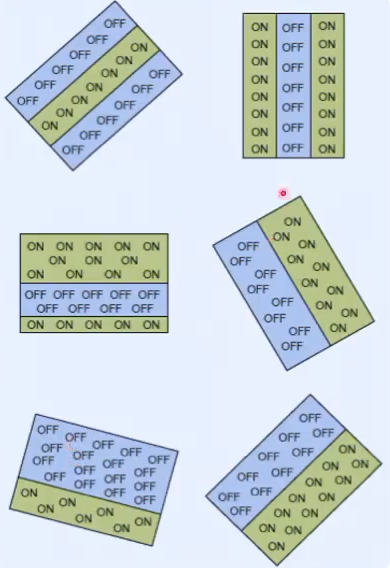
  • Simple cells form multiple aligned centre-surround receptive fields to create orientation specific receptive fields.  

  • Respond most vigorously when static bars with an approximate orientation falls onto the 'on' subfield of the receptive field 

  • Regions don't need to be uniform 

<ul><li><p class="Paragraph SCXO148199022 BCX0" style="text-align: left;"><span style="background-color: inherit; line-height: 19.55px; color: windowtext;">Simple cells form multiple aligned centre-surround receptive fields to create orientation specific receptive fields.&nbsp;</span><span style="line-height: 19.55px; color: windowtext;">&nbsp;</span></p></li><li><p class="Paragraph SCXO148199022 BCX0" style="text-align: left;"><span style="background-color: inherit; line-height: 19.55px; color: windowtext;">Respond most vigorously when static bars with an approximate orientation falls onto the 'on' subfield of the receptive field</span><span style="line-height: 19.55px; color: windowtext;">&nbsp;</span></p></li><li><p class="Paragraph SCXO148199022 BCX0" style="text-align: left;"><span style="background-color: inherit; line-height: 19.55px; color: windowtext;">Regions don't need to be uniform</span><span style="line-height: 19.55px; color: windowtext;">&nbsp;</span></p></li></ul><p></p>
17
New cards

SPATIAL FREQUENCY - SIMPLE CELLS

Low spatial frequency: 

  • Activates simple cells with widely separated subfields  

High spatial frequency: 

  • Activates simple cells with less separated subfields 

18
New cards

COMPLEX CELLS

  • Larger receptive fields  

  • They respond to oriented contour anywhere within their receptive field  

  • Receive input from both eyes although prefer one eye over the other 

  • Respond more vigorously when both eyes stimulated simultaneously 

19
New cards

ORGANISATION OF PRIMARY VISUAL CORTEX (V1) 

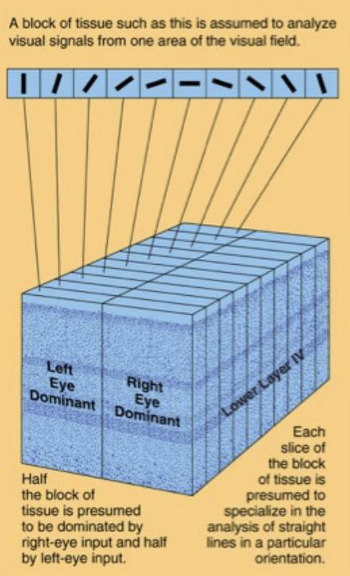
V1 is organised into functional columns perpendicular to cortical surface  

Columns alternate in eye dominance across the cortical surface 

Hypercolumn: 

  • A full set of orientation columns for both eyes 

Within column cells share: 

  • Same retinal location 

  • Same eye dominance 

  • Same preferred orientation 

<p class="Paragraph SCXO252060064 BCX0" style="text-align: left;"><span style="background-color: inherit; line-height: 19.55px; color: windowtext;">V1 is organised into functional columns perpendicular to cortical surface&nbsp;</span><span style="line-height: 19.55px; color: windowtext;">&nbsp;</span></p><p class="Paragraph SCXO252060064 BCX0" style="text-align: left;"><span style="background-color: inherit; line-height: 19.55px; color: windowtext;">Columns alternate in eye dominance across the cortical surface</span><span style="line-height: 19.55px; color: windowtext;">&nbsp;</span></p><p class="Paragraph SCXO252060064 BCX0" style="text-align: left;"><span style="background-color: inherit; line-height: 19.55px; color: windowtext;">Hypercolumn:</span><span style="line-height: 19.55px; color: windowtext;">&nbsp;</span></p><ul><li><p class="Paragraph SCXO252060064 BCX0" style="text-align: left;"><span style="background-color: inherit; line-height: 19.55px; color: windowtext;">A full set of orientation columns for both eyes</span><span style="line-height: 19.55px; color: windowtext;">&nbsp;</span></p></li></ul><p class="Paragraph SCXO252060064 BCX0" style="text-align: left;"><span style="background-color: inherit; line-height: 19.55px; color: windowtext;">Within column cells share:</span><span style="line-height: 19.55px; color: windowtext;">&nbsp;</span></p><ul><li><p class="Paragraph SCXO252060064 BCX0" style="text-align: left;"><span style="background-color: inherit; line-height: 19.55px; color: windowtext;">Same retinal location</span><span style="line-height: 19.55px; color: windowtext;">&nbsp;</span></p></li><li><p class="Paragraph SCXO252060064 BCX0" style="text-align: left;"><span style="background-color: inherit; line-height: 19.55px; color: windowtext;">Same eye dominance</span><span style="line-height: 19.55px; color: windowtext;">&nbsp;</span></p></li><li><p class="Paragraph SCXO252060064 BCX0" style="text-align: left;"><span style="background-color: inherit; line-height: 19.55px; color: windowtext;">Same preferred orientation</span><span style="line-height: 19.55px; color: windowtext;">&nbsp;</span></p></li></ul><p></p>
20
New cards

SCOTOMAS & CORTICAL FILLING-IN

  • Damage to V1 causes scotoma (cortical blind spot) 

  • Brain fills it in automatically 

21
New cards

BLIND SIGHT

Patients with large V1 scotomas report no conscious awareness of objects in blind field yet can still interact with objects there  

  • Incomplete damage leaving residual processing 

  • Parallel visual pathways that reach secondary visual cortex without passing through V1 

22
New cards

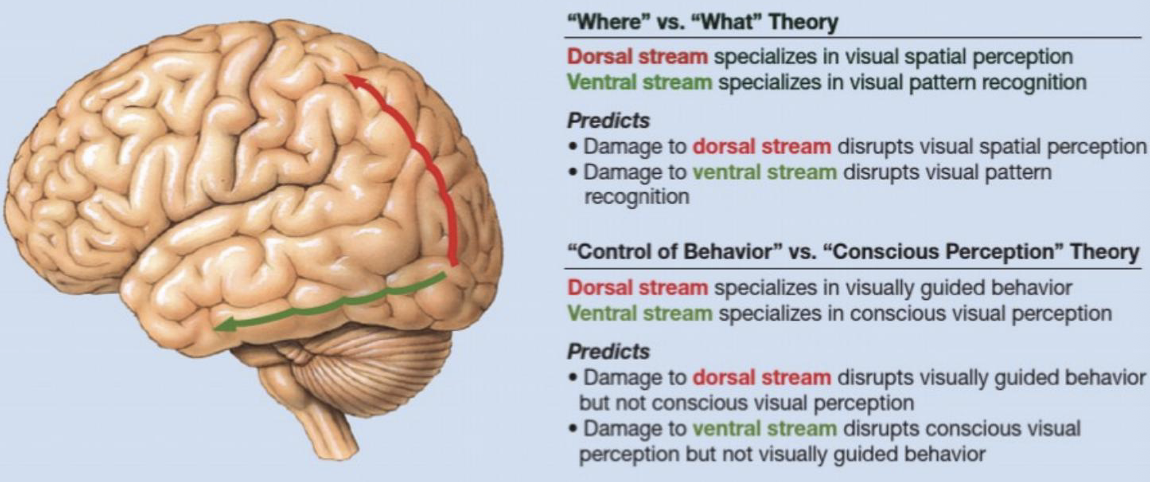
DORSAL STREAM (PARIETAL CORTEX)

  • Specialises in visual spatial perception 

  • Specialises in visually guided behaviour 

  • Reaching/intercepting/ interacting with objects 

  • Damage impairs motor interaction but not verbal description 
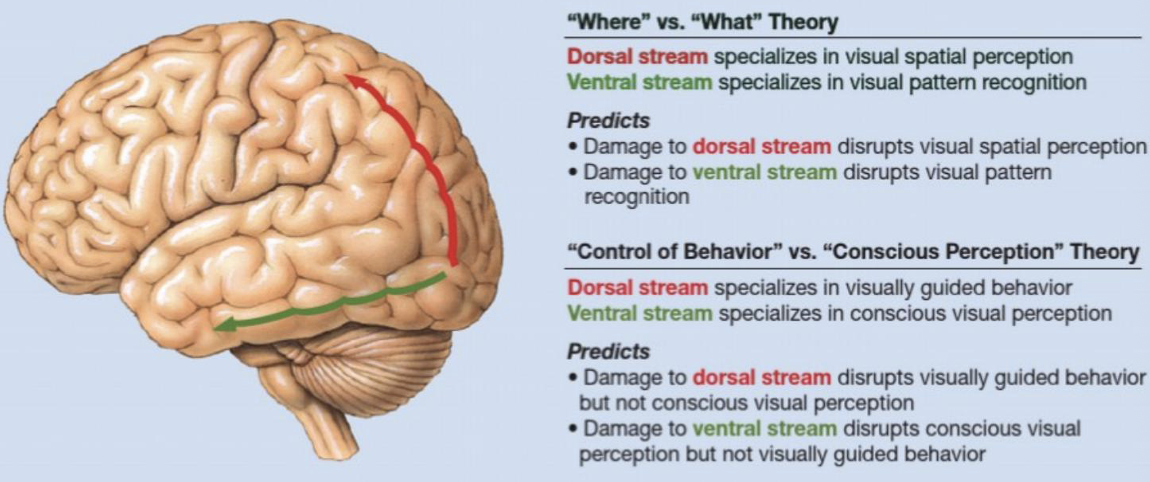
<ul><li><p class="Paragraph SCXO107995499 BCX0" style="text-align: left;"><span style="background-color: inherit; line-height: 19.55px; color: windowtext;">Specialises in visual spatial perception</span><span style="line-height: 19.55px; color: windowtext;">&nbsp;</span></p></li><li><p class="Paragraph SCXO107995499 BCX0" style="text-align: left;"><span style="background-color: inherit; line-height: 19.55px; color: windowtext;">Specialises in visually guided behaviour</span><span style="line-height: 19.55px; color: windowtext;">&nbsp;</span></p></li><li><p class="Paragraph SCXO107995499 BCX0" style="text-align: left;"><span style="background-color: inherit; line-height: 19.55px; color: windowtext;">Reaching/intercepting/ interacting with objects</span><span style="line-height: 19.55px; color: windowtext;">&nbsp;</span></p></li><li><p class="Paragraph SCXO107995499 BCX0" style="text-align: left;"><span style="background-color: inherit; line-height: 19.55px; color: windowtext;">Damage impairs motor interaction but not verbal description</span><span style="line-height: 19.55px; color: windowtext;">&nbsp;</span></p></li></ul><p></p>
23
New cards

VENTRAL STREAM (INFEROTEMPORAL CORTEX)

  • Specialises in visual pattern recognition 

  • Specialises in conscious visual perception 

  • Damage impairs description/recognition, but not motor interaction 
<ul><li><p class="Paragraph SCXO120667606 BCX0" style="text-align: left;"><span style="background-color: inherit; line-height: 19.55px; color: windowtext;">Specialises in visual pattern recognition</span><span style="line-height: 19.55px; color: windowtext;">&nbsp;</span></p></li><li><p class="Paragraph SCXO120667606 BCX0" style="text-align: left;"><span style="background-color: inherit; line-height: 19.55px; color: windowtext;">Specialises in conscious visual perception</span><span style="line-height: 19.55px; color: windowtext;">&nbsp;</span></p></li><li><p class="Paragraph SCXO120667606 BCX0" style="text-align: left;"><span style="background-color: inherit; line-height: 19.55px; color: windowtext;">Damage impairs description/recognition, but not motor interaction</span><span style="line-height: 19.55px; color: windowtext;">&nbsp;</span></p></li></ul><p></p>
24
New cards

PULFRICH ILLUSION

Illusion where a 2D moving object is perceived as 3D (moving in depth) dye to a delay in signal processing between eyes.

EX. ball swinging left to right it perceived as swinging in a circle

25
New cards

PULFRICH ILLUSION COMPONENTS

  1. Stereoscopic Vision

  2. Simple harmonic motion of the pendulum

  3. The filter/lens

26
New cards

STEREOSCOPIC VISION

  • 2 eyes get slightly different images of the world

  • brain combines these 2 images to get a single perception

  • important for depth perception

FIXATION:

fixate → eyes focus and align → image falls on fovea

PERIPHERAL:

image falls beside fovea, on retina.

27
New cards

UNCROSSED DISPARITY

Focusing/fixating on an image BEHIND what you were initially fixated on. Object appears further away in depth

  • farther than fixation point

  • image appears further to left in space to left eye

  • image appears further to right in space to right eye

28
New cards

CROSSED DISPARITY

Focusing/fixating on an image IN FRONT what you were initially fixated on. Object appears nearer in depth

  • nearer than fixation point

  • image appears further to right in space to left eye

  • image appears further to left in space to right eye

29
New cards

SIMPLE HARMONIC MOTION

Ball accelerates as travelling down due to gravity. At bottom it is maximum gravity. Ball slows down as it travels back up, due to going against gravity.

30
New cards

DIMMING FILTER/LENS

  • Signal transduction from retina to brain is faster for brighter images

  • filter over your eyes dims the image that falls on your retina

  • filter in ONE eye, means that signals from one eye are slightly delayed

31
New cards

COMBINATION: FILTER OVER LEFT EYE

  • ball appears further away on the same side as filtered eye

  • delay in filtered eye causes ball to always be perceived as behind

  • ball appears to move in clockwise direction

LEFT TO RIGHT MOTION

  • uncrossed disparity

  • further away in depth

  • illusory backward arc

RIGHT TO LEFT MOTION

  • crossed disparity

  • nearer in depth

  • illusory forward arc

32
New cards

COMBINATION: FILTER OVER RIGHT EYE

  • ball appears further away on the same side as filtered eye

  • delay in filtered eye causes ball to always be perceived as behind

  • ball appears to move in anti-clockwise direction

LEFT TO RIGHT MOTION

  • crossed disparity

  • nearer away in depth

  • illusory forward arc

RIGHT TO LEFT MOTION

  • uncrossed disparity

  • further in depth

  • illusory backward arc

33
New cards

MONOCULAR DEPTH CUES (ONE EYE)

  1. OCCLUSION - chair blocks persons leg therefore, person behind chair

  2. RETINAL SIZE - object gets ‘bigger’ when closer

  3. AMES WINDOW - using angles and shading

  4. LINEAR PERSPECTIVE - parallel lines converge in the distance

  5. TEXTURE GRADIENT - more detailed closer to

  6. SHADING - light generally comes from above (convex vs concave)

  7. LIGHT SCATTER - distant objects appear hazier & bluer

  8. MOTION PARALLEX - objects further away appear to move slower

Explore top flashcards

flashcards
VM 525 Final Exam
165
Updated 760d ago
0.0(0)
flashcards
Bio Unit Exam 2
153
Updated 848d ago
0.0(0)
flashcards
Conexiones Capítulo 8 (Vocab 1)
68
Updated 1232d ago
0.0(0)
flashcards
20 Amino Acids
20
Updated 435d ago
0.0(0)
flashcards
Pathophysiology Exam #3
65
Updated 1105d ago
0.0(0)
flashcards
6.5 Neurology
29
Updated 1117d ago
0.0(0)
flashcards
Morse Code
26
Updated 1230d ago
0.0(0)
flashcards
Genetics
23
Updated 1097d ago
0.0(0)
flashcards
VM 525 Final Exam
165
Updated 760d ago
0.0(0)
flashcards
Bio Unit Exam 2
153
Updated 848d ago
0.0(0)
flashcards
Conexiones Capítulo 8 (Vocab 1)
68
Updated 1232d ago
0.0(0)
flashcards
20 Amino Acids
20
Updated 435d ago
0.0(0)
flashcards
Pathophysiology Exam #3
65
Updated 1105d ago
0.0(0)
flashcards
6.5 Neurology
29
Updated 1117d ago
0.0(0)
flashcards
Morse Code
26
Updated 1230d ago
0.0(0)
flashcards
Genetics
23
Updated 1097d ago
0.0(0)