Protein Synthesis & Mutations: Central Dogma, Codons, and Genetic Variations
 Call Kai
 Learn
Learn Practice Test
 Spaced Repetition
 Match
Match Flashcards
 Knowt Play
1/44

There's no tags or description
Looks like no tags are added yet.
Name | Mastery | Learn | Test | Matching | Spaced | Call with Kai |
|---|
No analytics yet
Send a link to your students to track their progress
45 Terms
What is the Central Dogma of Molecular Biology?
The flow of genetic information from DNA to RNA to protein.
What is the role of DNA in the central dogma?
It serves as the information source, storing genetic instructions for cellular processes.
In what direction does RNA polymerase synthesize mRNA?
In the 5' to 3' direction.
Why is the 5' to 3' directionality of mRNA synthesis important?
It allows for accurate proofreading, correct codon reading by ribosomes, and provides energy for polymerization.
Where does transcription occur in eukaryotic cells?
In the nucleus.
Where does translation occur in both prokaryotic and eukaryotic cells?
In the cytoplasm on ribosomes.
What is the significance of the genetic code being redundant?
It allows 64 codon combinations to encode only 20 amino acids, providing robustness against errors and efficiency.
What is the universal start codon?
AUG.
What are the three stop codons?
UAA, UAG, and UGA.
What triggers the release of a completed protein from the ribosome?
Protein release factors that recognize stop codons.
When transcribing DNA to mRNA, which base is replaced by Uracil (U)?
Thymine (T).
What is a mutation?
A permanent change in the DNA sequence caused by uncorrected errors during replication.
What is a silent mutation?
A base pair change that results in no change to the protein or its function.
What is a missense mutation?
A mutation that changes a codon to specify a different amino acid.
What is a nonsense mutation?
A point mutation that changes an amino acid codon into a stop codon.
What is a frameshift mutation?
An insertion or deletion of bases (not in multiples of 3) that shifts the reading frame of the mRNA.
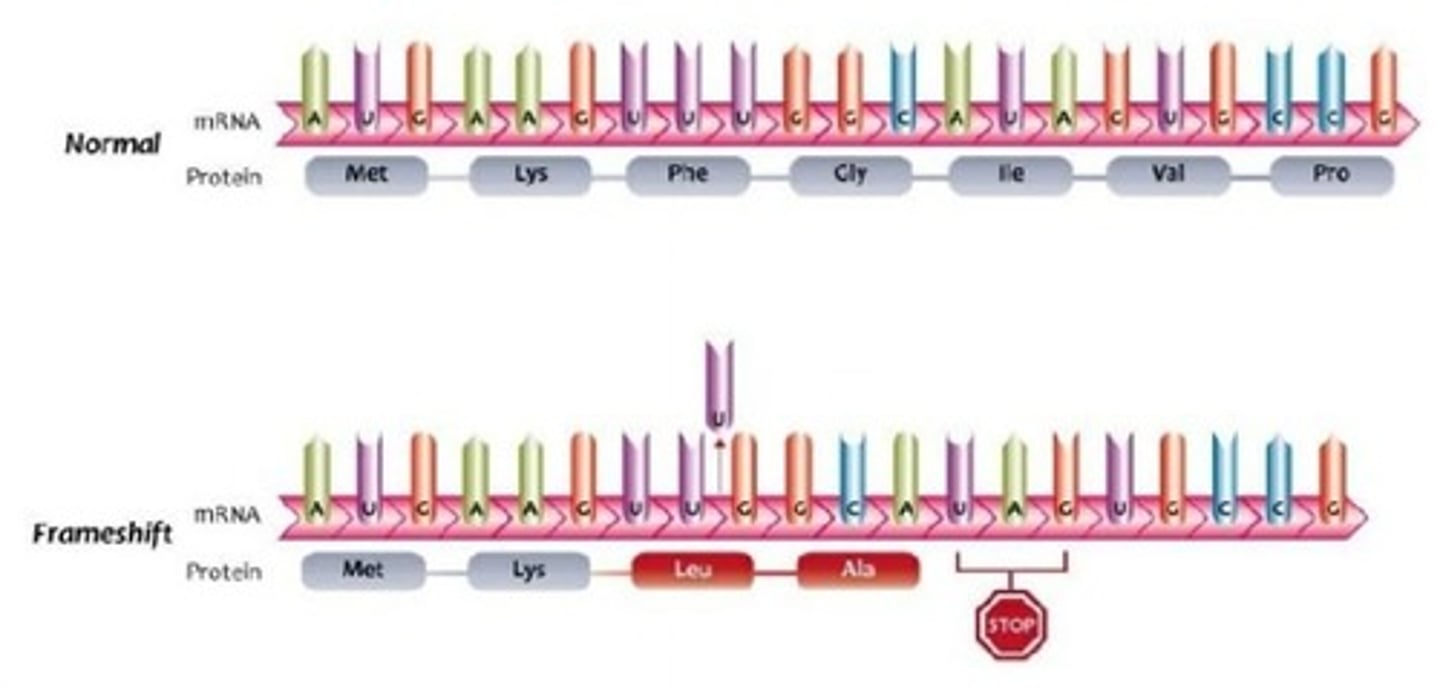
Why are frameshift mutations typically more harmful than point mutations?
They disrupt the entire downstream sequence, often resulting in a nonfunctional protein.
How does the location of DNA differ between prokaryotes and eukaryotes?
Prokaryotic DNA is in the cytoplasm/nucleoid, while eukaryotic DNA is enclosed in a nucleus.
What is the primary difference in gene expression speed between prokaryotes and eukaryotes?
Prokaryotes allow coupled transcription-translation, while eukaryotes must process mRNA and transport it out of the nucleus.
What is the function of protein release factors?
They recognize stop codons and trigger the release of the completed protein and ribosome disassembly.
What are the two types of frameshift mutations?
Insertion and deletion.
What does DNA polymerase do during replication?
It synthesizes new DNA strands and occasionally makes mistakes that can lead to mutations.
In the context of the central dogma, what is the role of RNA?
It bridges genetic information from DNA to functional protein molecules.
What is the template strand in transcription?
The DNA strand that RNA polymerase reads in the 3' to 5' direction to synthesize mRNA.
Why do eukaryotes require pre-mRNA processing while prokaryotes do not?
Eukaryotes must remove introns, add a 5' cap and poly-A tail, and export mRNA from the nucleus; prokaryotes lack a nucleus and introns, allowing immediate translation.
What is an intron?
A noncoding sequence in pre-mRNA that is removed during splicing.
What is an exon?
A coding sequence that remains after splicing and is joined to form mature mRNA.
What is the function of the 5' cap?
A modified guanine nucleotide that protects mRNA and facilitates ribosome binding.
What is the function of the poly-A tail?
A stretch of adenines that stabilizes mRNA and aids in export from the nucleus.
What is the role of the spliceosome?
A complex of enzymes and RNA that removes introns and joins exons together.
What do prokaryotic and eukaryotic translation have in common?
Both decode codons into amino acids using the same genetic code and both start translation at an AUG start codon.
What is the relationship between a tRNA anticodon and an mRNA codon?
They must be complementary to ensure the correct amino acid is added to the polypeptide chain.
What is the function of the A site on a ribosome?
The site where new tRNAs carrying amino acids enter and match their anticodon to the mRNA codon.
What is the function of the P site on a ribosome?
The site where the growing polypeptide chain is held.
What is the function of the E site on a ribosome?
The exit site where empty tRNAs leave the ribosome.
What occurs during the initiation stage of translation?
The ribosome assembles around the mRNA and the first tRNA binds to the start codon.
What occurs during the elongation stage of translation?
Amino acids are added one by one to the growing polypeptide chain as the ribosome moves along the mRNA.
What occurs during the termination stage of translation?
The ribosome reaches a stop codon, releasing the completed protein.
How does the non-template strand of DNA compare to the mRNA sequence?
They are identical in sequence, except that DNA contains thymine (T) while mRNA contains uracil (U).
What is a silent (neutral) mutation?
A mutation that changes a nucleotide but results in the same amino acid, causing no change to the protein.
Which site on the ribosome contains the open codon for tRNA matching?
The A site.
What is the primary difference in timing of gene expression between prokaryotes and eukaryotes?
Prokaryotes exhibit rapid, nearly simultaneous transcription and translation, while eukaryotes require time for mRNA processing and export.
What is the start codon for translation?
AUG.
What is the role of the spliceosome in mRNA maturation?
It cuts out introns and ligates exons together.
Why is the genetic code considered universal?
Because both prokaryotes and eukaryotes decode the same codons into the same amino acids.

