BIO 39 Lab Exam #1
 Call Kai
 Learn
Learn Practice Test
 Spaced Repetition
 Match
Match Flashcards
 Knowt Play
1/72

Earn XP
Name | Mastery | Learn | Test | Matching | Spaced | Call with Kai |
|---|
No analytics yet
Send a link to your students to track their progress
73 Terms
The specific area of microbiology that refers to the prevention, diagnosis, and treatment of infectious diseases as well as new clinical applications of microbes for the improvement of health.
Clinical Microbiology
What are the three purposes of the BIO 39 lab?
Recognition, diagnosis, and treatment of infectious diseases.
Cover standard practices in infection prevention and control.
Interpretation of lab and radiology tests related to infectious diseases.
The natural or habitat of a pathogen in disease communication.
Reservoir
An individual who discreetly shelters a pathogen and spreads it to others without any notice.
Carrier
An individual who shelters a pathogen and does NOT show symptoms of disease (Think: more specific term; a subtype).
Asymptomatic Carrier
An individual who shelters a pathogen for a long time after recovery due to the latency of the infectious agent.
Chronic Carrier
An infectious disease native to animals that humans can acquire through means of direct or indirect contact with infected animals. (Think: Rabies)
Zoonosis
An infection in a host that can be transmitted to another host.
Communicable Infectious Disease
An infection in a host cannot be transmitted to another individual.
Non-Communicable Infectious Disease
Transmission event involving the passing of an infectious agent from a host directly with no intermediate to transfer the infectious disease.
Direct Transmission Event
Sneezing, coughing, and speaking are examples of this type of transmission event.
Direct Transmission Event
List the five standard precautions.
Hand Hygiene
Environmental Cleaning (To Reduce pathogen transmission events)
Respiratory Hygiene
PPE Use
Sterilization (of medical wastes, soiled linens, medical instruments/equipment).
Machine that uses pressure to raise the boiling point of water to 121°C for 20 minutes in order to sterilize equipment or any other medical items. Destroys all microbes, enzymes, and biomolecules (sterilizes items).
Autoclave
Under what circumstances or which patients should standard precautions be applied?
Standard precautions should be applied in the care of ALL patients ALL of the time.
What is the purpose of standard precautions?
To Mitigate Infection Risk or Infection Risk Mitigation
Performing clinical techniques without causing infection or contamination of the patient tissues, medications, or patient environment.
Aseptic Techniques
The use of gloves, masks/respirators, gowns, shoe covers, and hair caps are examples of following this standard precaution.
PPE Use
Surgery, wound dressings, intubation tube placement, intravenous line placement, venipuncture, and transfusion are all clinical applications of ________ techniques.
Aseptic Techniques
A sample from a patient that is used to cultivate potential pathogen(s).
Clinical Culture
The method of destroying microbes by denaturing the proteins, DNA, or membranes of microbes through the use of heat.
Heat Inactivation
A machine that is used to sterilize surgical instruments, microbial media, and biomedical waste.
Autoclave
The Microbiology Department procedure used to identify bacterial pathogens from patient samples AND determines which antibiotics are most effect against the identified pathogen.
The Culture and Sensitivity Test or The C&S Test
What are the two purposes of the C&S test?
Identify Bacterial Pathogen
Determine Antibiotic Susceptibility
Test consisting of a battery of biochemical and genetic tests and microscopic analysis.
The C&S Test
What is the healthy range of heart rate?
60-100 bpm
What is the healthy range for respiration rate?
12 -20 bpm
What is the healthy body temperature?
98.6 degrees Fahrenheit
What is the healthy range of blood pressure?
90/60 -120/80 mmHg
What is the healthy range of oxygen saturation (SaO2)?
95%-99%
What is the significance of low blood pressure?
Indicates possible bloodstream or systemic infection
What does “A” stand for in the ABCs of emergency medicine?
Airway(s)
What does “B” stand for in the ABCs of emergency medicine?
Breathing
What does “C” stand for in the ABCs of emergency medicine?
Circulation
What question should you ask yourself when using “A” in the ABCs of emergency medicine.
Is there an obstruction or blockage of airways?
What question should you ask yourself when using “B” in the ABCs of emergency medicine.
Is there proper gas exchange happening in the lung?
What question should you ask yourself when using “C” in the ABCs of emergency medicine.
Is their blood pressure outside the normal range?
What specific temperature constitutes fever?
Any temperature greater than 100.4 degrees Fahrenheit
True or False: Immune system processes are more efficient at higher body temperatures.
True
True or False: Certain pathogens replicate more slowly under higher body temperatures.
True
The specific body temperature of ______ degrees Fahrenheit indicates infection.
101 degrees Fahrenheit
The specific body temperature of ______ indicates severe infection.
107 degrees Fahrenheit
True or False: High and prolonged fevers always increase levels of health and never require mitigation.
False (High and prolonged fevers can cause neurological disruptions that can be permanent)
What is the clinical importance of body temperature with regards to infection?
Body temperature indicates infection severity
A substance that causes a rise in body temperature or fever.
Pyrogens
Products from monocytes, neutrophils, and macrophages during the process of phagocytosis that raise body temperature.
Endogenous Pyrogens
Products of infectious agents (viruses, bacteria, protozoa, fungi) that raise the body temperature.
Exogenous Pyrogens
What are the three benefits of fever?
Slows pathogen multiplication
Interferes with pathogen’s iron availability
Stimulates immune system processes
True or False: Fever increases pathogen multiplication.
False (Fever slows pathogen multiplication)
True or False: Fever interferes with the nutrition of pathogens by reducing iron availability.
True
True or False: Fever inhibits the immune system response.
False (it stimulates immune system processes like phagocytosis)
Lipopolysaccharides (LPS) of gram negative bacteria are an example of this substance that raises body temperature.
Endogenous pyrogens
True or False: Patients with cardiovascular disease, head trauma, seizures, or respiratory ailments are at a higher risk when having a feaver, and thus require specific treatment with fever-reducing drugs.
True
What is the healthy range of white blood cells (WBCs)?
4,500 - 11,000 WBC/µL
What specific WBC value represents an above normal value?
A WBC value greater than or equal to 12,000 WBC/µL
What is the significance of increased WBCs with regards to infection?
They indicate infection severity (WBC count is directly proportional to infection severity)
A granulocyte. First responds to bacterial infections and phagocytize bacteria and cellular debris. The most abundant white blood cell type. Release enzymes to kill pathogens. Located in blood.
Neutrophil
Agranulocytes (or not a granulocyte). Blood precursors to macrophages. Phagocytize pathogens. Produce cytokines to regulate immune response.
Monocytes
Large white blood cells. Phagocytize pathogens. Present antigens to T cells. Secrete cytokines to recruit other immune cells. Located in tissues.
Macrophages
A granulocyte. Defend against parasites (helminths). Involved in allergic reactions and modulate inflammation. Produce toxic proteins for eliminating parasites.
Eosinophils
Composed of epithelial cells that are compacted and cemented together with keratin to physically block pathogens from entering both non-sterile and sterile parts of the body.
Skin
Impedes entry and attachment of bacteria to host cells. Rich with bacteriophages which help to kill bacteria. Example: Tear production in the eyes flush away irritants from the surface of the eye.
Mucous Membranes
One of the first lines of defense against microbes. Contains epithelial cells cemented together with keratin making it impermeable to pathogens. Additionally, it frequently sloughs off taking microbes with it.
Skin (Stratum Corneum)
Impedes entry and attachment of bacteria to epithelial cells. Rich with bacteriophages that work to eliminate bacteria. Not keratinized.
Mucous Membrane
Constantly guarded by effective and elaborate adaptations. Contains nasal hair that traps particles, mucus and fluid flow that flushes away irritants and infectious agents, and cilia that moves foreign particles up towards the pharynx to be removed.
Respiratory Tract
An injury to the skin or other tissue primarily caused primarily by heat, but can also be caused by radiation, radioactivity, friction, electricity, or chemical contact.
Burns
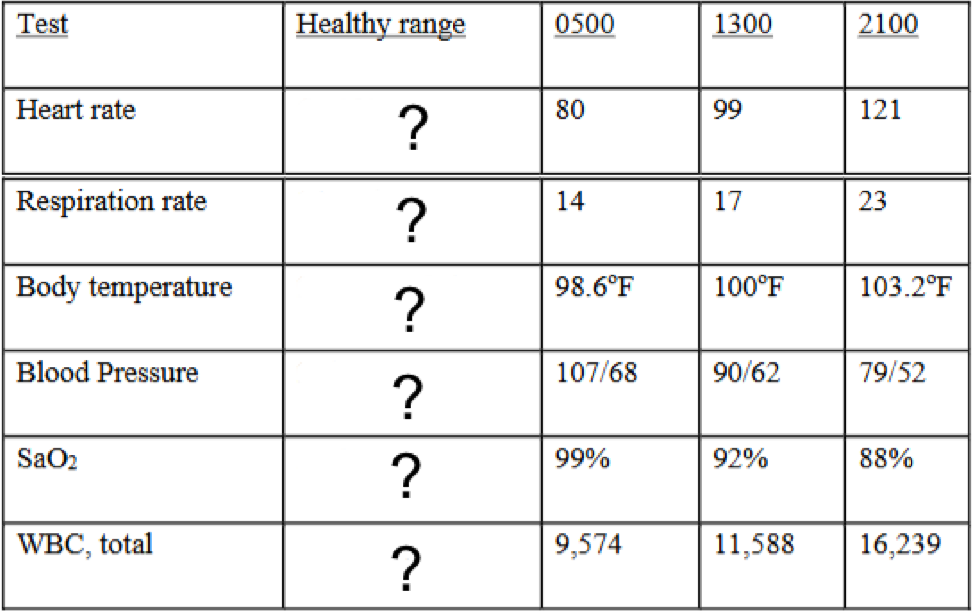
True or False: At least one of the five vital signs shown are within their healthy range.
False
What are the five vital signs?
Heart Rate
Respiration Rate
Blood Pressure
SaO2
Body Temperature
What is the healthy range of blood pH?
7.35-7.45
Is arterial or venous blood considered the best sample to determine accurate blood oxygenation during an ABG test?
Arterial blood
What is the healthy range of partial pressure of oxygen (PaO2) in the blood?
70-100 mmHg
Determines the amount of oxygen bound to hemoglobin in red blood cells (RBCs).
SaO₂
Determines the blood CO2 levels.
PaCO₂
D

