Ecology IB BIO
 Studied by 0 people
 Call Kai
 Learn
Learn Practice Test
 Spaced Repetition
 Match
Match Flashcards
 Knowt Play
1/70

There's no tags or description
Looks like no tags are added yet.
Name | Mastery | Learn | Test | Matching | Spaced | Call with Kai |
|---|
No study sessions yet.
71 Terms
Energy flows through a food web but only 10% gets to the next trophic level.
E.g. Earthworm → American Robin
Explain how energy is lost because:
a) it is not assimilated =
b) it is not absorbed =
c) of heat loss =
A) Some energy rich molecules are absorbed but then used in metabolism
B) Some molecules pass through the digestive tract
C) Many of the reactions of metabolism waste heat
Arrows in a food web show…
the flow of energy
The four trophic levels and the type of nutrition are:
Producers autotrophic nutrition
2. Primary consumers heterotrophic nutrition
3. Secondary consumers heterotrophic nutrition
4. Tertiary consumers heterotrophic nutrition
Two types of decomposers are ____ and _____.
saprotrophs and detritovores
Explain why nutrients must be recycled:
there is a limited supply of nutrients in an ecosystem
Why is energy not recycled?
Energy flows in one direction through an ecosystem and is eventually lost as heat, so it cannot be reused.
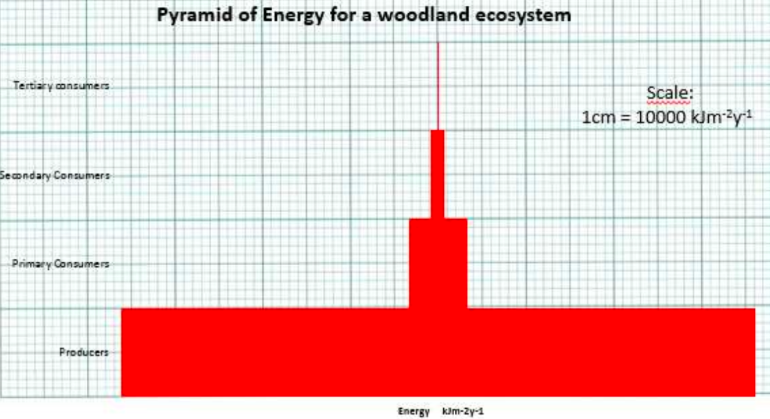
Explain how to draw a pyramid of energy like the one shown above:
Collect data for the amount of energy in each trophic level, figure out your scale, add a horizontal bar for the producers, center consumer bars above it.
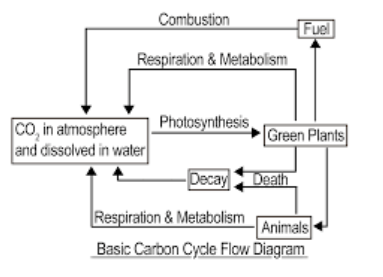
Carbon cycle processes which release CO2 into the atmosphere:
Respiration, Combustion, Erosion of Limestone
Carbon flux is…
the flow of carbon from one reservoir to another
Carbon cycle processes which absorb CO2 from the atmosphere:
Photosynthesis, Fossilization, Dissolution of CO2 into the sea
A carbon sink is a place where carbon can be stored long-term
Sketch the Carbon Cycle and Label the carbon reservoirs (and processes if possible)
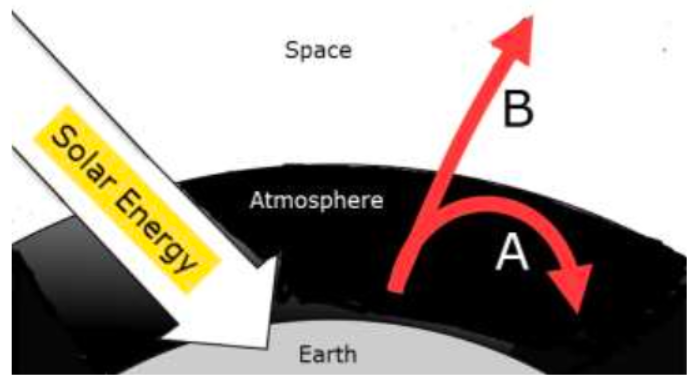
In the greenhouse effect diagram (below), what do the arrows represent?
A: Heat energy being lost into space from the earth
B: Heat energy being trapped by greenhouse gases in the atmosphere.
What is the role of each of the following in climate change?
Combustion of fossil fuels:
Rising atmospheric CO2 conc. :
Ocean acidification:
Combustion of fossil fuels: Increases the concentration of CO2 in the atmosphere
Rising atmospheric CO2 conc. : Traps more long wave radiation (heat) in atmosphere
Ocean acidification: CO2 absorbed by water is converted to carbonic acid, which decreases available calcium carbonate -> calcifiers are negatively affected.
The most significant greenhouse gases are:
Carbon dioxide and methane
Explain the concept of carrying capacity. How does carrying capacity affect population growth, and what factors determine the carrying capacity of an ecosystem?
Carrying capacity is the maximum population size. Limits growth population when the population reaches the carrying capacity. Factors determining it include food availability, habitat space, and water supply.
Define and distinguish between Type I, Type II, and Type III survivorship curves. Provide an example of a species for each type.
Type I curves show low death rates in early and middle life (e.g., humans), Type II curves represent a constant death rate over the organism's life span (e.g., birds), and Type III curves depict high death rates for the young and a lower death rate for survivors (e.g., oysters).
Describe the differences between r-selected and K-selected species.
R-selected species have high reproduction rates but low survivorship (e.g., insects), while K-selected species have lower reproduction rates but higher survivorship (e.g., elephants)
Describe the five major types of species interactions and give an example of each.
Mutualism: both species benefit, e.g., bees and flowers
Predation: one benefits and the other is harmed, e.g., lion and zebra
Competition: both species are harmed, e.g., two plants competing for light
Parasitism: one benefits and the other is harmed, e.g., tapeworms in humans
Commensalism: one benefits and the other is unaffected, e.g., barnacles on a whale
Define the concept of an ecological niche.
An ecological niche refers to the role and position a species has in its environment, including all its interactions with the biotic and abiotic factors.
What are some possible effects in a community due to competition?
Resource Partitioning: When different species compete for the same resources, they may evolve to utilize these resources in different ways or at different times.
Character Displacement: In cases where species do overlap, competition can drive evolutionary changes in physical or behavioral traits,
Competitive exclusion: When two species have overlapping niches, one could outcompete the otherresulting in the local extinction of the less competitive species.
Do table problems at the end of study guide
Check answer sheet
Ecology
the study of relations between living organisms and between organisms and their environment
Autotrophs
synthesise their own organic molecules and are therefore known as producers
Species Richness
number of different species
relative abundance
proportion of each species in total in the community
Heterotrophs
however obtain their organic molecules from other organisms
ALL autotrophs convert ? into ?
carbon dioxide, organic compounds
Few plants and algae use a combo of different modes of nutrition (mixotrophs) examples include?
Venus Fly traps, Euglena (an algae)
What type of heterotrophs ingest other organisms and obtain their organic molecules?
Consumers
What are the types of consumers?
Herbivores, carnivores, Omnivores, scvangers, detritivores
What are detritivores?
A type of heterotroph that obtains nutrients by consuming nonliving organic sources such as setritus and humus (dung beetles, earthworms, crabs, lice)
What does a detritus eat?
dead organic matter, decaying organic material and fecal matter
What does a humus eat?
decaying leaf litter mixed with soil
What kind of feeder is a saprotroph known as?
Decomposer
What do saprotrophs live on?
live on, live in, non-living organic matter, secrete digestive enzymes on organic matter, and absorb products of digestion
T or F sapprotrophs are consumers, and why?
F, they do not ingest food digestion is external as enzymes are secreted
Trophic levels (hint 7 levels)
Producers, primary consumers, secondary consumers, tertiary consumers, apex predators, detritivores, decomposers
what is a keystone species?
A species that might be more important than others as they are more benefical to an ecosystem (starfish and sea otters)
what are trophic cascades?
predators higher up in the food chain influencing success and growth of organisms by eating or chasing away predators
Law of conservation of energy is
matter and energy that CANT be created or destroyed but must stay constant within a system
what is matter in a community
matter and energy move through the food web
what is trophic efficiency
an ecosystem those towards the bottom of our pyramid appear in greater quantities. (MORE BOTTOM diversity and abundance SUPPORT higher)
What is the order of biomass in a terrestrial ecosystem? (Bottom to Top)
Producers > Herbivores > Primary Carnivores, Top Carnivores
Energy stored in organic molecules can be transferred by cell respiration to ATP then used by cells to support their metabolisms
building and breaking down molecules (anabolism and catabolism)
Other inefficiencies in the transfer if energy between and within organisms include:
Toxic waste organic molecules are EXCERTED, Some ingested material is not absorbed and is EGESTED, Some parts remain UNEATEN (wood fibers, bones), HEAT ENERGY is produced (losing energy = losing heat)
What are the laws of conservation?
Life adheres to the conservation of energy and mass
Energy - must be constantly input into an ecosystem
matter - cycles in an ecosystem
? and ? move into living systems from the environment. living systems transform ? and ? and return it to the environment
Matter, energy
what is a niche?
role within the community of species in that habitat, a result of evolutionary adaptations that the species developed, area and role a species could occupy is LARGER than what a species does, overlaps with other species
Fundamental niche
maximum possible niche, food, water, temperature, shelter
Realized niche
actual niche
Competition in a species
-/- interaction (both lose), Conspecific competition will result in a more UNIFORM population distribution
Effects of competition
Competitive exclusion, resource partitioning, character displacement
Competitive exclusion
two species overlap and one outcompetes the other
Resource partitioning
competition drives species with overlapping niches adapting non-overlapping resource pools
Character displacement
competing populations are more divergent in adaptive characteristics than non-competing populations of the same species
Different Relationship types:
Predation (+/-), Herbicory (+/-)
Symbiosis (3 types):
mutualism (+/+): allows some to be lazy and "cheat" partnership
paraitism (+/-): immune defenses become esstenial to defeat parasites
commensalism (+/0): eating leftovers from lions
Types of Population ecology (3 types):
Clumped, uniform, random
Clumped population
Safety, resource concerntration, mating, grouped (2-5+) ex. elephants
Uniform population:
Intense competition, territoriality, (singular) ex. creosote bush
Random population:
no limiting factors to encourage uniform or clumped grouping, ex. dandelions
Sessile
fixed in one place
Motile
capable of motion
Type I survivorship curves
few offspring, live long, prosper
Type II survivorship curves
death and taxes, odds of dying are generally equal throughout life
Type III survivorship curves
if they die, they die. many offspring produced few reach adulthood
Population ecological theory
Organisms enter in two ways: birth, immigration, Organisms leave in two ways: death, emigration
T or F growth rate is NOT uniform across the globe
T
What keeps populations in check?
Density independent regulation, density dependent regulations
density-independent regulation
no matter the size, population in an amount of space will reduce the population at equal rates.
carrying capacity is IRRELEVANT
weather, disaster or climate shifts affect populations at same rate regardless of pop. size
density-dependent regulation
Larger the population in same amount of space factors will kick in to control the population and drive back below the carrying capacity
carrying capacity is important
Disease, predation, competition, paraitism hits pop. higher when pop. is larger/clumped (uniform model)
 Note
Note  Flashcards (178)