Ch 9 - Hearing
 Call Kai
 Learn
Learn Practice Test
 Spaced Repetition
 Match
Match Flashcards
 Knowt Play
1/74

There's no tags or description
Looks like no tags are added yet.
Name | Mastery | Learn | Test | Matching | Spaced | Call with Kai |
|---|
No analytics yet
Send a link to your students to track their progress
75 Terms
amplitude (or intensity)
in reference to sound, the magnitude of displacement of a pressure wave
perceived as loudness
frequency
the number of times per second that a pattern of pressure change repeats
perceived as pitch
hertz (Hz)
a unit of measure for frequency
1 of these equals 1 cycle per second
decibel (dB)
a unit of measure for the physical intensity of sound
defines the difference between two sounds as the ration between two sound pressures
pure tone or sine tone
the single waveform for which variation as a function of time is a sine function
spectrum
a representation of the relative energy (intensity) present at each frequency
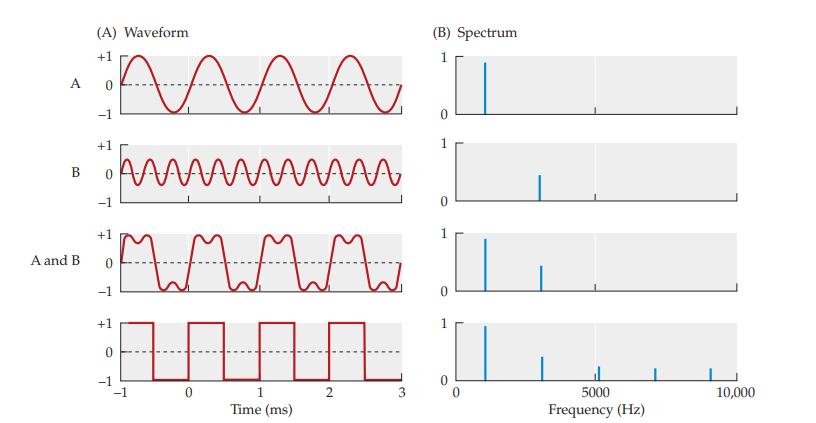
harmonic spectrum
the spectrum of complex sound in which energy is at integer multiples of the fundamental frequency
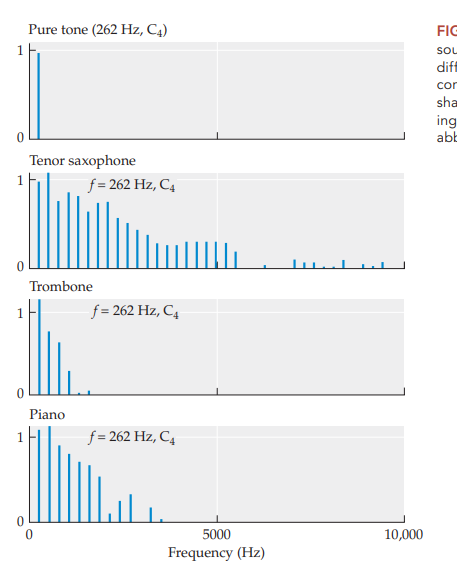
fundamental frequency
the lowest frequency component of a complex periodic sound
timbre
psychological sensation by which a listener can judge that two sounds with the same loudness and pitch are dissimilar
pinna
the outer, funnel-like part of the ear
ear canal
the canal that conducts sound vibrations from the pinna to the tympanic membrane and prevents damage to the tympanic membrane
outer ear
the external sound-gathering portion of the ear, consisting of the pinna and the ear canal
tympanic membrane
the eardrum; a thin sheet of skin at the end of the outer ear canal
vibrates in response to sound
middle ear
an air-filled chamber containing the ossicles
conveys and amplifies vibration from the tympanic membrane to the oval window
ossicle
any of the three tiny bones of the middle ear
includes the malleus, incus, and stapes
malleus
the most exterior of the three ossicles
receives vibration from the eardrum and is attached to the incus
incus
the middle of the three ossicles
connects the malleus and the stapes
stapes
most interior of the three ossicles
presses against the oval window of the cochlea on the other end
oval window
the flexible opening to the cochlea through which the stapes transmit vibration to the fluid inside
inner ear
a hollow cavity in the temporal bone of the skill and the structures within this cavity
tensor tympani
the muscle attached to the malleus
tensing this decreases vibration
stapedius
the muscle attached to the stapes
tensing this decreases vibration
acoustic reflex
a reflex that protects the ear from intense sounds, via contraction of the stapedius and tensor tympani muscles
cochlea
a spiral structure of the inner ear containing the organ or corti
tympanic canal
one of three fluid filled passages in the cochlea
extends from the round window at the base of the cochlea to the helicotrema at the apex
vestibular canal
one of three fluid filled passages in the cochlea
middle canal
one of the three canals of the cochlea
sandwiched between the vestibular and tympanic canals and contains the cochlear partition
helicotrema
the opening that connects the tympanic and vestibular canals at the apex of the cochlea
stria vascularis
specialized tissue lines in one side of the middle canal and maintains the right balance of charged ions in in the endolymph to keep hair cells working at their best
reissner’s membrane
a thin sheath of tissue separating the vestibular and middle canals in the cochlea
basilar membrane
a plate of fibers that forms the base of the cochlear partition and separates the middle and tympanic canals in the cochlea
cochlear partition
the combined basilar membrane, tectorial membrane, and organ of Corti
responsible for the transduction of sound waves into neural signals
round window
a soft area of tissue at the base of the tympanic canal that releases excess pressure remaining from extremely intense sounds
organ of Corti
a structure on the basilar membrane of the cochlea that is composed of hair cells and dendrites of auditory nerve fibers
auditory nerve (AN)
a collection of neurons that convey information from hair cells in the cochlea to the brainstem (afferent) and from the brainstem to the hair cells (efferent)
stereocilium
any of the hairlike extensions on the tops of hair cells in the cochlea that, when flexed, initiate the release of neurotransmitters
tectorial membrane
a gelatinous structure, attached on one end, that extends into the middle canal of the cochlea, floating above inner hair cells and touching outer hair cells
tip link
a tiny filament that stretches from the top of a stereocilium to the side of its neighbour
place code
tuning of different parts of the cochlea to different frequencies, in which information about the particular frequency of an incoming sound wave is coded by the place along the cochlear partition that has the greatest mechanical displacement
afferent fiber
a neuron that carries sensory information to the central nervous system
efferent fiber
a neuron that carries information from the central nervous system to the periphery
threshold tuning curve
graph plotting the thresholds of a neuron in response to sine waves with varying frequencies at the lowest intensity that will give rise to a response
characteristic frequency (CF)
the frequency to which a particular auditory nerve fiber is most sensitive
electromotility
the ability of outer hair cells to extend and contract which changes the stiffness and sensitivity of the cochlear partition
two-tone suppression
a decrease in the response (firing rate) of one auditory nerve fiber to one tone when a second tone is presented at the same time
isointensity curve
a map plotting the firing rate of an auditory nerve fiber against varying frequencies at varying intensities
rate saturation
the point at which a nerve fiber is firing as rapidly as possible and further stimulation is incapable of increasing the firing rate
rate-intensity function
a graph plotting the firing rate of an auditory nerve fiber in response to a sound of constant frequency at increasing intensities
low-spontaneous fiber
an auditory nerve fiber that has a low rate (less than 10 spikes per second) of spontaneous firing
require relatively intense sound before they will fire at higher rates
high-spontaneous fiber
an auditory nerve fiber that has a high rate (more than 30 spikes per second) of spontaneous firing
they increase their firing rate in response to relatively low levels of sound
mid-spontaneous fiber
an auditory nerve fiber that has a medium rate (10-30 spikes per second) of spontaneous firing
phase locking
firing of a single neuron at one distinct point in the period (cycle) of a sound wave at a given frequency
temporal code
tuning of different parts of the cochlea to different frequencies, in which information about the particular frequency of an incoming sound wave is coded by the timing of neural firing as it relates to the period of the sound
volley principle
the idea that multiple neurons can provide a temporal code for frequency if each neuron fires at a distinct point in the period of a sound wave but does not fire on every period
cochlear nucleus
the first brainstem nucleus at which afferent auditory nerve fibers synapse
superior olive
an early brainstem region in the auditory pathway where inputs from both ears converge
inferior colliculus
a midbrain nucleus in the auditory pathway
medial geniculate nucleus
the part of the thalamus that relays auditory signals to the temporal cortex and receives input from the auditory cortex
tonotopic organization
an arrangement in which neurons that respond to different frequencies are organized anatomically in order of frequency
primary auditory cortex (A1)
the first area within the temporal lobes of the brain responsible for processing acoustic information
belt area
a region of cortex, directly adjacent to the primary auditory cortex, with inputs from A1, where neurons respond to more complex characteristics of sounds
parabelt area
a region of cortex, lateral and adjacent to the belt area, where neurons respond to more complex characteristics of sounds, as well as to input from other senses
psychoacoustics
the branch of psychophysics that studies the psychological correlates of the physical dimensions of acoustics in order to understand how the auditory system operates
audibility threshold
the lowest sound pressure level that can be reliably detected at a given frequency
equal-loudness curve
a graph plotting sound pressure level against the frequency for which a listener perceives constant loudness
temporal integration
the process by which a sound at a constant level is perceived as being louder when it is of greater duration
also applies to perceived brightness, which depends on the duration of light
masking
using a second sound, frequently noise, to make the detection of another sound more difficult
white noise
noise consisting of all audible frequencies in equal amounts
critical bandwidth
the range of frequencies conveyed within a channel in the auditory system
conductive hearing loss
hearing loss caused by problems with the bones of the middle ear
otitis media
inflammation of the middle ear, commonly in children as a result of infection
otosclerosis
abnormal growth of the middle-ear bones that causes hearing loss
sensorineural hearing loss
hearing loss due to defects in the cochlea or auditory nerve
metabolic hearing loss
hearing loss caused by degraded ability of the stria vascularis to provide sufficient nutrients and ions to the cochlear partition
presbycusis
age-related hearing loss
Explore top notes

