Marketing
 Call Kai
 Learn
Learn Practice Test
 Spaced Repetition
 Match
Match Flashcards
 Knowt Play
1/77

There's no tags or description
Looks like no tags are added yet.
Name | Mastery | Learn | Test | Matching | Spaced | Call with Kai |
|---|
No analytics yet
Send a link to your students to track their progress
78 Terms
What is marketing?
it is about understanding customers and finding ways to provide products or services which customers demand
What is the purpose of marketing?
-identifying and understanding the needs of customers, done through market research
-informing customers about products and services the business provides e.g advertising online
-to increase sales for the business, can use a number of different methods including promotional offers and increased sales and advertising
Why carry out market research?
-identify if the demand exists
-to know what customers want/customer preferences
-can be the basis for a product launch
-to investigate competitor range, prices, location and buying habits
what is primary market research?
-Gathering fresh information
includes:
-product trials: a temporary offering to test the success of a new product to get feedback
-questionnaires: questioning current and potential customers
-interviews: speaking to customers 1:1
-focus groups: speaking to a group of customers, asking for opinions
-Others include observations, surveys, foot count
it is costly and time consuming however it suits what you want to find out
what is secondary market research?
-Gathering information which is already available
includes:
-census
-websites
-internal data: company records and accounts
-newspapers and magazines
-others: books, internet, business reports - keynote/mintel
what is quantitative research?
Gives facts and figures and is numerical - comes from closed questions
What is qualitative research?
opinion based, comes from open questions
What are the advantages of questionnaires?
-cheap
-can target particular customers
-can sample a large geographic area
-easy to compare
What are the disadvantages of questionnaires?
-Difficult to predict how many completed questionnaires will be available
-The people filling in the forms may not understand the questions being asked
What are the advantages of interviews?
-interviewer can explain questions if there is a misunderstanding
-customers can be targeted e.g picking out certain age groups
good rate of response
What are the disadvantages of interviews?
-can be expensive - interviewer has to be paid
-customers may feel uncomfortable being interviewed if they are randomly selected
What are the advantages of trials?
-As trials are conducted on a small scale, money can be saved in case the customers don’t like the product
-reduces the risk of mistakes
What are the disadvantages of trials?
-Costly to set up
-Area chosen must reflect target market of business
-Competitors could get an idea of what they are doing
What are the advantages of focus groups?
-Because focus groups are chosen to represent the target market for the business so the data from them is usually accurate
-Faster than individually surveying people
What are the disadvantages of focus groups?
-expensive
-selection of people time consuming
-quieter people don’t get their opinion heard
What are the advantages of Census?
-can be viewed easily
-includes a wide range of data
-cheaper, easier and quicker to get as it’s done by someone else
What are the disadvantages of census?
can be outdated
what are the advantages of websites?
-Huge amounts of information available on the Internet
-cheap, easy and quick to get
What are the disadvantages of websites?
may not be in a form the business can analyse easily
what are the advantages of internal danger?
-specific to the business
-easily accessed
-quicker, cheaper, easier to collect
what are the disadvantages of internal data?
may not be what the business needs
what are the advantages of newspapers/magazines?
-can include information on customer trends and interests
-quicker, easier, cheaper to collect
what are the disadvantages of newspapers/magazines?
-can be inaccurate
-can be outdated
What are the benefits of market segmentation?
-better matching of customer needs
-enhanced profits for business
-better opportunities for growth
-retain more customers
-target marketing communications
-gain share of the market segment
-enables businesses to understand and meet the needs of their customers more effectively
define market segmentation
dividing up the market or potential customers into groups
What are the ways the market can be segmented?
-age
-income
-gender
-location
-lifestyle
What is the purpose of segmenting the market?
to allow the business to focus on a certain customer and adapt the marketing to suit the target market
what are the drawbacks for market segmentation?
increased costs linked to research and product development
-potential for the brand to lose its identity and less able to exploit economies of scale
-additional marketing for a wider audience
What is cost plus pricing?
adding % profit to the actual cost
what are the advantages of cost plus pricing?
-ensures a profit is made
-easy to calculate
what are the disadvantages of cost plus pricing?
-may be too expensive and customers won’t buy the product
What is competitive pricing?
charging a price similar to competitors
What are the advantages of competitive pricing?
price will be competitive
what are the disadvantages of competitive pricing?
price may not be profitable
What is penetration pricing?
-start with a low price to attract customers
-mostly used for new products
What are the advantages of penetration pricing?
encourages people to try the product
what are the disadvantages of penetration pricing?
cannot last long
usually unprofitable
what is skimming pricing?
start with a high price for a unique product usually with no competition
what are the advantages of skimming pricing?
allows extra profits to be made
what are the disadvantages of skimming pricing?
only lasts while there is no competition
What is promotional pricing?
special price for a limited time
what are the advantages of promotional pricing?
useful to get rid of old stock
what are the disadvantages of promotional pricing?
only useful for a limited time
what is premium pricing?
high prices for perceived high quality products
what are the advantages of premium pricing?
only certain customers can afford it so maintains image
high profits
what are the disadvantages of premium pricing?
lots of potential sales lost
define marketing mix
the combination of factors which help the business to take into account customer needs when selling a product
What is important for a product?
different features have different levels of importance depending on the product or service
e.g
-design
-technology
-usefulness
-convenience
-value
-quality
-warranties
-packaging
-branding
what are the stages of the product life cycle?
-research and development
-introduction
-growth
-maturity
-decline
what does the product life cycle look like?
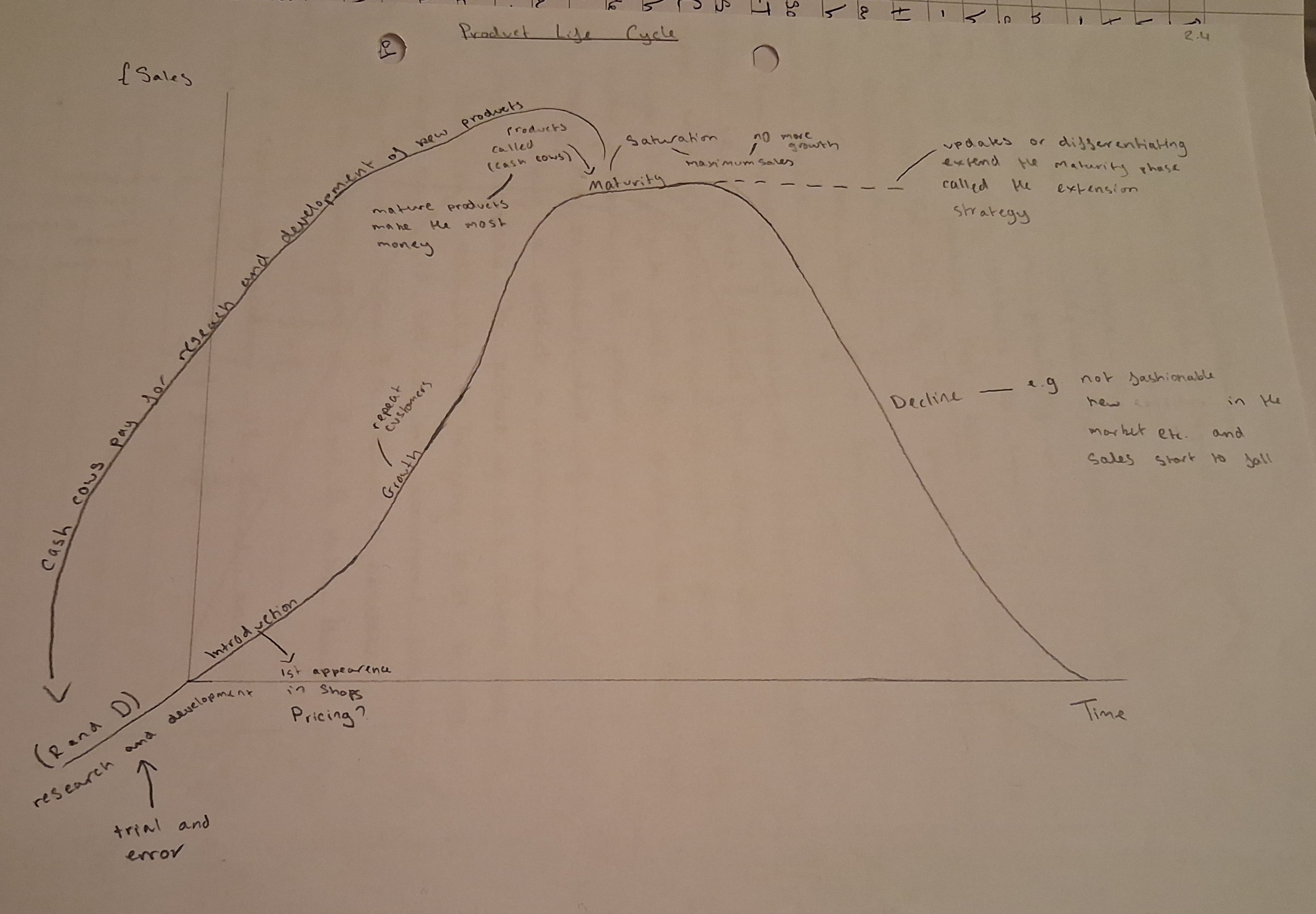
why is it important to have a ‘spread’ of products throughout the life cycle?
all products decline so they need to introduce new products to replace the cash cows when they start to decline
Why are maturity products so important?
they are the products that bring in the most money so they can cover the cost of the products in research and development
what options are there for a business with a very saturated market?
they can update or improve the product (the extension strategy) to try and extend the maturity phase
why might a business try to keep a declining product alive?
-if it was a cash cow and there isn’t another product to replace it
-if it is targeted at a specific group of people that are repeat customers
why might a business discontinue a product?
if it’s costing more to produce than the profit it’s bringing to the business, in this situation they could sell it on promotional pricing to get rid of the rest of the stock
why might a business invest in r&d even though it is expensive?
because a spred of products is needed, and new products are needed to replace declining products
what is the role of branding?
-about giving a product or service an identity
-a strong brand can be recognised by just a logo, slogan or colour
-a strong brand is linked with repeat custom
what are the benefits of branding?
-can charge a higher price if the brand is associated with quality
-likely to get repeat custom as customers are loyal to brands
-brands can be recognised anywhere around the world so it widens the customer base
-branding attracts investment from external partners
what are channels of distribution?
how the product gets to the consumer
what are the different channels of distribution?
-Producer→wholesaler (can also be distribution centres)→Retailers→consumer
retailers are usually small e.g corner shops
-product → retailer → consumer
-producer → consumer (also used for digital distribution: e.g music and films, good because quick to download and available to buy 24/7 + save business rent and physical costs, but relies on IT + some customers might be put off + goods are easily copied)
what are regional distribution centres used for?
Supermarkets have their own regional distribution centres (RDC) rather than wholesalers. They are very large, as they have to hold stock for multiple supermarkets in the same chain. They are built near roads to make transporting the goods easier for the lorries carrying the goods from the RDC to the supermarket
what helps the business decide on the channel?
-nature of the producer: technical/complex/customised/perishable/fragile
-the business: size and scope, does it already have an established distribution/network?
-the market: is it geographically spread? does it supply overseas?
-legal issues: are there limitations on the sale
What is the role of promotion?
-about informing the customer and persuading them to buy the product or service
what are the two types of promotion?
-point of sale promotion: something that will persuade a consumer at the point of sale (at the till) to make an extra or unexpected purchase e.g price reductions, loss leaders, competitions, free samples
-advertising: methods selected to advertise a product to potential customers, careful consideration goes into content, place and timing e.g TV, radio, newspaper
what is the role of loss leaders?
-loss making products
-targeted to impulse shoppers
-used in the hope that the customer will be attracted to the shop by the price reductions, but they will also buy normal price products
what is the role of competitions?
-customers are entered into a monthly prize draw offering a variety of prizes
-used in the hope that they will boost sales
what is the role of free samples?
-often used in cosmetics and other businesses to let the customer try the product
-used in the hope that, by providing a small sample they would potentially buy the full size
what is the role of price reductions?
-reducing the price of old stock that a shop no longer wants to keep
-used in the hope that this would boost sales at a time when the products don’t normally sell
what are the advantages of social media?
easy to target customers, ideal way of reaching a wide audience with any advertising and messages
what are the disadvantages of social media?
not all people, especially elderly people use it
what are the advantages of websites?
can impress the potential buyer, presents the business’ image
what are the disadvantages of websites?
setting up and maintaining a complex website can be expensive
what are the advantages of printed media?
-includes newspapers, magazines and leaflets
-can be low cost
-can reach a specific market
what are the disadvantages of printed media?
some magazines and newspapers (Daily Mail and Daily Mirror) can be expensive
no way of knowing if they have been read
what are the advantages of TV?
-reaches a very wide audience
-customers can be targeted based on the programme
what are the disadvantages of TV?
high costs
what are the advantages of radio?
cheaper than TV
portable - can get through anywhere
what are the disadvantages of radio?
the product can’t be seen

