Cell Differentiation and Death
 Studied by 0 people
 Call Kai
 Learn
Learn Practice Test
 Spaced Repetition
 Match
Match Flashcards
 Knowt Play
1/45

There's no tags or description
Looks like no tags are added yet.
Name | Mastery | Learn | Test | Matching | Spaced | Call with Kai |
|---|
No analytics yet
Send a link to your students to track their progress
46 Terms
The most basic function of the cell cycle is to —- and then —
duplicate the DNA
segregate the copies into two genetically identical daughter cells.
Chromosome duplication occurs during — phase
S
(S for DNA synthesis)
After S phase, chromosome segregation and cell division occur in —
M phase (M for mitosis)
M phase comprises two major events:
mitosis and cytokinesis
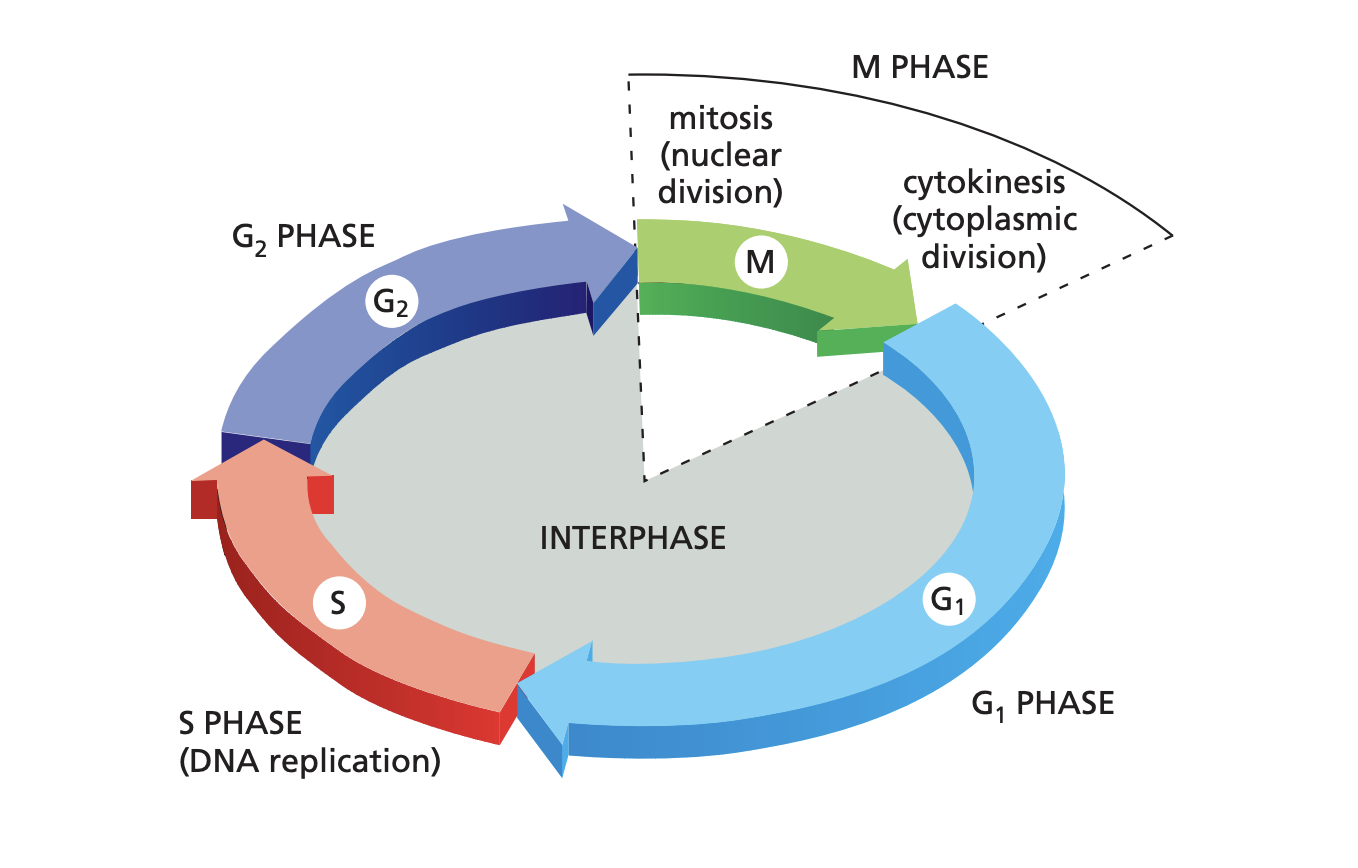
Most cells require much more time to grow and double their mass of proteins and organelles than they require to duplicate their chromosomes and divide. Because of this, the cell cycle has —
gap phases
G1 phase is
between M phase and S phase
G2 phase between —
S phase and M phase
—,—,— together are called interphase
G1, S, and G2
Cell growth occurs throughout the cell cycle, except during—
mitosis.
If extracellular conditions are unfavorable, for example, cells delay progress through G1 and may even enter a specialized resting state known as —
G0 (G zero) (senescence)
state the phases clearly
constant “ON” signal wouldn’t work. The cell needs:
Low kinase activity at some times
High kinase activity at others
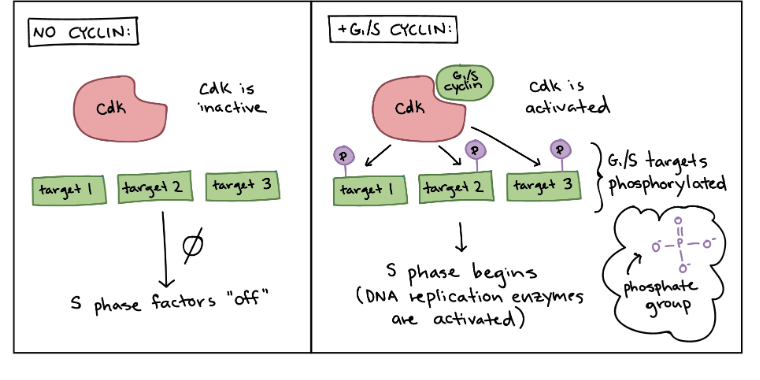
Cyclin-Dependent Kinases (Cdks) are —
protein kinases
A lone Cdk is inactive, but the binding of a — activates it
cyclin
okay at first I just thought the CDK aciavtes the cyclin, but why is that wrong?
it’s the opposite
it’s actually the cyclin that activates the CDK
the CDK is then active to act as a kinase and go phosphorylate a bunch of unnamed players
so why do we need so many different cyclins and kinases?
well there is one for each phase and
The cyclin doesn’t just activate the Cdk
It also directs the kinase to specific substrate target proteins
Each cyclin–Cdk complex phosphorylates a distinct set of targets
This triggers stage-specific event
Cdk Inhibitor Proteins can be good as —
an extra layer of control/regulation
DNA damage is an input that can immeditaly stop the cell cycle, it can
do dna repair
do apoptosis
—
inactivate CDKs directly to pause the cell cycle
How does one cell give rise to many different, stable cell identities?
Cell identity is defined by gene expression, not gene content
Since DNA is (mostly) the same in all cells:
Differences between cells arise from which genes are ON or OFF
Gene expression patterns determine:
Structure
Function
Future potential
—: the major developemnt restriction event
Gastrulation
Development does not jump directly from pluripotent to fully specialized.
Instead:
Cells pass through a series of —
Each step:
Narrows potential
Stabilizes identity
intermediate states
The genome is the same in a muscle cell as in a skin cell, but different genes are active because
these cells express different transcription regulators that bind to gene regulatory elements
f cells died randomly:
They would burst
Spill contents
Damage neighbors
Trigger inflammation
This would be catastrophic in tightly packed tissues.
so we developped:
controlled, non-damaging way for cells to die 9programmed cell death: apoptosis)
some reasons we need apoptosis
make fingers/structures
quality control: get rid of dysfunctional cells
The apoptosis cascade is driven by:
Caspases are:
— (protein-cutting enzymes)
Proteases
Two functional classes of caspases
initiator
excuetcuioner
Two ways to trigger apoptosis
, death signals can come from:
jj
—
Outside the cell
Inside the cell
Thus apoptosis has two pathways:
extrinsic (death signal from outside) aka death receptor pathway
intrinsic (death signalin from within cell)
Some cells must be killed on command by the Immune system
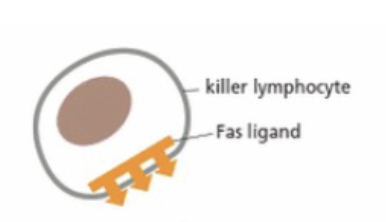
Killer lymphocyte s
Expresses — on its surface
Fas ligand
the target cell (to die)
Expresses the — on its surface
Fas death receptor
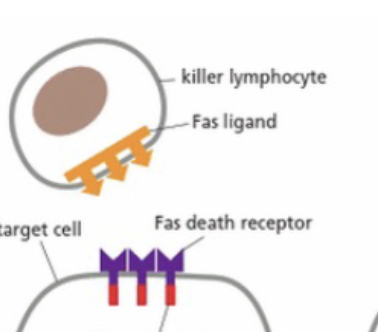
when Fas binds to death receptor, then what?
death domains ( and adaptor protein called FADD) are actiavted inside the cell
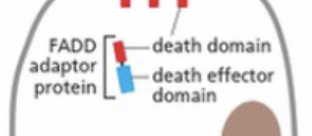
then what happens?
FADD recruits initiator caspase-8 and they form the DISC (Death-Inducing Signaling Complex)
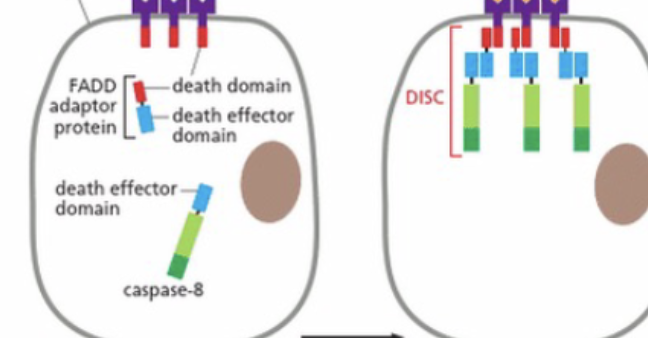
then what?
Caspase-8 activates executioner caspases
those caspases will trigger apoptosis
one part of apoptosis is destroying dna so that its not reused,
DNA is not destroyed randomly
DNA is cut at specific locations
where do the cuts happen?
Between nucleosomes, in the linker regions
this produces fragments of DNA that are ~180 bp
a key organelle involved in the intrinsic apoptosis pathway
mitochondria
the mitcohdonria releases:
cytochrome c
cytochrome c activates
Apaf1
Apaf1 causes
formation of the apoptosome
formation of the apoptosome causes
recruitment of caspcase 9 (excecuioner)
The intrinsic pathway is tightly regulated by —
Bcl2 family proteins.
what are the 3 groups in the Bcl2 family proteins.
anti-apoptotic
pro-apoptotic
BH3 only proteins
Anti-apoptotic
Bcl2,
Block—-
mitochondrial protein release (cytochrome c)
Pro-apoptotic effectors
Bax, Bak
Allow —
mitochondrial protein release (cytochrome c)
BH3-only proteins
Inhibit —
anti-apoptotic proteins
(so they tip the scaled towards apoptosis happening)
If survival factors disappear → —
apoptosis begins.
default is NOT survival
Some survival factors:
Activate —
Increase synthesis of —
transcription
Bcl2,
 Note
Note  Flashcards (76)