neurotransmission, neurochemistry, and neuroanatomy (copy)
 Studied by 8 people
 Call Kai
 Learn
Learn Practice Test
 Spaced Repetition
 Match
Match Flashcards
 Knowt Play
1/97

There's no tags or description
Looks like no tags are added yet.
Name | Mastery | Learn | Test | Matching | Spaced | Call with Kai |
|---|
No analytics yet
Send a link to your students to track their progress
98 Terms
Afferent
receiving information, towards cell body
Efferent
sending information, away from cell body
Active zone
where neurotransmitter vesicles bind to then release their content into the cleft
PSD
postsynaptic density, high density of receptors
what happens to postsynaptic potential when a anion enters?
it becomes inhibitory postsynaptic potential
-An anion has negative charge
cholinergic type
refers to anything involving or activated by acetylcholine (ACh), a crucial neurotransmitter for muscle control, learning, memory, and autonomic functions
ACh
what is Acetacholine (ACh) inactivated by?
- Inactivated by enzymatic degradation: once the neurotransmitter is broken down by enzymes, it’s permanently deactivated and its pieces can’t be recycled to make the same neurotransmitter again.
-the enzyme acetylcholinesterase(AChE), which rapidly breaks it down in the synaptic cleft into choline and acetic acid(acetate), preventing continuous nerve stimulation
what happens to postsynaptic potential when a cat ion enters?
it becomes an excitatory postsynaptic potential
what do acetocholyine receptor do when associated with ligand gated ion channels?
responsible for neurotransmission, binds to the gate for it to open and allow ions to travel through membrane
Catecholinergic types
NE - norepinephrine
Epi - epinephrine
DA - dopaminergic
where is NE - norepinephrine mainly found?
- Cell bodies located on locus coeruleus
whats another name for Epi - epinephrine?
- Adrenaline
what is the first system of DA - dopaminergic?
- Its called the mesolimbic DA system:
starts in the cell bodies in VTA (ventral tegmental area), and it controls motivation, which affects behavior
Serotonergic type
serotonin (5-HT):helps regulate mood, sleep, appetite, and overall emotional balance.>works through g coupled proteins
what is serotonin (5-HT) inactivated by?
- Inactivated by reuptake
Amino acidergic types
glutamate and GABA
Glutamate
- excitatory NT
- EPSP - excitatory post synaptic potential; stimulates an AP, depolarizes neuron
- Bind to ligand gated ion channels - directly change the electrical state of a neuron by allowing positive ions to enter
-after signaling then broken down by biotransformation(metabolic)
- "True" neurotransmission
GABA
- inhibitory NT
- ISPS - inhibitory post synaptic potential which hyperpolarizes neuron
- prevents threshold from being reached which makes an occurance of an action poetenial less likely
- Bind to ligand gated ion channels(cholrine channels)- directly change the electrical state of a neuron(more negative)
-After signaling it is broken down by buotransformation
- "True" neurotransmission
Ligand-gated ion channels
- NT binding receptor opens an ion channels
- Inotropic = ions move directly across the membrane
- Fast neurotransmission:Rapid onset, but a short duration of effects
-point-to-point communication between one neuron and one other neuron.
EPSP
cell becomes depolarized (postive ions move in or negative ions move out), an AP is more likely to occur, Na+ moves in cell
IPSP
cell becomes hyperpolarized (negative ions move in or positive ions move out), Cl- moves in or K+ moves out
G-Protein-coupled receptors
- Metabotropic effect-means that the neurotransmitter changes neuron activity indirectly
i. When a neurotransmitter (NT) attaches to the receptor on the neuron, it turns on a G-protein inside the cell. The NT itself does not enter the cell.
ii. Intracellular (second) message is created-The activated G-protein triggers the production of a second messenger inside the neuron. This messenger carries the signal from the receptor to other parts of the cell.
iii. Second messenger alters neuronal function (modulation)
The second messenger changes how the neuron behaves. Instead of directly causing the neuron to fire, it modulatesactivity—making the neuron more or less likely to respond.
iv.Slow
- But, the duration of the effect is longer: mood, motivation, tiredness, usually from one neuron to multiple other neurons (so it can affect a whole structure)
Firing rate
# of APs over time
Summation
Summation is the combining of graded potentials (depolarizations) produced by presynaptic action potentials so that the postsynaptic neuron reaches threshold and fires.
Spatial summation
occurs when action potentials from different presynaptic neurons arrive at the same postsynaptic neuron at the same time. Their graded potentials add together, helping the postsynaptic neuron reach threshold.
Temporal summation
occurs when two or more action potentials from the same presynaptic neuron arrive at the postsynaptic neuron very close together in time.
- The first action potential causes a brief depolarization, and before the membrane potential returns to resting level, the next action potential arrives.
- These graded potentials add together, helping the postsynaptic neuron reach threshold.
rostral
anterior
-toward the front of the brain (the forehead area).
caudal
posterior
- (toward the back of the brain).
dorsal
superior
up / superior in the brain
example
-The parietal lobe is dorsal to the temporal lobe.
-The somatosensory cortex is dorsal to deeper brain structures.
ventral
inferior
toward the bottom or underside of the brain.
Ipsilateral
Structures localized to the same side
Contralateral
Structures localized to different sides
Nucleus
in CNS, large area of cell bodies(grey matter) with clear boundaries
Locus
in CNS, small are of cell bodies with clear boundaries
Substantia
in CNS, large area of cell bodies with no clear boundaries
Ganglia
in PNS, collection of cell bodies in a defined area
Cortex
- Primarily cell bodies
- surface/outercovering of the brain
- Cell bodies are not myelinated, so the cortex is grey matter
- About 10% of the brain
Fiber
- White matter
- One singular, myelinated axon
Tract
- white matter
- Collection of fibers that start at one structure and terminate at one common structure
Bundle
- White matter
- A collection of fibers that pass through the same region, but do not start and end at the same spots
Commissure
- White matter
- A type of bundle that is contralateral; goes from one brain hemisphere to the other
Nerve
- White matter
- Axon bundles in the PNS
- Nerves = PNS only (neurons = CNS)
CNS
i. Brain
ii.Spinal cord
PNS
Everything outside spinal cord
Grey matter
lacks myelin, made up of cell bodies, makes up cortex (outside of brain)
Whiter matter
contains myelin, made up of axons, inside of brain
Gyri
parts of the brain folds that rises
Sulci
part of the brain fold that go in, the grooves
Fissure
a deep sulcus
Lateral sulcus
divides frontal and temporal lobes, dorsal from ventral
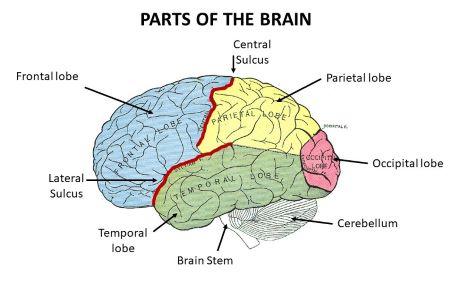
Central sulcus
divides frontal from parietal lobes, rostral(anterior) and cuadal(posterior)
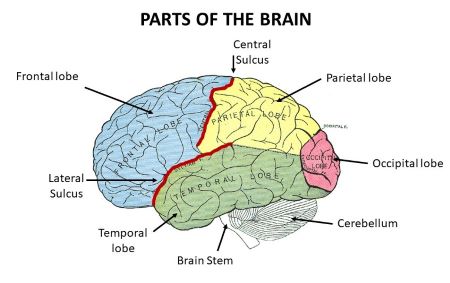
Parietoccipital sulcus
separates parietal from occipital lobe
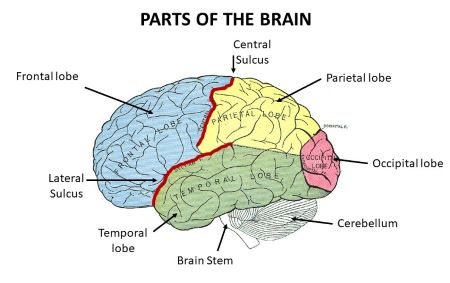
Superior longitudinal sulcus
separates the two brain hemispheres
Frontal lobe
high cognition
Parietal lobes
somatic (senses)
occipital lobe
sight
Temporal lobes
hearing, many other diverse functions
Cortex Layer 1
molecular layer, no cell bodies, only synapses + dendrites of other neurons to receive and send info
Cortex Layer 2 + 3
function together, pyramidal cells, its axons go to other cortical areas, receive and send information from toher parts of the cortex
Cortex Layer 4
stellate (star shaped) cells, sends information between the cortext and thalamus
Cortex Layer 5 + 6
function together, pyramidal cells, axons go to other parts of the brain (noncortical), receive and send information from other parts of the brain
Cortex circuitry is ...
columnar, meaning that the info that leaves the cortex integrates all the information from that column (vertical) of neurons (as opposed to horizontal rows)
Dicencephalon components
thalamus, hypothalamus, epithalamus
Thalamus
- A relay
- All ascending and descending information goes here first, undergoes some low level processing, and then is sent to the proper part of the cortex or another structure
-The thalamus receives sensory and motor information, processes and organizes it, and then sends it to the appropriate areas of the cerebral cortex. It also helps regulate alertness, sleep, and attention.
Hypothalamus
- Indirectly controls the endocrine system because it controls the pituitary gland
- Controls visceral states: the states of organs
- Ex: hunger, blood pressure, thermoregulation; all unconscious/Automatic
- Primtive emotion: largely suppressed in humans, predatory and territorial aggression in animals, usually only occur in humans with use of drugs (ex: some people are aggressive when drunk)
Epithalamus
-Secretory, epithelial cells
- Pineal gland: an endocrine gland, secretes melatonin which regulates circadian rhythm
- contains the Choroid plexus: creates cerebrospinal fluid (CSF)
cerebellum
- Integrates sensory and motor information, makes motor maps
- Exacts control over movements
- No direct access to motor neurons: has to send info to cortex which sends to lower motor neurons
-maintains balance
brainstem components
midbrain, pons, medulla
midbrain
- Procesing of visual and auditory information
- Contains the DMS
DMS
The dorsal midbrain system (DMS) is involved in visual and auditory reflexes, especially reflexive movements of the eyes and head in response to sensory stimuli.
Pons
Relay, creates a connection between the cerebellum and cerebrum
Medulla
- Visceral motor muscle functioning
- Muscles are controlled at an unconscious level: breathing, blood pressure, cardiovascular function
- Primitive brain reflex: sneezing, vomitting, yawning, hiccups
modulation
Adjusting how strongly or how likely neurons respond to signals, rather than directly causing them to fire or stop firing.
translation
changes electrical state of neuron
enzygamatic degradation
byproducts that can't become NTs again
biotransformation
inactive byproducts -> reactivated once returned to cell
reuptake
NTs pumped back into presnynaptic neuron -> repackaged -> reused (not modified)
diffusion (as form of neurotransmitter inactivation)
Diffusion deactivates neurotransmitters when they spread away from the synaptic cleft until their concentration is too low to bind receptors. This commonly occurs with G-protein–coupled receptors because they act through complex, widespread circuits, allowing neurotransmitters to affect and move across a larger area.
precentral gyrus
primary motor cortex
-controls voluntary movement of skeletal muscle
postcentral gyrus
primary sensory cortex
what is NE norepinephrine main function?
- Function in arousal and sleep, maintain routine bodily functions
how is NE norepinephrine inactive?
- Inactivated by reuptake
What receptors do NE-norepinephrine bind to?
Receptors = g protein-coupled receptors (modulation)
why is epi- epinephrine considered a hormone?
its released from the medulla into the bloodtream, acting a a hormone that affects many organs.
where is epi- epinephrine found and whats its function?
In CNS for modulation function. Adrenomedulla releases epinephrine during sympathetic NVS into blood stream
how is epi-epinephrine inactivated?
inactivated by reuptake
which type of receptors are epi-epinephrine associated with?
Receptors = g protein coupled receptors (modulation)
what is the 2nd system of DA- dopaminergic?
its called the basal ganglia dopamine system: controls movement
what is the primary function of DA-dopaminergic?
controls movement and associated with motivational behavior
what happens if theirs a lack of DA-dopaminergic?
parkisons disease
how is DA-dopaminergic inactivated?
by reuptake
what receptors is DA-dopaminergic associated with?
G protein coupled receptors
what type of receptors are serotonin (5-HT) associated with?
- G - protein-coupled receptors (modulation)
what is the primary function of serotonin (5-HT)?
- Modulate mood and affect
what are SSRI’s and what do they do?
- they are selective serotonin reuptake inhibitors and they block reuptake to treat depression
where is serotonin (5-HT) found?
- Location = raphe nuclei located in the midline of the brainstem
whats a another name for G protein coupled receptors?
neuromodulartransmission (slow onset and long duration)
diffuse neuromodullary system?
function is neuro-modulation
 Note
Note  Flashcards (54)