Evolution Exam 2 Study Guide
 Call Kai
 Learn
Learn Practice Test
 Spaced Repetition
 Match
Match Flashcards
 Knowt Play
1/42

There's no tags or description
Looks like no tags are added yet.
Name | Mastery | Learn | Test | Matching | Spaced | Call with Kai |
|---|
No analytics yet
Send a link to your students to track their progress
43 Terms
requirements for natural selection
variation- individuals in a population vary in a trait
inheritance- trait differences are passed from parent to offspring
differential reproductive success- individuals with some values of a trait survive and reproduce better than individuals with other values
target of selection
the phenotypic trait that selection acts directly upon
agent of selection
environmental pressures that determine which individuals in a population are more likely to survive and reproduce
genetic drift
change in allele frequency due to random chance
population bottleneck- a large population experiences a catastrophic reduction in numbers, greatly reducing genetic variation
founder events; a new population is founded from a small number of individuals, with a non-representative sample of the genetic variation present in the source
gene flow (migration)
the movement of alleles between populations
adaptation
a trait that increases the fitness of its possessor
a feature of an organism that enables it to survive and reproduce in its natural environment better than if it lacked that feature
biological machinery or process shaped by natural selection to help solve one or more problems faced by the organism
local adaptation
traits that enables organisms to survive and reproduce in their particular environment
ex: killifish can swim upstream agains strong currents and are found upstream and downstream of waterfalls vs pike cichlids cannot swim upstream against strong currents; are found downstream of waterfalls
function
the way in which a trait increases fitness
ex: antifreeze proteins are an adaptation in many fish that live in the arctic- function of these proteins is to prevent formation of ice crystals in the fish
directional selection
favors individuals with high (or low) values of a trait, causing a consistent directional change in a population through time
stabilizing selection
favors individuals with the mean value over that at the extremes, causing the form of a population to stay constant over time
how do we know traits are heritable
compare the trait in parents and offspring
ex: get the average value for the parents and the average value for the (grown) children
what are the agents of selection
natural selection- decreases
mutation- increases
genetic drift- decreases
gene flow- increases
what trait values are favored and why
dark color lice on dark birds
light color lice on light birds
large body on large birds
small body on small birds
more eye spots over less eye spots
more tail wagging over less tail wagging
feather lice color matching
darker birds have darker lice
lighter birds have lighter lice
birds removed more of the mismatched lice because they were detectable
lice left matched the color of the bird and therefore were the lice to reproduce and those that mismatched but were left possibly could have bred with those that matched and their offspring would have evolved to match the color of the bird
feather lice body size
the larger pigeons had larger lice and the smaller pigeons had smaller lice
easier to detect larger lice on smaller pigeons
HIV gp120 envelope protein
binds to CD4 and co-receptor on host cell
antibodies recognize gp120 coat protein- neutralize virus particles, leads to targeting of infected cells
immune responses attack the majority of virus particles but the mutated HIV particles aren't recognized to be proliferated allowing them to continue to spread
heritability
is the proportion of variation that is genetically based and thus transmitted from parents to offsping
how to measure heritability?
compare the trait in parents and offspring
how determine if a trait is heritable (common garden experiment, parent offspring regression, be able to identify hypothetical results that would indicate environmental vs genetic influence on trait
common garden experiment: through elimination of environmental variation you can see if the original traits remain the same which would indicate genetic influence, if moved to a different environment and then develops similar but different traits would show environmental influence
parent-offspring: values close to 1 indicate strong genetic influence; values closer to 0 indicate environmental influence
what determined whether males or females experience stronger sexual selection
sexual selection is stronger in the sex where the number of offspring an individual has depends on the number of matings they obtain
male-male competition example: giraffes (evidence that longer necks evolved in response to male-male competition)
only males do the necking behavior and males with larger necks get courted more often and mate more often
female mate-choice: direct vs indirect that females can gain by choosing among mates
direct: parental care, resources
indirect: increased fitness of offspring
female mate choice examples (what traits chosen, what are the benefits of choosing): peacocks, stickleback fish, MHC based mate choice in huamns
peacocks: larger spots, larger trains- offspring survived better
stickleback: more tail fanning increases oxygen to the eggs, helps them to survive and helps them to develop quicker
MHC in humans: women chose men that had differing MHC, leads to less genetic defects because they are less closely related
balance of natural and sexual selection example: color patterns & size of male guppies
predators are more likely to notice brighter and larger males and evolve the brighter coloration when the predation decreases
females choose mates that are larger and more colorful
balance of natural and sexual selection example: predation, female choice
the males increase coloration in lack of predators and it can fluctuate depending on their environment
balance of natural and sexual selection example: patterns in natural streams, experimental results
color patterns evolved in response to selection by predators when predation is introduced the killifish leveled off and the pike cichlids decrease
speciation: process (initial barrier to gene flow, adaptation to different environments, reproductive isolation)
initial barrier: either geographic or physical barrier
adaptation:
reproductive isolation: genetic incompatibility, pre-zygotic isolation
speciation example: Anolis lizard and snapping shrimp
snapping shrimp speciated as a result of a rise of the isthmus of panama therefor the species on the pacific side should have closest relative on Caribbean side
anolis lizard
genetic drift, gene flow: effect on genetic variation within a population
genetic drift: more important in small populations leads to decrease in genetic variation of the new population
gene flow: increases population genetic variation because it allows the movement of alleles form one pop to another pop
genetic drift, gene flow: effect on genetic difference between populations
genetic drift: increase the genetic difference- the two populations become more distinct from one another with no allele variation
gene flow: decrease the genetic difference- there is more gene flow which allows the two populations to have shared genes
genetic drift, gene flow: effect of population
genetic drift acts as a way to filter out genes decreasing genetic variation
gene flow acts as a mixer that increase genetic variation
genetic drift, gene flow: balance of gene flow and local adaptation, example from anti-predator behavior of stream salamanders
in streams with no fish the larvae need to be active to feed and grow before the stream dries out; in streams with fish the larvae need to be inactive so they arent predated upon by the fish
gene flow plays a role because they are seen to be too active in the presence of fish thus showing a failure to adapt to the stream showing the active genes in both populations
sexual vs asexual reproduction: why is the existence of sexual reproduction an evolutionary puzzle?
because sexual reproduction can be more dangerous and more exhaustive of energy sources but it allows for increase genetic diversity and increased fitness of offspring
sexual vs asexual reproduction: what are some potential advantages of producing offspring through sexual reproduction; example: topminnows
increased genetic diversity, increased adaptability to the environment, specifically in the topminnows sexual reproduction allows offspring to have lower rates of parasitism
phylogenetic trees: how to read a tree as a map of relationships among species
phylogenetic trees: using a tree to infer evolutionary patterns (ex: snapping shrimp speciation, anolis evolution within islands)
experiments with feather lice of pigeons show that evolutionary change can occur over relatively short time scales. We saw that lice that were introduced from average-sized pigeons onto a larger pigeon breed evolved larger body sizes within four years. To explain the evolution of body size in feather lice, answer the following questions:
a) how do we know that body size differences in feather lice are heritable?
when reared in control environments big parens had big offspring and small parents had small offspring
experiments with feather lice of pigeons show that evolutionary change can occur over relatively short time scales. We saw that lice that were introduced from average-sized pigeons onto a larger pigeon breed evolved larger body sizes within four years. To explain the evolution of body size in feather lice, answer the following questions:
b) what is the agent of selection that determines the success or failure of lice of different body sizes?
preening behavior of the host pigeon, if the lice were too large for the inter-barb space they cannot hide properly and may be easily removed by preening; if they are too small they may avoid preening but may not be able to survive due to reduced size or fecundity
experiments with feather lice of pigeons show that evolutionary change can occur over relatively short time scales. We saw that lice that were introduced from average-sized pigeons onto a larger pigeon breed evolved larger body sizes within four years. To explain the evolution of body size in feather lice, answer the following questions:
c) why are larger lice favored on larger birds?
because they can fit within the inter barb space to avoid preening, and they have increased speed to avoid predation unlike the smaller lice; they also lay more eggs than smaller lice which allows for reproductive advantage
experiments with feather lice of pigeons show that evolutionary change can occur over relatively short time scales. We saw that lice that were introduced from average-sized pigeons onto a larger pigeon breed evolved larger body sizes within four years. To explain the evolution of body size in feather lice, answer the following questions:
d) why are lice on larger birds reproductively isolated from the lice on smaller birds, even if the individuals from the two populations were to meet?
because the male lice if smaller cannot efficiently hold onto the female during copulation, if the male is bigger they cannot align properly for copulation
Male peacocks provide no parental care or other resources to females, yet females are very choosy about which males they mate with
a) what male trait are females choosing (be more specific than 'tail feathers')?
females are choosing males with more eyespots and larger trains
male peacocks provide no parental care or other resources to females, yet females are very choosy about which male they mate with.
b) what benefits do females gain by mating with males that have a high value of that trait?
the males that have larger eyespots and larger trains there is a correlation with better offspring survival so the females gains an indirect benefit of increased fitness with her offspring surviving
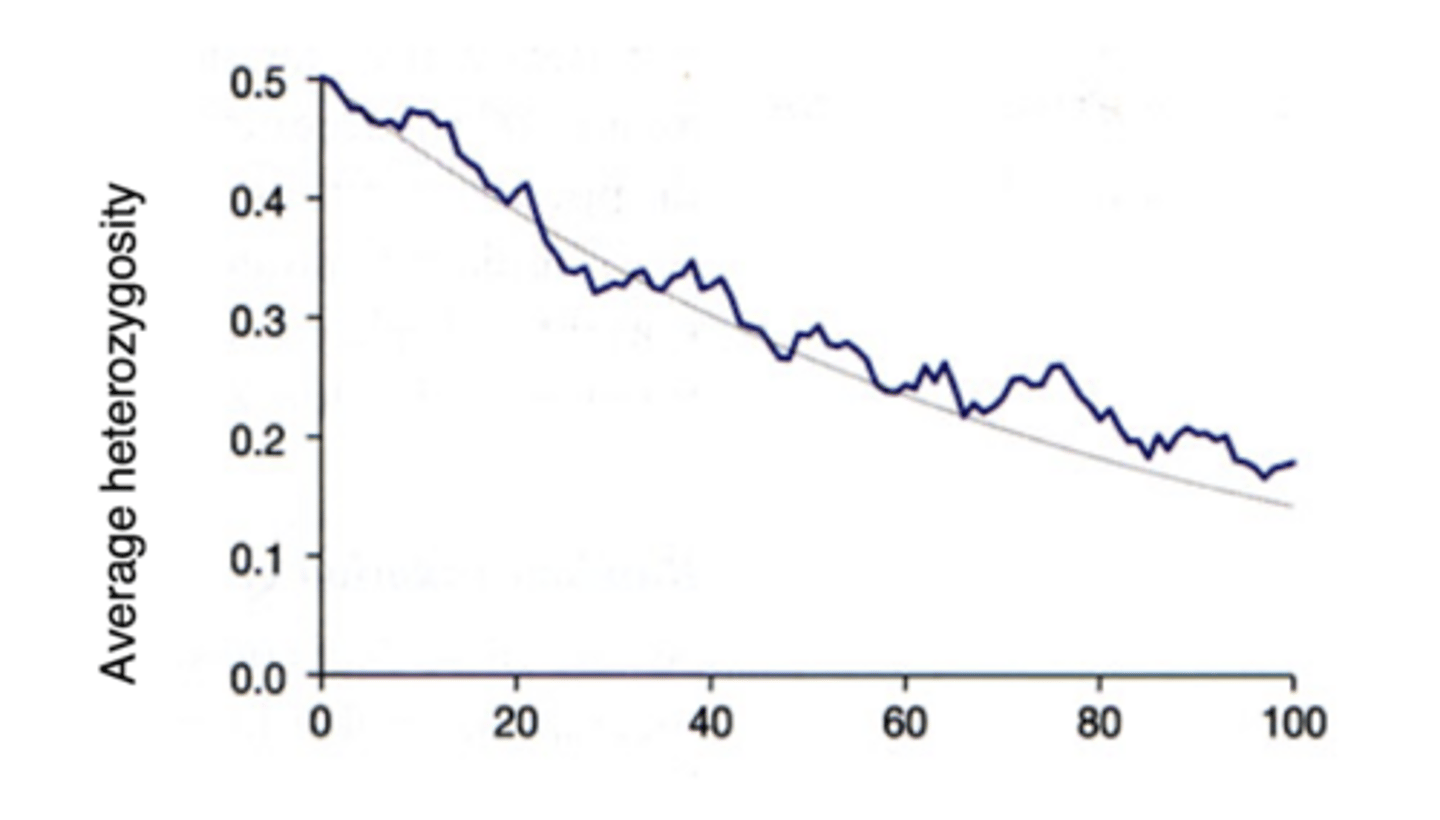
which of the following processes could cause the pattern shown in the graph below, in which genetic diversity within a population declines over time? Indicate all that apply:
genetic drift
natural selection
mutation
gene flow
Genetic Drift
Natural Selection
Explore top notes

