2.7 Task Analysis
 Call Kai
 Learn
Learn Practice Test
 Spaced Repetition
 Match
Match Flashcards
 Knowt Play
1/12

Earn XP
Description and Tags
2.7 Task Analysis
Name | Mastery | Learn | Test | Matching | Spaced | Call with Kai |
|---|
No analytics yet
Send a link to your students to track their progress
13 Terms
2 types of task analysis
human information processor models: which focuses on the input to the user, and the output from the user (similar to processor model)
Cognitive task analysis: a way of trying to get inside the user's head, instead of focusing just on the input and the output. (similar to predictor model)
GOMS Model
is a human information processor model so it builds off the processor model of the human's role in a system. It gets it's name from the four sets of information it proposes gathering about a task. It tries to distill tasks down to their goals, operators, methods, and selection rules.
G, stands for the users Goals in the system.
O, stands for the Operators the user can perform in the system.
M stands for the Methods that the user can use to achieve those goals.
S stands for the Selection rules that the user uses to choose among different competing methods.
Proposes that every human interact with the system has a set of Goals that they want to accomplish. They have sent methods that they can choose from to accomplish those goals. Each of those methods is comprise of a series of Operators that carries out that method. And they have some Selection rules that help them decide what method to use and when. The user starts with some initial situation, and they have a goal in mind that they want to accomplish, so they apply their selection of rule to choice between different competing methods to accomplish that goal. Once they've chosen a method, they execute that series of operators and makes that goal a reality.
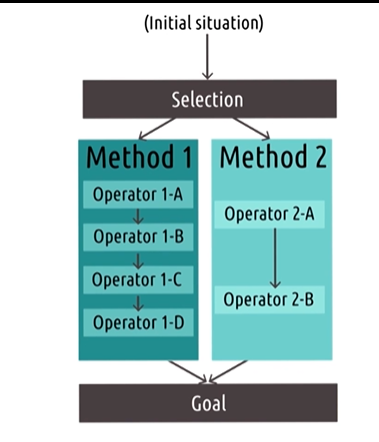
GOMS Example
We have an initial situation, which is the need to transfer information to a coworker. That carries with it the implicit goal of the information having been transferred. We might have a number of different methods in mind for how we could do that. We could email them, we could walk over and talk to them in person. And we also have some selection rules that dictate how we choose amongst these methods.
If what we need to transfer is very time-sensitive, maybe we walk over and talk to them in person or call them on the phone.
If the information we need to transfer is complex and detailed, maybe we write them an email.
Or if it's more casual, maybe we chat with them or text them.
No matter what method we choose, we then execute the series of operators that carries out that method, and the result is our goal is accomplished, the information has been transmitted. Or we could also take the problem of navigation. Our initial situation is the need to get to our destination, which carries with it the implicit goal of having reached our destination. We might have different methods, like take the scenic route, take the highway route, take the surface streets, and some selection rules that might say something like, when it's rush hour on the highway, take surface streets, or if it's not time sensitive, take the scenic route. After choosing, we execute those operators and reach our goal.
Pros and Cons of GMOS
Pros:
The strength of GOMS models is their ability to formalize user interaction into steps that we can use to actually make predictions. We can measure how long each these operators takes and so we can predict the overall efficiency of using a certain interface.(think of each operator in a method as a step/think of the GOMS Diagram) For example, in this GOMS model if we had included the operator to pull keys out of the users pocket, we might quickly identify that the relative efficiency of these two methods is very much dependent on how long that step takes. The Key Chain method might be a lot faster if the user can get their key chain out pretty quickly. But for other users, the fact that they need to pull something out of their pocket while holding bags or holding a baby, makes a keypad a more efficient option. By performing that kind of reasoning, we can focus on areas that either method and the interface as a whole can be improved.
Cons:
It doesn't automatically address a lot of the complexity of these problems. For example, there are likely many different methods and submethods for addressing this goal. Before even getting this selection rules among what route to take, you might decide whether to take public transportation or whether to work from home that day. In parallel to that, even after deciding to drive, you might decide what car to take if your family has more than one car. The standard GOMS model leaves those kind of things out, although there are augmented versions that have been created to deal with this kind of complexity like CMN GOMS or in GOMS L.
The GOMS model assumes the user already has these methods in mind, that means the user is already an expert in the area. GOMS models don't do a good job of accounting for novices or accounting for user errors. For example, if you are driving in an unfamiliar location, you don't even know what the methods are, let alone how to choose among them.
Varieties of GOMS
These varieties share the commonality of goals, operators, methods, and selection criteria, but they differ in what additional elements they provide.
Vanilla GOMS: Regular, plain GOMS.
KLM-GOMS(Keystroke-Level Model): which is the simplest technique. Here, the designer simply specifies the operators and execution times for an action and sums them to find the complexity of an interaction. This method proposed six different types of operators, although for moderate interfaces, we would need some new ones to cover touchscreens and other novel interfaces.
CMN-GOMS: An extension of GOMS that features sub-methods and conditions in a strict goal hierarchy. For example, here we see a hierarchy of goals, as well as the ability to choose between multiple goals in different areas. Notice also the level of granularity behind these GOMS models. The goals go all the way down to little goals like moving text or deleting phrases. These are very, very low-level goals. Notice also the way this model is being used. The authors are using it to find the places where there's a lot of complexity that can be cut out. They do this by modelling how long each individual action takes, as well as looking at the number of interactions required and seeing if it can be cut down a bit.
NGOMSL(Natural GOMS Language): A natural language form of GOMS that lends itself to human interpretation. In all these cases, the important point of emphasis is the way that these models allow us to focus in on places where we might be asking too much of the user. For example, in this model, the user was being asked to carry a lot of information in working memory. By making the assumptions and actions and operators this detailed, this model acts as target where working memory is being overly taxed in a way that we might miss when we're doing higher level designs.
5 Tips of Developing GOMS Models
Number one, focus on small goals. We've used some pretty big examples, but GOMS is really designed to work in the context of very small goals like navigating to the end of a document. You can abstract up from there, but start by identifying smaller moment-to-moment goals.
Number two, nest goals, instead of operators. It's possible to nest goals. For example, in our GOMS model of navigation, we could develop it further and break the overall task of navigating down to smaller goals like changing lanes or plotting routes. Operators, however, are the smallest atoms of a GOMS model. They don't break down any further, and those must be the actual actions that are performed.
Number three, differentiate descriptive and prescriptive. Make sure to identify whether you're building a model of what people do or what you want them to do. You can build a GOMS model of what people should do with your interface, but you shouldn't trick yourself into thinking that's necessarily what they will do.
Number four, assign costs to operators. GOMS was designed to let us make predictions about how long certain methods will take. The only way we can do that is if we have some measurement of how long individual operations take. Usually, this is time, but depending on the domain, we might be interested in phrasing the cost differently as well.
Number five, use GOMS to trim waste. One of the benefits of GOMS is it lets you visualize where an unnecessary number of operators are required to accomplish some task. That's bolstered by the costs we assign to this operators. So, use GOMS to identify places where the number of operators required can be simplified by the interface.
Cognitive Task Analysis
It’s another way of examining tasks, but it puts a much higher emphasis on things like memory, attention, and cognitive load. It aims to get into the head of the user and understand what they're thinking, feeling, and remembering at every stage of the task.
It's more of a type of method for approaching the evaluation of how people complete tasks. Performing a cognitive task analysis involves a number of different techniques and methods. For right now though, we're interested in what kinds of information we're trying to gather, not how we're gathering it. We are especially concerned with understanding the underlying thought processing performing a task, not just what we can see but specifically what we can't see.
Steps for Cognitive Task Analysis
There are a lot of different methods for performing cognitive task analyses but most methods follow a particular common sequence.
First, we want to collect some preliminary knowledge. While we as interface designers don't need to become experts in a field, we need a good bit of familiarity with it. So, we might observe people performing the task for example. In navigation, we might just watch someone driving and using a GPS.
Our second step is to identify knowledge representations. In other words, what kinds of things does a user need to know to complete their task? Note that we're not yet concerned with the actual knowledge they have, only the types or structures of the knowledge that they have. For example, we want to know, does this task involve a series of steps to do in a certain order? Does it involve a collection of tasks to check off in any order? Does it involve a web of knowledge to memorize? For navigation, for example, we would identify that the structure of the knowledge is a sequence of actions and order as well as knowledge of things to monitor as we go.
In the third stage, we actually want to populate those knowledge representations. This is the stage where we start to recognize what the user actually knows. With navigation for example, they know to start the GPS, to enter an address and to obey the turns while monitoring traffic and speed and things like that. During this stage, we identify all the specific actions they take, the knowledge they must have in mind to take those actions, the interruptions that can change their thought processes, the equipment involved and the sensory experience of the user. We do this by applying focused knowledge elicitation methods. In other words, we get users to tell us what's going on in their heads or what's going on in their environment or sometimes we do things that help us understand parts of the task that the user isn't even themselves aware of.
Then we analyze and verify the data we acquired. Part of that is just confirming with the people we observe that our understanding is correct. We might watch them do something and infer it for one reason when in reality it's for a very different reason. So, we want to present to our users our results and make sure that they agree with our understanding of their task. Then we attempt to formalize it into structures that can be compared and summarized across multiple data gathering methods.
Finally, we format our results for the intended application. We need to take those results and format them in a way that's useful for interface design. We want to develop models that show what the user was thinking, feeling and remembering at any given time and make those relationships really explicit.
Cognitive Task Analysis Example
Here we see a very high level model of the process of driving to a destination. What's interesting to note is that these tasks in the middle are highly cognitive rather than observable. If I had no knowledge about driving and I sat in the passenger seat watching the driver, I might never know that they're monitoring their route progress or keeping an eye on their dashboard for how much fuel they have left. If you have kids, you may have experienced this personally actually. Two kids sitting in the backseat, mommy or daddy are just sitting in the driver seat just like they're sitting in the passenger seat. They don't have a full understanding of the fact that you have a much higher cognitive load and you're doing a lot more things while you're driving then they are. That's because what you're doing is not observable. It's all in your head. So, to get at these things, I might have the user to think out loud about what they're doing, while they're doing it. I might have them tell me what they're thinking while they're driving the car. That would give me some insights into these cognitive elements of the task.
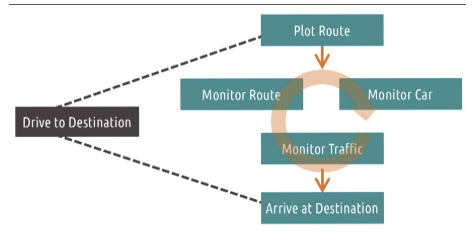
Hierarchical Task Analysis
This helps us understand what tools might already be available to accomplish certain portions of our task, or how we might design certain things to transfer between different tasks and different contexts. It also lets the designers of the site abstract over this part of the process and focus more on what might make their particular site unique. This kind of task analysis is so common that you generally will find tasks and sub-tasks whenever you're looking at the results of a cognitive task analysis.
Strengths of Hierarchical Task Analysis
Abstracting out unnecessary details for a certain level of abstraction, modularizing designs or principles, so they can be transferred between different tasks or different contexts, and organizing the cognitive task analysis in a way that makes it easier to understand and reason over.
Pros and Cons of Cognitive Task Analysis
Pros:
One strength is that they emphasize mental processes. Unlike the Goms model, cognitive task analysis puts an emphasis on what goes on inside the users head. It's thus much better equipped to understand how experts think and work. The information it generated is also formal enough to be used for interface design, for comparison in mode alternatives and more.
Cons:
Cogni-task analysis are incredibly time-consuming to perform. They involve talking to multiple experts for extended period of time, then systematically analyzing the data.
A second weakness is that cognitive task analysis risks deemphasizing context. In zooming in on the individual's own thought processes, cogni-task analysis risks deemphasizing details that are out in the world. Like the role of physical capabilities or interactions amongst different people, or different artifacts.
And third, like Goms models, cogni-task analysis also isn't well suited to novices. It's well suited to expert users who have very strong models of the way they work and clearly understand their own mental thought processes. But they're not very well suited for novice users who are still trying to learn how to use an interface.
Other Task Analysis Frameworks
For human information processor models, there exist models like KLM, TLM, and MHP, which capture even finer grain actions for estimating performance speed. There are other extensions to GOMS as well that add things like sub goals, or other ways of expressing content like CPM-GOMS and NGOMSL. CPM-GOMS focuses on parallel tasks, while NGOMSL provides a natural language interface for interacting with GOMS models.
More on the lines of cognitive models, there exists other methods as well like CDM, TKS, CFM, Applied Cognitive Task Analyses, and Skill-Based Cognitive Task Analyses.
CDM puts a focus on places where critical decisions occur.
TKS focuses on the nature of humans' knowledge. CFM focuses on complexity.
ACTA and Skill-Based CTA are two ways of gathering the information necessary to create a cognitive model.
Explore top notes

