religion & social change
 Studied by 0 people
 Call with Kai
 Learn
Learn Practice Test
 Spaced Repetition
 Match
Match Flashcards
 Knowt Play
1/15

There's no tags or description
Looks like no tags are added yet.
Name | Mastery | Learn | Test | Matching | Spaced | Call with Kai |
|---|
No study sessions yet.
16 Terms
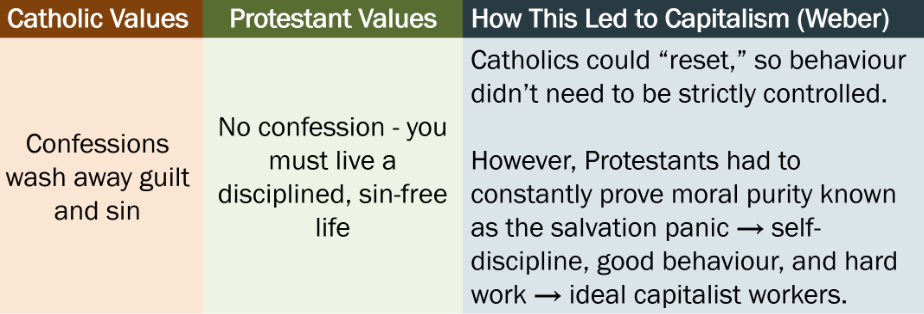
What are Max Weber’s overall findings
The Protestant ethic & the spirit of capitalism
Normative conditions
What is the Protestant ethic & the spirit of capitalism
The Protestants reformation’s emphasis on individual responsibility, thriftiness, and the pursuit of success created an environment conductive to the growth of capitalism
The Protestant work ethic encouraged people to view their economic success as gods favour → accumulating wealth
What are normative conditions & example
Norms & values
Evaluation of Weber
can’t explain why Calvinist countries like Norway did not experience industrialisation at the same time
Doesn’t demonstrate how strongly individual entrepreneurs held their religious beliefs - is their accumulation of wealth about religion?
Religious language Martin Luther King Jr used during the civil rights movement
“Our God is marching on” - highlights the progress of the civil rights movement
“I see the promised land” - shows the need to economic empowerment
“We are all God’s children”
What are Steve Bruce’s views on religion & the civil rights movement
The black clergy was the backbone of the movement by providing meeting places that could channel political dissent & act as a sanctuary away from the threat of white violence
The movement achieved its aims by shaming those in power
What is the Christian new right
A politically conservative, fundamentalist movement that strongly opposes the liberalising of America
They take the Bible literally, being strongly against abortion, divorce, contraception, and specifically homosexuality
They use TV, radio, and public protests to spread their message & recruit members to strengthen their pressure on the Republican Party
What a re Steve Bruces views on the Christian new right
Their movement has failed because they don’t work well with others due to their continual spread of hatred & their extremely radical ideology
Neo-Marxist key terms
Hegemony - ruling class control over ideas
Counter Hegemony - working class control over ideas
Ideological state apparatus - spread of ruling class ideologies
What are Althusser’s views
Relative autonomy - the superstructures of society (religion) have some freedom to support the working class rather than the ruling class
What are Gramsci’s views
Duel character:
Prevents change
Inspires protest & rebellion
Religion has duel character, it exercises counter hegemony at times when the demand for support was high
Example of duel character
Militant miners strike 1930’s - when they struggled for recognition from trade unions they were supported & encouraged by the church to riot & rebel
What is the liberation theology
A movement that was a fusion of Christianity & Marxism during the the 60’s in South America
Priests helped; the poor to establish support groups (base communities), workers to fight oppression, develop literacy programmes, educate the poor about their situation, & raise awareness
What factors led to the creation of liberation theology
deepening rural poverty & the growth of urban slums throughout Latin America
Human rights abuses - military death squads, torture & death squads who murdered political opponents
The growing commitment among catholic priests to an ideology that supports the poor & oppose human rights violations
Why did the movement lose influence
Pope John Paul II condemned liberation theology because it resembled Marxism
Examples of religion driving for social change
Catholic Church - condemned the communist regime in the 80’s which eventually led the rebellion movement against communism
The anti-apartheid movement led by Archbishop Desmond Tutu in South Africa
 Note
Note  Flashcards (79)