10: Population Growth
 Call Kai
 Learn
Learn Practice Test
 Spaced Repetition
 Match
Match Flashcards
 Knowt Play
1/40

There's no tags or description
Looks like no tags are added yet.
Name | Mastery | Learn | Test | Matching | Spaced | Call with Kai |
|---|
No analytics yet
Send a link to your students to track their progress
41 Terms
What is intrinsic rate of growth (r)?
The intrinsic rate of growth (r) is the difference between reproductive rate (R₀) and death rate; it shows how fast a population can grow under ideal conditions
What factors influence r?
Female fecundity (offspring produced), age at first reproduction, and mortality rates
How does age at reproduction affect population growth?
Earlier reproduction increases r because individuals contribute offspring sooner
Example of high vs low r species?
Mice have high r (early reproduction, short lifespan); elephants have low r (late reproduction, long lifespan)
Growth Patterns: What are the three types of population growth?
Exponential, geometric, and logistic growth
Exponential Growth:
When does exponential growth occur?
When resources are unlimited and environmental constraints are minimal
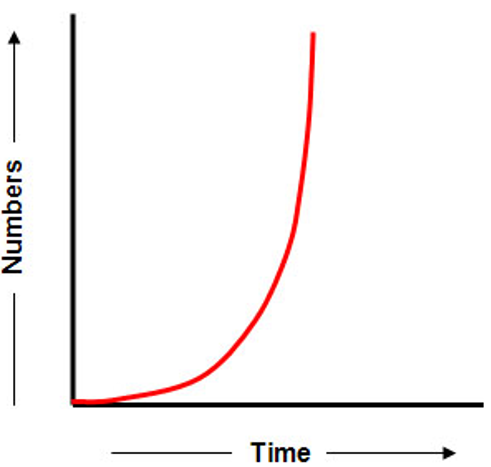
How does exponential growth work?
Population size changes based on r × N, so growth accelerates as population increases
What do different values of r indicate?
r = 0 → stable population
r > 0 → rapid increase
r < 0 → population decline
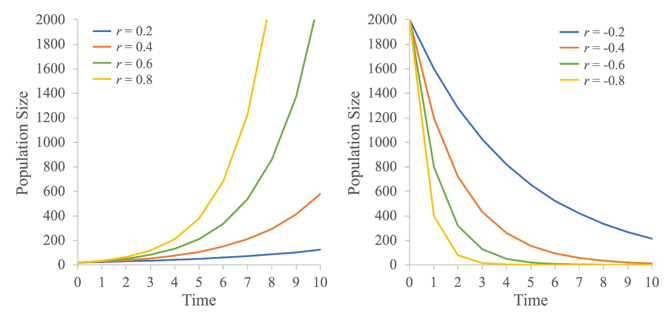
What happens when birth and death rates are equal?
No population growth occurs
What does a negative r mean biologically?
Death rates exceed birth rates, leading to population decline or extinction
Do natural populations grow exponentially?
Rarely; only temporarily under ideal conditions before limits are reached
Examples in nature?
Tree populations expanding after glaciers retreat; whooping cranes increasing after protection laws
Geometric Growth:
What is geometric growth?
Population growth in discrete time steps (generations), rather than continuously
When does geometric growth occur?
In species with non-overlapping generations, often in seasonal environments
How does population size change in geometric growth?
In pulses or jumps between generations
What is λ (lambda)?
The ratio of population size from one generation to the next
Logistic Growth:
How does logistic growth differ from exponential growth?
It begins like exponential growth but slows as resources become limited
What causes growth to slow in logistic models?
Limited resources, competition, disease, and other environmental constraints
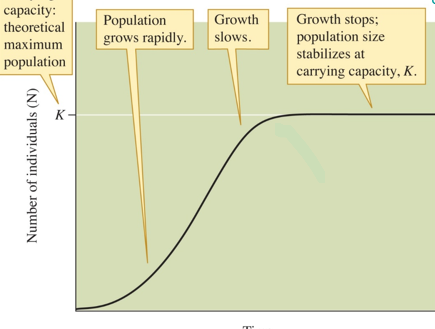
What is carrying capacity (K)?
The maximum number of individuals an environment can sustainably support
What determines carrying capacity?
Availability of resources, habitat space, disease, and environmental conditions
What does the logistic growth curve look like?
An S-shaped (sigmoid) curve that levels off at carrying capacity
Growth Comparison:
Why do exponential, logistic, and geometric growth differ?
They differ due to resource availability and reproduction patterns (continuous vs discrete)
Resources:
How do resources affect population growth?
Unlimited resources allow exponential growth; limited resources lead to logistic growth and stabilization
Why are resources important for population limits?
They determine how many individuals can survive, reproduce, and be supported
Limits to Growth:
How does the environment limit population growth?
By influencing birth rates and death rates through environmental conditions
What are key environmental limiting factors?
Food, shelter, rainfall, disease, predators, and natural disturbances (e.g., floods)
What are density-independent factors?
Abiotic factors that affect populations regardless of size (e.g., temperature, floods)
What are density-dependent factors?
Biotic factors whose effects increase with population size (e.g., competition, predation, disease)
How do density-dependent and independent factors differ?
Dependent factors intensify with population size; independent factors affect populations equally
Environment:
Example of environmental limits (Galápagos finches)?
Rainfall affects food supply, which in turn influences birth rates and population growth
Human Population:
What is the global distribution pattern of humans?
Clumped, with populations concentrated in favorable regions
Where are the highest densities found?
Asia and coastal regions, where resources and infrastructure are abundant
How does population density vary within regions?
It varies widely due to differences in resources, climate, and development
What can age structure diagrams tell us?
They reveal population growth trends based on proportions of age groups
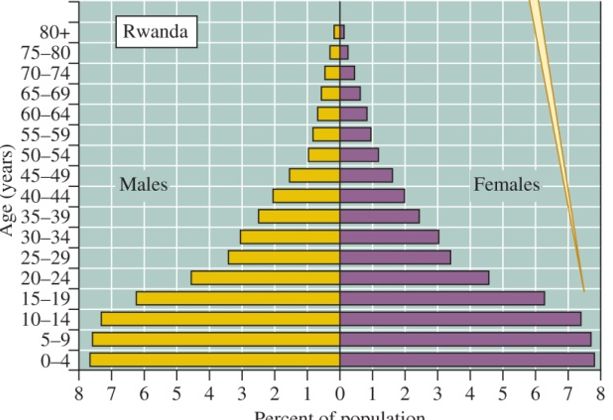
What does a bottom-heavy age structure indicate?
High birth rates and rapid population growth
high birth rate (growing population)
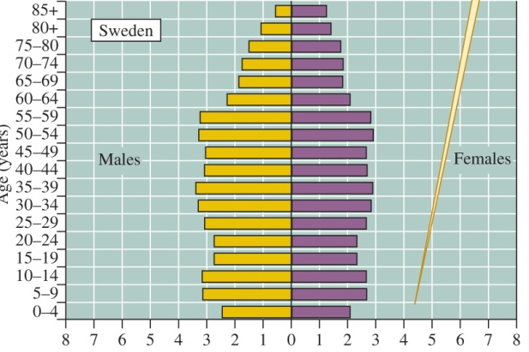
What does a uniform age structure indicate?
Stable population with roughly equal birth and death rates
self-replacement (birth = death)
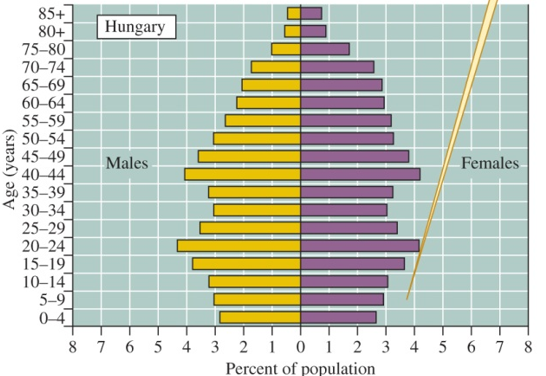
What does a narrow base age structure indicate?
Declining population due to low birth rates
declining population (low birth rate)
What do future projections suggest?
Global population growth is slowing and may decline by 2100
What factors are driving these projections?
Aging populations, declining fertility rates, and increased life expectancy
How have global birth rates changed over time?
They have declined significantly (from ~5.3 to ~2.2 children per woman)
Examples of country-level trends?
China is projected to decline, while India and Nigeria are expected to grow

