EFB 101 Exam 2
0.0(0)
Studied by 1 person Call Kai
 Learn
Learn Practice Test
 Spaced Repetition
 Match
Match Flashcards
 Knowt Play
Card Sorting
1/119

Earn XP
Description and Tags
Last updated 2:42 AM on 10/7/22
Name | Mastery | Learn | Test | Matching | Spaced | Call with Kai | Chat |
|---|
No analytics yet
Send a link to your students to track their progress
120 Terms
1
New cards
Phylogeny
Evolutionary history of a species or group of species.
2
New cards
Apomorphy
a derived character state.
3
New cards
Synapomorphy
shared derived character (i have a spine and birds have a spine because our shared ancestor has a spine)
4
New cards
Homology
shared trait resulting from common ancestry (same as synapomorphy)
5
New cards
Homoplasy
A similar (analogous) structure or molecular sequence that has evolved independently in two species. Aka convergent evolution.
6
New cards
Autapomorphy
A derived character state that is unique to a single taxon; e.g. only humans have opposable thumbs
7
New cards
Monophyly
the condition that a taxon or other group of organisms contains the most recent common ancestor of the group and all of its descendants
8
New cards
Polyphyly
a group that does not uniquely share a common ancestor - undesirable classification
9
New cards
Paraphyly
a group with an ancestor and only some of its descendants - undesirable classification
10
New cards
node
a point where one taxon diverges from another - where a common ancestor occurs
11
New cards
polytomy
a branch from which more than one taxon emerges due to lack of info
12
New cards
Taxon
group or level of organization into which organisms are classified
13
New cards
basal taxon
the most common ancestor
14
New cards
secondary loss
reversion to ancestral condition; a reason for homoplasy
15
New cards
Plesiomorphy
ancestral character state (plesiomorphic erin) (based)
16
New cards
parsimony
the least possible evolutionary steps; most parsimonious is preferred
17
New cards
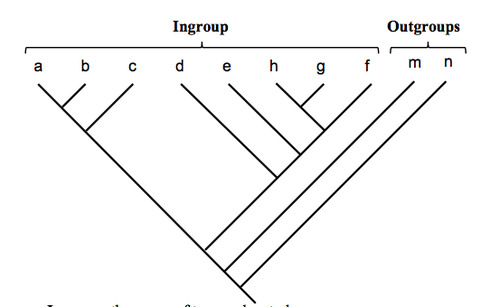
outgroup
a group of organisms not belonging to the group whose evolutionary relationships are being investigated. must be included in a phylogeny. They have all plesiomorphic traits
18
New cards
molecular clock
Supposed constant rate of change for evolutionary mutations. High error margin due to the following: (1)Some genes evolve in irregular bursts
(2)Even clocklike genes have deviations from AROC
(3)Some genes evolve at different rates in different organisms
(4)Some genes evolve faster than others even in the same organism
(5)Some mutations are selectively neutral and have little to no effect on fitness. These mutate faster.
(6)Estimates of evolutionary divergences predating the fossil record have a high degree of uncertainty
(2)Even clocklike genes have deviations from AROC
(3)Some genes evolve at different rates in different organisms
(4)Some genes evolve faster than others even in the same organism
(5)Some mutations are selectively neutral and have little to no effect on fitness. These mutate faster.
(6)Estimates of evolutionary divergences predating the fossil record have a high degree of uncertainty
19
New cards
Virus
A tiny, nonliving (debated), infectious particle that invades and then reproduces inside a living cell. Consisting of genetic material (either dna or rna, NOT both), obligate intracellular parasites.
20
New cards
three taxonomic domains
Bacteria, Archaea, Eukarya
21
New cards
obligate intracellular parasites
cannot multiply unless they invade a specific host cell and instruct its genetic and metabolic machinery to make and release new viruses. Host ribosomes are used to translate mRNA.
22
New cards
host range
The limited range of host cells that each type of virus can infect and parasitize.
23
New cards
tissue tropism
the range of tissue types that a virus can infect
24
New cards
lytic cycle
A type of viral (phage) replication cycle resulting in the release of new phages by lysis (and death) of the host cell. we just need to know it kills the host.
25
New cards
lysogenic cycle
a viral reproductive cycle in which the viral DNA is added to the host cell's DNA and is copied along with the host cell's DNA
26
New cards
Induction
switch from lytic to lysogenic cycles
27
New cards
phage conversion
alteration of the phenotype of a host cell by a lysogenization
28
New cards
Interferons
Antiviral proteins secreted by T cells; interfere with viral gene replication
29
New cards
Rendesivir
an antiviral that inhibits transcription
30
New cards
Ritonavir
an antiviral that inhibits protein synthesis
31
New cards
Hydroxychloroquine
an antiviral that inhibits viruses entering host cells
32
New cards
Antigen
A protein on a virus that triggers the production of an antibody
33
New cards
genetic recombination
The regrouping of genes in an offspring that results in a genetic makeup that is different from that of the parents.
34
New cards
Bacteriophage
A virus that infects bacteria, good for antibiotic resistant bacteria
35
New cards
How much of our genome is viral?
8%
36
New cards
Endosymbiosis
A theorized process in which early eukaryotic cells were formed from simpler prokaryotes.
37
New cards
What organelles does endosymbiosis concern?
Mitochondria and chloroplasts
38
New cards
Prokaryote
A unicellular organism that lacks a nucleus and membrane bound organelles
39
New cards
How many prokaryotic cells do we carry in comparison to our own cells?
10x more
40
New cards
Microbiome
all of the microorganisms that live in a particular environment, such as a human body
41
New cards
Symbiotic functions of prokaryotes living on us
Extract energy from food, produce vitamins, prevent disease
42
New cards
Microbiome delivery methods - horizontal
Environment to person
43
New cards
Microbiome delivery methods - vertical
Parent to child
44
New cards
Other microbiome delivery methods
Diet, pets
45
New cards
Mitochondria
Powerhouse of the cell
46
New cards
What kinds of conditions do prokaryotes love?
Harsh (hot, salty, cold, etc)
47
New cards
What two domains are prokaryotes?
Archaea and Bacteria
48
New cards
How is prokaryotic genetic material stored?
Single circular chromosomes
49
New cards
Bacillus
Of a bacterium, rod shapes
50
New cards
Coccus
Hahahahhahahahahahahahahahahah
a spherical bacterium
a spherical bacterium
51
New cards
Strepto-
chains of bacteria
52
New cards
Staphylo-
grape-like clusters of bacteria
53
New cards
Taxis
Of a bacterium, movement towards or away from a stimulus
54
New cards
Flagellum
Tail that helps with movement; homoplasious
55
New cards
Three components of a flagellum
Motor, hook, filament
56
New cards
tumble and run
Describes the movement of prokaryotic organisms. Tumbles in counterclockwise flagellum rotation and then runs in clockwise
57
New cards
Bacteria functions
Producers, decomposes, disease-causers, nutrient cyclers
58
New cards
peptidoglycan
A protein-carbohydrate compound that makes the cell walls of bacteria rigid
59
New cards
Gram-positive bacteria
Bacteria with a thick peptidoglycan layer, affected by antibiotics
60
New cards
Gram-negative bacteria
Bacteria that have complex cell walls with less peptidoglycan but with lipopolysaccharides (we just need to know it's an extra layer). Antibiotic resistant.
61
New cards
Commensalist bacteria
Skin bacteria
62
New cards
Mutualist prokaryotes
Gut microbiome, some fungi
63
New cards
nitrogen-fixing bacteria
bacteria that can use nitrogen in soil to make nitrogen compounds
64
New cards
parasitic bacteria
The bad guys. Cause disease by releasing endotoxins
65
New cards
Endotoxins
Toxin released only when bacteria die and their cell walls break down
66
New cards
Exotoxins
toxic substances that bacteria secrete into their environment
67
New cards
Bacterial organization is...
Simple!
68
New cards
(T/F) bacteria usually have circular chromosomes
True
69
New cards
(T/F) bacteria have a nucleus
False
70
New cards
R plasmid
A bacterial plasmid carrying genes that confer resistance to certain antibiotics.
71
New cards
binary fission
A form of asexual reproduction in single-celled organisms by which one cell divides into two cells of the same size
72
New cards
Antibiotic types - bacteriostatic
An antibiotic that halts bacteria reproduction
73
New cards
Antibiotic types - bactericidal
Kills bacteria
74
New cards
What makes a good antibiotic?
selective toxicity - targets stuff bacteria have that we don't
75
New cards
Methods of antibiotic resistance? (There are 4)
adjusting membrane permeability, breaking down with enzymes, using lysosomes to dispose of them, changing activation sites
76
New cards
Transformation
A change in genotype and phenotype due to the assimilation of external DNA by a cell. More common than once believed
77
New cards
Transduction
Bacteriophages (recall) carry genes from one host cell to another
78
New cards
Conjugation
In gram-negative bacteria, the direct transfer of DNA between two cells that are temporarily joined via pilus; requires set of up to 25 genes that create the pilus
79
New cards
Final electron donor in electron transport chain - aerobes
O2
80
New cards
Obligate aerobes
Require oxygen
81
New cards
Facultative aerobes
Choose to use O2
82
New cards
Phototroph
an organism that gets its energy from sunlight
83
New cards
Autotroph
An organism that makes its own food
84
New cards
Heterotroph
An organism that cannot make its own food.
85
New cards
Chemotroph
organisms that gain energy from chemical compounds
86
New cards
Chemolithotroph
an organism that obtains its energy from inorganic compounds
87
New cards
Chemoorganotroph
an organism that obtains its energy from organic compounds
88
New cards
Where do autotrophs get carbon?
CO2, HCO3+, etc
89
New cards
where do heterotrophs get their carbon?
organic compounds in things they eat
90
New cards
Anaerobic phototroph
Oxidize organic molecules, don't produce O2
91
New cards
Aerobic phototroph
Cyanobacteria, use water to get electrons, supply O2 and N
92
New cards
Endospore
A thick-walled protective spore that forms inside a bacterial cell and resists harsh conditions.
93
New cards
Eukaryote characteristics
Membrane-bound nucleus and organelles, larger
94
New cards
Genome
the complete instructions for making an organism, consisting of all the genetic material in that organism's chromosomes
95
New cards
Prokaryotic vs. Eukaryotic genome
Eukaryotic is much larger and therefore error prone, prokaryotes have mostly coding dna while eukaryotes have only a little
96
New cards
Why do cells have folds in the membrane.
To increase area we increasing volume
97
New cards
Mitochondria have their own circular dna and are self replicating.
Idk how to make that a flash card but it's important lol. Also supports the theory of endosymbiosis (recall)
98
New cards
Why are chloroplasts supportive to endosymbiosis?
They have similar bacterial characteristics to mitochondria. They are self replicating. Some have peptidoglycans also found in cyanobacteria cell walls.
99
New cards
(T/F) some prokaryotes can reproduce sexually.
False!
100
New cards
Disadvantages of sexual reproduction
Gene dilution (also an advantage if your genes are shit tho)
Decreases fitness, chance for maladaption during recombination, STDs.
Decreases fitness, chance for maladaption during recombination, STDs.