SBI4U1 Exam Review All Units
 Studied by 1 person
 Call with Kai
 Learn
Learn Practice Test
 Spaced Repetition
 Match
Match Flashcards
 Knowt Play
1/220

There's no tags or description
Looks like no tags are added yet.
Name | Mastery | Learn | Test | Matching | Spaced | Call with Kai |
|---|
No analytics yet
Send a link to your students to track their progress
221 Terms
What is dehydration synthesis?
The removal of OH from one reactant and H from another reactant to form H2O.
What is hydrolysis?
The disassembly of H2O into smaller subunits H and OH.
What are the properties of water?
Water is a universal solvent, forms hydrogen bonds creating a lattice structure in water and ice, and has high specific heat capacity.
What is specific heat capacity in relation to water?
The amount of thermal energy required to increase the temperature of a given quantity of water by breaking hydrogen bonds.
What is cohesion in water?
The tendency of water molecules to stay together due to hydrogen bonding, resulting in surface tension.
What is adhesion in water?
The ability of water molecules to form hydrogen bonds with other polar molecules, causing water to stick to other objects.
What are carbohydrates?
Organic compounds that serve as a primary source of energy and structural materials in cells.
What are monosaccharides?
Simple sugars composed of carbon, hydrogen, and oxygen in a 1:2:1 ratio.
What is the difference between α-glucose and β-glucose?
α-glucose has the OH group at C-1 below the plane of the ring, while β-glucose has it above the plane.
What are isomers?
Molecules with the same composition but different arrangements.
What are oligosaccharides?
Carbohydrates that contain two or three simple sugars linked by glycosidic linkages.
What are polysaccharides?
Carbohydrates formed by linking several monosaccharides through glycosidic linkages.
What is starch?
The main form of energy storage in plants, produced by linking excess glucose molecules.
What is the difference between amylose and amylopectin?
Amylose is unbranched (1-4 glycosidic link), while amylopectin is branched (1-4 and 1-6 glycosidic links).
What is glycogen?
The storage polymer in animals, primarily in muscles and liver, highly branched and compact.
What is cellulose?
A component of cell walls made of β-glucose linked by 1-4 glycosidic bonds, providing energy and structural support.
What is chitin?
A polymer that forms exoskeletons of insects and crustaceans, also used in biodegradable materials.
What are lipids?
Hydrophobic molecules that provide long-term energy, insulation, and cushioning for internal organs.
What are fatty acids?
Long hydrocarbon chains with a terminal carboxyl group, which gives them acidic properties.
What is the difference between saturated and unsaturated fats?
Saturated fats contain the maximum number of hydrogen atoms with no double bonds, while unsaturated fats have at least one double bond.
What are triglycerides?
Fats that consist of three fatty acids attached to a glycerol backbone, storing more than twice the energy of carbohydrates.
What type of bond holds phospholipids together?
Ester linkage by dehydration reaction.
What are the main components of phospholipids?
A phosphate head (polar/hydrophilic) and 2 fatty acid tails (non-polar/hydrophobic).
What is the structure of steroids?
Consists of 4 linked carbon rings with different functional groups, making them hydrophobic.
What role does cholesterol play in cell membranes?
It establishes proper membrane permeability and fluidity.
What are waxes composed of?
Long chains of fatty acids attached to an alcohol or carbon ring.
What percentage of dry mass do proteins constitute in cells?
About 50%.
What is the primary structure of a protein?
The linear sequence of amino acids in a polypeptide chain.
What is the secondary structure of a protein?
Results from hydrogen bonding between the carboxyl group of one amino acid and the amino group of an adjacent amino acid.
What are the two types of secondary structures in proteins?
β-pleated sheet and α-helix.
β-pleated sheet
2 separate polypeptide strands run parallel to each other due to H-bonds
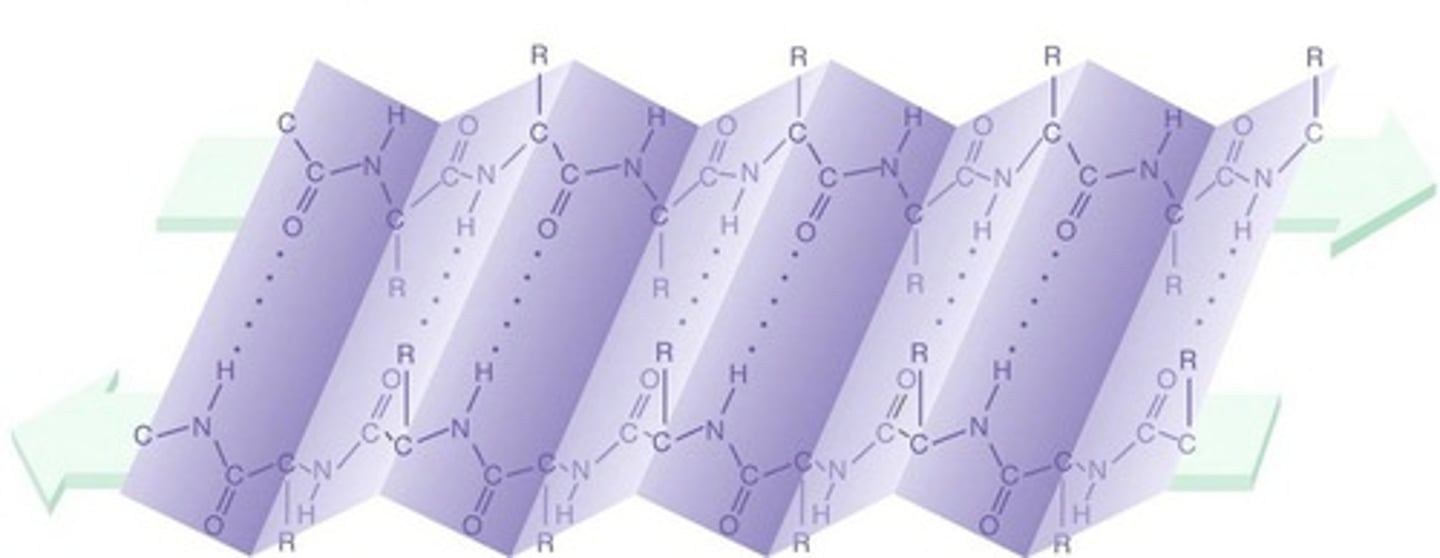
α-helix
coil structure held by H-bonds between every 4th AA
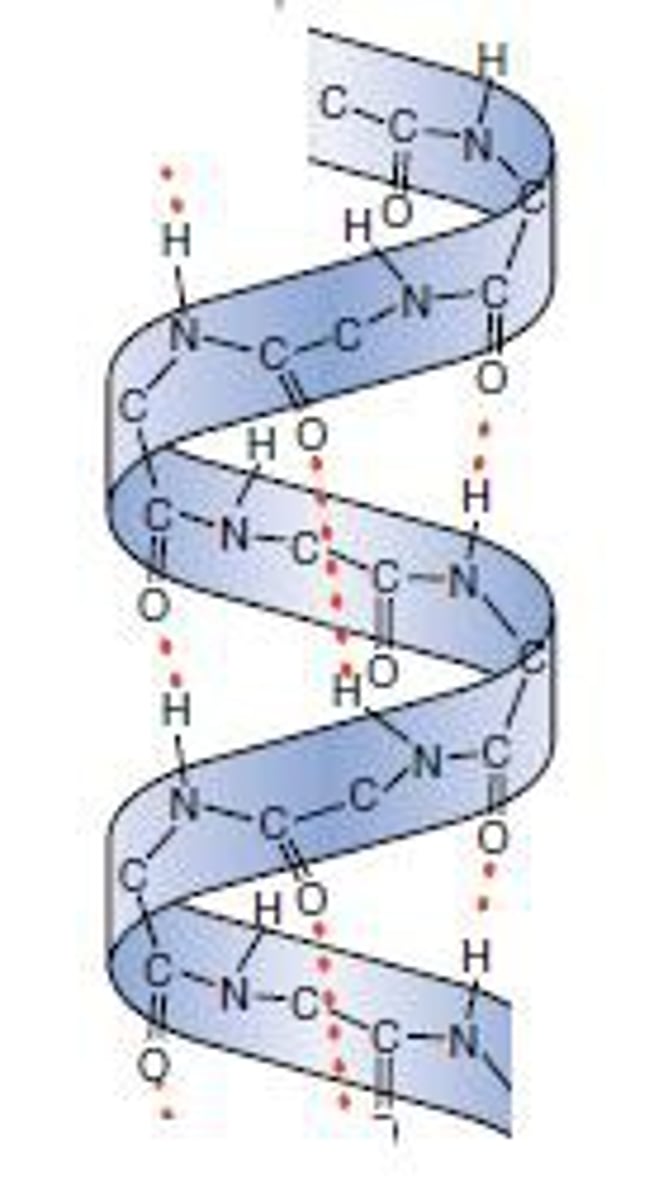
What defines the tertiary structure of a protein?
The bending and folding of a polypeptide chain due to interactions between R groups.
What is the quaternary structure of a protein?
Proteins consisting of two or more polypeptides into one macromolecule.
What are the components of nucleotides in DNA and RNA?
Nitrogenous base, 5-carbon sugar, and phosphate group.
What is the difference between purines and pyrimidines?
Purines have 2 rings (adenine and guanine), while pyrimidines have 1 ring (thymine and cytosine).
How are nucleotides in DNA linked together?
By phosphodiester bonds between the phosphate group at C-5 and the hydroxyl group at C-3.
What is the structure of DNA?
Double stranded and runs antiparallel, held together by hydrogen bonds between complementary bases (A+T and C+G).
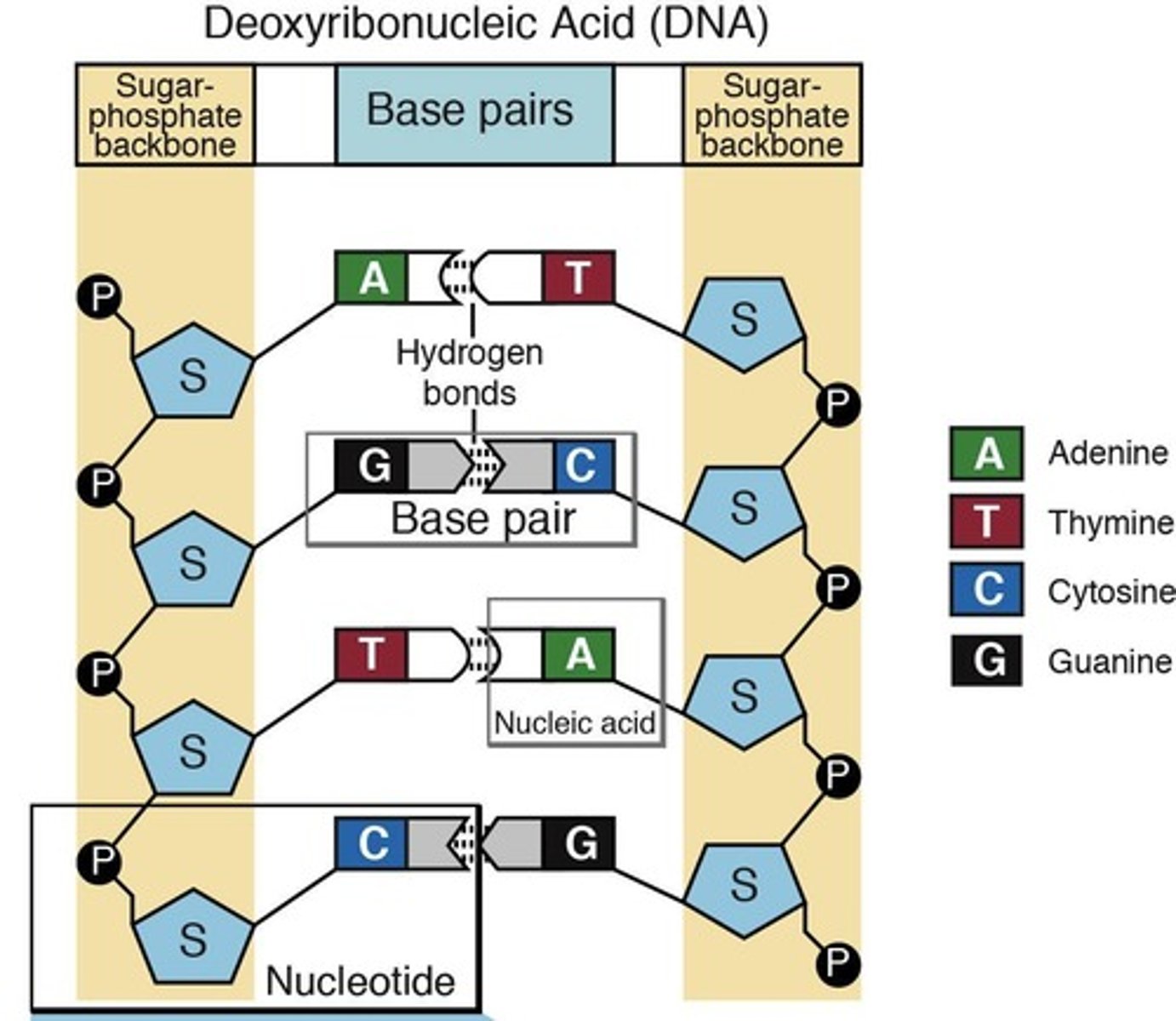
What is the structure of RNA?
Single stranded, involved in protein synthesis, with ribose sugar, nitrogenous bases (A, U, C, G), and phosphate group.
What is an enzyme?
A catalyst that increases the speed of biochemical reactions and is not consumed during reactions.
What is a substrate in the context of enzyme activity?
The reactant that the enzyme acts on during a chemical reaction.
What is the induced fit hypothesis?
The enzyme modifies its shape before the substrate attaches to the active site.
What are cofactors and coenzymes?
Cofactors are non-protein groups that aid enzyme function, while coenzymes are organic molecules that act as cofactors.
What factors affect enzyme function?
Enzyme and substrate concentration, enzyme inhibitors, temperature, and pH.
What are competitive and non-competitive inhibitors?
Competitive inhibitors compete with the substrate at the active site, while non-competitive inhibitors bind to an allosteric site, changing the enzyme's shape.
How does temperature affect enzyme activity?
If temperature increases beyond a set point, enzymes denature; each enzyme has an optimal temperature.
How does pH affect enzyme activity?
Enzymes have an optimal pH range, and deviations can affect their function.
What is the structure of the cell membrane?
The cell membrane is a phospholipid bilayer composed of hydrophobic tails (2 fatty acids) and a hydrophilic (phosphate) head.
How do unsaturated and saturated fats affect membrane fluidity?
Unsaturated fats with double bonds keep the membrane fluid (less viscous), while saturated fats with single bonds maintain a semi-solid gel state due to their linear arrangement.
What are integral proteins and their function in the cell membrane?
Integral proteins are embedded within the membrane and function as transport proteins and channels to move substances across the membrane.
What are peripheral proteins and their roles?
Peripheral proteins are loosely bound to the membrane surface, held by hydrogen and ionic bonds, and act as antigens or are involved with microtubules/-filaments.
What role do membrane carbohydrates play?
Membrane carbohydrates are involved in cell wall regulation, signaling, and identifying foreign cells by recognizing carbohydrates that bind to cell receptors.
What is the role of cholesterol in the cell membrane?
Cholesterol helps maintain membrane fluidity by occupying space between phospholipids, keeping the bilayer flexible in cold temperatures and restraining movement at high temperatures.
What is passive transport?
Passive transport is the movement of substances across a membrane without the use of chemical energy, achieving equilibrium from areas of higher concentration to lower concentration.
What is simple diffusion?
Simple diffusion is the unassisted movement of small non-polar or uncharged polar molecules across the membrane from high to low concentration.
What is facilitated diffusion?
Facilitated diffusion is the process by which large molecules or ions move through transport protein channels, driven by the concentration gradient.
What is osmosis?
Osmosis is the diffusion of water across a membrane from an area of low solute concentration to an area of high solute concentration.
What are the three types of solutions in osmosis?
Hypertonic (more solute, less water), hypotonic (less solute, more water), and isotonic (equal solute and water).
What is primary active transport?
Primary active transport involves pumps that move positively charged ions (Na, K, H, Ca) across the membrane against their concentration gradient.
What is an electrochemical gradient?
An electrochemical gradient is the difference in electrical charge across a membrane, created by the concentration of ions on either side.
What are endocytosis and exocytosis?
Endocytosis is the process of moving large molecules into the cell, while exocytosis is the export of large molecules out of the cell using vesicles.
What is phagocytosis?
Phagocytosis is a type of endocytosis that transports liquids or whole cells into the cell by engulfing them.
What is pinocytosis?
Pinocytosis is a form of endocytosis that involves the transport of liquids into cells within vesicles.
What is a gene?
A gene contains instructions for building proteins that are responsible for specific traits, such as hair color or eye color.
What are alleles?
Alleles are different versions of a gene that give a trait more than one appearance, such as brown eyes or brown hair.
How are chromosomes structured?
Chromosomes vary in size and number among species and contain instructions to build proteins, bundled into coils around histones to form thick chromatin fibers.
What is the structure of a DNA nucleotide?
A DNA nucleotide consists of deoxyribose sugar (5-C), a phosphate group, and nitrogenous base pairs.
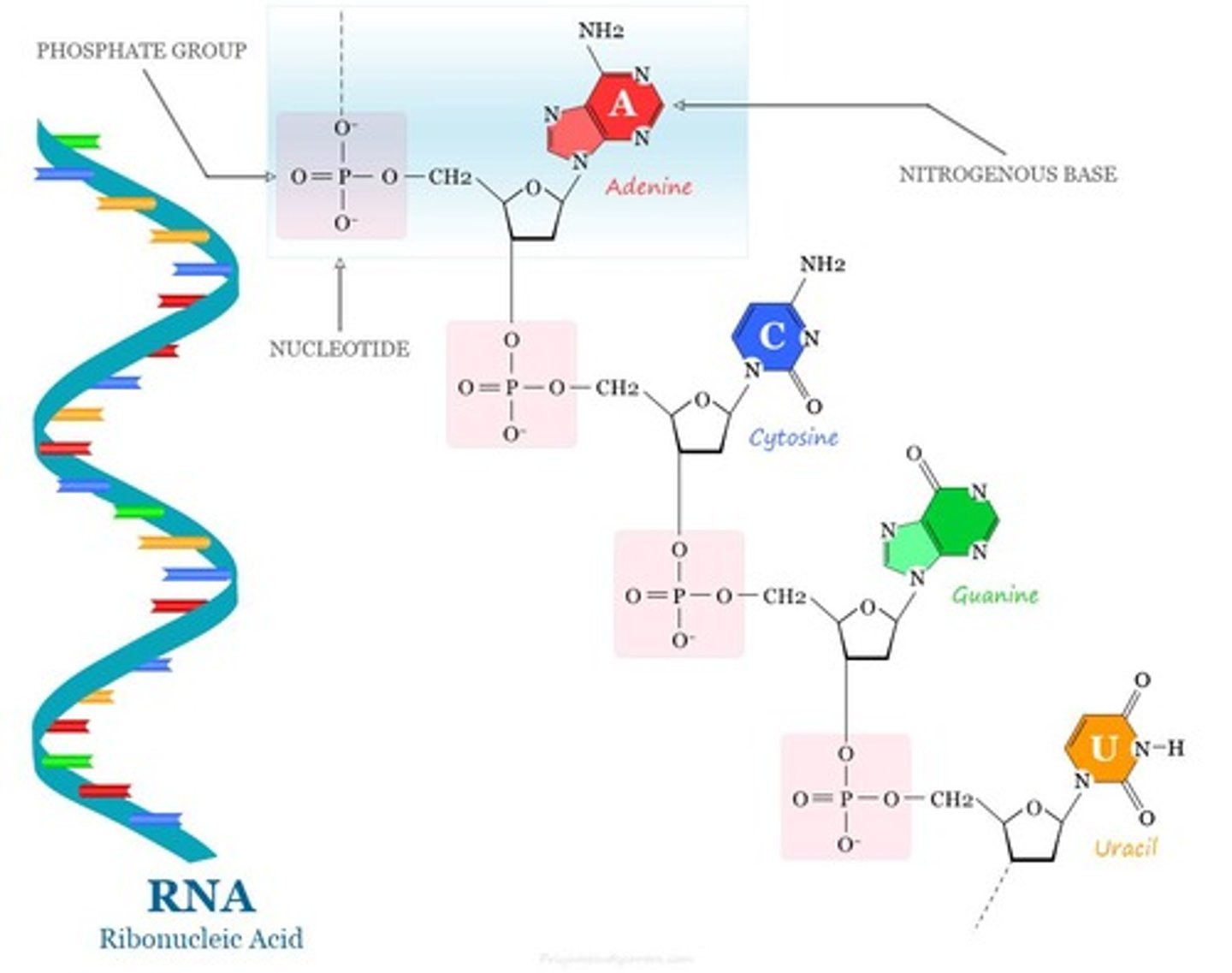
What are the differences between DNA and RNA nucleotides?
DNA nucleotides contain deoxyribose sugar, while RNA nucleotides contain ribose sugar; DNA has thymine (T) while RNA has uracil (U).
What are the base pairing rules in DNA?
In DNA, adenine pairs with thymine (2 hydrogen bonds) and cytosine pairs with guanine (3 hydrogen bonds).
What is a nucleosome?
A nucleosome is formed when DNA strands wrap around a cluster of 8 histones.
What are solenoids in the context of DNA?
Solenoids are groups of 6 nucleosomes that form chromatin fibers.
What is the role of DNA helicase in DNA replication?
DNA helicase unwinds the double helix by breaking hydrogen bonds between the base pairs.
What is the function of single-stranded binding proteins (SSBs) during DNA replication?
SSBs keep the two strands of DNA apart and block hydrogen bonds.
What does topoisomerase do during DNA replication?
Topoisomerase relieves tension from DNA unwinding by cutting both strands of DNA and then resealing them.
What is the process of DNA replication initiated?
DNA replication begins at the origin of replication, forming a 'bubble' where the two strands open, creating replication forks.
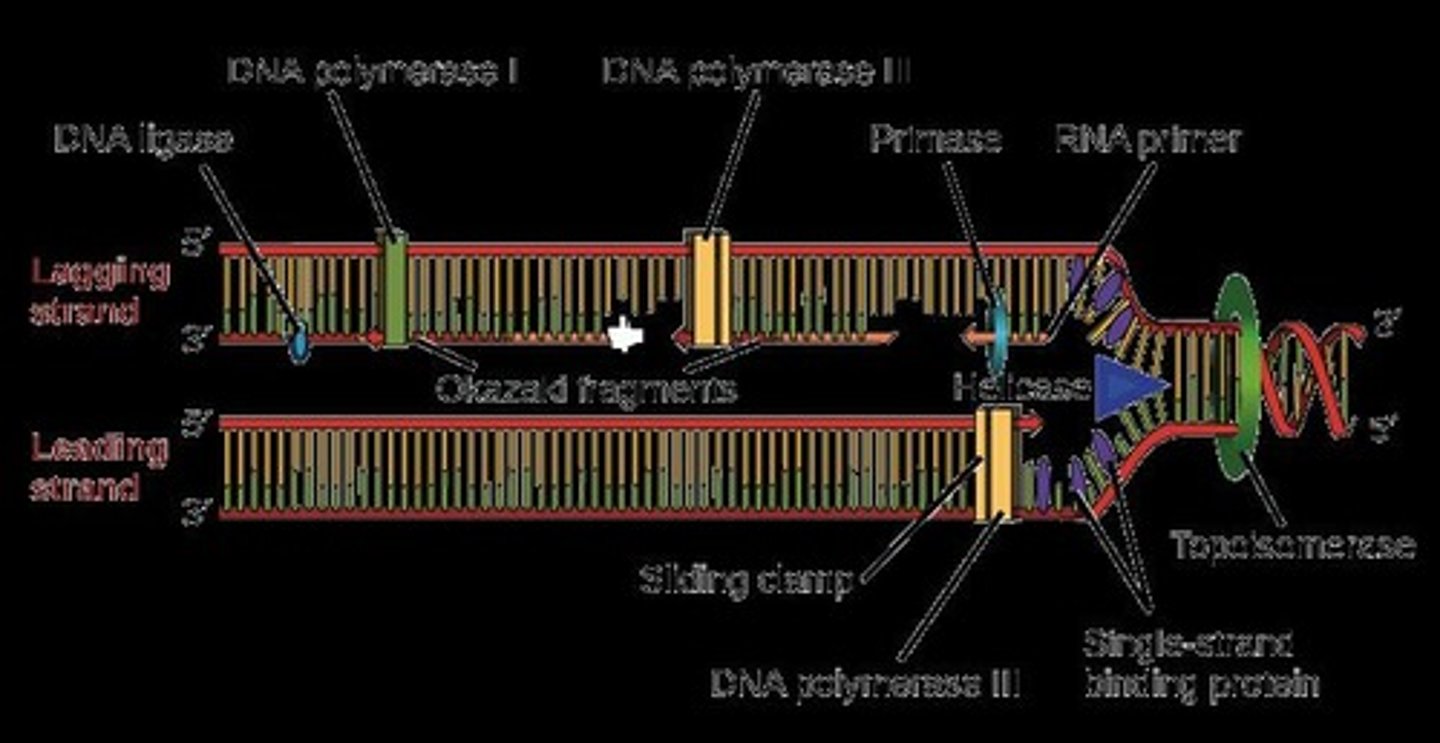
What is the difference between the leading and lagging strands in DNA replication?
The leading strand is synthesized continuously towards the replication fork using one RNA primer, while the lagging strand is made discontinuously in short fragments (Okazaki fragments) away from the fork, requiring several RNA primers.
What is the role of DNA polymerase III in DNA replication?
DNA polymerase III builds the complementary strand using the original strand as a guide, adding nucleotides in a 5'-3' direction.
What are RNA primers and what is their function?
RNA primers are made by primase and act as starting points for DNA polymerase III to build new strands.
What is deoxyribonucleoside triphosphate and its role in DNA replication?
Deoxyribonucleoside triphosphate is similar to ATP and is used by DNA polymerase III to build the complementary strand, with two phosphates removed during the process.
What does DNA polymerase I do after DNA replication?
DNA polymerase I removes all RNA primers and replaces them with the correct nucleotides.
What is the function of DNA ligase in DNA replication?
DNA ligase joins Okazaki fragments into one strand by forming phosphodiester bonds.
How do DNA polymerases 1-3 contribute to proofreading?
DNA polymerases 1-3 act as proofreaders, using exonuclease activity to remove incorrect nucleotides and add the correct ones.
What is transcription in the context of protein synthesis?
Transcription is the process of copying DNA into RNA.
What is the role of mRNA in protein synthesis?
mRNA is the RNA that is encoded by DNA and carries the code for amino acids in proteins.
What initiates the transcription process?
Transcription begins at the promoter region, where RNA polymerase binds to unwind the DNA.
What is the TATA box and its significance in transcription?
The TATA box is a region high in adenine-thymine bases that facilitates the unwinding of DNA due to easier hydrogen bond breakage.
What happens during the elongation phase of transcription?
RNA polymerase builds the mRNA strand in a 5'-3' direction using the 3'-5' DNA strand as a guide.
What occurs during the termination phase of transcription?
Transcription stops when RNA polymerase reaches the end of the gene (stop codon), and mRNA dissociates from the DNA template.
What are post-transcriptional modifications?
Post-transcriptional modifications include the addition of a 5' cap, a 3' tail, and the excision of introns.
What is the purpose of the 5' cap in mRNA?
The 5' cap, made of 7 guanine nucleotides, serves as the initial site for mRNA to bind to ribosomes during translation.
What is the function of the 3' tail in mRNA?
The 3' tail, added by poly-A polymerase, protects the mRNA from enzymatic destruction.
What is the role of tRNA in protein synthesis?
tRNA carries amino acids and has an anticodon that pairs with mRNA to form the corresponding amino acid.
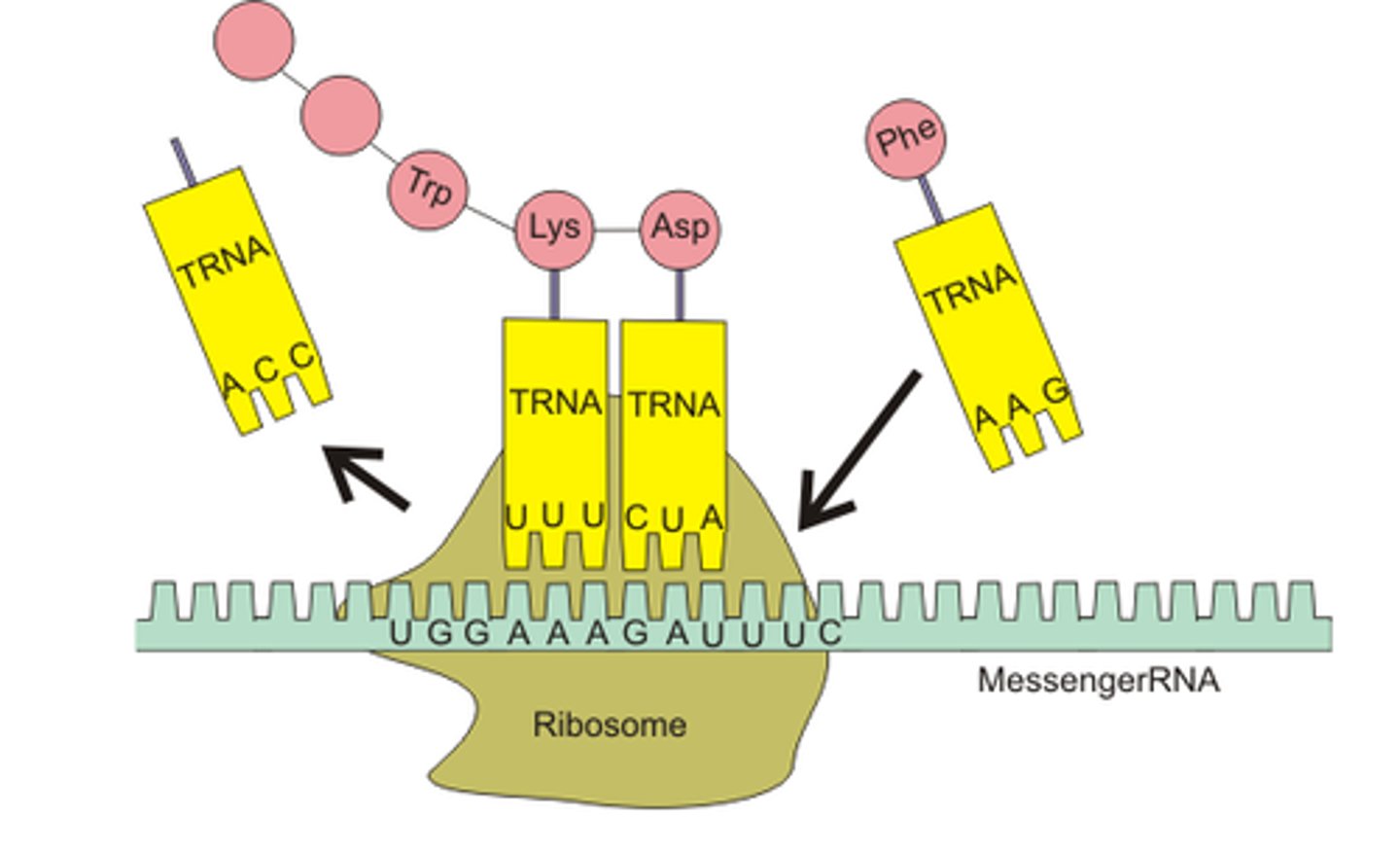
What is the process of initiation in translation?
Initiation begins when the initiator met-tRNA binds to the small ribosomal unit, which then scans for the start codon (AUG).
What happens during termination in protein synthesis?
Elongation continues until a stop codon is reached in the A site, where an enzyme release factor binds, causing the ribosome to fall off the mRNA and release the polypeptide chain.
What are the stop codons that do not code for an amino acid?
UAA, UAG, and UGA.
What is the function of operons in prokaryotes?
Operons regulate genes and their products.
What are the components of an operon?
Promoter (binding site for RNA polymerase), Operator (controls access of RNA polymerase), and Repressor (blocks RNA polymerase attachment to prevent transcription).
How does the lac operon function in the presence of lactose?
Lactose acts as an inducer, inactivating the repressor and allowing transcription of lactose-metabolizing enzymes.
What occurs in the lac operon when lactose is not present?
The repressor binds to the operator region, blocking transcription.
What is the role of tryptophan in the trp operon?
Presence of tryptophan activates the repressor, blocking transcription, while low levels allow transcription to occur.
 Note
Note  Flashcards (25)