Carbon cycle- intro
 Call Kai
 Learn
Learn Practice Test
 Spaced Repetition
 Match
Match Flashcards
 Knowt Play
1/34

There's no tags or description
Looks like no tags are added yet.
Name | Mastery | Learn | Test | Matching | Spaced | Call with Kai |
|---|
No analytics yet
Send a link to your students to track their progress
35 Terms
What are examples of materials in which carbon is found?
Graphite
Charcoal
Petroleum
Plastics
What element is found in all living organisms?
Carbon.
Around how many different compounds can carbon form?
Nearly 10 000 000.
Where is carbon formed?
The interior of stars.
What are diamond and graphite?
They are both allotropes of carbon
They are also some of the hardest and softest substances respectively
Carbon is the __ most abundant element?
4th.
Approximately how much carbon is there on earth?
65 000 billion metric tonnes.
Where is most of Earth’s carbon stored?
In rocks and the soil above them.
Define carbon flux.
A process moving carbon from one store to another.
What is the ocean for carbon?
A natural carbon sink.
What does the carbon cycle display?
The flows of carbon between stores.
What has human activity done to carbon levels on Earth?
Put more CO2 into the air, causing global temperature rise.
The carbon cycle:
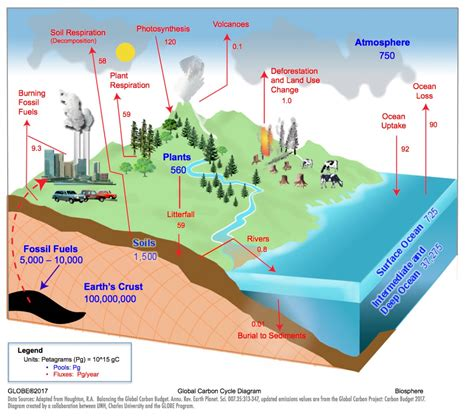
What are the four general places carbon is stored on earth?
Biosphere
Lithosphere
Atmosphere
Hydrosphere
What is the carbon budget?
The comparison of inputs and outputs of carbon in a particular carbon store.
Define carbon budget.
The balance of exchanges between the four carbon stores.
What is the largest carbon store?
The lithosphere.
What is the soil carbon store known as?
The pedosphere.
What is a carbon footprint?
The total amount of CO2 produced by human activities.
What is radiative forcing?
A measure of how much the Earth’s energy balance is disrupted by a factor like a change in greenhouse gases or solar output.
Quantified in watts per m².
What can radiative forcing tell us?
Whether a carbon imbalance will cause the planet to:
Warm (this is called positive forcing)
or
Cool (this is called negative forcing)
Why is radiative forcing a naturally important phenomenon?
Allows scientists to measure the relative impact of different factors on climate change
Helps us understand Earth’s climate overall
Provides insight into the climatic impacts of changes in greenhouse gas concentrations
Crucial for evaluating the extent of climate change
How much does CO2 contribute to radiative forcing?
Makes up 65% of greenhouse gas contributions
Is the largest contributor
2.16 W/m² from 1750-2019
How much has radiative forcing increased in the last decade?
Approximately 0.32 W/m².
What will atmospheric warming do to our planet?
Extreme weather
Sea level rise
Wild fires, leading to habitat loss
Desertification
Health risks
What are four causes of increased emissions?
Burning fossil fuels
Increase in mechanised industry
Agriculture
Food production
Which carbon sink is helping the most to remove carbon from the atmosphere?
The ocean- it is the largest carbon sink.
What is the role of peat soil in the UK?
Largest natural carbon store
Provides clean drinking water
Regulates flood risk
Vital habitat
What are four ways carbon is currently being lost from peat bog?
Drainage
Burning
Commercial extraction
Conversion to other land uses
How is drainage removing carbon from peat bogs?
When bogs are drained, the water table drops
This exposes peat to oxygen
Increased oxygen causes decomposition
This releases carbon
Why and how are peat bogs usually drained?
By humans, for land use.
How does burning remove carbon from peat bogs?
Fires burn away dry peat that has accumulated over time
This releases their stored carbon back as a greenhouse gas
How does commercial extraction remove carbon from peat bogs?
Peat is dug up for use in products like garden compost
This physically removes large amounts of stored carbon from the bog
How does conversion to other land uses remove carbon from peat bogs?
Peatlands are often converted for other land uses, such a farming or planting trees
This destroys the peatland ecosystem along with its ability to sequester carbon
This turns a former sink into a carbon source
How can climate change cause carbon loss from peat bogs?
It is dissolved and carried away in river water
Higher temperatures and wetter winters make the peat more vulnerable
Erosion of the ground allows peat to be washed away

