Alcohols
 Call Kai
 Learn
Learn Practice Test
 Spaced Repetition
 Match
Match Flashcards
 Knowt Play
1/29

Earn XP
Description and Tags
Name | Mastery | Learn | Test | Matching | Spaced | Call with Kai | Chat |
|---|
No analytics yet
Send a link to your students to track their progress
30 Terms
R-OH
written as
“-ol”
suffix in iupac naming
weakly acid
polar because of hydrogen bonding (-OH)
characteristics of alcohols
miscible in water
1-5 Carbons in water
immiscible in water
≥ 6 Carbons in water
Methanol
ethanol
octanol
“-diol”
naming if there are 2 -OH groups
“-triol”
naming if there are 3 -OH groups

glycerol (propane-1,2,3-triol)
primary (1°)
secondary (2°)
tertiary (3°)
alcohol classifications

C-OH carbon attached to one carbon

C-OH carbon attached to two carbons

C-OH carbon attached to three carbons

propyl alcohol
propanol

isopropanol
ispropyl alcohol
propanol and isopropanol
positional isomers of cyclohexanol
carbolic acid
old name of phenol
glycol
old name for diols
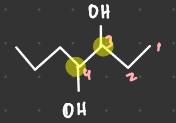
vicinal diols
OH groups are on adjacent carbons
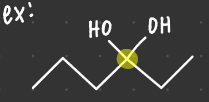
geminal diols
both OH group on same Carbon
dehydration
oxidation
grignard rxn
three alcohol reactions
dehydration
works on ≥ 2 Carbons
alcohol loses water (H2O) which forms alkene
ethanol
the simplest 2C alcohol
Oxidation of alcohols
A chemical reaction where alcohols lose hydrogen or gain oxygen, forming carbonyl compounds:
Primary alcohol → aldehyde → carboxylic acid
Secondary alcohol → ketone
Tertiary alcohol → no reaction (under normal conditions)
0 Order Kinetics
the Order Kinetics alcohol follows
0 Order Kinetics
A type of drug reaction where the rate of elimination is constant and does NOT depend on drug concentration. A fixed amount of drug is removed per unit time.
Example: ethanol (at high concentrations), phenytoin (at higher doses)
True or False: 3° alcohols do not undergo oxidation
grignard’s reaction
a reaction where carbonyl is converted into an alcohol. it has reagents such as RMgX