Env Econ Exam 2
 Call Kai
 Learn
Learn Practice Test
 Spaced Repetition
 Match
Match Flashcards
 Knowt Play
1/12

There's no tags or description
Looks like no tags are added yet.
Name | Mastery | Learn | Test | Matching | Spaced | Call with Kai |
|---|
No analytics yet
Send a link to your students to track their progress
13 Terms
Technology standards
none of the above
The most efficient use of revenue from Pigouvian taxes is to
reduce distortionary taxes
Market power is most likely to raise costs of compliance under
an emission trading system
Pigouvian tax equal to the marginal environmental damages from pollution
a and b
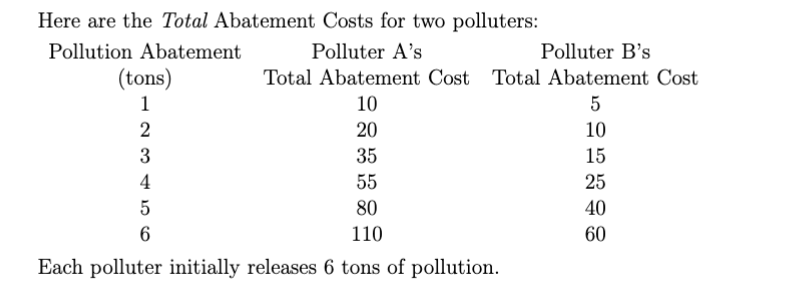
If the government issues a performance standard requiring each polluter to release only 4 tons of pollution, the total costs of the policy would be
30
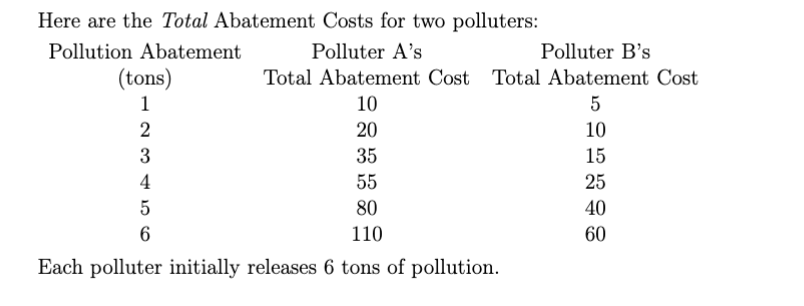
If the government issues 3 marketable pollution permits (each allowing 1 ton of pollution) to each polluter, what would happen?
Polluter A would buy 1 permit from Polluter B
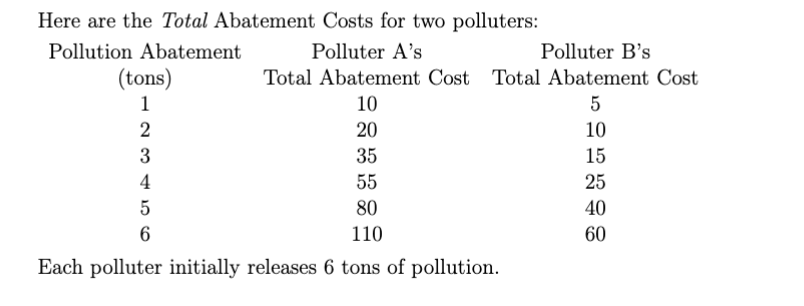
How much would polluter A pay for an innovation that would give it the same abatement cost as polluter B if it faces a performance standard capping its pollution at 3 tons?
$20
Suppose the marginal abatement costs (MAC) for most polluters turn out to be higher than expected at the time when the government imposes a policy. Under which policy is abatement lower than expected?
pollution tax
A “safety value” in an emission trading system
allows polluters to pay a pre-specified high price to buy allowances from the government
Consider a pollutant that is nonuniform in its effects, such as local air pollution that causes more damage when released by factories close to population centers
it may be optimal to have different marginal abatement costs for polluters depending on their locations
Which policy produces the strongest incentives for innovation?
pollution taxes
Fines for violations of pollution control laws in the United States
b and c
Relying on very high fines to enforce environmental policies may cause problems because
b and c

