[ORGB3201] Exam 2: Groups and Teams
 Call Kai
 Learn
Learn Practice Test
 Spaced Repetition
 Match
Match Flashcards
 Knowt Play
1/30

There's no tags or description
Looks like no tags are added yet.
Name | Mastery | Learn | Test | Matching | Spaced | Call with Kai |
|---|
No analytics yet
Send a link to your students to track their progress
31 Terms
Strengths of Group Decision Making
Generate more info/knowledge
Offer a diversity of views
Lead to increased acceptance of a solution
Weaknesses of Group Decision Making
Conformity pressures
Discussions can be dominated by a few key members
Groups may suffer from ambiguous responsibilities
Group
Collection of 2 or more people
Form because of social identity theory
Social identity theory
People have emotional reactions to the failure or successes of their group because their self-esteem gets tied into the group performance
Helps us understand where we fit in with other people, but it can lead to ingroup favoritism
Team
2 or more people working interdependently over some time period to accomplish common goals related to some task-oriented purpose
Interdependence and shared accountability are what differentiate them from groups
Are more heads better than one? (Group performance = ?)
Group performance = potential + (process gain - process loss)
Group-related potential
Information production
Group-related process gain
Information processing
Group-related process loss
Coordination
Motivation
TLDR: groups generate more information than individuals, but face coordination and motivation challenges that can undermine performance
Group-Related Potential for Information Production
More brains = more (& more diverse) ideas, knowledge, expertise
In general: more heads are better than one in this case (+)
Group-Related Process Gain: Information Processing
Individuals have limited info processing capacities (i.e. attention, memory)
Group members can extend this capacity
Ex: transactive memory, collective intelligence
In general: more heads are better than one in this case (+)
Transactive memory
Transactive memory: mechanism by which groups encode, store, and recall knowledge
Know in general what someone or something knows in details (know where to find something)
Person or thing serves as your external memory
The Google Effect: you don’t know what exact keywords to use, but you know the relative category info (Google — the other person — helps you get the result)
Transactive memory in groups and teams: develop a shared memory system where different people are responsible for different sets of knowledge
Collective intelligence (“c factor”)
Collective intelligence: measure of shared intelligence to explain group performance
Strongly correlated with:
Average social sensitivity of group members
Equality of conversation
Proportion of women in group (not associated with avg. or max. Individual intelligence)
Murder Mystery Class Activity Outcomes
Teams with more correct individual decisions are more likely to be correct as a team
Less than 50% of teams select correct suspect even though collectively, every team has the same information
Why? The common knowledge problem
The common knowledge problem
Groups spend the majority of time discussing information that they all have in common
Unique information is rarely shared (if it is shared, it is often not widely discussed)
Groups often make poor decisions because they do not fully communicate about all the information each member has
Group-Related Process Loss: Coordination
Not everyone can speak at the same time
The information the group focuses on isn’t always the most relevant or important
Ex: Hidden Profile Task
Shared information points to one option, but incorporating unshared information points to a different, better option
In general: more heads are worse than one in this case (-)
Hidden Profile Task
Why don’t people share unique information in a group?
Disrupts drive towards consensus and need for closure → “closing of the group mind”
Conformity and desire to be liked
Communication of status → “I know what’s going on”
Memory → easier to recall shared information
Evaluate shared information as more important, relevant, and accurate
Group-Related Process Loss: Motivation
Members exert less effort when feeling less accountable for team outcomes relative to independent work that results in individually identifiable outcomes
Ex: dishes piling up in the sink → roommates think one of them will eventually clean it
Social loafing, conformity
In general: more heads are worse than one in this case (-)
Social loafing
Social loafing: diffusion of responsibility (increases with group size)
Hard to assume who’s responsible for what in larger groups (i.e. groups of 3 vs. groups of 7)
1 + 1 + 1 doesn’t equal 3
Conformity
Defer to, or passively accept, overt group opinion to preserve status
Conform to imaginary wishes of the group (pluralistic ignorance or Abilene Paradox)
Individual & Group Decision Process (Desert Survival Activity)
Average individual score
Knowledge/expertise that members bring to the group individually
Better average score = higher average level of resources, knowledge, and task skills available to group
Group performance is more than knowledge/expertise individuals bring to the task
Interpersonal team processes
Average individual score > Group score → process loss
Average individual score < Group score → process gain
Groups tend to perform better than the average individual, but (sometimes) worse than the best member
Process gain (process is better) → wisdom of crowds
Process loss → something went wrong
How to Combat Process Loss
Nominal brainstorming technique
Assign devil’s advocate
Put all information on board before open discussion
In some circumstances, consider private voting/info. aggregation
Incentivize group members to avoid social loafing
Tuckman’s Stage of Group Development (Five-Stage Model)
Forming
Storming
Norming
Performing
Adjourning
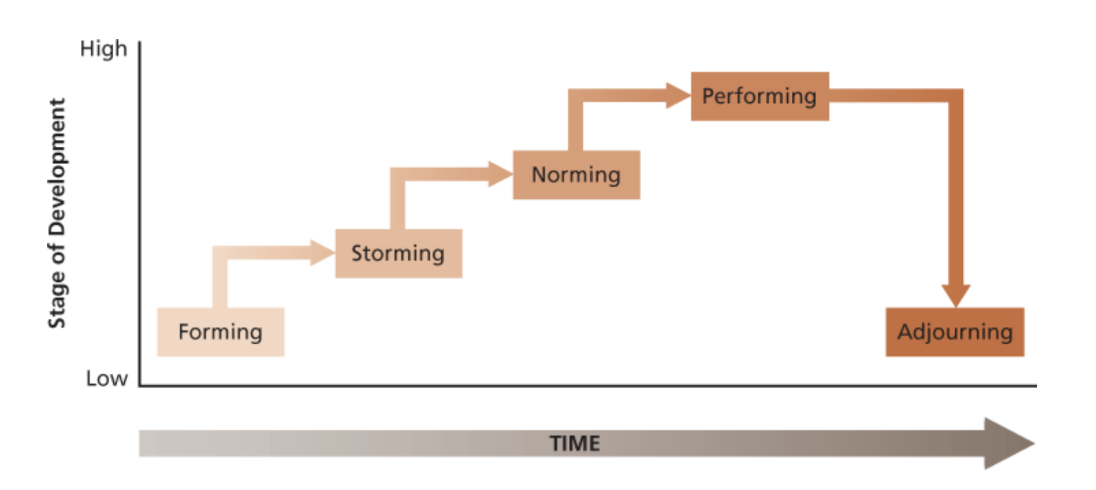
Stage 1: Forming
Who are you guys?
What are we doing here?
Uncertainty, working on defining the task and how to approach it
Focus on learning about other team members and what they offer via information seeking and self-disclosure
Successful teams: focus on identifying goals and coordination (agree on goals)
Stage 2: Storming
We’re going to do things MY WAY!
Focus on mastering the task, without regard to social coordination
For 50% of teams, this results in significant conflict (task and relational)
Rules haven’t been set yet
Tolerance of differences and patience will be key
Successful teams: develop mutual trust
Stage 3: Norming
Ok fine, let’s work together. But HOW?
When common goal is highlighted, members begin to think about how they must coordinate actions to be effective
Common expectations about acceptable group conduct are formed
Successful teams: Empower members to express ideas and set productive norms
Two Basic Kinds of Norms
Descriptive norms
Prescriptive norms
Descriptive norms
Shared beliefs about what is typical or usual
Influence our behavior through a social information mechanism
Ex: 90% of NEU students recycle, and you should too
More powerful for immediate team behavior → highlight safe actions through social proof
Prescriptive norms
Shared beliefs about what people should do
Influence our behavior through the threat of social sanctions or ostracism
Ex: You should recycle because it’s the right thing to do
Better for setting formal standards and ensuring consistency
Stage 4: Performing
It’s GO TIME!
Focus on achieving common goals
Team is now competent
Stage 5: Adjourning
THE END
The end of a group’s lifespan
Can be intentional or not (i.e. downsizing)
Natural → group project ends
Downsizing → layoffs
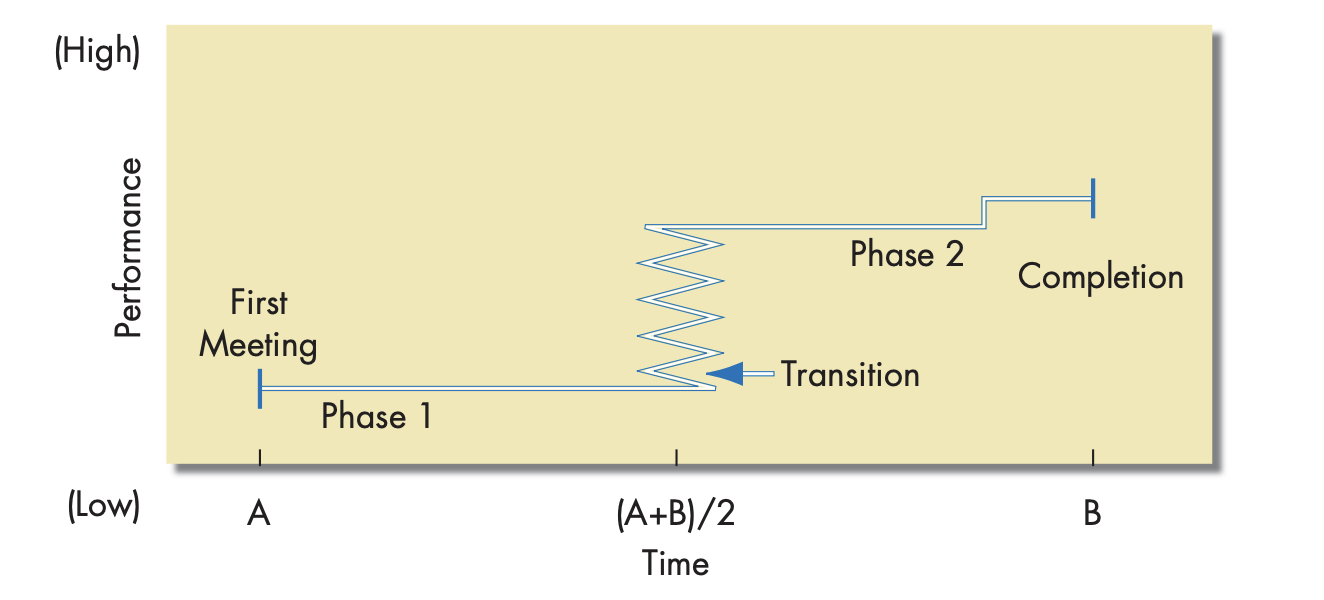
The Punctuated-Equilibrium Model
For temporary groups with deadlines (don’t usually follow Tuckman’s model)
Order:
First meeting → sets up group direction and framework for the rest of the model
First phase of group activity (period of inertia)
Transition → happens at the midpoint of first meeting and deadline
Major changes as a result of transition → dropping old patterns, taking on new perspectives
Second phase of inertia → execution of plans
Group’s last meeting (final burst of activities)
Groupthink
When the norm for consensus overrides the realistic appraisal of alternative courses of action
Result of group pressures for conformity
Lack of criticism of unusual, minority, or unpopular views → hinders performance
Illusion of unanimity
Make sure you’re actively seeking opinions from all group members (groupthink is more likely to occur with larger groups)
Groupshift
Group discussion causes members to adopt more extreme positions—either much riskier or more cautious—than their initial, individual viewpoints
Conservatives become more cautious
More aggressive types take on more risk
Causes:
Discussion makes people more comfortable
Diffusion of group responsibility (isn’t a single member who has to take accountability)
People want to demonstrate how different they are from the group (outgroup)

