All Geometry Terms, Properties, Formulas, Theorem, and Postulates
 Call Kai
 Learn
Learn Practice Test
 Spaced Repetition
 Match
Match Flashcards
 Knowt Play
1/85

Earn XP
Description and Tags
a composite list of everything i learned in geometry
Name | Mastery | Learn | Test | Matching | Spaced | Call with Kai | Chat |
|---|
No analytics yet
Send a link to your students to track their progress
86 Terms
Point
A point is a position in space. A point cannot move
Line
A line is a straight, continuous arrangement of infinite points
Collinear
Collinear means points that are lying on the same line
Noncollinear
Noncollinear means points that do not lie on the same line
Plane
A plane is a flat surface with infinite length and width
Ray
A ray is part of a line that begins at a point and extends forever
Opposite Ray
An opposite ray are two rays with the same endpoint that extend in opposite directions
Line Segment
A line segment is part of a line that includes two points and all collinear points between them
Coplanar
Coplanar are lines that are contained in the same plane
Noncoplanar
Noncoplanar are lines that are not contained in the same plane
Parallel Lines
Parallel Lines are lines with the same slope that run alongside each other that never intersect
Perpendicular Lines
Perpendicular Lines are lines that intersect at a 90° angle
Skew Lines
Skew Lines are lines that aren’t in the same plane, nor are they parallel or intersecting
Straightedge
A straightedge is any tool that has a straightedge
Compass
A compass is a tool used for drawing arcs and circles, as well as creating congruent lines and bisectors
Protractor
A protractor is a tool used to measure angles
Segment Addition Postulate
If B is between points A and C, then AB + BC = AC
Coordinate Plane
A coordinate plane is a two-dimensional plane formed by the intersection of two number lines, one going horizontal (x-axis) and the other going vertical (y-axis)
Midpoint
A midpoint is a point directly in the middle of a line segment
Midpoint Formula
(xₘ, yₘ) = (x₁ + x₂)/2, (y₁ + y ₂)/2
Angle
An angle is formed by two rays or line segments that share a common endpoint
Acute Angle
An acute angle is an angle less than 90°
Right Angle
An right angle is an angle measuring to 90°
Obtuse Angle
An obtuse angle is an angle less than 180° but more than 90°
Straight Angle
A straight angle is an angle measuring to 180°
Angle Addition Postulate
If line segment AD is in the interior of angle BAC, then the measurement of angle BAD + the measurement of angle DAC = the measurement of angle BAC
Adjacent Angles
Adjacent angles are two angles that share a common side and vertex, but share no interior poitns
Vertical Angles
Vertical angles are two congruent angles that have sides that form opposite rays; they are directly across from each other.
Linear Pair
A linear pair is two adjacent angles in which their noncommon sides are opposite rays; linear pairs form an angle that measures 180°
Complementary Angles
Complementary Angles are two angles whose measures add up to 90°. Each angle is called the complement of the other
Supplementary Angles
Supplementary Angles are two angles whose measures add up to 180°. Each angle is called the supplement of the other.
Angle Bisector
An Angle Bisector is a ray or line segment that splits an angle into two congruent parts.
Postulate
A postulate is a statement that are accepted as true
Congruence
Congruence means to be equal
Similarity
Similarity means same shape, different size
Theorem
A Theorem is a statement that can be proved using logic
Addition Property
If a=b, then a+b = b+c.
Subtraction Property
If a=b, then a-c = b -c.
Multiplication Property
If a=b, then a*c = b*c
Division Property
If a=b, and c ≠ 0, then, a/c = b/c
Reflexive Property
a=a
Symmetric Property
If a=b, then b=a
Transitive Property
If a=b, and b=c, then a=c
Substitution Property
If a=b, then b can replace a in any expression
Equal Complements Theorem
Complements of the same angle are equal in measure. If the measurement of angle 1 + the measurement of angle 2 = 90°, and the measurement of angle 2 + the measurement of angle = 90°, then the measurement of angle 1 is equal to the measurement of angle 3.
Equal Supplements Theorem
Supplements of the same angle are equal in measure. If the measurement of angle 1 + the measurement of angle 2 = 180°, and the measurement of angle 2 + the measurement of angle = 180°, then the measurement of angle 1 is equal to the measurement of angle 3.
Linear Pair Theorem
If two angles form a linear pair, then the angles are supplementary.
Vertical Angles Theorem
Vertical angles are congruent
Right Angles Theorem
Right angles are congruent and measure 90°
Equal Supplementary Angles Theorem
Two equal supplementary angles are right angles
Exterior
The exterior is the outside of two parallel lines
Interior
The interior is the inside of two parallel lines
Transversal
A transversal is when two parallel lines get intersected by a third line
Alternate Interior Angles
Alternate Interior Angles are two congruent angles in the interior of two parallel lines and on opposite sides of the transversal
Alternate Exterior Angles
Alternate Exterior Angles are two congruent angles in the exterior of two parallel lines and on opposite sides of the transversal
Corresponding Angles
Corresponding Angles are two congruent angles, one in the interior and one in the exterior, that are on the same side of the transversal.
Consecutive Exterior Angles
Consecutive Exterior Angles are two angles in the exterior on the same side of the transversal; they always add up to 180°, additionally they are supplementary
Consecutive Interior Angles
Consecutive Interior Angles are two angles in the interior on the same side of the transversal; they always add up to 180°, additionally they are supplementary
Distributive Property
a(b+c) = ab + ac
Proof
Proof is a logical, step-by-step argument that uses established facts to prove a geometric statement is true
Triangle
A triangle is formed by three noncollinear points connected by segments
Vertex of a triangle
The vertex of a triangle is the point at which each of the segments connect
Sides
Sides are the segments of a shape
Included Side
The Included Side is the side between two given points
Reference Angle
The reference angle is the angle being referred to
Adjacent Sides
Adjacent Sides are the sides of which the reference angle is next to
Opposite Side
The Opposite Side is the side across from the included side
Included Angle
The Included Angle is the angle formed by two adjacent sides of a shape at their common vertex.
Acute Triangle
An Acute Triangle has only acute angles
Obtuse Triangle
An Obtuse Triangle one obtuse angle in the triangle
Equiangular Triangle
An Equiangular Triangle has only congruent angles
Right Triangle
A Right Triangle has one right angle
Isosceles Triangle
An Isosceles Triangle has two congruent sides
Scalene Triangle
A scalene triangle has no congruent sides
Equilateral Triangle
An equilateral triangle has only congruent sides
Legs of an Isosceles Triangle
The legs of an isosceles triangle are the two sides that are congruent
Base Angles
Base Angles are the angles across from the legs, they are also congruent
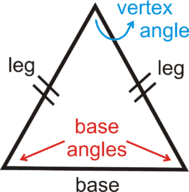
Vertex of an Isosceles Triangle
The vertex of an isosceles triangle is the angle formed by the legs
Base
The base is the side across from the vertex angle.
Triangle Sum Theorem
The Triangle Sum Theorem states that all three angles in a triangle will add up to 180°
Isosceles Triangle Theorem
The Isosceles Triangle Theorem states that in an isosceles triangle, the angles opposite from the equal sides are equal
Converse of Isosceles Triangle Theorem
The converse of the isosceles triangle theorem states if two angles in a triangle are congruent, the sides opposite from those angles are also congruent.
Remote Interior Angles
Remote Interior Angles are the two angles that are non-adjacent to the specified exterior angle
Exterior Angle Theorem
The measure of the exterior angle of a triangle is equal to the sum of the measures of the two remote interior angles of the triangle
Exterior Angle Inequality Theorem
The Exterior Angle Inequality Theorem states the measure of an exterior angle of a triangle is greater than the measure of either of the remote interior angles
Triangle Inequality Theorem
The sum of the lengths of any two sides of a triangle is greater than the length of the third side.