ONLINE MIDTERMS #1
 Studied by 0 people
 Call with Kai
 Learn
Learn Practice Test
 Spaced Repetition
 Match
Match Flashcards
 Knowt Play
1/39

There's no tags or description
Looks like no tags are added yet.
Name | Mastery | Learn | Test | Matching | Spaced | Call with Kai |
|---|
No analytics yet
Send a link to your students to track their progress
40 Terms
How many genetically different eggs could be formed by women with the following genotype? Assume that all of these genes are assorted independently.
AaBbCcDdEEff
16
An organism has a diploid number of 2n = 22 chromosomes. At the end of meiotic anaphase II, what is the number of chromosomes present in each cell?
What you’re given
2n = 22
That means:
n = 11
The ONLY rule you need
👉 If something has its own centromere, it counts as a chromosome.
What’s happening in anaphase II
Sister chromatids split apart
When they split:
each one becomes its own chromosome
Count it like this
Before splitting:
👉 11 chromosomes, each made of 2 chromatidsAfter splitting:
👉 11 × 2 = 22 chromosomes
So the answer is:
✅ 22 chromosomes per cell
An organism has a diploid number of 2n = 22 chromosomes. At the end of meiotic anaphase I, what is the number of chromosomes present in each cell?
Given
2n = 22
n = 11
What “end of meiotic anaphase I” REALLY means
At the end of anaphase I:
Homologous chromosomes have already separated
BUT
The cell has NOT split yet
👉 There is still ONE cell, not two.
Now count chromosomes in the cell
Each homolog still counts as one chromosome (sister chromatids are together)
All 22 chromosomes are still inside the same cell, just pulled toward opposite poles
So:
✅ 22 chromosomes are present in the cell
An organism has a diploid number of 2n = 22 chromosomes. At the end of mitotic anaphase, what is the number of chromosomes present in each cell?
Given
2n = 22
What happens in mitotic anaphase
👉 Sister chromatids split apart
The ONLY rule
🧠 Once chromatids split, each one counts as a chromosome
Count it
You start mitosis with:
22 chromosomes
each has 2 chromatids
In anaphase, chromatids split:
22 × 2 = 44 chromosomes
Why it’s 44
Because:
The cell has not divided yet
All 44 chromosomes are still inside the same cell
They’re just being pulled to opposite sides
If your blood type is B, your sister is AB, your brother is A, and your mother is AB, “Your father’s genotype must be heterozygous — true or false?”
FALSE
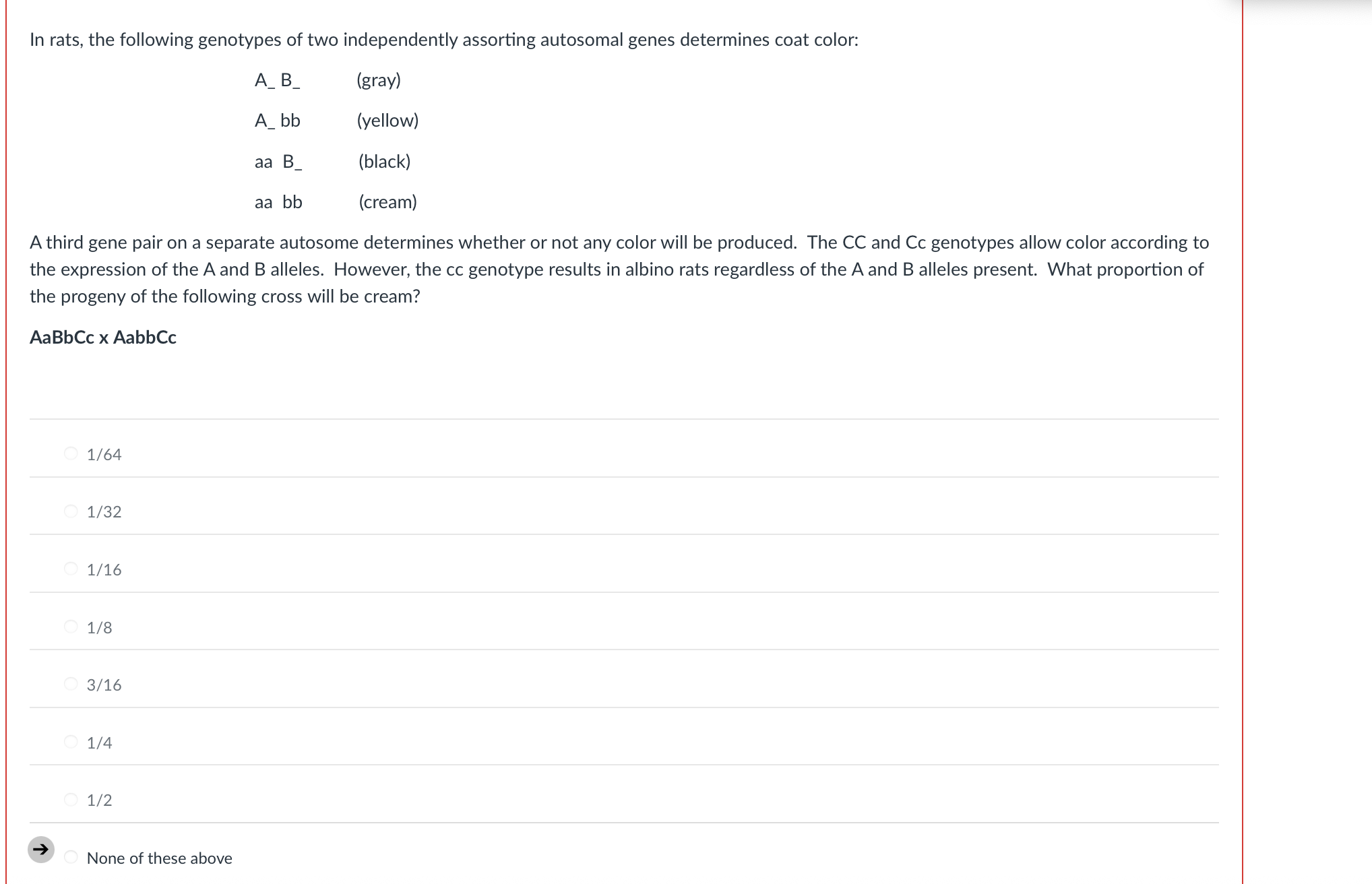
Step 1: What does cream require?
From the chart:
👉 Cream = aa bb
AND
👉 Color must be allowed → C_ (CC or Cc)
(because cc = albino, no color)
So cream genotype = aa bb C_
Step 2: Break the cross into pieces
Cross given:
AaBbCc × AabbCc
All genes assort independently → multiply probabilities.
Step 3: Probability of aa
From Aa × Aa?
NO — careful:
Parent 1: Aa
Parent 2: Aa? → nope, AabbCc → Aa
So:
Aa × Aa → aa = 1/4
✅ P(aa) = 1/4
Step 4: Probability of bb
Parent 1: Bb
Parent 2: bb
Bb × bb →
1/2 Bb
1/2 bb
✅ P(bb) = 1/2
Step 5: Probability of C_ (NOT albino)
Cc × Cc →
1/4 CC
1/2 Cc
1/4 cc ❌
So:
C_ = 3/4
✅ P(C_) = 3/4
Step 6: Multiply everything=3/32 (1/4×1/2×3/4)
Step 7: Check the answer choices
Choices include:
1/64 ❌
1/32 ❌
1/16 ❌
1/8 ❌
3/16 ❌
1/4 ❌
1/2 ❌
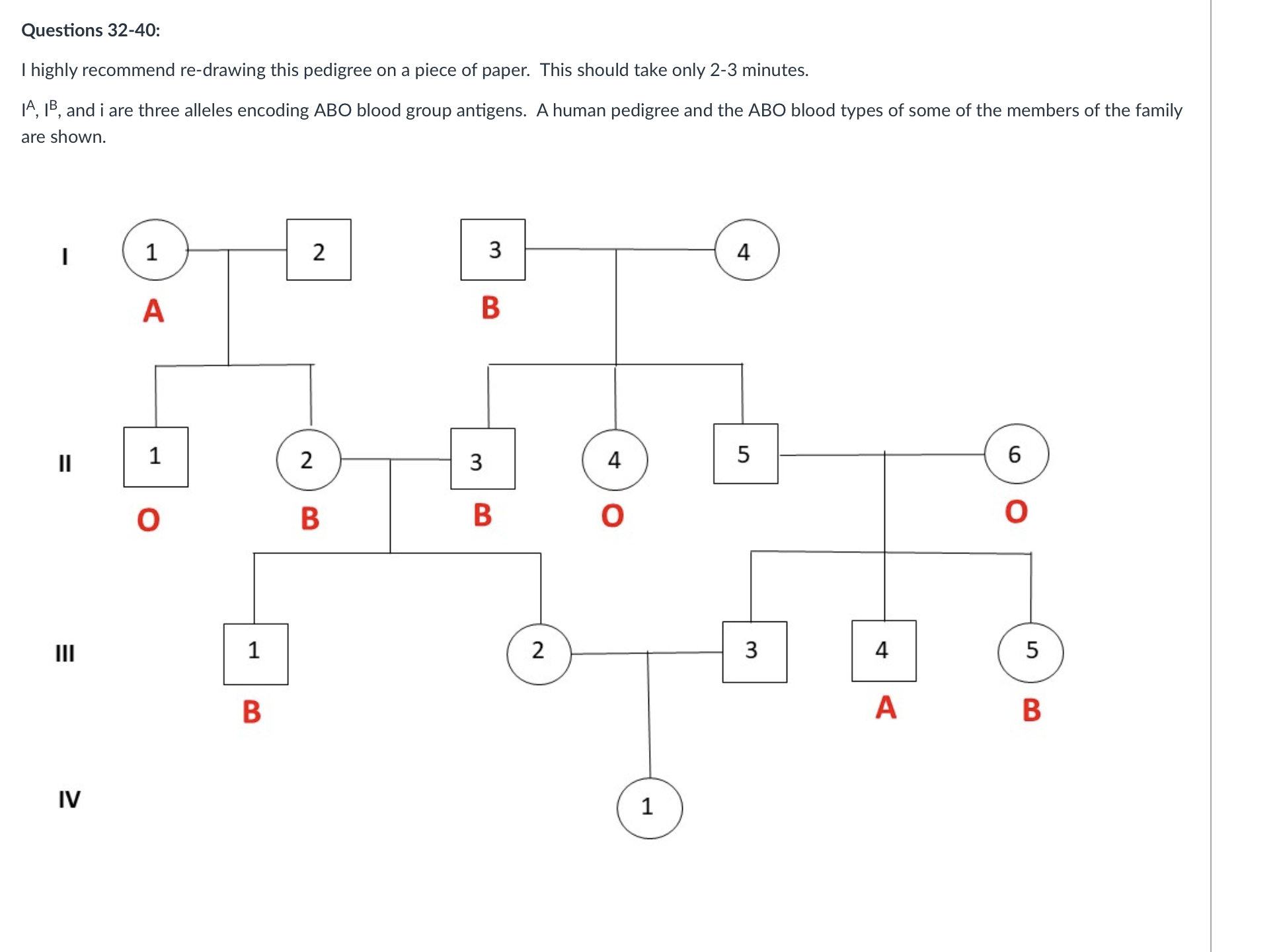
Questions 7-10:
IA, IB, and i are three alleles encoding ABO blood group antigens.
A father with blood type AB and a mother with blood type B have a son with blood type B and a daughter with blood type A.
Their daughter's genotype must be heterozygous.
T
Step 3: Is IA i heterozygous?
Yes:
Two different alleles
One dominant (IA), one recessive (i)
✅ Heterozygous
Questions 7-10:
IA, IB, and i are three alleles encoding ABO blood group antigens.
A father with blood type AB and a mother with blood type B have a son with blood type B and a daughter with blood type A.
Their son's genotype must be homozygous.
F
Questions 7-10:
IA, IB, and i are three alleles encoding ABO blood group antigens.
A father with blood type AB and a mother with blood type B have a son with blood type B and a daughter with blood type A.
If the couple is going to have a third child, what is the probability that this child will have AB blood type?
25%
Questions 7-10:
IA, IB, and i are three alleles encoding ABO blood group antigens.
A father with blood type AB and a mother with blood type B have a son with blood type B and a daughter with blood type A.
If the couple is going to have a fourth child, it is impossible that this child will have blood type O.
T
Soft toenail is an extremely rare recessive disorder. Mike whose aunt (his mother’s sister) has the condition marries Phoebe whose niece (her brother’s daughter) is affected by the condition. No one else in either family has the condition.
Soft toenail is an X-linked recessive disorder.
F
What is the probability that Mike is carrier?
1/3
Soft toenail is an extremely rare recessive disorder. Mike whose aunt (his mother’s sister) has the condition marries Phoebe whose niece (her brother’s daughter) is affected by the condition. No one else in either family has the condition.
What is the probability that Phoebe is a carrier?
1/2
Soft toenail is an extremely rare recessive disorder. Mike whose aunt (his mother’s sister) has the condition marries Phoebe whose niece (her brother’s daughter) is affected by the condition. No one else in either family has the condition.
What is the probability Mike and Phoebe's first child will be affected?
Step 1: Mike’s carrier probability
Mike’s aunt is affected → grandparents are Aa × Aa
Mike’s mom is unaffected → carrier probability = (2/3)
Dad is outsider → AA
Mike gets “a” from mom with probability (1/2)
Mike carrier = (2/3) × (1/2) = (1/3)
Step 2: Phoebe’s carrier probability
Phoebe’s niece is affected → brother must be Aa
Brother’s spouse = AA
Phoebe has (1/2) chance to be a carrier
Phoebe carrier = (1/2)
Step 3: Probability both are carriers
(1/3) × (1/2) = (1/6)
Step 4: Probability child is affected if both are carriers
Aa × Aa → aa = (1/4)
Step 5: Final probability
(1/6) × (1/4) = (1/24)
Soft toenail is an extremely rare recessive disorder. Mike whose aunt (his mother’s sister) has the condition marries Phoebe whose niece (her brother’s daughter) is affected by the condition. No one else in either family has the condition.
If their first child has soft toenails, what is the probability that their second child will also be affected by the condition?
If their first child is affected by a recessive disorder, then:
👉 Both parents MUST be carriers (Aa)
No probabilities anymore — this is now 100% certain.
So now the parents’ genotypes are fixed:
Mike = Aa
Phoebe = Aa
Step 1: Probability second child is affected
For Aa × Aa:
aa (affected) = (1/4)
Each child is an independent event, so the first child being affected does not change the odds for the second.
✅ Final Answer:
(1/4)
Soft toenail is an extremely rare recessive disorder. Mike whose aunt (his mother’s sister) has the condition marries Phoebe whose niece (her brother’s daughter) is affected by the condition. No one else in either family has the condition.
If they have four children, what is the probability that all four will have the same sex?
Key idea
Each child has:
(1/2) chance male
(1/2) chance female
Sex of each child is independent
“All four same sex” means two possible cases
All boys
All girls
Case 1: All boys(1/2)×(1/2)×(1/2)×(1/2)=(1/16)(1/2)×(1/2)×(1/2)×(1/2)=(1/16)Case 2: All girls(1/2)×(1/2)×(1/2)×(1/2)=(1/16)(1/2)×(1/2)×(1/2)×(1/2)=(1/16)
ADD THEM: 1/8
Soft toenail is an extremely rare recessive disorder. Mike whose aunt (his mother’s sister) has the condition marries Phoebe whose niece (her brother’s daughter) is affected by the condition. No one else in either family has the condition.
What is the probability that their first child will be homozygous for the normal allele?
1. Mike’s Probability
Mike’s aunt (mother’s sister) has the condition (aa).
Mike's Maternal Grandparents: Since they had an affected daughter (aa) but are not affected themselves, they must both be carriers (Aa).
Mike's Mother: She is not affected, but her parents are Aa x Aa. The probability she is a carrier (Aa) is 2/3 (we exclude the aa possibility since she is healthy).
Mike: If his mother is Aa, and we assume his father is AA (because the condition is "extremely rare"), Mike has a 1/2 chance of inheriting the a allele from her.
Total probability Mike is Aa: 2/3×1/2=1/3.
Probability Mike is AA: 1−1/3=2/3.
2. Phoebe’s Probability
Phoebe’s niece (her brother’s daughter) is affected (aa).
Phoebe's Brother: For him to have an affected daughter, he must be a carrier (Aa).
Phoebe's Parents: For her brother to be Aa (and assuming the niece's mother provided the other a), at least one parent must carry the allele. Since no one else is affected, we assume her parents are Aa x AA.
Phoebe: In a cross of Aa x AA, Phoebe has a 1/2 chance of being Aa and a 1/2 chance of being AA.
3. Calculating the Child's Genotype
To find the probability the child is AA, we look at the four possible parent combinations:
Scenario | Parent Genotypes | Probability of Scenario | Prob. Child is AA | Weighted Prob. |
1 | Mike AA, Phoebe AA | 2/3×1/2=2/6 | 1 | 2/6 |
2 | Mike AA, Phoebe Aa | 2/3×1/2=2/6 | 1/2 | 1/6 |
3 | Mike Aa, Phoebe AA | 1/3×1/2=1/6 | 1/2 | 1/12 |
4 | Mike Aa, Phoebe Aa | 1/3×1/2=1/6 | 1/4 | 1/24 |
Export to Sheets
Final Addition:
To get the total probability, we sum the weighted probabilities:
2/6+1/6+1/12+1/24=15/24
The gene for knuckle shape is found on the X chromosome. Straight is dominant to curled. Assume recombination does not occur. For each of the following families, identify the possible nondisjunction events (rare mistakes during meiosis) that could explain the phenotype of the offspring.
A man with curled knuckles and a woman with straight knuckles have a son with Klinefelter Syndrome (genotype XXY) and curled knuckles. Non-disjunction might have occurred in Meiosis I of the mother (the XX parent).
F
The gene for knuckle shape is found on the X chromosome. Straight is dominant to curled. Assume recombination does not occur. For each of the following families, identify the possible nondisjunction events (rare mistakes during meiosis) that could explain the phenotype of the offspring.
A man with curled knuckles and a woman with straight knuckles have a son with Klinefelter Syndrome (genotype XXY) and curled knuckles. Non-disjunction might have occurred in Meiosis I of the father (the XY parent).
T
The gene for knuckle shape is found on the X chromosome. Straight is dominant to curled. Assume recombination does not occur. For each of the following families, identify the possible nondisjunction events (rare mistakes during meiosis) that could explain the phenotype of the offspring.
A man with straight knuckles and a woman with curled knuckles have a son with Klinefelter Syndrome (genotype XXY) and curled knuckles. Non-disjunction might have occurred in Meiosis I of the mother (the XX parent).
T
The gene for knuckle shape is found on the X chromosome. Straight is dominant to curled. Assume recombination does not occur. For each of the following families, identify the possible nondisjunction events (rare mistakes during meiosis) that could explain the phenotype of the offspring.
A man with straight knuckles and a woman with curled knuckles have a son with Klinefelter Syndrome (genotype XXY) and curled knuckles. Non-disjunction might have occurred in Meiosis I of the father (the XY parent).
F
In Pleik-pleik flies, antenna shape is controlled by genes A and B. They are two independently assorting autosomal genes. Gene A has two alleles-dominant A and recessive a. Gene B also has two alleles-dominant B and recessive b. To form normal antenna, a fly needs both dominant alleles of genes A and B. Flies homozygous for either recessive aa or bb will have abnormal antenna. In addition, fly embryos simultaneously homozygous for both aa and bb are lethal.
Two abnormal true-breeding flies mated. All F1 flies had normal antenna. F1 were allowed to intercross, and 960 F2 were produced.
Among 960 F2 flies, 384 of them would have abnormal antenna.
Step 1: Translate the rules into plain language
Normal antenna → needs at least one A AND at least one B
genotype: A_ B_
Abnormal antenna →
aa B_ OR A_ bb
Lethal (dead) →
aa bb (never seen among F2 flies)
Step 2: What were the parents?
Two abnormal true-breeding flies mate
All F1 are normal
That tells us the parents must be:
Parent 1: aa BB (abnormal because aa)
Parent 2: AA bb (abnormal because bb)
These are true-breeding and complementary.
F1 Generation: aa BB * AAbb
F1: AaBb
They have:
at least one A
at least one B
✅ So all F1 are normal (matches the problem)
Step 4: F1 × F1 cross
Now cross: dihybrid cross (AaBb * AaBb)
A standard dihybrid cross gives 16 genotype combinations.
Step 5: Sort the 16 outcomes by phenotypeNormal antenna (A_ B_)
9/16
Abnormal antenna (aa B_ or A_ bb)
3/16 (aa B_)
3/16 (A_ bb)
➡ total 6/16
Lethal (aa bb)
1/16 ❌ (dies, not counted)
Step 6: Remove the lethal class
Only 15/16 of embryos survive.
Among survivors:
Abnormal = 6
Total survivors = 15
So:
Abnormal fraction=(6/15)Abnormal fraction=(6/15)
Step 7: Apply to 960 F2 flies 960×(6/15)
Simplify:
960 ÷ 15 = 64
64 × 6 = 384
In Pleik-pleik flies, antenna shape is controlled by genes A and B. They are two independently assorting autosomal genes. Gene A has two alleles-dominant A and recessive a. Gene B also has two alleles-dominant B and recessive b. To form normal antenna, a fly needs both dominant alleles of genes A and B. Flies homozygous for either recessive aa or bb will have abnormal antenna. In addition, fly embryos simultaneously homozygous for both aa and bb are lethal.
Two abnormal true-breeding flies mated. All F1 flies had normal antenna. F1 were allowed to intercross, and 960 F2 were produced.
The F2 phenotypic ratio is 3 normal: 2 abnormal.
Step 1: Start from the F1 intercross
From earlier, we know:
Parents: aa BB × AA bb
F1: Aa Bb (all normal)
So F1 intercross: AaBb * AaBb
Step 2: Standard dihybrid outcomes (before lethality)
Out of 16 total:
9/16 → A_ B_ → normal
3/16 → aa B_ → abnormal
3/16 → A_ bb → abnormal
1/16 → aa bb → lethal ❌
Step 3: Remove the lethal class
The aa bb (1/16) die, so they are not counted in the F2.
That leaves:
9 normal
6 abnormal
Total surviving = 15
Normal to Abnormal ratio 9:6 or 3:2
F2 phenotypic ratio = 3 normal : 2 abnormal
In Pleik-pleik flies, antenna shape is controlled by genes A and B. They are two independently assorting autosomal genes. Gene A has two alleles-dominant A and recessive a. Gene B also has two alleles-dominant B and recessive b. To form normal antenna, a fly needs both dominant alleles of genes A and B. Flies homozygous for either recessive aa or bb will have abnormal antenna. In addition, fly embryos simultaneously homozygous for both aa and bb are lethal.
Two abnormal true-breeding flies mated. All F1 flies had normal antenna. F1 were allowed to intercross, and 960 F2 were produced.
What proportion of abnormal F2 would be true breeding?
Step 1: Recall the F1 cross
From earlier:
Parents:
aaBB * AAbb
F1: AaBb
F1 cross: AaBb * AaBb
Step 2: List the abnormal F2 genotypes
Abnormal antenna = aa B_ or A_ bb
From a dihybrid cross:
aa B_ (missing A)
aa BB → true-breeding abnormal
aa Bb → NOT true-breeding
Counts:
aa BB = 1
aa Bb = 2
A_ bb (missing B)
AA bb → true-breeding abnormal
Aa bb → NOT true-breeding
Counts:
AA bb = 1
Aa bb = 2
Step 3: Total abnormal genotypes (alive only)
Remember:
aa bb is lethal → ignore it
So abnormal F2 (living):
Genotype | Count |
|---|---|
aa BB | 1 |
aa Bb | 2 |
AA bb | 1 |
Aa bb | 2 |
Total abnormal = 6
Step 4: Which abnormal are true-breeding?
True-breeding means homozygous at both loci.
True-breeding abnormal genotypes:
aa BB
AA bb
That’s: 2/6 or 1/3
In Pleik-pleik flies, antenna shape is controlled by genes A and B. They are two independently assorting autosomal genes. Gene A has two alleles-dominant A and recessive a. Gene B also has two alleles-dominant B and recessive b. To form normal antenna, a fly needs both dominant alleles of genes A and B. Flies homozygous for either recessive aa or bb will have abnormal antenna. In addition, fly embryos simultaneously homozygous for both aa and bb are lethal.
Two abnormal true-breeding flies mated. All F1 flies had normal antenna. F1 were allowed to intercross, and 960 F2 were produced.
What proportion of normal F2 would be true breeding?
Step 1: Recall the F1 cross
From earlier:
Parents:
aaBB * AAbb
F1: AaBb
F1 cross: AaBb * AaBb
Step 2: Identify normal F2
Normal antenna requires A_ B_.
From a standard dihybrid cross:
A_ B_ = 9/16 (before considering lethality)
The aa bb (1/16) are lethal, but note:
👉 aa bb are NOT normal anyway, so lethality does not change the makeup of the normal group.
So we still have 9 normal genotypes to consider.
Step 3: List the normal genotypes
Normal genotypes (A_ B_):
Genotype | Count |
|---|---|
AA BB | 1 |
AA Bb | 2 |
Aa BB | 2 |
Aa Bb | 4 |
Total normal = 9
Step 4: Which normal ones are true breeding?
True breeding means homozygous at BOTH loci.
Among the normal genotypes, only:
AA BB
That’s 1 genotype.
Step 5: Form the proportion: true-breeding normal/total normal=1/9
A true-breeding black-flowered plant of tulip was cross-fertilized with a true-breeding yellow plant, and the F1 progeny were all black. When the F1plants were allowed to self-fertilize. Among F2 plants, there are 252 black, 63 yellow, and 21 silver-flowered plants.
Flower colors of tulip are determined by two genes.
Step 1: Look at the F2 numbers
You’re given:
252 black
63 yellow
21 silver
First thing to do in any genetics problem like this 👉 check the ratio.
Divide everything by the smallest number (21):
252 ÷ 21 = 12
63 ÷ 21 = 3
21 ÷ 21 = 1
So the ratio is:
12 : 3 : 1
🚨 This is the key clue.
Step 2: What does a 12 : 3 : 1 ratio mean?
A 12:3:1 phenotypic ratio is the textbook signature of dominant epistasis involving two genes.
A true-breeding black-flowered plant of tulip was cross-fertilized with a true-breeding yellow plant, and the F1 progeny were all black. When the F1plants were allowed to self-fertilize. Among F2 plants, there are 252 black, 63 yellow, and 21 silver-flowered plants.
All silver-flowered plants must be homozygous for color gene(s).
Step 1: Use the F2 numbers to identify the pattern
You already saw:
252 black
63 yellow
21 silver
Divide by 21:
12 : 3 : 1
That ratio tells us this is dominant epistasis involving two genes.
Step 2: Set up the gene model (the only one that fits 12:3:1)
Let the two genes be A and B.
A standard dominant-epistasis setup that fits the data is:
A_ _ → black
aa B_ → yellow
aa bb → silver
Key idea:
👉 Silver only appears when BOTH genes are recessive
Step 3: Why silver MUST be homozygous
Silver genotype = aa bb
That means:
Homozygous recessive at gene A
Homozygous recessive at gene B
There is no heterozygous genotype that produces silver:
Aa bb → black (A masks everything)
aa Bb → yellow
Aa Bb → black
So silver shows up only when both loci are homozygous recessive.
Step 4: Check this against the F2 ratio
In a dihybrid self-cross (AaBb × AaBb):
aa bb occurs 1/16
That exactly matches the “1” in the 12:3:1 ratio
So every silver plant:
came from the 1/16 class
must be aa bb
therefore must be homozygous for all color genes
A true-breeding black-flowered plant of tulip was cross-fertilized with a true-breeding yellow plant, and the F1 progeny were all black. When the F1plants were allowed to self-fertilize. Among F2 plants, there are 252 black, 63 yellow, and 21 silver-flowered plants.
It is impossible to produce a black offspring from a cross between a yellow and a silver parent.
Step 1: Lock in the gene model (from the 12:3:1 ratio)
From the F2 numbers
252 : 63 : 21 → 12 : 3 : 1
This forces a dominant-epistasis model with two genes:
A_ _ → black (dominant epistasis)
aa B_ → yellow
aa bb → silver
There is no other model that gives 12:3:1.
Step 2: Write the genotypes of the parents in the statementYellow parent
Yellow = aa B_
So yellow can be:
aa BB or
aa Bb
Silver parent
Silver = aa bb
(always homozygous recessive at both genes)
Step 3: Cross yellow × silver
Let’s cross aa B_ × aa bb
Gene A
Yellow: aa
Silver: aa
So all offspring are aa
🚨 This is the key point.
There is no way to get an A allele.
Gene B
Yellow: B_
Silver: bb
Offspring can be:
aa Bb or
aa bb
Step 4: Determine offspring phenotypes
Recall:
Black requires A_ ❌
Yellow = aa B_
Silver = aa bb
Since all offspring are aa, black is impossible.
Possible offspring:
aa Bb → yellow
aa bb → silver
✅ Final Answer (why the statement is true)
It is impossible to produce a black offspring from a yellow × silver cross because:
👉 Both parents are aa, so no offspring can receive a dominant A allele, and black requires A_.
A true-breeding black-flowered plant of tulip was cross-fertilized with a true-breeding yellow plant, and the F1 progeny were all black. When the F1plants were allowed to self-fertilize. Among F2 plants, there are 252 black, 63 yellow, and 21 silver-flowered plants.
There are six possible different genotypes among those 252 F2 black plant.
Step 1: Lock in the gene → phenotype rules (from earlier)
From the 12 : 3 : 1 ratio, we know the model is:
Black → A_ _ (dominant A masks everything)
Yellow → aa B_
Silver → aa bb
So for a plant to be black, it must have at least one A.
Gene B can be anything.
Step 2: List ALL genotypes that give black
We’ll list possibilities by gene A first.
Gene A options for black
AA
Aa
Now combine each with all possible B genotypes.
Case 1: AA __
Possible B genotypes:
BB
Bb
bb
So we get:
AA BB
AA Bb
AA bb
(All are black because A is present.)
Case 2: Aa __
Possible B genotypes:
BB
Bb
bb
So we get:
4. Aa BB
5. Aa Bb
6. Aa bb
(All are black because A is present.)
There are six possible different genotypes among the 252 black F2 plants because any genotype with at least one A allele produces black, and gene B can be BB, Bb, or bb.
A true-breeding black-flowered plant of tulip was cross-fertilized with a true-breeding yellow plant, and the F1 progeny were all black. When the F1plants were allowed to self-fertilize. Among F2 plants, there are 252 black, 63 yellow, and 21 silver-flowered plants.
Among 63 F2 yellow plants, how many are true breeding?
Step 1: Recall the gene → color rules (from the 12 : 3 : 1 ratio)
From earlier, the only model that fits is:
Black → A_ _
Yellow → aa B_
Silver → aa bb
Step 2: What genotypes can be yellow?
Yellow requires:
aa (homozygous recessive at gene A)
at least one B
So yellow genotypes are:
aa BB → yellow (true breeding)
aa Bb → yellow (not true breeding)
Only aa BB is true breeding.
Step 3: Ratio of yellow genotypes in F2
From the F1 self-cross (AaBb × AaBb):
Among the yellow class (aa B_), the breakdown is:
aa BB = 1
aa Bb = 2
So the ratio within yellow is:
1 true breeding : 2 not true breeding
That means:
1/3 of yellow plants are true breeding
2/3 are not
Step 4: Apply this to the 63 yellow plants: 63 × 1/3=21
✅ Final Answer
21 of the 63 yellow F2 plants are true breeding
A true-breeding black-flowered plant of tulip was cross-fertilized with a true-breeding yellow plant, and the F1 progeny were all black. When the F1plants were allowed to self-fertilize. Among F2 plants, there are 252 black, 63 yellow, and 21 silver-flowered plants.
Among 252 F2 black plants, how many are true breeding?
Step 1: Lock in the color rules (from the 12 : 3 : 1 ratio)
We already know the only model that fits is:
Black → A_ _
Yellow → aa B_
Silver → aa bb
So any genotype with at least one A is black.
Step 2: List ALL black genotypes in the F2
From the F1 self-cross (AaBb × AaBb), the black genotypes are:
Genotype | Count |
|---|---|
AA BB | 1 |
AA Bb | 2 |
AA bb | 1 |
Aa BB | 2 |
Aa Bb | 4 |
Aa bb | 2 |
Total black = 12 (this is the “12” in the 12:3:1 ratio)
Step 3: Which black genotypes are true breeding?
True breeding = homozygous at BOTH genes.
Among the black genotypes, that means:
AA BB ✅
AA bb ✅
These are the only ones that will always produce black offspring when selfed.
So:
True-breeding black = 2
Total black = 12
Step 4: Convert to a proportion 2/12:1/6
So 1/6 of black F2 plants are true breeding.
Step 5: Apply to the 252 black plants: 252×1/6=42
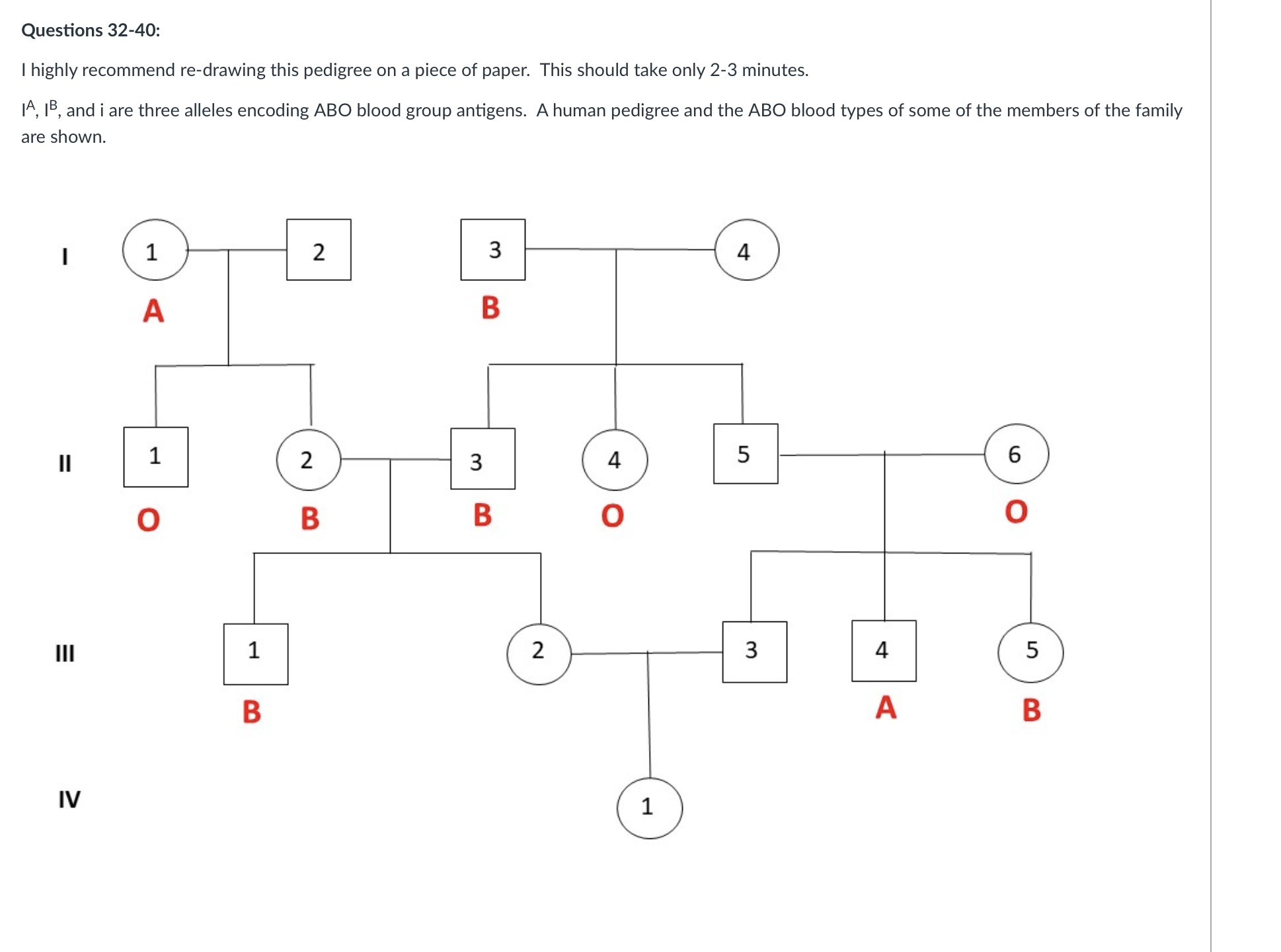
What is the genotype of I-2?
IBi
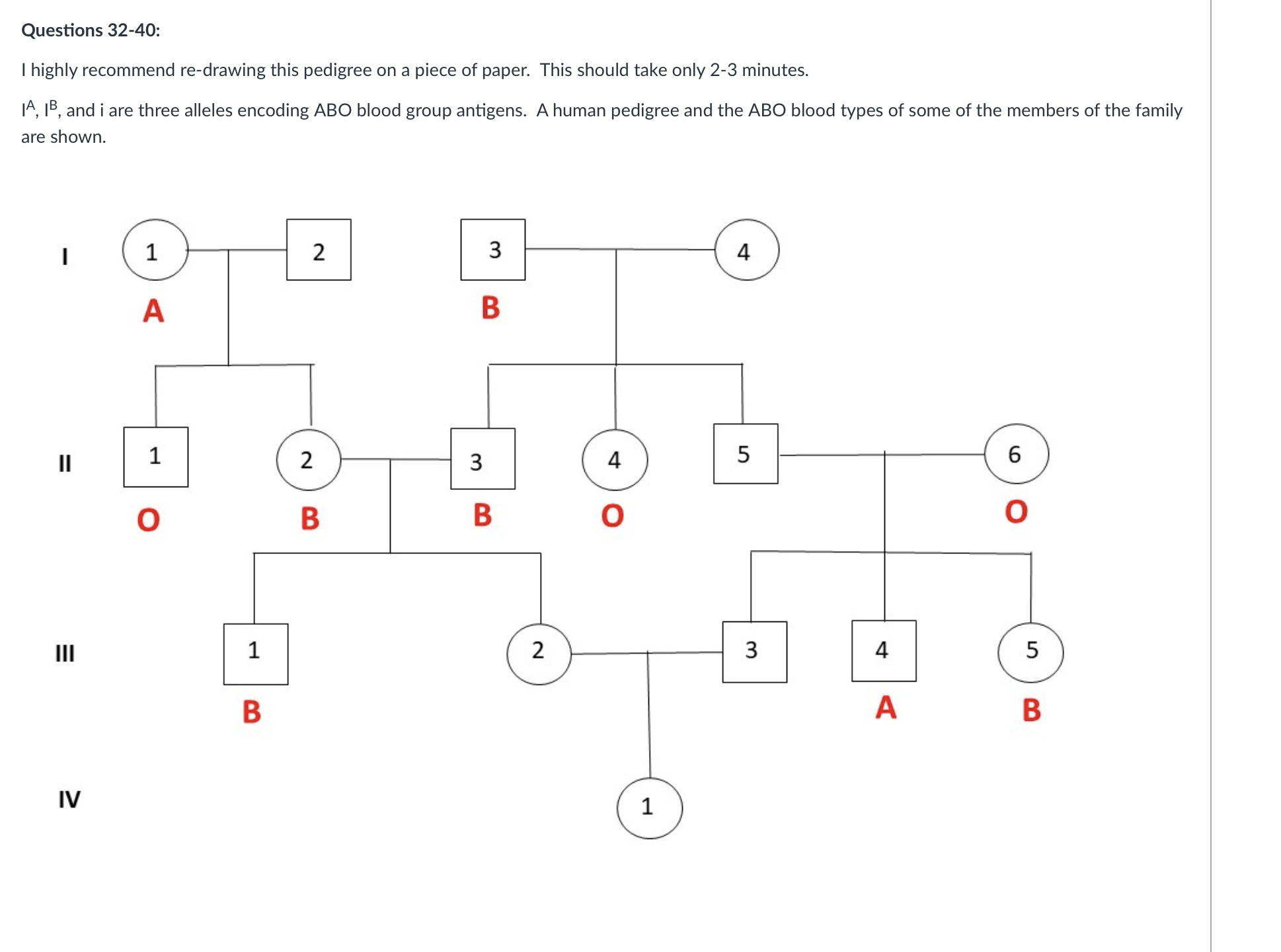
What is the genotype of I-4?
IAi
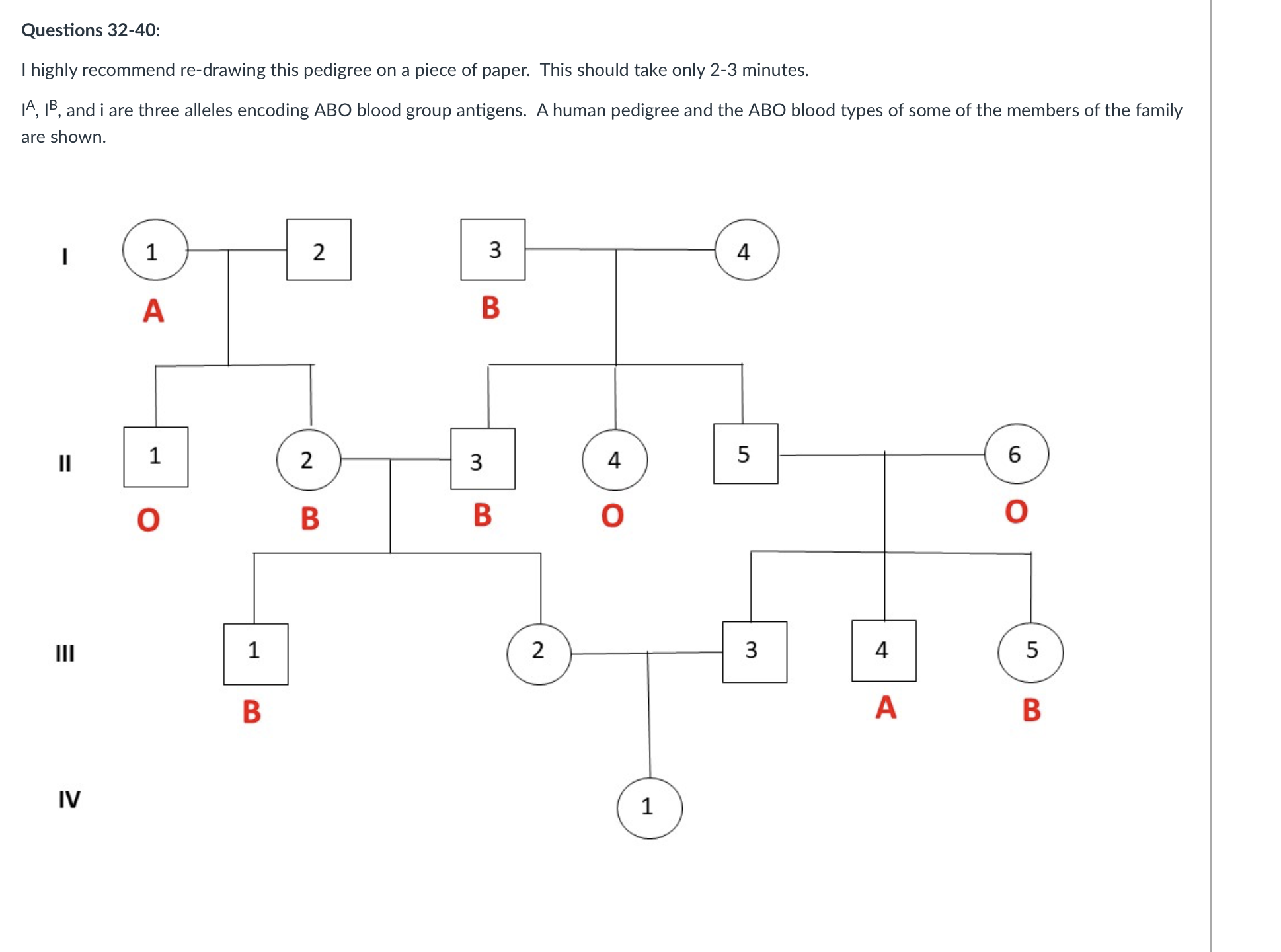
What is the genotype of III-4?
IAi
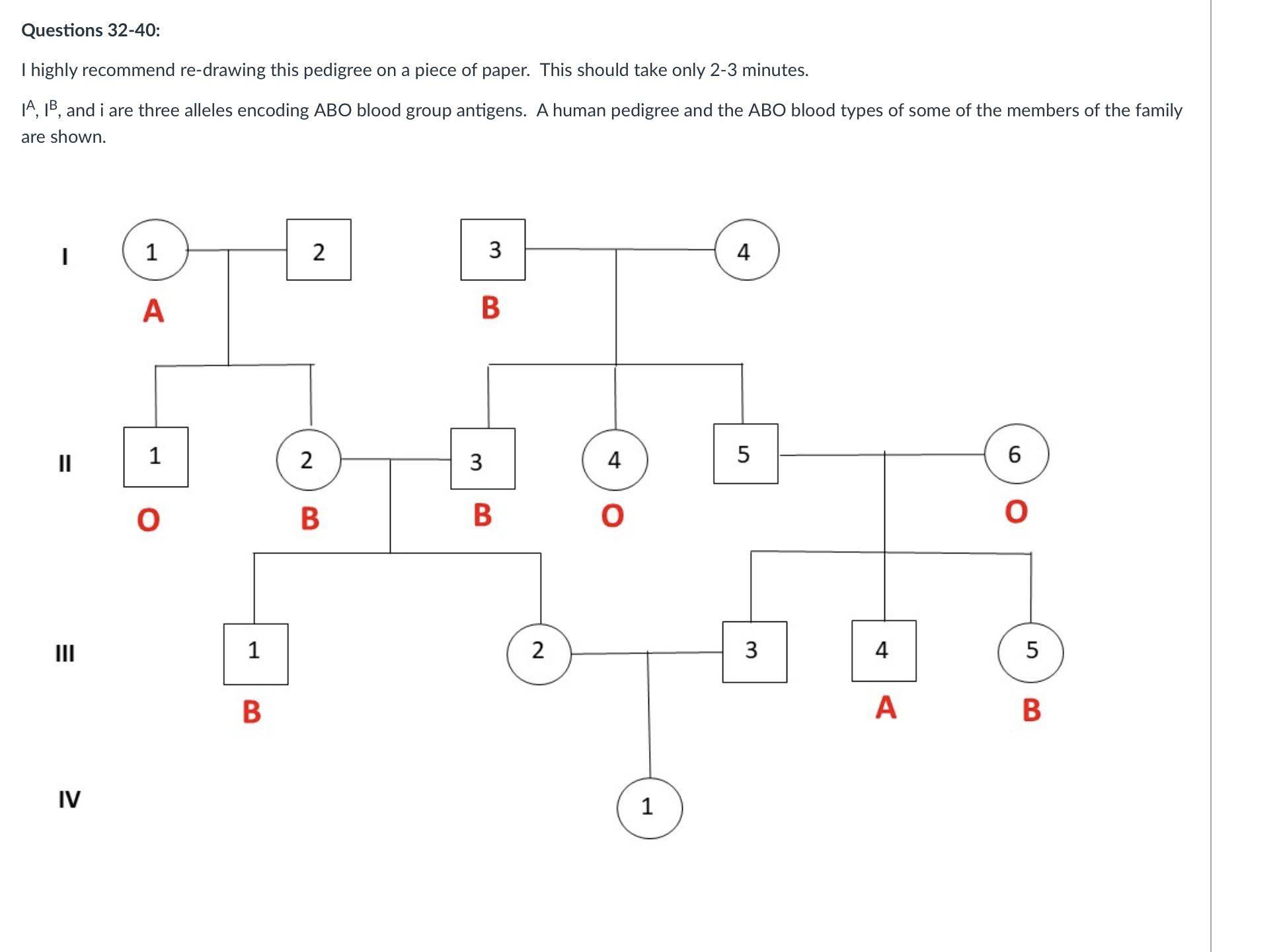
What is the genotype of II-5?
IAIB
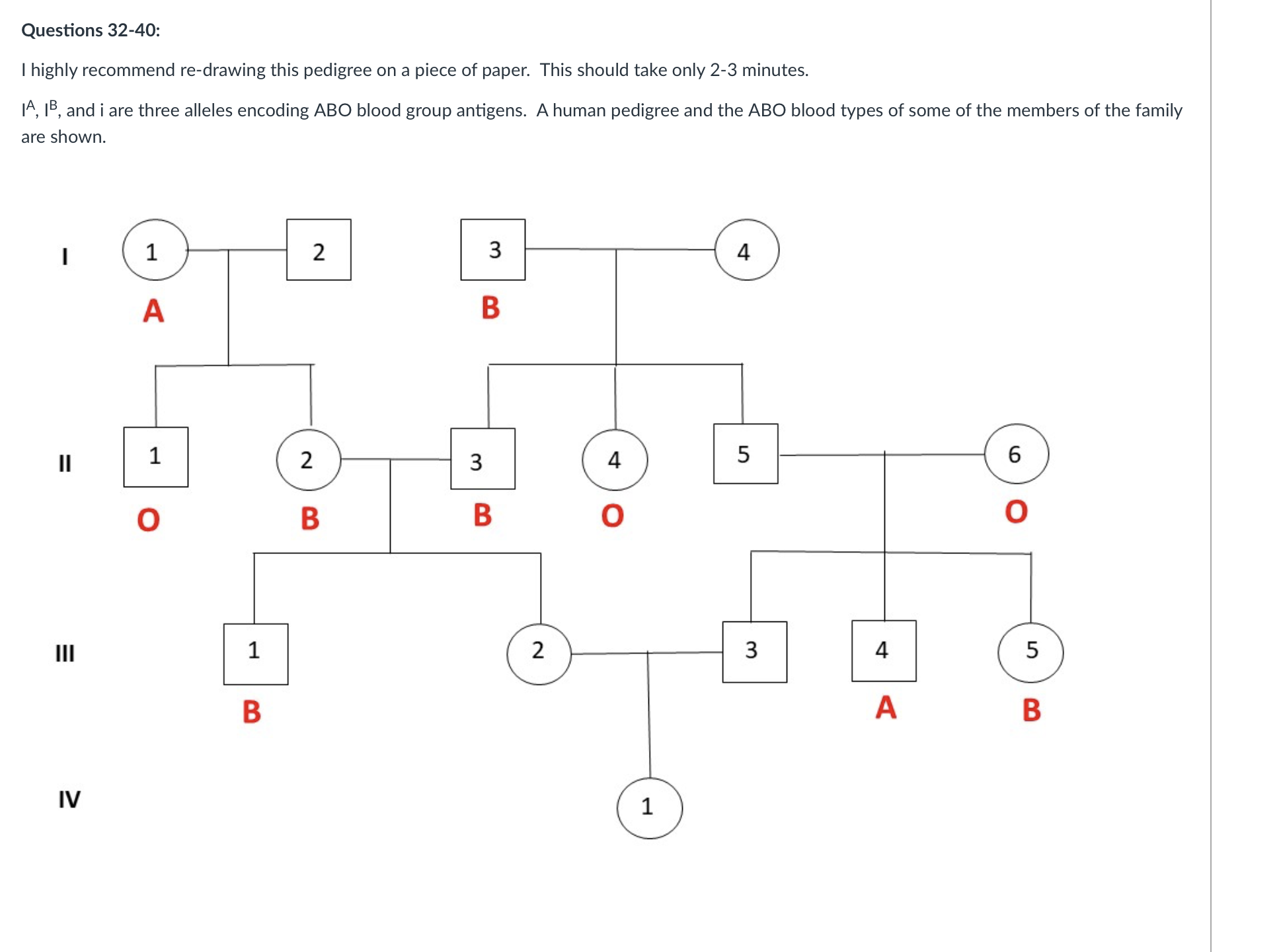
What is the genotype of II-3?
IBi
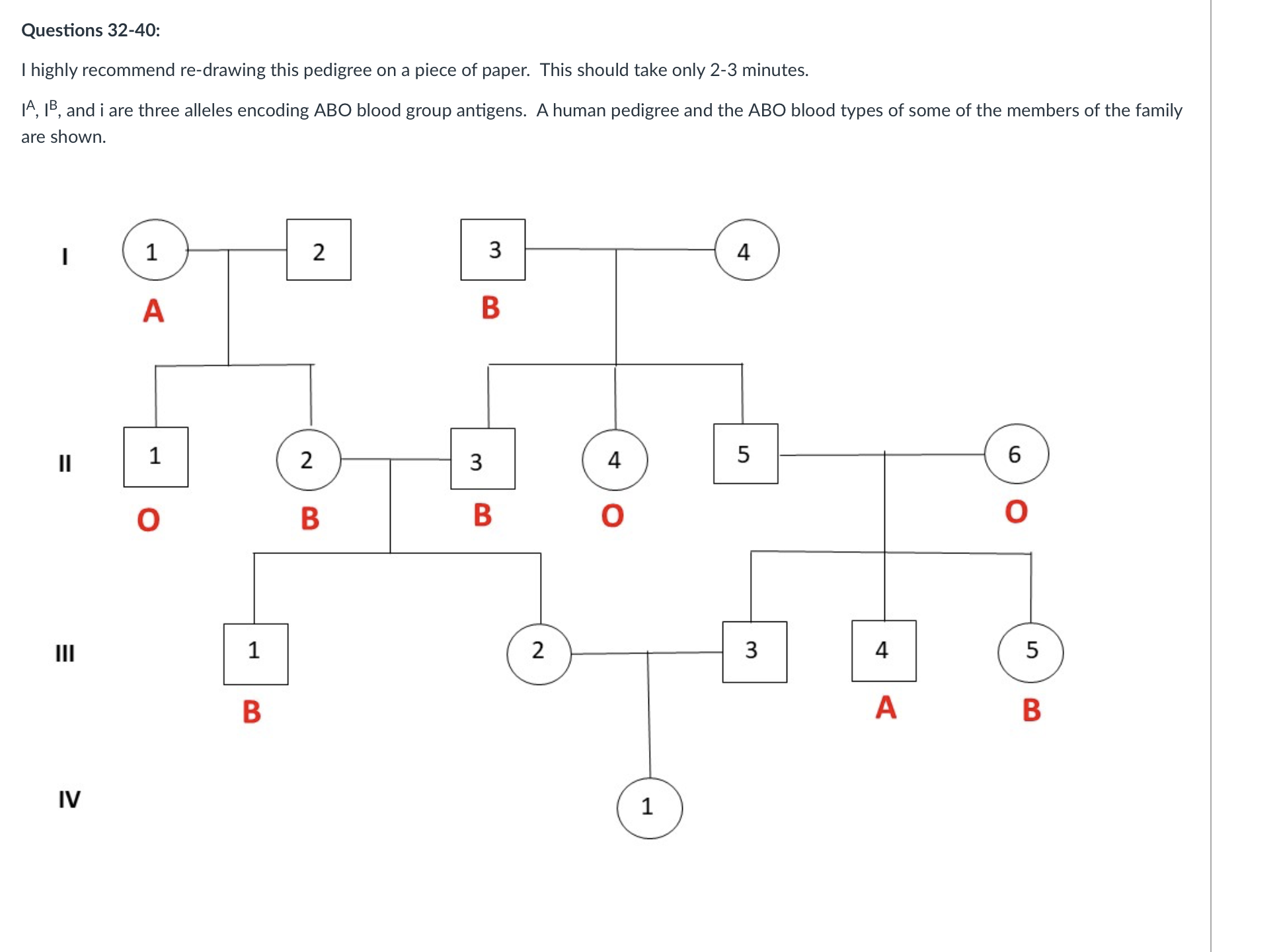
What is the genotype of II-2?
IBi
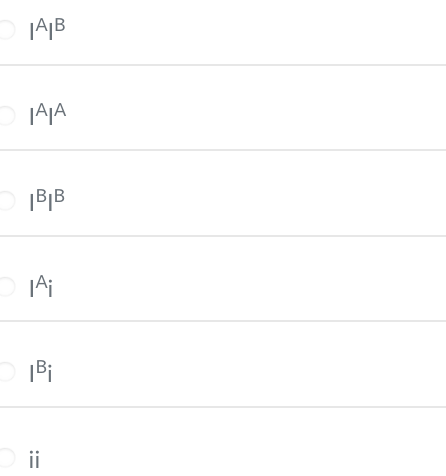
What is the genotype of III-1?
or more
more
What is the probability that IV-1's phenotype is O.
Mom has IB and i. Probability she gives i is 50% (1/2).
Dad has IA (or IB) and i. Probability he gives i is 50% (1/2).
For the baby to be ii, both "coin flips" must land on i.
1/2×1/2=1/4.
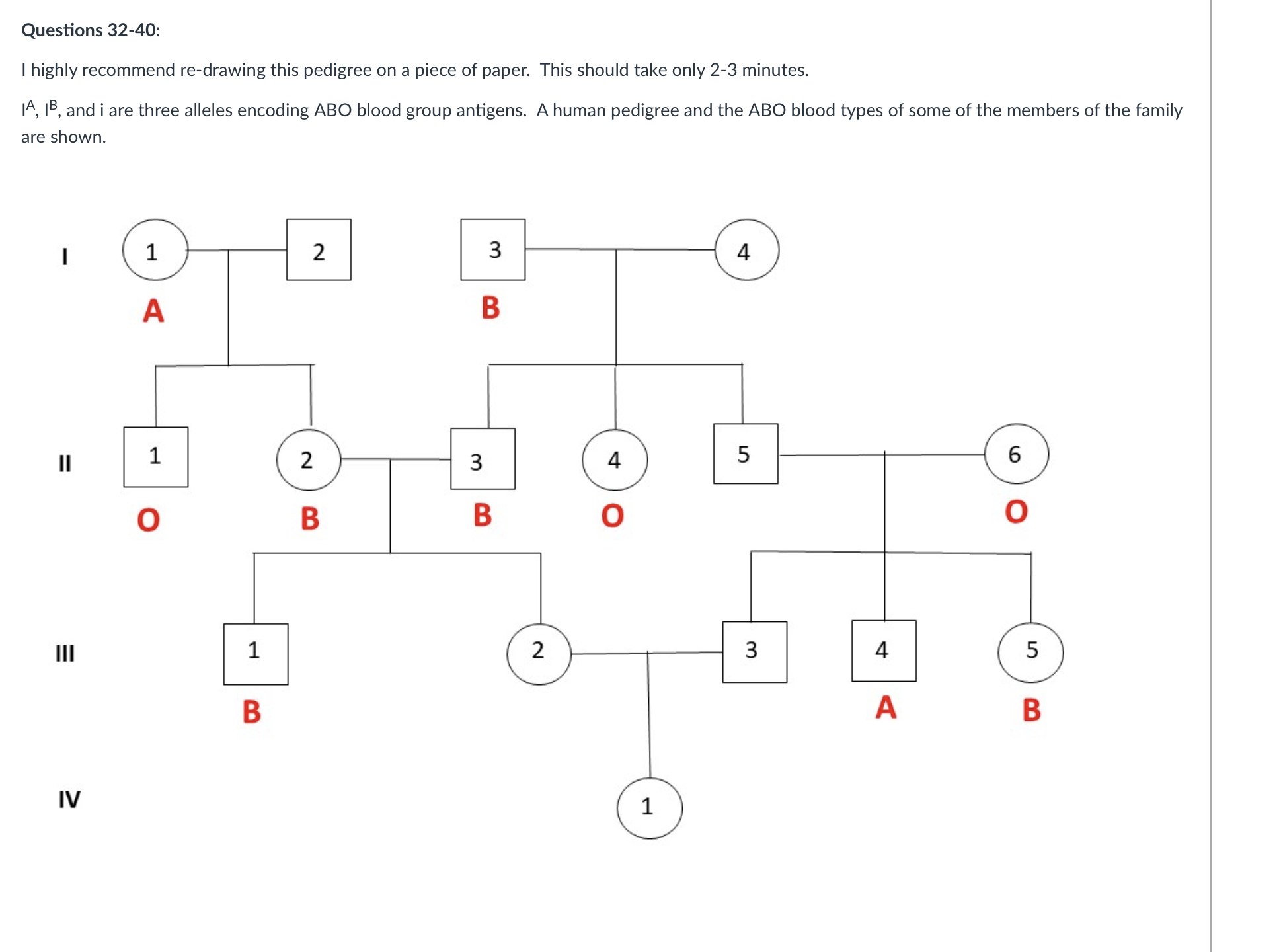
What is the probability that IV-1's blood type is AB?
1/8
 Note
Note  Flashcards (53)