AST101 everything after midterm 2
 Studied by 1 person
 Call with Kai
 Learn
Learn Practice Test
 Spaced Repetition
 Match
Match Flashcards
 Knowt Play
1/46

There's no tags or description
Looks like no tags are added yet.
Name | Mastery | Learn | Test | Matching | Spaced | Call with Kai |
|---|
No analytics yet
Send a link to your students to track their progress
47 Terms
asteroids
orbits the sun
made mainly of rock and metal
there are 600 asteroids larger than 50 KM diameter
there are 25 million asteroids larger than 100 m diameter
most of them between mars and jupiter
orbit of asteroid
orbits according to Keplers laws
objects orbit in ellipses
the time of an orbit depends on the semi-major axis
from centre of orbit to the edge
Kirkwood gap
a gap or dip in the distribution of the semi-major axes (or equivalently of the orbital periods) of the orbits of main-belt asteroids
3:1 orbital resonance with Jupiter
5:2 orbital resonance
orbital resonance
3:1 orbital resonance means that the asteroid goes around 3 times exactly when Jupiter goes around once
no asteroids going around more than 3 times when Jupiter is going once
5:2 orbital resonance
very few to no asteroids that go around more then 5 times when Jupiter goes around twice
orbits in exact resonance with Jupiter get displaced
most of the asteroids in the orbits above get knocked out from Jupiters orbit into another orbit
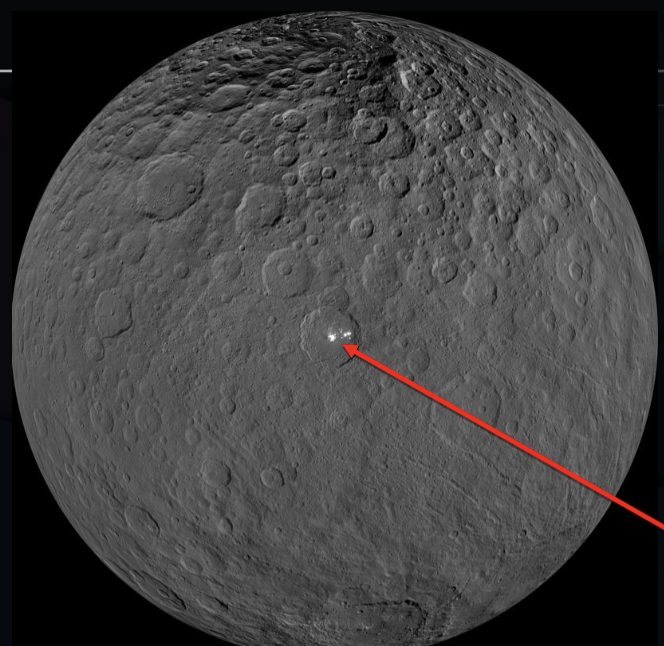
Ceres
the largest object in the asteroid belt
has bright spots
salt deposits from a cryo-volcano
still active after a metro strike
Ahuna Mons: a 4KM tall mountain
layers of ____
rocky center (not iron core!!)
liquid brine
icy crust
dark dust on surface
____ is spherical because it is large enough so the strength of gravity is stronger than the strength of the rock/ice it is made of
dwarf planets
orbits the sun
massive enough that gravity has made it roughly spherical
it is not massive enough that it (mostly) clears out its orbit
vesta
largest asteroid is _____
it is around half the size of ceres
it is not really round, so it is not a dwarf planet
layers of _____
nickel/iron core
mantle
crust
at one point, _____ was hot enough for the interior to become liquid, consequently, _____ experiences differentiation
Bennu’s orbit
_____ orbit crosses the earth’s
it’s orbit is continuously perturbed by the planets and is not stable
it has a 1 in 2700 chance of striking the earth before 2199
Kuiper Belt
20-200 times more massive than the asteroid belt
includes several known planets, including Pluto
formed outside the frost line
charon - pluto’s moon
compared to Pluto, ____ is a very large for a moon
the surface has more craters than pluto
the surface is mainly water ice
Pluto
_____ is very distant
the orbital period is 248 years
its orbit is inclined (not in the ecliptic)
it crosses Neptune’s orbit
is is in a 3:2 resonance with Neptune, so they never collide
comets
appear (rarely) in the sky
visible for days
have tails pointing roughly away from the sun
often come back on a fixed period (decades to millennia)
comet orbit
warmer close to the sun
the sun heats up the comet, and the ice melts and boils away
dust tail- accelerates by light form the sun, so it points a little behind the gas tail
gas tail- gas/plasma is pushed directly away from the sun by high energy particles called the solar wind
the Oort cloud
outside the kuiper is a huge spherical cloud of comets called the Oort cloud
the comets in the Oort cloud were formed near Jupiter, but were kicked out by gravitational interactions
there are trillions of objects in the Oort cloud
meteorites
when meteors hit earth, they are called meteorites
large ones can be destructive
jupiter’s atmosphere
complex clouds and stable storms
winds of up to 500km/hr
bands and storms stable over decades
wind bands are up to 3000 km thick
reasons for bands is not fully understood
Jupiter’s clouds
the temperature and pressure varies as you enter jupiter
different molecules form clouds at different temperatures
ammonia clouds are white
ammonium hydrosulfide clouds are orange
Jupiter
largest planet in the solar system
mass is 317.8 times that of earth
thick gaseous atmosphere surrounds a giant ball of liquid hydrogen
density increases towards the centre.
has very faint rings
many moons: 79 detected so far. Callisto, Ganymede(further from Jupiter, less tidal heating), europa, io (closer to Jupiter, more tidal heating)
orbits around 5AU from the sun
saturn
second largest planet in the solar system
3.3 times less massive than juptier
structure is much like jupiter
has rings
diameter is the rings is over 260,000 km but they are less than 100 meters thick
many moons: 82 have names
uranus
coldest planet
small rocky core (maybe)
thick water + ammonia + methane mantle
thick h2/He atmosphere
rotation axis tilted 98 degrees
thin rings and lots of moons
neptune
furthest jovian planet from the sun
structure similar to uranus
rotation axis is tilted 28 degrees
more surface features than uranus
strongest winds in the solar system: up to 2,100 km/h
Europa: a moon of jupiter
surface covers either un-cratered ice
smaller than earth’s moon
there may be a huge ocean beneath the surface
the smoothness of _____, the young age of the surface, the cracks on the surface, and magnetic field measurements suggest that _____ is covered by a huge ocean under the ice
why is the ocean under the surface of Europa not frozen?
when farther from Jupiter, tidal forces are less.
when closer to Jupiter, tidal forces are greater.
this changing force distorting the moon, heats up
structure in the rings is caused by:
gravitational interactions with moons
varying particle properties
atmospheric absorption
atmosphere absorbs and scatters light
not all wavelengths of light can travel through the atmosphere
the atmosphere is opaque at some wavelengths
astronomical seeing
turbulence in the earth’s atmosphere distorts images
for long exposures and large telescopes (required for dim objects) this blurs the image
without corrective measures, resolution for ground based telescopes is limited
voyager probes
in 1977, the alignment of planets was just right to visit all 4 jovian planets with one probe
it used each planet’s gravity to accelerate and change direction to the next planet (slingshot)
two were launched - voyager 1 and voyager 2
they are still operating, 20 light-hours from earth
gravity assist (slingshot manoeuvre)
when probe flies by a planet, gravity changes the probe’s speed and direction
passing behind speeds it up
passing ahead slows it down
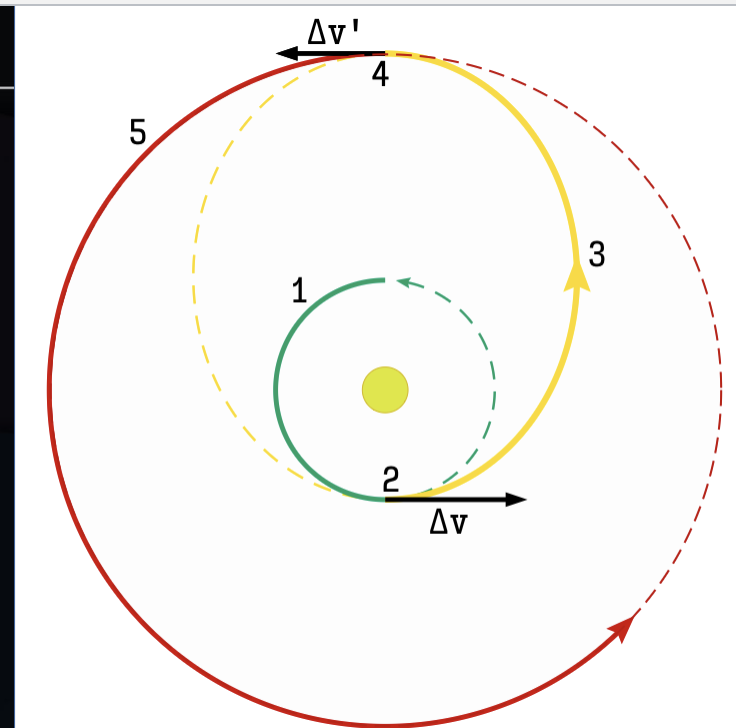
transfer orbit - how to move from one orbit to another
start in the inner orbit
engine burn to speed up
now in the transfer orbit
do a 2nd burn to speed up
end in the outer orbit
mars global surveyor
in orbit around mars
made high resolution images of mars
from 1999 until 2006
Juno mission to jupiter
launched: August 5, 2011
used both gravity assist (from earth) and a transfer obit to get to jupiter
Arrived: July 5, 2016
has 9 different instruments, including a camera. it measures gravity, magnetic fields, radiation, infrared and UV spectra, and radio emissions
end of mission: July, 2021
Venera 13: mission to venus
launched: Oct 30, 1981
landed: March 1, 1982
parachute landing
temperature: 457 C
pressure: 89 atmosphere
survived 127 minutes
first colour image from venus
fist sound recording from another planet
analyzed rock types
Mars Rovers
NASA has sent 4 rovers to mars
sojourner (1997), spirit and opportunity (2004), and curiosity (2012)
opportunity lasted 15 years and travelled 45 KM
curiosity is still running and has travelled 32.4 km
Apollo program: people on the moon
6 moon landings between 1969 and 1972
in 1969, first time in space and sending people
power in space
inner solar system: solar panels
outer solar system: radioisotopes thermoelectric generator
uses radioactive plutonium to generate electricity
communication in space
spacecraft communicate with earth using radio, large dishes are used to focus the very weak signals
data rates tend to be very low: it took more than a year for new horizons to send back its images
light travel times makes for long delays.
how can we find around other stars: direct imaging
take a picture of a nearby star
look for planets around it
take an image of the nearest sun-like star to the earth - 4.34 light years away
all we see is the bright diffraction spikes from the mirror supports
block the light from the star(s) with a “chronograph” in the telescope
best for planets where:
the system is near to the sun
the planet is far from its star
how can we find around other stars: radial velocity method
planets DO NOT actually orbit around their star
both orbit around the “centre of mass” of the system
this means that the star will be moving back and forth along the line of sight
measure the redshift and blueshift of the star as it and the planet around their centre of mass
the amount of motion depends on the man (and the angle)
the frequency of motion depends on the distance from the star
if we are in the same plane as the planet’s orbit, we see all of the motion
if the orbit is “face on”, 90 degrees from us, we see no motion
if the orbit is tilted, we see some of the motion
the velocity change we see depends on the mass and the angle
we cannot tell the angle this was, so we only know the minimum mass
doppler effect
sound is a pressure wave
pitch is frequency
when the source of a wave is coming towards you, the pitch is higher
when the source of the wave is going away from you, the pitch is lower
same thing happens with light
if the source is moving closer, the light shifts to higher frequency (blue shifted)
if the source is moving away, the light shifts to lower frequency (redshifted)
hot Jupiters
we see lots of massive stars close to their stars (so they are hot)
most planets found are this because they are easy to detect
but: according to the nebular theory, they shouldn’t exist
planetary migration
how to explain the existence of hot Jupiters?
one model: they formed outside the frost line, and migrated in
how?
friction from the protoplanetary disk slowed them down
interactions with some other massive object slowed them down
not fully understood
how can we find around other stars: the transit method
look at a star with a planet orbiting it
you cannot see the planet because of the star
but you can measure the total brightness
when the planet passes infant of the star, it blocks some of the star’s light
the signal stays lower for as long as the planet stays in front of the star
the signal goes back up when the planet is not in front of the star
from the depth of the dip, you can determine the size of the planet
bigger planets block more light
the period between dips depends on the distance form the planet tot the star
only works if the angle is right
only works if the telescope is in the plane of the planet’s orbit
the habitable zone
the habitable zone is the range of distances from the star where liquid water can exist
if the planet orbits too close to the star, it is too hot
if the planet orbits too far from the star it is too cold
in the habitable zone, liquid water can exist, so maybe life can too
small, low mass stars are much less bright
therefore the habitable zone is much closer to the star
the orbital period is much shorter
the probability of detection is much higher
what can the transit method tell us
the distance from the star to the planet
the radius of the planet
the orbital inclination
what can radial velocity method tell us
the distance from the star to the planet
if we know the orbital inclination, it can tell us the mass
what can radial velocity and transit method tell us
the distance from the star to the planet
the radius of the planet
the orbital inclination
the mass of the planet
the density of the planet
measuring atmospheres
planets also glow from their own thermal radiation
it is combined with the star’s spectrum
when it goes behind the star, it disappears
subtracting spectra gives the planet’s spectra
measuring a planet’s spectra tells you about its atmosphere
 Note
Note  Flashcards (31)