Module 5 - Shoulder Complex
 Call Kai
 Learn
Learn Practice Test
 Spaced Repetition
 Match
Match Flashcards
 Knowt Play
1/166

There's no tags or description
Looks like no tags are added yet.
Name | Mastery | Learn | Test | Matching | Spaced | Call with Kai |
|---|
No analytics yet
Send a link to your students to track their progress
167 Terms
Functional joints
where movement occurs in the shoulder complex
shoulder complex involves:
sternum
clavicle
ribs
scapula
humerus
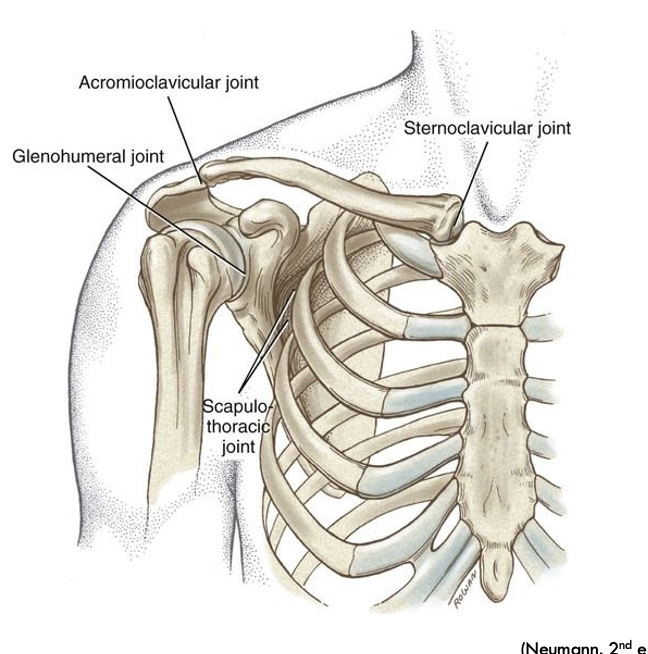
4 functional joints
scapulothoracic articulation
sternoclavicular (SC) joint
acromioclavicular (AC) joint
glenohumeral (GH) joint
sternoclavicular (SC) joint
links UE with the axial skeleton; incredibly stable joint
irregular saddle-shaped synovial joint
acromioclavicular (AC) joint
transfer force from the scapula to the clavicle
plane synovial joint
glenohumeral (GH) joint
ball and socket synovial joint
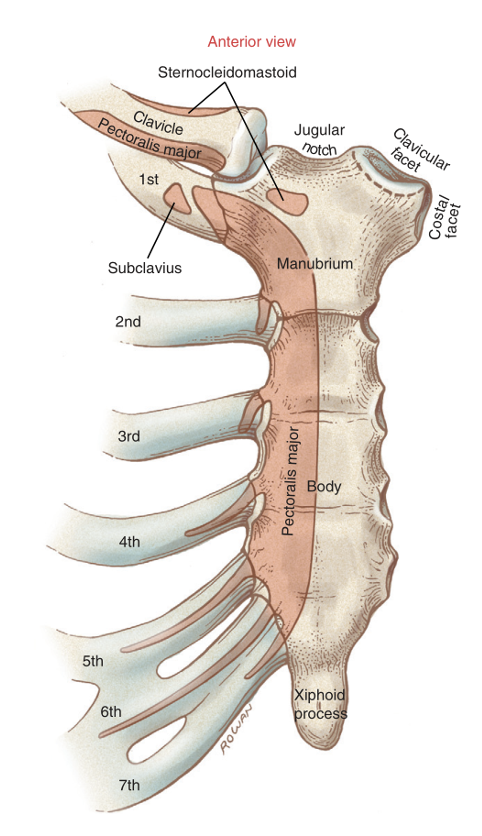
manubrium
upper part (proximal) part of the sternum that articulates with the clavicle at the clavicular facets
jugular notch
superior part of the manubrium between the clavicular facets
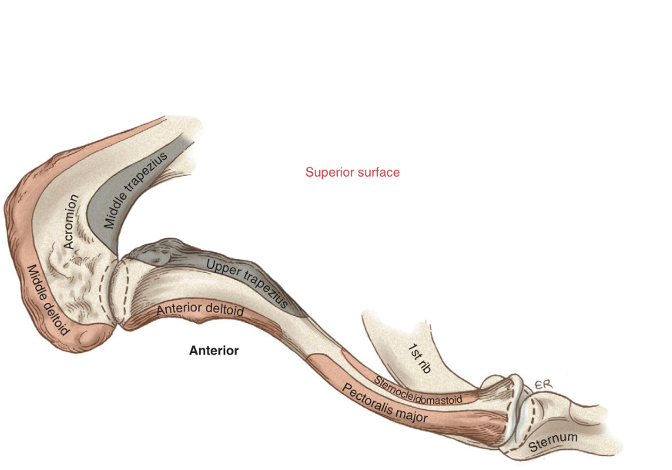
clavicle
s-shaped
medial third (anteriorly convex)
lateral third (anteriorly concave)
articulates with the scapula (at the acromial facet)
Acromioclavicular (AC) joint surface anatomy
if arm is elevated and shoulder is medially and laterally rotated, clunking/grating may be felt
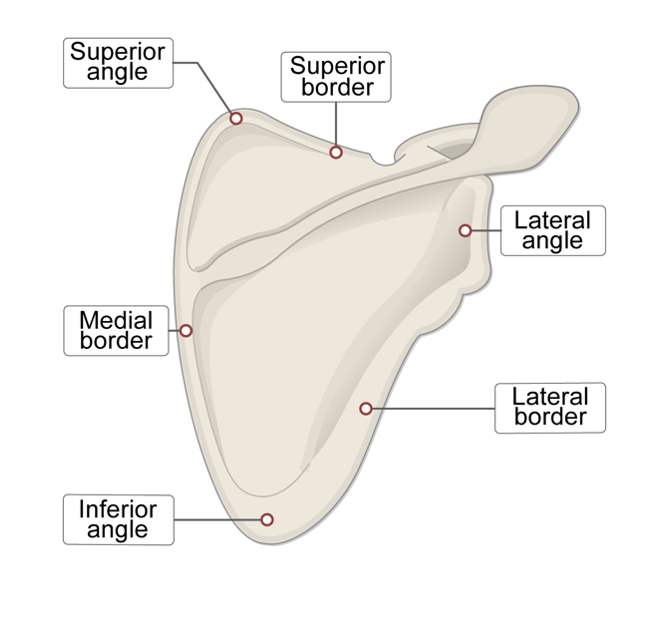
scapula
flat, triangular shaped bone
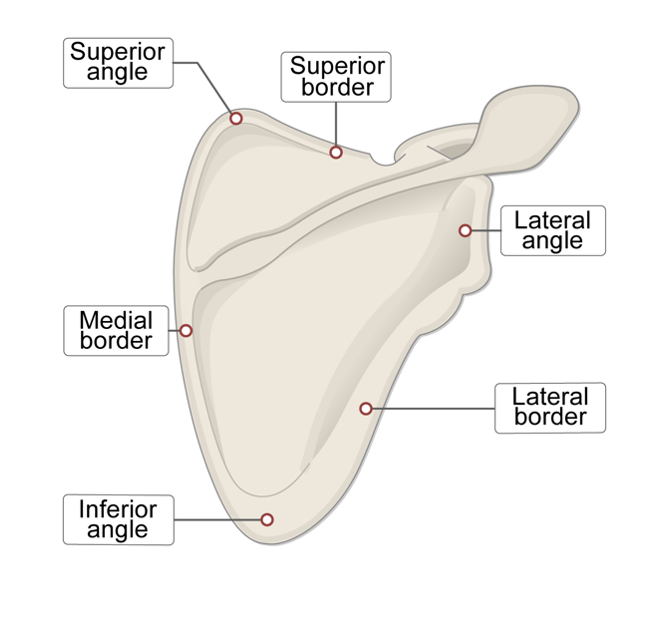
3 borders of the scapula
medial (vertebral) border
lateral (axillary) border
superior border
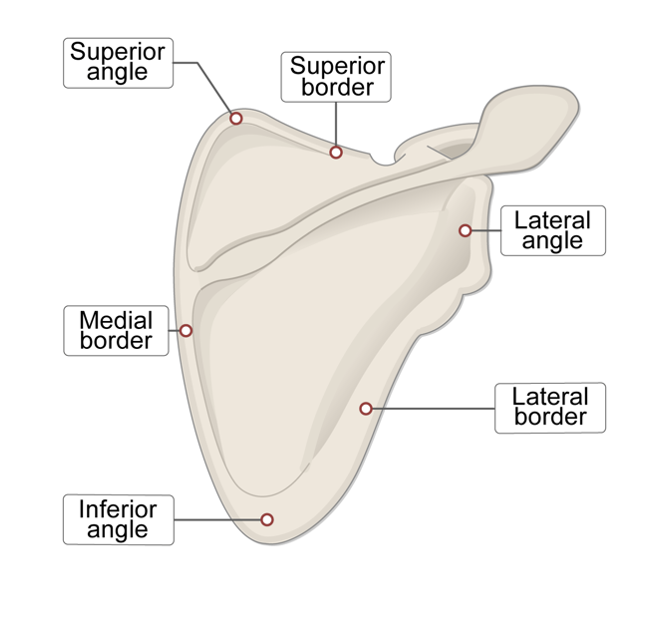
3 angles of the scapula
inferior angle
superior angle
lateral angle
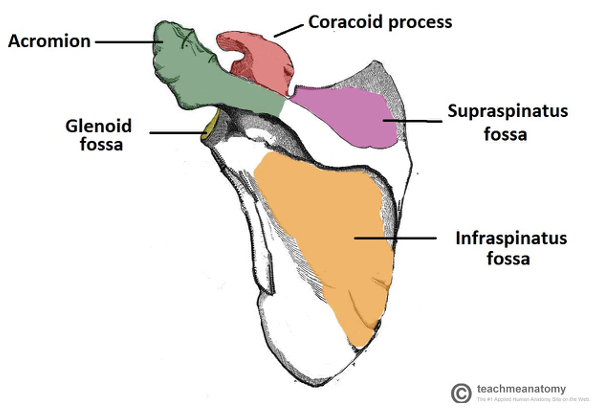
scapula fossae (cavities)
supraspinatus fossa
infraspinatus fossa
subscapular fossa
glenoid fossa
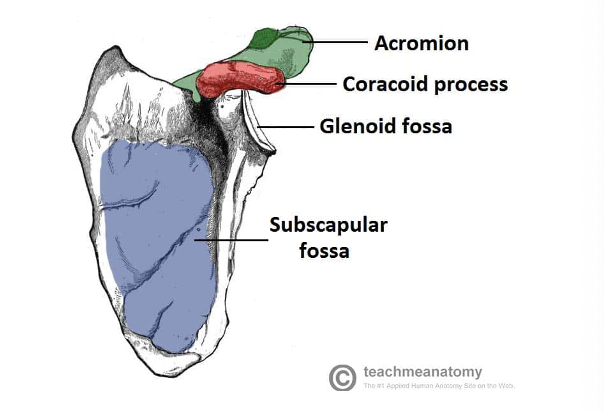
scapula prominences
spine
acromion
coracoid process
humeral head
articulates the scapula at the glenoid fossa
greater tubercle
prominence on the humerus
attachment site for supraspinatus, infraspinatus, and teres minor (lateral)
lesser tubercle
attachment site for subscapularis
deltoid tuberosity
insertion site of deltoid (lateral)
intertubercular (bicipital) groove
depression on the humerus
ceiling: transverse humeral ligament (not a true ligament, actually part of the subscapularis tendon)
center: long head of the biceps
floor: latissimus dosrsi attachment site
radial groove
path for the radial nerve (humerus)
greater tubercle surface anatomy
immediately inferior to the lateral edge of the acromion with a small gap between the two bony prominences
scapulothoracic (ST) articulation
not a direct joint but a functional joint between the rib cage and scapula separated by muscle tissue (subscapularis and serratus anterior)
-almost all functional activities involve a combo of ST joint motions
ex) pulling a door open: scapula adduction and posterior tilt
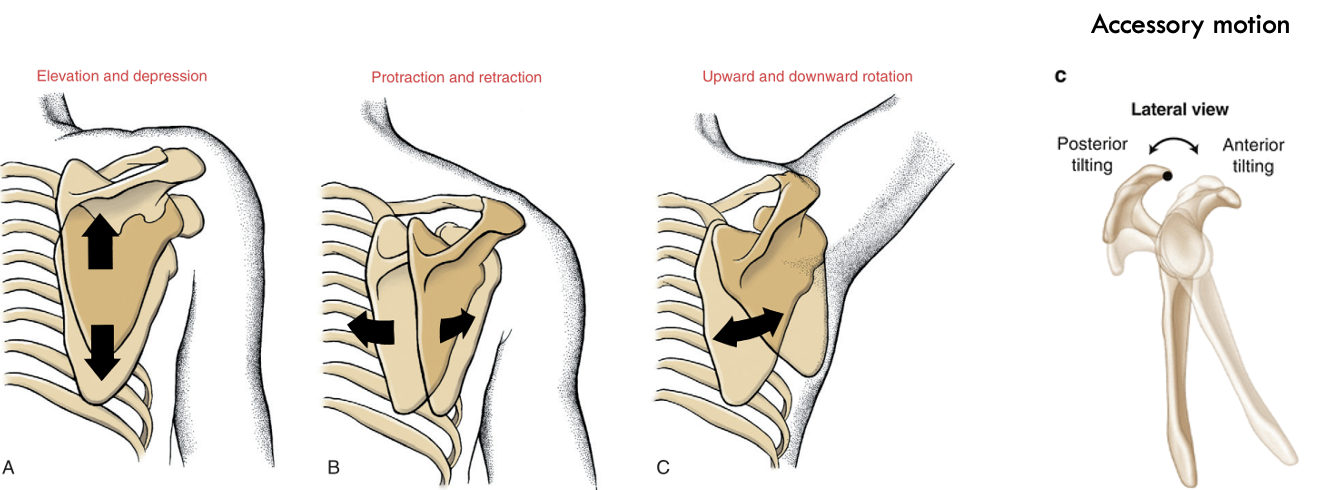
scapulothoracic (ST) joint motions
elevation and depression, protraction and retraction, upward and downward motion, accessory motion
Scapulothoracic (ST) joint motion examples
elevation: shrug
protraction: punch
upward rotation: jumping jack
scapular plane (scaption)
plane of motion traveled by the scapula along the rib cage
protraction: out like pushing a door
retraction: bringing arm to side (frontal plane) -→ moving up and down
sternoclavicular (SC) joint
links the upper extremity with the axial skeleton ; incredibly stable joint
sternoclavicular (SC) joint stabilizers
anterior and posterior sternoclavicular joint ligaments
interclavicular ligament
costoclavicular ligament
articular disc
anterior and posterior sternoclavicular joint ligaments
resist anterior/posterior translation
interclavicular ligament
limits excessive depression
costoclavicular ligament
primary resistant to elevation
articular disc
joint stability and shock absorber
sternoclavicular (SC) joint kinematics
3 DOF
frontal plane (sagittal axis): shrugging (~45°) / depression (~10-15°)
transverse plane (vertical axis): reaching forward and back (protraction (~15°) / retraction (~15°)
sagittal plane: posterior axial rotation of clavicle (~20-35° during full elevation)
Acromioclavicular (AC) joint stabilizers
acromioclavicular ligaments
corcoclavicular (CC) ligaments
acromioclavicular ligaments
provide horizontal stability, preventing the joint from separating front-to-back
coracoclavicular (CC) ligaments
composed of the conoid and trapezoid ligaments
provide primary vertical stability and prevent superior displacement
Acromioclavicular (AC) joint is inherently susceptible to dislocation due to the ____ nature of the articulation
sloped
common mechnism of injury for AC joint
fall on said of the body, sports, car accident
Acriomioclavicular (AC) joint kinematics
3 DOF
frontal plane (sagittal axis): upward rotatuon during abduction (upward/downward rotation)
transverse plane (vertical axis): internal rotation during scapula protraction (internal/external rotation)
sagittal plane (frontal axis): anterior tilt during shrugging (anterior/posterior tilting)
Shrugging (elevation) is a combination of what two joints?
SC elevation + AC downward rotation
Protraction (punching forward) is a combination of what two joint motions?
SC protraction + AC internal rotation
Upward rotation “reaching overhead” is a combination of what two joint motions?
SC elevation + AC upward rotation
Glenohumeral (GH) joint
articulates with the convex head of humerus with the concavity of glenoid fossa
ball and socket synovial joint
glenohumeral (GH) joint kinematics
3 DOF
frontal plane (sagittal axis): reaching sideways (Abduction 120° /Adduction ~75°)
transverse plane (vertical axis): Internal rotation (70-90°) / External rotation (90°)
Horizontal adduction (130°) / Horizontal abduction
Sagittal plane (frontal axis): Flexion (120°) / Extension (45-60°) ; e.g. reaching forward
glenohumeral (GH) joint stability
inherently unstable
only 25-30% of the humeral head is in contact with the glenoid fossa
glenohumeral (GH) joint stabilizers
active stabilizers: rotator cuff muscles
passive stabilizers: restraint provided by the joint capsule, and tendons
scapulothoracic posture
negative intrascapular pressure
Inferior glenohumeral ligament (IGHL)
most important stabilizer in abduction against anterior translation
sling/hammock like
injury/laxity leads to recurrent anterior dislocations of the humeral head
Glenoid labrum
rim of fibrocartilage around the glenoid fossa
deepens the concavity of the fossa
increases surface area contact with the humeral head (~50%)
Long head of biceps _____ from the superior labrum and supraglenoid tubercle
originates
Long head of biceps function
dynamic stabilizer resisting anterior translation in abduction and external rotation
Superior Labrum (SLAP) lesions are them most common injuries in _____ throwing athletes
overhead
coracoacromial arch
forms the “roof” of the GH joint, providing superior stability
subacromial pain syndrome
presents as pain with ovehead motion (60°-120°)
weakness in scapular and rotator cuff muscles
GH joint abduction arthrokinematics
superior roll, inferior glide
arthrokinematics
small-amplitude, involuntary movements (roll, glide, spin) occurring between joint surfaces during voluntary motion
Full abduction requires _____ rotation
external
Scapulohumeral rhythm
describes the coordinated movement between the glenohumeral (GH) joint and the scapulothoracic (ST) articulation during shoulder motion
ratio for glenohumeral (GH) joint: ST joint
2:1
for every 3° of shoulder elevation: 2° ___ joint abduction', 1° _____ joint upward rotation
GH; ST
flexion (shoulder ROM)
total ROM; 180°
GH contribution: 120°
ST contribution: 60°
extension (shoulder ROM)
total ROM: 60°
GH contribution: 40°
ST contributiom: 20°
abduction (shoulder ROM)
total ROM: 18°
GH contribution: 120°
ST contribution: 60°
adduction (shoulder ROM)
Total ROM: 30-50°
GH contribution: 20-35°
ST contribution: 10°-15°
internal rotation (shoulder ROM)
total ROM: 70°-90°
GH contribution: 70°-90°
ST contribution: 0°
external rotation (shoulder ROM)
total ROM: 90°
GH contribution: 90°
ST contribution: 0°
adhesive capsulitis
frozen shoulder
common in adults, especially females 40-60 y/o
axioscapular muscles originate on the _____
spine, ribs, cranium
axioscapular muscles insert on the _____
scapula and clavicle
posterior axioscapular muscles
trapezius (upper, middle, lower) levator scapulae, rhomboids
anterior axioscapular muscles
serratus anterior, pectoralis minor, subclavius
axiohumeral muscles
muscles that link the axial skeleton and humerus directly
anterior: pectoralis major
posterior: latissimus dorsi
trapezius
elevates, depresses, retracts, and rotates the scapula: rotates arm, extends head and neck
trapezius origin
external occipital protuberance, medial portion of superior nuchal line of the occipital ligamentum nuchae and spinous processes of C7-T12
trapezius insertion
lateral 1/3 of clavicle acromion, and spine of the scapula
ex) reaching for an object overhead, rowing a kayak
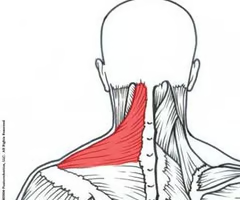
upper trapezius
extends and laterally flexes head and neck, scapular elevation and upward rotation
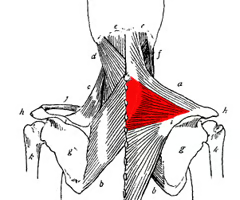
middle trapezius
abducts and stabilizes scapula
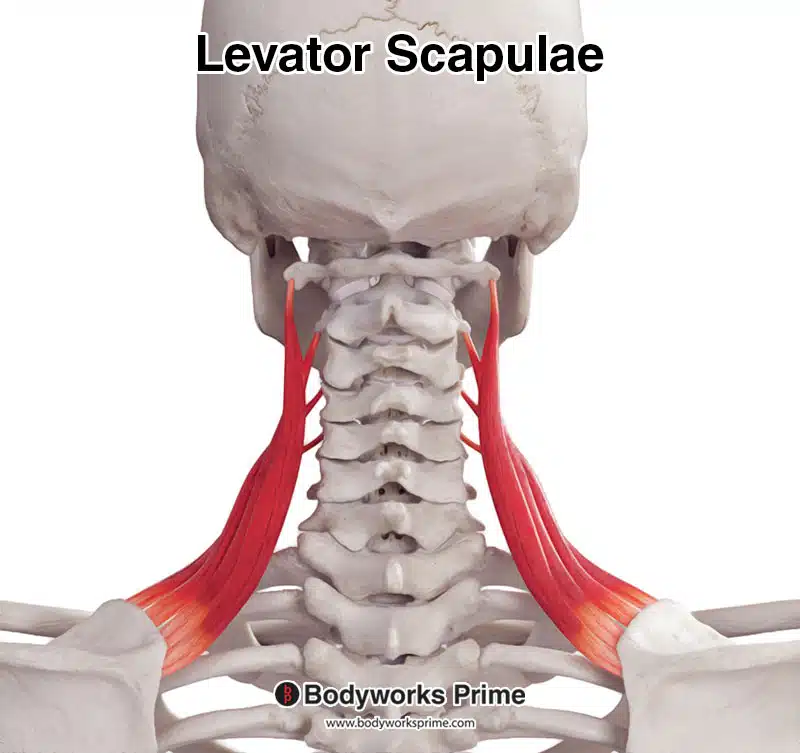
levator scapulae
elevates and adducts scapula, downward rotates scapula, rotates and laterally flexes the head and neck
levator scapulae origin
transverse processes of first through fourth cervical vertebrae
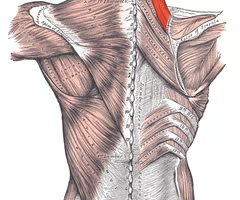
levator scapulae insertion
medial border of scapula between superior angle and superior portion of spine of scapula
ex) shrugging shoulders or carrying a briefcase
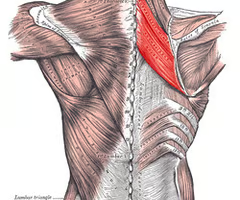
rhomboids
adducts, elevates, and downwardly rotates scapula
rhomboids major origin
spinous processes of T2-T5
rhomboids minor origin
spinous process of C7-T1
rhomboids major insertion
medial border of the scapula between the spine of the scapula and inferior angle
rhomboid minor insertion
upper portion of medial border of the scapula, across from spine of the scapula
ex) reaching into back pocket
latissimus dorsi
extends, adducts and medially rotates the arm, draws shoulder downward and backward
ex) wheelchair mobility (propelling a manual wheelchair forward), standing from sitting (pushing down on the arms of a chair)
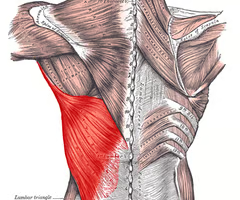
latissisimus dorsi origin
inferior angle of scapula
spinous processes of last 6 thoracic vertebrae
last 3-4 ribs
thoracolumbar fascia
posterior iliac crest
latissimus dorsi insertion
intertubecular groove of the humerus
serratus anterior actions with the origin fixed
abducts scapula
upwardly rotates scapula
depress the scapula
hold the medial border of the scapula against the ribcage
serratus anterior actions with the scapula fixed
may act to elevate the thorax during forced inhalation
serratus anterior origin
external surface of the upper 8-9 ribs
serratus anterior insertion
anterior surface of medial border of the scapula
ex) pushing a heavy door
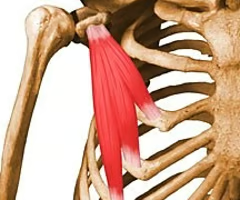
pectoralis minor
depresses, abducts, and downwardly rotates the scapula
pectoralis minor origin
third, fourth, and fifth ribs
pectoralis minor insertion
medial surface of coracoid process of the scapula
ex) taking a deep breath, walking with crutches
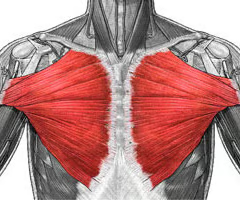
pectoralis major
adducts shoulder, internally rotates shoulder, elevates the thorax
clavicular fibers of the pectoralis major
flexes shoulder, horizontally adducts shoulder
sternocostal fibers of the pectoralis major
extends shoulder
pectoralis major origin
medial half of the clavicle, sternum, cartilage of first through sixth ribs
pectoralis major insertion
crest of greater tubercle of humerus
ex) reaching across the body into an overhead cabinet, putting on a seatbelt
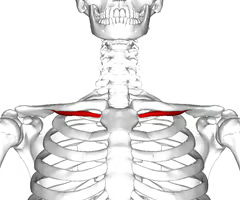
subclavius
anchors and depresses the clavicle

