Extracellular Matrix - Derived Biomaterials
 Call Kai
 Learn
Learn Practice Test
 Spaced Repetition
 Match
Match Flashcards
 Knowt Play
1/50

There's no tags or description
Looks like no tags are added yet.
Name | Mastery | Learn | Test | Matching | Spaced | Call with Kai |
|---|
No analytics yet
Send a link to your students to track their progress
51 Terms
extracelullar matrix
living environment od cells, substantial part of tissues is extracellular space
non cellular component of tissues and organs: biological material composed of polymeric networks
parts of extracellular matrix
several types of macromolecules (proteins and polysaccharides)
locally secreted and assembled into organized meshwork
close association with surface of cell that produced them
smaller molecules are bound
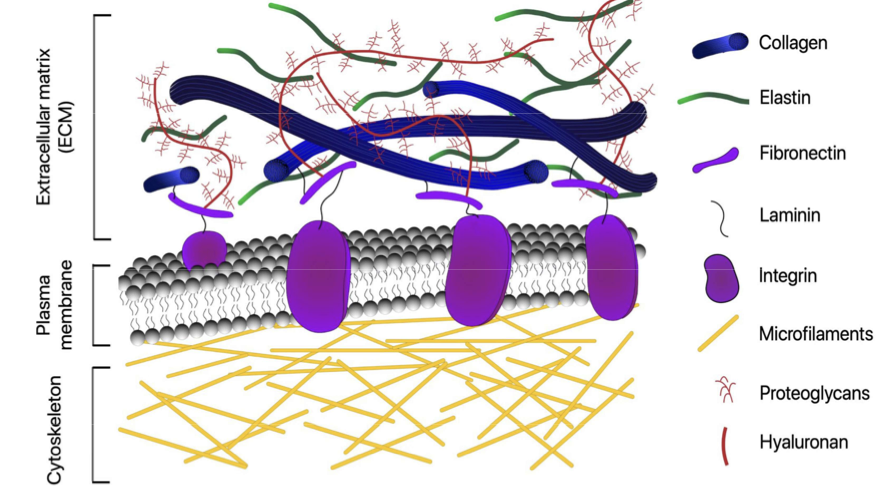
Function of ECM
functions as adhesive substrate
provides structure
presents growth factors to receptors
requestors and stores growth factor
senses and transducer mechanical signals
ECM Function: Adhesive Substrate
tracks to direct migratory cells
concentration gradients for haptotactic migration EC
ECM Function: Providing Structure
define tissue boundaries
provides integrity and elasticity to developing organs
degraded by invasive cell during development and disease
ECM Function: presents growth factors to receptors
controls spatial distribution of ECM bound surface molecules
facilities crosstalk between growth factor receptors and ECM receptors
ECM Function: sequesters and stores growth factors
allows for patio-temporal regulation of factor release
organizes morphogen gradients
mediates release of factors in presence of appropriate cell-mediated forces or proteolytic degradation
ECM Function: senses and transducer mechanical signals
defines mechanical proeprties permissive/instructive to cell differentiation
activate intracellular signaling through interaction with cell-surface receptors
engages cytoskeletal machinery and synergies with growth factor signaling
Cells continue to interact with ECM
chemical, mechanical, and topographic cues provide cells with cell shape, migration, growth, orientation, adhesion, differentiation, division, and fate
molecular singlalinf by celular adhesion receptors (integrals)
ECM is modified by cells as they proliferate, differentiate, and migrate
How do cells communicate with ECM?
uses interns, largest family of ECM molecule receptors
transmembrane heterdimers, linkers between the ECM and actin cytoskeleton
cells both bind to and respond to ECM
understanding cell matrix interactions is essential to understand and direct tissue response to biomaterials
Extracellulat domain: binds to ECM-moleculues
Intracellular domain: binds to cytoskeleton and also to specific molecules of signal transduction pathways
Components of ECM
Water (65% of tissue weight)
secreted by variety of cells: fibroblasts, bone, and cartilage cells
polymer forming proteins
structural proteins
elongated molecules usually insoluble
special mechanical properties, resulting from unique structure
Collagens (strength) and elastic fibers (elasticity)
Collagen
must abundant protein in mammals 25-30% of total protein amss
secreted bt connective tissue cells
predominant structural component of ECM in bones, cartilage, tendons, and skin
collagen superfamily compromises 28 members
Tensile Strength of Collagen Fibers
long and highly stable molecule with rigid structure that provides structure framework and strength of tissues
Triple Helix Secondary Structure
three polypeptides alpha chains twisted around one another in a rope like triple helix (braid)
intra and intermolecular cross linked collagen fibrils into strong fibers
self assembly of collagen fibrils into collagen fibers due to hydrophobic, electrostatic, and cross linking interactions
Collagen Fiibers for Structure-Function Relations
orientation pattern marches mechanical function
What is collagen-based biomaterials used for in biomedical applications?
used as tissue filler, for nerve guides, wound healing, drug delivery, scaffold in tissue engineering and bioinks
Elastic Fiber
responsible for tissue elasticity
used in tissues requiring reversible extensibility or deformability
inelastic collagen fibrils are interwoven with elastic fibers to limit extent of stretching and prevent tissue from tearing
Elastin: mechanical behavior
main component of elastic fibers is elastin
elastin resists tension and endow resilience to ECM by passive, entropy driven mechanism allowing stretching and recoil
ability to stretch resting molecular length and recoil without damage to protein
allows many tissues in body to resume shape after stretching or contracting
Why does elastin work the way it does?
during elastin synthesis: cross linking of elastin precursor molecule
elation is rich in hydrophobic amino acids that cluster to avoid waterE
Elastin-based biomaterials (Tropoelastin-coated scaffolds)
used as coating
enhance integration of scaffolds into hosts
provides biological cues for cell adhesion
used as scaffold and as hydrogel matrices
Adhesive Glycoproteins (Fibronectin, Tenascin, Laminin)
binds to both cells and ECM (laminin and fibronectin)
red for coatings and surface modifications of scaffolds to improve host-biomaterial interaction
Laminin
large ECM family of proteins, cross-like structure
separate binding domains to cells and ECM molecules
localized at basement membrane: sheets of highly organized and specialized ECM beneath many types of cell sheets
function: organization of ECM, regulate cell-matrixa adhesion, cell migration and cell shape
Fibronectin
different domains: binds cell surfaces and different ECM molecules
RGD amino acid sequence as the integral-binding region
Functions: cell migration and proliferation, wound healing, maintenance of cell cytoskeleton
Laminin/Fibronectin Based Biomaterials
used as coating and for surface medication of biomaterials
Proteoglycans
core protein + glucosaminoglycans
large complexe that are highly diverse
GAGs are highly negatively charged: traps a lot of water
resists compression by retaining water and by occupying large volume
forms porous hydrated gels that fill most of extracellular space
Hyaluronic Acid
provides compression strength, lubrication and hydration within ECM and regulates cell functions
great biocompatibility, biodegradability, and bioactivity
versatile molecule in both drug delivery and tissue engineering applications, including formulations of coatings, nanoparticles and hydrogels
Fibrinogen and Fibrin
promotes cell adhesion and migration
used as hemostatic agent, sealant, scaffold and bioink
Fibrin
provisional metric during wound healing and also primary protein component of blood clots, rich in growth factor
Fibrinogen
precursor of fibrin
Tissue Engineering
extracellular matrix-derived biomaterials
scaffold mimicking target tissue’s ECM
ingredients of tissue engineering: cells, cell signaling, scaffold (biomaterial) E
ECM-based Biomaterials
main use as scaffold for tissue engineering
biocompatible, biodegradable and bioactive
temporary ECM to accommodate cells and support 3D tissue regeneration
degraded in body and replaced by natural ECM produced by host cells
Applications of Scaffolds in ECM-Based Biomaterials
tissue regeneration, wound healing, drug / growth factor delivery, cellular models
ECM Varies in Composition from One Tissue to Another
varying commotion of collagen, GAGs and elastic fibers generate different properties DIFFERENT ECM RATIO
Best Scaffold for TE
ECM of target tissue is in active state
architectural, biological and mechanical features of ECM should be mimicked by ECM-dervied scaffolds
should be Porous, Biodegradable, Biocompatible, Bioactive, and recapitulate the architecture of the target tissue (chemical, physical, and mechanical parameters)
ECM-derived Biomaterials (Sources)
sources for isolating ECM protein
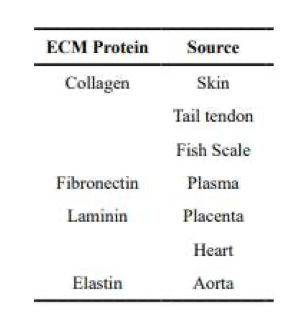
Species Sources fro ECM
from humans (autologous or allogenic) or other species (xenogenic)
Obtention in ECM-derived biomaterials
traditional purification methods
recombinant technology
Decellularization
Obtention (Traditional Purification Methods)
tissue isolation and processing through mechanical disruption, enzymatic digestion and precipitation
Obtention (Recombinant Technology)
production of ECM proteins in vitro in bioreactors as recombinant proteins expressed in either bacteria, insect, or mammalian cells
possibility to tune, modify, and manipulate the expressed protein
Obtention (decellularization)
best scaffold for engineered tissue in ECM of target tissue in native state
removing cellular compartment of living tissues, creating acellular ECM scaffolds
used in many clinical applications
preservation of ECM structure and composition of tissue, vascular networks, and specific functional and structural molecules Bi
Biofabrication Techniques
Purified ECM Component, Decellularised Tissues, In Vitro-Generated Biomaterials
Biofab Technique: hydrogen, electrospinning, and 3d dECM bioink
Bioprinting
printing of structures consisting of living cells, biomaterials and active biomolecules
applications in biomaterial inks, bionink formulations
Biofabricated Scaffolds by Electrospinning
nano and micro-sized non-woven fibers through electrostatic forced driven by high voltage electric fields
oriented multifilament nano fibers structurally similar to nano fibrous framework of native ECM
natural and synthetic polymers can be combined to improve low mechanical properties of natural polymers and low biocompatibility of synthetic ones
Scaffolds in ECM-Derived Biomaterials
further modifications of scaffolds:
crosslinking
improve mechanical
retard biodegration
different treatments prior to implantation to minimize immune response in human body
combine with synthetic biomaterials to improve mechanical properties
Scaffold after in-vivo implantation
acellular scaffolds
ex: human fibroblasts which express a complete dermal stroll matrix
serves as vehicles for delivery of signals that augment the recruitment of endogenous cells
Cellular Scaffolds
bearing embedded cells to guide tissue formation
in vivo: bearing embedded cells to guide tissue formation, serve as cells carriers
cells with regenerative capacities
When will you use acellular or cellular scaffolds?
patient with genetic disease, acute wounds, patient with extensive tissue loss, aged patients
acellular scaffold
huge number of commercially available decellularized scaffolds
limited immune reaction
low cost
without regulatory and scientific challenges of cell based therapies
no donor required
red to facilitate the repair activity of native cell populations Ce
Cellular Scaffolds
addition of a cellular component with regenerative capacity: increased biological activity over material alone
useful in patients with systemic pathologies that compromise native tissue repair responses (like diabetes and other diseases limiting wound repair)
Coatings for ECM-derived Biomaterials
coatings to improve host device transition, using laminin and fibronectin
host cell binds to ECM molecules through integral receptors
motifs present in ECM protein domains with biological activity
cell adhesion photo controlled spatio-temporally
applications is for coatings
Current Issues in ECM
excellent biomaterial suitable for many therapeutic applications
challenge:
undersstanding 3D architecture, mimic biochemical and biophysical composition, improve manufacturing processes, understand and modulate the changes that occur after in vivo placement and host remodeling

