UNIT 5.4. MEMBRANE-BOUND ORGANELLES: NUCLEUS
 Studied by 0 people
 Call Kai
 Learn
Learn Practice Test
 Spaced Repetition
 Match
Match Flashcards
 Knowt Play
1/60

There's no tags or description
Looks like no tags are added yet.
Name | Mastery | Learn | Test | Matching | Spaced | Call with Kai |
|---|
No analytics yet
Send a link to your students to track their progress
61 Terms
Nucleus
It is the controlling center of the cell. This is where the genetic information will be stored and regulated. Furthermore, is very crucial in central dogma mechanism and cellular processes
nucleus
The presence of a ________ distinguishes eukaryotic cells from prokaryotic cells
Ernest Rutherford (1871–1937)
Nucleus Theory (1910)
Gold foil experiment with alpha particles
Key Observations:
Most alpha particles passed straight through → atom is mostly empty space
Some alpha particles deflected at large angles → presence of a dense central nucleus
Mosely
Proved that the nucleus have a positive charge
Drosophila melanogaster in embryonic stages
myocytes
examples of multinucleate cells
mammalian RBCs
cells of lens of vertebrae eye
examples of anucleate cells
Unicellular
Multicellular
2 Main types of Eukaryotic cells:
Unicellular
2 Main types of Eukaryotic cells:
made up of single cell that carries out all life processes
Fungi
Protista
Multicellular
2 Main types of Eukaryotic cells:
made up of numerous cells;
numerous cells are specialized to performs a specific function
Plants
Animals
Nuclear membrane
Nucleoplasm
Nucleolus
Chromatin
4 Components of Nucleus
Nuclear envelope
4 Components of Nucleus:
pore-riddled
also known as nucleolemma
Separates the nuclear material from cytoplasm
Consists of two lipid bilayers
Outer membrane
Inner membrane
The nuclear envelope is a double-layered membrane perforated with pores, which control the flow of material going in and out of the nucleus.
Nuclear membrane
4 Components of Nucleus:
1) Shape and stability: helps the nucleus from collapsing
2) Compartmentalizing: separates the nucrear material from cellular material
3) Regulation of substances: allow the exchange of materials
4) Communication: develops a chemical connection between nucleus and cell
Outer nuclear membrane
Perinuclear space
inner nuclear membrane
Parts of nuclear membrane
Outer nuclear membrane
Parts of nuclear membrane:
continuous w the ER
functionally homologous to ER membrane
7-8 nm
ribosomes ;
membrane proteins (for cytoskeleton binding)
The cytoplasmic surface of the outer nuclear membrane has ________ that are different in composition of protein and t_ese ribosomes are enriched in ______________________________________.
Perinuclear space
Parts of nuclear membrane:
“lumen of envelope”
Space is present between ONM and INM
20-40 nm thick.
same content as with the ER lumen
Inner Nuclear Membrane
4 Components of Nucleus:
contains proteins that are specific to nucleus are present, involved in nuclear structure, organization, and gene regulation
Help maintain nuclear shape, mechanical stability, and chromatin organization
Lamin B receptor (LBR)
Lamina-associated polypeptides (LAP, LAP2)
Emerin
MAN1
Nurim
INM Proteins
muscular dystrophies & lipodystrophy
Mutations in emerin and nuclear lamins are linked to
RER
INM integral proteins are synthesized on the ___________
lateral diffusion
Integral proteins reach the inner nuclear membrane by _________________ through the continuous ER–nuclear envelope membrane system
phosphorylation ;
cylin-dependant protein kinase
The nuclear membrane disassembles and the nuclear lamina depolymerizes due to ________________ of nuclear lamins by___________________________
Nuclear Pore Complexes (NPC)
The nuclear envelope membrane proteins also disassemble by phosphorylation leading to disassembling of _______________________
nuclear import receptors
NPC proteins become bound to ________________, which play an important part in the reassembly of NPCs at the end of mitosis.
chromatin
Offset:
The nuclear envelope forms around ________.
Ran-GTP
Offset:
Chromatin is surrounded by a shroud of _________
nuclear import receptors
Offset:
The assembly of NPCs is started by _____________ from NPC proteins displaced by the Ran-GTP cloud.
ER
Offset:
Membranes from _______ fuse over the chromatin until a complete nuclear envelope is formed.
Onset (Pre-mitosis)
DURING MITOSIS THE NUCLEAR ENVELOPE DISASSEMBLES:
★ The nuclear membrane disassembles and the nuclear lamina depolymerizes due to phosphorylation of nuclear lamins by cylin-dependant protein kinase.
★ The nuclear envelope membrane proteins also disassemble by phosphorylation leading to disassembling of NPCs.
★ NPC proteins become bound to nuclear import receptors, which play an important part in the reassembly of NPCs at the end of mitosis.
★ Motor proteins in microtubules also help in tearing down the nuclear membrane.
Offset (Post-mitosis)
DURING MITOSIS THE NUCLEAR ENVELOPE DISASSEMBLES:
★ The nuclear envelope forms around chromatin. Chromatin is surrounded by a shroud of Ran-GTP.
★ The assembly of NPCs is started by nuclear import receptors from NPC proteins displaced by the Ran-GTP cloud.
★ Alongside the nuclear envelope membrane proteins with dephosphorylated lamins start attaching to chromatin again.
★ Membranes from ER fuse over the chromatin until a complete nuclear envelope is formed.
nuclear pore
Most distinctive feature of the nuclear envelope
Composed of small cylindrical channels
Provides direct communication between cytosol and nucleoplasm
Formed where inner and outer nuclear membranes fuse
Highly structurally complex
Regulates and controls selective transport of proteins, RNAs, and other macromolecules
freeze-fracture microscopy
Nuclear pore is readily visible using __
Small molecules;
passive diffusion
___ are able to pass rapidly through open channels in nuclear pore complex by _____.
macromolecules;
selective, energy-dependent mechanism
In contrast, ____ are transported by a ____ that acts predominantly to import proteins to the nucleus and export RNAs to the cytoplasm
Nuclear Localization Signal
bipartite, consisting of a Lys-Arg sequence, followed by a Lys-Lys-Lys-Lys sequence located ten amino acids farther downstream.
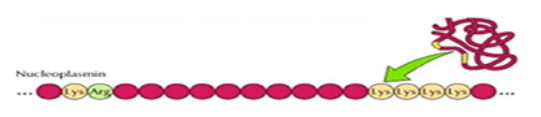
Nuclear Localization Signals (NLS)
Short specific amino acid sequences that target proteins to the nucleus
Recognized by nuclear transport receptors (importins)
Guide proteins through the nuclear pore complex (NPC)
Commonly rich in basic amino acids (lysine and arginine)
Amino acids involved are often clustered together but not always directly adjacent
Nucleoplasm/ Karyoplasm
4 Components of Nucleus:
A jelly-like (made mostly of water) matrix within the nucleus
All the other materials “float” inside
Helps the nucleus keep its shape and serves as the median for the transportation of important molecules within the nucleus
It is completely enclosed within the nuclear membrane or nuclear envelope.
Nucleolus
4 Components of Nucleus:
Ribosome factory
Large, prominent structures
Doesn’t have membrane
most cells have 2 or more
takes up around 25% of the volume of the nucleus
This structure is made up of proteins and ribonucleic acids (RNA)
Nucleolus
4 Components of Nucleus:
● Site of transcription
● Assemblage of ribosomes
● Synthesis of ribosomes and RNA
5S
5.8S
18S
28S
Ribosomes of higher eukaryotes contain four rRNAs:
RNA polymerase I ;
45S pre-rRNA.
The 5.8S, 18S, and 28S rRNAs are transcribed as a single unit in the nucleolus by _________________ —>
5S rRNA ;
RNA polymerase III
The _________ is transcribed outside the nucleolus by ____________and later imported into the nucleolus for ribosome assembly.
rRNAs
plays key roles in decoding genetic information and catalyzing peptide bond formation
200 copies
2, 000 copies
The human genome, for example, contains about _________ of the gene that encodes the 5.8S, 18S, and 28S rRNAs and approximately _________ of the gene that encodes 5S RNA.
tandem arrays ;
5
chromosome 13
chromosome 14
chromosome 15
chromosome 21
chromosome 22
The genes for 5.8S, 18S, and 28S rRNAs are clustered in___________ on ___ different human chromosomes
single tandem array ;
chromosome 1
The 5S rRNA genes are present in a_______________ on ________.
oocytes
The importance of ribosome production is particularly evident in _______ in which the rRNA genes are amplified to support the synthesis of the large numbers of ribosomes required for early embryonic development.
Xenopus oocytes
In ______________, the rRNA genes are amplified approximately two-thousand-fold, resulting in about one million copies per cell.
nucleolar organizing regions (NORs)
rRNA genes are located in _______
tandemly repeated rRNA genes ;
non-transcribed spacer DNA
Each NOR contains_______________________, separated by________________________
organization of rRNA genes —> initiation —> elongation —> christmas tree apprearance —> high polymerase density —> 45S pre-rRNA —> cleavage, trimming, chemical moifications —> mature 5.8S, 18S, 28S —> combine with ribosomal proteins —> 40S and 60S ribosomal subunits —> export to the cytoplasm
rRNA Transcription and Processing steps
Chromatin
4 Components of Nucleus:
DNA in a condensed form attached to a histone protein
Nucleic acids
Proteins
2 components of chromatin:
NA
2 components of chromatin:
DNA (primary nucleic acid) + small amount of RNA 9transit to the cytoplasm)
Proteins
2 components of chromatin:
a. Histones (basic pH) – core histones (H2A, H2B, H3 & H4),
Linker histone (H1)b. Non-histone proteins
nucleosomes ;
linker DNA
Electron microscopy of interphase chromatin shows ellipsoidal beads
These beads are called ________________, connected by__________
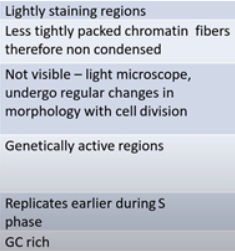
Euchromatin = lighlty staining
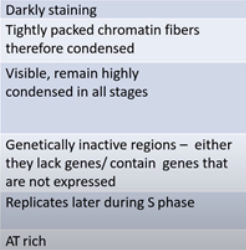
Heterochromatin = darkly staining
2 regions of chromatin
Euchromatin
Heterochromatin
Chromosome
● It controls the activities of cell
● Information of the form of genes is located in chromosomes
● Control inheritance and metabolism
DNA
contains the information needed for the creation of proteins (which include enzymes and hormones) and is stored in the nucleus, as already said, in the form of chromatin or chromosomes.

