Virginia Tech HNFE 4025 Dr. Anderson Exam 1 Review
 Studied by 0 people
 Call Kai
 Learn
Learn Practice Test
 Spaced Repetition
 Match
Match Flashcards
 Knowt Play
1/249

There's no tags or description
Looks like no tags are added yet.
Name | Mastery | Learn | Test | Matching | Spaced | Call with Kai |
|---|
No analytics yet
Send a link to your students to track their progress
250 Terms
metabolism
life sustaining chemical reactions that occur in the cells of our body; takes macronutrients and makes ATP
ATP
what is the life sustaining end product of macronutrient metabolism?
internal
our metabolism adapts in a physiological response to ___________ and external cues, which can be short term or long term
anabolism
___________ metabolism: to build/store
catabolism
___________ metabolism: to breakdown
carbohydrates, lipids, proteins
what are the 3 macronutrients in relation to metabolism?
carbohydrates, lipids
which macronutrient(s) is/are primarily used to produce ATP?
anabolic
glycogen, triglyceride, & protein synthesis are examples of (anabolic/catabolic) metabolism
catabolic
glycogenolysis, lipolysis, & protein degradation are examples of (anabolic/catabolic) metabolism
adenosine (adenine nucleotide + ribose sugar) & 3 phosphate groups (PO4)
what makes up ATP?
metabolic regulation
the response to a stressor that drives metabolism in one way or another
cellular
Metabolic Regulation
- can be short term or long term adaptation
- can be an anabolic or catabolic response
- occurs at a ___________ level
stressor
Metabolic Regulation
(1) ____________: meals, environment, toxins, time of day, exercise, etc.
↓↓↓↓
(2) response: transcription, translation, post-translational modification, signaling, etc.
long term
short term OR long term metabolic regulation?
dealing with DNA or building/destroying enzymes
short term
are post-translational modifications (PTMs) short term or long term metabolic regulation?
allosteric regulation
what type of metabolic regulation involves activating or inhibiting an enzyme via a ligand that binds to a separate site from the substrate binding site on the enzyme?
short term
is allosteric regulation short term or long term metabolic regulation?
competitive inhibition
what type of metabolic regulation involves something else getting in the way of the active site, preventing activation of the enzyme?
short term
is competitive inhibition short term or long term metabolic regulation?
substrates
Importance of Metabolic Regulation
- provision of _____________ (glucose, FAs, amino acids) to meet ATP demand
- ensure ample energy stores
- utilization of the substrate that is most abundant
- ATP production from alternative sources (example: PCr)
short term
Metabolic Regulation
___________________ = immediate adaptability to a stressor; rapid modifications that ensure our cells have adequate energy (ATP) to meet demands of stressors; seconds to minutes
examples:
(1) change from FA metabolism to Glucose metabolism with increases in %VO2max workload (the cross-over effect)
(2) going from fasted state over night to fed state after breakfast
long term
Metabolic Regulation
___________________ = physiological adaptations as a result of stressors applied over time; hours to days; transcription and translation are largely responsible
examples: dietary change, changes in physical activity, exposure to toxins, changes in health status
covalent
Short-Term Metabolic Regulation
Post-translational modifications (PTMs) involve ____________ additions of functional groups proteins during or after protein biosynthesis
transcription
Long-Term Metabolic Regulation
_______________ refers to the translation of genetic information from DNA to mRNA; the reading of DNA by RNA polymerase and the production of mRNA
translation
Long-Term Metabolic Regulation
_____________ refers to the transfer of genetic information from mRNA to make functional proteins via the reading of mRNA by ribosomes
in born
Ramifications of Metabolic Dysregulation
results from inability to adapt short term and/or long term
leads to...
- compromised performance
- compromised health → development of pathology (obesity, diabetes, metabolic syndrome, cancer)
- _____ ________ errors in metabolism (example: PKU)
metabolic regulation
______________ ______________ can occur through transcription of the DNA to mRNA, translation of the mRNA to proteins, or post-translational modifications (PTM) of enzymes; PTMS are transient
transcription factors
protein that binds to a DNA and initiates the transcriptional process; proteins involved in the process of converting, or transcribing, DNA into mRNA; include a wide number of proteins, excluding RNA polymerase
promoter
Transcription Factors
- TFs determine if we are going to get mRNA from each gene
- TFs determine which parts of the DNA get turned into mRNA and which don’t → different functionality of neurons versus muscle cells (for example)
- located in the ____________ region (upstream) of the genes to be transcribed
proteome
PTMs increase the _______________ complexity (after transcription and translation, we end up with lots of different proteins)
phosphorylation
PTMs: which one is described below?
adds a phosphate to serine, threonine, or tyrosine
glycosylation
PTMs: which one is described below?
attaches a sugar, usually to an "N" or "O" in an amino acid side chain
ubiquitination
PTMs: which one is described below?
adds ubiquitin to lysine residue of a target protein for degradation; flags a protein for degradation
SUMOylation
PTMs: which one is described below?
adds a small protein SUMO (small ubiquitin-like modifier) to a target protein
disulfide bond
PTMs: which one is described below?
covalently links the "S" atoms of two different cysteine residues
acetylation
PTMs: which one is described below?
adds an acetyl group to an N-terminus of a protein or at lysine residues
lipidation
PTMs: which one is described below?
attaches a lipid, such as a fatty acid, to a protein side chain
methylation
PTMs: which one is described below?
adds a methyl group, usually at lysine or arginine residues
hydroxylation
PTMs: which one is described below?
attaches a hydroxyl group (-OH) to a side chain of a protein
methylation
this PTM happens a lot at the promoter region, getting in the way of RNA polymerase binding → transcription inhibition
Allosteric regulation (allosteric control)
PTMs
the regulation of an enzyme by binding an effector molecule at a site other than the enzyme's active site; can be positive or negative
positive effector
Allosteric Regulation
allows the substrate or co-enzyme to more easily bind
negative effector
Allosteric Regulation
makes it harder for the substrate or co-enzyme to bind
products
Allosteric Regulation
usually allosteric effectors are _____________ of the enzymatic reaction that feed back on the enzyme, but can also be upstream substrates or downstream products of the metabolic pathway
allosteric site
PTMs: allosteric regulation
The site to which the effector binds during allosteric regulation is termed the ___________________
acetyl-CoA
PTMs: acetylation
- result from accumulation of ___________________ = product of macronutrient oxidation
- can increase or decrease protein activity, depends on the protein
- can also affect transcription by binding to histones
O-GlcNAcylation
Metabolic Regulation: PTMs
______________________
- the final end product of the hexosamine biosynthetic pathway
- important for proper nutrient sensing and stress regulation by maintaining proper cell signaling and transcription rates
- a result of several components from fatty acid, glucose, and amino acid metabolism
Glutathionylation
Metabolic Regulation: PTMs
______________________
- can increase or decrease activity of a protein, depends on the protein
- cysteine residues are the site of glutathione addition
- glutathione (GSH) is a protein important for preventing oxidative stress
epigenetics
Metabolic Regulation
_______________ refers to modifications to the DNA structure that affects transcription
example: methylation of the DNA (methylating the promoter region changes the ability to transcribe a gene, but doesn’t change the genetic code)
endoplasmic reticulum stress
Metabolic Regulation
_________________________ refers to abnormalities in forming the proper structure or conformation of a protein
transcriptional regulation
controlling the rate of gene transcription by helping or hindering RNA polymerase binding to DNA
upregulation, activation, or promotion
this form of transcriptional regulation increases the rate of gene transcription
downregulation, repression, or suppression
this form of transcriptional regulation decreases the rate of gene transcription
co-activator
Transcriptional Regulation
a protein which works with transcription factors to increase rate of transcription
co-repressor
Transcriptional Regulation
a protein which works with transcription factors to decrease rate of gene transcription
transcriptional-control region
Transcriptional Regulation
TFs regulate by binding to specific DNA sequences termed the __________________________
promoter
Transcriptional Regulation
this transcriptional-control region is usually in an area of a gene called the ____________ region
response elements
Transcriptional Regulation
the specific sequences that the transcription factors bind to are termed ___________ ____________
general, modulatory
Transcriptional Regulation
what are the 2 classes of TFs?
general
Transcriptional Regulation: TFs
______________ TFs are needed for transcription of most protein-coding genes
modulatory
Transcriptional Regulation: TFs
______________ TFs are those that modulate general transcription factors through activation of repression for cell specificity
gene
the individual unit of inheritance; the entire DNA sequence, including introns, exons and non-coding transcription control regions responsible for the production of a polypeptide (mRNA), tRNA or rRNA molecule
☺
understand this image of the layout of a gene
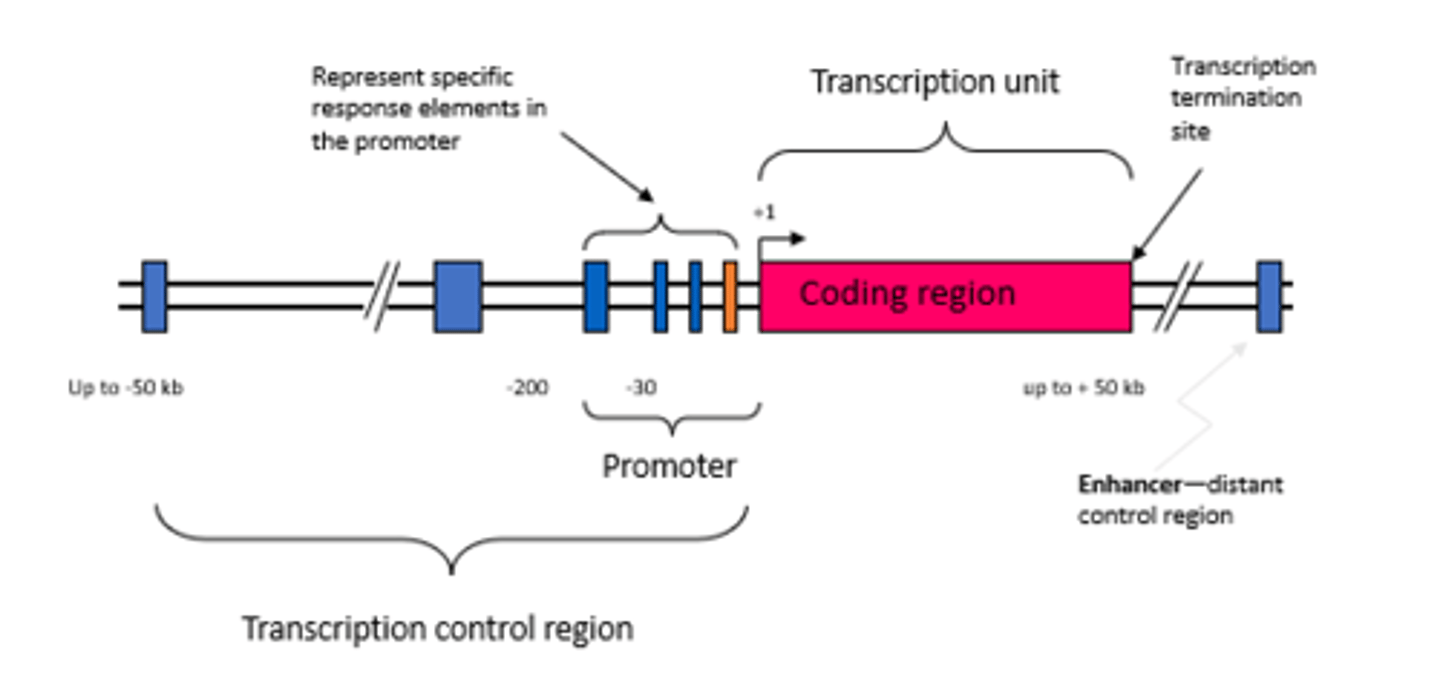
ligand
TF Activation
refers to a substance (substrate, metabolite, protein) that can bind to a transcription factor, which leads to activation
ligands
TF Activation
___________ are important for metabolic control
examples:
- transition from fasted to fed state
- post-absorptive period after a meal
- initiation of exercise
- adaptation to chronic exercise
- over consumption of energy (dependent of macronutrient)
storage
Proteins
- represent about 14-16% of the body weight of healthy adults
- no ____________ form of protein or constituent amino acids
- all proteins have a function: structure (skeleton), movement (contractile proteins), catalysis (enzymes), protection (antibodies), signaling, transport, etc.
- body protein is continually synthesized and degraded (actual amount of each protein reflects its rate of synthesis and breakdown)
more
Enzymes
- type of protein
- catalyze all chemical reactions in cells
- speed up reactions, but are not consumed in the reaction
- most enzymes are highly specific acting on a single substrate molecule or several substrate molecules
- enzymatic reactions can be: equilibrium (rxn goes both ways) or non-equilibrium (rxn goes 1 way; enzymes in these rxns are (more/less) regulated)
hydrolases
Enzyme Types
cleave compounds into two
isomerases
Enzyme Types
transfer atoms within a molecule
ligases/synthases
Enzyme Types
join compounds
oxidoreductases
Enzyme Types
transfer electrons
transferases
Enzyme Types
move functional groups
cofactor
Enzymes
some require a ____________ (eg: zinc, iron, copper) or coenzyme (eg: vitamin B) to carry out a reaction
kinases/phosphorylases
what type of enzymes phosphorylate things?
phosphatases
what type of enzymes take OFF phosphates?
AMP-activated protein kinase (AMPK)
this enzyme is responsive to AMP to add phosphates to drive ATP synthesis
ATP
AMPK
AMPK can be allosterically regulated
- AMP activates AMPK
- ________ inhibits AMPK
PKA (protein kinase A)
AMPK
AMPK can also be regulated covalently
- AMPK can itself be phosphorylated by what enzyme?
energy balance
State in which energy intake, in the form of food and/or alcohol, matches the energy expended, primarily through basal metabolism and physical activity
90
approx. _____% of the Kcals we ingest are absorbed, with 10% lost in feces, urine, respiration, and non-digestible food
basal metabolic rate (BMR)
Energy Expenditure Breakdown
_________________________ = sleeping metabolic rate + arousal (falling asleep/waking up)
fat free mass (muscle mass)
Energy Expenditure Breakdown
what is the biggest determinant for BMR?
other determinants include age, sex, genetics, hormones/sympathetic NS
65
BMR
- energy expended to maintain base, or resting, functions of the body
- highest proportion (~____%) of total energy budget
- decreases with age (~3-5% per decade after ~30)
height
Factors that INCREASE BMR
- higher lean body mass
- greater ___________ (more SA)
- younger age
- elevated thyroid hormone levels
- stress
- being male
- pregnancy and lactation
- certain drugs (stimulants, caffeine, tobacco)
starvation
Factors that DECREASE BMR
- lower lean body mass
- lower height
- older age
- depressed levels of thyroid hormones
- ____________ or fasting
- being female
thermic effect of food (TEF)
Energy Expenditure Breakdown
energy expended to process food
5-10%
Energy Expenditure Breakdown
Thermic Effect of Food (TEF)
- accounts for ~_______% of total energy budget
- fat requires less energy to digest, transport and absorb
- proteins and carbs require more (transporting glucose and storing glycogen costs ATP)
- proteins require the most (protein synthesis costs ATP)
food
Energy Expenditure Breakdown
Thermic Effect of Food (TEF) determinant is the amount/composition of _______ (hormones/SNS)
spontaneous PA & thermogenesis (NEAT = non-exercise activity thermogenesis)
Energy Expenditure Breakdown
______________________ = fidgeting and shifting in one's seat + facultative thermogenesis
thermogenesis
Energy Expenditure Breakdown
the production of heat, especially in a human or animal body
facultative thermogenesis
Energy Expenditure Breakdown
regulated production of heat in response to environmental changes in temperature and diet
unrestricted activity
Energy Expenditure Breakdown
________________ = physical activity
determinants: intensity, duration, body weight, psychological, environmental, genetics/SNS
20-35
Energy Expenditure Breakdown
Physical Activity (unrestricted)
- average of _________% of total energy budget
- includes everything above basal level (sitting, standing, walking)
- moving large muscles requires more energy
- calculating energy expenditure: energy cost (kcal/kg/min) * Time (min)
food balances
Energy intake can be measured
(1) directly via ______ _____________
- subtract the ending weight from the beginning weight to determine the amount eaten (& any left on the floor of the cage)
- in humans we use food diaries for free living OR participants eat in a food lab
Comprehensive Lab Animal Monitoring System (CLAMS)
Energy Expenditure can be measured….
- using a what? = a closed cage that measures respiration
- in humans we use metabolic chambers or indirect calorimetry with a metabolic hood
ergometers
Energy expenditure during exercise can be measured
- voluntary using a wheel with a counter or assisted using a treadmill with an electric grid that shocks the rodent if they slide off the treadmill- some of these systems can measure gas exchange
- in humans we use treadmills and cycle ______________ mostly using indirect calorimetry with a gas exchange mask
ventilated hood
measures energy expenditure (kcal) and precisely how much fat and CHO is being used to make ATP. Measures are generally less than 1 hour, and extrapolated to 24 h energy expenditure.
Whole room calorimeter
measures energy expenditure (kcal) and precisely how much fat and CHO is being used to make ATP, but for 24 hour periods; using either gas exchange (indirect) or heat produced (direct)
Doubly labeled water
- uses water (2H218O) labeled with stable isotopes; humans consume the water
- isotopes equilibrate with water in the body
- isotopes are recovered in breath (CO2) and urine (water)
- research based tool that is insanely expensive
- very precise tool for measuring energy expenditure
- the rate that the isotopes show up in urine and breath, is proportional to energy expenditure, e.g., higher EE, faster appearance in urine and breath.
facultative thermogenesis
Contributions to Energy Balance
Input
- hunger/satiety mechanisms: central, peripheral
- environmental factors: food consumption, food accessibility, non-hunger related eating
Output
- energy burn: BMR/RMR
- thermic effect of food
- physical activity
- _____________ ____________________
 Note
Note  Flashcards (76)