Bio 101 Exam 3
 Call Kai
 Learn
Learn Practice Test
 Spaced Repetition
 Match
Match Flashcards
 Knowt Play
1/79

There's no tags or description
Looks like no tags are added yet.
Name | Mastery | Learn | Test | Matching | Spaced | Call with Kai |
|---|
No analytics yet
Send a link to your students to track their progress
80 Terms
Why do cells need to divide?
growth
development
replace damaged cells
replace old cells
immune response
maximize SA:V ratio
Mitosis
division of DNA in the nucleus
happens in somatic cells
1 parent cell divides into 2 daughter cells
each cell contained an identical copy of DNA from the parent
Stages of Cell Cycle
G1 → S → G2 → M → C
Stages of Mitosis
interphase (before)
prophase
prometaphase
metaphase
anaphase
telophase/cytokenesis
interphase
preparing to divide
G1 → S → G2
G1 - growth, make protein, copy organelles
S - copy DNA/centrioles
G2 - growth, checkpoints
What does it mean for a cell to switch to the G0 phase
cell exits cell cycle and stops dividing
Apoptosis
cell programmed death if the process has any mistakes
removes damaged, infected, unnecessary cells to maintain health
Cyclins
signaling proteins and control passage from 1 stage to the next
act as checkpoints
Cancer
uncontrolled cell division
cyclins don’t work properly and cells speed through cell cycle ignoring cyclins (stop signs)
Contact inhibition + Cancer
when cells stop dividing when they touch neighboring cells
cancer lose it → cells start piling up an form a tumor (mass of cells)
Chromatin
complex of DNA and proteins that make up eukaryotic chromosomes (stringy)
Chromosome
one very long condensed DNA molecule
humans have 46 total (diploid); 23 from mom and 23 from dad (haploid)
Diploid
2 sets of chromosomes
somatic cells
Haploid
1 set of chromosomes
gametes
Somatic Cells
Body cells
Gametes
sperm/eggs
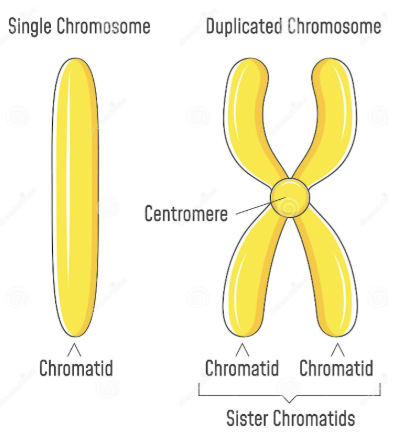
Parts of a duplicated chromosome
Prophase
nucleus begins to disappear
chromosomes condense
centrosomes form + begin moving apart
Prometaphase
Nucleus disappears completely, including nucleolus
Spindle fibers extend and attach to the kinetochore (centromere region)
Chromosomes begin to move and line up → moved by spindle fibers
Metaphase
chromosomes align single file in middle of cell
Anaphase
sister chromatids separate and move to opposite poles
Telophase
Each daughter cell begins to form a nuclear membrane
Nucleolus returns
Chromosomes unravel → become chromatin again
Happens at the same time/sequentially as cytokinesis (division of the cytoplasm)
Cytokinesis (animals)
after mitosis 2 nuclei are in the same cell
cell membrane starts to pinch in at the center of the cell
cleavage furrow forms - acts as a belt tightening in the middle
furrow deepens and separates 2 daughter cells with their own nuclei
Cytokinesis (plants)
after mitosis 2 nuclei are in the same cell
vesicles from golgi gather in middle of cell
vesicles fuse to form a cell plate
cell plate grows outward toward existing cell walls - reaches edges and splits cell into 2 daughter cells with their own nuclei
Mitosis vs. Cytokinesis
Mitosis -
division of nucleus and DNA
results in 2 identical nuclei
4 phases
Cytokinesis -
division of cytoplasm and organelles
results in 2 separate daughter cells
happens after mitosis
Asexual Reproduction
single parent
no fusion of gametes
offspring are (in most cases) identical to parent (creates clones)
single cell organisms reproduce asexually through cell division
Sexual Reproduction
2 parents
gametes
Offspring have unique combinations of genes inherited from both parents - genetically different from siblings and parents
genetic variation advantageous for environmental changes
Binary Fission
a single cell splits into two identical cells, each with the same DNA as the original
how bacteria reproduce
1 chromosome
Genetics
field of study involving inheritance and hereditary variation
Genes
discrete unit of heredity information consisting of a specific sequence in DNA
located on chromosome
hereditary traits passed from 1 generation to the next
Locus
the specific location on a chromosome
Gene A is always at the same locus in every individual within a species (same place on same chromosome)
Karyotype
ordered display of all chromosomes in a cell arranged in pairs of homologous chromosomes
provides information about number of chromosomes, detect genetic disorders, and shows if there are missing or extra chromosomes
Homologous Chromosomes
paired chromosomes of the same size, shape, and genes
Autosomes
all other chromosomes (not sex chromosomes X and Y)
Alleles
different versions of the same gene that exist at the same locus
can determine eye color, hair color, etc.
Ploidy
the number of sets of chromosomes in a cell
Polyploidy
cells that have more than 2 sets of chromosomes (tetraploid, hexaploid, etc.)
Euploidy
correct number of chromosomes for a species
ex: humans have 46 (2 sets of 23)
Aneuploidy
change in chromosome number resulting from nondisjunction
ex. down syndrome 3 copies of chromosome 21 instead of 2
Nondisjunction
chromosomes fail to separate properly during meiosis
one gamete gets too many chromosomes and the other gets too few
can lead to aneuploidy
affects offspring that develops from abnormal gamete
Human Life Cycle
starts with 2 haploid gametes (n=23)
fertilization - fusion of 2 nuclei of gametes (2 sets of chromosomes 2n=46)
creates zygote (diploid fertilized egg)
repeated mitosis and development single cells become mature multicellular adult
Why does the human life cycle need to alternate between haploid and diploid
So that chromosome numbers remain constant from generation to generation
Fertilization with 2 diploid cells would double the chromosome number (2n + 2n = 4n or 96 chromosomes)
Meiosis
how chromosome number gets reduced - counterbalances fertilization
in gonads of sexually reproducing organisms
created haploid gametes (sperm/egg)
2 rounds of cell division; 1 round of DNA replication
Results in cells with half the number of chromosomes sets as the original cell
Meiosis is a ___ divison
reductional
What major events occur in prophase 1 of meiosis?
Chromosome condense
Nuclear envelope breaks down
Centrosomes separate
Spindle fibers form and attach to kinetochores
Homologous chromosomes pair up (synapsis) to form tetrads (akas bivalents)
Crossing over occurs → causes genetic variation
Tetrads
2 homologous chromosomes pair up and each chromosome is replicated = 4 chromatids
formed during meiosis in prophase 1
break apart in anaphase 1
Crossing Over
genetic swap between homologous, non-sister chromatids (one from each chromosome in a tetrad exchange dna)
occurs in prophase 1 of meiosis
increases genetic diversity, helps chromosomes separate correctly
Anaphase 1
homologous chromosomes separate and move to opposite poles
Sister chromatids remain attached
Anaphase 2
sister chromatids separate and move toward opposite spindle poles
same as mitosis
Metaphase 1
Pairs of homologous chromosomes (tetrads) line up at the metaphase plate
Metaphase 2
Chromosomes align at the metaphase plate → single file
sister chromatids may not be genetically identical because crossing over occured
most similar to mitosis
daughter cells at the end of mitosis vs. meiosis
mitosis - 2 diploid daughter cells genetically identical to parent
meiosis - 4 haploid daughter cells, half as many chromosomes as parent + genetically different from parent
When do cells first become haploid in meiosis
telophase 1
Spermatogenesis
occurs in testes
makes 4 sperm cells
small and mobile
begins at puberty and continues through life
cytoplasm divides evenly among 4 sperm
Oogenesis
occurs in ovaries
makes 1 functional egg and 3 polar bodies
large and non-mobile
begins before birth, pauses, and then continues from puberty to menopause
cytoplasm divides unevenly producing 1 large egg
Gametogenesis
generic term for sperm and egg formation
Chromosome mutation
change in structure of number of chromosomes which can affect many genes at once
Trait
genetically determined characteristic → expression of proteins
ex. hair color, eye color, etc. (general category)
Phenotype
physical appearance of a trait (what you see)
Genotype
genetic makeup of a trait (the letters)
Dominant
always expressed if present → use capital letter (B)
Recessive
only expressed if there are 2 of the same no dominant allele is present → use lowercase letter (b)
P1 generation
True breeding, parental generation
homozygous dominant or homozygous recessive for the trait
F1 generation
1st filial generation
Offspring from P generation
F2 Generation
Second filial generation
Offspring from the F1 generation
Law 1: Law of Dominance
an organism with a dominant allele will express the dominant trait
An organism with a recessive allele will only express the recessive trait if the dominant allele is not present
Law 2: Law of Segregation
Punnet Square
Each individual has 2 “factors” (alleles) for each trait - one from mom one from dad
Alleles separate during the formation of gametes
Alleles are found on homologous chromosomes
Fertilization gives each new individual 2 allele for each trait
Homozygous - 2 allele are the same
Heterozygous - 2 alleles are different
Expressed in monohybrid cross
Law 3: Law of Independent Assortment
Each pair of alleles segregates (assorts) independently of other traits in meiosis
The inheritance pattern of 1 trait will NOT affect the inheritance pattern of another
For a single human gamete, the possible ways for chromosomes to assort is an astounding 8388608 (223) possible combinations
All possible combinations of alleles can occur in the gamete
Expressed in a dihybrid cross (2 traits)
What factors / events contribute to the great diversity among individuals within a sexually reproducing species?
random fertilization
independent assortment of chromosomes
crossing over (recombination)
mutations
Why is diversity within a species so important that many organisms reproduce sexually?
creates genetic diversity
adaptation to environments
disease resistance
evolutionary advantage
test cross
used to discover the unknown genotype of a known phenotype (the dominant phenotype)
Cross a true breeding recessive individual (yy) with a dominant phenotype (YY or Yy unknown)
ratio reveals genotype - if any with the recessive trait appear, unknown must be heterozygous
Multiple alleles
Some traits have more than 2 allele
Ex: Blood type in humans (A, B, O alleles)
Incomplete Dominance
Occurs when 1 allele is not completely dominant over another
Results in blending of traits
Codominance
In cases of multiple alleles sometimes more than 1 allele can act as a dominant allele
Ex: Blood type in humans (A, B, O alleles) - codominance A and B
Incomplete penetrance
Alleles have a “true” dominant/recessive relationship, but dominant does not always determine the phenotype
Polydactyly: autosomal dominant, but not all who inherit the gene have additional fingers
Pleiotropy
single gene affects multiple traits
sickle cell disease - affects blood, oxygen transport, and disease resistance
Epistasis
the action of 1 gene overrides the actions of another gene
Polygenic Inheritance
a phenotype is determined by more than one gene
most human traits (skin color, height, etc.)
X-linked inheritance
Some traits are not located on autosomes but instead are on sex chromosomes - can lead to phenotypes based on sex
males affected more - only have one X chromosome
Females with 1 copy are considered carriers and can pass it to their offspring - half her sons will be affected, half her daughters will be carriers, and daughters can be affected if dad contributed affected X chromosome
Pedigree analysis
autosomal dominant - trait appears in every generation, affected need to have at least one affected parent
autosomal recessive - traits can skip generations, affected individuals may have carrier parents
X-linked recessive - trait often skips generations, affected fathers cant pass to son but daughters of affected fathers are all carriers

