Human Attention
 Studied by 0 people
 Call with Kai
 Learn
Learn Practice Test
 Spaced Repetition
 Match
Match Flashcards
 Knowt Play
1/10

There's no tags or description
Looks like no tags are added yet.
Name | Mastery | Learn | Test | Matching | Spaced | Call with Kai |
|---|
No study sessions yet.
11 Terms
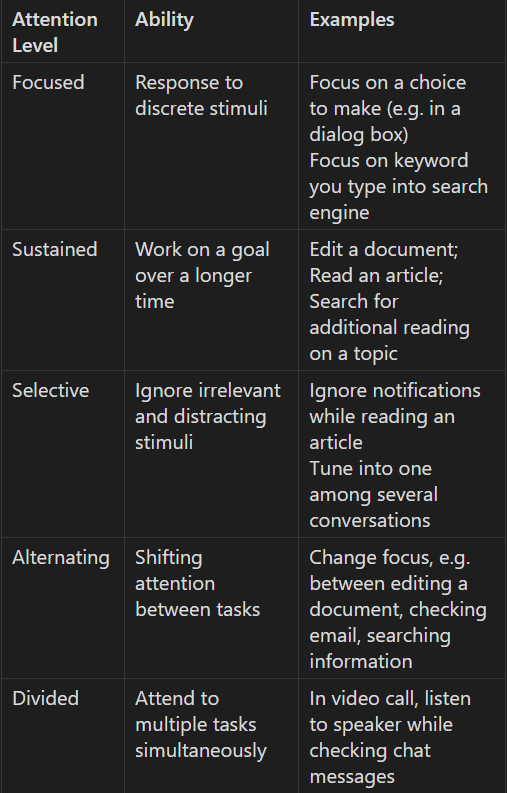
What are the Types of Attention?
What is the Spotlight Model?
metaphor for focused attention
only what the spotlight illuminates can be seen, everything else is in the dark
What is Working Memory?
determined by focused attention
the information we focus on is brought to the foreground of our awareness
What is Selective Attention?
the ability to focus attention on one stimulus while ignoring distractions
filter model - selective filter in processing of sensory ‘data’, only selected data becomes processed further
visual attention control - overt attention (where we look), covert attention (what we notice in the periphery)
What is Auditory Attention Control?
attenuation model - information isn’t filtered but volume is turned down
cocktail party effect - ability to focus on one conversation, still processing others in the background, attention to the familiar
What is Top-Down Attention?
based on our goals, intentions and expectations
internal cues/triggers
What is Bottom-Up Attention?
driven by sensory stimuli
external cues
involuntary
What is a Saliency Map?
an image in which the brightness of a pixel represents saliency
highlights regions of interest
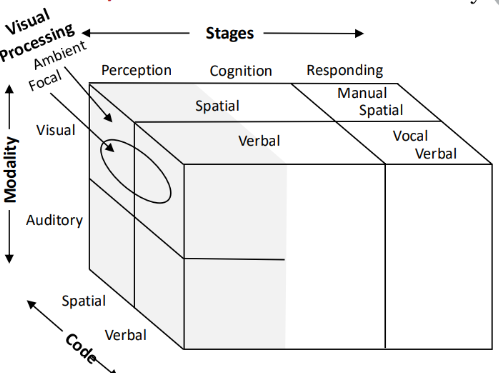
What is the Multiple Resource Theory?
processing stages
perception and cognition draw on shared resources (working memory)
but we can attend to new stimuli while responding to prior ones
modality
different modalities draw on different resources: audio, video, tactile, …
visual processing
different resources for foveal processing and peripheral awareness
codes
different resources for information that is spatial versus semantic
What is Inattentional Blindness?
not noticing information that is in plain view because we are not directing any attention to it
What is Change Blindness?
not noticing changes that have been introduced into the visual scene
can happen when they coincide with an interruption of the visual perception
 Note
Note  Flashcards (40)