Bio 2 Test 3

0.0(0)
Studied by 0 people
call kaiCall Kai
learnLearn
examPractice Test
spaced repetitionSpaced Repetition
heart puzzleMatch
flashcardsFlashcards
GameKnowt Play
Card Sorting

1/84

encourage image

There's no tags or description

Looks like no tags are added yet.

Last updated 8:44 PM on 3/13/26
Name
Mastery
Learn
Test
Matching
Spaced
Call with Kai

No analytics yet

Send a link to your students to track their progress

85 Terms

1
New cards

What does evolution start with and affect? What is it?

  • Evolution affects populations, not individuals

  • Evolution starts with a population (gene pool)

    • A population is a group of individuals of a single species that live and interbreed in a shared geographic area

2
New cards

Over time, in the bounds of constraints and trade-offs, evolutionary changes happen due to….. What is the result of this?

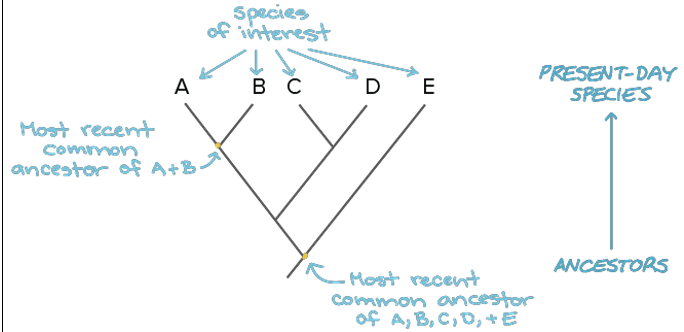
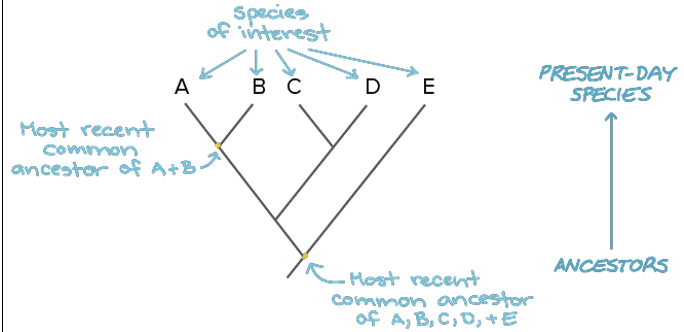
  • Evolutionary processes

    • Natural selection

    • Mutation

    • Gene flow

    • Genetic drift

    • Non-random mating

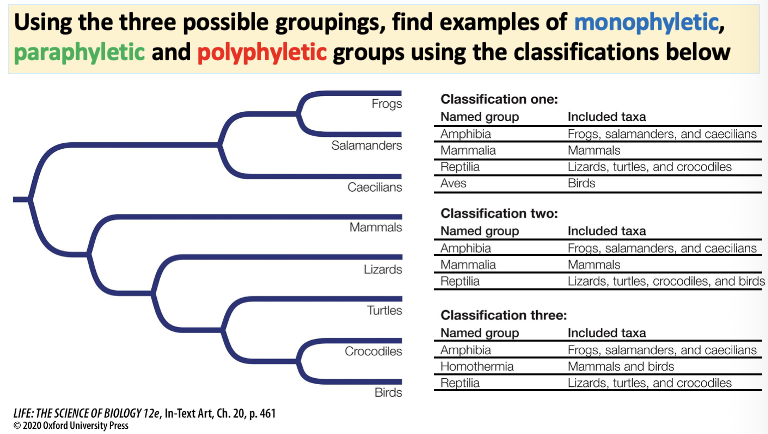
  • A different gene pool (genetic makeup) is created that can further drive the origination or extinction of a species.
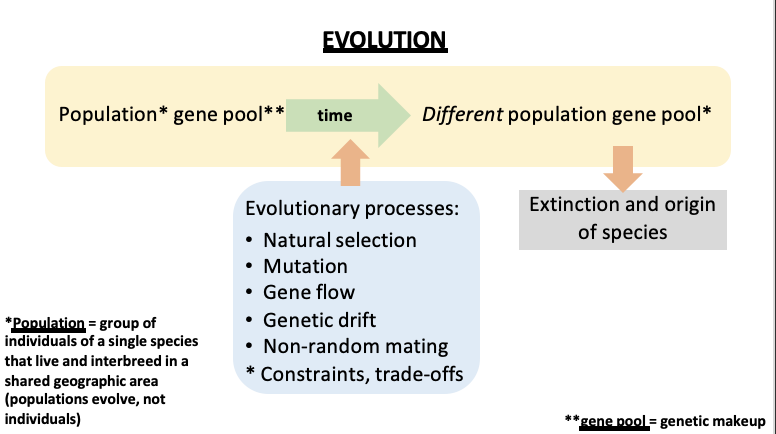
<ul><li><p>Evolutionary processes</p><ul><li><p>Natural selection</p></li><li><p>Mutation</p></li><li><p>Gene flow</p></li><li><p>Genetic drift</p></li><li><p>Non-random mating</p></li></ul></li><li><p>A different gene pool (genetic makeup) is created that can further drive the origination or extinction of a species.</p></li></ul><p></p>
3
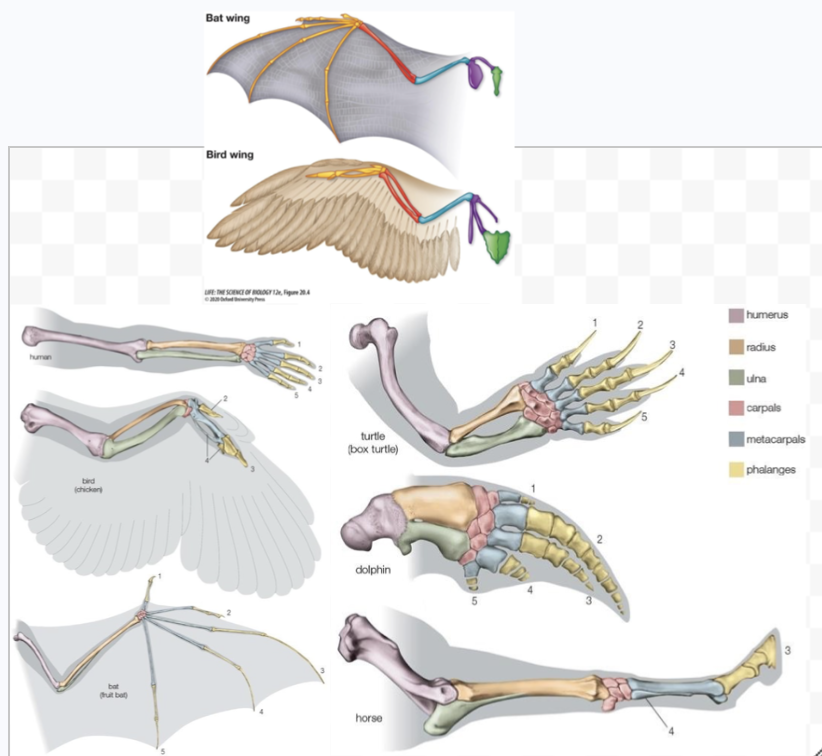
New cards

How do we know evolution is happening?

Vast evidence from geological, morphological, behavioral, and molecular data that can be observed in the lab or natural populations.

4
New cards

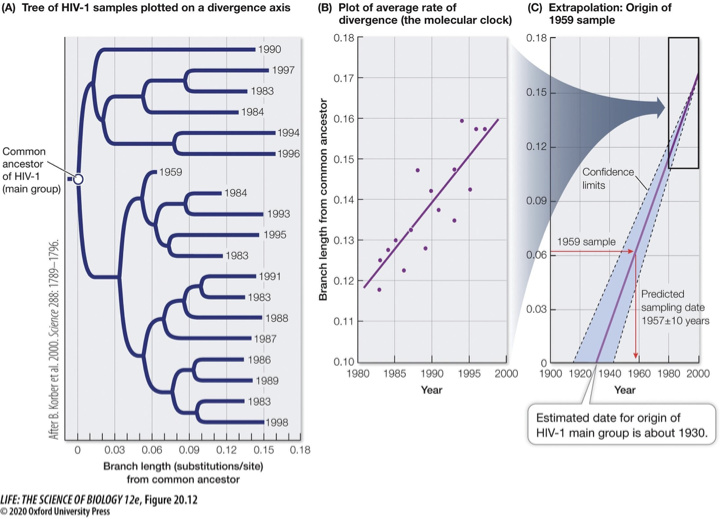
Who proposed natural selection and how did they come upon it?

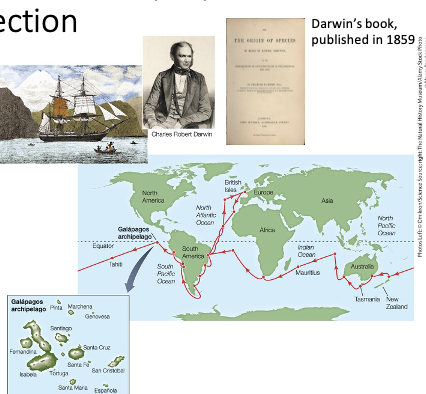
  • Charles Darwin and Alfred Wallace- Natural Selection

    • The goal of their mission: chart the oceans; collect oceanographic and biological information

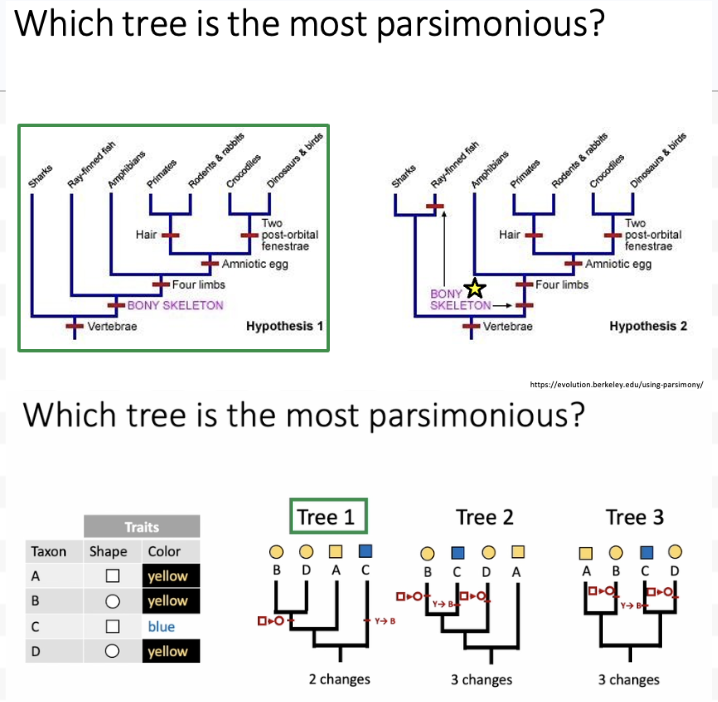
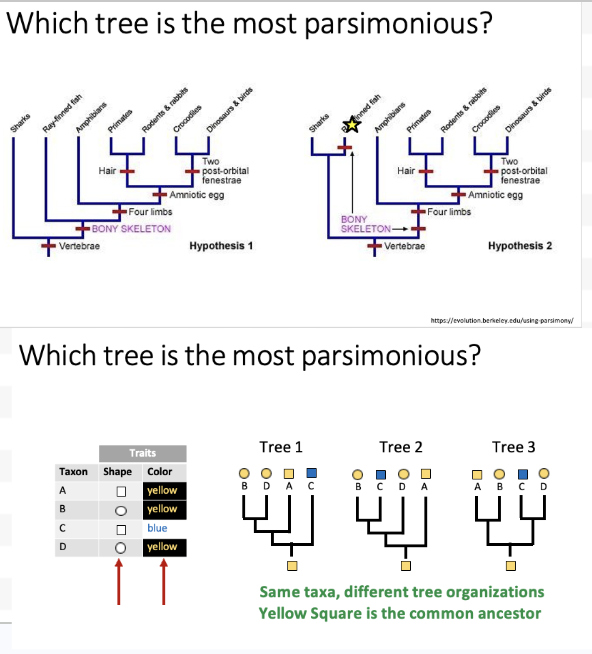
  • Darwin’s Findings:

    • He observed differences in the animals in Europe versus those in South America

    • Animals in temperate and tropical regions in South America were similar

    • In the Galapagos Islands, some animals were only found in that area

      • Island-to-island differences

<ul><li><p>Charles Darwin and Alfred Wallace- Natural Selection</p><ul><li><p>The goal of their mission: chart the oceans; collect oceanographic and biological information</p></li></ul></li><li><p>Darwin’s Findings:</p><ul><li><p>He observed differences in the animals in Europe versus those in South America</p></li><li><p>Animals in temperate and tropical regions in South America were similar</p></li><li><p>In the Galapagos Islands, some animals were only found in that area</p><ul><li><p>Island-to-island differences</p></li></ul></li></ul></li></ul><p></p>
5
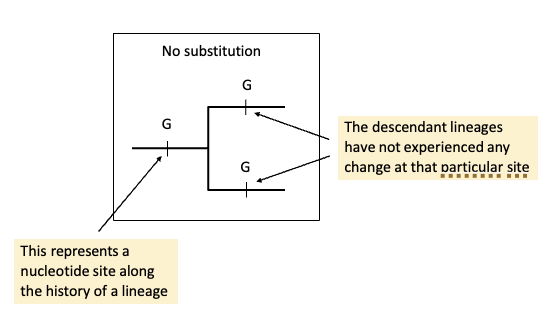
New cards

What were Darwin’s 3 primary evolutionary frameworks?

  • Species are not immutable

    • They change over time

  • Descent with modification

    • Divergent species share a common ancestor

    • Species diverged from one another gradually over time

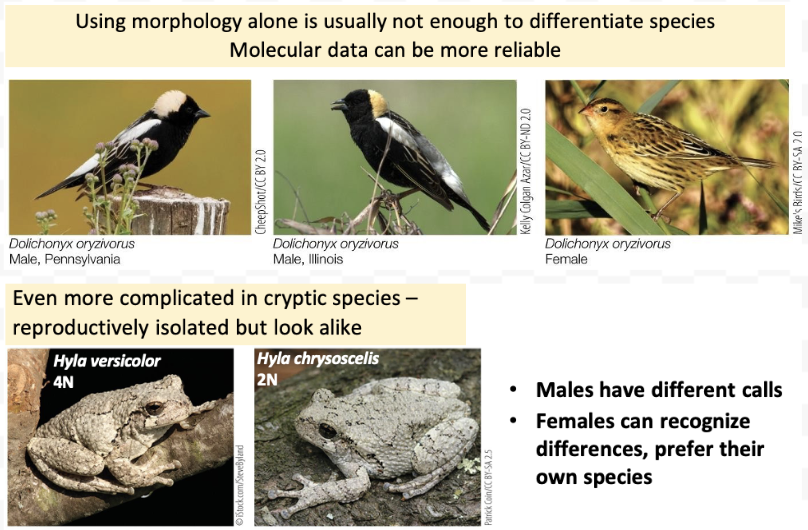
  • Changes in species over time can be explained by natural selection
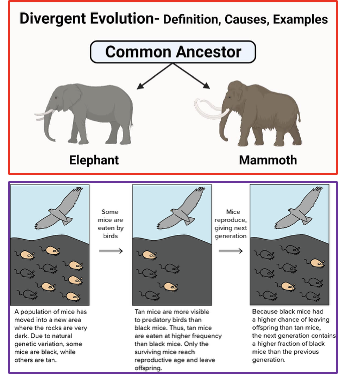
<ul><li><p>Species are not immutable</p><ul><li><p>They change over time</p></li></ul></li><li><p>Descent with modification</p><ul><li><p>Divergent species share a common ancestor</p></li><li><p>Species diverged from one another gradually over time</p></li></ul></li></ul><ul><li><p>Changes in species over time can be explained by natural selection</p></li></ul><p></p>
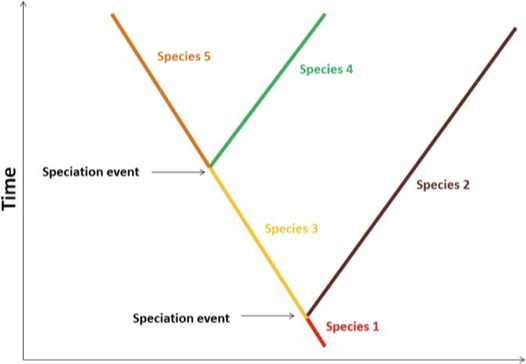
6
New cards

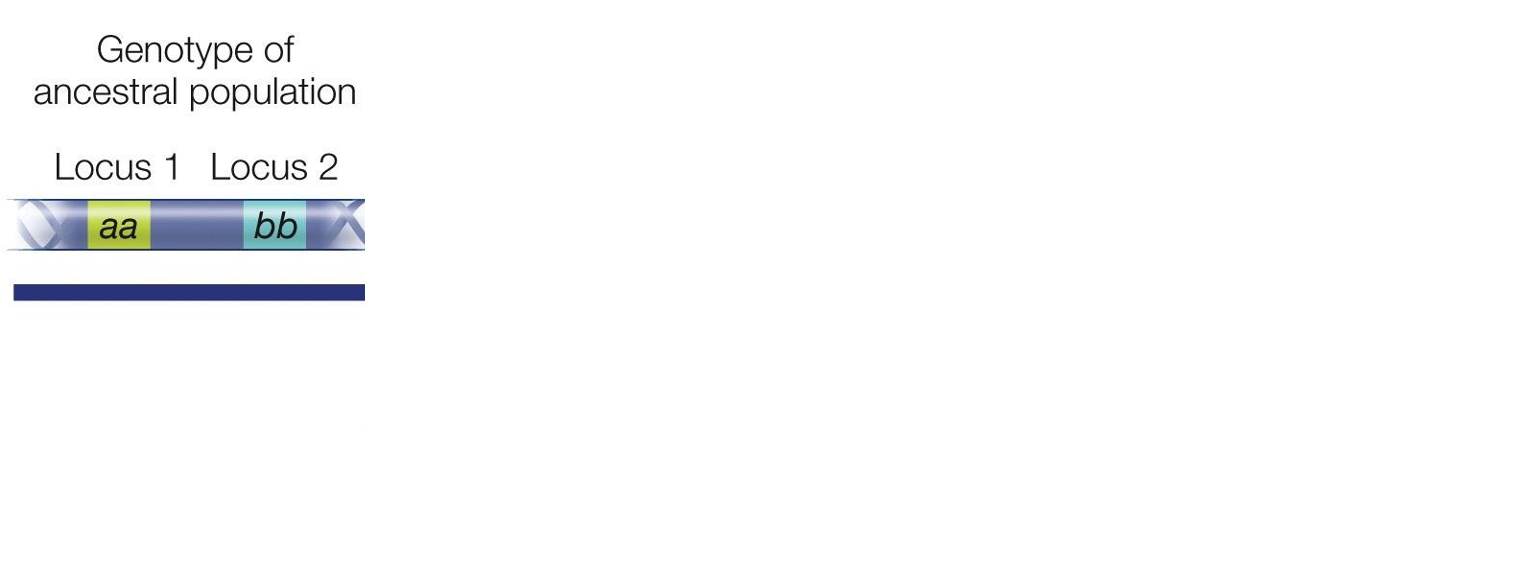
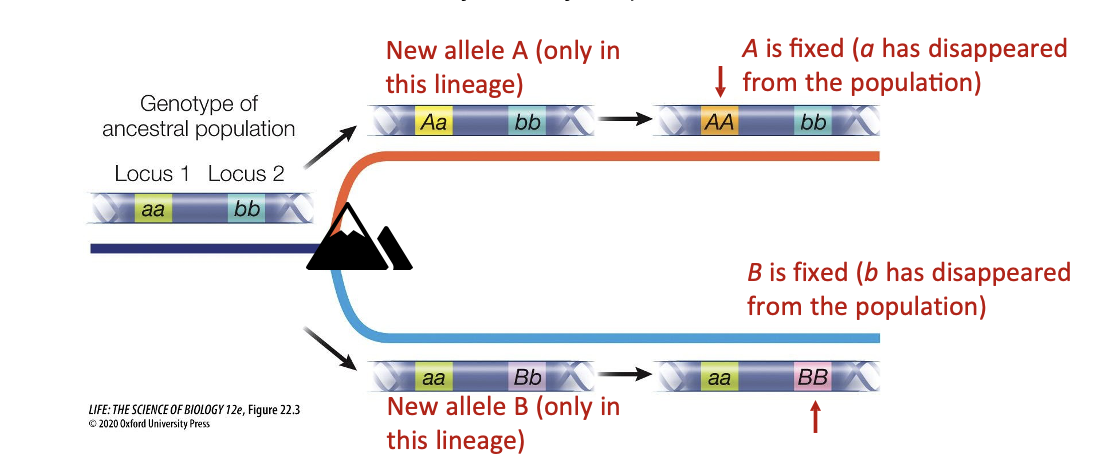
Evolution can be cause by ___ ___. Explain this

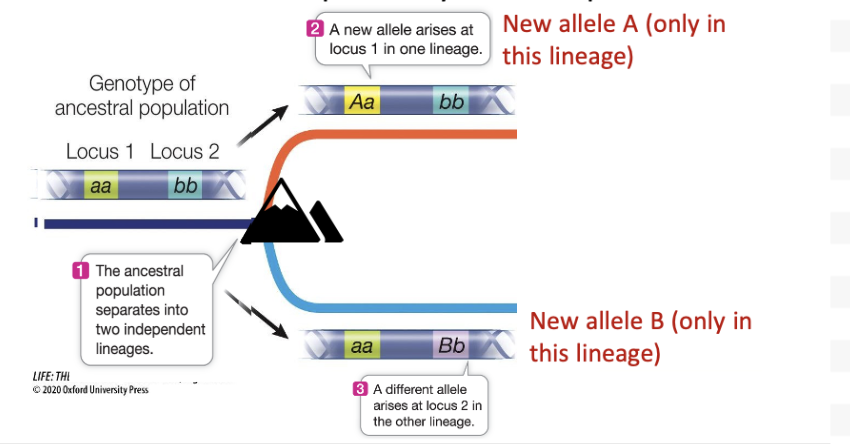
  • Natural Selection

    • Increased relative individual fitness (survival and reproduction success over a lifetime) of certain individual phenotypes within a population:

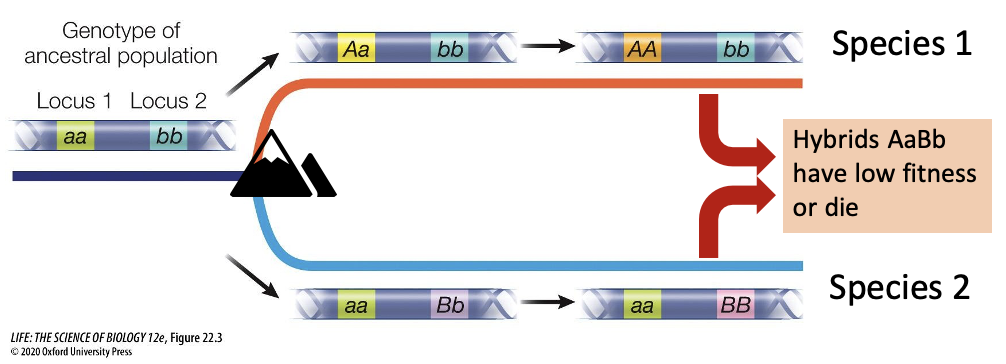
      • Genetic Variation in a population (due to mutations)

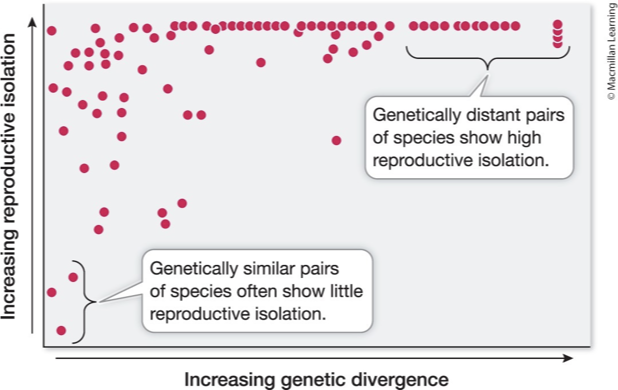
      • Heritable Traits

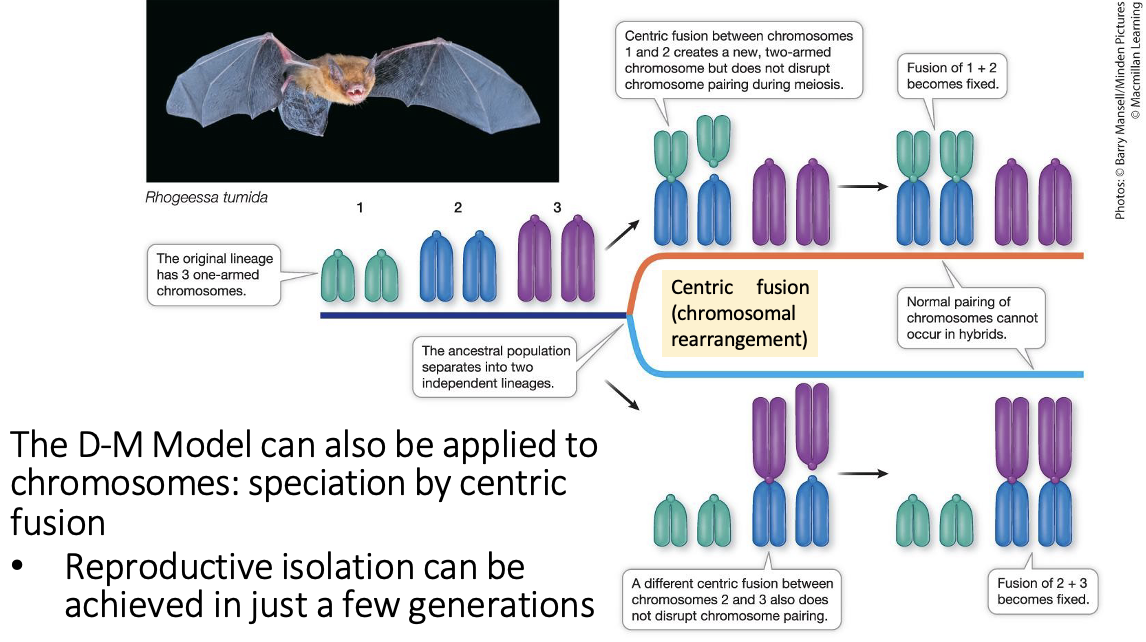
      • The traits are related to fitness (survival and reproduction)

  • The result/consequence

    • The favored phenotypes (and the corresponding underlying genetic differences) are spread throughout the population and to future generations: leading to evolution

7
New cards

A population’s genetic structure can be described by ___ and ___ frequencies. Explain what this structure is.

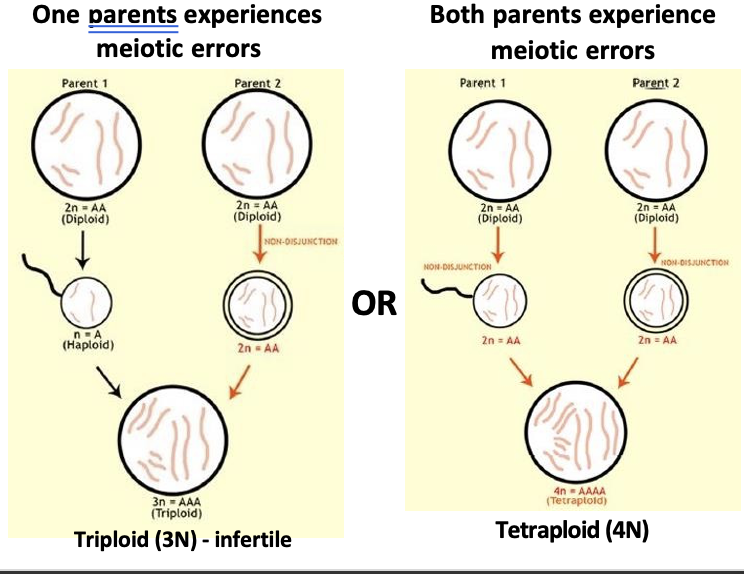
  • Allele, genotype

  • The Gene Pool’s Structure

    • 2 Key descriptions:

      • Allele Frequency

        • The proportion of individual alleles in a population

          • Example: Frequency of allele X1 vs. allele X2 in a population

    • Genotype Frequency

      • The proportion of genotypes (which are composed of multiple alleles)

        • Example: Frequency of the Genotype X1X2 vs. X1X1 in a population
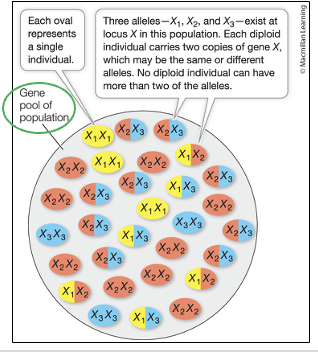
<ul><li><p>Allele, genotype</p></li><li><p>The <strong>Gene Pool’s</strong> Structure</p><ul><li><p>2 Key descriptions:</p><ul><li><p>Allele Frequency</p><ul><li><p>The proportion of individual alleles in a population</p><ul><li><p>Example: Frequency of allele X1 vs. allele X2 in a population</p></li></ul></li></ul></li></ul></li><li><p>Genotype Frequency</p><ul><li><p>The proportion of genotypes (which are composed of multiple alleles)</p><ul><li><p>Example: Frequency of the Genotype X1X2 vs. X1X1 in a population</p></li></ul></li></ul></li></ul></li></ul><p></p>
8
New cards

Evolution is defined by changes in ____ frequencies, NOT ____ frequencies

Allele, genotype

9
New cards

What are adaptations?

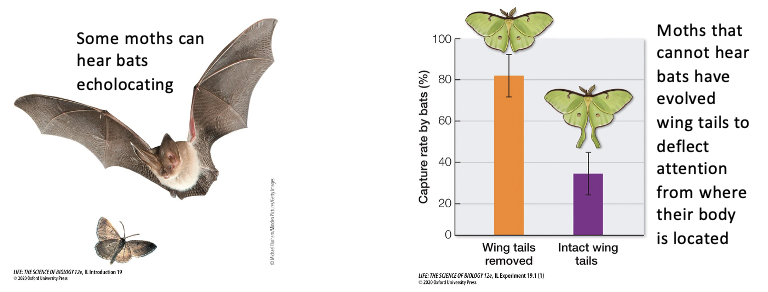
  • Favored traits that are spread through a population by natural selection

  • They tend to be favorable for a specific organism in a particular habitat

    • Describes a trait and a process

      • Some moths can hear bats echolocating

      • Moths that cannot hear bats have evolved wing tails to deflect attention from where their bodies are located
<ul><li><p>Favored traits that are spread through a population by natural selection</p></li><li><p>They tend to be favorable for a specific organism in a particular habitat</p><ul><li><p>Describes a trait and a process</p><ul><li><p><span>Some moths can hear bats echolocating</span></p></li><li><p><span>Moths that cannot hear bats have evolved wing tails to deflect attention from where their bodies are located</span></p></li></ul></li></ul></li></ul><p></p>
10
New cards

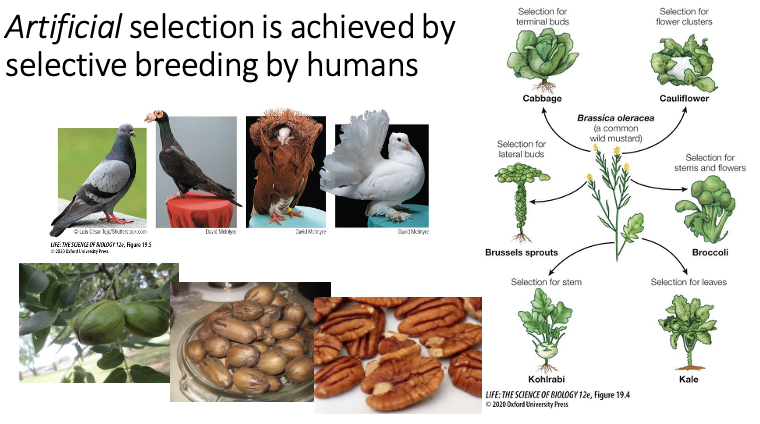
What is artificial selection?

  • When certain traits are selected for by humans
<ul><li><p>When certain traits are selected for by humans</p></li></ul><p></p>
11
New cards

What do mutations generate? Where are they common? Are they maintained?

  • Genetic variation: raw material for evolution by selections

    • Basis for genetic variation

  • At the population level, mutations are common (in contrast to where mutations are a more rare event in individuals)

    • Mutations can stem from unfixed errors in DNA replication

  • Mutations are maintained in a population when the mutation is beneficial (via natural selection)

    • Can be a form of adaptation

12
New cards

What is gene flow? What can it change?

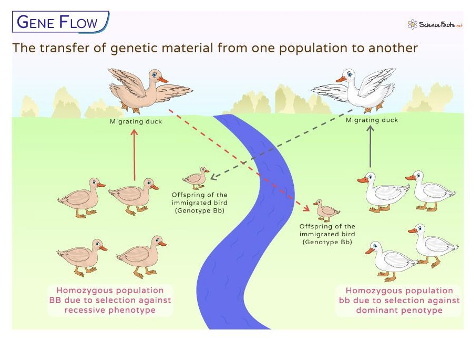
  • Gene flow is the exchange of genetic material between populations through migration of individuals or movement of gametes (i.e., pollen dispersal)

    • This exchange of allele frequencies in a population

    • Populations are not isolated from each other: they can experience emigration and immigration.

      • Two different populations of ducks. Immigration/emigration. Dispersal of gametes is like in pollination. If they can breed, they can introduce new alleles into the respective population. A homozygous dominant cross with a homozygous recessive.
<ul><li><p><span><strong>Gene flow</strong> is the exchange of genetic material between populations through migration of individuals or movement of gametes (i.e., pollen dispersal)</span></p><ul><li><p>This exchange of allele frequencies in a population</p></li><li><p><span>Populations are not isolated from each other: they can experience emigration and immigration.</span></p><ul><li><p><span>Two different populations of ducks. Immigration/emigration. Dispersal of gametes is like in pollination. If they can breed, they can introduce new alleles into the respective population. A homozygous dominant cross with a homozygous recessive. </span></p></li></ul></li></ul></li></ul><p></p>
13
New cards

What is genetic drift? What does it impact the most and why?

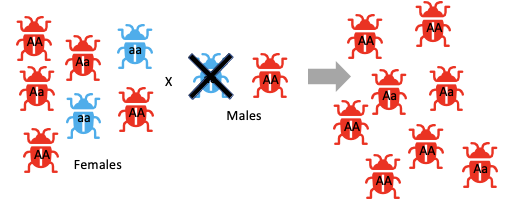
  • Random evolutionary process that impacts small populations the most.

    • Why? Chance events have a proportionately larger impact on their smaller gene pools, leading to rapid, significant shifts in allele frequencies.

  • Is a process of random changes in allele frequencies over generations

    • This impacts the ratio of deleterious vs beneficial alleles.

    • In small populations, advantageous alleles might be lost, and harmful ones spread.

      • Blue little a allele is starting to be removed over time if the only male breeder is the red beetle.
<ul><li><p>Random evolutionary process that impacts <strong>small populations</strong> the most.</p><ul><li><p>Why? Chance events have a proportionately larger impact on their smaller gene pools, leading to rapid, significant shifts in allele frequencies.</p></li></ul></li></ul><ul><li><p>Is a process of random changes in allele frequencies over generations</p><ul><li><p>This impacts the ratio of deleterious vs beneficial alleles. </p></li><li><p><span>In <u>small populations</u>, advantageous alleles might be lost, and harmful ones spread. </span></p><ul><li><p><span>Blue little a allele is starting to be removed over time if the only male breeder is the red beetle.</span></p></li></ul></li></ul></li></ul><p></p>
14
New cards

What is the effect of genetic drift on large populations? What are the two types?

  • In large populations, frequencies of neutral alleles (no effect on fitness) might change.

    • Founder effect and bottleneck effects

15
New cards

What is a population bottleneck?

  • Result of an environmental event (Volcano, Tornado, etc.)

    • A population starts with equal allele frequencies, but after an event in which a small group of individuals gets isolated from the original population, the allele frequency changes.

    • Loses genetic variation.

      • Happened with the greater prairie chicken in Illinois
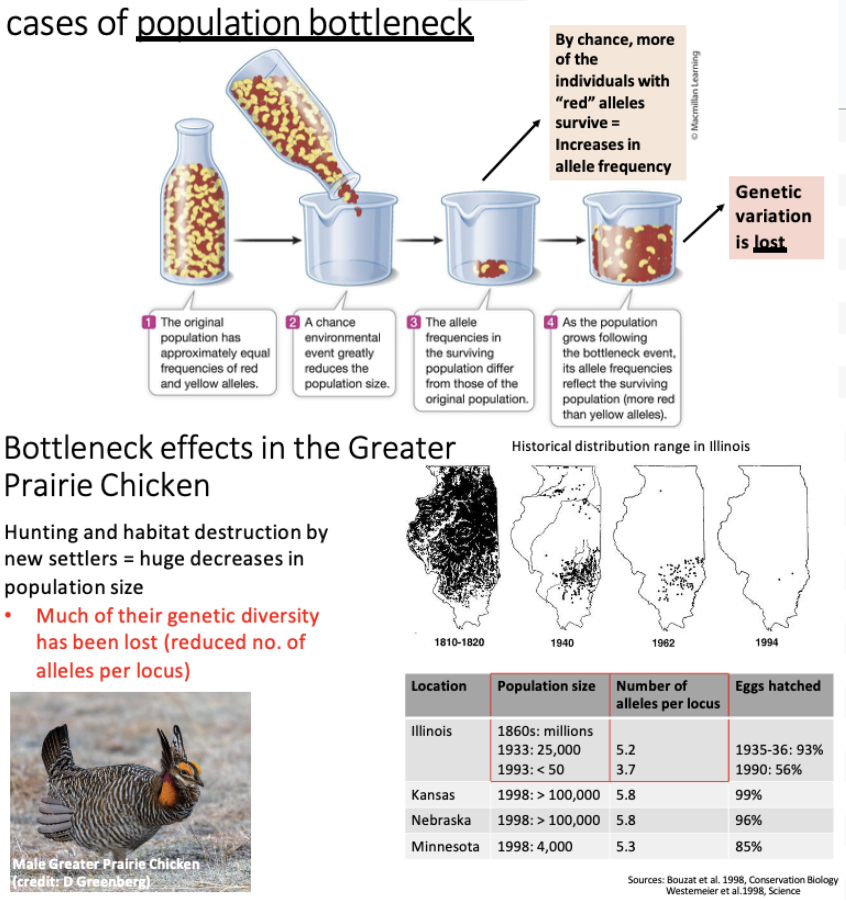
<ul><li><p>Result of an environmental event (Volcano, Tornado, etc.)</p><ul><li><p>A population starts with equal allele frequencies, but after an event in which a small group of individuals gets isolated from the original population, the allele frequency changes. </p></li><li><p>Loses genetic variation. </p><ul><li><p>Happened with the greater prairie chicken in Illinois</p></li></ul></li></ul></li></ul><p></p>
16
New cards

What is the founder effect?

  • Result of a Dispersal Event (migration, colonization)

    • A small portion of the population leaves and populates a different area, causing only certain alleles to be present in the new population

    • Genetic variation decreases

      • Because only a subset of the population is present on the new island = lower genetic variation compared to ancestral population

      • No grey individuals, hence lower than the ancestral that did include the grey.
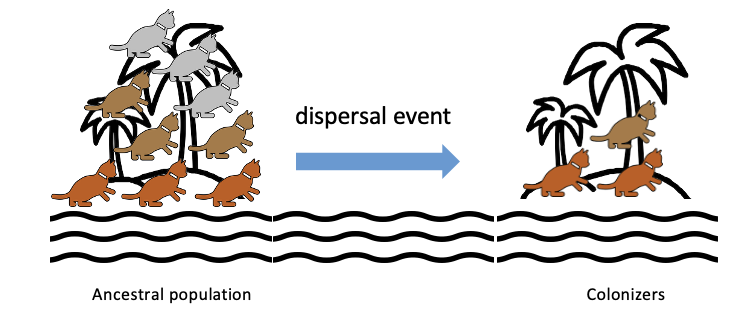
<ul><li><p>Result of a Dispersal Event (migration, colonization)</p><ul><li><p>A small portion of the population leaves and populates a different area, causing only certain alleles to be present in the new population</p></li><li><p>Genetic variation decreases</p><ul><li><p><span>Because only a <em><u>subset</u> </em>of the population is present on the new island = <em>lower </em>genetic variation compared to ancestral population</span></p></li><li><p><span>No grey individuals, hence lower than the ancestral that did include the grey.</span></p></li></ul></li></ul></li></ul><p></p>
17
New cards

What is non-random mating? What can it change?

  • Based on individuals’ preferentially choosing specific mating partners

    • Nonrandom mating changes genotype frequencies: no evolution

    • Nonrandom mating changes allele frequencies: evolution
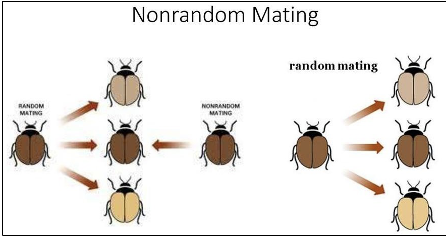
<ul><li><p>Based on individuals’ preferentially choosing specific mating partners</p><ul><li><p>Nonrandom mating changes genotype frequencies: no evolution</p></li><li><p>Nonrandom mating changes allele frequencies: evolution</p></li></ul></li></ul><p></p>
18
New cards

What is non-random mating’s impact on genotypic frequencies?

  • Two types of mating preferences

    • Mating with their own genotypes:

      • Self-Fertilization in Hermaphroditic Species

        • Result: Increase in homozygous genotype in a population

    • Mating with different genotypes:

      • Result: Increase in heterozygous genotype

19
New cards

What is non-random mating’s impact on allele frequencies?

  • Only in species with sexual reproduction and 2 or more sexes.

  • Individuals of one sex mate preferentially with particular individuals of the other sex(es):

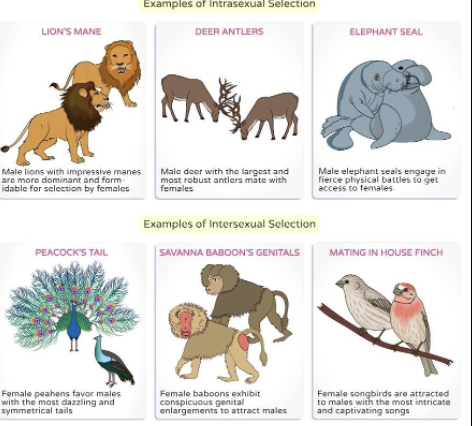
    • Intersexual selection- Based on desirable traits

      • Individuals of one sex prefer to mate with individuals of another sex that show certain phenotypes

    • Intrasexual selection- Based on competition

      • Individuals of one sex compete among each other to access mates

      • Interaction between sexes

<ul><li><p>Only in species with sexual reproduction and 2 or more sexes.</p></li><li><p>Individuals of one sex mate preferentially with particular individuals of the other sex(es):</p><ul><li><p>Intersexual selection- Based on desirable traits</p><ul><li><p>Individuals of one sex prefer to mate with individuals of another sex that show certain phenotypes</p></li></ul></li><li><p>Intrasexual selection- Based on competition</p><ul><li><p>Individuals of one sex compete among each other to access mates</p></li><li><p>Interaction between sexes</p></li></ul></li></ul></li></ul><p></p>
20
New cards

What are the two main reproductive strategies and their subsets?

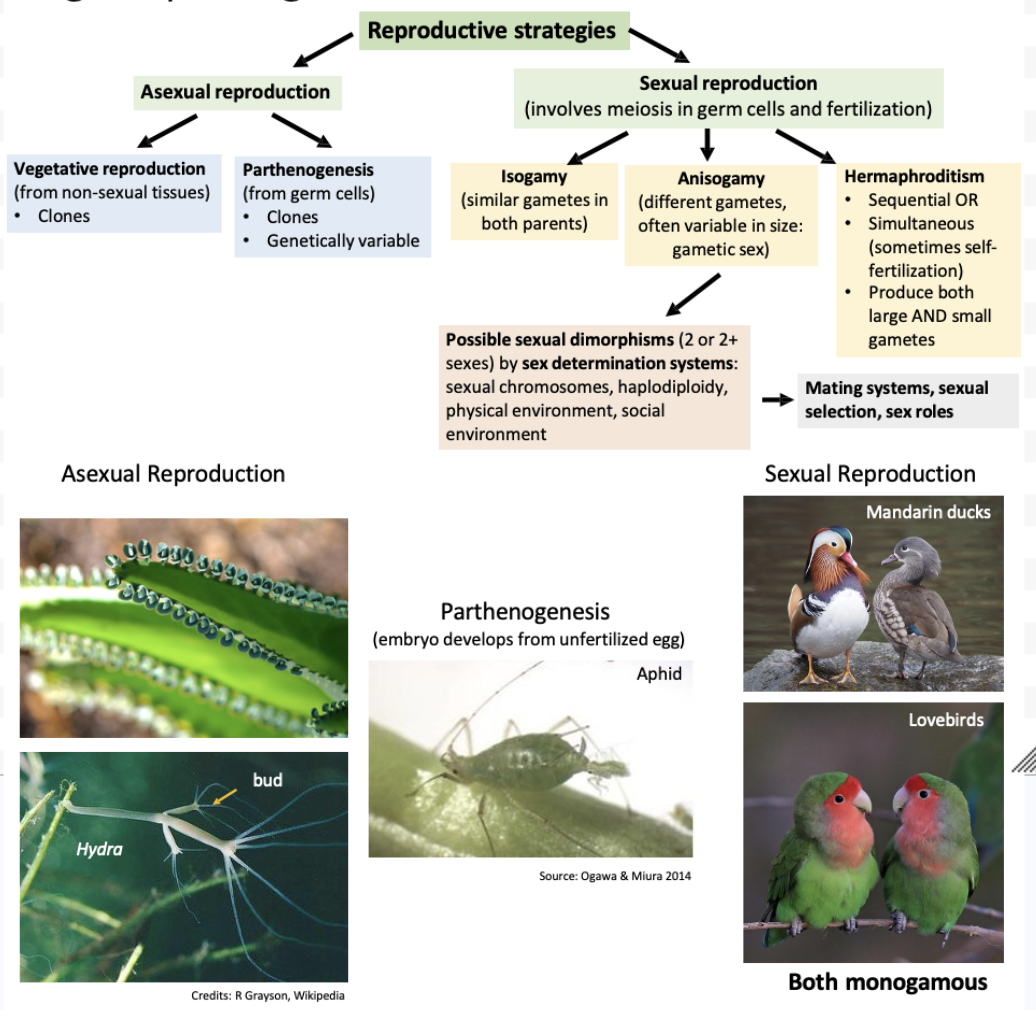
  • Asexual reproduction

    • Vegetative reproduction

      • From non-sexual tissues: clones

    • Parthenogenesis

      • From germ cells: clones, genetically variable

  • Sexual reproduction

    • Isogamy

      • Similar gametes in both parents

    • Anisogamy

      • Different gametes, often variable in size: gametic sex

        • Possible sexual dimorphisms (2 or 2+ sexes) by sex determination systems: sexual chromosomes, haplodiploidy, physical environment, social environment

          • Mating systems, sexual selection, sex roles

    • Hermaphroditism

      • Sequential OR Simultaneous (sometimes self-fertilization)

      • Produce both large AND small gametes

<ul><li><p><strong>Asexual reproduction</strong></p><ul><li><p><u>Vegetative reproduction</u></p><ul><li><p>From non-sexual tissues: clones</p></li></ul></li><li><p><u>Parthenogenesis</u></p><ul><li><p>From germ cells: clones, genetically variable</p></li></ul></li></ul></li></ul><ul><li><p><strong>Sexual reproduction</strong></p><ul><li><p><u>Isogamy</u></p><ul><li><p>Similar gametes in both parents</p></li></ul></li><li><p><u>Anisogamy</u></p><ul><li><p>Different gametes, often variable in size: gametic sex</p><ul><li><p>Possible sexual dimorphisms (2 or 2+ sexes) by sex determination systems: sexual chromosomes, haplodiploidy, physical environment, social environment</p><ul><li><p>Mating systems, sexual selection, sex roles</p></li></ul></li></ul></li></ul></li><li><p><u>Hermaphroditism</u></p><ul><li><p>Sequential OR Simultaneous (sometimes self-fertilization)</p></li><li><p>Produce both large AND small gametes</p></li></ul></li></ul></li></ul><p></p>
21
New cards

Explain hemaphroditeisms that exist.

  • Some species are simultaneous hermaphrodites (80% flowering plants, some mollusks, some crustaceans, many corals) and can sometimes self-fertilize.

  • Some species are sequential hermaphrodites throughout their lives (many fish, some mollusks, a few plants)

    • In clownfish:

      • The largest fish is the female, the second largest is the breeding male

      • If a female dies, the largest male becomes female

      • The next largest male becomes the breeding male
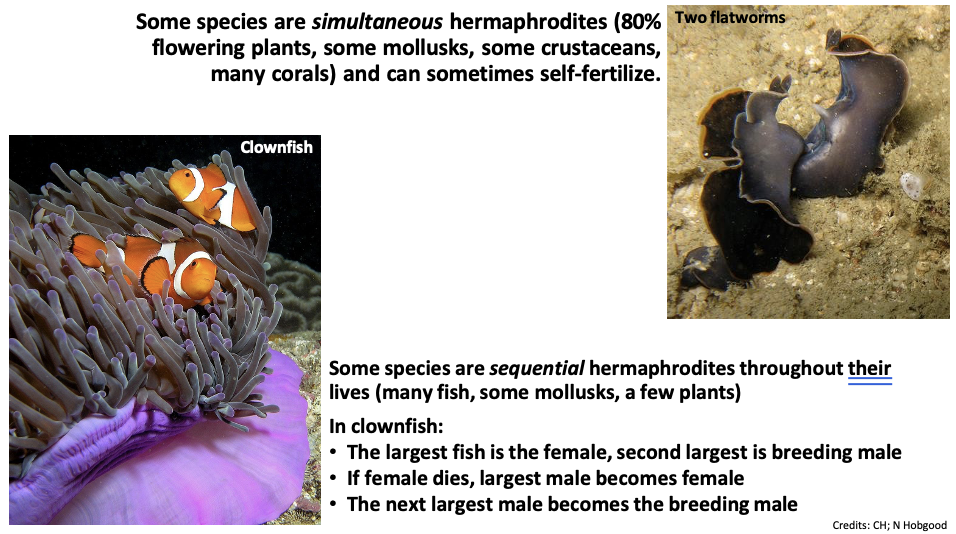
<ul><li><p>Some species are simultaneous hermaphrodites (80% flowering plants, some mollusks, some crustaceans, many corals) and can sometimes self-fertilize.</p></li><li><p><span>Some species are <em>sequential </em>hermaphrodites throughout their lives (many fish, some mollusks, a few plants)</span></p><ul><li><p><span>In clownfish:</span></p><ul><li><p><span>The largest fish is the female, the second largest is the breeding male</span></p></li><li><p><span>If a female dies, the largest male becomes female</span></p></li><li><p><span>The next largest male becomes the breeding male</span></p></li></ul></li></ul></li></ul><p></p>
22
New cards

Sex roles associated to mating systems are also ___ ____

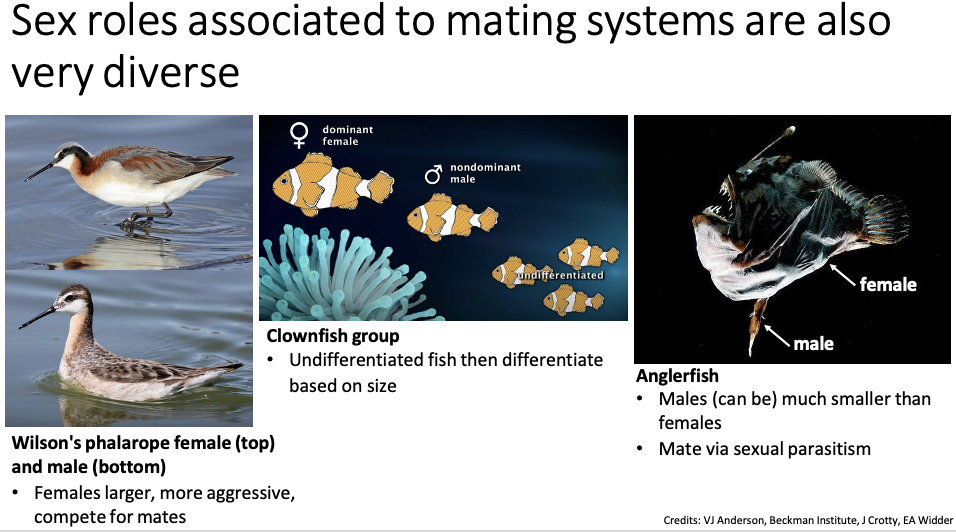
  • Very diverse!

    • Wilson's phalarope female (top) and male (bottom)

      • Females are larger and more aggressive, and compete for mates

    • Clownfish group

      • Undifferentiated fish then differentiate based on size

    • Anglerfish

      • Males can be much smaller than females

      • Mate via sexual parasitism

<ul><li><p>Very diverse!</p><ul><li><p><span>Wilson's phalarope female (top) and male (bottom)</span></p><ul><li><p><span>Females are larger and more aggressive, and compete for mates</span></p></li></ul></li><li><p><span>Clownfish group</span></p><ul><li><p><span>Undifferentiated fish then differentiate based on size</span></p></li></ul></li><li><p><span>Anglerfish</span></p><ul><li><p><span>Males can be much smaller than females</span></p></li><li><p><span>Mate via sexual parasitism</span></p></li></ul></li></ul></li></ul><p></p>
23
New cards

Constraints and Trade-Offs Shaping Evolution: Preexisting Traits

  • Preexisting Traits can limit the outcome of selection

  • Physical and chemical constraints limit evolution (e.g., thermodynamics, cell functioning and cell size, etc.)

    • All evolutionary innovations are modifications of previously existing structures

      • Can only evolve if its pre-exisisted in some fashion.

    • Lack of the necessary genetic variation prevents the evolution of certain traits

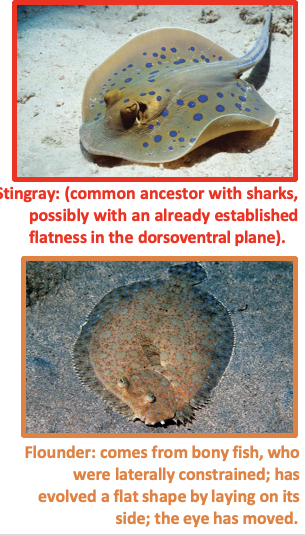
      • Example: Flounder versus Stingray

<ul><li><p>Preexisting Traits can limit the outcome of selection</p></li><li><p><span>Physical and chemical constraints limit evolution (e.g., thermodynamics, cell functioning and cell size, etc.)</span></p><ul><li><p><span>All evolutionary innovations are modifications of <strong>previously existing structures</strong></span></p><ul><li><p><span>Can only evolve if its pre-exisisted in some fashion.</span></p></li></ul></li><li><p><span>Lack of the necessary genetic variation prevents the evolution of certain traits</span></p><ul><li><p>Example: Flounder versus Stingray</p></li></ul></li></ul></li></ul><p></p>
24
New cards

Constraints and Trade-Offs Shaping Evolution: Trade-offs

  • Trade-offs balance costs and benefits in the evolution of adaptations.

  • Case Study: Garter Snakes

    • When garter snakes consume rough-skinned newts, a toxin kills them

    • Certain snakes have evolved to not die from the toxin by means of a modified sodium channel that resists the toxin

      • The benefit: They are resistant to the toxin

      • The cost: They generally move more slowly than non-resistant snakes, especially after consuming a newt.

      • The result: Because the resistant snakes are slower, they are more susceptible to predation, which overrides the benefit of being resistant to the toxin. This resistance is therefore selected against.
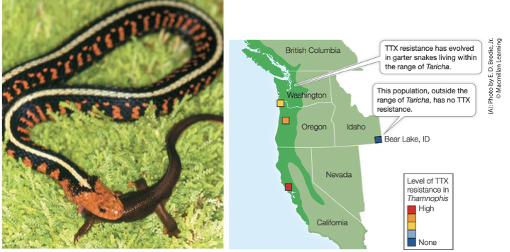
<ul><li><p>Trade-offs balance costs and benefits in the evolution of adaptations.</p></li><li><p>Case Study: Garter Snakes</p><ul><li><p>When garter snakes consume rough-skinned newts, a toxin kills them</p></li><li><p>Certain snakes have evolved to not die from the toxin by means of a modified sodium channel that resists the toxin</p><ul><li><p>The benefit: They are resistant to the toxin</p></li><li><p>The cost: They generally move more slowly than non-resistant snakes, especially after consuming a newt.</p></li><li><p>The result: Because the resistant snakes are slower, they are more susceptible to predation, which overrides the benefit of being resistant to the toxin. This resistance is therefore selected against.</p></li></ul></li></ul></li></ul><p></p>
25
New cards

Explain how natural selection ties into traits.

  • Natural selection acts directly on the phenotype, and thus indirectly on the genotype

    • Each phenotype within a population has a relative fitness

      • Fitness - relative rates of survival + reproduction of the phenotype in the population

26
New cards

Traits can be qualitative or quantitative, explain. What are Allele vs Locus?

  • Traits affected by one locus (place on the chromosome) are qualitative

    • Discrete variation (smooth vs wrinkled peas)

  • Traits affected by more than one locus are quantitative

    • Continuous variation (height vs weight)

    • The different types of selection apply to quantitative!

  • Allele = variant form of a gene at a particular locus

  • Locus = specific location on a chromosome where a gene is found
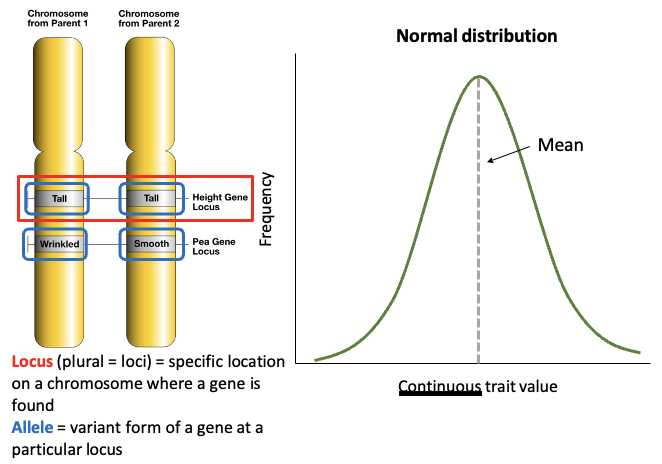
<ul><li><p>Traits affected by one locus (place on the chromosome) are qualitative</p><ul><li><p>Discrete variation (smooth vs wrinkled peas)</p></li></ul></li></ul><ul><li><p>Traits affected by more than one locus are quantitative</p><ul><li><p>Continuous variation (height vs weight)</p></li><li><p><strong>The different types of selection apply to quantitative!</strong></p></li></ul></li></ul><ul><li><p>Allele = variant form of a gene at a particular locus</p></li><li><p>Locus = <span>specific location on a chromosome where a gene is found</span></p></li></ul><p></p>
27
New cards

What is stabilizing selection? Example?

  • Quantitative selection where the mean phenotype is favored by natural selection, while variation is reduced

    • Sometimes referred to as purifying selection

      • Birth weight in humans.

        • Babies born with weights < or > than the mean have higher death rates than those closer to the mean

        • Selection against deleterious mutations or consequences
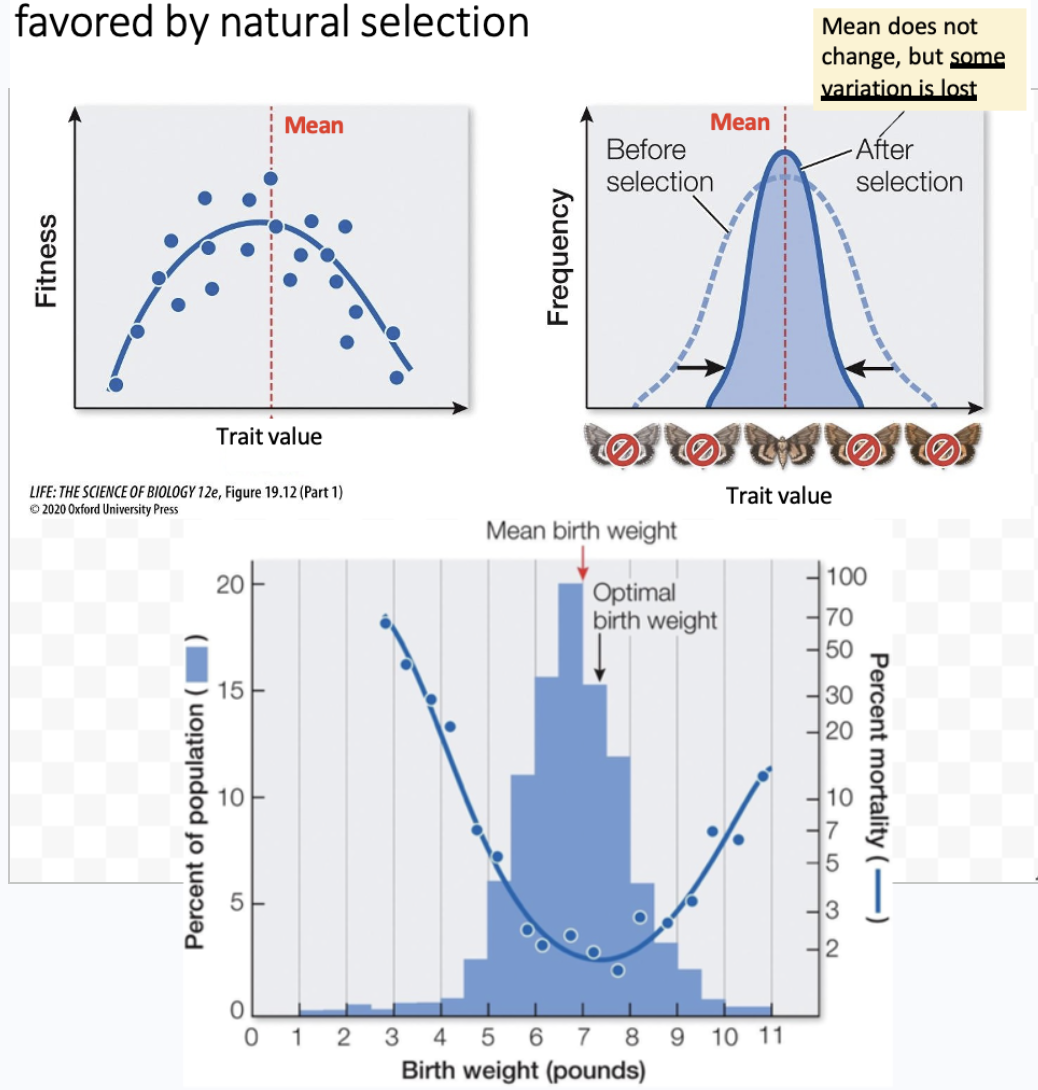
<ul><li><p>Quantitative selection where the mean phenotype is favored by natural selection, while variation is reduced</p><ul><li><p>Sometimes referred to as purifying selection</p><ul><li><p>Birth weight in humans. </p><ul><li><p><span>Babies born with weights &lt; or &gt; than the mean have higher death rates than those closer to the mean</span></p></li><li><p><span>Selection against deleterious mutations or consequences</span></p></li></ul></li></ul></li></ul></li></ul><p></p>
28
New cards

What is directional selection? Example?

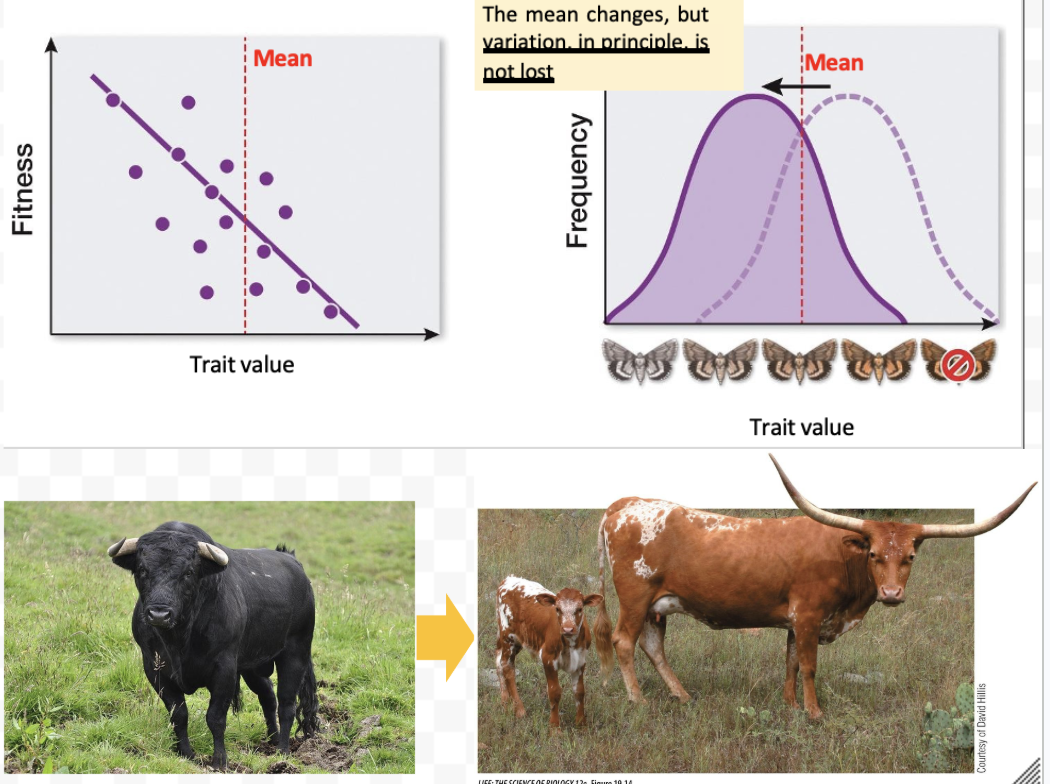
  • Quantitative selection where one phenotype other than the mean is favored by natural selection

    • The mean changes, but the variation stays the same

      • Texas longhorn = result of directional selection on cattle introduced from Europe

      • Directional selection in horn length favored protection against local predators in Texas and the SW (mountain lions, bears and wolves)

        • A form of “positive selection”

<ul><li><p>Quantitative selection where one phenotype other than the mean is favored by natural selection</p><ul><li><p>The mean changes, but the variation stays the same</p><ul><li><p><span>Texas longhorn = result of <strong><em>directional selection </em></strong>on cattle introduced from Europe</span></p></li><li><p><span>Directional selection in horn length favored protection against local predators in Texas and the SW (mountain lions, bears and wolves)</span></p><ul><li><p><span>A form of “positive selection”</span></p></li></ul></li></ul></li></ul></li></ul><p></p>
29
New cards

What is disruptive selection? Example?

  • Quantitative selection where both extremes are favored as phenotypes vary in both directions from the mean.

    • Mean stays the same, but variation increases

      • Black-bellied seedcrackers have two morphs as a result of disruptive selection (credit: T Smith, UCLA)

      • Feed on seeds with different morphologies from the same genus of tree

      • Those with an intermediate bill/beak size do not survive
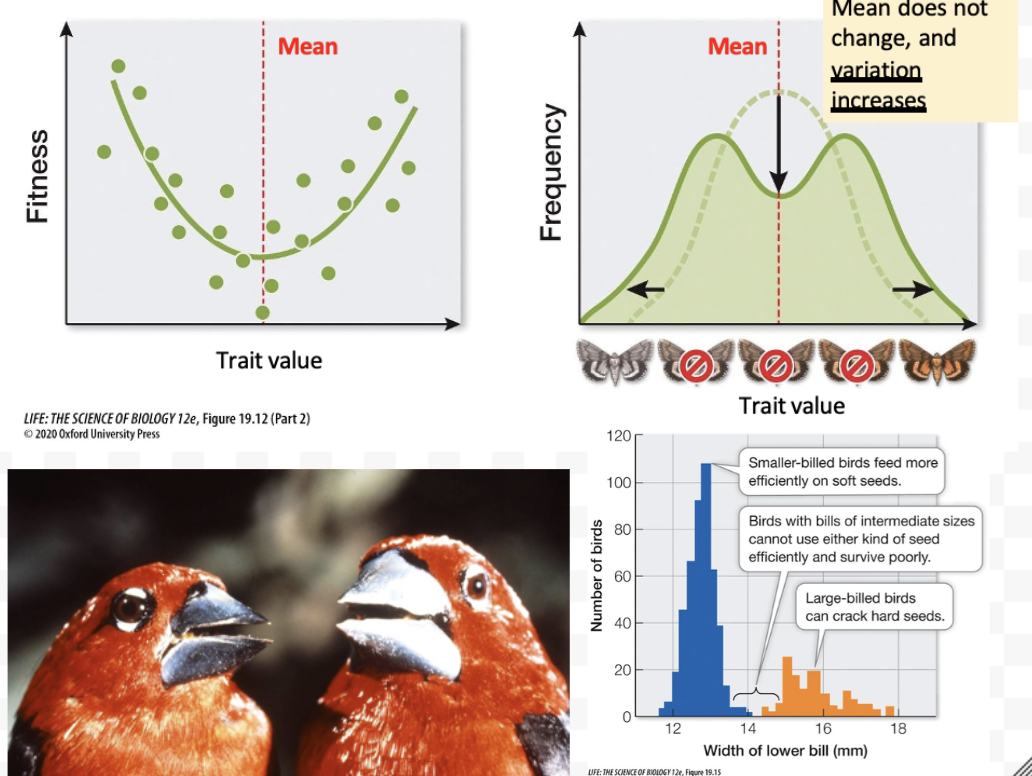
<ul><li><p>Quantitative selection where both extremes are favored as phenotypes vary in both directions from the mean. </p><ul><li><p>Mean stays the same, but variation increases</p><ul><li><p><span>Black-bellied seedcrackers have two morphs as a result of disruptive selection (credit: T Smith, UCLA)</span></p></li><li><p><span>Feed on seeds with different morphologies from the same genus of tree</span></p></li><li><p><span>Those with an intermediate bill/beak size do not survive</span></p></li></ul></li></ul></li></ul><p></p>
30
New cards

Frequency-dependent selection maintains genetic variation within populations. Explain.

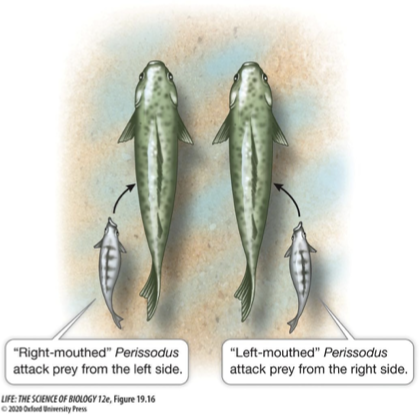
  • Genetic variation normally results in having two or more phenotypic variations within the same population.

  • The frequency of each phenotype determines the individual fitness

    • Think back to the example of right and left mouthed scale eaters

      • Prey fish are more likely to be attacked if they have to watch both sides for predators

      • This favors equal numbers of right- and left-mouthed scale-eaters in a population
<ul><li><p><span>Genetic variation normally results in having two or more phenotypic variations within the same population. </span></p></li><li><p>The frequency of each phenotype determines the individual fitness</p><ul><li><p>Think back to the example of right and left mouthed scale eaters</p><ul><li><p><span>Prey fish are more likely to be attacked if they have to watch <strong><em>both sides </em></strong>for predators</span></p></li><li><p><span>This favors equal numbers of right- and left-mouthed scale-eaters in a population</span></p></li></ul></li></ul></li></ul><p></p>
31
New cards

Heterozygote advantage maintains polymorphic loci. Explain.

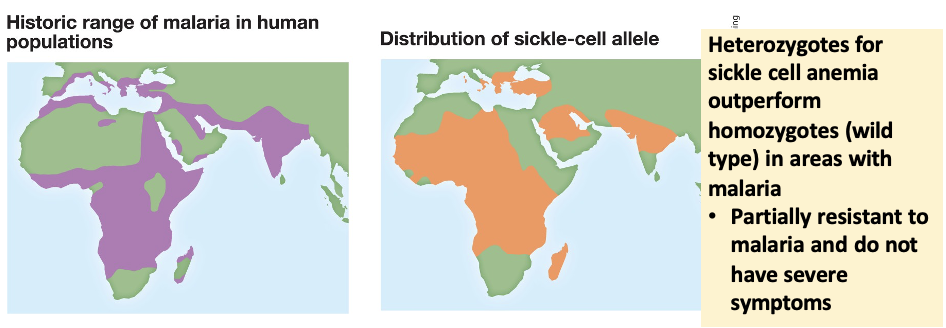
  • Heterozygote individuals (with 2 alleles) could outperform homozygotes (with 1 allele) under variable environmental conditions.

    • Sickle-cell anemia provides heterozygotes with immunity to malaria
<ul><li><p><span>Heterozygote individuals (with 2 alleles) could outperform homozygotes (with 1 allele) under variable environmental conditions. </span></p><ul><li><p>Sickle-cell anemia provides heterozygotes with immunity to malaria</p></li></ul></li></ul><p></p>
32
New cards

Genetic variation within species maintained in geographically distinct populations

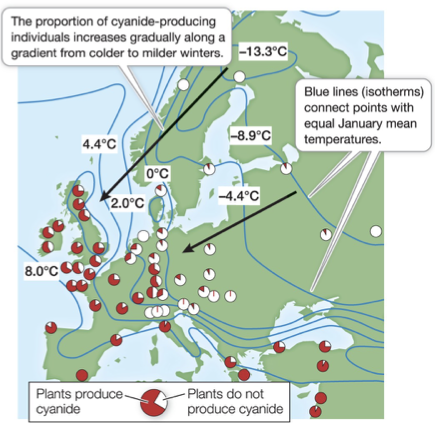
  • Populations are under different local selection pressures (differing environments)

    • Temperature, sunlight, predation, etc.

  • More cyanide production = in warmer environments

    • Cyanide production in clover (red) protects from herbivory, but makes the plants susceptible to frost

    • Damages cell membranes, releases cyanide into their own cells

      • Clover plants. Eat the leaves; they contain cyanide. The downside is that when they live where it’s cold, it bursts their cell membranes and they essentially kill themselves. In warmer climates, it survives just fine.
<ul><li><p>Populations are under different local selection pressures (differing environments)</p><ul><li><p>Temperature, sunlight, predation, etc.</p></li></ul></li><li><p><span>More cyanide production = in warmer environments</span></p><ul><li><p><span>Cyanide production in clover (red) protects from herbivory, <strong><u>but</u> </strong>makes the plants susceptible to frost</span></p></li><li><p><span>Damages cell membranes, releases cyanide into their own cells</span></p><ul><li><p><span>Clover plants. Eat the leaves; they contain cyanide. The downside is that when they live where it’s cold, it bursts their cell membranes and they essentially kill themselves. In warmer climates, it survives just fine.</span></p></li></ul></li></ul></li></ul><p></p>
33
New cards

END OF CHAPTER 19

END OF CHAPTER 19

34
New cards

All things share what?

A common ancestor.

35
New cards

What are evolutionary relationships called? How are they presented?

  • Phylogeny - the history of how organisms are related

  • Historical relationships represented among lineages using a phylogenetic tree

    • A lineage = line of ancestors and descendants

36
New cards

What can a phylogenetic tree be used for, and how is it determined? What are branches and what do it use?

  • Can be used for major evolutionary groups (i.e., insects), populations, species, genes, etc.

  • Usually determined via morphological (physical) and/or molecular data, but can also use behavioral, physiological, developmental, and ecological.

    • Uses DNA

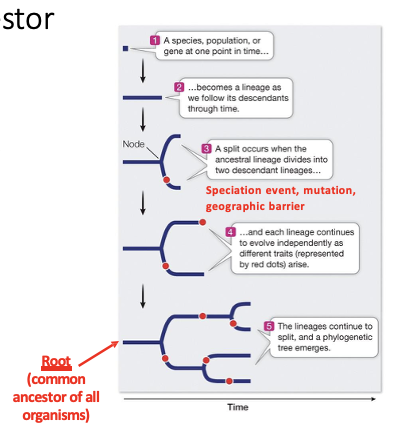
  • Branches form when a new species evolves over a period of time

    • Mutations can cause these splits

<ul><li><p><span>Can be used for major evolutionary groups (i.e., insects), populations, species, genes, etc.</span></p></li><li><p><span>Usually determined via morphological (physical) and/or molecular data, but can also use behavioral, physiological, developmental, and ecological.</span></p><ul><li><p>Uses DNA</p></li></ul></li><li><p>Branches form when a new species evolves over a period of time</p><ul><li><p>Mutations can cause these splits</p></li></ul></li></ul><p></p>
37
New cards

What does matter when reading a phylogenetic tree? What doesn’t?

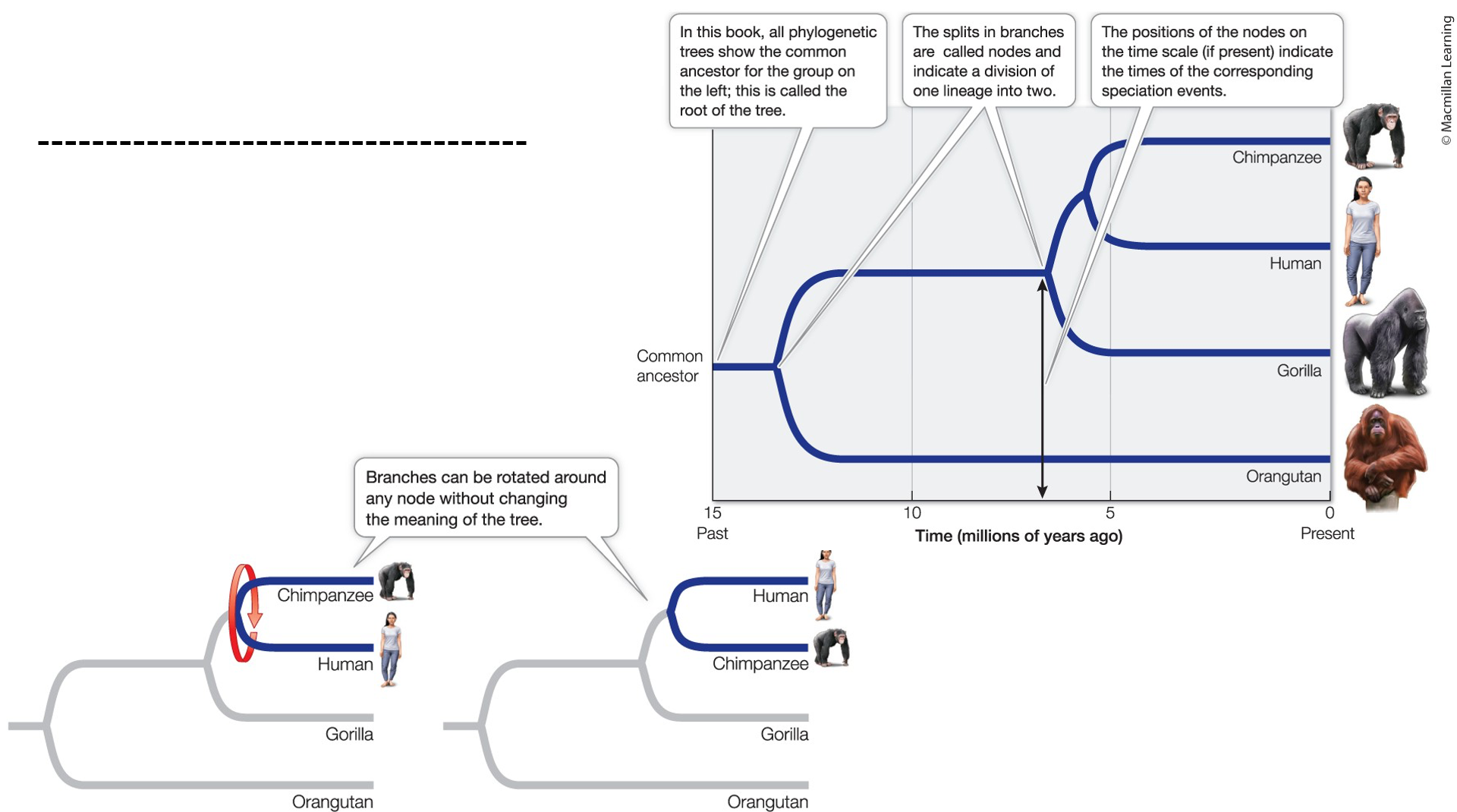
  • DOES MATTER

    • Order of nodes

    • Branch Length represents time (longer branches=longer time)

  • DOES NOT MATTER

  • The vertical distance between branches is irrelevant

    • No connection to the relationship among groups

  • The order of neighboring branches (i.e., chimp and human) d
<ul><li><p><strong>DOES MATTER</strong></p><ul><li><p>Order of nodes</p></li><li><p>Branch Length represents time (longer branches=longer time)</p></li></ul></li><li><p><strong>DOES NOT MATTER</strong></p></li><li><p><span>The vertical distance between branches is irrelevant </span></p><ul><li><p><span>No connection to the relationship among groups</span></p></li></ul></li><li><p><span>The order of <em>neighboring </em>branches (i.e., chimp and human) d</span></p></li></ul><p></p>
38
New cards

How are organisms named?

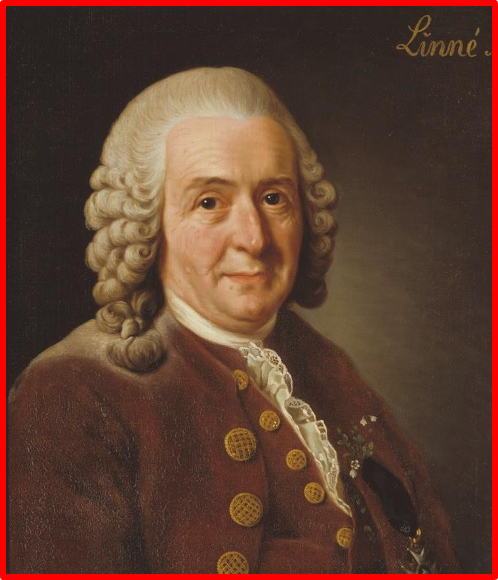
  • Binomial nomenclature: a system made by Carolus Linnaeus

    • Each one has a genus+species

    • Both italicized; genus is capitalized, species is not

      • Homo sapiens Linneaus: Genus is Homo, sapiens is the species, whole is italicized, last part is who proposed it

    • Written in Latin

<ul><li><p>Binomial nomenclature: a system made by Carolus Linnaeus</p><ul><li><p>Each one has a genus+species</p></li><li><p>Both italicized; genus is capitalized, species is not</p><ul><li><p><em>Homo sapiens </em>Linneaus: Genus is Homo, sapiens is the species, whole is italicized, last part is who proposed it</p></li></ul></li><li><p>Written in Latin</p></li></ul></li></ul><p></p>
39
New cards

What is taxonomy?

  • The primary system used to classify and organize living things

  • Organisms are grouped into categories based on similarities (traits, DNA, behavior, etc.)

  • A group at the same classification/taxonomic level = taxon

  • A clade is a group that includes a common ancestor and all of its evolutionary descendants
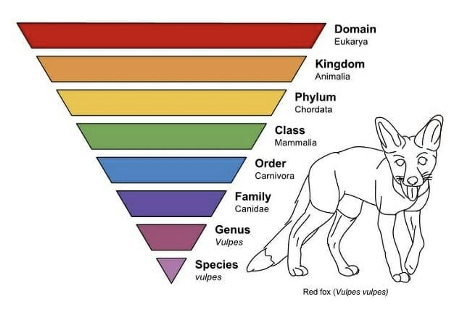
<ul><li><p>The primary system used to classify and organize living things</p></li><li><p>Organisms are grouped into categories based on similarities (traits, DNA, behavior, etc.)</p></li><li><p>A group at the same classification/taxonomic level = taxon</p></li><li><p>A clade is a group that includes a common ancestor and all of its evolutionary descendants</p></li></ul><p></p>
40
New cards

Phylogenetic trees and sister grouping. Explain.

  • Sister taxa are the closest relatives in the tree

    • Includes the most recent common ancestor

  • Sister clades are the closest clade (group) relatives

    • Includes ancestor and all descendants

  • Know that the sister is the closest because they have the most recent common ancestor. Clades share a common ancestor, but it’s not the most recent one. Shared ancestor is big.
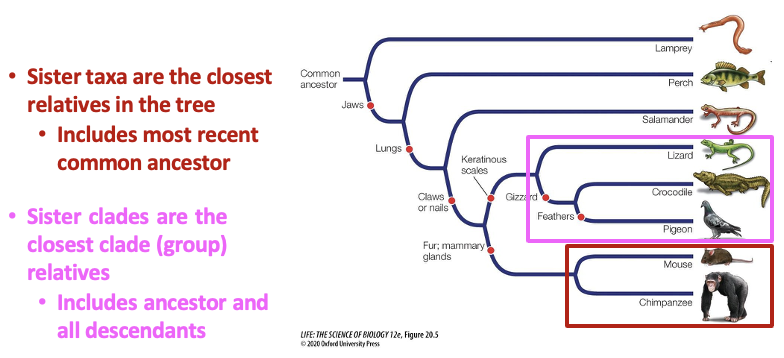
<ul><li><p><span>Sister taxa are the closest relatives in the tree</span></p><ul><li><p><span>Includes the most recent common ancestor</span></p></li></ul></li><li><p><span>Sister clades are the closest clade (group) relatives</span></p><ul><li><p><span>Includes ancestor and all descendants</span></p></li></ul></li></ul><ul><li><p><span>Know that the sister is the closest because they have the most recent common ancestor. Clades share a common ancestor, but it’s not the most recent one. Shared ancestor is big.</span></p></li></ul><p></p>
41
New cards

Explain the three types of grouping on a phylogenetic tree.

  • Polyphyletic Group: does not include a common ancestor

  • Paraphyletic Group: common ancestor + some descendants

  • Monophyletic Group (clade): common ancestor + all descendants (H, I, J)
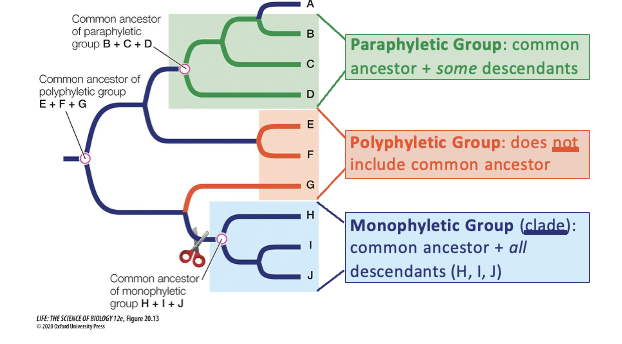
<ul><li><p><span><strong>Polyphyletic Group</strong>: does <u>not</u> include a common ancestor </span></p></li><li><p><span><strong>Paraphyletic Group</strong>: common ancestor + <em>some </em>descendants</span></p></li><li><p><span><strong>Monophyletic Group </strong>(<u>clade</u>): common ancestor + <em>all </em>descendants (H, I, J)</span></p></li></ul><p></p>
42
New cards
<p>Answer this question diva!</p>

Answer this question diva!

Answer to thy phylogenetic tree that you seek yass queen.
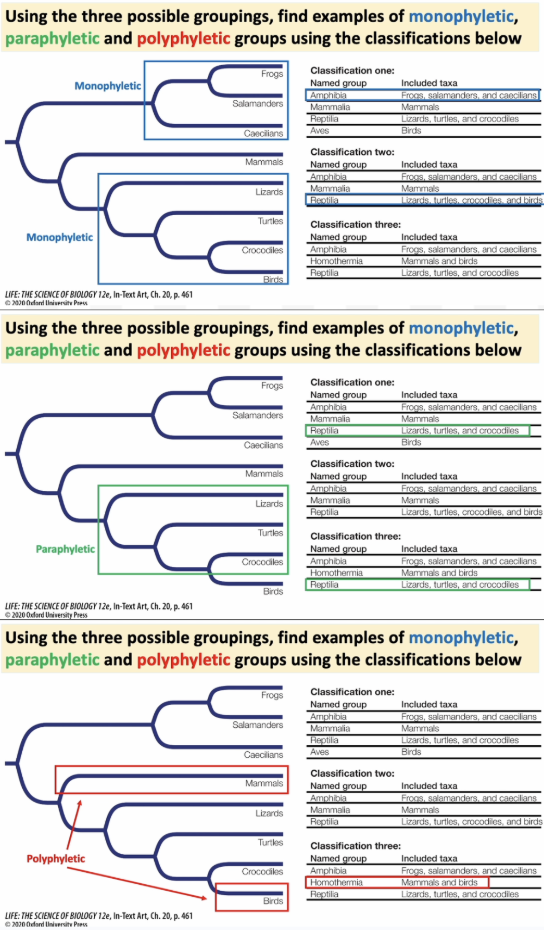
<p>Answer to thy phylogenetic tree that you seek yass queen. </p>
43
New cards

Phylogenies help scientists study and compare how traits evolved over time. Explain in terms of how they are derived and examined.

  • They compare shared traits across different groups (taxa), and thus study the evolution of traits

    • Current traits are derived, meaning they evolved from an ancestral trait

    • Scientists can estimate and reconstruct the ancestral state of traits by looking at the trait values of the extant (currently living) species.

    • Synapomorphies = shared derived traits that evolved from a common ancestor and are passed down to its descendants.

      • These are the red dots on the phylogenetic tree!
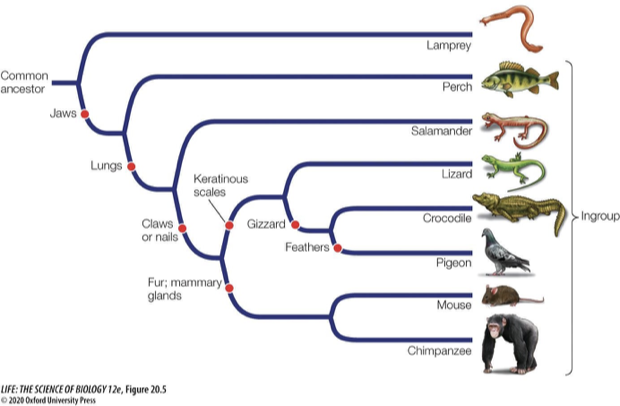
<ul><li><p>They compare shared traits across different groups (taxa), and thus study the evolution of traits</p><ul><li><p>Current traits are derived, meaning they <u>evolved</u> from an ancestral trait</p></li><li><p>Scientists can estimate and reconstruct the ancestral state of traits by looking at the trait values of the extant (currently living) species. </p></li><li><p><u>Synapomorphies</u> = shared derived traits that evolved from a common ancestor and are passed down to its descendants.</p><ul><li><p>These are the red dots on the phylogenetic tree!</p></li></ul></li></ul></li></ul><p></p>
44
New cards

Explain homologous and analogous traits. What can analogous traits be an example of?

  • A similar trait function does not always involve shared ancestry

    • Homologous traits = features that come from the same ancestor.

      • Same-colored bones

    • Analogous traits = features that evolved separately/independently but do the same job and are intended for the same function

      • Convergent evolution

        • Like wings in bats and birds

<ul><li><p>A similar trait function does not always involve shared ancestry</p><ul><li><p>Homologous traits = features that come from the same ancestor.</p><ul><li><p>Same-colored bones</p></li></ul></li><li><p>Analogous traits = features that evolved separately/independently but do the same job and are intended for the same function</p><ul><li><p>Convergent evolution</p><ul><li><p>Like wings in bats and birds</p></li></ul></li></ul></li></ul></li></ul><p></p>
45
New cards

What are homoplasies? What is snapomorphy?

  • They are similar traits that arise from convergent evolution or evolutionary reversals, not ancestry

  • Shared derived trait from a common ancestor. normal evolution within a lineage.

    • “syn” + “apo” + “morphies” = shared + derived + form
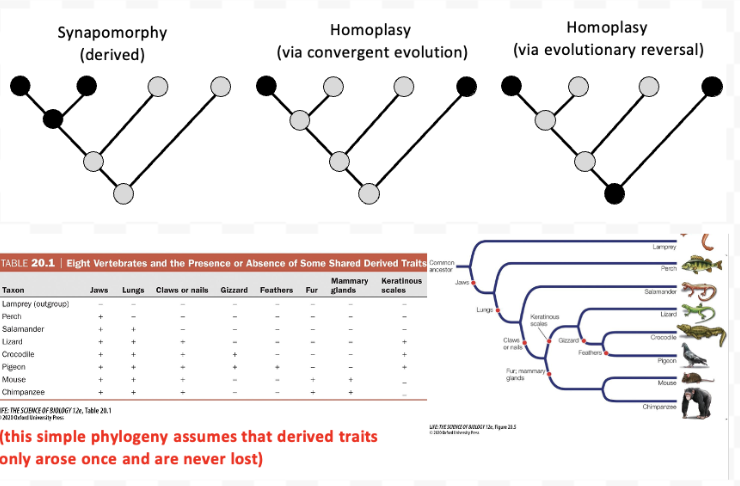
<ul><li><p>They are similar traits that arise from convergent evolution or evolutionary reversals, not ancestry</p></li><li><p>Shared derived trait from a common ancestor. normal evolution within a lineage.</p><ul><li><p><span>“syn” + “apo” + “morphies” = shared + derived + form</span></p></li></ul></li></ul><p></p>
46
New cards

Phylogenetic trees help scientists figure how relationships have _____. Thanks to these trees, ___ ____ can be reconstructed. This in turn shows how species have ____ over time, can help trace when ____ first appeared, and can show when groups ____ form a ___ ancestor

  • Evolved

  • Past events

  • Evolved, traits, split, common

47
New cards

What was used to investigate HIV and why?

  • Phylogenetic analysis can help figure out where a virus came from

    • HIV likely came from a monkey host, but scientists do not know exactly which one it came from. Likely came from the sooty mangabeys and chimpanzees through blood transmission.
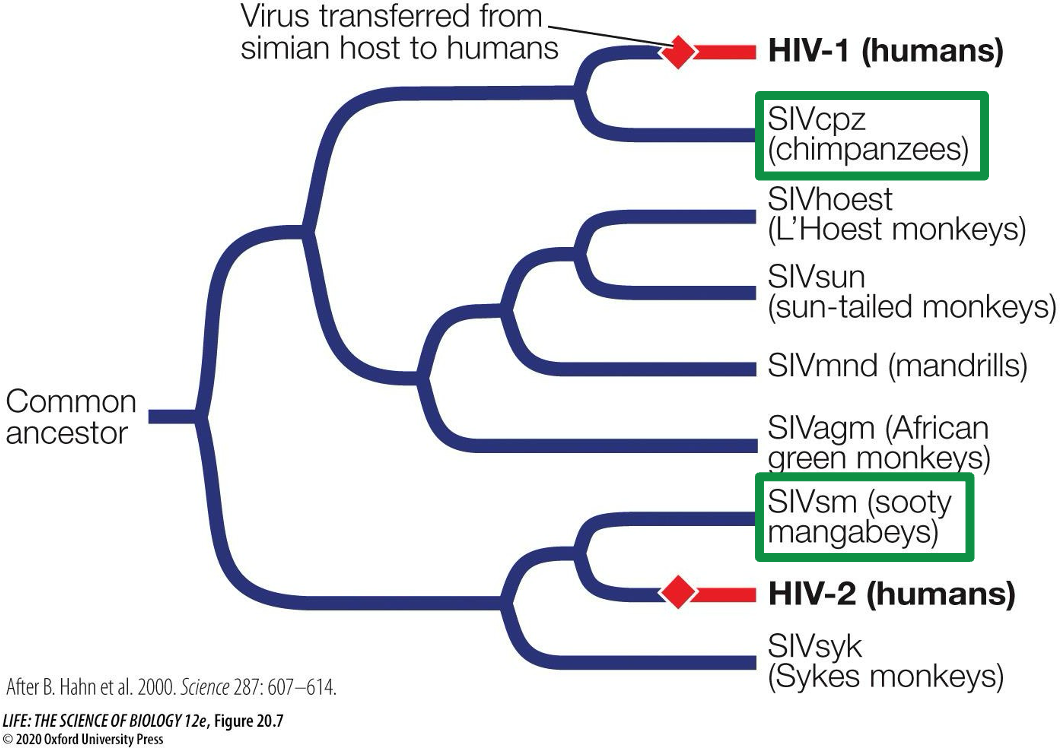
<ul><li><p>Phylogenetic analysis can help figure out where a virus came from</p><ul><li><p><span>HIV likely came from a monkey host, but scientists do not know exactly which one it came from. Likely came from the sooty mangabeys and chimpanzees through blood transmission.</span></p></li></ul></li></ul><p></p>
48
New cards

Phylogenetic trees can also be used in forensic investigations, explain with physician HIV.

  • The physician is accused of injecting blood from his HIV-positive patient into his girlfriend

  • Phylogenetic analysis can show if the HIV strain found in the girlfriend is present in a subset of his patients
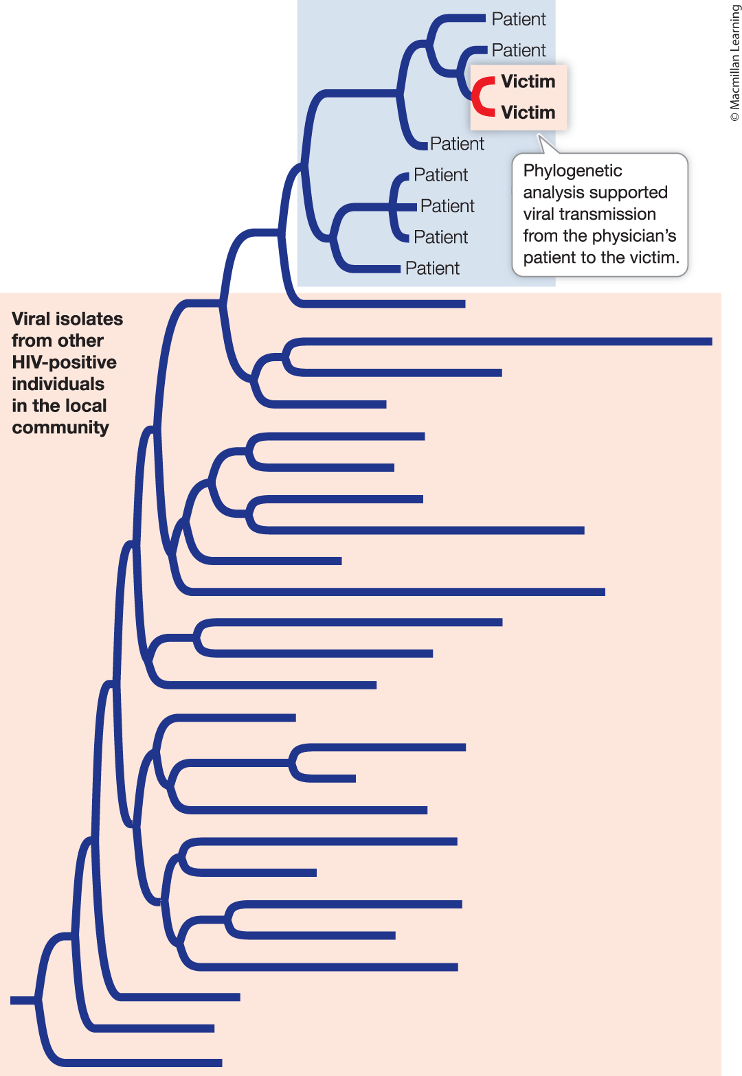
<ul><li><p><span>The physician is accused of injecting blood from his HIV-positive patient into his girlfriend</span></p></li><li><p><span>Phylogenetic analysis can show if the <strong>HIV strain found in the girlfriend is present in a subset of his patients</strong></span></p></li></ul><p></p>
49
New cards

Why are molecular clocks useful?

  • Molecular clocks use how fast DNA changes (mutation rate) to estimate when events happened in evolution.

    • Example: When did HIV jump from chimpanzees to humans?

      • Most samples of HIV-1 were collected from human specimens in the 1980s

      • Some samples from as early as the 1950s

        • Scientists can use the observed changes in HIV-1 over the past several decades to predict the common ancestor of all HIV-1 isolates

        • We can estimate when HIV-1 first entered human populations from chimps

50
New cards

Molecular clocks and closely related species

  • In closely related species, a given gene evolves at a reasonably constant rate

    • Not ALL genes evolve at the same rate

  • The corresponding protein accumulates amino acid replacements at a relatively constant rate: the rate of change is the molecular clock (slope of the line)

  • A molecular clock needs to be calibrated in the evolutionary timeline (e.g., fossil record, biogeographic dates)

    • Collect many HIV samples from different years, compare the number of substitutions and mutations (length exemplifies this), translate the tree into a line graph to show a molecular clock, and track this slope back in time to track when the virus jumped from monkeys to humans.
<ul><li><p><span>In <strong><u>closely related species</u></strong>, a given gene evolves at a reasonably constant rate</span></p><ul><li><p><span>Not ALL genes evolve at the same rate</span></p></li></ul></li></ul><ul><li><p><span>The corresponding protein accumulates amino acid replacements at a relatively constant rate: the rate of change is the molecular clock (<strong>slope of the line</strong>)</span></p></li><li><p><span>A molecular clock needs to be <em>calibrated </em>in the evolutionary timeline (e.g., fossil record, biogeographic dates)</span></p><ul><li><p><span>Collect many HIV samples from different years, compare the number of substitutions and mutations (length exemplifies this), translate the tree into a line graph to show a molecular clock, and track this slope back in time to track when the virus jumped from monkeys to humans.</span></p></li></ul></li></ul><p></p>
51
New cards
<p>Visual chart for building a phylogenetic tree</p>

Visual chart for building a phylogenetic tree
Visual chart for building a phylogenetic tree

<p>Visual chart for building a phylogenetic tree</p>
52
New cards

The principle of parsimony, explain.

  • The best phylogenetic tree is the one that assumes the fewest evolutionary changes.

    • Scientists prefer the simplest explanation

  • The best tree has the lowest number of independent trait changes

    • This avoids too many homoplasies (traits that evolved separately in different groups)

  • Phylogenetic trees can be built based on many traits
53
New cards
<p>Parsimony practice question</p>

Parsimony practice question

  • The left tree because it doesn’t have as many red lines on it. The bony skeleton appears twice on the right vs only once on the left.

  • Tree 1 – 2 changes, a color change, and a shape change. Tree 2 – 3 changes: shape change, shape change, and a color change. Tree 3 – 3 changes: shape change, color change, and a shape change.

    • So tree #1 is most parsimonious!

<ul><li><p><span>The left tree because it doesn’t have as many red lines on it. The bony skeleton appears twice on the right vs only once on the left.</span></p></li><li><p><span>Tree 1 – 2 changes, a color change, and a shape change. Tree 2 – 3 changes: shape change, shape change, and a color change. Tree 3 – 3 changes: shape change, color change, and a shape change.</span></p><ul><li><p><span>So tree #1 is most parsimonious!</span></p></li></ul></li></ul><p></p>
54
New cards

Phylo trees can be based on many traits, explain.

  • Hundreds or thousands of traits from morphology, paleontology, development, physiology, ecology, behavior, and molecular data

    • Phenotype can be influenced by the environment

    • Using more data helps account for these possible changes

  • Results are usually not the same depending on the traits used, so a consensus tree (showing the most common characteristics) is computed

    • DNA and molecular data can be leveraged along with ecology, behavior, etc. Trees with multiple kinds of data produce different results, and all look different. Computer software can create a consensus tree to make this simpler.

55
New cards

Scientists can study evolution by comparing DNA and protein sequences. Explain how and why.

  • They compare large amounts of molecular data between ancestors and descendants to build the trees

    • Homologous DNA sequences (like nuclear or mitochondrial DNA) are aligned and compared

      • Helps with the study of gene evolution: mutations accumulate over time, at different paces across organisms

  • Mathematical models (like maximum likelihood) are used to find the tree that best fits the data

    • There are different models of evolutionary change, so this method is more flexible than parsimony
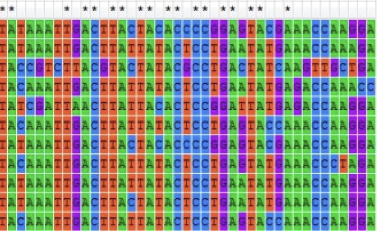
<ul><li><p>They compare large amounts of molecular data between ancestors and descendants to build the trees</p><ul><li><p>Homologous DNA sequences (like nuclear or mitochondrial DNA) are aligned and compared</p><ul><li><p>Helps with the study of gene evolution: <span>mutations accumulate over time, at different paces across organisms</span></p></li></ul></li></ul></li><li><p>Mathematical models (like maximum likelihood) are used to find the tree that best fits the data</p><ul><li><p><span>There are different models of evolutionary change, so this method is more flexible than parsimony</span></p></li></ul></li></ul><p></p>
56
New cards

When comparing DNA sequences using a mathematical model, some changes can be missed or underestimated. Explain why this is.

  • Multiple substitution events might have happened, but they are now undetectable.

    • We do not know the ancestral sequence

      • BUT we can compare observed sequences and predict how these sequences have evolved from the ancestral sequence

  • In a mathematical model, we consider possible rates of change (e.g., transitions vs. transversions, introns vs. exons).
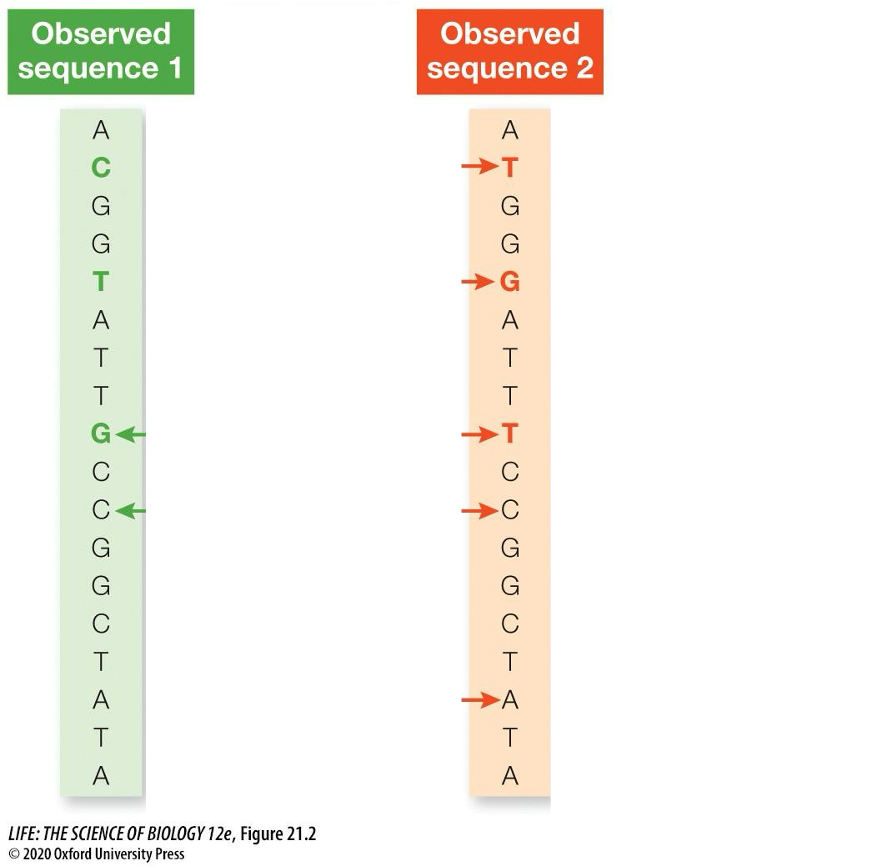
<ul><li><p><span>Multiple substitution events might have happened, but they are now undetectable.</span></p><ul><li><p><span>We do not know the ancestral sequence</span></p><ul><li><p><span>BUT we can compare observed sequences and <strong><em>predict </em></strong>how these sequences have evolved from the ancestral sequence</span></p></li></ul></li></ul></li><li><p><span>In a mathematical model, we consider possible rates of change (e.g., transitions vs. transversions, introns vs. exons).</span></p></li></ul><p></p>
57
New cards

How would the mathematical model be carried out?

  • Count the number of differences at homologous nucleotide positions

    • Reflects the minimum number of nucleotide changes that have occurred since the two sequences diverged from a common ancestral sequence

    • BUT this count likely underestimates the actual number of changes that have occurred since the sequences diverged

  • Any given change counted by comparing DNA sequences may result from multiple substitution events that occurred at a given nucleotide position over time
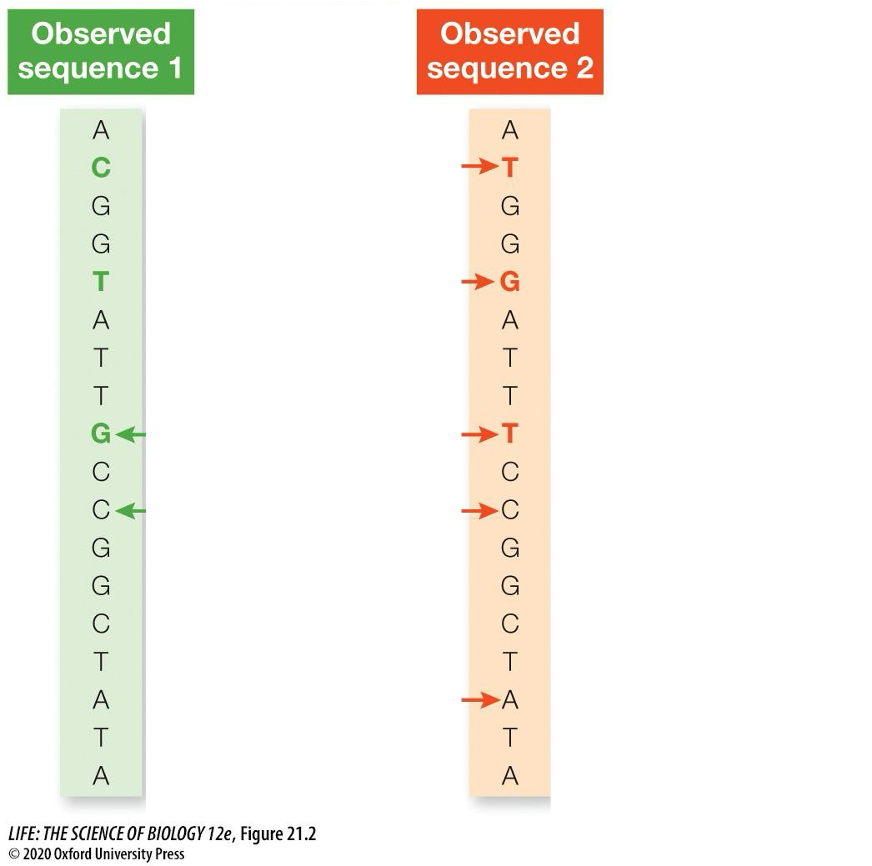
<ul><li><p><span>Count the number of differences at homologous nucleotide positions</span></p><ul><li><p><span>Reflects the <strong><em>minimum number of nucleotide changes </em></strong>that have occurred since the two sequences diverged from a common ancestral sequence</span></p></li><li><p><span>BUT this count likely <strong><u>underestimates</u> </strong>the actual number of changes that have occurred since the sequences diverged</span></p></li></ul></li><li><p><span>Any given change counted by comparing DNA sequences may result from multiple substitution events that occurred at a given nucleotide position over time</span></p></li></ul><p></p>
58
New cards

Continually using this approach, how is the ancestral sequence determined?

  • Two observed descendant sequences, which share a common ancestor, have undergone a series of substitutions

  • The two observed sequences (green, red) differ by only three nucleotides (colored letters)

    • BUT these three differences result from a total of nine substitutions (arrows)
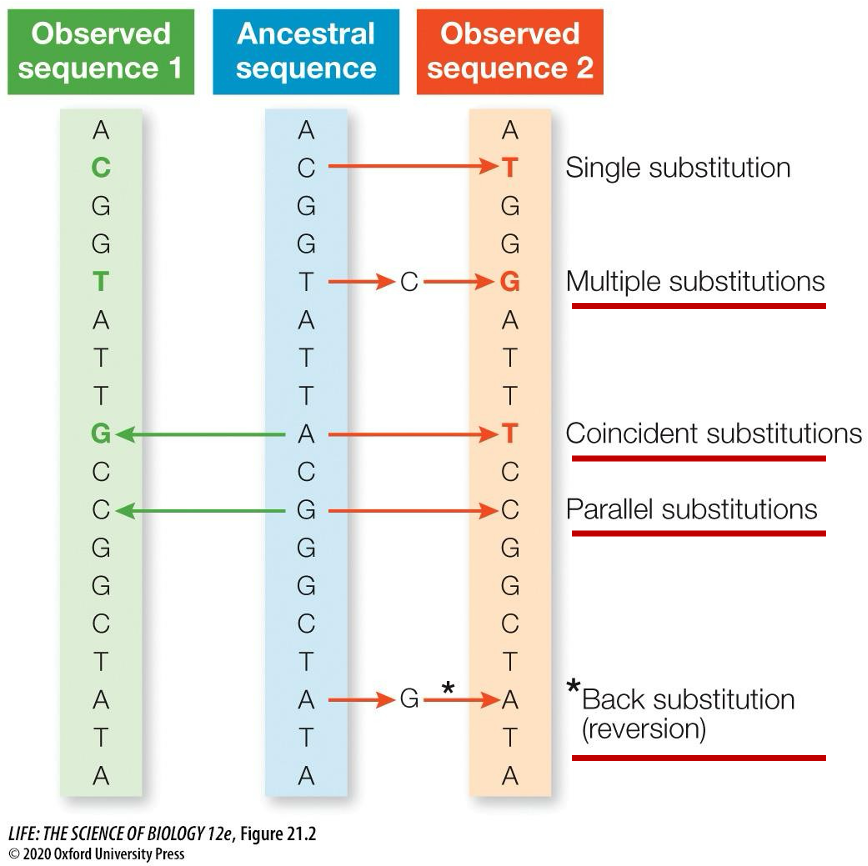
<ul><li><p><span>Two observed descendant sequences, which share a common ancestor, have undergone a series of substitutions</span></p></li><li><p><span>The two observed sequences (green, red) differ by only three nucleotides (colored letters)</span></p><ul><li><p><span>BUT these three differences result from a total of nine substitutions (arrows)</span></p></li></ul></li></ul><p></p>
59
New cards
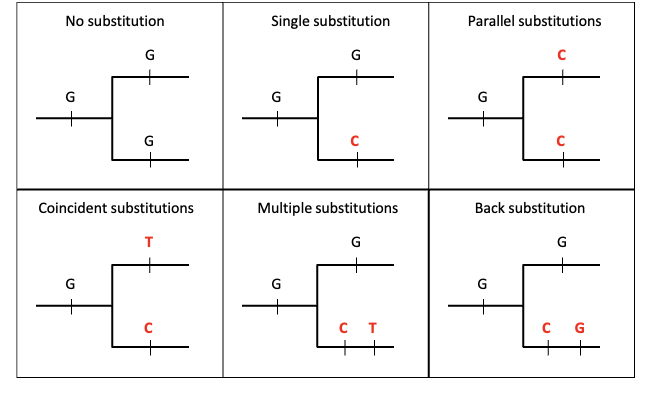
<p>How can these substitutions be visually represented? No, single, parallel, coincident, multiple, and back. </p>

How can these substitutions be visually represented? No, single, parallel, coincident, multiple, and back.

Substitution Type

What Happens

Example in Diagram

Key Idea

No substitution

The nucleotide stays the same throughout evolution.

G → G → G

No mutation occurs.

Single substitution

One mutation happens on one branch of the tree.

G → C in one lineage

Only one evolutionary change.

Parallel substitutions

The same mutation occurs independently in two separate lineages.

G → C and G → C

Example of convergent homoplasy.

Coincident substitutions

Different mutations occur at the same site in different branches.

G → T and G → C

Multiple independent mutations.

Multiple substitutions

Several mutations occur sequentially along the same lineage.

G → C → T

A site mutates more than once over time.

Back substitution

A mutation occurs and later changes back to the original base.

G → C → G

Example of evolutionary reversal (homoplasy).

<table style="min-width: 100px;"><colgroup><col style="min-width: 25px;"><col style="min-width: 25px;"><col style="min-width: 25px;"><col style="min-width: 25px;"></colgroup><tbody><tr><th colspan="1" rowspan="1"><p>Substitution Type</p></th><th colspan="1" rowspan="1"><p>What Happens</p></th><th colspan="1" rowspan="1"><p>Example in Diagram</p></th><th colspan="1" rowspan="1"><p>Key Idea</p></th></tr><tr><td colspan="1" rowspan="1"><p><strong>No substitution</strong></p></td><td colspan="1" rowspan="1"><p>The nucleotide stays the same throughout evolution.</p></td><td colspan="1" rowspan="1"><p>G → G → G</p></td><td colspan="1" rowspan="1"><p>No mutation occurs.</p></td></tr><tr><td colspan="1" rowspan="1"><p><strong>Single substitution</strong></p></td><td colspan="1" rowspan="1"><p>One mutation happens on one branch of the tree.</p></td><td colspan="1" rowspan="1"><p>G → C in one lineage</p></td><td colspan="1" rowspan="1"><p>Only one evolutionary change.</p></td></tr><tr><td colspan="1" rowspan="1"><p><strong>Parallel substitutions</strong></p></td><td colspan="1" rowspan="1"><p>The same mutation occurs independently in two separate lineages.</p></td><td colspan="1" rowspan="1"><p>G → C and G → C</p></td><td colspan="1" rowspan="1"><p>Example of <strong>convergent homoplasy</strong>.</p></td></tr><tr><td colspan="1" rowspan="1"><p><strong>Coincident substitutions</strong></p></td><td colspan="1" rowspan="1"><p>Different mutations occur at the same site in different branches.</p></td><td colspan="1" rowspan="1"><p>G → T and G → C</p></td><td colspan="1" rowspan="1"><p>Multiple independent mutations.</p></td></tr><tr><td colspan="1" rowspan="1"><p><strong>Multiple substitutions</strong></p></td><td colspan="1" rowspan="1"><p>Several mutations occur sequentially along the same lineage.</p></td><td colspan="1" rowspan="1"><p>G → C → T</p></td><td colspan="1" rowspan="1"><p>A site mutates more than once over time.</p></td></tr><tr><td colspan="1" rowspan="1"><p><strong>Back substitution</strong></p></td><td colspan="1" rowspan="1"><p>A mutation occurs and later changes back to the original base.</p></td><td colspan="1" rowspan="1"><p>G → C → G</p></td><td colspan="1" rowspan="1"><p>Example of <strong>evolutionary reversal (homoplasy)</strong>.</p></td></tr></tbody></table><p></p>
60
New cards

Genetic changes can affect organisms in different ways, synonymously explain.

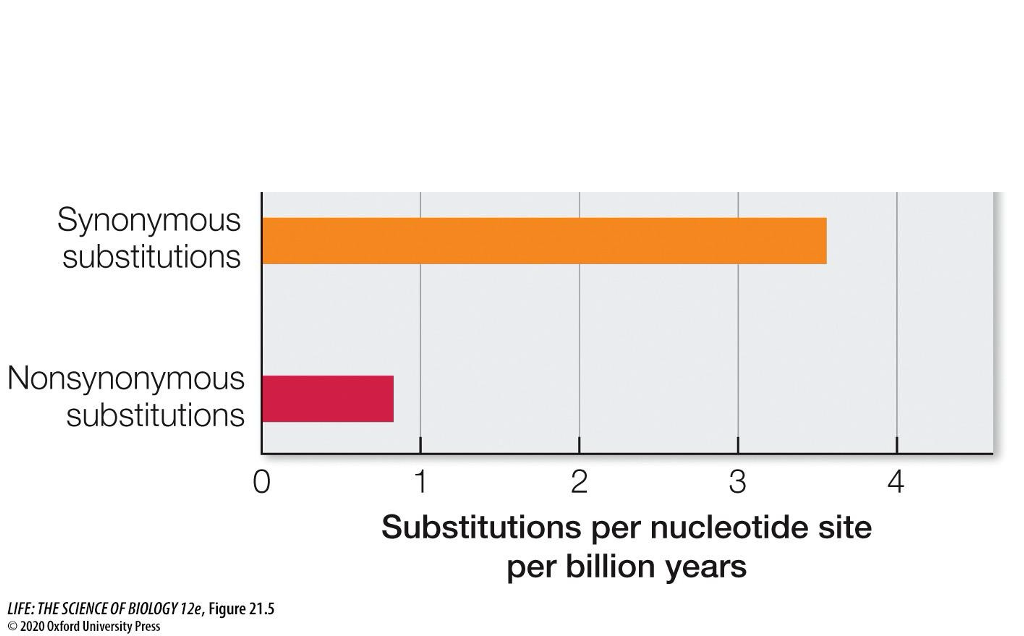
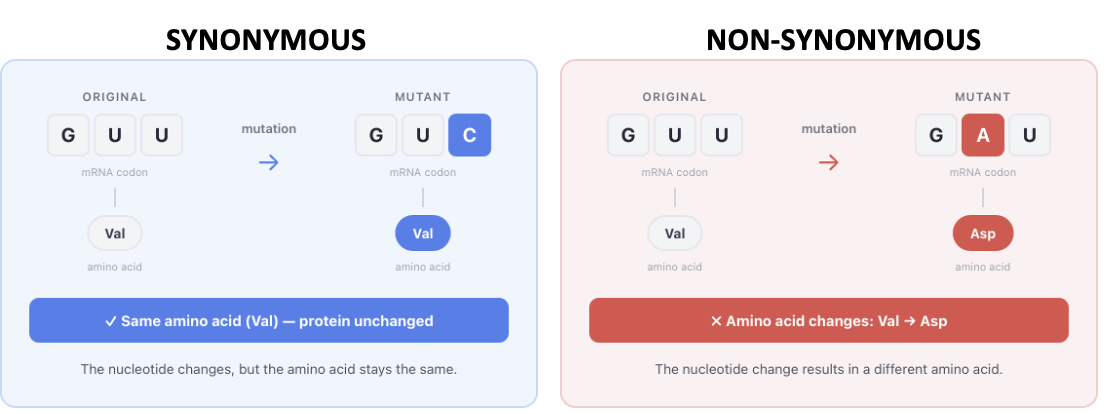
  • Synonymous substitutions (silent mutations) are neutral to natural selection and don’t change the protein and usually don’t matter, so they build up over time

  • Non-synonymous substitutions do change the protein

    • Most non-synonymous substitutions are harmful and get removed (deleterious)

    • Some are almost neutral (small effect with similar AA or outside coding region)

    • A few are beneficial and can create a new or improved function (gain of function)
<ul><li><p>Synonymous substitutions (silent mutations) are neutral to natural selection and don’t change the protein and usually don’t matter, so they build up over time</p></li><li><p>Non-synonymous substitutions do change the protein</p><ul><li><p>Most non-synonymous substitutions are harmful and get removed (deleterious)</p></li><li><p>Some are almost neutral (small effect with similar AA or outside coding region)</p></li><li><p>A few are beneficial and can create a new or improved function (gain of function)</p></li></ul></li></ul><p></p>
61
New cards

Selection in ____ among _____ populations or species can be detected by comparing the rate of _____ and ___ _____ substitutions.

  • Genes, different, synonymous and non-synonymous
<ul><li><p>Genes, different, synonymous and non-synonymous</p></li></ul><p></p>
62
New cards

What is advantageous in comparing the rates of these substitutions? What do they represent?

  • Can help detect natural selection

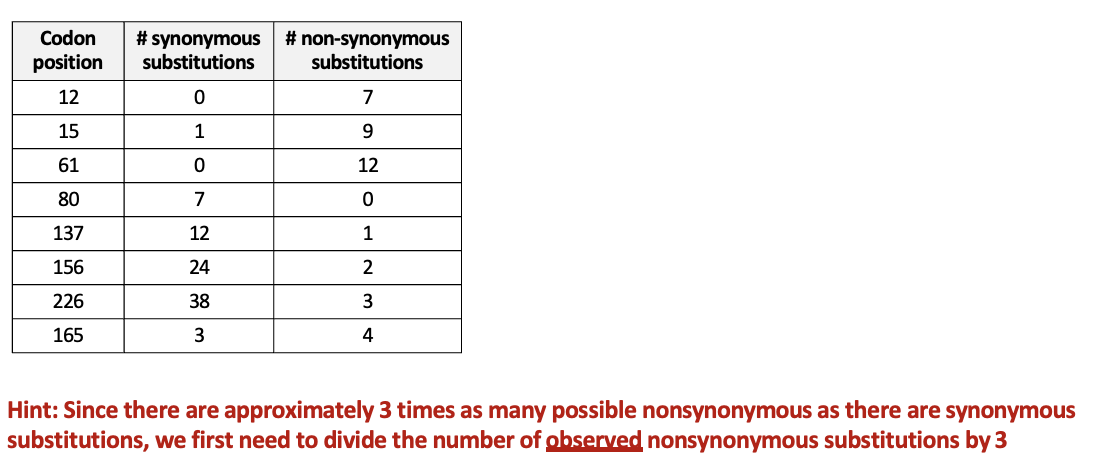
    • Rate of synonymous/*non-synonymous substitutions:

  • Compare the rate of non-synonymous changes to synonymous changes (dN/dS ratio)

    • If the rate is close to 1, the mutations have no effect on fitness (neutral to selection)

      • * = There are about 3 times more possible non-synonymous substitutions than synonymous ones

    • A few are beneficial and can create a new or improved function (gain of function)

63
New cards

What does it mean when one synonymous is more present than the other?

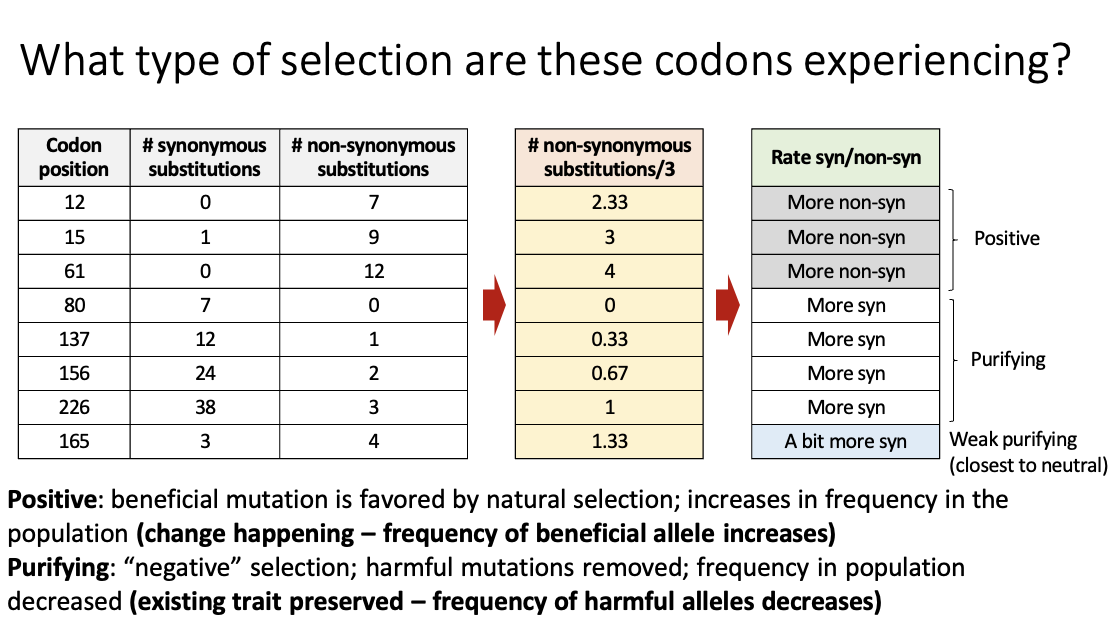
  • Synonymous < non-synonymous (more non-synonymous): positive selection

    • Beneficial mutations that change an amino acid are favored, changing the protein sequence, driving evolution

  • Synonymous > non-synonymous (more synonymous): purifying selection

    • Deleterious non-synonymous mutations removed; conserves protein sequence
64
New cards
<p><span style="font-family: &quot;Calibri Light&quot;;">What type of selection are these codons experiencing?</span></p>

What type of selection are these codons experiencing?

Codons experience answers
<p>Codons experience answers</p>
65
New cards

END OF CHAPTER 20

END OF CHAPTER 20

66
New cards

How is a species defined? - Physically/appearance. Drawbacks?

  • Morphological species concept

    • A species is a group of individuals that look alike

      • Linnaeus named thousands based on this

    • Drawback: members of the same species do not always look alike, an issue for cryptic species

67
New cards

How to define a sexually reproducing species on a biological level? What is the criteria and how does speciation play into this? Drawbacks?

  • A group of actually or potentially interbreeding natural populations that is reproductively isolated from other groups

    • A species is a group of interbreeding individuals that are reproductively isolated

    • Known as the biological species concept (via reproductive isolation).

  • Species result from speciation: divergence of lineages and emergence of reproductive isolation between lineages.

    • There’s no gene flow to make them their own species
<ul><li><p><span>A group of <em><u>actually or potentially </u></em><u>interbreeding natural populations</u> that is <u>reproductively isolated</u> from other groups</span></p><ul><li><p>A species is a group of interbreeding individuals that are reproductively isolated</p></li><li><p>Known as the biological species concept (via reproductive isolation). </p></li></ul></li><li><p><span>Species result from <u>speciation</u>: divergence of lineages and emergence of reproductive isolation between lineages.</span></p><ul><li><p>There’s no gene flow to make them their own species</p></li></ul></li></ul><p></p>
68
New cards

How is a species defined? - Lineage-wise. What is it a series of?,

  • A species is a group of organisms that share a pattern of ancestry and descent

    • Forms a unique branch on the tree of life, emphasizing evolutionary history and distinct lineages

    • Ancestor-descendant series

      • Start with the speciation event

      • End with an extinction event OR another speciation

      • Is gradual - could take thousands of years
<ul><li><p>A species is a group of organisms that share a pattern of ancestry and descent</p><ul><li><p>Forms a unique branch on the tree of life, emphasizing evolutionary history and distinct lineages</p></li><li><p>Ancestor-descendant series</p><ul><li><p>Start with the speciation event</p></li><li><p>End with an extinction event OR another speciation</p></li><li><p>Is gradual - could take thousands of years</p></li></ul></li></ul></li></ul><p></p>
69
New cards

How can reproductive isolation be reached? What is required for speciation to occur?

  • Speciation requires the interruption of gene flow (i.e., the sharing of genetic material) within a species that formerly exchanged genes

    • A result of a genetic change

  • Gene incompatibility can result in reproductive isolation

70
New cards

What is the Dobzhansky-Muller model and what does it explain?

  • Explains the evolution of reproductive isolation

    • Let’s start with an ancestral lineage and focus on two loci (1 and 2) with one allele each (a and b).
<ul><li><p>Explains the evolution of reproductive isolation </p><ul><li><p><span>Let’s start with an ancestral lineage and focus on two loci (1 and 2) with one allele each (<em>a </em>and <em>b</em>).</span></p></li></ul></li></ul><p></p>
71
New cards

When is the ancestral lineage separated? What do they form?

  • Ancestral lineage is separated if there is a barrier to gene flow

    • In this example, the isolation is caused by a mountain range   (geographic isolation)

  • They form independently evolving descendant lineages

    • •New mutations and alleles can independently arise in separate loci.
<ul><li><p>Ancestral lineage is separated if there is a barrier to gene flow</p><ul><li><p><span>In this example, the isolation is caused by a mountain range &nbsp; (geographic isolation)</span></p></li></ul></li><li><p>They form independently evolving descendant lineages</p><ul><li><p><span>•New mutations and alleles can independently arise in separate loci.</span></p></li></ul></li></ul><p></p>
72
New cards

What happens over time as a result of this separation?

  • The loci can experience allele fixation over time

    • Loss of polymorphism (ex. AA, not Aa), resulting in a single allele in a locus (just a single A or B)
<ul><li><p>The loci can experience allele fixation over time</p><ul><li><p>Loss of polymorphism (ex. AA, not Aa), resulting in a single allele in a locus (just a single A or B)</p></li></ul></li></ul><p></p>
73
New cards

What happens now if the two lineages try to interbreed?

  • They have now become incompatible, as new alleles have never interacted (hybrids have low fitness or die

    • A combination of AB within the same individual is lethal or causes low fitness

  • Two separate species have formed, as now the A or B alleles will not spread throughout the other respective lineages
<ul><li><p>They have now become incompatible, as new alleles have never interacted (hybrids have low fitness or die</p><ul><li><p>A combination of <em>AB </em>within the <span>same individual is lethal or causes low fitness</span></p></li></ul></li><li><p><span>Two separate species have formed, as now the <em>A </em>or <em>B </em>alleles will not spread throughout the other respective lineages</span></p></li></ul><p></p>
74
New cards

What does reproductive isolation increase with over time? What is it not?

  • Reproductive isolation increases with genetic divergence

    • Some species experience isolation with FEW genetic changes (left on the x-axis)

    • BUT others need more genetic divergence to achieve reproductive isolation (right on the x-axis)

  • Gene incapability drives this process, but it’s not one size fits all.
<ul><li><p>Reproductive isolation increases with genetic divergence</p><ul><li><p><span>Some species experience isolation with FEW genetic changes (left on the x-axis)</span></p></li><li><p><span>BUT others need more genetic divergence to achieve reproductive isolation (right on the x-axis)</span></p></li></ul></li><li><p><span>Gene incapability drives this process, but it’s not one size fits all.</span></p></li></ul><p></p>
75
New cards

What else can the model apply to? How is it caused, and what is achieved? What are these unique as well?

  • Can apply to chromosomes

    • Speciation by centric fusion

      • Chromosomal rearrangement

      • Fusion doesn’t stop viable sex cells, but could stop breeding. Could not produce a functional zygote.

    • Isolated achieved in only a few generations (fatser than the DM)

  • Chromosomes are acrocentric: centromere very close to one end, not in the middle
<ul><li><p>Can apply to chromosomes</p><ul><li><p>Speciation by centric fusion</p><ul><li><p>Chromosomal rearrangement</p></li><li><p><span>Fusion doesn’t stop viable sex cells, but could stop breeding. Could not produce a functional zygote.</span></p></li></ul></li><li><p>Isolated achieved in only a few generations (fatser than the DM)</p></li></ul></li><li><p><span>Chromosomes are <strong><u>acrocentric</u></strong>: centromere very close to one end, not in the middle</span></p></li></ul><p></p>
76
New cards

Speciation processes - Allopatric. How? When? What happens?

  • Occurs due to physical barriers (of inhospitable habitat) that separate a population

    • The most common mode of speciation

    • Usually over geological time (continental drift, sea level shifts)

    • Separated populations experience a mutation, genetic drift, and local adaptation

      • Lineages split, and reproductive isolation may arise

    • As a result, = Observe pairs of closely related sister species

  • Disruption of a population's habitation with something that is inhospitable. Glaciation split the central highlands into 2. Habitat in between became inhospitable, and gene flow became limited between the two populations. Will also adapt to their new local habitat, forming distinct species. Sister species very closely related.

  • Those (fish) are the sister species. They are different but also the same. Closely related but can’t interbreed.
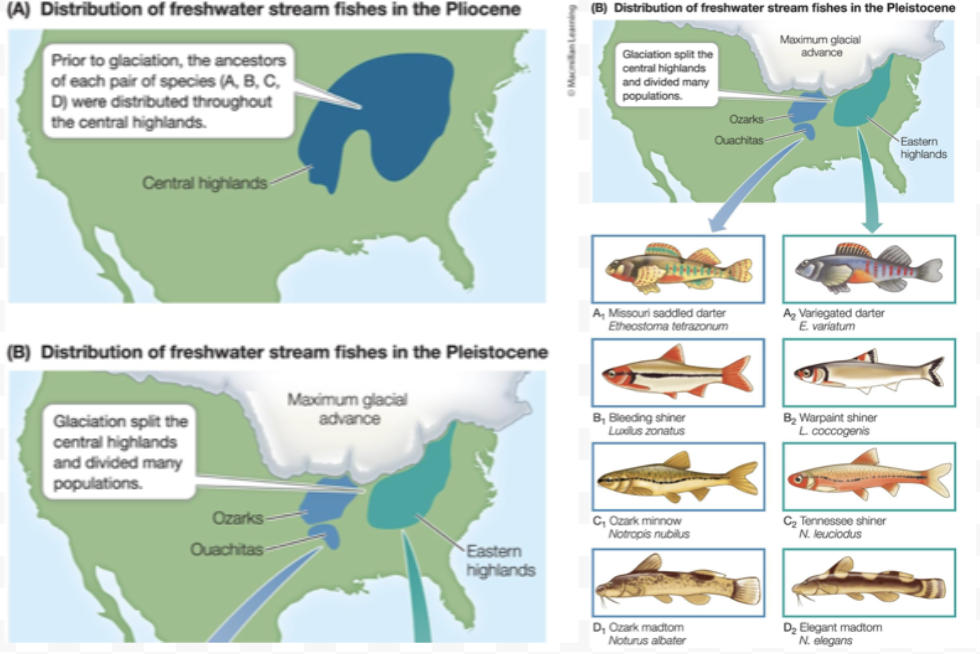
<ul><li><p>Occurs due to physical barriers (of inhospitable habitat) that separate a population</p><ul><li><p>The most common mode of speciation</p></li><li><p>Usually over geological time (continental drift, sea level shifts)</p></li><li><p>Separated populations experience a mutation, genetic drift, and local adaptation</p><ul><li><p>Lineages split, and reproductive isolation may arise</p></li></ul></li><li><p>As a result, = Observe pairs of closely related sister species</p></li></ul></li><li><p><span>Disruption of a population's habitation with something that is inhospitable. Glaciation split the central highlands into 2. Habitat in between became inhospitable, and gene flow became limited between the two populations. Will also adapt to their new local habitat, forming distinct species. Sister species very closely related.</span></p></li><li><p><span>Those (fish) are the sister species. They are different but also the same. Closely related but can’t interbreed.</span></p></li></ul><p></p>
77
New cards

How else can allopatric speciation occur? Explain this.

  • Founder effects

    • A group of individuals crosses an existing barrier (like islands) and establishes a new population

    • Each colonization generated a new, isolated population

    • Genetic drift, mutation, and local adaptation occur in the founder population
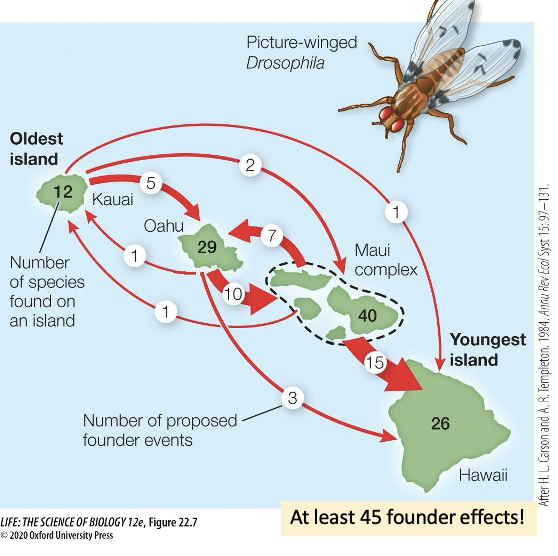
<ul><li><p>Founder effects</p><ul><li><p><span>A group of individuals crosses an <em>existing </em>barrier (like islands) and establishes a new population</span></p></li><li><p><span>Each colonization generated a new, isolated population</span></p></li><li><p><span>Genetic drift, mutation, and local adaptation occur in the founder population</span></p></li></ul></li></ul><p></p>
78
New cards

What is one of the most famous examples of the allopatric founder effect? What happened?

  • Darwin’s Finches!

    • Species across the Galapagos Islands differ greatly

      • Both from their ancestor and from one another

    • The islands are far apart, have unique and distinct geography and climate

    • Feeding specializations (i.e., beak size and shape) arose on these different islands to meet the environments of each island
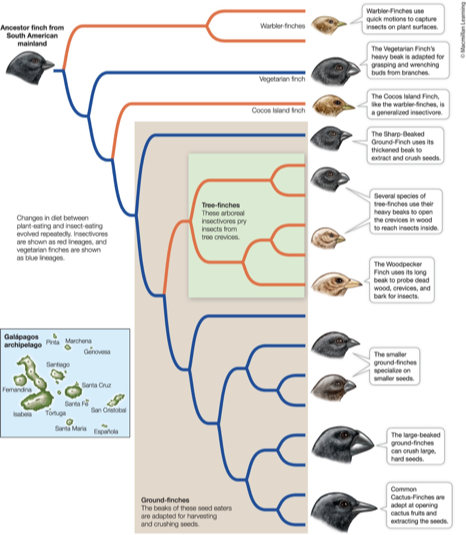
<ul><li><p>Darwin’s Finches!</p><ul><li><p><span>Species across the Galapagos Islands differ <strong><em>greatly</em></strong></span></p><ul><li><p><span>Both from their ancestor and from one another</span></p></li></ul></li><li><p><span>The islands are far apart, have unique and distinct geography and climate</span></p></li><li><p><span>Feeding specializations (i.e., beak size and shape) arose on these different islands to meet the environments of each island</span></p></li></ul></li></ul><p></p>
79
New cards

Speciation processes - Sympatric. How? What are the two main mechanisms?

  • Occurs without physical barriers

    • Disruptive selection (resulting in ecological isolation)

    • Polyploidy

80
New cards

What can disruptive selection result in? What is the fly example?

  • Results in ecological isolation

    • AKA habitat separation within the same area

  • The chart reflects when the tree flowers and goes on to produce fruit.

    • The apple has earlier flowering, and so over time the flies will develop a smell preference for one or the other, and hence drive to mate in breed on the apple earlier or later on the downy hawthorn.

    • A change in when and where they are breeding causes reproductive isolation over time.

    • Nearing becoming a distinct species today.
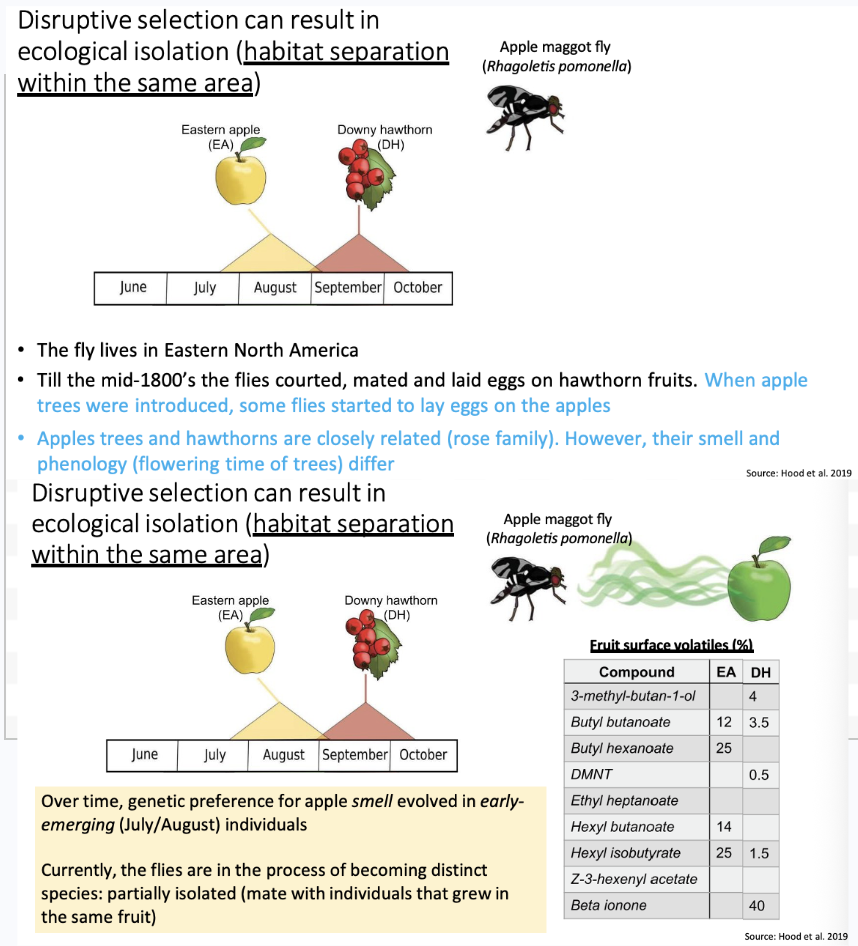
<ul><li><p>Results in ecological isolation</p><ul><li><p>AKA habitat separation within the same area</p></li></ul></li><li><p>The chart reflects when the tree flowers and goes on to produce fruit.</p><ul><li><p><span>The apple has earlier flowering, and so over time the flies will develop a smell preference for one or the other, and hence drive to mate in breed on the apple earlier or later on the downy hawthorn. </span></p></li><li><p><span>A change in when and where they are breeding causes reproductive isolation over time.</span></p></li><li><p><span>Nearing becoming a distinct species today.</span></p></li></ul></li></ul><p></p>
81
New cards

What does polyploidy cause? What is autoployploidy?

  • The phenomenon of when homologous chromosomes fail to separate from one another

    • This can cause speciation in just one generation

  • Autoployploidy

    • Two of the same species breed

    • One or both parents experience a meiosis error → A gamete has twice as many chromosomes as normal

      • Results in an offspring with chromosomal duplication. (3N or 4N vs 2N).
<ul><li><p>The phenomenon of when homologous chromosomes fail to separate from one another</p><ul><li><p>This can cause speciation in just one generation</p></li></ul></li><li><p>Autoployploidy</p><ul><li><p>Two of the same species breed</p></li><li><p>One or both parents experience a meiosis error → A gamete has twice as many chromosomes as normal</p><ul><li><p>Results in an offspring with chromosomal duplication. (3N or 4N vs 2N). </p></li></ul></li></ul></li></ul><p></p>
82
New cards
83
New cards
84
New cards
85
New cards

Explore top notes

Explore top flashcards

flashcards
Vocab Lesson 12
48
Updated 1141d ago
0.0(0)
flashcards
WWW List 13
25
Updated 30d ago
0.0(0)
flashcards
Quarter 4 Religion : )
140
Updated 659d ago
0.0(0)
flashcards
Unit 5: Westward Migration
25
Updated 344d ago
0.0(0)
flashcards
DMU 3313 Kremkau
140
Updated 966d ago
0.0(0)
flashcards
biol114 - ch.9
54
Updated 373d ago
0.0(0)
flashcards
SPH3U1 - key definitions
191
Updated 1145d ago
0.0(0)
flashcards
APUSH Unit 1 Giddes Test
242
Updated 890d ago
0.0(0)
flashcards
Vocab Lesson 12
48
Updated 1141d ago
0.0(0)
flashcards
WWW List 13
25
Updated 30d ago
0.0(0)
flashcards
Quarter 4 Religion : )
140
Updated 659d ago
0.0(0)
flashcards
Unit 5: Westward Migration
25
Updated 344d ago
0.0(0)
flashcards
DMU 3313 Kremkau
140
Updated 966d ago
0.0(0)
flashcards
biol114 - ch.9
54
Updated 373d ago
0.0(0)
flashcards
SPH3U1 - key definitions
191
Updated 1145d ago
0.0(0)
flashcards
APUSH Unit 1 Giddes Test
242
Updated 890d ago
0.0(0)