Translocation
 Studied by 0 people
 Call with Kai
 Learn
Learn Practice Test
 Spaced Repetition
 Match
Match Flashcards
 Knowt Play
1/22

There's no tags or description
Looks like no tags are added yet.
Name | Mastery | Learn | Test | Matching | Spaced | Call with Kai |
|---|
No analytics yet
Send a link to your students to track their progress
23 Terms
what is translocation?
the transport of assimilates throughout the plant in the phloem by mass flow (source to sink)
what are assimilates?
mainly sucrose
amino acids
where are sugars made (and what type of sugar and what is it turned into)?
in the leaves
glucose is made
every other glucose is turned into sucrose
Why can mass flow in the phloem occur both up and down a plant?
Different parts of the plant require assimilates at different times, so mass flow can move up or down depending on where sugars are needed.
Can mass flow occur in both directions in the same sieve tube?
Yes, because different regions of the plant act as sinks at different times, causing assimilates to move either up or down.
what is a source of sucrose?
where sucrose is produced and then loaded into the phloem
what are the main sources in plants?
Green leaves and green stems (when they are fully grown)
Storage organs (e.g. seeds, bulbs) ~ during the spring (during Autumn, when they are developing they are sinks)
Food stores un germinating seeds
what is a sink of sucrose?
where sucrose is used up and therefore unloaded from the phloem
what are the main sinks in plants?
Meristematic and growing tissues, such as small leaves - not big enough to produce all the glucose they need for respiration, shoot tips and root tips
Roots
Storage tissues such as seeds, bulbs or seeds during development
what does a pressure difference in the phloem cause?
sap to move either up or down in the phloem (from high pressure to low pressure)
what is the first step at the source of a plant?
loading
what are 2 ways sucrose is loaded into the phloem at the source?
the symplast pathway
the apoplast pathway
what is the symplast route when loading the phloem?
the sucrose diffuses through the cytoplasm in neighbouring mesophyll cells, moving through plasmodesmata
this does not require ATP so it is passive
the sucrose lowers the water potential of the cytoplasm in the neighbouring cell
water follows by osmosis
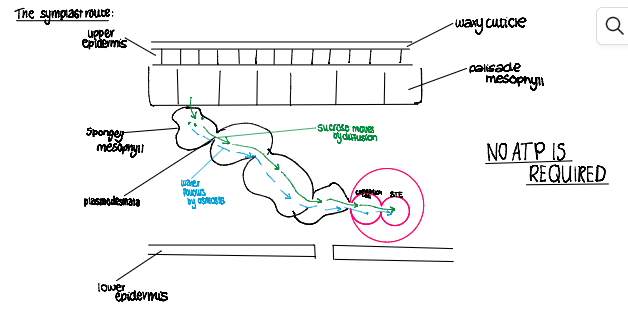
is the symplast route for loading at the source passive or active?
passive
describe the apoplast route for loading sucrose into the phloem
Sucrose diffuses through the cell walls to the companion cells down a concentration gradient
This gradient is maintained by the constant movement of sucrose into phloem vessels (from where sucrose moves to a sink)
At the companion cells, sucrose is moved into the cytoplasm of the companion cell across the cell surface membrane by an active process.
Companion cells actively transport H+ ions out into surrounding tissue using ATP
H+ ions return by diffusion down their concentration gradient via co-transporter proteins
They bring sucrose along with them
As sucrose builds up in the companion cells it diffuses into the sieve tube through the plasmodesmata down its concentration gradient.
The build-up of sucrose lowers the water potential of the sieve tube element and so water follows by osmosis (from the xylem and surrounding cells) - both symplast and apoplast
This leads to high hydrostatic pressure in the sieve tube element at the source
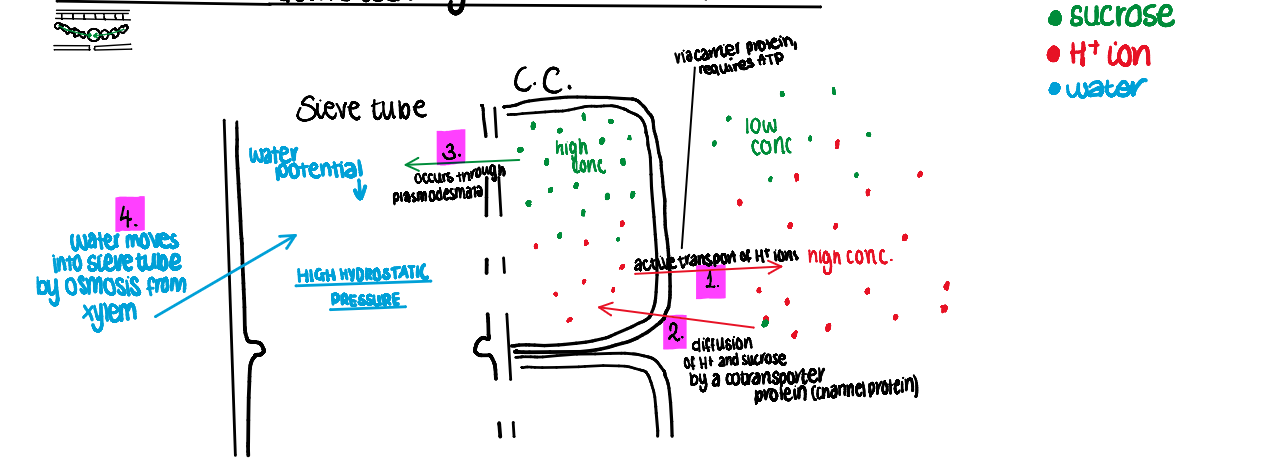
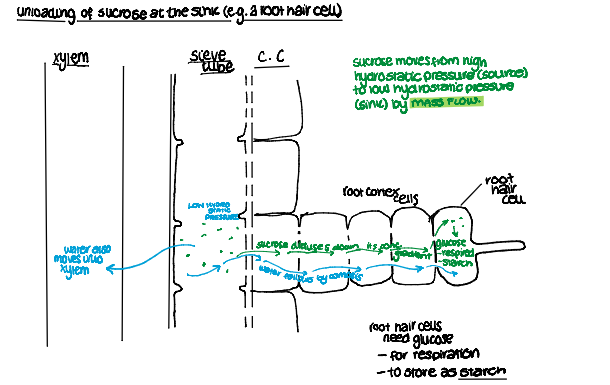
where does sucrose diffuse to and from at the sink?
sucrose diffuses out of the sieve tube elements and into the surrounding cells down its concentration gradient
what happens when sucrose diffuses into the surrounding cells?
the water potential of the cell lowers
water follows in by osmosis down its water potential gradient
This leads to low hydrostatic pressure at the sink, thereby creating a hydrostatic pressure gradient between the source and the sink
what causes the sap to be transported through the plant?
the hydrostatic pressure gradient between the source and the sink
what is sap made up of?
sucrose
amino acids
does the sap move up or down the plant via transcloaction?
it can be moved up or down depending on the relative positions of the source and the sink
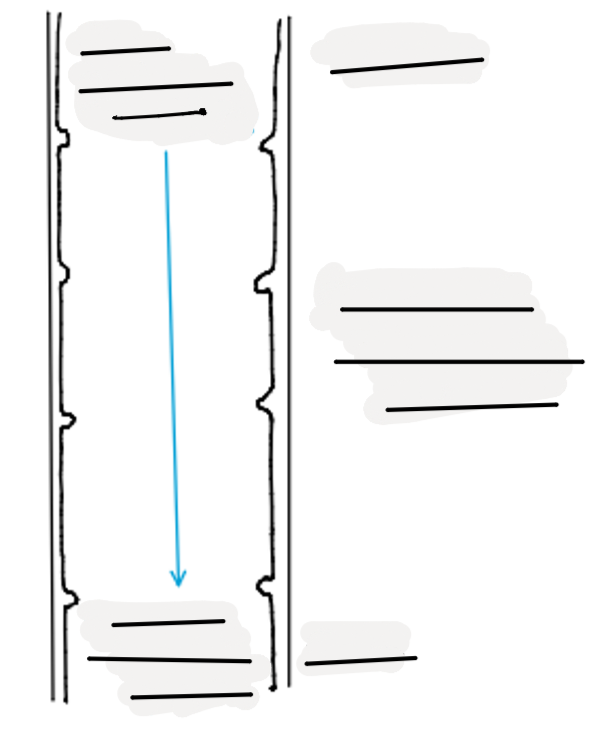
fill in the gaps
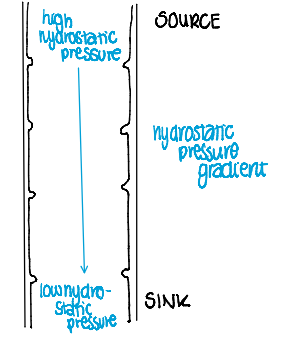
how does sucrose more from high hydrostatic pressure (source) to low hydrostatic pressure (sink)?
mass flow
how is sucrose unloaded out of the phloem?
At the sink, sucrose diffuses out of the sieve tube elements and into the surrounding cells down its concentration gradient
As sucrose diffuses into a cell, it lowers the water potential of that cell, and so water therefore follows by osmosis down its water potential gradient
This leads to low hydrostatic pressure at the sink, thereby creating a hydrostatic pressure gradient between the source and the sink
This pressure difference (between the source and the sink) means that sap (sucrose and amino acids) can be transported over many metres
Depending on the relative positions of the source and sink, sucrose can be moved either up or down the plant by translocation
 Note
Note  Flashcards (22)