L8: Personality & the Self [PSYC1001 -1A]
 Studied by 1 person
 Call Kai
 Learn
Learn Practice Test
 Spaced Repetition
 Match
Match Flashcards
 Knowt Play
1/52

There's no tags or description
Looks like no tags are added yet.
Name | Mastery | Learn | Test | Matching | Spaced | Call with Kai |
|---|
No analytics yet
Send a link to your students to track their progress
53 Terms
People’s personalities (similar & different)
Origins of personality:
Biological basis
Childhood experiences
Personality predicts future behaviour
Evolutionary adaptivity
Freud’s psychoanalytical theory
Id
The animalistic self that we’re born with & follows the pleasure principle
Superego
Moral principles acquired through socialisation
Ego
Deals with the reality in the conflicts between “Id” & “Superego”
What if the “ego” can'‘t resolve conflicts?
We have other defence mechanisms:
Repression
Regression
Displacement
Denial
Reaction formation
Rationalisation
Projection
Sublimation
Repression
Expulsion from awareness of unacceptable ideas or motives
Regression
The return of behaviour that’s typical of earlier stages of development
Displacement
The transfer of acceptable impulses away from their original objects onto safer or less threatening objects
Denial
Refusal to recognise a threatening impulse or desire
Reaction formation
Behaving in a way that’s opposite of one’s true wishes or desires to keep them repressed
Rationalisation
Use of self-justifications to explain away unacceptable behaviour
Projection
Imposing one’s own impulses or wishes onto another person
Sublimation
Transforming the anger into something productive
Freud's Theory of Psychosexual development
Oral
Anal
Phallic
Latency
Genital
Oral [Birth to 12-18 months]
Erogenous zone | Source of Sexual Pleasure | Source of Conflict |
Oral cavity | Sucking, biting & mouthing | Weaning |
Anal [18 months to 3 years]
Erogenous zone | Source of Sexual Pleasure | Source of Conflict |
Anal zone | Retention & release of bodily waste | TPoilet training |
Phallic [3 to 6 years]
Erogenous zone | Source of Sexual Pleasure | Source of Conflict |
Penis in boys; clitoris in girls | Masturbation | Masturbation; Oedipus complex |
Latency
Erogenous zone | Source of Sexual Pleasure | Source of Conflict |
None | None (focus on play & school activities) | None |
Genital
Erogenous zone | Source of Sexual Pleasure | Source of Conflict |
Genitals (penis in men; vagina in women) | Return of sexual interests espressed in mature relationships | None |
Fixations at Psychosexual Stages
Weaning at the oral stage — “I am not a baby anymore”
Potty training at the anal stage — “I can control myself”
Oedipal complex at the phallic stage — “I will become my father” (identification)
Psychodynamic
A theory put forward by Freud, in which psychic energy is moved along the compartments of the [Id, Ego & Superego].
Criticism’s of Freud’s Theory [Positive]
Innovative views about human development and personality
Concepts continue to influence current psychology (unconsciousness, psychoanalysis, defence mechanisms)
Criticism’s of Freud’s Theory [Negative]
Unscientific premises
Unnecessary premises on sex drives
Androcentrism
Neo-freudism
A psychoanalytic approach that builds upon Sigmund Freud's work but deemphasises his focus on biological instincts and sexuality, instead prioritising the role of social and cultural factors in shaping personality
The Behaviourist approach
Personality is a consistent pattern of response tendencies
The pattern is shaped by past reinforcement & punishment
It’s modifiable & not constrained by any developmental stages
The Humanistic approach
Human’s aren’t animals — we have unique needs & values
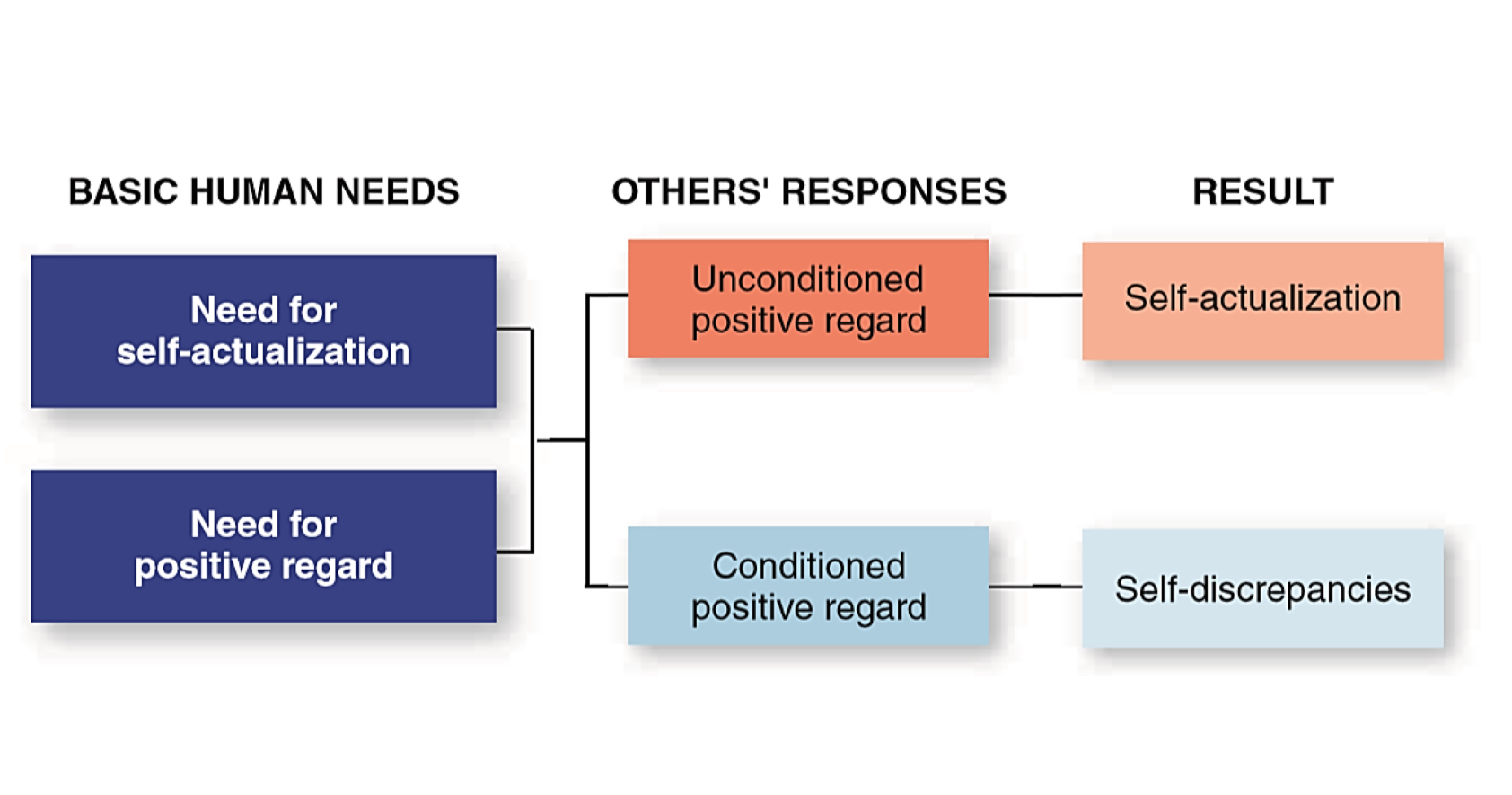
Personality results from whether people fulfil their innate need for personal growth
The sense of self comes from:
The need for self-actualisation
The need for positive regard
Carl Roger’s Humanistic Theory of Personality
Centres on the idea that individuals have an innate drive toward self-actualisation (fulfilling one’s potential).
Achieving that goal depends on the response of other people (family, friends, society) to the self
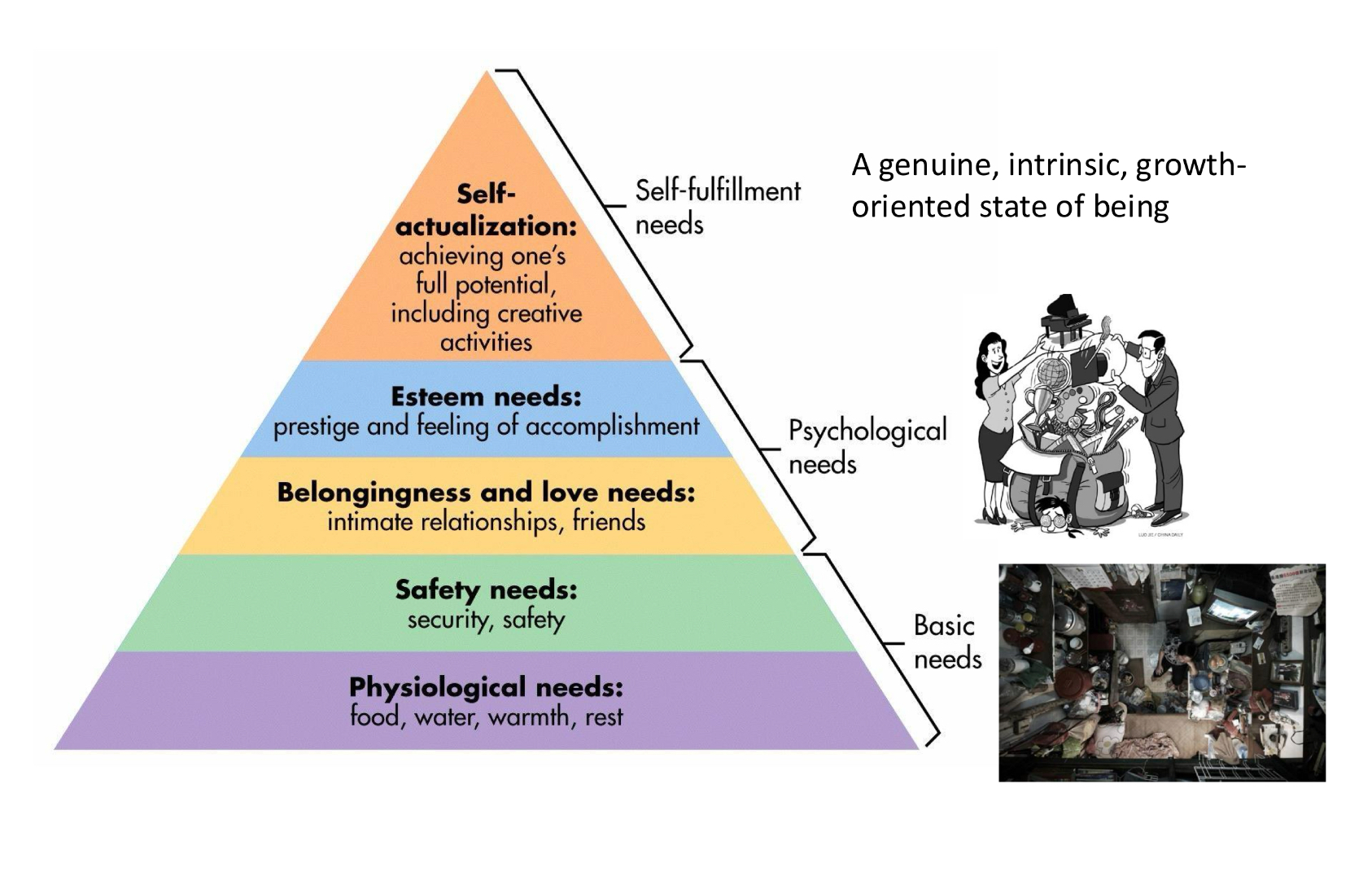
[Maslow’s] Hierarchy of human needs
Trait(s)
A stable personality characteristic
Types of traits
It isn’t easy to compare people of distinct types
Traits as continuous dimensions
People are different, but the differences can be captured on some common dimension with a central tendency
Physical traits — height, weight, eye colour
Personality traits
The Psycho-lexical approach
A method for identifying the most important personality traits or values by studying the natural language people use to describe themselves and other.
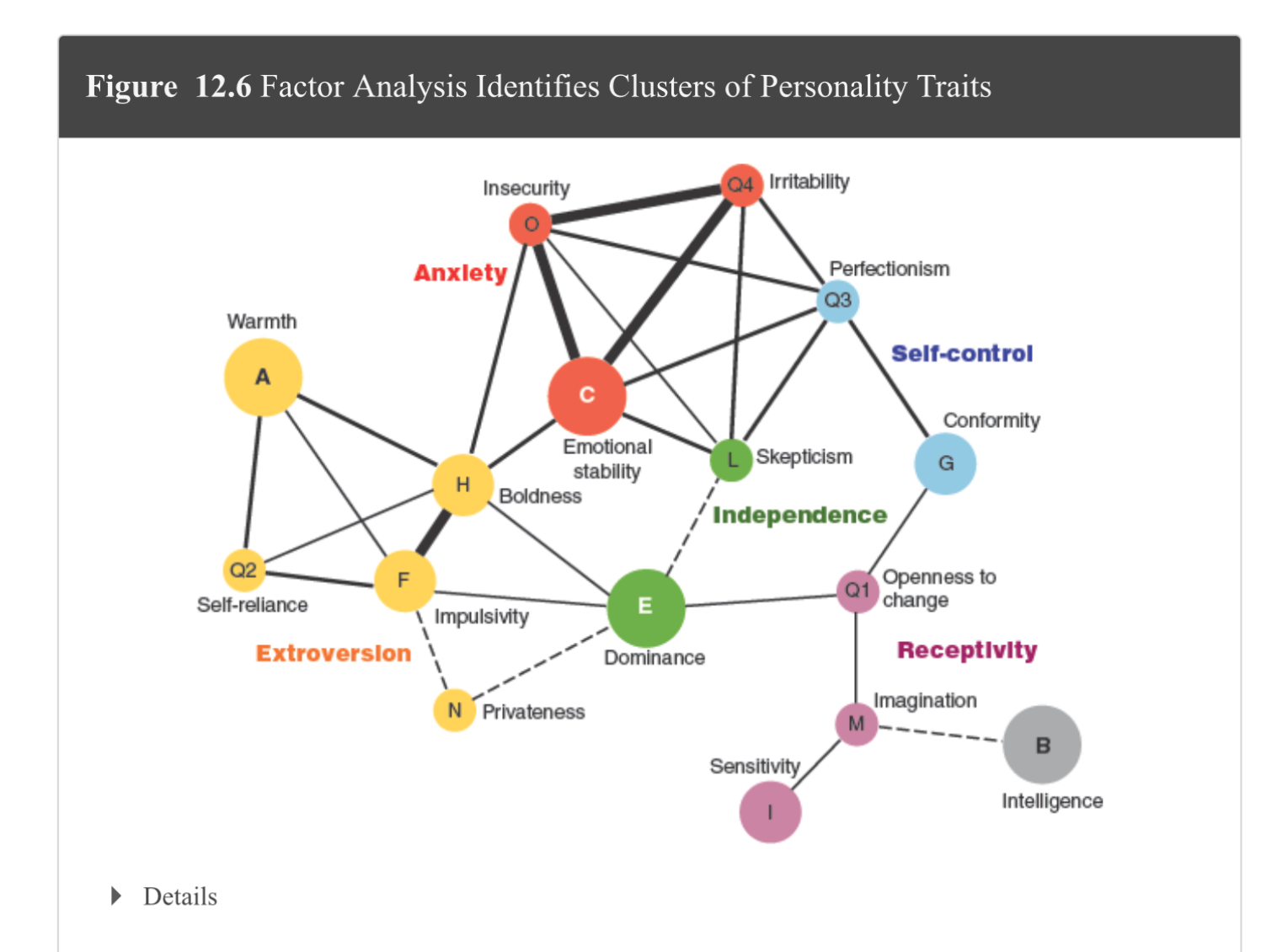
Factor Analysis Identifying Clusters of Personality Traits
The statistical technique of factor analysis allows psychologists to identify factors that positively correlate/cluster together, as well as strengths of those relationships.
The 5 clusters:
Extroversion
Anxiety
Self-control
Independence
Receptivity
The Big Five Theory of Personality (five-factor model [FFM])
Identifies 5 traits [O.C.E.A.N]:
Openness to experience
Conscientiousness
Extroversion (surgency)
Agreeableness
Neuroticism
![<p><u>Identifies 5 traits [O.C.E.A.N]:</u></p><ul><li><p>Openness to experience</p></li><li><p>Conscientiousness </p></li><li><p>Extroversion (surgency)</p></li><li><p>Agreeableness</p></li><li><p>Neuroticism</p></li></ul><p></p>](https://knowt-user-attachments.s3.amazonaws.com/d417c448-a012-4131-a7c4-7f5873012f5e.jpg)
Social Cognitive Theory (SCT)
Proposed by Albert Bandura, explains how people learn and change their behaviour within a social context. Works through reciprocal determinism.
Personal Factors: Your internal thoughts, beliefs, and attitudes (e.g., your self-efficacy, or the belief in your ability to succeed).
Behavioural Factors: Your actions and skills.
Environmental Factors: External influences like social norms, the actions of others (observational learning/modelling), and available resources,
Reciprocal determinism
The idea that our behaviour, personal characteristics (like thoughts and beliefs), and environment all interact and influence each other in a continuous loop
Social Cognitive Theory — explainations
The direct experience of reinforcement/ punishment is not always necessary to (de)motivate behaviour – people do develop a mental representation of the outcomes through observational learning.
We can control our impulses through active, cognitive means (not necessarily punishment). For example, a child may distract themselves from the temptation of a marshmallow by imagining it as a rock
Beliefs in the self (self-efficacy) are more important than reinforcement history
It is an oversimplification to expect people of certain traits to behave in the same way across different situations. An introvert can be talkative when it comes to his/her subject!
Biology & Personality
From temperament to personality
Heritability of personality is not as high as that of temperament
Social input (e.g, sensitive & caring parenting)
Skills development (SCT)
Personality & the brain
The case of Phineas Gage
Biological ‘explanations’ of personality
Personality traits are constructs that are not based on any real biological systems – just that we are differentiated into extroverts and introverts does not mean that there is a specific biological system that encodes extra/intro-version.
Personality assessment
Guided by theoretical premises.
Personality is a result of unconscious conflicts
A result of reinforcement & punishment history
A result of the interaction between cognitive beliefs and social environment
Personality are latent personality traits that can only be inferred indirectly
Projective [Personality] tests — Bypassing the defence mechanism
Rorschach Inkblot Test
Thematic Apperception Test
Locus of control
A psychological concept that describes how much you believe you have power over the events in your life.
If you have an internal locus of control, you tend to think your actions shape your outcomes.
If it’s external, you’re more likely to see luck, fate, or other people as in charge.
Self-efficacy
A person's belief in their ability to succeed in a specific situation or to achieve a particular goal
Temperament
A child’s pattern of mood, activity, or emotional responsiveness linked to later personality
Reinforcement sensitivity theory (RIST)
A biopsychological framework that suggests individual personality differences stem from variations in the sensitivity of the brain's motivational systems to rewards and punishments.
Bottom-up approach to Personality [Brain structure & Brain function]
It’s perhaps more realistic to conceptualise individual differences based on basic biological systems.
The Reinforcement Sensitivity Theory (RST) identifies 3 primary systems:
Behavioural Approach System (BAS)
Fight-flight freeze system (FFFS)
Behavioural inhibition system (BIS)
Behavioural Approach System (BAS)
A motivational system in psychology that drives goal-oriented and reward-seeking behaviour.
It is sensitive to signals of reward, hope, and positive feelings, and it prompts a person to move toward achieving desirable outcomes.
Fight-flight freeze system (FFFS)
A neurobiological system that is responsible for an organism's reactions to all aversive (punishing or threatening) stimuli.
It is a survival mechanism designed to help an individual escape or avoid danger and is associated with the primary emotion of fear.
Behavioural inhibition system (BIS)
A motivational system responsible for an individual's sensitivity to cues of punishment, threat, and non-reward.
When activated, it causes a person to stop ongoing behaviour and increase their attention to the environment to avoid potential negative outcomes.
Evaluations of the assessments in personality
The issues of reliability (consistent) & validity (measures what it’s supposed to)
Objectivity — the scores are interpreted without subjective biases
The NEO-PI that assesses the FFM has a standardised scoring system
Projective tests are highly dependent on the experiences of the interpreter
Ethics
Subjective experiences of the self
Patterns of thoughts, feelings, and actions we perceive in our own minds
The sense of self changes depending on external environments
The self experience may not align closely with the personality assessment
Self-concepts
Like LTM, our self-concepts are organised in a schematic activation network
Core self-concepts are most readily activated (“I am…”)
The self-reference effect
We encode information input according to our self-concept (we tend to remember information relevant to us)
Self-awareness
Our self-awareness is heightened when we see our own reflections in the mirror
Often leads to a higher sense of morality
De-individuation
When our identity is masked, self-awareness decreases
Self-esteem
Sense of self-worth
It’s a useful gauge for self-acceptance, which is why we seek to restore it after experiencing social rejection
Self-esteem protection
Upward or downward social comparison
Self-serving biases
Why personality psychology?
Psychologists aim to explain and predict human behaviour
Personality may serve these 2 objectives
Caution
Circular reasoning
Social / environmental output
Sometimes social situations can override our sense of self
Circular reasoning
A fallacy where the conclusion is used as a premise to support itself, creating a loop without providing independent evidence.
He loves looking in the mirror ⇄ He is narcissistic
 Note
Note  Flashcards (30)