Art History Midterm 1
 Studied by 0 people
 Call Kai
 Learn
Learn Practice Test
 Spaced Repetition
 Match
Match Flashcards
 Knowt Play
1/132

There's no tags or description
Looks like no tags are added yet.
Name | Mastery | Learn | Test | Matching | Spaced | Call with Kai |
|---|
No analytics yet
Send a link to your students to track their progress
133 Terms
What is prehistory?
The period of human history that occurred before the existence of written records; includes the Stone Age and Early Bronze Age
What is the Stone Age and when was it?
The prehistoric period of human history when people used stone to make tools and weapons. The Stone Age began ~2.5 million years ago and lasted until ~3200 BCE.
What is the Three Age System?
Three Epochs (division of time) based on technology: Stone Age, Bronze Age, and Iron Age.
How is the Stone Age subdivided (include dates and descriptions)?
Paleolithic (2.5 million years ago - 10,000 BCE)
- First stone tools until the end of the Great Ice Age
- Begins with the first evidence of our humanoid ancestors using chipped stone tools
- Basis of the cultural traits that define our species
Mesolithic (10,000 BCE - 4000 BCE)
- From end of Great Ice Age to development of farming
- Considered a transition period and less important for art history
Neolithic (9000 BCE to 2000 BCE)
- From development of agriculture to the use of bronze
- Led to increased social organization and sedentary lifestyle which promoted the development of art
What is the Great Ice Age?
A major climatic resulting in changes in landscape, habits, and plant and animal populations which influenced human evolution by favoring traits like upright walking (bipedalism) and tool use; drove megafauna (big plants and animals) to extinction
Where and when was art first made? What forms did it take? What does it tell us about human evolution at that time?
- The first art was made in the Blombos Cave in South Africa and came from between 100,000 to 60,000 years ago (30,000 years before Europe)
- It took the form of personal ornament; incised stone, ochre, and ostrich shells with abstract patterns inscribed on them
- The first art tells us that our ancestors had higher levels thinking, self-awareness, and had developed language by this point
What are the three main categories of Paleolithic art?
- Personal ornament
- Cave art
- Mobiliary Art
What is a personal ornament?
These are objects that are worn on the human body, such as jewelry; one of the first types of art
What is cave painting and the traits of it?
Paintings on cave walls and ceilings, especially those dating from prehistoric times. They have the following traits:
- Found deep in cave networks
- Subjects of cave art were usually animals, abstract shapes and patterns, and human or quasi-human figures
- Images are a mixture of naturalistic and abstract styles
What were the methods used in cave-art?
- Imprinting
- Tracing with fingers, sticks, etc.
- Scraping the rock surface
- Shading with charcoal
- Painting with paintbrushes made out of hair or moss with pigments made from vegetables
What is imprinting?
- Imprinting is when an individual puts their hand in paint and then on the wall or when a hand is placed on the wall and paint is sprayed on it (when the hand is removed, the negative space is hand-shaped). The latter technique is called hand stencils.
- Most of the hands are those of children or teenagers
What are hand stencils? Is it a type of imprinting?
- When a hand is placed on the wall and paint is sprayed on it (when the hand is removed, the negative space is hand-shaped).
- It is a type of imprinting
What are the theories behind imprinting?
They could have been:
- Signatures
- Property markers
- Memorials
- Love magic
- A desire to leave one's mark in a sacred place
- A sign of being responsible for a site
- They could record growth or be a growth-related ritual
- They could have been a mark to say "I was here"
What is a Naturalistic style?
A term used to describe a style of art in which subjects are depicted as they appear in real life
What is Abstract style?
A term used to describe a style of art in which the artist does not attempt to depict objects as they visually appear in real life
What is Style?
Style refers to a distinctive manner that allows for the grouping of works into related categories. It encompasses the visual appearance of a piece of art, linking it to other works by the same artist or from the same period, location, or art movement
What is the Chauvet Cave? Describe it
- It is a cave in South-Central France and is famous for its cave paintings and figures with over 960 art works
- It houses the Great Panel
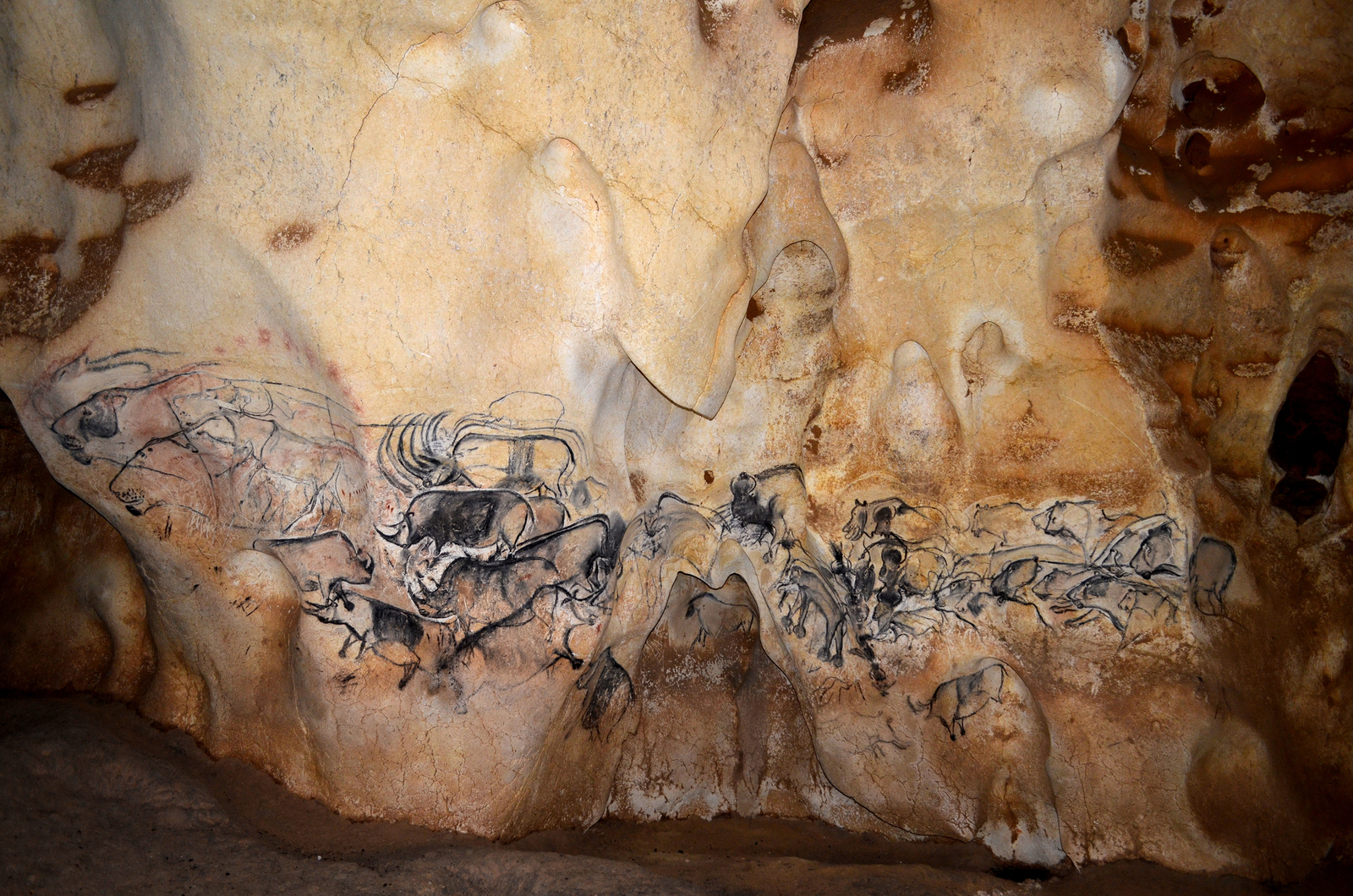
The Great Panel from the left-hand wall of the End Chamber, Chauvet Cave, France, c. 32,000-30,000 BP (Middle Paleolithic)
Depicts a densely packed stampede or animals drawn from charcoal and depicted in profile (from the side)
Sense of movement caused by the animals overlapping with one another
Implied line suggests that the animals are moving in a direction
Has ground line
Feeling of chaos because animals are spaced chaotically
The way we see the painting today is likely not how it was intended to be viewed (ancestors would have seen it with torchlight)
What is an implied line?
An implied line is a line that is not actually drawn but suggested by elements placed in a certain order or the direction that figures point, look, or gesture
What is space?
Space refers to the illusion or depiction of three dimensionality in a two dimensional space
What is shading?
Shading is the artistic process of using graduation of light and dark to depict the appearance of volume, texture, and space on a flat surface
What is foreground?
Foreground refers to the area of a picture that appears nearest to the observer
What is the ground line?
A ground line is a base line, drawn or implied, in an artwork on which objects or architecture appears to stand
What is composition?
Composition is the arrangement and organization of visual elements -- such as line, shape, color, space, value, and form -- within a work
What are some suggested purposes for cave art?
Art for art’s sake, although this theory has been rejected by modern scholars
Boundary markers, allowing people to mark territory; this aligns with high population density back then, but doesn’t account for similarity of images so it is a maybe
Reflection of prehistoric cosmology; this theory suggests that there are certain patterns in the cave art resulting from the beliefs of early humans and their place in the world around them; these patterns were based on the idea of male and female animals being separate which ended up not being the case so this theory is rejected
Hunting magic; the idea was that these paintings would make animals appear so they could be hunted, but this was proven false since most animals shown were not ones early humans ate
Shamanism; this theory stated that early humans used hallucinogenic drugs and then drew some of those abstract hallucinations on the cave walls, but this theory is a maybe
What can cave art tell us about human society and evolution in the Paleolithic period?
Our ancestors had higher levels thinking, self-awareness, and had developed language.
What is Mobiliary Art and some characteristics of it?
They are small, portable artworks that can be easily carried or moved
There were two main types of mobiliary art:
Figurines made from wood or clay or carved from stone, ivory, or bone
2D engravings on stone, bone, shell, or ivory
Popular subjects were humans, animals, and human-animal hybrids
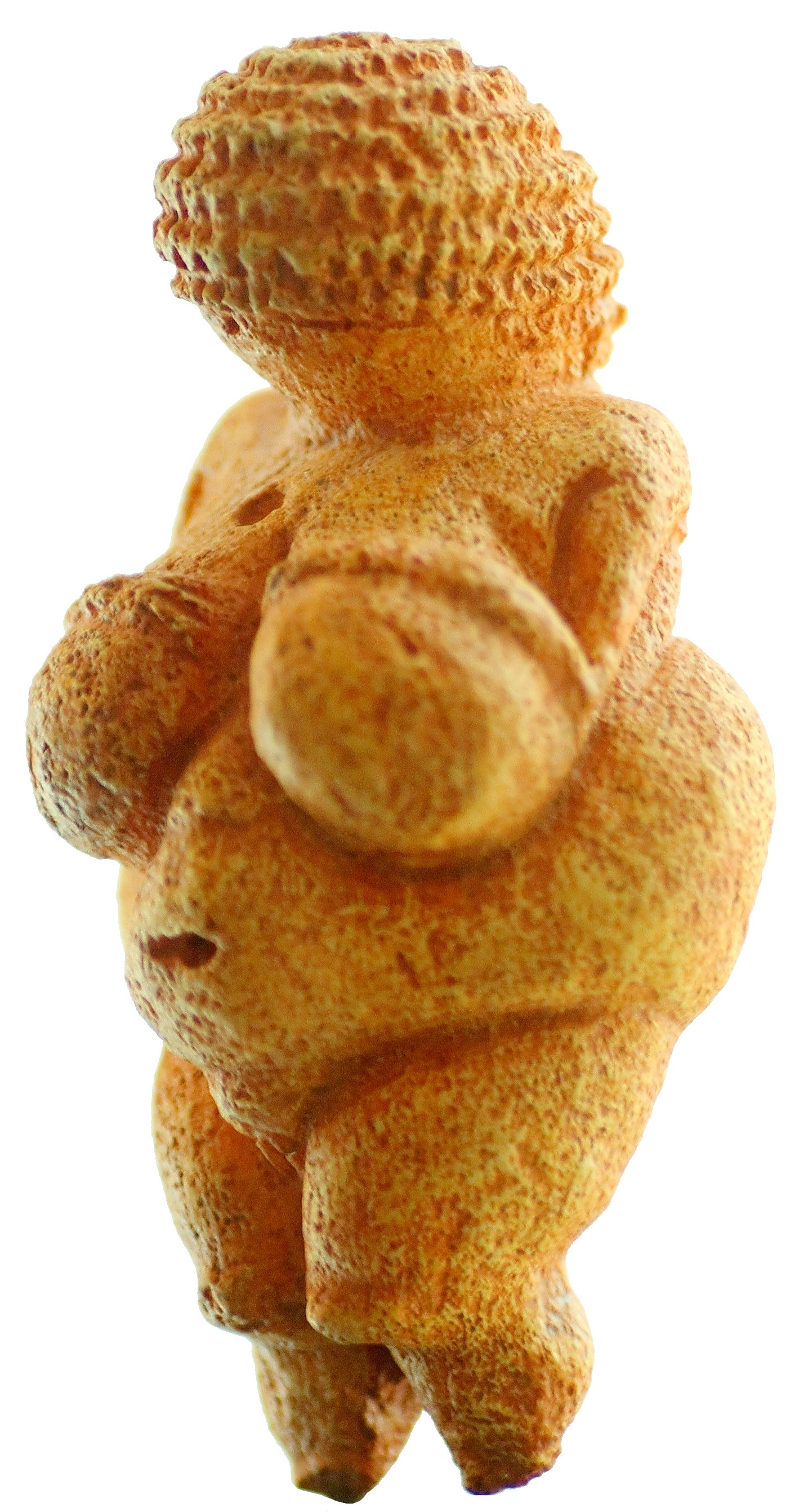
Venus of Willendorf, Austria, c. 28,000 BCE
A Venus figure
What were common characteristics of Venus figures and what do scholars speculate?
Small and easily portable
Depict a nude, faceless woman in an upright pose
Breasts, genitalia, abdomen, and buttocks are emphasized
Head, legs, and arms are simplified
Scholars speculate that:
Lack of facial features indicate they are generic representations of women as a whole
They could have represented motherhood and fertility due to the emphasized features
They could have been amulets or talesman carried by women who wanted to conceive or be safe when pregnant or for fertility rituals
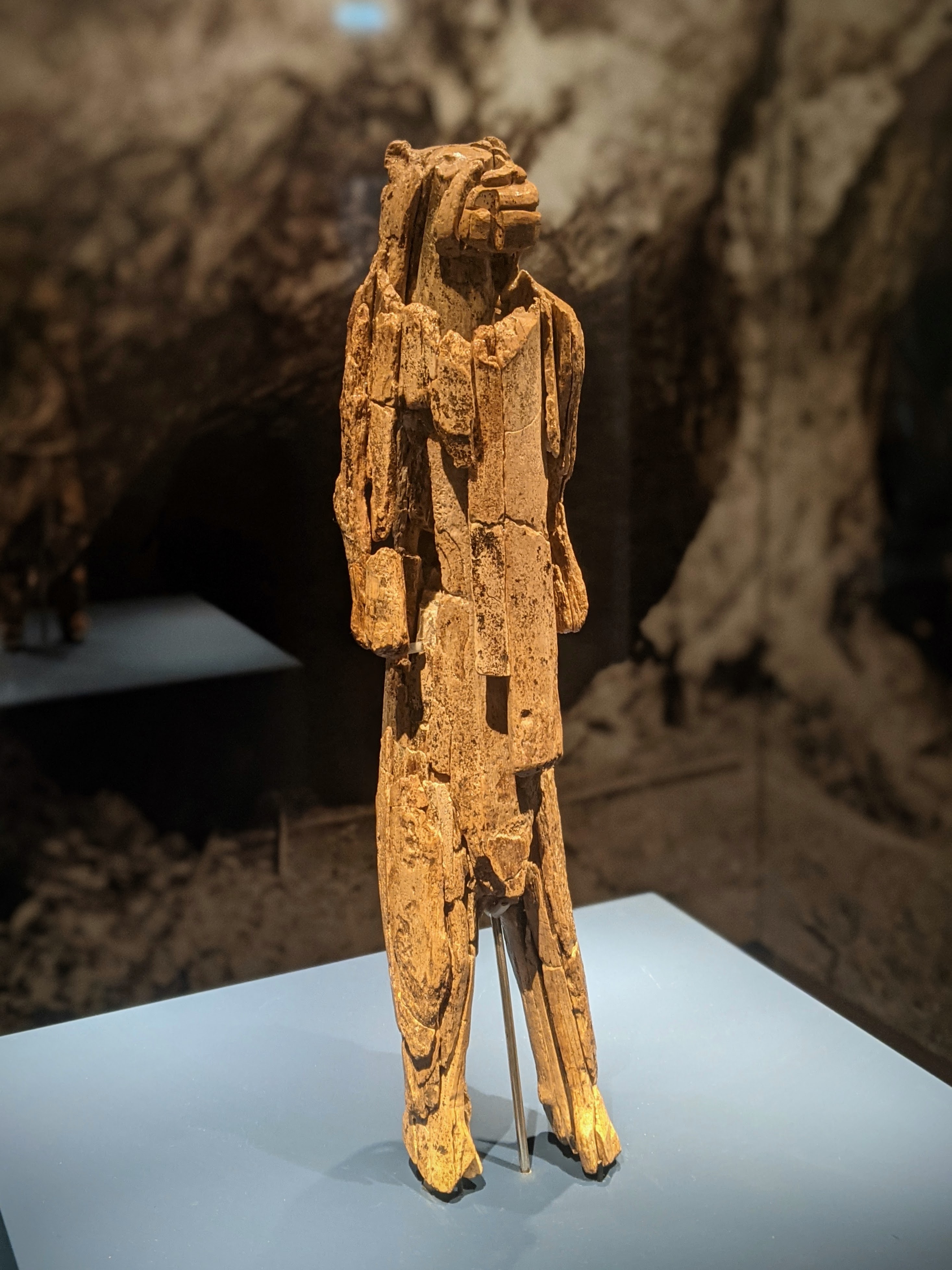
The Lion Man of Hohlenstein Stadel, Germany, c. 40,000 BP (Upper Paleolithic)
Lion’s head atop a human body
Is 12 inches tall and carved from a woolly mammoth tusk
Tension in figure make viewer expect movement
Eyes stare directly at the viewer increasing tension
Juxtaposition of lion figure made from material of prey while being a main predator of man
Lion man may have:
Symbolized prehistoric ideas about the supernatural
Been a means of people understanding their place in the world
Been a totem to protect people from dangers like lions and whatnot
Give people the power of a cave lion
What was the Neolithic Revolution?
Is when humanity transitioned from a hunter-gatherer society to one centered around farming and animal husbandry
Had a change from a nomadic to a settled lifestyle
These changes led to social stratification (the formation of a social hierarchy)
Was not a rapid change, was more gradual
What forms did Neolithic art take?
Pottery
Functional and artistic
Megalithic architecture (Stonehenge for instance)
This was only due to the fact that large groups of people could be mobilized to build these things (due to the formation of a social hierarchy) and due to the fact humanity now resided in the same place
Tombs
New ways of honoring the dead due to a sedentary society
How did the Neolithic Revolution change human culture and how did these changes lead to fundamental changes in art?
It made society become sedentary which allowed for increase social stratification (allowing for bigger structures to be built) and made bigger art pieces possible (because they didn’t have to be carried from place to place anymore).
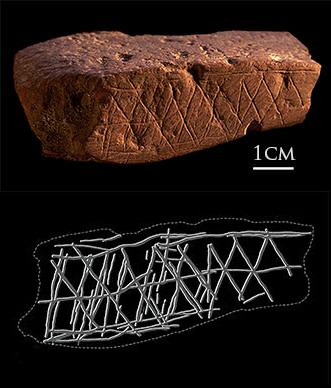
Incised ochre from Blombos Cave, South Africa, c. 77,000 BP (Middle Paleolithic)
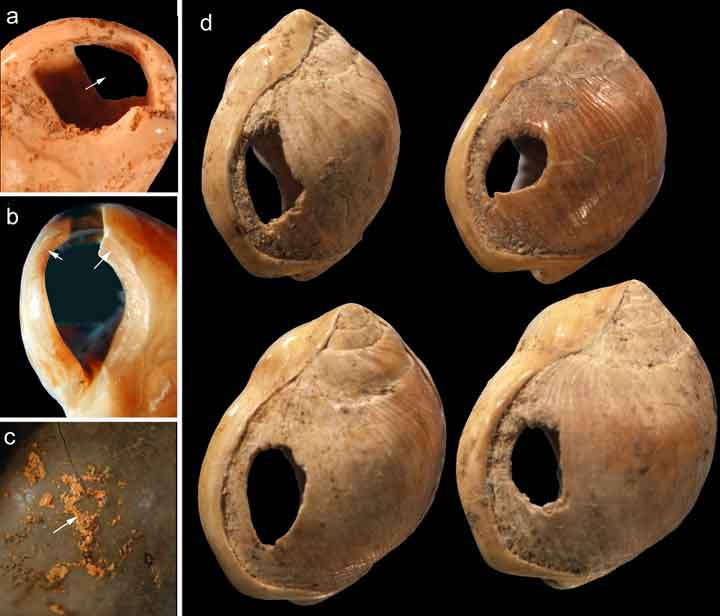
Pierced Nassarius kraussianus shells from Blombos Cave, South Africa, c. 75,000 BP (Middle Paleolithic)
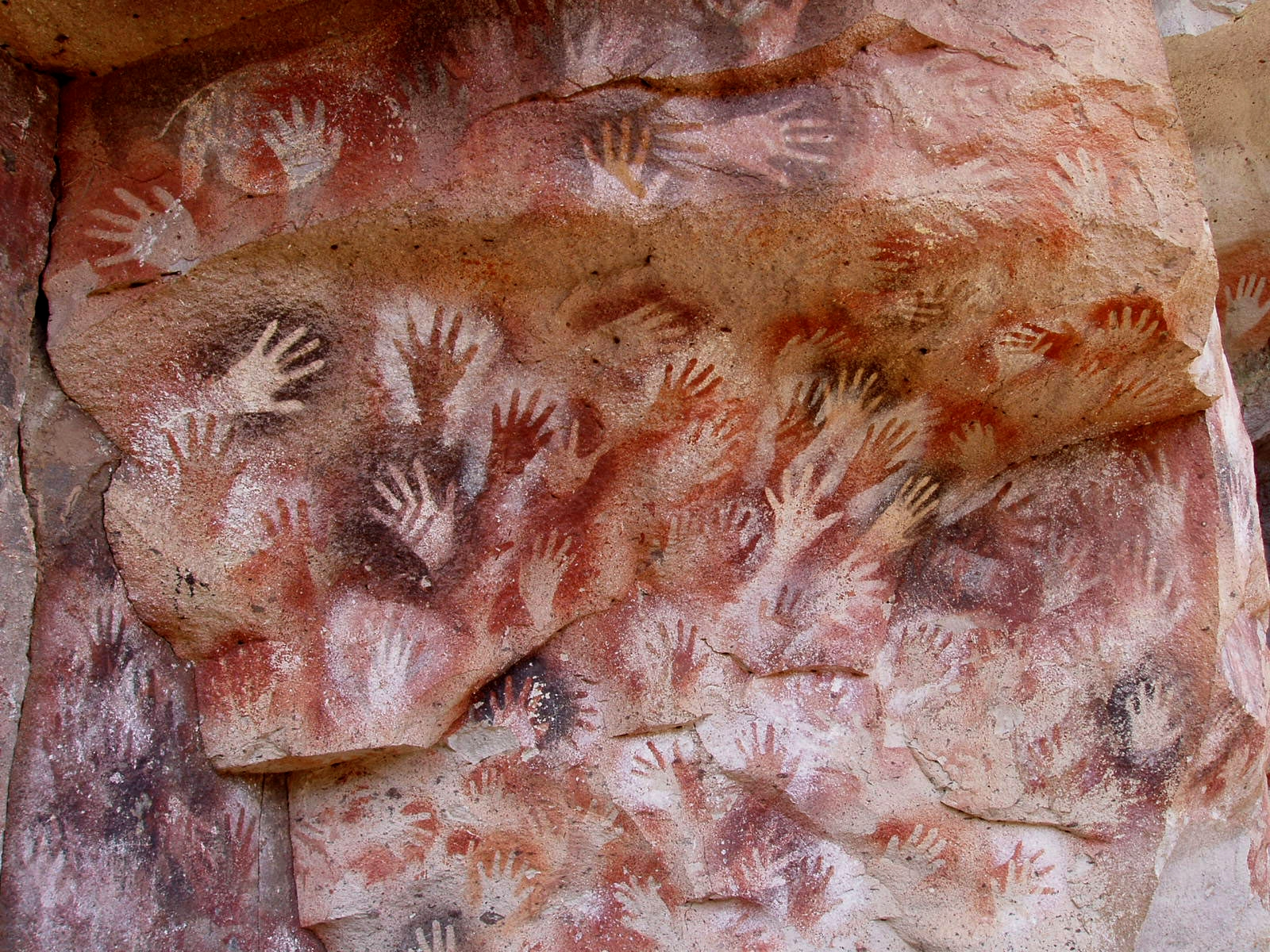
Hand Stencils, Cueva de Los Manos, Santa Cruz Province, Argentina, c. 7300 BCE
What is a petroglyph?
Art carved on the surface of rocks
What is Large Wild Fauna Style and its characteristics?
It is a style which depicted many images of animals
It is naturalistic in style, yet has many unexplained symbols
Dates between 7500-5000 BCE
Many found in Messak Settafet
Demonstrates the importance of the animals featured to local populations
Note that these could be human-animal hybrids as well
The Large Wild Fauna Style has been found across the entire Sahara dating from as early as 9000 BCE to as late as 4000 BCE. What does this suggest about the early people of northern Africa?
This suggests that early African populations were linked through migration patterns and that these populations may have shared religious practices
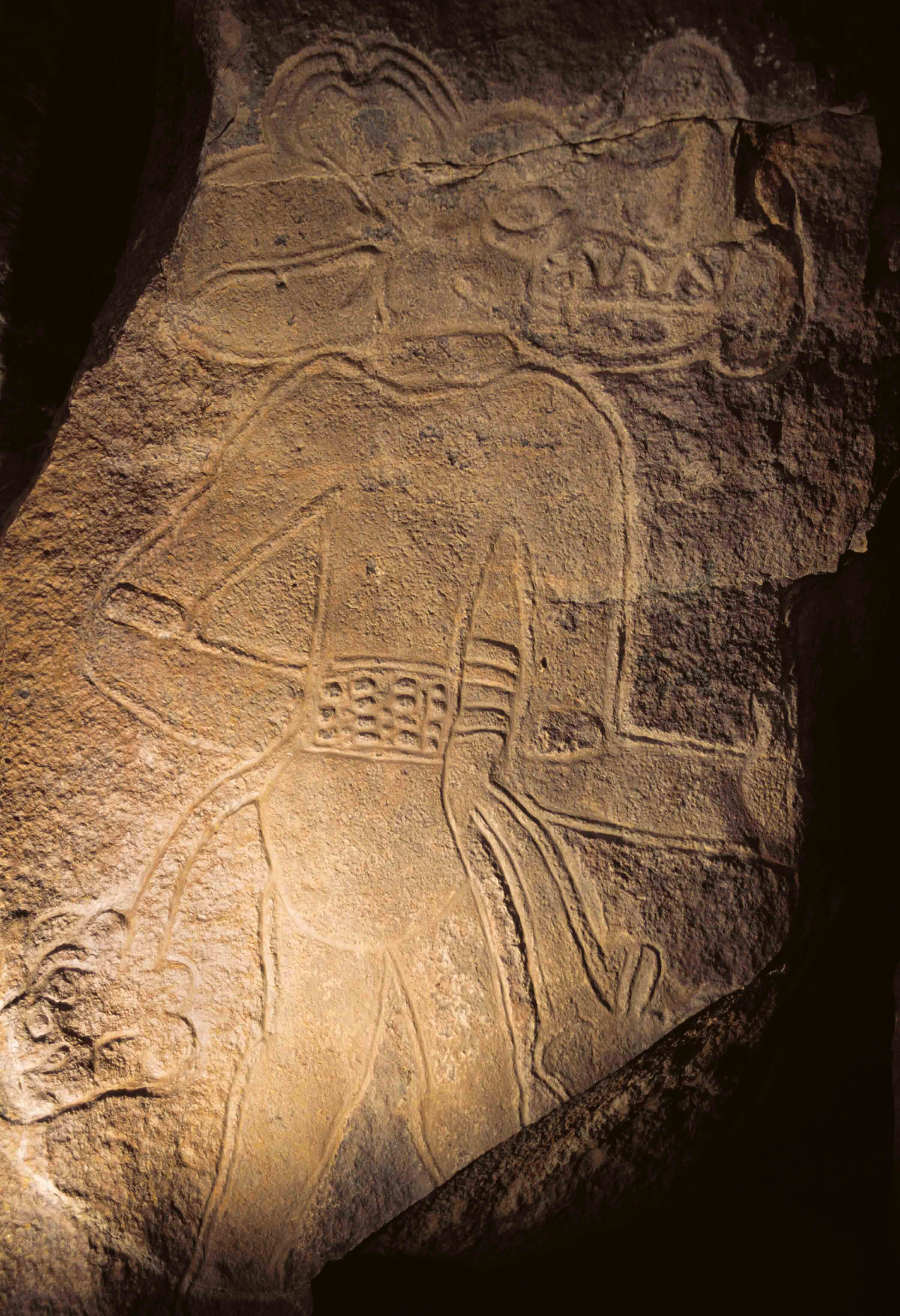
Jackal-headed figure, Messak Settafet, Libya, 7500-5000 BCE
Example of Large Wild Fauna Style
Human-jackal hybrid
Has a polished bottom area and the animal is wearing a belt
Often depicted with mouth closed or smiling, although this example shows sharp teeth instead to make it look threatening
What is Round Head Style (also known as Archaic Style)?
Found in rock shelters in Tassili n’Ajjer, dating to around 6000 BCE
They are naturalistic in style and portrayed human figures
They were generally huge paintings
Featured rounded heads
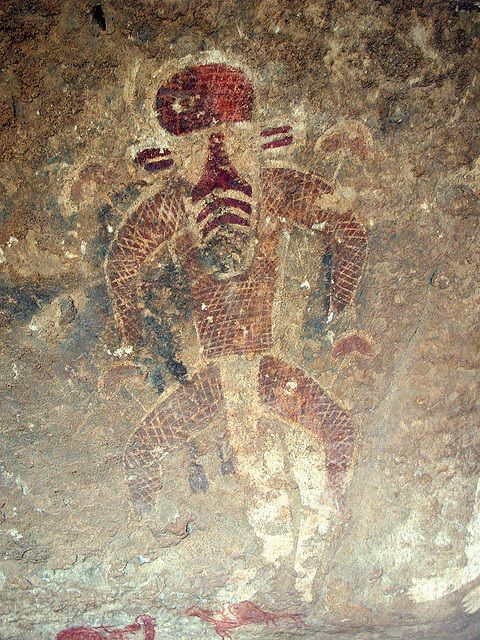
Masked figure (or supernatural being), Tassili n’Ajjer, Algeria, Round Head Style, c. 6500-6000 BCE
An example of Round Head Style
Head and hands are abstract in shape
Seems like it is representing a masquerade (when a person donning a mask becomes the spirit or deity they are representing)
The purpose of these rituals is to communicate to the gods and ancestors to ask for blessings and other favors
What is a masquerade?
When a person donning a mask becomes the spirit or deity they are representing
The purpose of these rituals is to communicate to the gods and ancestors to ask for blessings and other favors
What is Pastoralist Style and its characteristics?
Date from between 5000 to 2000 BCE
Depict cattle and scenes of everyday life with humans interacting with natural gestures
Cultures in the area had recently developed cattle herding
Naturalistic in style
Found in Tassili n’Ajjer
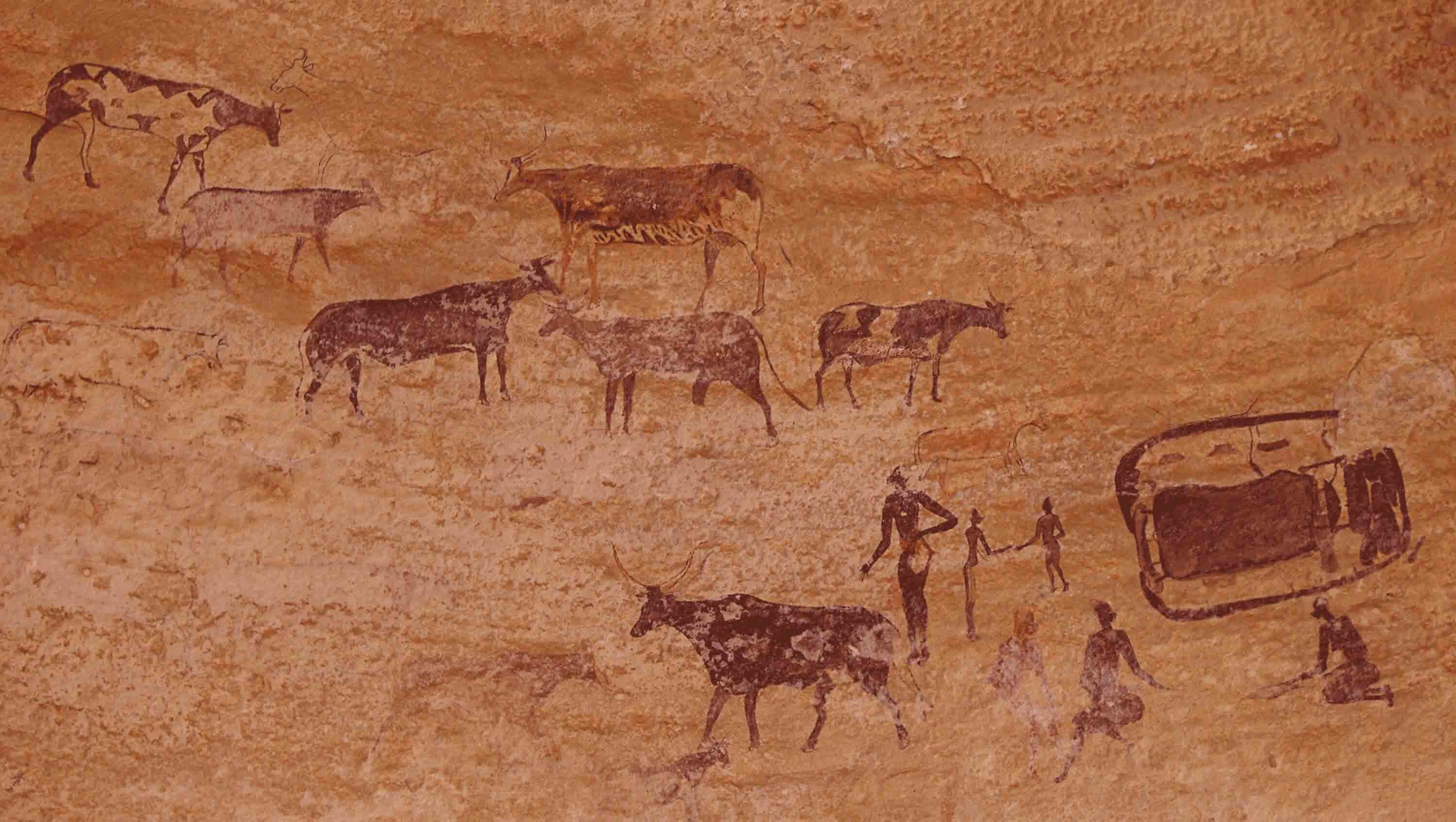
Scene of cattle with men, women, and children, Tassili n’Ajjer, Algeria, c. 5000-2000 BCE
Showed lifelike images of children despite it being uncommon at the time
Contained the same types of pigments used in Round Head style, except they were mixed with cow’s milk to create the pigment
What are some of the common characteristics of art from the Highlands of the Sahara during the period c. 8000 to 2000 BCE?
All mostly naturalistic in style
All were carved into rock faces
Most had some animals or animalistic features (like horns)
What is the Messak Settafet?
A rocky plateau in present day southern Libya home to numerous example of rock art depicting human-animal hybrid figures in Large Wild Fauna Style
What is the Tassili n’Ajjer?
A mountain range in southern Algeria containing art from Round Head Style and Pastoralist Style
What was Ancient Nubia?
Lasted from 2550-653 BCE
Was an ancient region in northeastern Africa extending from the 1st Cataract of the Nile River valley to the Red Sea; also 1st Cataract to Sudan (east) and to the Libyan Desert (west)
Nubia is a region and within it is the kingdom of Kush
What was Kush?
Kush was a kingdom in Ancient Nubia (resided in lower Nubia)
What was Kerma?
Kerma was a city around which the Kerma culture was centered and it was around the 3rd Cataract of the Nile
What was the Kerma Culture? Describe it (including time)
The Kerma culture resided in the state of Kush and were trade partners and rivals with Egypt
The Kerma culture was best known for its distinctive ceramics called Kerma ware
Lasted from 2500-1500 BCE
What is Kerma ware?
It is pottery from the Kerma culture that had a gray band that ran across the middle of the pottery
What happened to Kush and the Kerma culture?
It was conquered by the Egyptian pharaoh Thutmose I in 1500 BCE; the city Kerma was burned and most of Kush was conquered
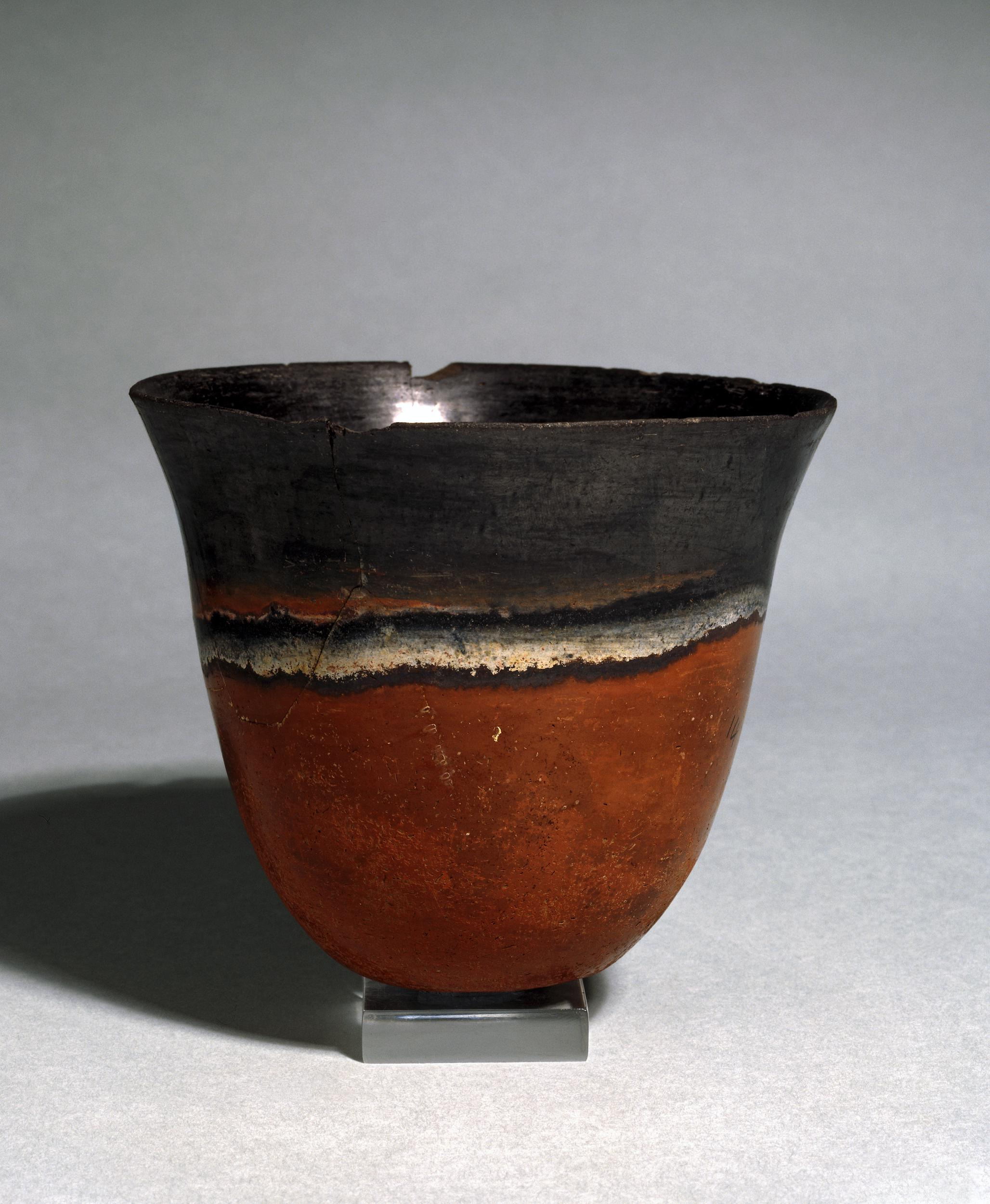
Kerma ware pottery beaker, Kush, Nubia, c. 1750-1550 BCE
Who is Thutmose I?
The Egyptian pharaoh who burned Kerma and conquered most of Kush in 15000 BCE
What is the Napatan Dynasty of Kush?
It is the dynasty which revived the Kushite culture and restored power to them and it began in the city of Napata
Lasted from 900-653 BCE
What was Napata?
Napata was the capital/center of the Napatan Dynasty
Who was King Piye? Describe and give time period
He was a king who completed the Kushite conquest of Egypt and established himself as the 25th dynasty of Egypt
Piye also revived traditional Egyptian art and architecture, including pyramids and temples, to identify himself with the glorious past of Egypt and those famous pharaohs to legitimize his rule of Egypt
Why did Piye invade Egypt?
He invaded Egypt because he believed that the Jebel Barkal moutain in Egypt was where humanity originated and where the Kushite and Egyptian God Amun lived in his primordial form.
Who was Amun?
The main God who was believed in live in Jebel Barkal and who was the creator god
What is important in Nuri?
The Royal pyramids of the Napatan Dynasty. Building pyramids was a practice revived by Piye
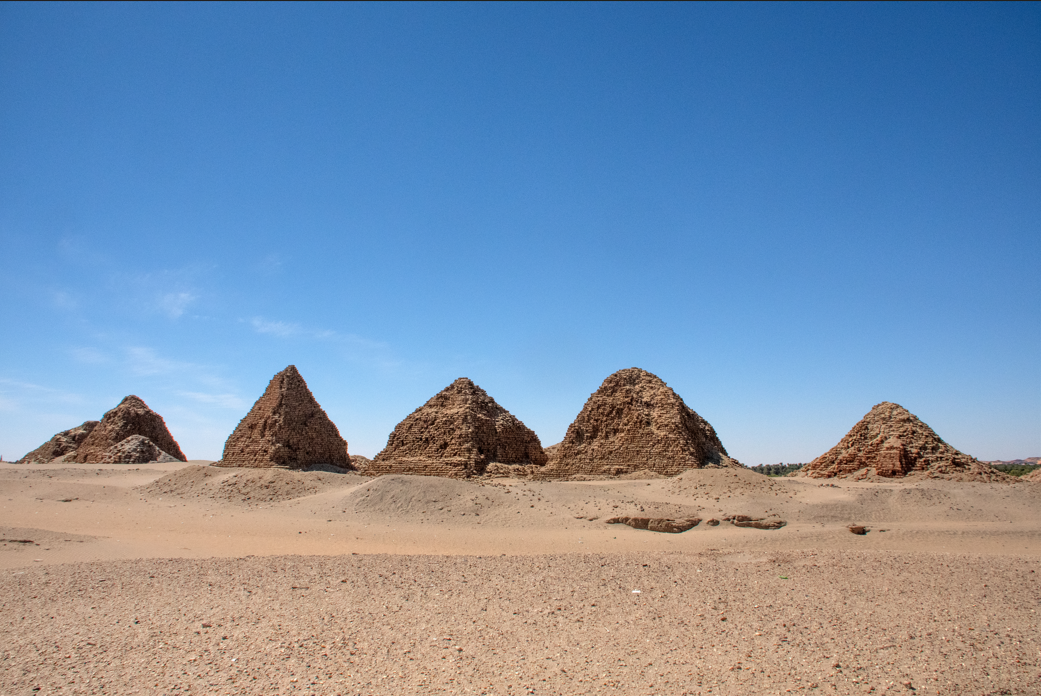
Royal pyramids at Nuri, Kush, Nubia, c. 664-300 BCE
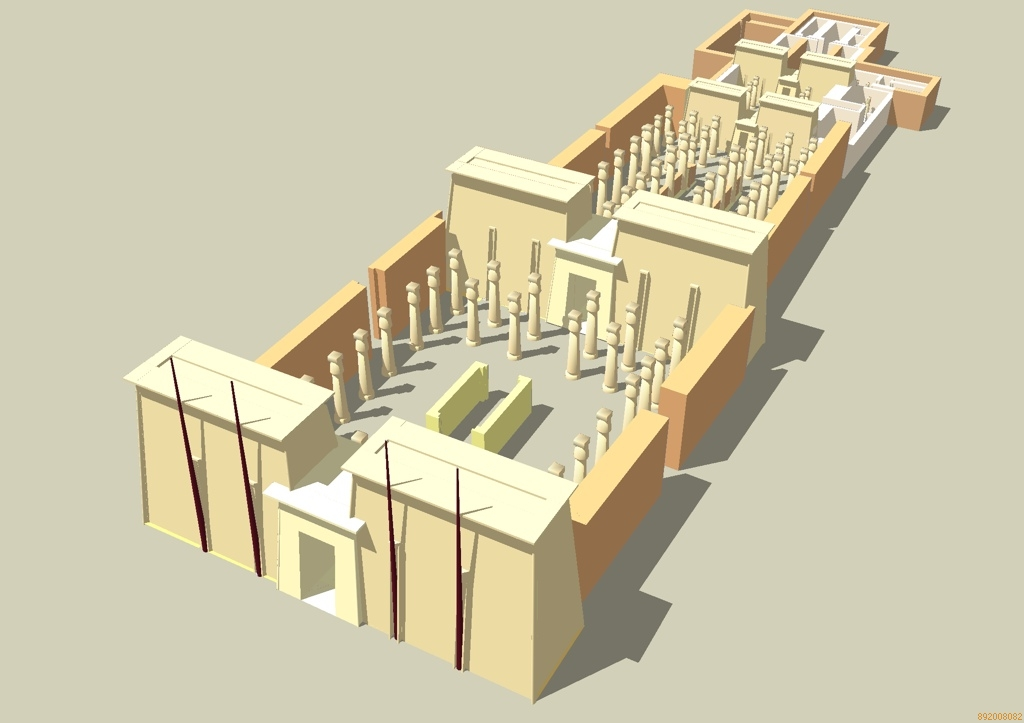
The Temple of Amun at Jebel Barkal as it may have appeared at the end of Piye’s reign, c. 716 BCE
Mature form of Amun lived in the temple and the primordial form lived in the mountains surrounding the temple (Jebel Barkal)
Important religious site for Nubians and Egyptians
Piye renovated the Temple of Amun, expanding it by adding another room and adding a new front gate (pylon)
What is a dais?
It is a raised platform in the front of a room or hall
What is a hypostyle hall?
It is a hall with a roof that is supported by columns
What is a pylon?
A pylon is a monumental gate fronting an Egyptian temple
What was the significance of the Temple of Amun at Jebel Barkal in Egyptian and Nubian culture and religion? In this context, why might King Piye have chosen to commission renovations to the temple?
It was believed to be the place where the creator god Amun resided, which was one of the major gods in Egypt and Nubia
Amun was the god who was believed to give the each pharaoh the “royal ka”, which gave them the right to rule; thus the temple was the “birthplace” of Egyptian kingship
Piye likely renovated the Temple of Amun because:
It was tradition for pharaohs to maintain and add onto existing temples (so by doing this Piye legitimized his rule further)
Amun was the god associated with the right to rule and thus Piye putting his stamp on the temple associated him with this monument and thus the right to rule
Genuine religious devotion as Kushite kings were devoted followers of Amun
Explain the functions of architecture in ancient Nubia.
Under the Napatan Dynasty, architecture and art were used as:
Expression of religious devotion
Political propaganda
And to revive cultural traditions and protect a “sacred” place
What region does West Asia refer to?
It refers to the Middle East
Where is Sumer and what is its importance?
Sumer is the name of a region in South Mesopotamia and is where the earliest civilizations developed and where written language was invented/developed
What is the Fertile Crescent?
It was a crescent-shaped region in the Middle East known for its rich soils and early development of agriculture and civilization
What was Mesopotamia and its importance?
Mesopotamia was the region in Western Asia between the Tigris and Euphrates regions and within this region the characteristics of civilization developed because of the stability of the region during this time
What are the characteristics of civilization in Mesopotamia?
Writing
Rise of an urban elite class
Economic institutions
Temple
Palace
Artist became a professor
Art began to be used by elites to show power of the temple and the ruler
What are the important periods of Sumer history?
The Uruk Period
The Early Dynastic Period
The Akkadian Empire
Describe the Uruk Period
It was a transitory period where the shift from small towns to big cities occurred
Development of monumental architecture
Development of the cylinder seal
Development of written language
Society was theocratic (religious leaders rule)
Describe the importance of temples in the Uruk period
Temples were where religious rituals and festivals were held
Temples were where people went to worship
It was believed the gods resided in the temple and needed to be kept happy
Temple organized agricultural production, owned herds of animals, and employed craftspeople and merchants
Priest-king was responsible for performing special rituals in order to keep the gods happy
Name and describe the two major temple precincts
Temple Precinct of Anu
Dedicated to the god Anu, the god of the heavens
Was on a ziggurat
Had niched facade
Was white
3-room design to make it look like a traditional domestic home (home to the god)
Temple Precinct of Inanna
Key center for the goddess Inanna who was the goddess of love, war, and fertility
Precessions, feasts, performances, and more took place in the temple
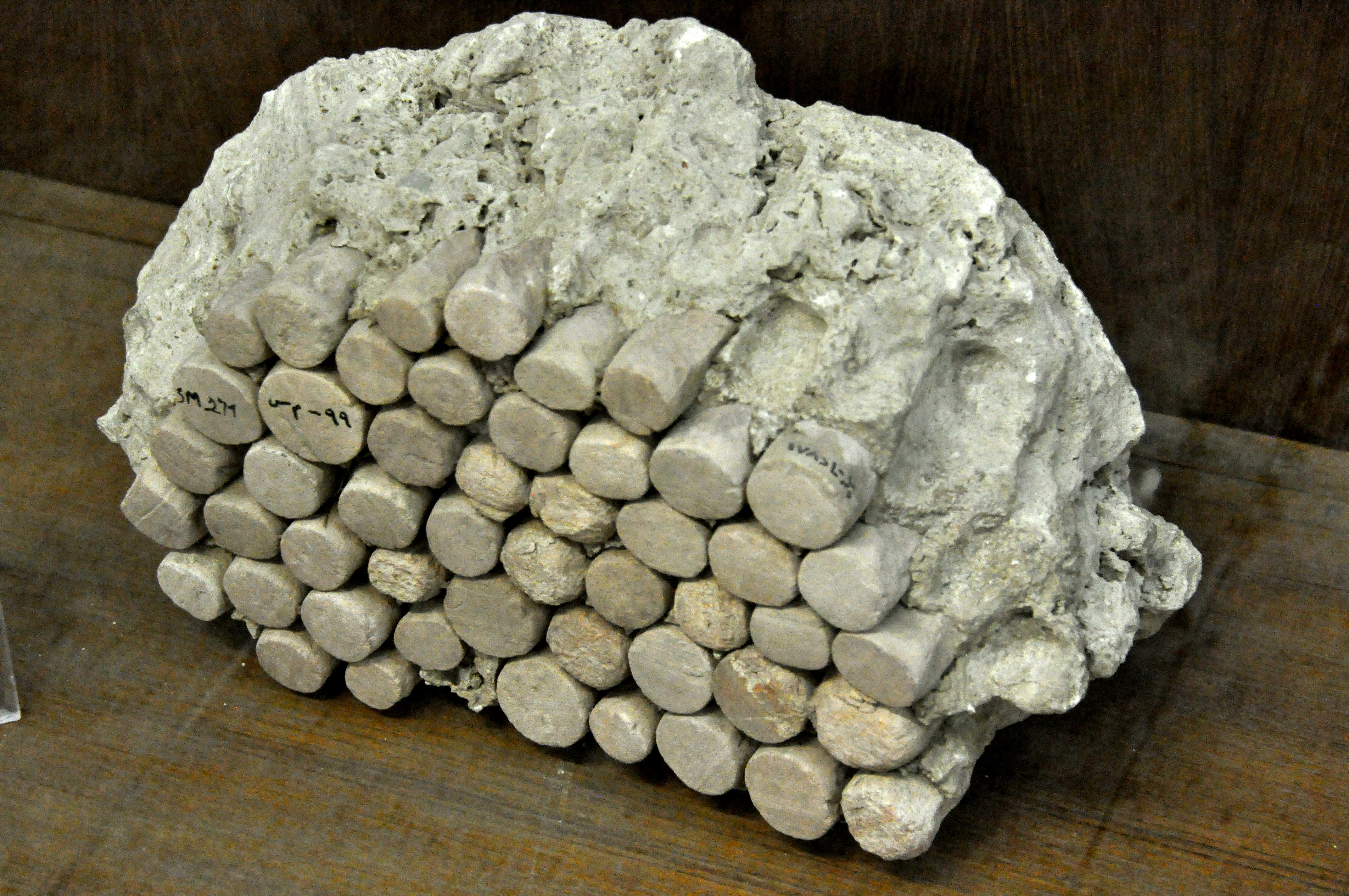
Had cone mosaics and ashlar masonry
What is ashlar masonry?
Ashlar masonry is the use of finely cut square blocks laid carefully in regular rows
What are cone mosaics?
They are decorations made from small, baked clay cones pressed into wet plaster with their pointed ends facing out to form colorful geometric patterns
What does niched mean?
It means there a is a carved out area of the structure.
What is a facade?
It is the front or exterior of a building
What is a ziggurat?
It is a platform made of sloping mud brick and the size of the ziggurat was a symbol of the power of both the temple and the god honored
What was Uruk?
Uruk was an ancient Sumerian city-state in Mesopotamia and is considered the first city in history
What is a relief?
A relief is a type of sculpture or carving in which raised forms project from a flat background
What is alabaster?
A fine form of gypsum
What is a pictorial narrative?
It is a sequence of pictures which shows a sequence of events separated by registers
What are registers?
Registers are a horizontal band or level in a composition used to organize narrative or decorative elements in stacked rows separated by lines
Describe the characteristics of Uruk Vases
They were made with alabaster
They had pictorial narratives
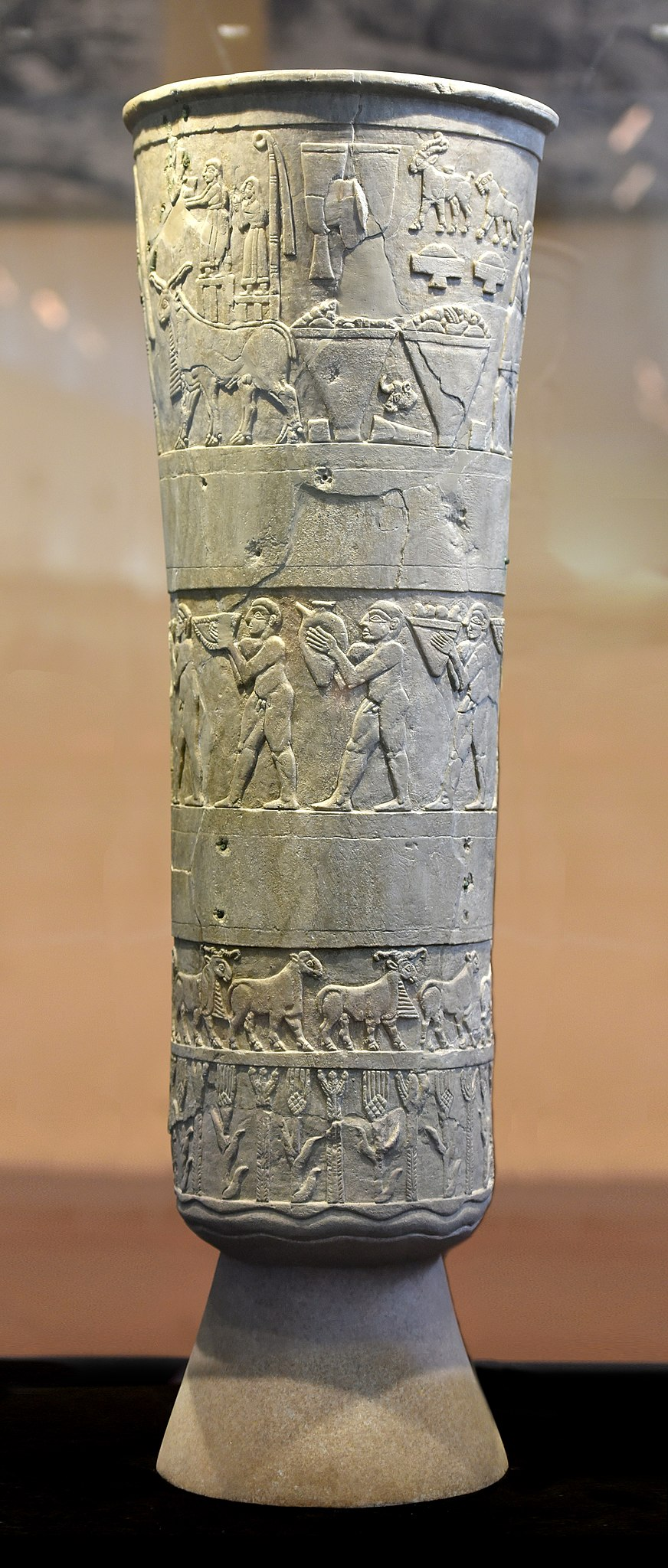
Uruk vase, Uruk, Sumer (Uruk Period)
The reed poles on the vase are a symbol of the goddess Inanna
The two bearded rams have a sign on their back which means priest-king/chief-priest (same thing back then)
Behind the rams is the tribute brought by the people in the procession
There was originally also a larger male figure on the vase which was suggested to have been the priest-king because of the long ceremonial skirt, the headband, and the ceremonial sash being held
The narrative depicts the symbolic sacred marriage between the priest-king and the goddess Inanna which would ensure prosperity for the people and thus the king’s right to rule is justified since he is the only one with this special relationship with the goddess who can thus keep the land prosperous
The lower registers show crops and livestock which are evidence of the priest-king doing his job correctly
What is a stele?
A stele is a carved stone slab that includes commemorative inscriptions or relief sculptures; they were normally placed in public places to serve as markers, monuments, or legal proclamations.
What is iconography?
Iconography is when images or symbols are used to convey specific meanings in an artwork
What is a theocracy?
When religious leaders rule
What is a priest-king?
It is a ruler who had both secular authority and served as a divine intermediatory; thus a key part of his duties was performing rituals for the gods
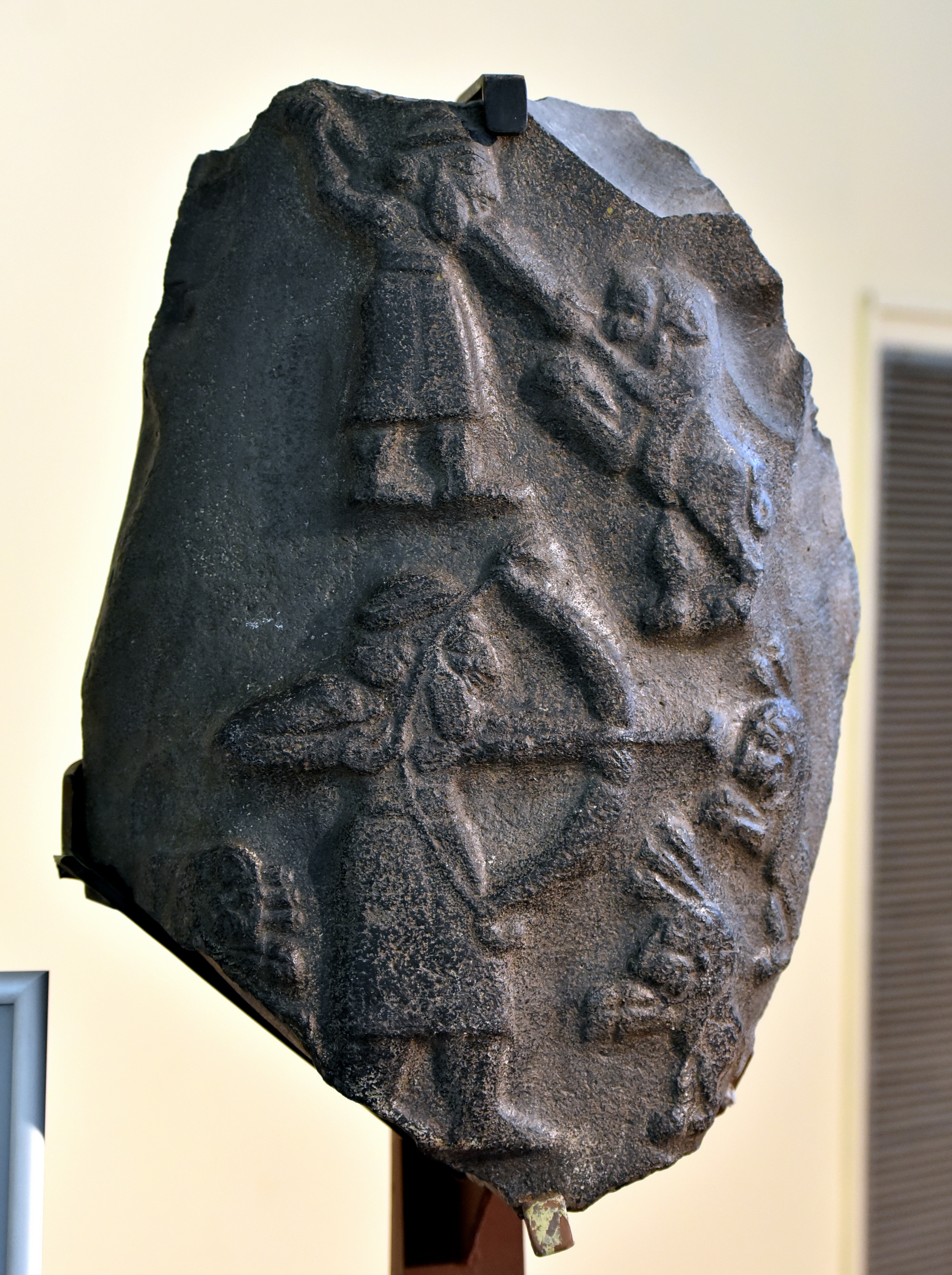
Lion-Hunt Stele, Uruk, Sumer (Uruk Period)
Both visible figures have a beard and wear a skirt which signify that the figure is a priest-king
This piece shows the priest-king hunting lions and he appears twice in this piece
This stele is an early example of a public monument designed to display a particular ideology to the public (i.e. the power and role of the priest-king)
What is a cylinder seal?
They are cylindrical objects engraved with designs that create unique, raised impressions when rolled onto wet clay
They functioned as a personal signature or mark of ownership
Commonly depicted the priest king
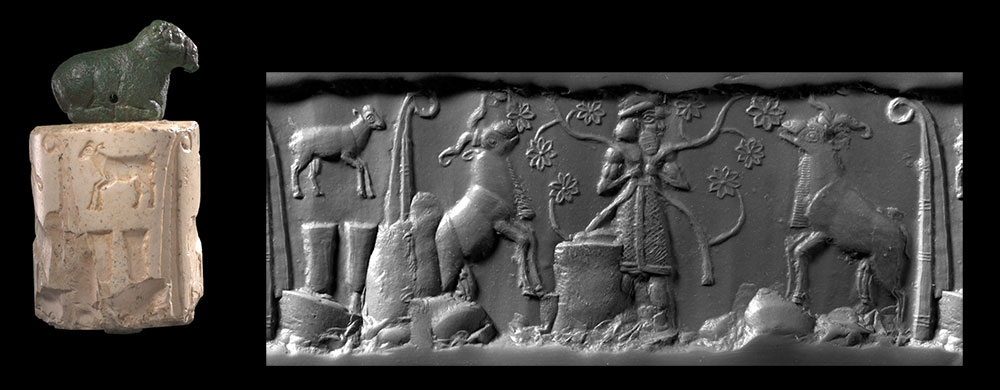
Cylinder seal (with a modern impression), Uruk, Sumer, c. 3300-3100 BCE (Uruk Period)
Functioned as a personal signature or mark of ownership
Depicts the priest king which we know because of the long skirt, the headband. and the beard
What are the key takeaways of the Uruk Period?
The temple was the most powerful urban institution that functioned as a center of government, religion, and economy
Uruk was ruled by a priest-king whose power from his union with Inanna gave him both the right and responsibility to rule
The priest-king is depicted in artworks using a specific iconograph, which meant that he would have been recognizable to anyone who viewed these images and thus that art could be used to create and spread a particular state ideology
What was the Early Dynastic Period and what happened during it?
A period marked by the rise of many independent and competing city states and the further development of monarchical rule
There was an increase in the production of luxury goods
There was a growth of the urban elite
There was a shift from the king being a priest-king to a secular (non-religious) ruler
What does votive mean?
The term votive refers to objects, paintings, or sculptures created and offered to a deity, saint, or divine power as part of a vow, a prayer, or to express gratitude for favors received
 Note
Note  Flashcards (26)