Conjugated unsaturated systems
0.0(0)
Studied by 1 person Call Kai
 Learn
Learn Practice Test
 Spaced Repetition
 Match
Match Flashcards
 Knowt Play
Card Sorting
1/29

Earn XP
Description and Tags
Last updated 3:03 PM on 9/27/22
Name | Mastery | Learn | Test | Matching | Spaced | Call with Kai | Chat |
|---|
No analytics yet
Send a link to your students to track their progress
30 Terms
1
New cards
what is a conjugated unsaturated system?
one that has at least one p orbital adjacent to at least π bond (orbital can be full or empty)
- e.g. allylic cation/anion
- e.g. allylic cation/anion
2
New cards
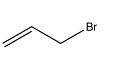
allylic system
a group that is attached to a carbon α to a C=C bond is called an allylic group (Br is in allylic position)
3
New cards
SN1 reactions involve what carbons?
tertiary (3°)
4
New cards
why does allyl chloride undergo an SN1 reaction even though its a primary carbon?
due to the stability of the allyl cation by resonance
- shares + charge between more atoms
- shares + charge between more atoms
5
New cards
what is the order of cation stability? (most stable to least stable)
3° > Allyl > 2° > 1° > CH₃
6
New cards
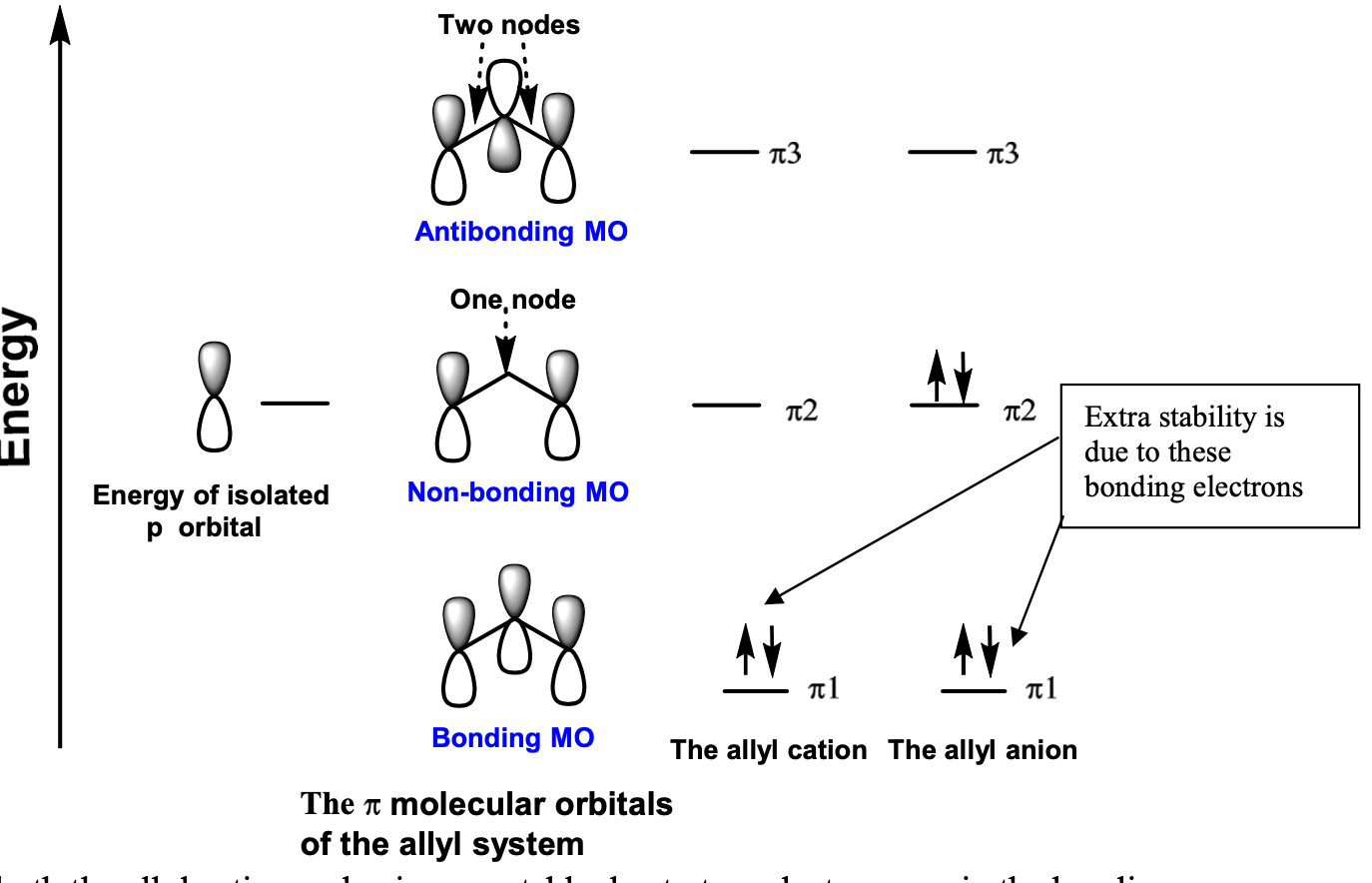
how can the stability of allylic cation / anion be explained using molecular orbital theory? draw and explain
allyl cations have two π electrons in the bonding MO, which is lower energy and is the most stable orbital. the anion has 4 π electrons, 2 in the bonding MO and 2 in the non-bonding MO, which is less stable. The extra stability is due to the bonding electrons in the bonding MO
7
New cards
what are the three types of dienes?
1. *conjugated dienes*: is conjugated because the two C=C double bonds are separated by a single bond
2. *isolated dienes*: is isolated because the two C=C bonds are separated by more than one single bond
3. *Cumulated* dienes: the two C=C double bonds are not separated by single bond
2. *isolated dienes*: is isolated because the two C=C bonds are separated by more than one single bond
3. *Cumulated* dienes: the two C=C double bonds are not separated by single bond
8
New cards
how would the heat of hydrogenation of a conjugated diene compare to that of an alkene or an isolated diene?
alkene and isolated diene would release more heat because they are less stable. the conjugated dienes have extra stability (due to overlap of π bonds)
9
New cards
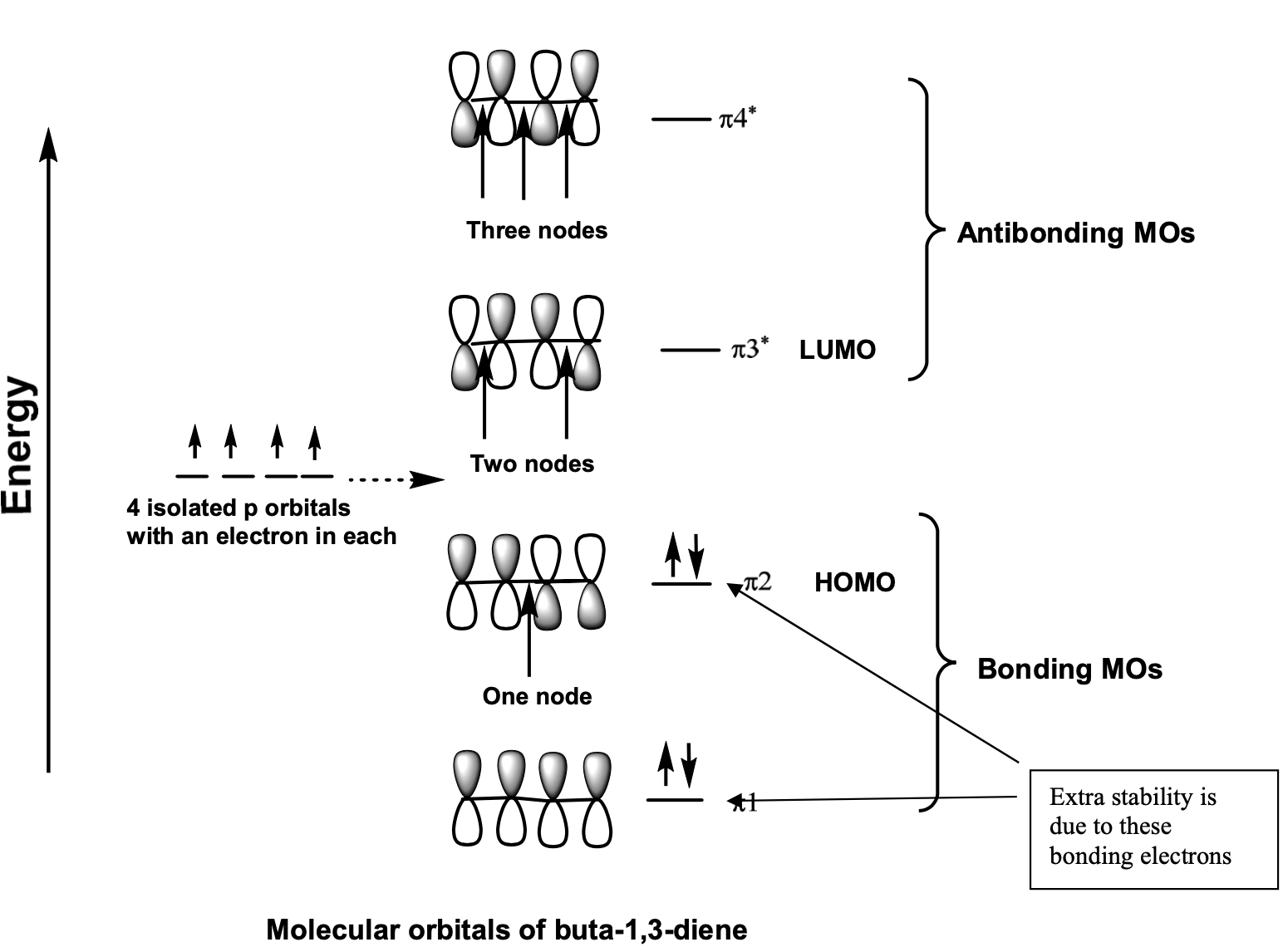
explain and draw the extra stability of conjugated dienes using molecular orbital theory
since there are 4p orbitals, they combine to form 4 MOs. The lower 2 MOs are bonding MO and top two are antibonding. since there are two π bonds (4 π electrons), they occupy the *bonding* MOs (π₁ and π₂)
10
New cards
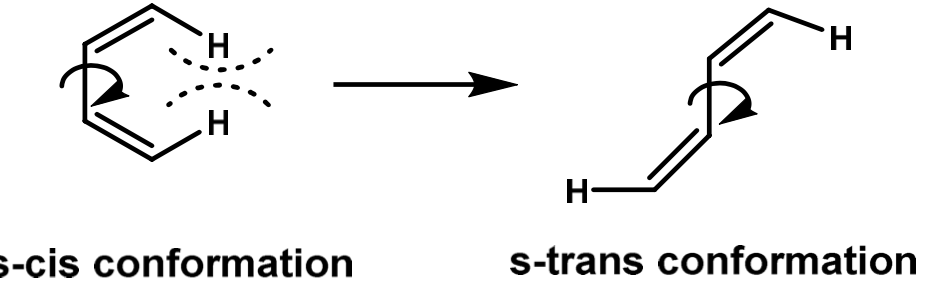
what are the conformations of buta-1,3-dienes and which is less stable?
- the *s-trans* conformation (s refers to single bond) where the double bonds are on opposite sides of the single bond
- *s-cis* conformation where the double bonds are on the same side
- *s-cis is less stable* due to steric interference
- *s-cis* conformation where the double bonds are on the same side
- *s-cis is less stable* due to steric interference
11
New cards
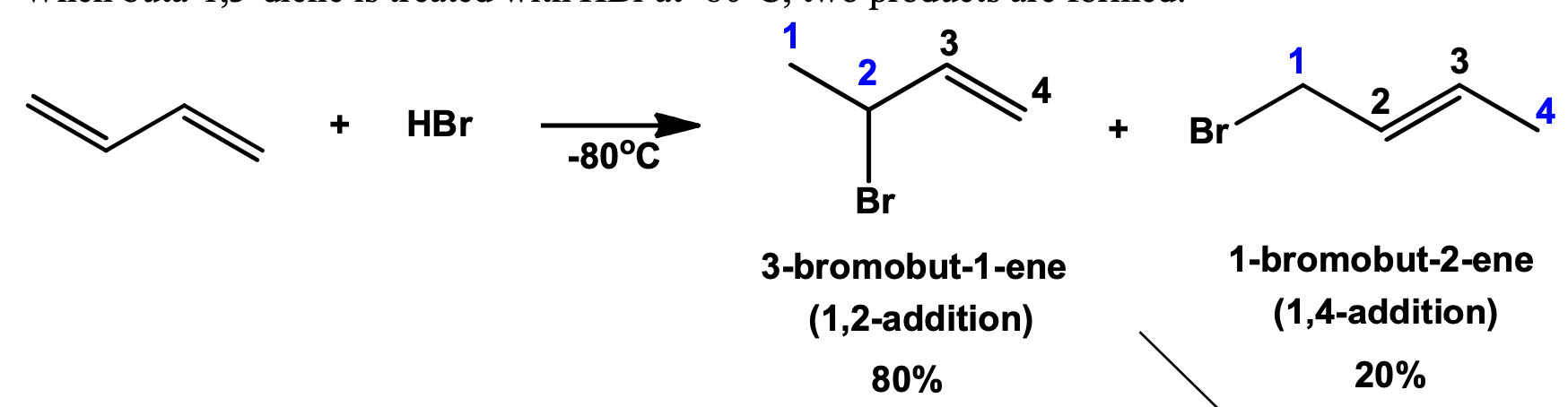
what is the major product formed in the electrophilic addition of HBr on alkene at -80C?
3-bromobut-1-ene (1,2-addition) 80%
- 20% is 1-bromobut-2-ene (1,4 addition)
- 20% is 1-bromobut-2-ene (1,4 addition)
12
New cards
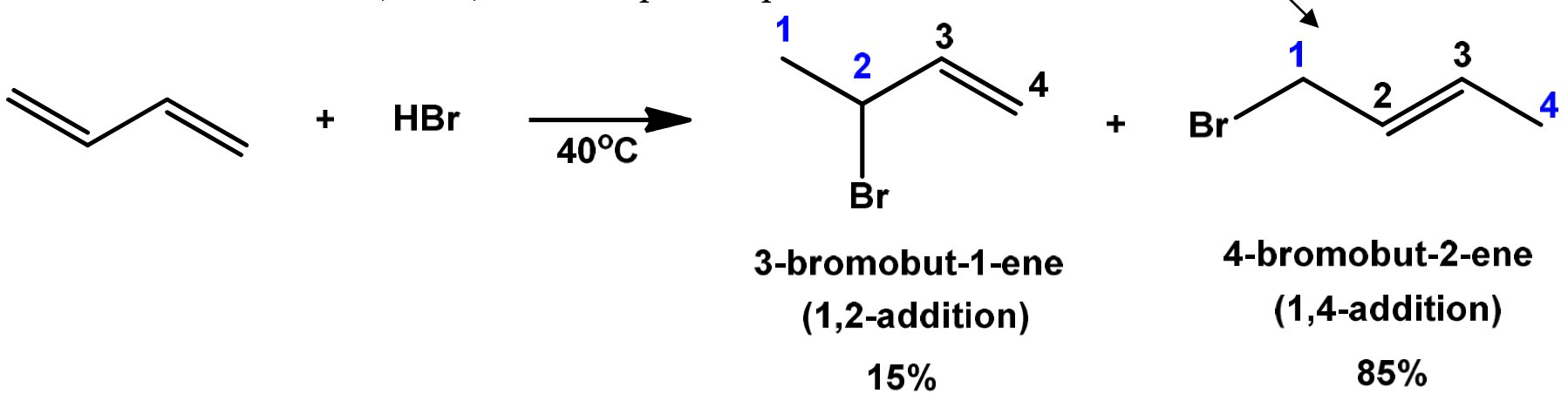
what is the major product formed in the electrophilic addition of HBr on alkene at 40C?
4-bromobut-2-ene (1,4 addition) 85%
- 15% 3-bromobut-1-ene (1,2 addition)
- 15% 3-bromobut-1-ene (1,2 addition)
13
New cards
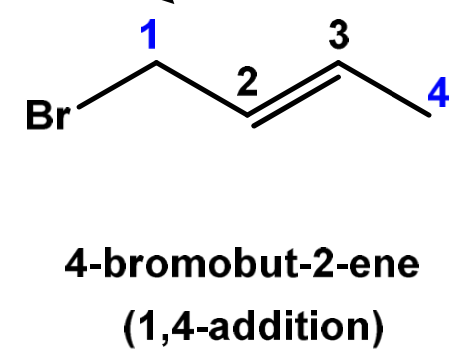
what is the more stable product of the electrophilic addition of HBr?
the 1,4 product
14
New cards
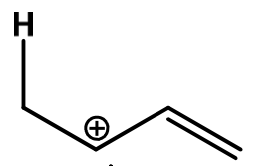
what is the more stable carbocation in the electrophilic addition of HBr?
the secondary carbocation
15
New cards
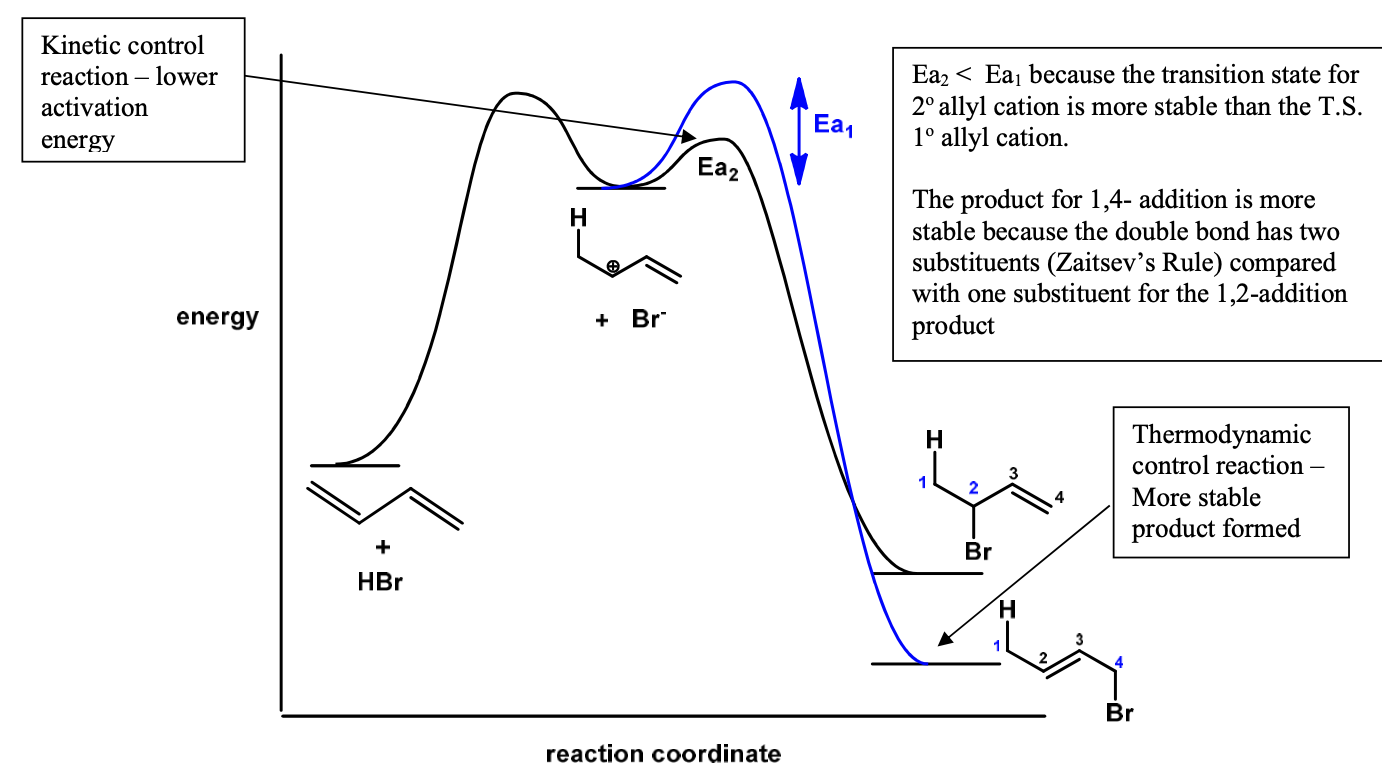
describe the energy diagram for the electrophilic addition of HBr to a an allylic compound
has two peaks with one intermediate (carbocation). depending on which carbocation is formed (primary or secondary), the second peak will be different heights. If the more stable carbocation is formed, the peak is slightly lower. If the less stable carbocation is formed, then the peak is slightly higher. The product from the less stable carbocation will be lower in energy than the other product, and is therefore more stable. The product from the more stable carbocation will be higher in energy, and is therefore more unstable
16
New cards
what is the kinetic vs thermodynamic control in the electrophilic addition of HBr to an allylic compound?
at low temperature, the reaction is kinetic control due to its lower activation energy barrier, it is formed easier and faster to give the 1,2 products at higher temperature, the reaction is thermodynamic control. The driving force for this reaction is due to more stable 1,4 product
17
New cards
what kind of reaction is the Diels-Alder reaction?
1,4 - cycloaddition reactions
- 1,4 addition to a compound with multiple bonds hive 6-membered ring product
- 1,4 addition to a compound with multiple bonds hive 6-membered ring product
18
New cards
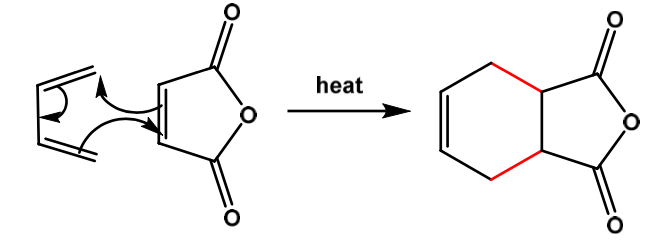
describe and draw the mechanism of a Diels-Alder reaction
concerted reaction: happens in one single step. building 2 sigma bonds, breaking 3 pi bonds, and building one pi bond happens simultaneously
19
New cards
Diels-Alder reaction
cycloaddition (electrophilic addition) of a of a dienophile to a diene to form a 6 membered ring. because it involves a system of 4 atoms from the diene and 2 atoms from the alkene, it is called a [4+2] cycloaddition.
- the alkene/alkyne is called a dienophile because it reacts w/ a diene
- the alkene/alkyne is called a dienophile because it reacts w/ a diene
20
New cards
what are the conditions for a Diels-Alder reaction?
1. diene must be able to form a s-cis conformation (not too bulky, bonds need to be able to rotate)
2. reaction is enhanced if there is a e- present in the leaving group (OR or alkyl group for resonance)
3. the dieneophile MUST have pi electrons and possess an electron-withdrawing group
2. reaction is enhanced if there is a e- present in the leaving group (OR or alkyl group for resonance)
3. the dieneophile MUST have pi electrons and possess an electron-withdrawing group
21
New cards
what are some good electron withdrawing groups?
conjugated carbonyl (ketone), esters, Nitro group, nitrile, conjugates aryl alkene, vinyl ether, halogen
22
New cards
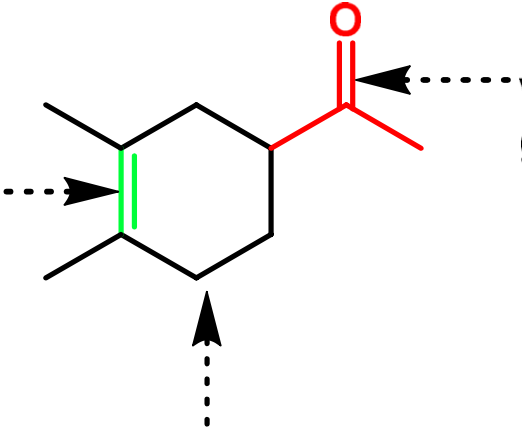
what are three features to recognize Diels-Alder products?
double bond in the ring, six membered ring, electron withdrawing group
23
New cards
is a Diels-Alder reaction stereospecific? why or why not?
yes, it is highly stereospecific. since the reaction is concerted and on the same side, there is not chance for a change in stereochemistry for the dienophile in the reaction. the stereochemistry of BOTH the diene and the dienophile is retained
24
New cards
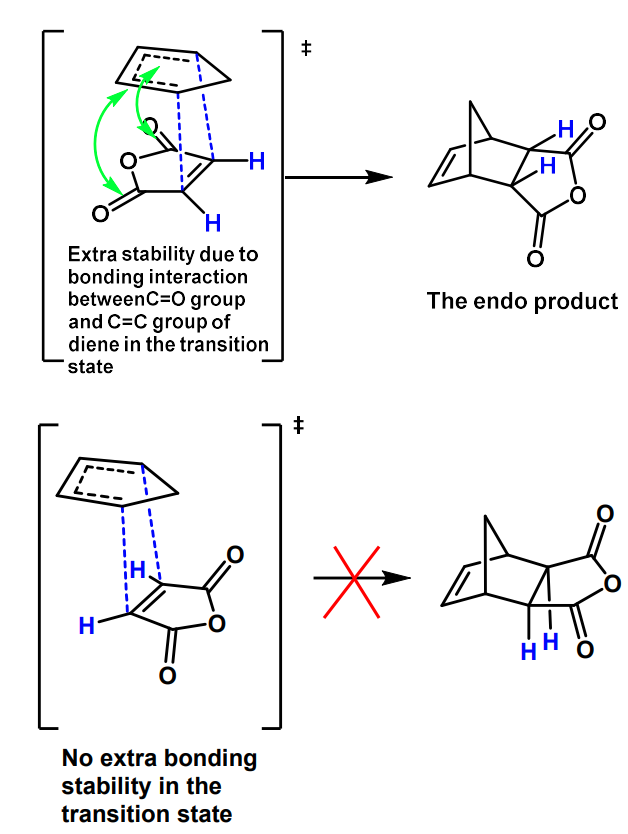
In a Diels-Alder reaction with two rings reacting, which way will the hydrogens be facing and what is this product called? why does this occur?
the hydrogens will point UP to form the ENDO product rather than the Exo product. This is becuase the secondary overlapping between the C=O p orbitals and the carbon p orbital of the diene which stabilizes the transition state
25
New cards
if the dienophile is non-symmetrical, a pair of what will be formed?
enantiomers. the reaction can take place on both sides of the dienophile
26
New cards
using MO theory, excitation from what oribtals will give light?
from Highest Occupied Molecular Orbital (HOMO) to Lowest Unoccupied Molecular Orbital (LUMO)
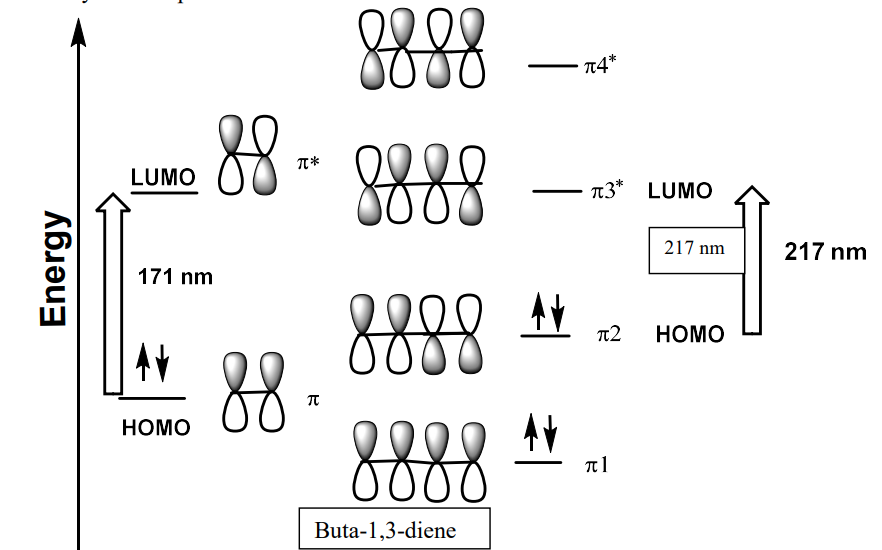
27
New cards
with more conjugated double bond, the energy difference between the HOMO and LUMO would get _________ and the wavelength required for excitation would be ________
smaller; longer
28
New cards
what is the general rule regarding light absorption and conjugated systems?
a compound with a longer chain of conjugated double bonds absorbs light at a longer wavelength
29
New cards
how many conjugated double bonds are required to absorb light in the visible region?
at least 6 conjugated double bonds
30
New cards
what is the reason for colour perception?
an object is coloured because absorption of one colour reflects the opposite colour in the colour wheel