Forensic Psychology
 Studied by 0 people
 Call Kai
 Learn
Learn Practice Test
 Spaced Repetition
 Match
Match Flashcards
 Knowt Play
1/100

There's no tags or description
Looks like no tags are added yet.
Name | Mastery | Learn | Test | Matching | Spaced | Call with Kai |
|---|
No analytics yet
Send a link to your students to track their progress
101 Terms
Top Down Approach AO1 - Development
Developed in US by FBI in 70s, gathered data from 36 interviews with 36 sexually-motivated murderers.
Categorised the data into O/DO.
Future crime scene data matches = easier to predict other characteristics.
Collect data about a murder, then decide on category of best fit.
Top Down Approach AO1 - Organised Offenders + Distinction
Distinction based on serious offenders having their modus operandi, correlates to particular social/psychological characteristics.
Organised: Evidence of planning in advance, victim deliberately targeted, killer has a ‘type’, offender maintains large degree of control, detatched from their actions, leave little evidence, above average intelligence, in a skilled professional occupation, socially and sexually competent, Ususally married (with kids).
Top Down Approach AO1 - Disorganised Offenders
Disorganised: Little evidence of planning, spontaneuous offence. Crime scene reflects this - body still at scene, little offender control. Lower than average IQ, in unskilled work/unemployed, history of sexual dysfuntion and failed relationships. Live alone, and near the crime scene.
Top Down Approach AO1 - Profile Construction
4 stages in construction of FBI profile:
Data Assimilation – Profiler reviews evidence (crime scene photographs, witness reports, pathology reports).
Crime Scene Classification – Organised/Disorganised
Crime Reconstruction – Hypotheses of sequence of events, victim behaviour
Profile Generation – Hypotheses of likely offender e.g. physical characteristics, behavioural characteristics, relation to target, demographic.
Top Down Approach AO3 – Research Support (STR)
Support for distinction.
Canter et al (2004) analysis 100 US murders from different serial killers. Statistical technique smallest space analysis identified correlations across different samples of behaviour. Assesses co-occurrence of 39 aspects of serial killings e.g. torture/restraint, attempt to conceal body, murder weapon, cause of death.
Analysis reveals subset of features for many of the killings that matched with FBI typology for organised offenders, demonstrating validity.
Top Down Approach AO3 – Wider Application (STR)
Can be adapted to other types of crime, e.g. burglary.
Meketa (2017) reports top-down profiling applied in 3 states to burglary led to 85% rise in solved cases. Retains O/DO distinction, adds 2 new categories:
Interpersonal (offender knows victim, steals something of significance).
Opportunistic (generally inexperienced young/homeless offender).
Suggests top-down profiling has wider application than assumed (just sexually motivated murders).
Top Down Approach AO3 – Flawed Evidence (LIM)
Canter et al argues sample of original FBI study is poor (only 36 murderers, 25 serial – 11 single/double, 24 Org – 12 Disorg).
FBI did not select random or large sample including different kinds of offenders.
No standardisation, so different murderers not comparable.
Top Down does not have sound scientific basis.
Top Down Approach AO3 – Personality (LIM)
Top down based on behavioural consistency, modus operandi. Situationist psychologist Mischel (1968) argues behaviour driven by situation over just personality, so behavioural patterns seen at a crime scene don’t reveal much about how that individual behaves in everyday life.
Bottom Up Approach AO1 - Development
Developed by UK Psychologists led by Canter with police input. Systematic analysis of crime scene evidence generated picture of offender: likely characteristics, routine behaviour, social background.
Small details → Bigger Picture
Bottom Up Approach AO1 - Investigative Psychology 1
Aim - Establish patterns of behaviour likely to occur/cooccur across crime scenes to develop statistical database, acts as baseline for comparison. Specific details of an offence matched against database to reveal important details about offender.
Bottom Up Approach AO1 - Investigative Psychology 2
5 factor model, following 3 most important:
Interpersonal coherence - Suggests personal interaction style with victim = same as with others in their lives e.g. aggressive. Gives idea of how offender relates to larger subset e.g. women.
Time & Place significance - Location chosen by offender = significant to them. Ties into their mental model of environment. Feel more comfortable/in control in a place they know.
Forensic Awareness - If criminal shows knowledge of criminal justice system.
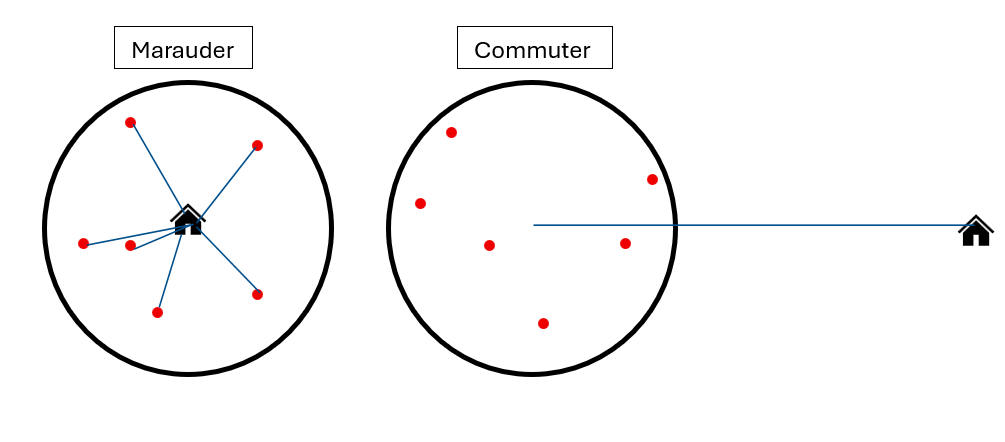
Bottom Up Approach AO1 - Geographical Profiling & Canter’s circle theory.
Uses info of location linked to crimes = make inferences about likely home/operational base of offender - crime mapping. Used to create hypotheses of modus operandi.
Canter’s circle theory suggests 2 models of offender behaviour:
Marauder: Close proximity to residence
Commuter: Travelled distance away from residence.
Bottom Up Approach AO3 - Evidence for Investigative Psychology (STR)
Canter & Heritage (1990) analysis of 66 sexual assault cases, examined using smallest space analysis.
Several common behaviours identified e.g. use of impersonal language, lack of reaction to victim. Each individual displayed characteristic pattern of behaviours, helping establish case linkage.
Supports basic bottom up approach principle of behavioural consistency.
Bottom Up Approach AO3 - Evidence for Geographical Profiling (STR)
Lundrigan and Canter (2001) collated info from 120 US serial killer murder cases.
Smallest space analysis revealed spatial consistency in killer behaviour. Location of each body disposal site created centre of gravity: Presumably, offender goes in different direction for each disposal, but the different sites create circular effect around home base, offender base located invariably in centre of pattern.
Effect more noticeable in marauders.
Supports use of geographical information as valid.
Bottom Up Approach AO3 - Sole Geogprahical Profiling insufficient (LIM)
Success dependent on quality of database, however crime recorsding not always accurate, varies between police forces. Estimated 75% of crimes not even reported to police in first place, calling into question the utility of approach that relies on geographical data being accurate.
Ainsworth (2001) - Even correct information does not acknowledge other important factors e.g. timing of offence, age/experience of offender.
Sole geographic info may not always be succesful =.
Bottom Up Approach AO3 - Mixed Results (LIM)
Copson (1995) surveyed 48 police depts, found advice provided by profiler judged to be useful in 83% of cases (suggests valididty of investiagtive tool). However, same study revealed it only led to accurate offender identification in 3% of cases.
Kocsis et al (2002) - Chemistry students produced more accurate offender profiles on solved murder case than senior detectives.
Suggest inconsistency of method.
Biological (Historical) Explanations AO1 - Biological Approach
(speculative, innacurate) Lomboro’s L’Uomo Delinquente suggests criminals where genetic throwbacks (primitive subspecies, biologically different from non-criminals).
They lack evolutionary development, unable to adjust to civillised society due to their savage and untamed nature.
Offending behaviour is a natural tendency, innate, rooted in the genes.
Biological (Historical) Explanations AO1 - Atavistic Form
Offender subtype could be identified by physiological markers linked to particular offences (biologically determined ‘atavistic’ characteristics, mainly features of the head and face).
Cranial Char: Narrow sloping brow, strong prominent jaw, high cheekbones, facial asymmetry.
Other Physical Char: Dark skin, extra toes/nipples/fingers.
Other Char: Pain insensitivity, slang use, tattoos, unemployment.
Biological (Historical) Explanations AO1 - Offender Types and Lombroso’s research
Offenders then characterised by these char.
Murderers = bloodshot eyes, curly hair, long ears
Sexual Deviants = Glinting eyes, swolen fleshy lips, projecting ears
Fraudsters = Thin, reedy lips.
Atavistic form concluded after Lombroso analysis of facial and cranial features of 383 dead/3839 alive convicts, and that these char were key indicators of criminality (40% crime fit his critera).
Biological (Historical) Explanations AO3 - Legacy (STR)
Challenged preconceived ideas of criminals.
Father of crimonology, shifted crime explanations from moralistic to biological.
Attributing specific characteristics to specific type of criminal = beginning of offender profiling.
Major contribution to psychology.
Biological (Historical) Explanations AO3 - Contradictory Evidence (LIM)
Goring (1913): Compared 3000 offenders/non offenders. Found no evidence of distinct (physiologically different) offender group.
Reduces likelihood of human subspecies.
Biological (Historical) Explanations AO3 - Poor Control (LIM)
Lombroso failed to include control group, could have resulted in confounding variables.
Hay and Forrest (2009): One example = social conditions (poverty, poor education) explain why offenders would be unemployed.
Lombroso doesn’t fit modern scientific standard.
Biological (Historical) Explanations AO3 - Negtive Consequences (LIM)
DeLisi (2012): Attention drawn to racist undertones of Lombroso’s ideas.
Atavistic features most common in Africans (Africans more likely to offend = 19th century eugenic racist ideas).
Subjectivity of his conclusions.
Biological (Genetic) Explanations AO1 - Twin Studies
Assumption: Offenders inherit gene/combination, predisposes them to crime.
Christiansen (1977): 3500 pairs Danish twins born 1880-1910, concordance rates for offendeing 35%-MZ, 13%-DZ. Checked against police records.
= Behaviour & underlying predisposing traits inherited.
Biological (Genetic) Explanations AO1 - Adoption Studies
Crowe (1972): Ado children with bio mother criminal record = 50% risk by 18, compared to 5% in control group.
Biological (Genetic) Explanations AO1 - Candidate Genes
Tiihonen et al (2015): Analysis of 800 Finnish offenders suggested 2 genes assc. violent crime:
- MAOA gene regulates serotonin, linked to aggressive behaviour.
- CDH13 gene linked to substance abuse and ADHD.
5-10% severe violent crime (Finland) attributable to MAOA/CDH13 genotypes.
Biological (Genetic) Explanations AO1 - Diathesis-Stress Model
Genetic offending partly moderated by environment. May happen due to biological / psychological trigger e.g. dysfunctional environment, criminal role models.
Biological (Genetic) Explanations AO3 - Support for Diathesis-Stress (STR)
Mednick et al (1984): 13000 Danish adoptees studied, 3 conditions:
Bio & Ado no convictions = 13.5% convictions
Bio convictions = 20% convictions
Bio & Ado convictions = 24.5% convictions.
Both genetic and environmental influences cause incremental increases in rate of offending = both implicated.
Biological (Genetic) Explanations AO3 - Twin Studies (LIM)
Shared Environment Assumption
Biological (Neural) Explanations AO1 - Basis
Evidence for neural differences, mainly involves APD. Assc. reduced emotional responses and lack of empathy = characterises many offenders.
Biological (Neural) Explanations AO1 - Prefrontal Cortex
Raine conducted many studies on APD brain showing reduced activity in prefrontal cortex, part of brain that regulates emotional behaviour
Raine et al (2000) found 11% grey matter reduction in APD brain prefrontal cortex compared to controls.
Biological (Neural) Explanations AO1 - Mirror Neurons
APD offenders can experience empathy but more sporadically.
Keysers (2011): Offenders shown video of someone in pain. Only felt empathy when asked to. Empathy reaction is controlled by mirror neurons. Their neural switch has to be turned on.
Biological (Neural) Explanations AO3 - Brain Evidence (STR)
Support for crime - frontal lobe link.
Kandel & Freed (1989): Reviewed evidence of frontal love damage and antisocial behaviour. People with damage showed impulsive behaviour, emotional instability, inability to learn from mistakes.
Supports brain damage as causal factor.
Biological (Neural) Explanations AO3 - Intervening Variables (LIM)
Complex link between neural differences / APD.
Farrington et al (2006): Men who scored high on APD experienced various childhood risk factors, e.g. raised by convicted parent, physical neglect.
Possibly early childhood experiences caused APD and neural differences. Rauch et al (2006): Trauma can result in reduced frontal lobe activity.
Intervening variables may have an impact of neural/APD link.
Psychological (Eysenck) Explanations AO1 - Personality Theory Intro & Biological Basis
Eysenck (1947): Behaviour represented across 2 dimensions-
Introversion - Extraversion (E)
Stability - Neuroticism (N).
Later added Sociability - Psychoticism (P)
All personality traits innately biological and therefore inheritable. The criminal personality is E-N-P.
Psychological (Eysenck) Explanations AO1 - Extraversion
Underactive nervous system = constantly seeking excitement, stimulation (more likely risky behaviour). Tend to be hard to condition, not learning from mistakes.
Psychological (Eysenck) Explanations AO1 - Neuroticism
Highly reactive sympathetic NS. Tend to be nervous, jumpy, overanxious. Instability = hard to predict behaviour.
Psychological (Eysenck) Explanations AO1 - Psychoticism
Higher levels of testosterone = more prone to aggression, lack empathy.
Psychological (Eysenck) Explanations AO1 - Role of Socialisation
Offending behaviour = developmentally immature (selfish, concerned with immediate gratification). Offenders = impatient.
Socialisation = children taught ability to delay gratification, more socially oriented.
People with high E and N = Nervous system difficult to condition. Less likely to learn anxiety responses to antisocial impulses (unable to properly socialise), therefore morel ikely to act antisocially.
Psychological (Eysenck) Explanations AO1 - Measuring Criminal Personality
Developed EPQ psychological test to locate respondents along
E-N-P dimensions.
Psychological (Eysenck) Explanations AO3 - Research Support (STR)
Eysenck & Eysenck (1977): Compared 2070 prisoner EPQ results with 2422 controls. Prisoners scored higher average on E-N-P across all ages.
Aligned with their predictions.
Psychological (Eysenck) Explanations AO3 - Central Assumptions Challeneged (LIM)
Farrington et al (1982): Offenders score high on P but not E-N. Challenges 3 dimensional assumption.
Kussner (2017): Inconsistent EEG evidence of intro-extra differences = challenges physiological basis assumption.
Psychological (Eysenck) Explanations AO3 - Too Simplistic (LIM)
Moffitt (1993): Distinction between asolesence-limited and life-course-persistent offending. Personality traits = poor predictor of future criminal behaviour.
Offending persistence = recpirocal process between individual personality and environmental reactions to it.
Psychological (Eysenck) Explanations AO3 - Cultural Relativism (LIM)
Cultral variation of offending.
Bartol & Holancock (1979): African-A and hispanic offenders divided into 6 groups based on history and offences. All 6 groups less E than non-offender control.
Ungeneralisable concept.
Psychological (Cognitive - Moral Reasoning) Explanations AO1 - Moral Development
Kohlberg (1968) : Decisions & Judgements of right/wrong summarised into stage theories of moral reasoning.
Higher stage = Reasoning based on what is right.
Lower stage = Reasoning based on avoiding punishment/disapproval.
Theory based on people’s responses to moral dilemmas.
Psychological (Cognitive - Moral Reasoning) Explanations AO1 - Later Studies
Kohlberg et al (1973): Using moral dilemmas, group of violent youths at sig. lower level than non-violent youths from same social background.
Psychological (Cognitive - Moral Reasoning) Explanations AO1 - Criminality Link Basis
Offenders more likely to be classified at pre-conventional level, compared to non offenders at the conventional level and beyond.
Pre-conventional level characterised by need to avoid punishment and gain rewards. Less mature, childish reasoning.
Adults/Adolescents who reason at this level commit crime because they can get away with it / gain rewards (money, respect).
Psychological (Cognitive - Moral Reasoning) Explanations AO1 - Criminality Link Evidence
Chandler (1973): Offenders often more egocentric, display poorer social perspective-taking skills (ability to appreciate other POVs)
Individuals who reason at higher levels = sympathise more with rights of others, more conventional behaviours (honesty, generosity, non violence).
Psychological (Cognitive - Moral Reasoning) Explanations AO3 - Research Support (STR)
Palmer & Hollin (1998): Compared moral reasoning in 332 non-offenders, 126 convicted offenders.
Used Socio Moral Reflection Measure Short Form (SRM-SF). Contains 11 moral dilemmas.
Offending group showed less mature moral reasoning than non-offenders.
Psychological (Cognitive - Moral Reasoning) Explanations AO3 - Conditional (LIM)
Thornton & Reid (1982): Financial convicts more likely to show pre-conventional moral reasoning than Impulsive convicts.
Pre-convnetional moral reasoning associated with crimes where offenders believes they can evade punishment.
=Lack of generalisability.
Psychological (Cognitive - Cognitive Distortions) Explanations AO1 - Basis
People with faulty, biased, irrational information processing system affects perception of self, others, the world. Links to the ways offenders interpret others’ behaviour and justify own actions.
2 types:
Hostile Attricution Bias
Minimalisation
Psychological (Cognitive - Cognitive Distortions) Explanations AO1 - Hostile Attribution Bias
Propensity for violence = tendency to misinterpret others’ actions as confrontational. Misread non-aggressive cues e.g. being looked at, triggers disproportionate (violent) response.
Schonenberg & Jusyte (2014): Showed 55 violent offenders with emotionally ambigous facial expressions. More likely to percieve images as hostile compared to mathced non-violent control group.
Psychological (Cognitive - Cognitive Distortions) Explanations AO1 - Hostile Attribution Bias origins
Dodge & Frame (1982): Showed children video clip of ‘ambiguous provocation’ (not hostile, not accidental).
Children prior to studied identified as ‘aggressive’ and ‘rejected’ interpreted situation as hostile more than those identified as ‘non-aggressive’ and ‘accepted’.
HAB rooted in childhood experiences.
Psychological (Cognitive - Cognitive Distortions) Explanations AO1 - Minimalisation
Deceptive attempt to deny / downplay seriousness of an offence, application of a ‘euphimistic label’ for behaviour (Bandura 1973). Common strategy dealing with guilt.
E.g. Burglars describe themselves ‘doing a job’, ‘supporting my family’ to minimise their offence.
Barbaree (1991): 14/26 convicted rapists denied they has commited any offence, another 10/26 minimised the harm they caused.
Psychological (Cognitive - Cognitive Distortions) Explanations AO3 - Real World Application (STR)
CBT aims to challenge irrational thining. Offenders encouraged to ‘face up’ what they did, establish less disorted view of her actions.
Harkins et al (2010): Reduced incidence of denial and minimalisation in therapy = reduced risk of reoffending (acceptance important aspect of rehabilitation).
Practical value of applying cognitive distortions.
Psychological (Cognitive - Cognitive Distortions) Explanations AO3 - Conditional (LIM)
Depends on type of offence.
Howitt & Sheldon (2007): Questionnare for sexual offenders. Contrary to predictions, non-contact sex offenders (internet sexual images) used more cognitive distortions than contact sex offenders (physically abused children). Previous history of offending more likely to justify with distortions.
= Not used in same way by all offenders.
Psychological (DAT) Explanations AO1 - Basis
Individuals learn values, attitudes, techniques, motives for offending behaviour through assc and interaction with diff people.
Sutherland (1924): Develop scientific principles of offending, only distinction is not/offending.
Psychological (DAT) Explanations AO1 - Learning
Offendingl earns through interaction with sig. others that child values most (family, peers).
Should be able to mathematically predict likelihood: frequency, intensity, duration of exposure (to non/deviant norms and values).
Learning Attitudes → Person exposed to attitudes towards law when socialised into group. If pro-criminal > anti-criminal, likelihood of offending increases.
Learning Techniques → Person may learn particular techniques for offending, makes easier (therefore more likely). can be more likely in certain social groups, e.g. prison socialisation (more experienced offenders, increase reoffending).
Psychological (DAT) Explanations AO1 - Cambridge Study of Delinquent Development
Farrington et al (2006): Longitudinal Survey of 411 boys (aged 8 in 1961) living in deprived city area S London.
41% between 10-50 at least 1 offence. Average conviction career from age 19-28.
Most important childhood risk factors were family criminality, risk taking, low school attainment, poverty, poor parenting.
Only 7% chronic offenders.
Psychological (DAT) Explanations AO3 - Shift of Focus (STR)
Changed focus on offending explanations. Moves away from early biological explanations, e.g. atavistic theory.
More desirable as more realistic/humane solution to offending (rehabilitation), instead of biological (eugenics, expulsion).
Psychological (DAT) Explanations AO3 - Wide Reach (LIM)
Accounts for offending all across society.
Sutherland acknowledged same patterns not exclusive to working class backgrounds.
Other crimes more prevalent in more affluent groups e.g. fraud (white collar).
DAT has high explanatory power.
Psychological (DAT) Explanations AO3 - Difficulty in Testing (LIM)
Difficult to test predictions Sutherland outlines.
Concepts are vague, cannot be operationalised (hard to see overall number of times encountering anti/pro law sentiment). Sig issue when theory is built on assumption that this is measurable.
Lacks scientific credibility.
Psychological (Psychodynamic) Explanations AO1 - Inadequate Superego
Blackburn (1993): Deficient superego makes offending behaviour inevitable, ID has free rein. 3 types:
Weak Superego → Same gender parent absent during phallic stage. Cannot internalise fully formed superego (immoral), no opportunity to identify with them.
Deviant Superego → Same gender parent is immoral (e.g. criminal), child internalises those values.
Over-harsh Superego → Same gender parent is excessively punitive, makes child feel guilt & anxiety. Unconsciously drives to commit criminal acts, satisfy superego’s need for punishment.
Psychological (Psychodynamic) Explanations AO1 - Role of Emotion
Inadequate superego allows primitive emotional demands to guide moral behaviour. Different from other approaches (emotional life of individual). takes into account role of anxiety and guild (or lack thereof).
Psychological (Psychodynamic) Explanations AO1 - Maternal Deprivation
Bowlby (1944): 14/44 juvenile thieves AP, 12/14 prolonged seperation from mothers. Lack of guilt, empathy.
Psychological (Psychodynamic) Explanations AO3 - Research Support (STR)
Research support for offending - superego link.
Goreta (1991): Freudian analysis 10 offenders ref. psychiatric treatment.
All experienced unconscious feelings of guilt, need for punishment. Concluded consequence of overharsh superego.
Supports role of psychic conflicts.
Psychological (Psychodynamic) Explanations AO3 - Gender Bias (LIM)
Implicit Freudian assumption → Girls develop weaker superego as no castration anxiety. Therefore, less developed superego makes more prone to offending than men.
Contradicts prison stats: 20x more men in prison than women in UK.
Alpha biased theory.
Psychological (Psychodynamic) Explanations AO3 - Bowlby counter-evidence (LIM)
Lewis (1954): Data from 500 young people interviews, found MD poor predictor of future offending. May be correlational link, but not causal, e.g. MD due to growing up in poverty.
MD might be a reason, but not the reason.
Psychological (Psychodynamic) Explanations AO3 - Unscientific (LIM)
Freudian theories deal with unconscious concepts, application to crime not open to empirical testing.
Psychodynamic explanations = widely considered as pseudoscience,
Low validity & usefulness of theory, cannot be used to prevent crime.
Dealing with Offending Behaviour (Custodial Sentencing) AO1 - Aims, 1/4, 2/4
Convicted offender spends time in insitution (prison, juvenile, psych hospital), for 4 reasons:
1) Deterrence → Prison unpleasant, puts off individual from offending. General deterrence sends broad societal message (crime not tolerated), Individual deterrence prevents individual from repeating behaviours in light of prison experience (vicarious punishment).
2) Incapacitation → Offender removed from society to prevent reoffending (protect public). Likely depending on severity/nature of offence. Serial murderer/rapist more dangerous than someone commiting fraud.
Dealing with Offending Behaviour (Custodial Sentencing) AO1 - 3/4, 4/4
3) Retribution → Society enacting revenge on offender, making them suffer. Suffering proportionate to offense. Alternative to prison seen as soft option, criticised.
4) Rehabilitation → Prison is to punish and reform. Offenders leave prison better adjusted, reenter society. Provides opp for skills development, treatment programmes (addiction, anger management). Give offender chance to reflect.
Dealing with Offending Behaviour (Custodial Sentencing) AO1 - Psychological Effects
1) Stress & Depression → Suicide rates, self harm/mutilation higher in prison than gen pop. Stress of prison experience inc. risk of developing psychological disorders post release.
2) Institutionalisation → Long sentences = adapt to prison norms. Unable to readjust to normal outside life.
3) Prisonisation → Prisoners socialised into adopting ‘inmate code’. Bheaviour unnaceptable in normal world encouraged and rewarded in prison.
Dealing with Offending Behaviour (Custodial Sentencing) AO1 - Recidivism
Measure for effectiveness of custodial sentencing. Figures by Yukhnenko et al.
UK MoJ figures show 45% ‘proven’ recidivism.
USA, Aus, Denmark rates of over 60%.
Norway as low as 20% (less emphasis on incarceration, more on rehabilitation).
Dealing with Offending Behaviour (Custodial Sentencing) AO3 - Opportunity for Rehabilitation (STR)
Education/training offered can help improve offenders’ characters, prevent recidivism. Vera IoJ claims offenders take part in college education programmes 43% less likely to reoffend., fewer incidents of violence.
Dealing with Offending Behaviour (Custodial Sentencing) AO3 - Psychological Effects (LIM)
UK MoJ: 119 suicides in 2016, 9x higher than gen pop.
Prison Reform Trust: 25% women, 15% men reported symptoms of psychosis.
Prisons detrimental to psychological health, worsen capability of rehabilitation.
Dealing with Offending Behaviour (Custodial Sentencing) AO3 - University of Crime (LIM)
Desirable and undesirable skills learnt in prison.
Differential Association Theory: Time young inmates spend with hardened criminals give chance to learn how to commit different offences than those imprisoned for.
Undermines capability of rehabilitation, increases recidivism.
Dealing with Offending Behaviour (Custodial Sentencing) AO3 - More Effective Alternatives (LIM)
Alternatives e.g. community service, restorative justice allow offender to continue employment, keep family contact (prevent psychological effects, prevent negative influences).
Offenders less likely to reoffend if they can continue working.
Dealing with Offending Behaviour (Behaviour Modification) AO1 - Token Economy Basis
Based on operant condition, reinforce obedience, punish disobedience (to make disobedience extinct).
Given token for desirable behaviours (secondary reinforcer).
Not given token for undesirable behaviours (punishment)
Tokens traded in for rewards (primary reinforcement).
Dealing with Offending Behaviour (Behaviour Modification) AO1 - Design & Use
Target variables operationalised, e.g. improved interaction broken into: group cooperation, speaking politely, non violence, not swearing. Units of behaviour objective and measurable, agreed with staff and inmates to make behaviours easy achievable.
Staff trained to standardise procedures (equal treatment, recording rewards).
Staff and inmates made aware of scoring system, hierarchy of behaviours. Not swearing worth less than group cooperation. Reinforcements should outnumber punishments 4:1.
Dealing with Offending Behaviour (Behaviour Modification) AO3 - Research Support (STR)
Hobbs & Holt (1976): TkEc with groups of young offenders. Sig. diff in positive behaviour compared to non TkEc group.
Suggests they work, esp with younger offenders.
Dealing with Offending Behaviour (Behaviour Modification) AO3 - Easy to implement (STR)
Straightforward to set up. No need for specialist to be involved, compared to other methods (e.g. anger management).
Anyone in institution can design & implement.
Cost effective, easy to follow & understand.
Can be established and used in most prisons by most prisoners.
Dealing with Offending Behaviour (Behaviour Modification) AO3 - Little Rehabilitative Value (LIM)
Blackburn (1993): Positive effects quickly lost when offender released. Offender becomes accustomed to treatment, cannot readapt once released.
Prisoners complying with rewards =/= internalising positive characteristics assc with rewards.
Once TkEc discontinued, offender likely to regress back to former behaviour.
Dealing with Offending Behaviour (Behaviour Modification) AO3 - Ethical Issues (LIM)
TkEc assc. with reducing stress on prison staff, not neccesarily helping offender.
Moya et al (1974): TkEc manipulative, dehumanising. Requires obligatory not optional ptcptn. Withdrawal of privileges (through token withdrawal) seen as unethical.
Dealing with Offending Behaviour (Anger Management) AO1 - CBT
Novaco (1975): Cog factors trigger emt arousal, precedes aggro acts. Anger often quick to surface if percieved anxiety-inducing (threatening) situations.
Behaviourism → Anger reinforced by individuals sense of control in situation. CBT anger management helps individuals recog cog factors, trigger anger & lost control. Ebcouraged to develop techniques, conflict resolution w/o violence.
Dealing with Offending Behaviour (Anger Management) AO1 - Stage 1
Cognitive Preparation → Req offender to reflect on past experience, consider typical pattern of anger. Offender learns to identify situations that act as triggers.
Therapist tries to make clear offender interpretation of events is irrational. Redefining situation as non-aggro helps break offender automatic response.
Dealing with Offending Behaviour (Anger Management) AO1 - Stage 2
Skills Acquisition → Offenders introduced to range of techniques and skills, help deal with anger-provoking situations more rationally, effectively:
Cog - Positive self talk (encourage calmness), etc
Beh - Assertiveness training, how to communicate more effectively (regular practice = automatic response).
Physio - Relaxation training / Meditation deal with physical anger reaction. Control emotions rather than being controlled by them.
Dealing with Offending Behaviour (Anger Management) AO1 - Stage 3
Offenders given opp to practice skills within controlled environment. Role play likely to reenact scenarios specific to offender.
Requires their commitment, must see each scenario as real.
Requires bravery from therapist, has to wind up offender.
Offender anger management = therapist gives positive reinforcement.
Dealing with Offending Behaviour (Anger Management) AO1 - Young Offenders
Eng & Wales Prison Serv made National AngMang Package. 8 2hr sessions.
Keen et al (2000): Young offenders 17-21 ptcptd, initially didnt take seriously, forgetting diary etc. Overall though, generally positive outcomes. Inc capacity for self control.
Dealing with Offending Behaviour (Anger Management) AO3 - Better than Behaviour Modification (STR)
Benifits outlast TkEc.
Anger Management tackles cause of offending (cog proc that trigger offending - anger), compared to Behaviour Modification (deals with surface behaviour, not processes that drive behaviour).
Experiences of anger management may give offenders new insight into criminality cause, self-discover ways of management outside of prison setting.
More likely to lead to permanent behavioural change.
Dealing with Offending Behaviour (Anger Management) AO3 - Individual Differences (LIM)
Howells et al (2005): Investigation with Aus offenders. Ptcptn in anger management programme had little overall impact compared to contro group, but not true for all offenders.
Sig. level of progress made with offenders with intense levels of anger.
Offenders with ‘treatment readiness’ experienced similar progress.
May only benifit some offenders.
Dealing with Offending Behaviour (Anger Management) AO3 - Expensive (LIM)
Requires highly trained specialists, used to dealing with violent offenders. Prisons may not have resources to fund programmes.
Expensive & Inconsistent, esp if ptcps are uncoop, apathetic, may take more sessions (adds expense).
Most prisons cant facilitate.
Dealing with Offending Behaviour (Anger Management) AO3 - Counter Research (LIM)
Anger Management based on assumed anger - crime causal relationship.
Research challenges assumption. Loza & Loza (1999):
No diff in levels of anger between offenders classed as non/violent.
Anger Management programmes misguided, provide offenders with behaviour justification.
Dealing with Offending Behaviour (Restorative Justice) AO1 - Changing the Emphasis
Treatment should be healing, state should not punish but but help individual come to terms.
Braithwaite (2004): Restorative Justice less about retribution, more about reparation. Seeks to focus on 2 things;
Survivor of crime and their recovery.
Offender and their recover/rehabilitation process.
Dealing with Offending Behaviour (Restorative Justice) AO1 - Key Features: Surroundings, Goals
Trained mediator supervises meeting.
Non courtroom setting, offenders voluntarily meet survivors.
Face/Face or Remote meeting
Focus on positive outcomes for both.
Dealing with Offending Behaviour (Restorative Justice) AO1 - Key Features: Actions, Behaviours
Survivor given opp to confront offender, explain how incident affected them. Enables offender to comprehend consequences of actions, incl emotional distress caused.
Other relevant community members can play role (family, friends, neighbours). All can explain effects of crime.
Important that involvement from all is active rather than passive.
Dealing with Offending Behaviour (Restorative Justice) AO1 - Sentencing and Restitution
May occur pre-trial, alongisde prison sentence, alternative to prison (esp for young offenders), incentive to reduce sentence length.
Offender may make financial restitution to survivor, reflect psychological/physical damage caused.
Can also involve offender repairing damaged property themselves (specific).
Offender can play more emotional role, help rebuild survivor confidence, self esteem.
Dealing with Offending Behaviour (Restorative Justice) AO1 - Restorative Justice Council
RCJ is independent body, establish clear standards for use of restorative justice, support survivors and specialist professionals in field.
Advocates use of restorative practice beyond dealing with crime e.g. managing conflict in schools, workplaces, hospitals, institutions, etc.
Dealing with Offending Behaviour (Restorative Justice) AO3 - Positive Outcomes (STR)
RCJ Shapland et al (2008): 7 year research project. 85% survivors satisfied with process, 78% recommend to others. 60% survivors said experience made them feel better about incident (gave closure, they could move on).
Only 2% said it made them feel worse.
Restorative Justice achieves at least some aims, helping survivors cope.
Dealing with Offending Behaviour (Restorative Justice) AO3 - Decreased Recidivism (STR)
Strang et al (2013): Meta analysis, 10 studies, restorative justice sig less likely to reoffend compared to custodial sentencing.
Similar results in Bain (2012), lowered adult recidivism in 1-1 situations.
RJ likely to lead to permanent change.
Dealing with Offending Behaviour (Restorative Justice) AO3 - Abusing the System (LIM)
Success hinges on honourable offender intentions (wanting to make amends).
Van Gijseghem (2003): Offenders can use RJ for selfish reasons (avoid punishment, downplay faults, taking pride in relationship with survivor).
Not all offenders benifit from RJ.
 Note
Note  Flashcards (30)