Unit 2 Test
 Call Kai
 Learn
Learn Practice Test
 Spaced Repetition
 Match
Match Flashcards
 Knowt Play
1/31

Earn XP
Description and Tags
Name | Mastery | Learn | Test | Matching | Spaced | Call with Kai | Chat |
|---|
No analytics yet
Send a link to your students to track their progress
32 Terms
Mass
The amount of matter or “stuff” in an object
Weight
Thea measure of the force of gravity acting on a body
Mass - universal measurement of matter
Weight - measurement of gravitational force dependent on location
What is the difference between mass and weight?
Friction
The force that resists the motion of an object
opposite
Friction works in the ___________ direction as the motion of an object
Inertia
An object’s tendency to resist a change in motion
Train; it has a greater mass
Which has more inertia: a train or a car? Why?
kg
What is the unit of mass?
N (w)
What is the unit of weight?
N (F)
What is the unit of force?
m/s2
What is the unit of acceleration?
Newton’s First Law of Motion
An object at rest stays at rest and an object in motion stays in motion unless acted on by an unbalanced force
Inversely Proportional
the value of one quantity increases and another will decrease
mass (m) and acceleration (a)
Which pair of variables has an inversely proportional relationship in F=ma?
Directly Proportional
One quantity goes up by a certain percentage, the other quantity goes up by the same percentage
force (F) and acceleration (a)
Which pair of variables has a directly proportional relationship in F=ma?
The acceleration will increase by three times (triple)
What happens to the acceleration of an object if you increase the force by 3 times?
The acceleration will increase by 2 times (double)
What happens to the acceleration of an object if you lower the mass by ½?
100N, Newton’s Third Law
Teddy swings his bat and hits a ball with a force of 100N. The ball hits the bat with a force of ________. Why?
3N to the initial force of 17N
A 20 Newton force and a 17 Newton force are acting on a block in opposite directions. What additional force must be added to produce equilibrium (no net force)?
Newton’s 3rd Law of Motion
For every action force, there is an equal and opposite reaction force
Neither the car or train; Newton’s 3rd Law
When a train and car collide, which experiences the bigger force? Why?
The car; it has less mass compared to the train
When a train and car collide, which experiences the bigger acceleration? Why?
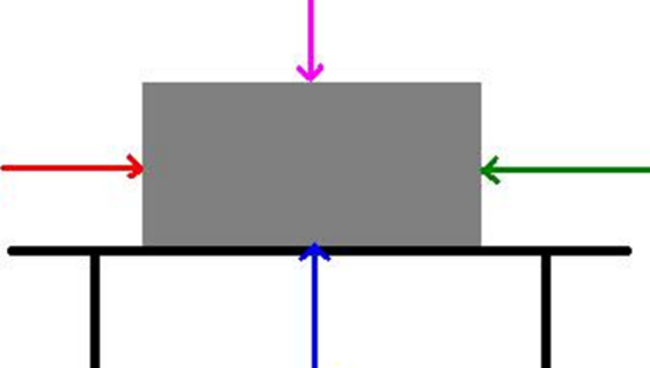
Red Arrow: Force of Friction (Ff) or Force Applied (Fa)
Green Arrow: Force of Friction (Ff) or Force Applied (Fa)
Purple Arrow: Force of Gravity (Fg)
Blue Arrow: Normal Force (Fn)
Label the diagram with the appropriate forces
Rest
The act of not moving
Motion
Action or process of moving or being moved
Force
A push or pull
Force of Gravity
The downward force that holds all objects on the surface of the Earth
Normal Force
The force something exerts on something else because gravity is pulling it down
Applied Force
A push or pull that is applied to an object by a person or another object
Acceleration
Object’s capacity to gain or lose speed, or change direction
Newton’s 2nd Law of Motion
The force required for a certain object to accelerate depends on the object’s mass