Multi-Store model of memory
 Call Kai
 Learn
 Practice Test
 Spaced Repetition
 Match
 Flashcards
 Knowt Play
1/16

There's no tags or description
Looks like no tags are added yet.
17 Terms
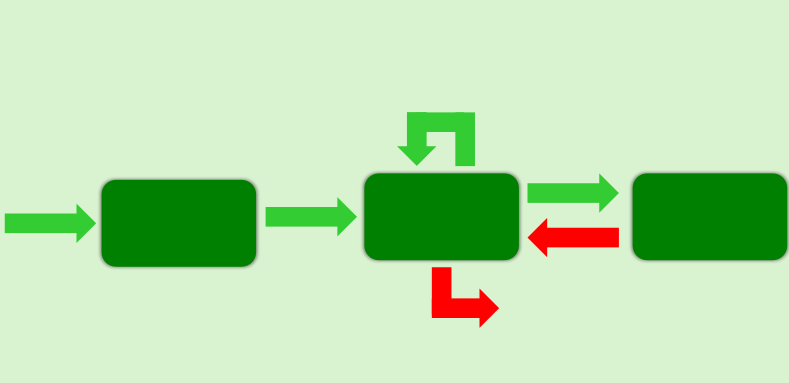
Label the different parts of the Multi Store Model of Memory
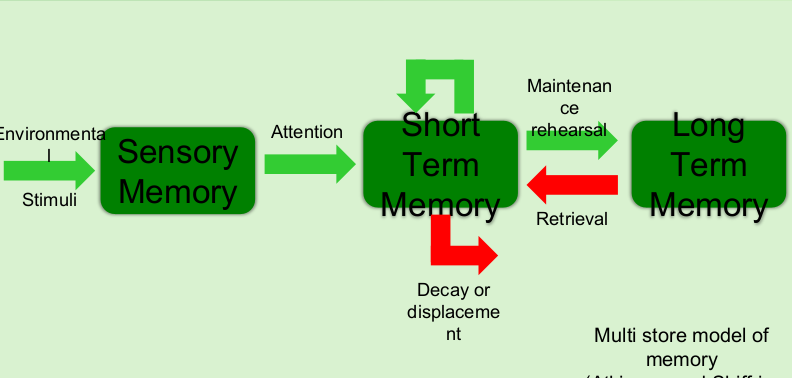
Which researchers made the multi store model of memory?
Atkison and Shiffrin
What are the sensory registers?
The memory stores for each of the 5 senses
What is the capacity of the sensory registers?
Very high capacity
How long does information usually stay in the sensory registers?
0.05 seconds for iconic memory(visual)
As much as 3 seconds for echoic memory (acoustic)
What is maintenance rehearsal?
Occurs when we repeat the material to ourselves over and over again
What happens after prolonged rehearsal?
The information enters the LTM store
What is decay?
When information fades away due to it not being rehearsed or used after being retrieved from LTM
What is retrieval?
It is what occurs when information is transferred from the LTM to STM for recall
What is displacement?
When information is replaced by other information after being retrieved from LTM
What is the recency effect?
It is when the last few items are still available in the STM due to immediate recall
What can affect the recency effect and why?
The amount of time between learning and recall. This is due to the STM store having a short duration of less than 18 seconds.
What is the primacy effect?
It is the tendency to remember items in the beginning of a sequence because it has gone to the long term memory and is being retrieved
What are 2 strengths of the MSM?
Controlled lab studies on coding, capacity and duration support the theory of having separate memory stores
Baddeley (1966) tested the recall of four groups of participants with different lists of words (his findings support, due to a mix up between certain memory
This suggests that there is a clear distinction between STM and LTM
The case study of HM (Henry Molaison) who suffered from epilepsy and underwent brain surgery to correct this, removing his hippocampus
Following this surgery, HM could remember events and some information and details from before the surgery (LTM) but he could not form new memories (STM could not be transferred to LTM)
This adds weight to the argument that the brain uses separate regions or structures for STM and LTM
What are 2 weaknesses of the MSM?
The MSM may be too simple
Research suggests that STM and LTM are made up of more than one store (WMM)
According to MSM, maintenance rehearsal is the only way that information moves from the STM to LTM, however elaborative rehearsal can be used in addition to or without maintenance rehearsal
Research supporting MSM lacks ecological validity
Much of the research into the MSM uses artificial tasks such as recalling a string of digits/letters
Baddeley (1966) used artificial stimuli instead of meaningful material. This suggests there is a limited application to real world memory use
What is the MSM?
It is a reprsentation of how memory works in terms of 3 stores: Sensory register, STM store and LTM store.
It also shows how information is transferred between these memory stores.
What is Elaborative rehearsal?
When information is linked to existing knowledge