EAPP Quiz 1
 Call Kai
 Learn
Learn Practice Test
 Spaced Repetition
 Match
Match Flashcards
 Knowt Play
1/25

Name | Mastery | Learn | Test | Matching | Spaced | Call with Kai |
|---|
No analytics yet
Send a link to your students to track their progress
26 Terms
Academic
Literary
Transactional
Informative
LITA
The 4 main types of texts
Academic text
Type of text
Defined as critical, objective, specialized texts
Written by experts/professionals
Uses formal (and technical) language
Essay
Research
Reaction paper
Journal
Book review
Synthesis
Review of the literature
RRRJEBS
Types of academic text (7 items)
Observes structure
Applies appropriate tone
Uses clear language
Cites sources of information
Addresses complex issues
Provides evidence-based arguments
Thesis-driven
CAAPOUT
Nature & characteristics of academic texts (7 items)
Complex
Formal
Precise
Objective
Explicit
Accurate
Cautious (hedging)
Responsible
Organized
Well-planned
POOR-FAE-WCC
Features of academic texts (10 items)
Locate main idea
Scan information
Identify gaps in existing studies
Connect new ideas to existing ones
Gain more information
Support a writing assignment
Understand an existing idea
SSIC-LUG
Purposes of reading academic texts (7 items)
Purpose
Audience
Perspective
Language
PALP or PPAL or LAPP
4 factors to consider in writing academic texts
States critical issues
Provides facts and evidence
Uses precise and accurate words
Objective POV
References
Cautious language
SOUP-RC
Language of academic texts
Formal
Characteristic of academic language
It should not sound conversational or casual
Avoid colloquial, idiomatic, slang or journalistic expressions
Impartial
Characteristic of academic language
Involves avoiding the personal pronouns ‘I’ and ‘we’
Objective
Characteristic of academic language
Unbiased
Based on facts and evidence and are not influenced by personal feelings
Reporting verbs
Lexical verbs
Modals
That clauses
Adverbs
MART-L
Types of hedging language
Outline
Organized list of
steps
ideas
information
Arranged hierarchically under headings and subheadings
Visual strategy
Helpful in organizing, clarifying, and structuring information and ideas
Research, organize and compile information in an orderly manner
Compare, prioritize and decide on topics and ideas to be included
Derive a general structure to work with
RCD
Outlining helps …
Filter unnecessary information
Organize information
Get an overview of the task at hand for better planning
FOG
By writing outlines, you can …
Format
Topic outline
Sentence outline
Style
Alphanumeric
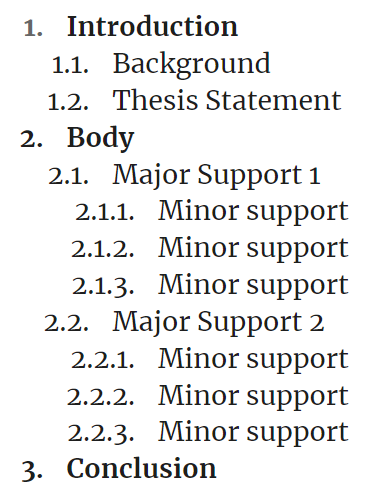
Decimal
Types of outlines
Topic outline
Uses keywords and phrases
Rely heavily on parallelism
Sentence outline
It expresses each point as a complete sentence
Alphanumeric
The traditional outline format
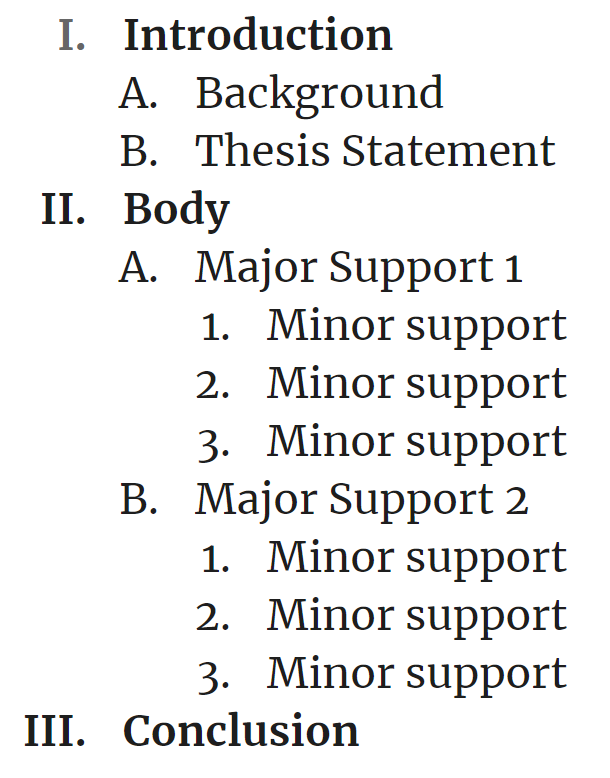
Decimal
The standard outline format
Parallelism
Coordination
Subordination
Division
PC-SD
The 3 principles of outlining
Parallelism
Principle of outlining
All items in formal outlines must be parallel in grammar and structure
If 1 starts with a verb, the others must as well
However, reasonableness and flexibility of form is preferred to rigidity
Coordination
Principle of outlining
Each point should have the same relationship to your main point
Subordination
Principle of outlining
Each point in the outline goes from general headings to more specific subpoints
Division
Principle of outlining
Each main point (or heading) on your outline must have at least two subpoints
Reduce cognitive load
Organizing & chunking
Visual representation
Prioritizing information
Active learning
Transfer knowledge
PAVORT
What is the connection between outlining and information processing? (6 items)